
Office of Science and Technology Policy Blog
Illinois Team Wins Prize for Innovative Oil Spill Cleanup Technology
Posted by on October 18, 2011 at 9:08 AM ESTLast week, the X PRIZE Foundation and philanthropist Wendy Schmidt announced winners of the $1.4 million Wendy Schmidt Oil Cleanup X CHALLENGE. Launched in July 2010 in the wake of the Deepwater Horizon oil spill in the Gulf of Mexico, the competition inspired entrepreneurs, engineers, and scientists worldwide to develop innovative, rapidly deployable, and highly efficient methods of cleaning up oil spills from the ocean surface.
More than 350 teams competed from around the world. Submissions were evaluated by a panel of judges, including Hung Nguyen, Emergency Oil Spill Response Coordinator at the Department of Interior’s Bureau of Safety and Environmental Enforcement; Dave Westerholm, Director of the Office of Response and Restoration at the National Oceanic and Atmospheric Administration (NOAA); and several respected former U.S. Coast Guardsmen. The 10 top-ranked proposals – including five submitted by teams in the United States – were subjected to rigorous field testing at Ohmsett, the National Oil Spill Response Research & Renewable Energy Test Facility, a Department of Interior facility that boasts the largest outdoor saltwater wave/tow facility in North America.
Elastec/American Marine – an Illinois-based manufacturer of oil spill and environmental equipment that uses local talent for nearly all its fabrication – won first place, recovering oil at a rate more than three times the best previously recorded in controlled conditions. This significant advance, which involved grooved, high-surface-area spinning discs that grab large amounts of oil while leaving water behind, is all the more exciting given the potential for the novel mechanical solution to have a real impact on the industry. The judges were impressed by teams’ attention to real-world application, ease of deployment and decontamination, and consistency of performance in varied conditions. (Here is an engaging video of how the team developed its solution.) In addition, the competition’s supporting partner, Shell, has committed to bringing oil experts and other industry leaders in to help move the winning technology to market and promote its use.
We congratulate the winners and all of the finalist teams on their efforts to achieve the important goals of this competition.
And while the prize itself was privately funded, kudos to the Department of Interior and NOAA for bringing their technical expertise to bear in the judging. By strengthening the prize and its impact, these agencies advanced important shared goals, stimulating the development of new tools that can be brought to bear in future oil spills and generating a treasure trove of data by testing novel technologies under controlled conditions.
This is just the latest milestone in the Administration’s ongoing work to increase the use of competitions and prizes to spur innovation and solve tough problems as called for by President Obama in his Strategy for American Innovation.
Tom Kalil is Deputy Director for Policy at the White House Office of Science and Technology Policy and Robynn Sturm Steffen is Senior Advisor to the Deputy Director
President Obama Meets the Nation's Cutting-Edge Researchers
Posted by on October 17, 2011 at 4:14 PM EST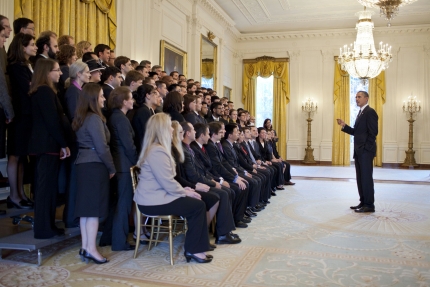
President Barack Obama greets the 2010 PECASE recipients in the East Room of the White House, Oct. 14, 2011. (Official White House photo by Pete Souza)
For over half a century, solar astronomers around the world have been baffled by two questions: Why is the sun’s outer atmosphere hotter than the surface of the sun itself, and what causes solar winds? In 2018, NASA will launch its first mission to the sun, using cutting-edge technology designed to shed light on these mysteries at last.
Riding with one of the groundbreaking instruments for that mission will be the hopes and dreams of Justin Kasper, a young astrophysicist who helped develop the mission’s solar wind analyzer and who on Friday proved himself a stellar scientist in a second sense of the word by being one of 94 scientists and engineers to receive a Presidential Early Career Award for Scientists and Engineers (PECASE).
PECASE awards are bestowed each year upon outstanding scientists and engineers who are beginning their independent research careers, show exceptional potential for leadership, and have demonstrated a commitment to community service and the advancement of science, technology, engineering and math education.
This year’s PECASE recipients represent extraordinary examples of American creativity across a diverse span of disciplines while demonstrating the immense potential of ongoing Federal investments in health care, manufacturing, global development, and other fields.
Take for example Pierre Comizzoli of the Smithsonian Institution, who has been investigating innovative processes relating to fertility—including methods for isolating and drying the DNA of egg cells, which is a less expensive and easier alternative to freezing and preserving the entire egg. His work, funded by the National Institutes of Health (NIH), could someday be used not only to extend human fertility but also to save endangered species.
Or consider PECASE winner Nicola J. Camp, a professor at the University of Utah, who is focused on two forms of blood cancer—chronic lymphocytic leukemia and multiple myeloma—as well as breast cancer. Her research, also supported by NIH, looks at how genetic changes within generations of families may lead to an increased risk of cancer.
PECASE winner David J. Brumley, an assistant professor in Electrical and Computer Engineering at Carnegie Mellon, works with the Department of Defense to identify computer systems security flaws and to anticipate cyber security problems before they occur.
And Rommie Amaro, of the University of California at Irvine, has developed new computational methods that, when applied to studies of cell-surface proteins, is expected to speed development of pharmaceuticals for influenza, chlamydia, and other diseases that today take their tolls on the planet's most underprivileged people.
After receiving their awards in a ceremony with agency officials, friends, and relatives—a ceremony keynoted by OSTP Director John Holdren—the ambitious researchers were greeted by President Obama in the White House. With this much progress at this early stage of their careers, we can expect even greater things from these leading lights in the years to come.
Learn more about Education, TechnologyApplying iPhone Innovation to Better Schools and Cleaner Energy
Posted by on October 17, 2011 at 11:32 AM ESTApple earlier this month announced that a virtual personal assistant called Siri would be the premier feature of the new iPhone 4S. People will be able to ask Siri to book a table at a nearby restaurant, make an appointment with a friend or colleague or answer a question using the information from multiple search engines and web sites.
Siri is a significant advance in our ability to develop computers that understand and do what we mean. Many experts believe that this technology – which integrates advances in wireless communications, speech recognition, artificial intelligence and smartphones, will transform the way we interact with information technology.
What you may not know is that this technology is a direct outgrowth of a federally-funded research project called the “Personalized Assistant that Learns.” This project was backed by the Defense Advanced Research Projects Agency (DARPA), the same agency that supported the early research that led to the Internet, GPS and stealth aircraft. DARPA wanted to build “cognitive” computers for the military that can reason, learn from experience, be told what to do, explain what they are doing, and reflect on their experience.
Although a start-up company, venture capitalists and Apple itself had to make significant investments to commercialize Siri, federally-funded research played a key role in developing the basic technology. Federal basic research has also contributed to the other components of your smartphone, including the lithium-ion batteries, the hard drive, the memory chips, and the liquid crystal display.
That’s why President Obama believes that the United States must continue to invest in research and innovation if we want to “win the future.” Investments in research are the rocket fuel for the American economy – creating jobs, new products and services, and new industries.
And it’s why the President has called for replication of the DARPA model to help address other national priorities such as education and energy. ARPA-E is investing in game changing energy technologies that have the potential to dramatically reduce our dependence on foreign oil and make clean energy the profitable kind of energy. The Administration has also proposed creating an “ARPA for Education,” which would support research on learning technologies that are as effective as a personal tutor and engaging as the best video game.
Tom Kalil is the Deputy Director for Policy at the White House Office of Science and Technology Policy, Kumar Garg is Senior Advisor to the Deputy Director at OSTP.
Learn more about TechnologyEmbracing Diversity as Hispanic Heritage Month Ends
Posted by on October 15, 2011 at 12:25 PM ESTDime con quién andas, y te diré quién eres.
There are a few ways to interpret this Spanish proverb, which I learned from my mother, who was counseling me to choose my school friends carefully. To some, the phrase cautions “you are judged by the company you keep,” so keep company with those who reflect well on you.
I hear it in a more literal way. “Tell me whom you walk with, and I will tell you who you are.” In other words, the people we spend time with contribute to our character and what we want out of life. With this in mind, it’s not at all surprising that I, the daughter of an electrical engineer and an elementary school teacher of a bilingual classroom, am spending this year working on broadening participation in science, technology, engineering, and math education at the White House Office of Science and Technology Policy.
Hispanic Heritage Month in the United States began on September 15 and runs through today. The middle of a month is a strange day to begin a celebration, but less so if you know that beginning that week, eight Latin American countries celebrate their independence, including Costa Rica, where my mother was born, and Mexico, where my father’s parents grew up. My parents were the first members of their respective families to graduate from college, and the value they placed on education has led me thus far to a lifetime in schools of all kinds.
Going to school has exposed me to different communities and regions of the country, and learning about my classmates is how I understand what it means to be American. The high school I attended in Cerritos, California, was rated No. 3 in the country by US News & World Report. In 1988, the year Congress created Hispanic Heritage Month, a study found Cerritos “the most ethnically diverse place in America." Through tutoring and studying with peers, I got to know families whose lives were rich with details that were foreign to me (and mine to them), even as our parents wanted the same success for all of us.
College, teaching, and graduate school, took me to the flat farmland of Ohio, mountainous Virginia, and hot, hilly Central Texas. Though I come from an ethnically diverse town, I never would have had the guts to leave home if I hadn’t been excited about the schools, and more specifically, the science. I didn’t see many people who looked like me in my PhD program in chemistry, but science labs are diverse in other ways, especially including international students on visas who share a desire to work and learn.
Upon visiting America, de Tocqueville remarked that “born often under another sky… himself driven by the irresistible torrent which draws all about him, the American … grows accustomed only to change… He feels the need of it, more he loves it; for the instability; instead of meaning disaster to him, seems to give birth only to miracles all about him.” Being well prepared by my parents and my teachers allowed me to choose science from among many possible careers; a good education allows us to be flexible and less fearful about the unknown and excited about what we might discover.
Chelsea Martinez is a Congressional Hispanic Caucus STEM Fellow at OSTP
Learn more about Education¡Saludos!
Posted by on October 14, 2011 at 3:27 PM ESTYou may not know it, but Tuesday, September 27, 2011, was a momentous day for us Latinos in science, engineering, and technology. On that day, President Obama announced the names of seven prominent scientists and engineers who will receive the National Medal of Science. One of these luminaries is Dr. Richard Tapia, University Professor and Maxfield-Oshman Professor of Engineering at Rice University in Houston, Texas.
Dr. Tapia is not the first person of Hispanic descent to receive the medal, but I think his story is among the most inspiring. And since we are in the midst of National Hispanic Heritage Month--declared by President Obama in mid-September—I thought I’d share a few of the details of Dr. Tapia’s life that I find especially inspiring.
First of all, he is a prime example of el que quiere, puede, or “he who wants, can.” You see, Dr. Tapia’s parents were immigrants from Mexico who were themselves not highly educated but who stressed the importance of education to their children. He was the first person in his family to receive college degrees. He proved to be very talented in mathematics and could have stopped after getting his first degree. But he wanted more… el que quiere, puede… so he got a doctoral degree in math from UCLA. Dr. Tapia moved from sunny Los Angeles to snowy Wisconsin to teach for a few years, then moved south to Rice University, where he has made a tremendous impact on both mathematical knowledge and the science community.
While honing his academic credentials (he was the first Hispanic elected to the National Academy of Engineering, was appointed by President Clinton to the National Science Board, chaired the National Research Council's Board on Higher Education and the Workforce, and has had two annual academic conferences named after him), Dr. Tapia has never forgotten where he comes from and has been a relentless advocate for diversity in mathematics. He was a founding member of the Society for Advancement of Chicanos and Native Americans in Science (SACNAS) in 1973, an organization that fosters the success of Hispanic/Chicano and Native American scientists—from college students to professionals—to attain advanced degrees, careers, and positions of leadership in science. He is a national hero in promoting the education and careers of women and other underrepresented minorities. His outreach and mentoring efforts have turned Rice University into a national leader in producing Ph.D. recipients in the mathematical sciences.
According to his website, thirty-five mathematics students have received, or are currently working on, the Ph.D. degree under his direction or co-direction. Of these 35 students, 15 have been women and 8 have been underrepresented minorities. To capture the awesomeness of these numbers, let us consider that in 2008 there were 15,636 graduate students in mathematics in the U.S. According to UNESCO, the U.S. has 5,758 institutions of higher learning, roughly giving each institution an average of almost 3 graduate students in math. Why has Tapia’s program been so successful? Simple answer: because he cares. He is personally involved in the nurturing of talented youth, setting a living example of el que quiere, puede.
Richard Tapia’s life, professional excellence, and giving nature make him a wonderful role model to all of us. Let us celebrate our Latino Laureate! ¡Felicidades, Dr. Tapia!
Mayra N. Hernández Montrose is the Manager of the National Medal of Science at the National Science Foundation
Learn more about TechnologyHappy World Standards Week!
Posted by on October 14, 2011 at 9:01 AM ESTImagine a world where shoe sizes were not standardized, or where golf balls came in a variety of sizes and weights. What if your favorite CDs didn’t fit in your friend’s CD player? None of these things are problems today, thanks to an army of unsung heroes known as standards.
Standards—agreed upon parameters such as the size and shape of electrical outlets, the number of threads per inch on machine bolts, or the tolerances allowed for various medical tests—may seem arcane or abstract. But they are critical to American competitiveness, technological innovation, and global trade because they facilitate manufacturing, speed delivery, and enable the widespread use of countless products and services in the market today.
Today, in recognition of the importance of standards, the President’s National Science and Technology Council released a new report on Federal government engagement in standards-setting processes to further national priorities.
In the United States, standards are mostly developed and adopted by the private sector. The new report supports this system, noting that the vibrancy and effectiveness of the U.S. standards system depends on this leadership and engagement. In fact, many standards developed and used by U.S. markets were created with little or no government involvement. But the report also notes that in areas where the government is an important player (e.g., Health IT and Smart Grid), Federal involvement is desirable.
In fact, when a national priority is identified in statute or Administration policy, active engagement by the Federal government—often working through private-sector standards organizations—may accelerate standards development and implementation. In these cases, the report concludes, a clearly defined Federal role can catalyze breakthrough advances, promote market-based innovation, and encourage more competitive market outcomes. Working closely with private-sector companies, consumer advocates, academic experts, and standards organizations, the Federal government can help convene all interested private stakeholders to contribute towards a common goal.
One thing worth appreciating about standards, even though it may seem counterintuitive, is that they are capable of evolving. Take for example Internet Protocol (IP), which is the networking standard used to route electronic information packets around the world. Like most Internet and Web standards, IP was developed and is used by a multitude of stakeholders across the world and the general agreement codified in this standard has been essential to the growth and vibrancy of the Internet. But if the IP standard never changed, the Internet would have a hard time growing and being innovative.
Happily, standards are “living” agreements. In the case of IP, the next generation protocol (IPv6) is in the process of being launched to support a range of new Internet devices that will make people’s lives easier and more productive. At the same time, the World Wide Web Consortium is working on a new version of HTML, the lingua franca in which billions of Web pages are written. The new version, HTML5, already supported by many leading browsers, will enable a whole new generation of interactive Web applications and serve as the programming language of the future Web.
The Obama Administration is committed to making the most of standards to make people's lives safer and easier and to boost the economy. Interested in the wide world of standards? Read more here.
Mary H. Saunders is the Director of the Standards Coordination Office at the National Institute of Standards and Technology
Nick Sinai is Senior Advisor to the U.S. Chief Technology Officer
Learn more about Technology
- &lsaquo previous
- …
- 104
- 105
- 106
- 107
- 108
- 109
- 110
- 111
- 112
- …
- next &rsaquo


White House Blogs
- The White House Blog
- Middle Class Task Force
- Council of Economic Advisers
- Council on Environmental Quality
- Council on Women and Girls
- Office of Intergovernmental Affairs
- Office of Management and Budget
- Office of Public Engagement
- Office of Science & Tech Policy
- Office of Urban Affairs
- Open Government
- Faith and Neighborhood Partnerships
- Social Innovation and Civic Participation
- US Trade Representative
- Office National Drug Control Policy
categories
- AIDS Policy
- Alaska
- Blueprint for an America Built to Last
- Budget
- Civil Rights
- Defense
- Disabilities
- Economy
- Education
- Energy and Environment
- Equal Pay
- Ethics
- Faith Based
- Fiscal Responsibility
- Foreign Policy
- Grab Bag
- Health Care
- Homeland Security
- Immigration
- Innovation Fellows
- Inside the White House
- Middle Class Security
- Open Government
- Poverty
- Rural
- Seniors and Social Security
- Service
- Social Innovation
- State of the Union
- Taxes
- Technology
- Urban Policy
- Veterans
- Violence Prevention
- White House Internships
- Women
- Working Families
- Additional Issues