
Office of Science and Technology Policy Blog
Laying the Groundwork for American Competitiveness Throughout the 21st Century
Posted by on September 26, 2011 at 4:49 PM ESTThe President has been travelling the country talking about how we can get America back to creating good, middle-class jobs. Last week, President Obama sent Congress the American Jobs Act, which will put people back to work and put money back in the pockets of working Americans.
A number of the measures in the American Jobs Act will have an immediate effect on the economy and will start to put Americans back to work right away. And on September 16, the President signed the America Invents Act, which will help American entrepreneurs and businesses get their inventions to the marketplace sooner so they can turn their ideas into new products and new jobs.
At the same time, the Administration is working hard to make sure that we focus both on immediate needs and the long term health of the U.S. economy. As President Obama explained on September 8 in his speech to a joint session of Congress:
“...the American Jobs Act answers the urgent need to create jobs right away. But we can’t stop there. As I’ve argued since I ran for this office, we have to look beyond the immediate crisis and start building an economy that lasts into the future -- an economy that creates good, middle-class jobs that pay well and offer security. We now live in a world where technology has made it possible for companies to take their business anywhere. If we want them to start here and stay here and hire here, we have to be able to out-build and out-educate and out-innovate every other country on Earth.”
The Administration is hard at work on implementing President Obama’s long term competitiveness agenda, most recently laid out in the Strategy for American Innovation. On Friday, I joined Acting Commerce Secretary Rebecca Blank and number of colleagues from the White House and the Commerce Department to meet with the Innovation Advisory Board in Boulder, Colorado. This impressive group of business and labor leaders was established by the America COMPETES Reauthorization Act of 2010, signed by President Obama in January 2011. The Innovation Advisory Board members have been soliciting feedback from stakeholders across the country to assist the Commerce Department in producing a study that will analyze the competitiveness of the U.S. economy and its capacity for innovation in comparison to that of our global competition. The study is due to be submitted to Congress on or before January 4, 2012.
Members of the public can submit ideas to the Administration by emailing competitiveness@doc.gov.
Advisory Board members have held several public events to get feedback from the public, most recently last Friday afternoon at the Silicon Flatirons Center for Law, Technology & Entrepreneurship at the University of Colorado Law School. The next public event will be held on Tuesday, October 11 from 1:00 to 5:00 p.m. at the Georgetown University Law Center in Washington, D.C. (registration required).
Quentin Palfrey is Senior Advisor to the CTO for Jobs & Competitiveness
Learn more about Economy, InnovationsSupporting Scientists at the Lab Bench ... and at Bedtime
Posted by on September 26, 2011 at 12:31 PM ESTToday is a good day for science and technology, a good day for scientists and engineers, and a good day for the Nation.
As highlighted in a Washington Post op-ed this morning, the National Science Foundation (NSF) is announcing a major, 10-year initiative to provide greater work-related flexibility to women and men in research careers.
Among other advances, the NSF—the Nation’s major funder of research in engineering, computer science, mathematics, and other high-tech fields that will be central to U.S. economic growth in the years ahead—will allow researchers to delay or suspend their grants for up to one year in order to care for a newborn or newly adopted child or fulfill other family obligations.
That change and others being launched today at a White House event featuring First Lady Michelle Obama and NSF Director Subra Suresh aim to facilitate scientists’ reentry into their professions with minimal loss of momentum—especially women scientists, who, more often than not, are the ones who end up delaying or dropping their promising science careers because of competing family demands.
Today the White House also announced the winners of the Presidential Early Career Awards for Scientists and Engineers (PECASE)—the highest honor bestowed by the United States government on science and engineering professionals in the early stages of their research careers.
There’s a great synergy between these two announcements because these up-and-coming researchers are tomorrow’s all-stars in the making, and about 40 percent of them are women. The Nation needs all of these high-achievers, including all those women, to stick with their innovative work—to make the discoveries and design the technologies that will keep America the international science and technology powerhouse it is today.
Finally, special kudos to NSF and others in the Administration, including staff here at OSTP, for using the convening power of the White House and the Obama Administration to encourage businesses and academic and professional organizations to adopt policies similar to those that NSF is putting into place. Several are today announcing ambitious efforts in coordination with NSF’s announcement. A list of them is available here.
John P. Holdren is Assistant to the President for Science and Technology, Director of the White House Office of Science and Technology Policy, and Co-Chair of the President’s Council of Advisors on Science and Technology
Delivering on the Promise of Innovation to Help Prevent CyberBullying
Posted by on September 26, 2011 at 9:15 AM ESTLast Thursday, the 2nd Annual Bullying Summit closed with demonstrable progress on a range of important topics surfaced during President Obama’s Bullying Prevention Summit last March. Our focus last March was on the challenges and opportunities in preventing cyberbullying. In the months that followed our roundtable, we are pleased to report on two commitments in response to the White House’s “Call to Action”:
- Facebook pledged to invest in research grants on the most innovative approaches to bullying prevention found across our Nation’s universities and non-profits. Last month, Facebook delivered on this promise by launching the $200,000 “Digital Citizenship Research Grant”. We look forward to celebrating the inaugural awardees when they are announced later this fall.
- MTV offered to collaborate with the MIT Media Lab to encourage innovative approaches to detect and deter cyberbullying. MTV and MIT delivered on this promise by formalizing a partnership centered around “Over the Line?”, a Web and iPhone app where young people share and rate personal stories of how technology is complicating social interactions. The app has elicited a strong and empathetic response – with more than 9,000 user-submitted stories generating over 325,000 ratings – and it represents one of the largest bodies of knowledge on youth digital ethics.
Learn more about Foreign Policy, TechnologyRocketry Winners Come to Washington
Posted by on September 23, 2011 at 10:48 AM ESTLast week Michael Gerritsen, Colt McNally, Landon Fisher, and I visited Washington, DC as ambassadors for the Team America Rocketry Challenge (TARC). We spoke on Capitol Hill on September 14th and met with leaders in the Obama Administration, including his science and technology advisor Dr. John Holdren, Administrator of NASA Charlie Bolden, and Secretary of Education Arne Duncan.
Our team of four competed in the Team America Rocketry Challenge, which is a nation-wide contest where students in 7th through 12th grades design, build, and fly a rocket to reach specific parameters while competing for over $60,000 in scholarships and prizes. For the 2010-2011 challenge, the rocket entries were required to reach 750 feet in altitude and land in 40 to 45 seconds, all while carrying a raw egg payload. If the egg breaks, or even fractures, the team is disqualified. Over 600 teams from across the nation entered the challenge this past year, and only the top 100 qualifying teams were invited to compete at the national finals located in The Plains, Virginia on May 14. Our team was not only fortunate enough to make the top 100, but also to win the title of national champions. Later we became international champions at the 2011 Paris Airshow.
At the Paris Airshow we competed against the top teams from the UK and France by launching our rocket to the target altitude and by giving presentations covering our extensive rocket program to a panel of judges. Michael, now a plebe at the US Naval Academy, said: “The Paris Airshow was absolutely incredible. It was the perfect way to end our story in rocketry and made all of the hard work, long hours of trouble shooting, and failure worth it. Getting involved with the rocket club has been one of the most rewarding decisions I have ever made.”
Our winning team was created in 2006 as a group of my friends and I while in 8th grade. At the time, none of us on the team knew anything about rockets, but we were driven to success by the prizes posted by the challenge. Colt summed up his TARC experience as life changing: "The adventure the program put me through has really changed my view of science. I first joined the rocket club purely because of the potential to win money, never thinking that I would become a science major."
Becoming world champions was not easy, as it took innovation, intuition, and good science and engineering skills to create the conditions needed to make our rocket fly accurately. However, the challenge and the rewards ultimately led me to pursue a degree in Engineering Physics at Embry-Riddle Aeronautical University, where I started school this fall.
The primary objective of the Team America Rocketry Challenge is to create an interest in science, technology, engineering, and mathematics (STEM) based careers, particularly in the aerospace industry. TARC was also designed to create an excited and well educated workforce for the future. Landon agreed that “TARC is such an important competition, especially for those students, such as myself, who wish to pursue a career in engineering. It teaches us problem-solving, teamwork, perseverance, and gives us a sense of accomplishment (especially this year, when we won).”
Programs that promote STEM are important to the future of the United States, because pressing concerns like national security and the economy will not be problems that vanish for future generations to come, and they will be managed tomorrow by the children of today.
John Easum is a freshman at Embry-Riddle Aeronautical University in Florida
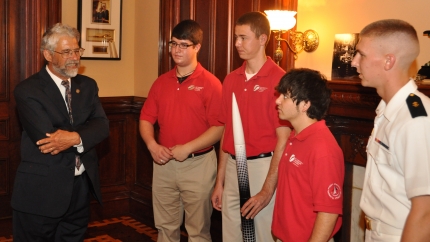
OSTP Director John P. Holdren meets with Landon Fisher, John Easum, Colt McNally, and Michael Gerritsen, the Team America Rocketry Challenge winners, on September 14, 2011. (Photo courtesy Patrick Carlson, AIA)
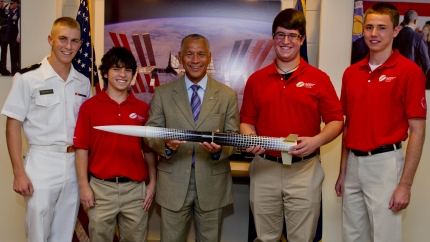
The winners of TARC meet with NASA Administrator Charlie Bolden on September 14, 2011. (Photo courtesy Patrick Carlson, AIA)

Secretary of Education Arne Duncan with the winners of TARC on September 14, 2011. (Photo courtesy Patrick Carlson, AIA)
Learn more about Education, Technology21st Century Learning: A Digital Promise
Posted by on September 16, 2011 at 7:57 AM ESTToday, the White House and Secretary of Education Arne Duncan are announcing the launch of “Digital Promise,” a new national center created by Congress with bipartisan support to advance technologies to transform teaching and learning.
Supported by startup funds from the Department of Education, the Carnegie Corporation of New York, and the William and Flora Hewlett Foundation—and overseen by board made up of prominent leaders in education and technology—Digital Promise will work with leading researchers, entrepreneurs, and schools to identify and spur breakthrough learning technologies that deliver the best results for students, parents, and teachers.
Secretary Duncan will lead a White House event at 10:00 this morning to introduce the new initiative. Watch it live at www.whitehouse.gov/live and check out http://obamawhitehouse.archives.gov/the-press-office/2011/09/15/fact-sheet-digital-promise-initiative for more information.
Rick Weiss is Communications Director at OSTP
Learn more about Education, TechnologyModeling a Green Energy Challenge after a Blue Button
Posted by on September 15, 2011 at 3:55 PM ESTOn Monday, President Obama declared this week National Health IT Week. To kick it off, HHS Secretary Sebelius co-hosted a Consumer Health IT Summit where the Robert Wood Johnson Foundation announced the creation of bluebuttondata.org. This new website advances the movement of enabling consumers to download their personal health data and share it with health providers, care givers, and others they trust—all by the click of a button.
The US Department of Veterans Affairs originally launched Blue Button with industry and non-profit collaboration. It’s a simple, common-sense idea—people should be able to access and download their own health information—with the potential for a big impact.
As President Obama said in August 2010, “For the first time ever, veterans will be able to go to the VA website, click a simple blue button, and download or print your personal health records so you have them and can share with your doctor outside of the VA.”
Why can’t the same common-sense concept be applied to the energy industry with a “Green Button”? Consumers should have access to their energy usage information. It should be easily downloadable and in an easy-to-read format offered by their utility or retail energy service provider.
So today at GridWeek, I challenged the smart grid ecosystem to deliver on the vision of Green Button and provide customers access to their energy usage information electronically. With this information at their fingertips, consumers would be enabled to make more informed decisions about their energy use and, when coupled with opportunities to take action, empowered to actively manage their energy use.
Furthermore, making this information available—in simple standard formats—will help spur innovative new consumer applications and devices from entrepreneurs, big companies, and even students. Imagine being able to check your air conditioner from your smartphone or having a clothes dryer that saves money for you automatically during critically hot days or simply getting some helpful customized hints on how best to save energy and money in your house or apartment.
This concept of encouraging customer access to electronic energy usage information is part of the Administration’s Policy Framework for a 21st Century Grid. This framework, launched at a White House event in June 2011, highlights the value of empowering consumers with enhanced information to save energy, ensure privacy, and shrink bills.
The vision of consumer access to energy data is shared by the National Association of Regulatory Utility Commissioners (NARUC), which recently passed a resolution endorsing smart grid principles that include the importance of providing consumers with affordable and timely access to their own energy use data.
And if modeled after a successful program like Blue Button, Green Button has the potential to deliver untold benefits to consumers and utilities alike.
Since its release, Blue Button has been adopted by Medicare, the Department of Defense, and private sector health care organizations. Software developer challenges have spurred applications that expand on the Blue Button’s promise by helping consumers use their data to stay healthy and manage their care.
Through a collaborative effort, we can build an open-reference implementation of a Green Button, based on national standards for the smart grid. If the health industry can work together through Blue Button to make this world a better place, then the energy industry can do so through Green Button.
Let’s get to work.
Aneesh Chopra is US Chief Technology Officer
- &lsaquo previous
- …
- 106
- 107
- 108
- 109
- 110
- 111
- 112
- 113
- 114
- …
- next &rsaquo


White House Blogs
- The White House Blog
- Middle Class Task Force
- Council of Economic Advisers
- Council on Environmental Quality
- Council on Women and Girls
- Office of Intergovernmental Affairs
- Office of Management and Budget
- Office of Public Engagement
- Office of Science & Tech Policy
- Office of Urban Affairs
- Open Government
- Faith and Neighborhood Partnerships
- Social Innovation and Civic Participation
- US Trade Representative
- Office National Drug Control Policy
categories
- AIDS Policy
- Alaska
- Blueprint for an America Built to Last
- Budget
- Civil Rights
- Defense
- Disabilities
- Economy
- Education
- Energy and Environment
- Equal Pay
- Ethics
- Faith Based
- Fiscal Responsibility
- Foreign Policy
- Grab Bag
- Health Care
- Homeland Security
- Immigration
- Innovation Fellows
- Inside the White House
- Middle Class Security
- Open Government
- Poverty
- Rural
- Seniors and Social Security
- Service
- Social Innovation
- State of the Union
- Taxes
- Technology
- Urban Policy
- Veterans
- Violence Prevention
- White House Internships
- Women
- Working Families
- Additional Issues