


Energy and Environment Latest News
America Recycles Day 2011
Posted by on November 15, 2011 at 7:23 PM EDTIt’s America Recycles Day! Today, we celebrate the commitment to living sustainably and rededicate ourselves to thoughtful resource management at home and in the workplace.
As President Obama wrote in his America Recycles Day Proclamation, Americans have been recycling for decades. During the First and Second World Wars, families gathered scraps and material that could be reused for war manufacturing. In 2011, we recycled or composted 34 percent of the 250 million tons of municipal waste generated in the United States. President Obama’s proclamation highlighted the importance of recycling for our economy:
We have bolstered recycling programs through individual action, community engagement, and national initiatives, and we have broadened our efforts to include a vast array of pioneering industrial processes that will drive our clean economy and create green jobs. These advances cut waste, preserve our natural bounty, and spur the robust and sustainable economic growth that will carry us through this century and into the next.
Our progress is impressive, but there is more we can be doing to protect our environment and conserve our limited natural resources. For example, updating and expanding our recycling programs to accommodate the 2 million tons of used electronic waste we generate each year can help put these resources back into productive use. Recycling just one cell phone saves enough energy to power a laptop for 44 hours, according to the EPA.
On this America Recycles Day, commit yourself to producing less waste, reusing and recycling more materials, and protecting our nation’s precious natural resources.
Learn more about Energy and EnvironmentCould an Arizona Town Become the Solar Capital of the World?
Posted by on November 15, 2011 at 5:39 PM EDTWhen Rick Buss left his position as city manager of Maricopa, Arizona, to become the town manager of a 2,000-person, economically struggling town called Gila Bend in 2008, some people who know him personally and professionally wondered why.
But with a firm background in both technology companies and sustainable management, Mr. Buss had a vision: "There's no reason why Gila Bend, Arizona, can't be the solar capitol of the world."
So he got to work. He brought over a young talent from Maricopa, Eric Fitzer, to serve as his right hand man. Fitzer, Buss tells me, is particularly skilled with zoning and economic development, and working together they crafted a "Solar Field Overlay Zone" (SFOZ), which greatly reduced the complications for solar companies to develop the sun-soaked fields located within the town.
In addition, Rick worked with the town government to expedite the speed at which solar companies’ construction plans could get approved. Processes that usually take at least a year, and often several years, can now go through public hearings, citizen review sessions, planning and zoning commissions hearings, publication in a newspaper, and council approval in as little as four weeks.
"We aren't even seeing that kind of consistent speed for permitting approvals in the residential sector," said Energy Department's Solar Market Transformation Lead Jennifer DeCesaro. “Whether we're talking about a small 5 kilowatt residential system or a large several hundred megawatt industrial system, lack of consistency and transparency in solar permitting is a challenge for every market sector in this country.”
Learn more about Energy and EnvironmentFort Monroe: A Symbol of our Past, a Promise for our Future
Posted by on November 9, 2011 at 3:00 PM EDTThere is a history lesson that all Americans should know, but it may not have been in your textbooks.
Just six weeks after the Civil War began, three slaves – Frank Baker, James Townsend and Shepard Mallory – escaped from behind Confederate lines and sought refuge at Fort Monroe in Hampton, Virginia. Commanding General Benjamin Butler refused to return the fugitives and declared the three men contraband of war. Soon, thousands of enslaved African Americans from all over the region descended on Fort Monroe in pursuit of freedom and sanctuary. This event fundamentally changed the meaning of the Civil War from states' rights to the immorality of slavery, and marked the beginning of the end of slavery in the United States.
Last week, President Obama signed an Executive Order designating Fort Monroe as a National Monument. Now, this 400 hundred year old site belongs to all Americans, and I hope all will have the chance to know its story, and appreciate its beauty.
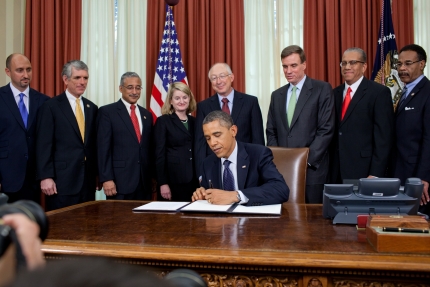
From left, Adam Goodheart, Civil War Historian, Washington College; Rep. Scott Rigell, R-Va.; Rep. Bobby Scott, D-Va.; Mayor Molly Ward, Hampton, Va.; Interior Secretary Ken Salazar; Sen. Mark Warner, D-Va.; Lacy Ward Jr., Director, Robert Russa Moton Museum, Farmville, Va.; and Rep. Emanuel Cleaver, D-Mo.; watch President Barack Obama sign a Proclamation to designate Fort Monroe, in Hampton, Va., a National Monument under the Antiquities Act, in the Oval Office, Nov. 1, 2011. (Official White House Photo by Pete Souza)
From 1609 until just a few months ago, Fort Monroe was an active military base built on the site known as Old Point Comfort. Here's a little bit about its remarkable history: In 1619, it's where the first Africans arrived in America. Hampton is also where, in 1624, the first African-American child was born, named William Tucker. Robert E. Lee was stationed at Fort Monroe, and Jefferson Davis was imprisoned there at the conclusion of the Civil War. Edgar Allen Poe and Harriet Tubman both spent time at Fort Monroe, and Abraham Lincoln stayed there during the assault on Norfolk, VA – the last time a sitting President was actively involved in a military campaign.
Hampton is a city of about 140,000 people located in the middle of what is known as "Hampton Roads," consisting of more than 1.6 million people in 17 municipalities. It is home to NASA Langley, Joint Base Langley Eustis, Hampton University and boasts 124 miles of shoreline and gorgeous beaches. Those of us fortunate enough to live here revere the water, our history and our wonderful location, but what our community treasures most of all is historic Fort Monroe.
President Obama's decision to designate Fort Monroe a National Monument secures the stature of the Fort in our Nation's history. It also ensures the Fort will remain a vibrant part of our region's economy. Hampton lost more than 5,000 jobs when the Army left the Fort in September. Now, with the work of the National Park Service and a state-led reuse plan, the campus should become a center for recreation, history, business and education. This fortress will continue to be a refuge for those who wish to revel in its natural and man-made beauty for its – and Hampton's – next 400 years.
Molly Joseph Ward is Mayor of Hampton, Virginia
Learn more about Energy and EnvironmentProtecting Historic Progress on Clean Air
Posted by on November 7, 2011 at 12:33 PM EDTPresident Obama believes that American families should never be asked to choose between the health of their children and the health of the economy. That is a false choice. Four decades of success under the Clean Air Act have shown clearly that strong environmental protections and a strong economy can go hand in hand.
To build on the tremendous success of the Clean Air Act, the Obama Administration has taken the most significant steps in a generation to reduce harmful pollution and promote public health. The new standards that we have issued or proposed – to curb interstate pollution, reduce mercury exposure, and make our cars more fuel efficient, just to name a few – will result in significant economic and health benefits each year.
Just over forty years ago, the Senate did something that would be almost unthinkable today: It passed major legislation by a unanimous vote. That legislation was the Clean Air Act of 1970, signed by President Richard Nixon. Two decades later, the Clean Air Act Amendments of 1990 were passed, again with large bipartisan majorities in both houses of Congress, and signed by President George H. W. Bush.
But today, Republicans in Congress are trying to use our current economic climate as an excuse to roll back clean air protections that Americans have counted on for decades. Senator Rand Paul (R-KY) is currently leading an effort to block the Cross-State Air Pollution Rule (CSAPR) that would save tens of thousands of lives each year. In doing so, Senator Paul is using the Congressional Review Act to repeal this important rule and prohibit the Environmental Protection Agency from protecting American families from cross-state pollution in the future.
Let’s be clear – this brazen effort doesn’t just undermine the public health, it also undermines the judgment of the courts. In 2008, the U.S. Court of Appeals for the Washington, D.C. Circuit found critical flaws in the Bush Administration’s efforts on interstate air pollution and directed the EPA to issue a replacement rule as quickly as possible. After seeking and incorporating extensive input from the public, the states, environmental and public health groups, as well as industry, the EPA finalized the Cross-State Air Pollution rule in July of this year.
Lending Federal Support as Communities Prepare for Impacts of Climate Change
Posted by on November 4, 2011 at 1:00 PM EDTLast week the Administration released a report that outlines how the Federal Government is expanding and strengthening the Nation's capacity to better understand, prepare for, and respond to the risks associated with climate change. From the Federal Government's perspective, adapting to the impacts of a changing climate is simply responsible risk management. Working together, communities and the Federal Government can reduce long-term risks and costs, including from projected increases in extreme weather events.
Here's what others have to say about the importance of this interagency work to build resilience and protect people, property and economies across the country:
Mayor Mark Mallory, Cincinnati, OH
"Climate scientists tell us that Cincinnati will experience more frequent and more severe storms as a result of climate change. More frequent and more severe summer heat waves are expected as well. The Cincinnati region is just beginning to identify the things that we will need to do to be prepared for these weather changes. Just like cities plan for natural disasters or outbreaks of the flu, we need to prepare for the effects of climate change."Aaron N Durnbaugh, Climate Adaptation Coordinator, City of Chicago
"As a local government working to prepare our city, citizens and natural resources for a changing climate, the City of Chicago is encouraged to see the coordinated federal climate action presented in the 2011 progress report. The federal efforts supporting cities including building local resilience and making climate science accessible, will create the resilient, healthy and prosperous City envisioned by the Chicago Climate Action Plan and, in turn, the resilient nation envisioned by the Interagency Climate Change Adaptation Task Force."Mark Tercek, President and CEO, Nature Conservancy
"We commend the Administration's Climate Change Adaptation Task Force on continued progress toward preparing our nation for coping with the impacts of climate change. We're pleased that the Administration continues to emphasize the essential role natural systems play in protecting Americans from climate impacts. As just one example, our barrier islands and floodplains have protected America's communities from storms for millennia and we need to ensure they continue to do so."Laura Spanjian, Sustainability Director, City of Houston
"The City of Houston is beginning to implement adaptation strategies and tools to address the impacts and risks associated with climate changes that affect Houston's water resources and coastal zones, among other systems. Sustained funding from federal agencies will help cities employ proactive measures, instead of only short-term reactive measures that are detrimental to human livelihood, as well as being cost-prohibitive."Brian Holland, Director of Climate Programs, ICLEI – Local Governments for Sustainability USA
"The Council on Environmental Quality's Progress Report on Adaptation demonstrates the success achieved by federal agencies in building resilience in partnership with local communities. In working with our 550 local government members in the US, ICLEI has clearly identified a need for local-federal climate collaboration and has seen critical federal resources in action. This report lays the groundwork for continued partnership with the cities and counties that are on the front lines of extreme weather events and climate resilience."J. Wayne Leonard, CEO, Entergy Corporation
"A meaningful discussion on climate change cannot stop at mitigation. The solutions must also include adapting to and resilience against its most negative consequences. Today's report recognizes that the livelihoods of people living in coastal communities, the sustainability of rich natural resources that support our economy and the security of residential, commercial and industrial assets are at great risk if we don't devise and implement plans to protect against, and recover from, the adverse effects associated with climate change."Bennett Freeman, Vice President for Sustainability and Research, Calvert Investments
"Investing in climate preparations can create American jobs at home and spur exports abroad. We support efforts by the Administration to prepare for and respond to climate change impacts in vulnerable communities."Jim Taft, Executive Director, Association of State Drinking Water Administrators
"ASDWA appreciates the efforts of the Interagency Climate Change Adaptation Task Force in developing this Action Plan. We believe the six principal recommendations of the Action Plan (along with the various supporting actions) are sound and appropriate. In particular, the call for the compilation of the best available data/information, coupled with use of appropriate decision-making tools will be of considerable benefit to drinking water utilities as they consider meeting both the quantity and quality challenges posed by a changing climate. We also support the holistic approach to this challenge under the banner of integrated water resources management (e.g., promoting both efficient use of currently available water resources as well as careful consideration of future water resources). The Action Plan should prove beneficial to both drinking water utilities and state drinking water programs as they consider their future roles and actions."Paul Fleming, Manager, Climate & Sustainability Group, Seattle Public Utilities
"Identifying, assessing and managing the risks and opportunities associated with climate change is not just about understanding the physical impacts of climate change, but also the managerial, technical and policy implications. From strengthening data observation systems, to calling for stronger coordination between federal and local governments to promoting flexible decision making, the National Action Plan reflects the multi-dimensional nature of the intersection between climate change and water."Ken Kirk, Executive Director, National Association of Clean Water Agencies
"Climate change will affect water more than any other resource, and NACWA commends CEQ for recognizing the challenges facing wastewater utilities in adapting to and in mitigating the impacts of climate change. NACWA is especially pleased that CEQ recognizes the importance of integrated water resources management for managing these impacts, and the need for improved data to enable utilities to make better long-term decisions in the face of climate change. With utilities facing huge financial challenges as a result of the economic downturn, studies that help in planning for the additional costs and investment that climate change will necessitate are particularly helpful."Susan Ruffo is Deputy Director for Climate Change Adaptation at the White House Council on Environmental Quality
Learn more about Energy and EnvironmentSmart Buildings = Better Buildings
Posted by on November 4, 2011 at 9:18 AM EDTIn June, the surprise stars of a White House event on smart grid policy were a couple of high-school seniors who had convinced their school to finance the installation of submetering technology and software that allowed them to measure their school’s energy consumption in unprecedented detail. They discovered that the air conditioning was needlessly running in the gym at night, which led to an operational change that helped the school earn a 250% return on investment.
What those students discovered was the potential benefit of submetering—the use of monitoring and measurement technologies to provide real-time information about resource use that can help pinpoint variations in performance, optimize automated building systems, and encourage building managers and occupants to adopt energy-conserving behaviors.
Today, the National Science and Technology Council (NSTC)—a cabinet-level interagency group of scientists and engineers—released a new report (pdf) that recommends systematic consideration of submetering technologies that can yield up-to-date, finely grained snap shots of energy and water use in commercial and residential buildings to drive energy efficiency and capture the advantages of a modernized electric power grid. The approach is complementary to the Obama Administration’s Blueprint for a Secure Energy Future, released in March 2011, which stressed the need to reduce greenhouse gas emissions and cut energy bills by increasing the efficiencies of homes and buildings.
The report, Submetering of Building Energy and Water Usage: Guidance and Recommendations of the Subcommittee on Buildings Technology Research and Development, concludes that submetering can dramatically improve building performance and reduce resource consumption. Submetering devices can be deployed at successively finer levels of resolution, from individual buildings and rooms down to specific building systems or water and electrical outlets.
And while the return on investment (ROI) for submeters depends on specific energy-efficiency strategies that may vary by climate, building type, and other factors, "numerous case studies provide evidence that the ROI can be significant,” the report concludes. “Further, submetering provides the necessary infrastructure for more advanced conservation and efficiency techniques.”
The increased use of submeters—especially when combined with software solutions developed and deployed by innovators, entrepreneurs and students—can play a significant role in the President’s Better Buildings Initiative to make commercial facilities 20 percent more efficient by 2020.
Nick Sinai is Senior Advisor to the U.S. Chief Technology Officer
Learn more about Energy and Environment, Technology
- &lsaquo previous
- …
- 102
- 103
- 104
- 105
- 106
- 107
- 108
- 109
- 110
- …
- next &rsaquo
Related Videos
-
 May 09, 2014 9:21 AM
Inside the White House: Solar Panels
-
 September 01, 2016 9:25 PM
President Obama Delivers a Statement to the Press
White House Blogs
- The White House Blog
- Middle Class Task Force
- Council of Economic Advisers
- Council on Environmental Quality
- Council on Women and Girls
- Office of Intergovernmental Affairs
- Office of Management and Budget
- Office of Public Engagement
- Office of Science & Tech Policy
- Office of Urban Affairs
- Open Government
- Faith and Neighborhood Partnerships
- Social Innovation and Civic Participation
- US Trade Representative
- Office National Drug Control Policy