



Energy and Environment Latest News
EPA Announces Smart Growth Achievement Award Winners
Posted by on December 5, 2011 at 3:17 PM EDT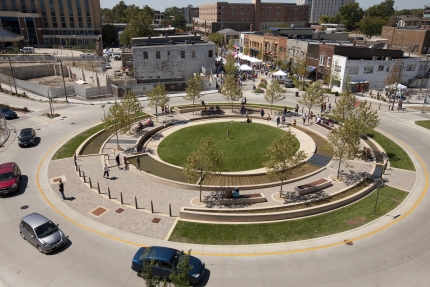
The Uptown Normal Roundabout was named an EPA 2011 Smart Growth Achievement Award Winner. (Photo by Scott Shingley, courtesy of the Town of Normal, Illinois) December 5, 2011.
Last week, EPA announced the winners of the 2011 National Award for Smart Growth Achievement. This annual award recognizes American communities that employ innovative approaches to development that use resources efficiently, create new economic opportunities, and make neighborhoods healthier and cleaner.
The 2011 winners are:
-
St. Louis, Missouri: Overall Excellence Award - With the Old North St. Louis Revitalization Initiative, community leaders redefined and rebuilt a historic neighborhood to attract new residents, economic growth, and much-needed amenities such as a grocery store.
Preservation and reuse of historic buildings helped protect the Old North neighborhood's distinctive character.
-
Albuquerque, New Mexico: Smart Growth and Green Building Award - Silver Gardens Apartments is the first LEED Platinum-certified affordable housing project in the Southwest. Close to downtown, it is also near a variety of transportation options, making it easy for residents to reach jobs.
-
El Paso, Texas: Programs, Policies and Regulations Award - Plan El Paso 2010 is a comprehensive, transit-oriented development plan that will help link neighborhoods to greater economic opportunity and to one another. It provides a blueprint for investment in new homes and jobs.
-
Howard, South Dakota: Rural Smart Growth Award - This town, smaller than many city high schools, revitalized its downtown and created new jobs and economic opportunities by building Maroney Commons. This green building houses a rural learning center that offers training for green energy and rural healthcare jobs, a hotel, a restaurant, and other amenities.
- Normal, Illinois: Civic Places Award - The Uptown Normal Roundabout, originally designed to manage traffic, has evolved into a civic gathering place that draws people to nearby businesses. Its pleasant green space and water features keep polluted runoff out of the local creek.
These five communities have thought creatively about how to make better use of their existing assets and how to achieve multiple environmental, economic, and social goals with new investments. They can be models for other communities around the country, demonstrating creative solutions to development-related challenges.
Click to learn more about these five award winners the National Award for Smart Growth Achievement, and EPA's smart growth work. You can also see videos highlighting each of the five winning communities-St. Louis, MO; Normal, IL; El Paso, TX; Albuquerque, NM; and Howard, SD.
Bob Perciasepe is the Deputy Administrator of the Environmental Protection Agency
Learn more about Energy and Environment-
St. Louis, Missouri: Overall Excellence Award - With the Old North St. Louis Revitalization Initiative, community leaders redefined and rebuilt a historic neighborhood to attract new residents, economic growth, and much-needed amenities such as a grocery store.
Recruiting and Retaining Women in STEM
Posted by on December 5, 2011 at 11:16 AM EDTOn December 9th at 3:30pm, the White House will honor individuals who help to recruit and retain “Women in STEM,” or Science-Technology-Engineering-and Math, as this week's “Champions of Change.”
President Obama has made it a priority to recruit and retain women in STEM in his Administration as well. Leading up to this Friday’s event, we will be featuring a number of key women in STEM in the Obama Administration, beginning with our fantastic EPA Administrator (and Engineer!), Lisa Jackson.
Lisa Jackson
 Since being named President Obama’s cabinet member in charge of environmental protection, EPA Administrator Lisa P. Jackson has been named one Newsweek’s “Most Important People in 2010,” featured on Time Magazine’s 2010 and 2011 lists of the “100 Most Influential People in the World”, listed in Essence Magazine’s “40 Women Who Have Influenced the World,” and profiled in O Magazine for her work to protect our nation’s air, water and land from pollution that threatens human health.
Jackson leads EPA’s efforts to protect the health and environment for all Americans. She and a staff of more than 18,000 professionals are working across the nation to usher in a green economy, address health threats from pollution in our air, water and land, and renew the public’s trust in EPA’s work.
Background: From New Orleans to New Jersey
Raised a proud resident of New Orleans, Louisiana, Administrator Jackson is a summa cum laude graduate of Tulane University and earned a master’s degree in chemical engineering from Princeton University. In 2011, she received an honorary doctorate degree from Florida A&M University. She has also received an honorary law degree from Pace Law School.
She started with the EPA as a staff-level scientist in 1987 and spent the majority of her career working in EPA’s Region 2 office in New York. In 2002, Jackson joined the New Jersey Department of Environmental Protection and was appointed Commissioner of the agency in 2006.
Learn more about Energy and Environment, WomenThe President's Big Boost to Sacramento's Green Economy
Posted by on December 5, 2011 at 10:37 AM EDTEditor's note: Sacramento Mayor Kevin Johnson joined President Obama on Friday in announcing nearly $4 billion in combined federal and private sector energy upgrades to buildings over the next 2 years. This blog is cross-posted from the Council on Environmental Quality.
I just finished one of the most important meetings in my term as Mayor of Sacramento. Last night, I took a red-eye flight and rushed this morning to the White House for a meeting with President Obama, former President Clinton and 60 university presidents, CEOs and elected leaders from around the country.
The topic? Jobs -- and the incredible opportunity Sacramento has by partnering with President Obama in his plan to invest nearly $4 billion in combined federal and private sector energy upgrades for our nation's commercial buildings through the Better Buildings Initiative.
This outstanding news could not have come at a better time. Sacramento is one of five cities that has taken the President’s Better Buildings Challenge, which translates into new jobs in our construction industry, where the unemployment rate has topped 30 percent. That's what I mean when I talk about putting Sacramento on the map!
Thanks to President Obama and our work through our Greenwise initiative here in Sacramento, hundreds of workers from the Sacramento region will return to job sites and begin retrofitting commercial buildings, and eventually schools and government offices, making them more energy efficient. And the work won't be done at taxpayer expense. Private companies will finance the upfront costs, and they will be paid back through the energy savings that result from the improvements.
In Sacramento, we have committed to retrofitting 12 million feet of commercial property. And that's just the beginning. There's $100 million available for energy upgrades to property owners within the city, thanks to our partnership with Ygrene Energy Fund.
The Ygrene program translates to 1,500 jobs -- and that's before we add schools and universities to the program and achieve a 20 percent energy use reduction by 2020. The 1,500 jobs do not include the 4,100 paychecks that will be created by our new Entertainment and Sports Complex, which will be one of the greenest and most energy efficient civic centers in the world.
This is huge. Sacramento is thinking big, acting big and generating jobs in a big way through smart investment in energy efficiency.
Kevin Johnson is Mayor of the City of Sacramento.
Learn more about Energy and EnvironmentBy the Numbers: 1.6 Billion Square Feet
Posted by on December 2, 2011 at 6:43 PM EDT
Today, President Obama announced commitments from 60 major CEOS, universities, mayors, labor leaders, and others to improve the energy efficiency of 1.6 billion square feet of commercial and industrial property. That’s more square footage than 500 Empire State Buildings.
Refitting our nation’s buildings to be more energy efficient will help businesses save money, create jobs for out-of-work construction workers, and help protect our environment. In fact, meeting President Obama’s Better Building Initiative goal—improving energy efficiency in our commercial buildings 20 percent by 2020—will save businesses $40 billion per year and create 114,000 jobs.
President Obama knows that we can’t wait on Congress to offer incentives for building owners to move forward with energy efficiency upgrades on their properties. That’s why he partnered with the former President Bill Clinton and his Council on Jobs and Competitiveness to spur the $2 billion private sector investment that led to today’s announcement. To jumpstart even more energy efficient upgrades, President Obama also directed Federal agencies to make at least $2 billion worth of energy efficiency upgrades in the next two years.
Read more:
- Better Buildings Initiative Fact Sheet on today's announcement
- President Obama Announces $4 Billion Investment to Make Buildings More Energy Efficient
Learn more about Economy, Energy and EnvironmentPresident Obama Announces $4 Billion Investment to Make Buildings More Energy Efficient
Posted by on December 2, 2011 at 3:36 PM EDT
President Barack Obama and former President Bill Clinton take a tour of the upgrades of the Transwestern Building in Washington, Dec. 2, 2011. (Official White House Photo by Lawrence Jackson)
This morning, President Obama met with former President Bill Clinton to announce the next piece of the "We Can't Wait" campaign -- a $4 billion effort to improve energy efficiency in buildings across the country.
The two were joined by Tom Donohue -- the head of the U.S. Chamber of Commerce -- and Randi Weingarten -- the president of the American Federation of Teachers.
The group toured a building in northwest Washington that's currently seeing an efficiency upgrade. That improvement employs around 250 full-time workers and will save the building $200,000 a year on its energy bills.
Making our buildings more energy efficient is one of the fastest, easiest, and cheapest ways for us to create jobs, save money, and cut down on harmful pollution, President Obama said:
It is a trifecta, which is why you’ve got labor and business behind it. It could save our businesses up to $40 billion a year on their energy bills – money better spent growing and hiring new workers. It would boost manufacturing of energy-efficient materials. And when millions of construction workers have found themselves out of work since the housing bubble burst, it will put them back to work doing the work that America needs done. So this is an idea whose time has come.
As part of today’s announcement, President Obama directed all Federal agencies to make at least $2 billion worth of energy efficiency upgrades over the next two months. Additionally, 60 private companies, hospitals, cities, states, colleges, and universities, among others, have collectively committed another $2 billion in energy efficiency retrofits to 1.6 billion square feet of property—roughly the equivalent of 500 Empire State Buildings.
The investments announced today are part of President Obama’s Better Buildings Initiative, which set a goal of improving energy efficiency in commercial buildings by 20 percent by 2020. The initiative will reduce energy bills for businesses by $40 billion per year, and one report found it could create up to 114,000 jobs.
More information:
Learn more about Economy, Energy and Environment22 Regions Across America Race to the Rooftop for Solar Power
Posted by on December 2, 2011 at 1:44 PM EDTPresident Obama’s comprehensive energy plan included the pairing of investments in research and development with process improvements to reduce the bottlenecks and red tape associated with clean-energy technology deployment. The Department of Energy responded with the Rooftop Solar Challenge – a chance for local and regional teams to drive significant improvements in the market for solar panels in their communities and throughout the United States by identifying best practices to make installing solar energy cheaper and less cumbersome.
The results were overwhelming. Forty-six applicants from 17 states applied with approaches to reducing bureaucratic barriers and “soft costs,” such as administrative and permitting requirements, which can stifle the deployment of new technologies.
Learn more about Energy and Environment, Technology
- &lsaquo previous
- …
- 100
- 101
- 102
- 103
- 104
- 105
- 106
- 107
- 108
- …
- next &rsaquo
Related Videos
-
 May 09, 2014 9:21 AM
Inside the White House: Solar Panels
-
 September 01, 2016 9:25 PM
President Obama Delivers a Statement to the Press
White House Blogs
- The White House Blog
- Middle Class Task Force
- Council of Economic Advisers
- Council on Environmental Quality
- Council on Women and Girls
- Office of Intergovernmental Affairs
- Office of Management and Budget
- Office of Public Engagement
- Office of Science & Tech Policy
- Office of Urban Affairs
- Open Government
- Faith and Neighborhood Partnerships
- Social Innovation and Civic Participation
- US Trade Representative
- Office National Drug Control Policy