Energy and Environment Latest News
Transforming Our Rivers and Our Communities
Posted by on January 13, 2012 at 3:00 PM EDT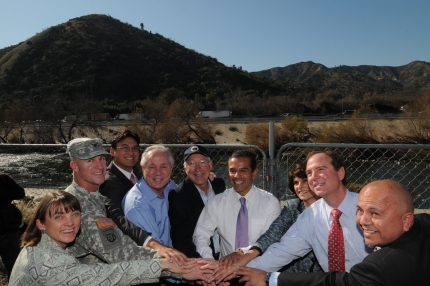
Secretary Salazar joins friend and colleague Los Angeles Mayor Antonio Villaraigosa to celebrate the partnerships that are making the Los Angeles Riverfront a better place to live, work, and visit. January 13, 2012. (by DOI photo by Tami A. Heilemann)
Ed. Note: Cross-posted from the Department of the Interior.
Yesterday, I had the pleasure of joining my friend and colleague Los Angeles Mayor Antonio Villaraigosa to celebrate the partnerships that are making the Los Angeles Riverfront a better place to live, work, and visit.
Identified twice as a priority project by the Obama Administration under the America’s Great Outdoors initiative and the Urban Waters Federal Partnership, the restoration and revitalization of the Los Angeles River Watershed is a huge undertaking, but has enough support behind it to make it a reality.
Learn more about Energy and EnvironmentPraise for the National Ocean Policy Implementation Plan
Posted by on January 12, 2012 at 4:30 PM EDTToday, the National Ocean Council released a draft National Ocean Policy Implementation Plan for public comment, laying out an action plan for addressing the most critical challenges facing ocean, coastal, and Great Lakes resources. Here's what others have to say about the plan:
Jim Lanard, President, Offshore Wind Development Coalition
“We support the National Ocean Policy and believe that it can help bring clarity to the management of our oceans and advance the growth of the offshore wind industry. A National Ocean Policy will result in the protection of marine ecosystems and will ensure the orderly and economically - and environmentally-sustainable development of ocean resources, in a manner that respects and minimizes conflicts with existing users.”
Bill Ruckelshaus, Co-chair, Joint Ocean Commission Initiative
“The Joint Ocean Commission Initiative Leadership Council applauds release of the National Ocean Policy Implementation Strategy. This is a crucial step toward realizing a policy that will benefit not only the health of our oceans and coasts but our economy, our environment, and our nation’s security. We look forward to continued collaboration with the National Ocean Council in support of timely and effective implementation of the National Ocean Policy.”
Rick Bellavance, Owner and Operator, Priority Fishing Charters, Rhode Island
“Our ocean is critical to Rhode Island’s economy and way of life. We need all government agencies to work with fishermen and everyone else who uses the ocean to create a comprehensive plan that allows us to tackle big problems like climate change and ocean acidification while protecting and sustainably growing our coastal economies. Today’s announcement lays out a plan to do just that.”
Richard Nelson, Lobsterman, Friendship, Maine
“A healthy ocean is the foundation of New England’s coastal economy. We need to get everyone to the table—the government, scientists and people like me who make a living out there—and we need to make a comprehensive plan for the ocean so that new businesses like renewable ocean energy can develop while ensuring that existing industries like fishing can grow and flourish into the future.”
Molly McCammon, Executive Director, Alaska Ocean Observing System
“The National Ocean Policy and the draft implementation plan really highlight the important role our oceans play in the nation’s economy and global environment. I am especially pleased that the plan recognizes the importance of ocean observations, making data publicly available, and especially focusing on the issues facing the Arctic region.”
Tricia K. Jedele, Director, Conservation Law Foundation’s Rhode Island Office
“The implementation plan announced today gives us new approaches and tools for tackling the many challenges facing our ocean. This is a great opportunity for everyone who works or plays on Rhode Island Sound to work together to improve the health of our ocean ecosystems, clean up our beaches, and strengthen the economies of our coastal communities.”
Jack Clarke, Director of Public Policy & Government Relations, Massachusetts Audubon Society
“Mass Audubon supports the Obama administration’s initiative in planning for and managing America’s ocean waters. This is an important and necessary step as we work together to provide for our oceans’ environmental, economic and national security functions. We look forward to partnering with the federal agencies focusing on ocean management planning in the New England region.”
Berl Hartman, the New England Chapter Director of Environmental Entrepreneurs (E2)
“E2 welcomes the National Ocean Policy draft implementation plan as a major milestone to protect the health of our valuable ocean ecosystems and bolster our coastal economies. Our oceans and Great Lakes are incredible engines of economic development and jobs. Today’s draft plan moves us towards a coherent, coordinated policy that sets national priorities and provides data for better decisions.”
Rep. Ed Markey, Ranking Member of the House Natural Resources Committee
“President Obama's ocean plans provide a framework for coastal communities to address some of the most pressing challenges to ensure healthy oceans, coasts and Great Lakes for present and future generations. Right now our oceans and Great Lakes are as active as they are vast, teeming with competition to fish, ship goods, train our Naval forces, harness wind energy, and conserve vital species and recreation locations. This plan will strengthen regional efforts to promote efficiency and collaboration in sharing these resources.”
Michael Weiss is Acting Director of the National Ocean Council
Learn more about Energy and EnvironmentPresident Obama Visits the EPA
Posted by on January 10, 2012 at 6:47 PM EDTPresident Obama earlier today stopped by the Environmental Protection Agency for his first ever visit. He made the trip to express his appreciation for the vital work done by the staff.
In a meeting with the staff, he said:
I want to say thank you to each and every one of you, because the EPA touches on the lives of every single American every single day. You help make sure that the air we breathe, the water we drink, the foods we eat are safe. You protect the environment not just for our children but their children. And you keep us moving towards energy independence.
And it is a vital mission. Over the past three years, because of your hard work, we’ve made historic progress on all these fronts.
The President pledged to stand by the EPA in its work:
Our environment is safer because of you. Our country is stronger because of you. Our future is brighter because of you. And I want you to know that you’ve got a President who is grateful for your work and will stand with you every inch of the way as you carry out your mission to make sure that we’ve got a cleaner world.
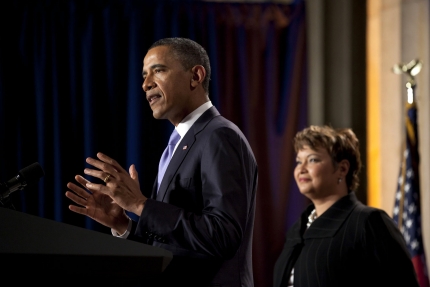
President Barack Obama delivers remarks to employees of the Environmental Protection Agency at the Andrew W. Mellon Auditorium, Washington, D.C., Jan. 10, 2012. EPA Administrator Lisa Jackson stands at right. (Official White House Photo by Pete Souza)
Read the full remarks here.
Learn more about Energy and EnvironmentProtecting the Nation’s Electric Grid from Cyber Threats
Posted by on January 9, 2012 at 4:58 PM EDTProtecting the electric system from cyber threats and ensuring its resilience are vital to our national security and economic well-being. This is exactly why cybersecurity is one of four key themes in the White House’s Policy Framework for a 21st Century Grid. For obvious reasons, the private sector shares our interest in a safe and secure electric grid. The Administration has benefited from working closely with industry, including to develop the Roadmap to Achieve Energy Delivery Systems Cybersecurity, released by the Department of Energy last September.
To continue that close cooperation, last week Deputy Secretary of Energy Dan Poneman and I, along with senior officials from Department of Homeland Security, hosted industry leaders to discuss a new initiative to further protect the electric grid from cyber risks. This initiative -- the Electric Sector Cybersecurity Risk Maturity Model Pilot -- is a new White House initiative led by the Department of Energy, in collaboration with the Department of Homeland Security, to develop a model to help us identify how secure the electric grid is from cyber threats and test that model with participating utilities. Gaining knowledge about strengths and remaining gaps across the grid will better inform investment planning and research and development, and enhance our public-private partnership efforts.
I was encouraged to see an impressive number of electric sector leaders participating and sharing their views with us. Their high level of interest in this new effort reaffirmed for me that these stakeholders share our desire to better understand the strengths and remaining gaps across the sector, so that together we can continue to take concrete steps to protect the electric grid from cyber threats.
We look forward to continued cooperation with our partners in industry to ensure this initiative builds on industry efforts and becomes a meaningful tool to create a modern, secure electric grid that carries us through the 21st century.
A Shining Example from the Sunshine State
Posted by on January 6, 2012 at 7:00 PM EDTSchools spend more than $6 billion annually on their energy bills -- more than they spend on computers and textbooks combined. The average public school building in the United States is more than 40 years old, and many struggle with old, inefficient, or broken heating and cooling systems and a host of other challenges, from crumbling roofs to outdated textbooks. As the President said: "We can't expect American kids to do their best in places that are falling apart. This is America. Every kid deserves a great school -- and we can give it to them." That's why, in the American Jobs Act, the President proposed a $25 billion investment in school infrastructure to modernize at least 35,000 public schools across the country. The funds would provide for a range of emergency repair and renovation projects, energy efficiency upgrades, asbestos abatement and removal, new science and computer labs, and internet-ready classrooms – and put 16,000 Americans back to work making those upgrades.
Modernizing our schools makes sense for American students, and makes sense for schools' bottom lines. Northboro Elementary is a clear example of how this investment would create jobs, improve classrooms, and bring our schools into the 21st century.
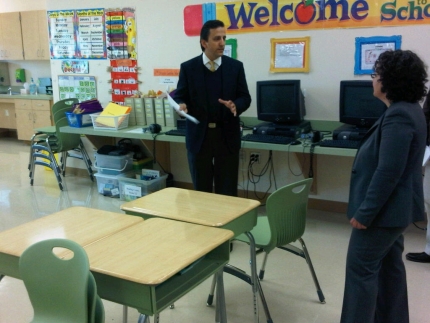
Chair Nancy Sutley meets with school leadership at Northboro Elementary School in West Palm Beach, Florida.
Taryn Tuss is Acting Communications Director at the White House Council on Environmental Quality
Learn more about Education, Energy and EnvironmentAmerica’s Ideas to Support Entrepreneurship in Education, Energy, and Health Care
Posted by on January 6, 2012 at 10:56 AM EDTIn December, the Obama Administration announced the Startup America Policy Challenge to identify high-impact ideas to support entrepreneurship in areas of national interest: education, energy, and health care.
To kick off the challenge, Secretary Arne Duncan (Department of Education), Secretary Steven Chu (Department of Energy), and Secretary Kathleen Sebelius (Department of Health and Human Services) each asked the American public for ideas about how the U.S. government can break down barriers to entrepreneurship and enable the use of clean energy, digital learning, and health information technologies.
On Quora, a public question and answer website, I asked the America people to respond to these specific questions:
- In the U.S. education system, what can the government do to best enable the use of new learning technologies?
- In the U.S. energy system, what can the government do to best enable the use of new clean energy technologies?
- In the U.S. healthcare system, what can the government do to best enable the use of new health information technologies?
The response has been thoughtful, wide ranging, and inspiring.
- On the subject of learning technologies, respondents had ideas to increase the flexibility of existing funds, spread best practices of what works, and improve basic infrastructure. And a number of respondents provided feedback about reducing bureaucracy and empowering teachers.
- On the subject of clean energy technologies, respondents had ideas on how the US Government could support consumer awareness of clean energy, be an anchor customer, and invest in research and development. Respondents also suggested including negative externality costs into the price of fossil fuels, and were adamant that government not pick a “winning technology.”
- On the subject of health care IT, respondents proposed ideas to promote interoperability standards, ensure a greater focus on the end user experience, share industry best practices, and measure the impact of specific technologies.
This is just a sampling of the great dialogue and answers – please feel free to vote on which ideas resonate with you and/or provide your own feedback. In the White House and in the Agencies, we are reading your responses.
To sharpen the dialogue a bit further and solicit additional input, I posted follow-up questions on Quora about specific barriers that customers face:
- Learning Technologies: Parents and teachers – what’s your biggest barrier to educating your kids that technology could solve? How important is the ability to access your child’s assessment data in electronic form?
- Clean Energy: Building and business owners – what’s your biggest barrier to using clean energy in your building or business? How important is the ability to access your building energy usage data in electronic form?
- Health IT: Doctors and patients – what’s your biggest barrier to using information technology to improve health outcomes? How important is the ability to share or receive your health records data in electronic form?
We look forward to hearing your feedback – so please keep it coming!
Aneesh Chopra is U.S. Chief Technology Officer
- &lsaquo previous
- …
- 96
- 97
- 98
- 99
- 100
- 101
- 102
- 103
- 104
- …
- next &rsaquo
Related Videos
-
 May 09, 2014 9:21 AM
Inside the White House: Solar Panels
-
 September 01, 2016 9:25 PM
President Obama Delivers a Statement to the Press
White House Blogs
- The White House Blog
- Middle Class Task Force
- Council of Economic Advisers
- Council on Environmental Quality
- Council on Women and Girls
- Office of Intergovernmental Affairs
- Office of Management and Budget
- Office of Public Engagement
- Office of Science & Tech Policy
- Office of Urban Affairs
- Open Government
- Faith and Neighborhood Partnerships
- Social Innovation and Civic Participation
- US Trade Representative
- Office National Drug Control Policy