Energy and Environment Latest News
Lighting the Path toward Energy Efficiency
Posted by on February 3, 2012 at 10:50 AM EDT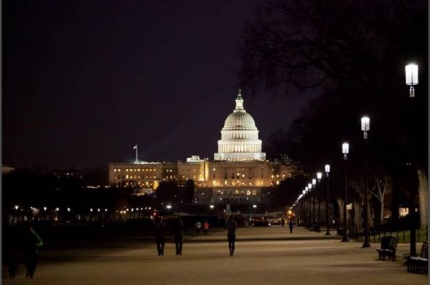
Tourists and joggers using the elm path, underneath the LED lighting, with the Capitol Building in the background.
Many cities have installed LEDs in public spaces and are already taking advantage of the benefits, and the Federal government continues to lead by example by installing LEDs and implementing other energy efficient measures.
The lighting installation on the Mall provides a 65 percent savings on electric bills and maintenance costs incurred by the National Park Service. The brighter light from the LEDs, as compared to the old bulbs, will also help to create a more secure park area.
Energy Secretary Steven Chu noted that "Using energy-efficient LED light bulbs is an important way Americans can save money by saving energy." Secretary Chu also commented that "Investing in an American economy that is built to last includes taking advantage of all of America's energy resources while working to improve efficiency. Installing these energy-efficient bulbs on the National Mall is an important demonstration of our commitment to partnering with the private sector to promote energy saving technologies." The bulbs are expected to last 25 years.

Close up of one of the 174 LED Retrofit Kits for Outdoor Lighting on the National Mall.
View Slideshow: Flipping the Switch on LED Lighting for the National Mall.
Michelle Moore is Federal Environmental Executive at the White House Council on Environmental Quality
Learn more about Energy and EnvironmentPraise for Charting a New Direction on National Forests
Posted by on February 1, 2012 at 12:00 PM EDTEditor's Note: Tom Tidwell is Chief of the U.S. Forest Service.
Last week, USDA Secretary Tom Vilsack and I announced our intent for finalizing a new planning rule to govern management of the National Forest System. The 193 million acres of national forests and grasslands are critical to President Obama’s vision of an economy built to last, providing clean air, clean water, habitat for wildlife, opportunities for healthy outdoor recreation, jobs and growth in rural communities, and a range of other benefits for all Americans.
When finalized, a new rule will replace outdated procedures that have been in place since 1982 that no longer reflect the best science, public values, or agency expertise. Land management plan revisions under the preferred alternative would cost less money and take less time, while protecting and restoring our forests, water and wildlife and supporting vibrant rural communities.
We listened to input from the public to develop the preferred course of action, included as the preferred alternative in the final Programmatic Environmental Impact Statement released last week. We hosted the most collaborative and transparent rule-making process in agency history, and carefully considered more than 300,000 public comments.
Here is what some of our partners and interested members of the public have said about the preferred alternative:
"In the early 1980’s, I was a forest planner attempting to implement what was then the new planning rule. I believed it was a good rule, and for its time, it was. But the 1982 rule is out of date for today’s circumstances. Today, the Forest Service is focused on restoration, including restoring fire dependent ecosystems to a more natural condition. This new preferred alternative protects our natural resources, promotes sustainable recreation and safeguards our precious drinking water while allowing for timber harvest and facilitating restoration.
The preferred alternative modernizes the planning process. It promotes a collaborative approach where people are engaged throughout the entire process all the way to implementation. It is the outcome of extensive public engagement, including hundreds of thousands of comments and thousands of people participating in roundtable discussions around the country. When the final decision is published, the Forest Service needs an opportunity to implement a new planning rule for the benefit of the American people."
~ Dale Bosworth, Former Chief of the U.S. Forest Service
"It is vital that the Planning Rule be modernized to enrich the contribution of a local National Forest or Grassland, within the context of its statutory mandates and obligations, to natural resource conservation at the landscape level. The preferred alternative will facilitate the contribution of the individual National Forest or Grassland to statewide and regional fish and wildlife conservation objectives.
A modernized rule provides for better integration of National Forest System management with other landscape conservation initiatives such as the Migratory Bird Joint Ventures, National Fish Habitat Partnerships, and in facilitating fish, wildlife and plant adaptation response to climate change. The State Fish and Wildlife Agencies look forward to greater successful delivery of conservation on the ground through implementation of the new planning rule."
~ Gary Taylor, Legislative Director, Association of Fish and Wildlife Agencies
“The National Forest System is a haven for Americans seeking a stronger connection with their families and nature through healthy outdoor recreational pursuits. The preferred alternative will support these sustainable recreational experiences, and will increase the involvement of the public in planning efforts.
We expect this new collaborative process to result in better, more broadly supported outcomes for these treasured public lands and their enjoyment. We look forward to working with the U.S. Forest Service on the first plan revisions carried out under a new rule when it is finalized in the near future.”
~ Kevin Colburn, National Stewardship Director, American Whitewater
“Forests cover one-third of the United States; store and filter half the nation’s water supply; provide jobs to more than a million wood products workers; absorb nearly 20% of U.S. carbon emissions; offer 650 million acres of recreational lands that generate well over $15 billion in economic activity annually; and provide habitat for thousands of species across the country. Yet our forests today face a “perfect storm” of threats, including catastrophic wildfires, outbreaks of pests and disease, poorly planned roads, increasing development, climate change, and policies that lead to gridlock rather than restoration.
A new Forest Planning Rule is sorely needed, and the preferred alternative is a positive proposal based on extensive public participation. It will allow plans to be developed more efficiently. The preferred alternative encourages restoration treatments that are needed to catch up to the problems our forests face. And it strengthens science requirements, giving science a clear role that can bring stakeholders together to strengthen long-term forest conservation. Most people born in 1982 have kids by now; it’s time for a new generation of Forest Planning, too.”
~ Laura McCarthy, Senior Forest Policy Lead, The Nature Conservancy
Tom Tidwell is Chief of the U.S. Forest Service
Learn more about Energy and EnvironmentAnother Step Toward Ocean Stewardship
Posted by on February 1, 2012 at 10:30 AM EDTIn another important step toward implementing President Obama’s National Ocean Policy, the National Ocean Council has determined it will formally include Regional Fishery Management Councils in regionally based coastal and marine spatial planning. The participation of the councils will ensure their valuable expertise is part of the collaborative effort to improve the health and stewardship of our ocean.
CMSP brings Federal agencies, States, Tribes and communities together to better manage the marine resources that Americans depend on for food, business, energy, security, recreation and a variety of other essential uses. The National Ocean Council will establish Regional Planning Bodies to carry out CMSP using an ecosystem-based approach that emphasizes better coordination across all levels.
In this collaborative spirit, and recognizing the unique and important role that Regional Fishery Management Councils play in fisheries management, the National Ocean Council will include members from each of the eight Regional Fishery Management Councils on the Regional Planning Bodies. These councils bring valuable expertise and knowledge about the array of marine fishery resources that are used on a region-specific basis to support local economies.
Each Regional Fishery Management Council will be asked to identify one of its Federal, State, Tribal, or local government voting members as its representative to the Regional Planning Body. In addition, each Regional Planning Body will form a standing technical committee that includes the scientific and technical experts from the councils to ensure their input is incorporated into the spatial planning process.
We look forward to working closely with the Regional Fishery Management Councils – as well as our other partners and the public – to ensure healthy oceans, coasts, and Great Lakes for all Americans.
Michael Weiss is Acting Director of the National Ocean Council
Learn more about Energy and EnvironmentState of the Union: Investing in our Nation's Youth
Posted by on January 31, 2012 at 12:00 PM EDTAs President Obama noted on Tuesday in his State of the Union address, "the easiest way to save money is to waste less energy." It's also true that the cleanest energy in the world is energy that we don't use at all. Last week, I traveled to Des Moines, Iowa, to visit North High School, where the school district's energy upgrades have saved them 20 percent on their energy bills even as air conditioning in their classrooms has increased by 40 percent. Overall, Des Moines Public Schools saved $370,000 in energy costs last year alone – enough to pay the salary of almost 10 first-year teachers. At North High I met an outstanding group of students busy preparing for the future. They were clear that their renovated and upgraded school was creating a better learning environment.
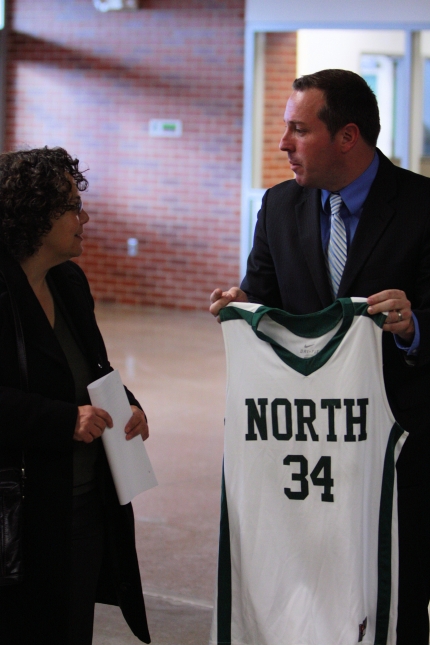
Principal Matt Smith presents Chair Sutley with a Polar Bears jersey. (Photo Credit: Des Moines Public Schools)
North High's example is exactly the kind of smart investment in clean energy the President proposed in his State of the Union last week. He laid out a blueprint for an economy that's built to last—an economy built on American manufacturing, American energy, skills for American workers, and a renewal of American values. No American value is more fundamental than living up to the promise of our Nation's youth. We will continue to push for investing in modern, healthy school environments for our students, and training and programs that will help them succeed in the 21st century economy.

Chair Sutley engages with North High School Advanced Placement students on the President's clean energy goals for the Nation. (Photo Credit: Des Moines Public Schools)
Nancy Sutley is Chair of the White House Council on Environmental Quality
Learn more about Energy and EnvironmentStartup America Policy Challenge: Universities Respond
Posted by on January 31, 2012 at 11:01 AM EDTToday, President Obama recognized the one-year anniversary of Startup America, the White House initiative to celebrate, inspire, and accelerate high-growth entrepreneurship throughout the nation.
As part of the Administration’s commitment to unleash market opportunities for entrepreneurs, in December we launched the Startup America Policy Challenge to identify high-impact ideas to support entrepreneurship in areas of national interest: education, energy, and health care.
To kick off the challenge, Secretary Arne Duncan (Department of Education), Secretary Steven Chu (Department of Energy), and Secretary Kathleen Sebelius (Department of Health and Human Services) each asked the American public for ideas about how the U.S. government can break down barriers to entrepreneurship and enable the use of clean energy, digital learning, and health information technologies.
The dialogue on Quora continues to be inspiring, with impassioned discussion about how to best enable use of these technologies, including discussion about how to tear down barriers to customer adoption. In the spirit of today’s focus on innovators, I also want to pose the question directly to entrepreneurs:
- Ed-tech entrepreneurs – what’s your biggest barrier to introducing learning technologies solutions into the marketplace?
- Clean-tech entrepreneurs – what’s your biggest barrier to introducing clean energy innovations into the marketplace?
- Health IT entrepreneurs – what’s your biggest barrier to introducing healthcare IT solutions into the marketplace?
Entrepreneurs and innovators are busy, though, building their businesses. Other than a response on Quora, they may not have the time or interest in thinking about the idea translates to policy solutions. That’s why I’m pleased to announce today that a network of universities have responded to the Startup America Policy Challenge, launching a contest for students and other solvers to compete to develop the best “policy business plans.”
The independent contest is open to students, problem solvers and the American public at large – anyone who wants to take the ideas from the Policy Challenge and turn them into compelling policy proposals. Finalists will get a chance to attend a conference in Washington D.C. and present their full proposals to a panel of high-profile expert judges with backgrounds in government, industry, and academia—and winning proposals will be shared with the Cabinet Secretary from the relevant federal agency.
Watch Live: President Obama Answers Your Questions in a Google+ Hangout
Posted by on January 30, 2012 at 10:09 AM EDT
Today, President Obama will participate in the first completely virtual interview from the White House to talk about his State of the Union Address. During the live interview, which will be held through a Google+ Hangout, the President will answer questions submitted by people from across the country. In fact, more than 227,000 people have participated already, submitting over 133,000 questions and casting more than 1.6 million votes on the questions they would like to hear President Obama address. In the Hangout, the President will be joined by a selection of citizens who will engage in the conversation live.
Don't miss your chance to Hangout with the President. Watch live at 5:30 EST on Monday, January 30, 2012. Your interview with President Obama will be streamed live on WhiteHouse.gov, YouTube.com/WhiteHouse and on the White House Google+ page.
Learn more about Economy, Education, Energy and Environment, Immigration, Taxes, Technology, Veterans, Women, Additional Issues
- &lsaquo previous
- …
- 92
- 93
- 94
- 95
- 96
- 97
- 98
- 99
- 100
- …
- next &rsaquo
Related Videos
-
 May 09, 2014 9:21 AM
Inside the White House: Solar Panels
-
 September 01, 2016 9:25 PM
President Obama Delivers a Statement to the Press
White House Blogs
- The White House Blog
- Middle Class Task Force
- Council of Economic Advisers
- Council on Environmental Quality
- Council on Women and Girls
- Office of Intergovernmental Affairs
- Office of Management and Budget
- Office of Public Engagement
- Office of Science & Tech Policy
- Office of Urban Affairs
- Open Government
- Faith and Neighborhood Partnerships
- Social Innovation and Civic Participation
- US Trade Representative
- Office National Drug Control Policy