Energy and Environment Latest News
Growing America’s Outdoor Heritage and Economy
Posted by on March 2, 2012 at 3:36 PM EDT
President Barack Obama is seen on a monitor as he delivers remarks during a conservation conference at the Department of the Interior in Washington, D.C., March 2, 2012. (Official White House Photo by Lawrence Jackson)
There is no doubt that our nation’s public lands – national parks, refuges, waterways and open spaces – are economic engines that produce and support jobs across the country.
On Tuesday, a report issued by the National Park Service showed that visitors to the National Park System contributed more than $31 billion to local economies and supported 258,000 jobs in 2010, an increase of $689 million and 11,500 jobs over 2009.
These are incredible numbers – and just a slice of the pie when it comes to the economic contributions of our public lands. For example, recreation in national parks, refuges, and other public lands led to nearly $55 billion and 440,000 jobs in 2009.
That’s part of the reason that President Obama called on his administration to take actions to promote travel and tourism in the United States. Investing in our parks and public lands and promoting them to visitors, especially internationally, is one way we can make the United States - with all its natural, historic and cultural assets - the top tourist destination in the world. International travel to the U.S. already supports 1.2 million jobs alone, so our efforts will help bolster job creation.
This is one of the topics we’re discussing today at the White House Conference on Conservation where President Obama and senior members of his Cabinet are meeting with conservation leaders from across the country to strengthen partnerships and identify next steps in advancing community-driven conservation, preservation and outdoor recreation initiatives that are building strong local economies and healthy lands, waters and wildlife.
The White House conference – Growing America’s Outdoor Heritage and Economy – is bringing together hundreds of boaters, hunters, anglers, farmers, ranchers, land conservationists, historic preservationists, outdoor recreationists, small business owners, local governments, tribal leaders and other key stakeholders from around the nation.
Learn more about Economy, Energy and EnvironmentWest Wing Week: 3/2/2012 or "That's Worth Fighting For"
Posted by on March 2, 2012 at 12:01 PM EDTThis week, the President touted the resurgence of the American auto industry, challenged governors to invest in education, held a dinner honoring Iraq War Veterans, hosted the Prime Minister of Denmark, and urged Congress to end subsidies for oil and gas companies during a trip to New Hampshire.
A Clean Energy Standard for America
Posted by on March 2, 2012 at 11:22 AM EDTThis week, answering the President’s call in the last two State of the Union addresses, Senator Bingaman proposed legislation that would establish a Clean Energy Standard for America. This is an important step towards the President’s goal of doubling clean energy by 2035, and we look forward to working with Congress as the bill moves forward.
Since taking office, President Obama has been committed to an all-of-the-above energy strategy that expands production of American energy resources, like oil and natural gas; increases energy efficiency to save families and businesses money at the pump; and drives investment and innovation in clean energy technologies.
A centerpiece of that strategy is the President’s ambitious but achievable goal to double the share of the Nation’s electricity from clean energy sources – including renewable energy sources like wind, solar, biomass, and hydropower; nuclear power; efficient natural gas; clean coal; even new technologies that have yet to be invented. It’s a wide-ranging approach that will drive innovation and create jobs across the country.
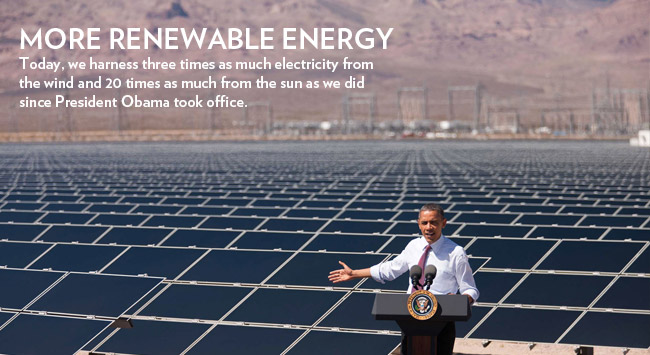
Over the past three years, the Obama Administration has already made significant progress. We’ve made the largest investment in renewable energy in American history. We’ve nearly doubled the amount of electricity generated from renewable sources like wind, solar, and geothermal. We’ve supported the world’s largest wind farm and several of the largest solar power projects. Domestic production of natural gas has risen to near-record levels, and last year the first new nuclear power plant was approved in three decades.
But we need to do more. We need to take additional steps to build a clean energy economy that can creates new jobs, reduces pollution, and makes America more competitive. The legislation introduced by Senator Bingaman this week is an important step forward in meeting that goal.
Learn more about Energy and EnvironmentPresident Obama on Gas Prices and Oil Subsidies
Posted by on March 1, 2012 at 6:47 PM EDT
President Barack Obama delivers remarks on the economy at Nashua Community College in Nashua, N.H., March 1, 2012. The president used a diagram to illustrate the decline in U.S. dependence on foreign oil. (Official White House Photo by Pete Souza)
Today in New Hampshire, President Obama renewed his call to repeal the $4 billion in subsidies that taxpayers provide the oil industry each year and said there's only one real path forward for America's future -- an all of the above approach that develops every source of energy available to us.
He also addressed the idea that we'll be able to drill our way to lower gas prices and energy independence:
So when it comes to oil production, under my administration, America is producing more oil today than at any time in the last eight years. That is a fact ... Under my administration, we have a near-record number of oil rigs operating right now -- more working oil and gas rigs than the rest of the world combined. Think about that.
The President is directing the federal government to address a range of issues that are having a real impact on what each of us pays at the pump. For starters, he's working to prevent speculators from taking advantage of uncertainties in the commodities market and trying to reduce bottlenecks in the supply chain.
And the President is making a real push to eliminate the tax breaks that we provide to one of the most profitable industries in the world:
[Oil] companies are making record profits right now -- tens of billions of dollars a year. Every time you go to the gas tank or fill up your gas tank, they’re making money. Every time. Now, does anyone really think that Congress should give them another $4 billion this year? Of course not. It’s outrageous. It’s inexcusable. And I am asking Congress -- eliminate this oil industry giveaway right away. I want them to vote on this in the next few weeks.
For more information about America’s decreasing dependence on foreign oil, check out our post from earlier today.
Learn more about , Economy, Energy and EnvironmentOur Dependence on Foreign Oil Is Declining
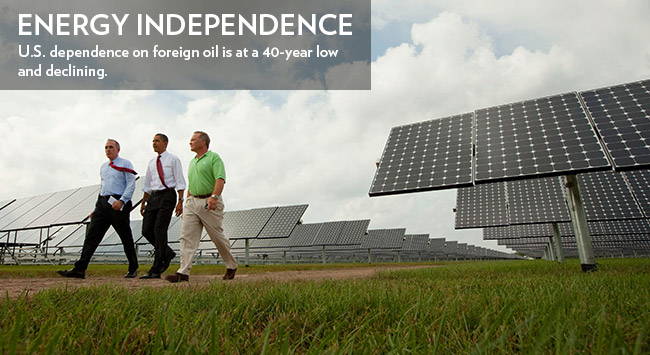
Posted by on March 1, 2012 at 10:30 AM EDTAmerica’s dependence on foreign oil has gone down every single year since President Obama took office. In 2010, we imported less than 50 percent of the oil our nation consumed—the first time that’s happened in 13 years—and the trend continued in 2011.

We’re relying less on imported oil for a number of reasons, not least that production is up here in the United States. In fact, America is producing more oil today than at any time in the last eight years. As part of his strategy to increase safe, responsible oil production in the United States, President Obama has opened millions of new acres for oil and gas exploration and we now have more working oil and gas rigs than the rest of the world—combined.
Despite all this, Americans are still paying more at the pump when we fill up. That's because drilling for more oil here at home won’t affect the price of gas on its own. Oil is bought and sold on a world market. In the short term, it’s subject to price spikes when there’s instability or uncertainty along the global supply chain. And growing demand in countries like India, Brazil, and China, which tripled the number of cars on the road in the last five years, will drive prices even higher over the long term.
So we have to do more than drill now to bring down prices for the future. Relying on the fossil fuels of the last century won’t be enough, especially as demand keeps increasing. We need an all-out, all-of-the-above strategy that develops every available source of American energy. This includes everything from tapping our offshore oil supplies and vast natural gas reserves, to doubling down on clean energy resources like wind and solar power, and developing new technologies that help us use less energy altogether.
Learn more about , Economy, Energy and EnvironmentGreat Lakes Summit: Advancing Partnerships for Great Lakes Restoration
Posted by on February 29, 2012 at 6:00 PM EDTToday, CEQ hosted a White House Community Leaders Briefing on the Great Lakes Region with environmental, academic, business and civic leaders from throughout the Midwest. The briefing was an important opportunity for dialogue between Great Lakes leaders and senior Administration officials like Counselor to the President Pete Rouse, Secretary of Commerce John Bryson, Deputy Secretary of the Interior David Hayes, and USDA Deputy Under Secretary for Natural Resources and Environment Ann Mills, on the importance of community leadership in Great Lake restoration.
The Great Lakes are home to some of America's finest beaches, world-class fisheries, and some of the world's most popular tourist destinations. They are also one of the planet's greatest natural resources, providing drinking water for more than 30 million people and supporting one of the world's largest regional economies.
The Administration has made it a priority to work with state, city, environmental, academic and business leaders toward lasting solutions for the Great Lakes. We have made the most significant investment in history in Great Lakes restoration – more than $1 billion since the President took office – and launched the Great Lakes Restoration Initiative to dedicate sustained attention to restoring this vital ecosystem. Led by U.S. EPA, the initiative has already removed more than 1 million cubic yards of contaminated sediment and protected or restored more than 20,000 acres of essential habitat.
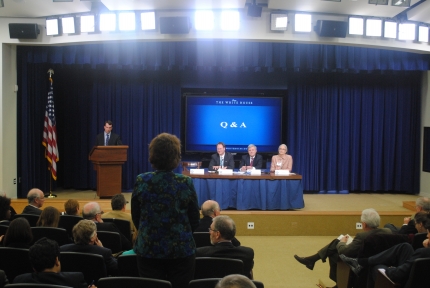
Senior Administration officials engage with Great Lakes Community Leaders.
But there is much more work to do, and now is not the time to scale back our Nation's commitment to the Great Lakes. Most recently, the President's FY 2013 budget included $300 million to continue critical interagency Great Lakes ecosystem restoration work. These GLRI funds, combined with agencies' significant base Great Lakes funds, will help advance our collective work to return this ecosystem to health.
We are committed to continuing progress in the Great Lakes. Today's gathering at the White House was another important step in advancing the partnership between the Administration and the dynamic community of leaders that has fostered success for the Great Lakes Restoration Initiative and its goal of a healthy environment and thriving economy for all Americans.
Rohan Patel is Associate Director for Public Engagement at the White House Council on Environmental Quality
Learn more about Energy and Environment
- &lsaquo previous
- …
- 88
- 89
- 90
- 91
- 92
- 93
- 94
- 95
- 96
- …
- next &rsaquo
Related Videos
-
 May 09, 2014 9:21 AM
Inside the White House: Solar Panels
-
 September 01, 2016 9:25 PM
President Obama Delivers a Statement to the Press
White House Blogs
- The White House Blog
- Middle Class Task Force
- Council of Economic Advisers
- Council on Environmental Quality
- Council on Women and Girls
- Office of Intergovernmental Affairs
- Office of Management and Budget
- Office of Public Engagement
- Office of Science & Tech Policy
- Office of Urban Affairs
- Open Government
- Faith and Neighborhood Partnerships
- Social Innovation and Civic Participation
- US Trade Representative
- Office National Drug Control Policy