Energy and Environment Latest News
West Wing Week: 2/24/12 or West Wing Week 100!
Posted by on February 24, 2012 at 10:00 AM EDTIt's hard to believe that when West Wing Week was born, "Don't Ask Don't Tell" was still around, American troops were still fighting in Iraq, the American auto industry was on the brink of collapse, and nobody knew that President Obama could sing -- what a difference 694 days makes. We've got a great week for you -- featuring BB King, the Boeing Dreamliner, a speech about American energy, a payroll tax cut extension, and special musical guest Keb Mo.
President Obama Describes an All-of-the-Above Strategy for Energy
Posted by on February 23, 2012 at 7:55 PM EDT
President Barack Obama tours the University of Miami Industrial Assessment Center in Miami, Florida, Feb. 23, 2012. The IAC is where students learn how to become industrial energy-efficiency experts as they help small to mid-sized manufacturers reduce their energy costs. (Official White House Photo by Chuck Kennedy)
President Obama was in Miami today to talk about securing a future for America built on home-grown energy -- and his blueprint to help us get there.
Part of the conversation focused on fuel prices -- and the fact that they're increasing. It's a real problem for people all over the country, which the President said required a real solution, not a slogan from a bumper sticker.
You know there are no quick fixes to this problem. You know we can’t just drill our way to lower gas prices. If we’re going to take control of our energy future and can start avoiding these annual gas price spikes that happen every year -- when the economy starts getting better, world demand starts increasing, turmoil in the Middle East or some other parts of the world -- if we’re going to avoid being at the mercy of these world events, we’ve got to have a sustained, all-of-the-above strategy that develops every available source of American energy. Yes, oil and gas, but also wind and solar and nuclear and biofuels, and more.
As President Obama pointed out, that's a vision toward which we are making progress:
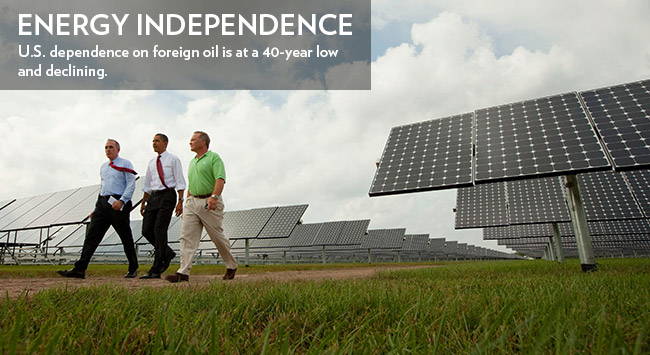
In 2010, our dependence on foreign oil was under 50 percent for the first time in over a decade. We were less reliant on foreign oil than we had been. In 2011, the United States relied less on foreign oil than in any of the last 16 years. That's the good news. And because of the investments we’ve made, the use of clean, renewable energy in this country has nearly doubled -– and thousands of American jobs have been created as a consequence.
But there is still much more that needs to be done. The President is fighting to roll back the $4 billion in tax subsidies that the oil industry receives every year. And in the weeks and months ahead, the President will continue to finding ways to invest in clean energy technologies and innovation.
Want more details about the President's blueprint? Here's everything you need to know.
Learn more about , Energy and EnvironmentMulti-National Partnership to Benefit Climate, Health, and Agriculture
Posted by on February 21, 2012 at 11:57 AM EDTSecretary of State Hillary Clinton last week announced the Climate and Clean Air Coalition, a voluntary partnership thast includes the United States, Bangladesh, Canada, Ghana, Mexico, Sweden, and the United Nations Environment Programme (UNEP) to reduce short-lived atmospheric pollutants such as methane, hydrofluorocarbons, and black carbon, or soot. These fast-acting climate pollutants are estimated to be responsible for about a third of global warming over the past 50 years, and are proven to have significant impacts on public health and world food production.
Learn more about Energy and EnvironmentUSDA Commemorates the “New Year of the Trees”
Posted by on February 16, 2012 at 6:53 PM EDT
United States Department of Agriculture (USDA) Under Secretary Natural Resources and Environment Harris Sherman (left), next to the freshly planted Dawn Redwood for the Celebration of Tu B’Shevat “The New Year of the Trees” event. February 8, 2012. (by Lance Cheung)
It is written in the Talmud – a central text of Judaism – that ‘just as my parents planted for me, so I will plant for my children.’ Here at USDA, we’re planting trees across the country and in Israel to bring the wide-ranging benefits of trees, both ecological and spiritual, to future generations.
Today, USDA Natural Resources and Environment Under Secretary Harris Sherman planted a tree next to the USDA’s Washington DC headquarters in commemoration of Tu B’Shevat, “The New Year of the Trees.” This event brought together the local Jewish community and government leaders alike to share their common bond of conserving our natural resources and leaving a healthier world for the next generation.
Also in attendance were Nancy Sutley, Chair of the White House Council on Environmental Quality, Terry Bellamy, Director of the District of Columbia Department of Transportation. Rabbi Levi Shemtov offered remarks, and students from Washington DC’s Jewish Primary Day School. The local school children were able to partake in the holiday and learn about the importance of urban trees

3rd Grade Class of the Jewish Primary Day School of the Nation’s Capitol sing “the Almond Tree is Blossoming” to the attendees, during the Celebration of Tu B’Shevat “The New Year of the Trees” event February 8, 2012. (by Lance Cheung)
After planting the dawn redwood, Sherman took the opportunity to highlight the importance of urban trees in both Israel and the United States. Sherman oversees the U.S. Forest Service, an agency that has more than a century of experience in managing America’s national forests and helping to sustain the nation’s forests for the benefit of generations to come. This week, other Obama Administration officials planted trees in Arizona , Colorado, and Israel as part of this commemoration.
USDA has been working with the Jewish National Fund (JNF) on many forest-related issues—for Israel and other parts of the Middle East face many similar challenges in that arena.
Ultimately, we must continue to work together to protect our urban green spaces for future generations. Our partnership with JNF has produced great results, and we look forward to working with them for many years to come.

United States Department of Agriculture (USDA) Under Secretary Natural Resources and Environment Harris Sherman (left), District Department of Transportation Director Terry Bellamy (2nd from right), White House Council on Environmental Quality Chair Nancy Sutley (right) begin to apply a layer of mulch to the freshly planted Dawn Redwood for the Celebration of Tu B’Shevat “The New Year of the Trees” event on the District of Columbia western lawn next to the USDA Headquarters, Whitten Building at 14th Street and Independence Ave SW, Washington, D.C. on Wednesday, February 8, 2012. February 8, 2012. (by Lance Cheung)
Max Finberg serves as Director of the Center for Faith-based and Neighborhood Partnerships at the U.S. Department of Agriculture.
Learn more about Energy and EnvironmentGreen Streets: Using One Approach to Tackle Multiple Environmental, Social, and Economic Goals
Posted by on February 15, 2012 at 2:30 PM EDT
As we go about our busy lives, we often forget the value natural resources bring to our daily routine. Those fortunate enough to have green spaces in their communities often busily drive past the neighborhood park without a glance on the way to work. At times we take for granted the trees providing shade for and adding property value to our homes. And generally we don’t think about where our rainfall goes after it enters the storm drain and begins to degrade the local creek where we might have taken our kids fishing.
When we start to notice is when these resources are missing.
In many urban settings, a new technique is being formulated that seeks to bring back the connection to those natural resources with a cost-effective approach. Communities routinely must repave and sometimes reengineer roadways: What if we leverage these necessary activities and, with only a small additional investment, help our local natural resources, improve quality of life, and train workers in new techniques all at the same time? It turns out this small additional investment may end up saving us money down the road.
2013 Energy Budget: What It Means for You
Posted by on February 14, 2012 at 3:12 PM EDT
Secretary Chu details President Barack Obama's $27.2 billion fiscal year 2013 budget request for the Department of Energy.
Yesterday, Secretary Chu detailed President Barack Obama's fiscal year 2013 budget, which includes a $27.2 billion request for the Energy Department. The Secretary emphasized the President's commitment to an all-of-the-above energy strategy that includes critical investments in innovation, in job-creating clean energy technologies, and in our national security. You can check out a video of the event below.
"The United States is competing in a global race for the clean energy jobs of the future," said Secretary Chu. "The choice we face as a nation is simple: do we want the clean energy technologies of tomorrow to be invented in America by American innovators, made by American workers and sold around the world, or do we want to concede those jobs to our competitors? We can and must compete for those jobs. This budget request includes responsible investments in an American economy that is built to last."
Specifically the President's FY 2013 budget request for the Department of Energy:
- Invests in cross-cutting research to lead in the research, development, deployment and production of clean energy technologies;
- Promotes efforts to make solar power affordable for all Americans by reducing the cost of solar energy by 75 percent and making it cost competitive without subsidies by the end of the decade;
- Continues the Obama Administration’s efforts to reduce our dependence on oil by one-third by 2025;
- Supports groundbreaking basic science, research and innovation to solve our energy challenges and ensure that the United States remains at the forefront of science and technology;
- Strengthens national security by reducing nuclear dangers and maintaining a safe, secure and effective nuclear deterrent; and
- Advances responsible environmental management by cleaning up the legacy from the Manhattan Project and the Cold War.
Learn more about , Economy, Energy and Environment
- &lsaquo previous
- …
- 90
- 91
- 92
- 93
- 94
- 95
- 96
- 97
- 98
- …
- next &rsaquo
Related Videos
-
 May 09, 2014 9:21 AM
Inside the White House: Solar Panels
-
 September 01, 2016 9:25 PM
President Obama Delivers a Statement to the Press
White House Blogs
- The White House Blog
- Middle Class Task Force
- Council of Economic Advisers
- Council on Environmental Quality
- Council on Women and Girls
- Office of Intergovernmental Affairs
- Office of Management and Budget
- Office of Public Engagement
- Office of Science & Tech Policy
- Office of Urban Affairs
- Open Government
- Faith and Neighborhood Partnerships
- Social Innovation and Civic Participation
- US Trade Representative
- Office National Drug Control Policy