Energy and Environment Latest News
Built to Last: Energy and the Environment in the Southwest
Posted by on February 14, 2012 at 2:40 PM EDTCISSEM is one of 46 Energy Frontiers Research Centers created under the American Recovery and Reinvestment Act of 2009. These centers are focused on transformative innovations in renewable energy production that will reduce our dependence on foreign oil and protect our environment. Appropriate to Arizona’s photon-rich landscape, UA’s center is at the cutting edge of the effort to create solar cells that are economically competitive with fossil fuels. Such cells must be both relatively inexpensive to manufacture and efficient at converting sunlight into electricity.
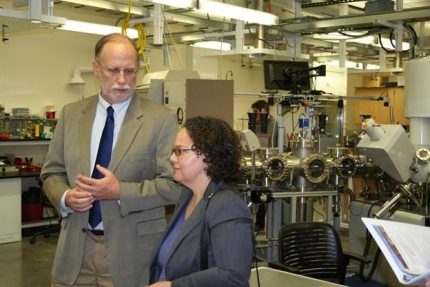
Chair Sutley tours UA’s Energy Frontiers Research Center with Director Neal Armstrong. (Photo Credit: University of Arizona)
After visiting CISSEM’s laboratories, Chair Sutley was briefed on UA’s own sustainability efforts by Senior Associate Vice President for Business Affairs Bob Smith. In the Southwest, water management is a critical priority, and UA is conserving through efforts including waterless urinals, reclaimed water irrigation, water harvesting, xeriscaping, and irrigation scheduling. The University is also actively reducing energy consumption by installing photovoltaic and solar thermal panels on a number of campus buildings, lighting retrofits, combined heat and power plants, HVAC scheduling, high-efficiency boilers, smart thermostats, and more.
Chair Sutley wrapped up her visit to the University of Arizona at a sustainability roundtable with UA scientists, administrators, and students, moderated by UA Provost Jacquelyn Mok. In her opening remarks, the Chair noted several of the challenges facing federal policymakers: How do we best take advantage of the information technology revolution? How do we think about federal assets in the face of a changing planet so that we can provide actionable information to local and regional managers? And, how do we change from a stovepipe mindset to bring a systems approach to managing natural resources and energy systems? Steered by Executive Dean Joaquin Ruiz, a focus on water echoed throughout the discussion, since water is a critical variable in all natural resource issues including energy production. The discussion ended with an impassioned plea from undergraduate Noelle Espinosa for continued federal support of our nation’s universities that foster innovative programs such as CISSEM and help lay the groundwork for a prosperous, sustainable future for America.
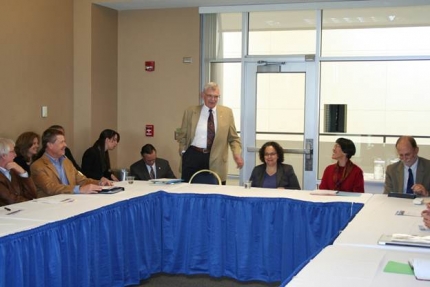
UA President Gene Sander introduces Chair Sutley to the sustainability roundtable. (Photo Credit: University of Arizona)
Neal R. Armstrong is Director of the Center for Interface Science: Solar Electric Materials at The University of Arizona
Learn more about Energy and EnvironmentThe 2013 Budget
Posted by on February 13, 2012 at 3:34 PM EDTEd. Note: This has been cross-posted from the OMB blog
Earlier today, the President sent to Congress his budget for the 2013 fiscal year. This year’s budget reflects the President’s firm belief that our country has always done best when everyone gets a fair shot, everyone does their fair share, and everyone plays by the same rules. It’s a document built around the recognition that this is a make or break moment for the middle class and those trying to reach it. What’s at stake is the very survival of the basic American promise that if you work hard, you can do well enough to raise a family, own a home, and put a little away for retirement.
The Budget continues our commitment to keeping that promise alive by creating an economy that’s built to last – with good jobs that pay well and security for the middle class.
It’s a commitment that starts with jumpstarting job creation so that our economic recovery quickens and more Americans are able to get back to work. The Budget proposes more than $350 billion in short-term measures for job growth starting this year. These proposals include the extension of the payroll tax cut and unemployment insurance benefits for rest of 2012; an upfront investment of $50 billion from the surface transportation reauthorization bill for roads, rails, and runways to create thousands of quality jobs in the short term; continuing to allow businesses to write-off the full amount of new investments; and $30 billion to modernize at least 35,000 schools, and $30 billion to help states and localities retain and hire teachers and first responders.
Building an economy that is built to last also requires that we transform our economy from one focused on speculating, spending, and borrowing to one constructed on the solid foundation of educating, innovating, and building. We need to make America the place with the highest-skilled, highest-educated workers; the most advanced transportation and communications networks; and cutting-edge research that will lead to the innovations and industries of tomorrow. To get us there, the Budget targets resources to the areas critical to growing the economy and restoring middle-class security: education and skills for American workers, innovation and research and development, clean energy, and infrastructure.
Learn more about , Economy, Education, Energy and Environment, Fiscal Responsibility, Health Care, TaxesIndependent Report Review Confirms Energy Loan Portfolio is Expected to Perform Well
Posted by on February 10, 2012 at 4:00 PM EDTOn October 28, 2011, the White House Chief of Staff directed an independent review of the current state of the Department of Energy (DOE) loan portfolio, focusing on future loan monitoring and management. The review was conducted by Herb Allison, who has wide-ranging experience in the finance, business, and government sectors during a career in public and private service that spans four decades and both Republican and Democratic Administrations.
This independent report on the DOE Loan Guarantee programs confirms that the loan portfolio as a whole is expected to perform well and holds less than the amount of risk envisioned by Congress when it created and funded the program. The report also includes a number of recommendations on how to improve the management of the Department’s loan program and ongoing monitoring of the loan portfolio. The Department of Energy is reviewing the recommendations to determine the best way to use them to further strengthen the program.
DOE’s loan programs are generating $40 billion in private investment in America’s economy that is supporting 60,000 direct jobs and thousands more up and down the supply chain. With the help of this program, American workers will build wind, solar, geothermal and nuclear power plants across the country that will help power our economy for decades to come – as well as the next generation of automobiles that will reduce our dangerous dependence on foreign oil. And these numbers don’t include the investments made in the supply chain or from other investments made from projects that have been able to get financing because the loan program helped structure and establish a market for them.
Learn more about Energy and EnvironmentDOE Announces $12 Million in Support of the Materials Genome Initiative
Posted by on February 10, 2012 at 2:10 PM EDTIn his State of the Union address last month, President Obama reaffirmed his commitment to advancing high-tech research and manufacturing within our borders, saying “I will not cede the wind or solar or battery industry to China or Germany because we refuse to make the same commitment here.” Support for research, development, and innovation in the fields of materials science and manufacturing is foundational to this goal, as advanced materials like those used in photovoltaic solar panels, lithium-ion batteries, and other high-tech energy-related products stand to revolutionize how we generate and store energy in everything from homes to cars to cell phones.
Learn more about Energy and Environment, TechnologyA Rural Council Initiative – Creating Jobs and Building a Forest Restoration Economy
Posted by on February 10, 2012 at 12:15 PM EDTSince the Rural Council was established last June, the Council has been a tremendous forum for discussing how to increase the focus on conservation work and create jobs in rural America. Here at the White House, we have been proud to work with Secretary of Agriculture Tom Vilsack on the recent report: “Increasing the Pace of Restoration and Job Creation on our National Forests” (USDA Restoration Report). The commitments we made in this report exemplify the progress we can achieve through the work of the Rural Council.
America’s forests provide myriad goods and services for the American public: clean drinking water, habitat for wildlife and fish, timber, and jobs that generate opportunities to create rural wealth. We believe that increasing the pace of forest restoration is important to the economic prosperity of rural America. Accelerating the restoration of our National Forests will also help combat the threats of disease, pests, wildfires and climate change to our forests.
Our forests support rural economies through recreation, tourism, and the production of wood products and bioenergy. The forest restoration report calls for a 20 percent increase of treated forest acres over the next three years, which would increase forest products sold by the National Forests from 2.4 billion board feet in 2011 to 3 billion board feet no later than 2014. This increase will accomplish critical restoration objectives, support jobs and stimulate a more vibrant forest industry that will provide workers with the skills to undertake other restoration projects. Active management of the nation’s forests, and the forest products industry that supports sustainable actions, are vital to meeting these objectives. The Collaborative Forest Landscape Restoration (CFLR) program is an excellent example of how USDA works successfully in partnership with states, communities, tribes and private land owners and it is exciting to see opportunities ahead with the announcement of ten additional forest and watershed restoration projects for a total of twenty (CFLR projects in 2012).
Accelerating restoration also will encourage an expanded market for wood products, including biomass utilization. The Forest Service is currently working with USDA on 12 Wood-to-Energy projects that will showcase how forest restoration and job creation go hand in hand.
The forest restoration strategy also advances the priorities of President Obama’s Americas Great Outdoors initiative by encouraging greater use and access to our public lands. We know there is a strong link between outdoor recreation and economic health. Currently, recreation activities on National Forest System lands alone contribute $14.5 billion annually to the U.S. economy and support hundreds of thousands of jobs in local communities. Just last month, President Obama directed his Administration to craft a new national tourism strategy focused on creating jobs – and a key piece will be encouraging foreign tourists to visit national parks and national forests, which will benefit rural economies.
The Rural Council provides an excellent forum for advancing ideas to benefit rural America. The Council will support this effort to deliver results from the forest restoration report and as work progresses in building a forest restoration economy.
Jay Jensen is Associate Director for Land and Water Ecosystems at the Council on Environmental Quality.
Doug McKalip is Senior Policy Advisor for Rural Affairs in the White House Domestic Policy Council.
Learn more about Energy and Environment, RuralAlaskan Permafrost Mapped from the Skies
Posted by on February 3, 2012 at 5:06 PM EDTLast week, the Interior Department’s US Geological Survey (USGS) released details about a landmark airborne survey of permafrost in the Yukon Flats of Alaska that yielded some of the most detailed, data-rich maps of permafrost ever generated. Permafrost—frozen ground that remains at or below water’s freezing point for at least two years—accounts for only 0.022% of all water on Earth, but it covers more than 20% of exposed land of Earth’s northern high latitudes (in addition to areas of Antarctica and the Patagonia region), where it plays a potentially important role in climate dynamics.
Learn more about Energy and Environment
- &lsaquo previous
- …
- 91
- 92
- 93
- 94
- 95
- 96
- 97
- 98
- 99
- …
- next &rsaquo
Related Videos
-
 May 09, 2014 9:21 AM
Inside the White House: Solar Panels
-
 September 01, 2016 9:25 PM
President Obama Delivers a Statement to the Press
White House Blogs
- The White House Blog
- Middle Class Task Force
- Council of Economic Advisers
- Council on Environmental Quality
- Council on Women and Girls
- Office of Intergovernmental Affairs
- Office of Management and Budget
- Office of Public Engagement
- Office of Science & Tech Policy
- Office of Urban Affairs
- Open Government
- Faith and Neighborhood Partnerships
- Social Innovation and Civic Participation
- US Trade Representative
- Office National Drug Control Policy