Energy and Environment Latest News
2012 State of the Union: Behind the Scenes
Posted by on January 24, 2012 at 2:59 PM EDTWe're just hours away from the time when President Obama will head to the Capitol to give this year's State of the Union address, and the speech is close to done. If you want to know what goes into making the State of the Union, check out our new behind-the-scenes video.
Related:
Find out how you can talk to Obama Administration officials about the President’s plan
Watch the enhanced version of the 2012 State of the Union Address
Read the full transcript of President Obama's 2012 State of the Union Address
Read President Obama’s Blueprint for an America that is built to last
Take a deep dive into the data behind the President’s plan
Photo Gallery: Scenes from the State of the Union
Interactive Feature: Who Joined the First Lady for the Speech?Learn more about Economy, Education, Energy and Environment, Fiscal Responsibility, Foreign Policy, Veterans, Additional IssuesFor the Win: Saving the Wetlands
Posted by on January 24, 2012 at 2:16 PM EDTFor the Win is a guest blog series featuring the remarkable initiatives that young Americans are advancing to win the future for their communities. Each week we highlight a new young person and learn about their inspiring work through their own words. Submit your story to appear in the For the Win guest blog series.
Clay McMullen, 17, lives in Munson Township, Ohio and is a senior at West Geauga High School where he is President and Founder of the Wetlands Education Team. He is a member of the of the 2011 PARADE All-America High School Service Team, an award recognizing outstanding young service leaders presented by PARADE Magazine in partnership with generationOn, the global youth service division of Points of Light.
Clean air and clean water. These are things that too many of us take for granted. What most of us don’t appreciate is that without wetlands, we wouldn’t have either of those things. Wetlands are called the sponges of the natural world, and for good reason. Much of the pollution that we put out, they absorb. They filter out pollutants and slowly release cleaner water and oxygen back into the ecosystem. So, when I learned that Ohio had lost 90 percent of its wetlands in the past 100 years, I was appalled. How could we let such a precious resource slip away? How did we fail to notice this? Sadly, most people just stood idly by or, in the name of progress, actively encouraged policies and practices that let Ohio’s most precious resource fall by the wayside.
Having learned about this unfortunate history, I chose to act by starting the Wetlands Education Team (WET) in sixth grade. I convinced a couple of good friends to help and we got to work. We started out small, attempting to spread the message of conservation to small groups of children. I am sure that many of them were just there for the complimentary juice boxes and temporary tattoos of bugs, but most of them learned to recite a few basic facts about how to preserve wetlands before they left us. For example, they learned that vernal pools look like puddles and dry up part of the year. They learned to tell their parents to protect them, or at least to leave them alone. Slowly but surely, however, we grew into a viable educational resource that was making a positive impact.
Learn more about , Energy and EnvironmentState of the Union 2012: We Want to Hear From You
Posted by on January 20, 2012 at 12:45 PM EDTMark your calendars! Next Tuesday January 24, President Obama will present the annual State of the Union Address at 9 pm EST, and all week long, the White House wants to hear from concerned citizens on the topics that most matter to you.
Once again, we will be streaming an enhanced version of the speech that features graphics, data and stats that highlight the issues the President is discussing on Whitehouse.gov/sotu. We will also live stream that broadcast through the White House Live App on Facebook, YouTube and our new Google+ page.
Starting immediately after the speech and continuing through the rest of the week, senior White House officials will hear from you about the state of our union. President Obama is committed to creating a system of transparency, public participation, and collaboration using social media and other online resources to engage citizens across America on your highest priorities.
Immediately following the speech, we’ll be streaming an online panel live from the White House. The panel of senior advisors -- Mark Zuckerman, White House Deputy Director of the Domestic Policy Council; Roberto Rodriguez, Special Assistant to the President for Education Policy; Brian Deese, Deputy Director National Economic Council; Ben Rhodes, Deputy NSA for Strategic Communications and Speechwriting and Jen Palmieri, Deputy White House Communications Director – will be answering questions about the President’s address submitted by citizens via twitter (#WHChat & #SOTU), Google+, Facebook and the in-person audience of tweetup participants.
Administration officials will spend Wednesday taking questions on the State of the Union in a day-long Office Hours marathon, an online question and answer session through Twitter. Josh Earnest, White House Principal Deputy Press Secretary, will be available throughout the day, and Mark Zuckerman, White House Deputy Director of the Domestic Policy Council will be taking questions at 1 pm EST. Dan Pfeiffer, the White House Communications Director, will also participate.
Thursday’s Office Hours will feature community-focused discussions with policy advisors and experts and Friday will be directed towards specific issues.
Review the full schedule of events below to learn how you can participate. We hope you will join us at some point next week.
Learn more about Economy, Education, Energy and Environment, Fiscal Responsibility, Foreign Policy, Health Care, Urban Policy, Veterans, WomenAcid Rain Program Benefiting Environment, Human Health
Posted by on January 19, 2012 at 2:30 PM EDTA Federal program to reduce pollutants that cause environmentally damaging acid rain has been remarkably successful, resulting in improved ecosystem health and providing human health benefits at a fraction of the predicted cost. That's the conclusion of a new report—National Acid Precipitation Assessment Program Report to Congress: An Integrated Assessment—released today by OSTP.
Learn more about Energy and EnvironmentGreen Button: Providing Consumers with Access to Their Energy Data
Posted by on January 18, 2012 at 7:09 PM EDTImagine being able to shrink your utility bill, or knowing the optimal size and cost-effectiveness of solar panels for your home, or verifying that energy-efficiency retrofit investments have successfully paid for themselves over time. Far too often these and similarly important—and potentially money-saving—opportunities are unavailable to us. Why? Because consumers haven’t had standard, routine, easy-to-understand access to their own energy usage data. Today, the Obama Administration is announcing another step forward in solving this problem.
Learn more about Energy and Environment, TechnologyIncreasing Energy Security
Posted by on January 18, 2012 at 5:32 PM EDTEd Note: Read Heather Zichal’s editorial in USA Today on the Administration’s Announcement on the Keystone XL Pipeline
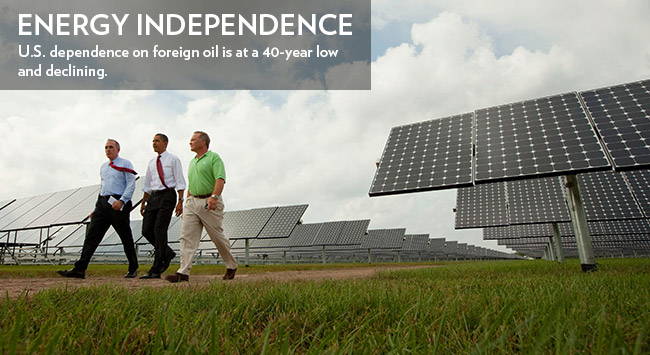
There is a lot of discussion lately about domestic energy production and American energy security. For the Obama Administration, moving towards the goal of energy independence has been a clear priority since day one. When President Obama took office, the United States imported 11 million barrels of oil a day. The President has put forward a plan to cut that by one-third by 2025 by strengthening domestic production of our energy resources, making our homes and buildings more efficient, and transitioning to a wide range of clean energy technologies.
When it comes to domestic energy production, the numbers speak for themselves. Since 2008, U.S. oil and natural gas production has increased, while imports of foreign oil have decreased. Here are the facts:
- In 2011, U.S. crude oil production reached its highest level since 2003, increasing by an estimated 90,000 barrels per day (bbl/d) over 2010 levels to 5.57 million bbl/d.
- U.S. natural gas production grew by an estimated 7.4 percent in 2011– the largest year-over-year volumetric increase – and easily eclipsed the previous all-time production record set in 1973.
- Overall, oil imports have been falling since 2008, and net imports as a share of total consumption declined from 57 percent in 2008 to 45 percent in 2011 – the lowest level since 1995.
In May of last year, President Obama outlined a series of additional steps to expand domestic oil and gas production as part of his long-term plan to reduce our reliance on foreign oil. More specifically, the President directed the Department of Interior (DOI) to conduct annual lease sales in Alaska’s National Petroleum Reserve (NPR-A), speed up the evaluation of oil and gas resources in the mid- and south-Atlantic, develop new incentives for industry to develop unused leases both onshore and offshore, extend drilling leases in the areas of the Gulf impacted by the temporary moratorium following the Deepwater Horizon oil spill, and lease new areas in the Gulf of Mexico.
Significant progress has been made in many of these areas. For instance, in December 2011, DOI held the first oil and natural gas lease sale in the Gulf of Mexico since the oil spill. The sale, which covered over 1 million acres, attracted more than $338 million in total bids – about $100 million more than average for Western Gulf sales over the previous decade. During the same month, DOI held a lease sale in Alaska’s NPR-A that generated winning bids of over $3.6 million and covered 17 tracts on over 140,000 acres.
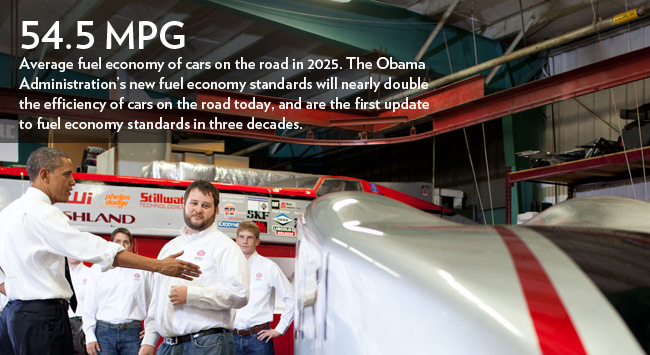
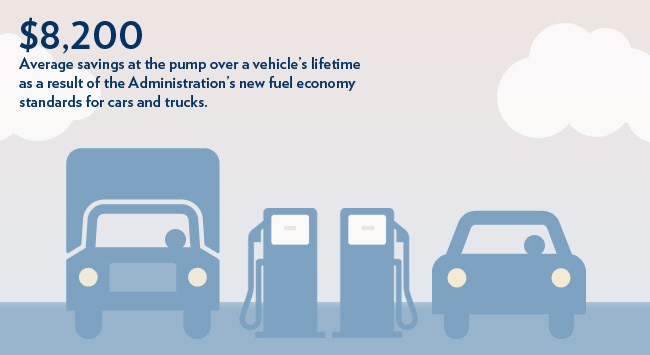
The Administration has also taken historic action to reduce our dependence on oil by making our cars and trucks more efficient. In July of last year, the President announced the next phase in the Administration’s program to increase fuel economy, which will require a performance equivalent to 54.5 miles per gallon for model year 2017-2025 passenger vehicles. Taken together, the standards established under this Administration span Model Years 2011 to 2025. They will save American families money at the pump, for a total of $1.7 trillion in fuel savings over the life of the program. They will clean up our environment, cutting greenhouse gas emissions by more than 6 billion metric tons over the life of the program, while reducing pollutants like air toxics, cause soot, and smog.
These new fuel economy standards will dramatically cut our oil dependence, reducing consumption by an estimated 2.2 million barrels a day in 2025 (eventually reaching more than 4 million barrels a day as the fleet turns over), and saving 12 billion barrels in total over the lifetime of the program. To put that in perspective, it would take a pipeline that carried 700,000 barrels a day nearly 47 years to transport the amount of oil we are saving thanks to these new fuel economy standards.
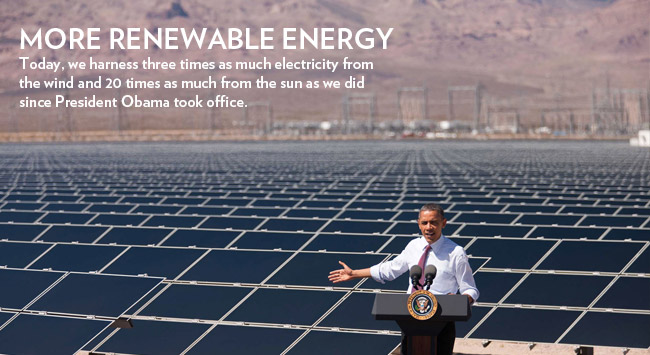
Of course, the Administration has also been intent on developing and deploying clean energy technologies and positioning the United States as the global leader in the clean energy race. The Recovery Act invested more than $90 billion in clean energy, the largest such investment in America’s history. Those investments have created hundreds of thousands of jobs and spurred thousands of clean energy projects across the country. For example, the Department of Energy’s (DOE) Loan Guarantee Program has already supported more than 40 clean energy projects that will ultimately employ more than 60,000 Americans. And because of Recovery Act investments, we are on track to double non-hydro renewable electricity generation from 2008 levels this year.
In short, the Obama Administration’s approach to achieving American energy independence has been a comprehensive and sustained effort, with emphasis on boosting domestic energy production, increasing efficiency, and transitioning to cleaner energy sources.
But what’s abundantly clear is that there are no silver bullets when it comes to this challenge. And the idea, as some in Washington have tried to suggest, that building a pipeline is the ultimate answer to the question of American energy security and job creation is nothing more than a pipe dream. The truth is that just two of the Administration’s programs – the DOE Loan Guarantee Program and the EPA’s Mercury and Air Toxics Standards – will create more than 10 times the amount of jobs generated by the Keystone XL pipeline, which will only generate a few thousand temporary jobs. In terms of reducing America’s dependence on oil, the Administration’s fuel economy standards alone will save more than twice the amount of oil the Keystone pipeline would deliver.
Learn more about Economy, Energy and Environment
- &lsaquo previous
- …
- 95
- 96
- 97
- 98
- 99
- 100
- 101
- 102
- 103
- …
- next &rsaquo
Related Videos
-
 May 09, 2014 9:21 AM
Inside the White House: Solar Panels
-
 September 01, 2016 9:25 PM
President Obama Delivers a Statement to the Press
White House Blogs
- The White House Blog
- Middle Class Task Force
- Council of Economic Advisers
- Council on Environmental Quality
- Council on Women and Girls
- Office of Intergovernmental Affairs
- Office of Management and Budget
- Office of Public Engagement
- Office of Science & Tech Policy
- Office of Urban Affairs
- Open Government
- Faith and Neighborhood Partnerships
- Social Innovation and Civic Participation
- US Trade Representative
- Office National Drug Control Policy