

Energy and Environment Latest News
Weekly Address: Ending Subsidies for Big Oil Companies
Posted by on March 17, 2012 at 5:30 AM EDTPresident Obama says that America needs an all-of-the-above energy strategy that invests in new technologies and ends the $4 billion in annual subsidies to oil companies that are earning historic profits.
Transcript | Download mp4 | Download mp3
Learn more about Energy and EnvironmentWeekly Wrap Up: Standing Together and Working Together
Posted by on March 16, 2012 at 6:49 PM EDTA quick look at what happened this week at WhiteHouse.gov:
No Quick Fix: Speaking from Prince George’s Community College in Largo, Maryland on Thursday, the President explained his all-of-the-above strategy to develop every available source of American-made energy. “We need an energy strategy for the future,” the President explained. “Yes, develop as much oil and gas as we can, but also develop wind power and solar power and biofuels.”
Rock-Solid Alliance: On Wednesday morning, President Obama – together with the First Lady, the Vice President and Dr. Biden – welcomed British Prime Minister David Cameron and Samantha Cameron to the White House during the Official Arrival Ceremony on the South Lawn. Later that evening, the Prime Minister and his wife were honored with a State Dinner, where they were joined by dignitaries from both countries. “In war and I peace, in times of plenty and times of hardship,” President Obama remarked, “we stand tall and proud and strong, together.”
Announcing a New Trade Case: After forming the Trade Enforcement Unit two weeks ago, President Obama announced on Wednesday that, “we’re bringing a new trade case against China – and we’re being joined by Japan and some of our European allies.” The effort is focused on expanding American manufacturers’ access to rare earth materials, which China currently supplies and, due to their policies, prevents the United States from obtaining.
Bracketology: Before the madness began, the President took time to fill out his brackets for the 2012 NCAA men and women’s basketball tournaments. While Kentucky, Ohio State and Mizzou made his Final Four, it’s the North Carolina Tar Heels who he selected as his national champion. On Monday night, the President headed to Dayton, Ohio with Prime Minister Cameron to catch some early round action in person.
Learn more about Energy and Environment, Foreign PolicyAmerican Energy: The Facts
Posted by on March 15, 2012 at 8:03 PM EDTAny American who has filled up recently knows that prices at the pump, driven by increased world oil prices, are too high. The President understands the impact this has on families and businesses. He also knows there’s no silver bullet to bring down the price at the pump. That is why he continues to invest in a sustained, all-of-the-above approach to American energy, increasing the efficiency of the vehicles we drive, investing in advanced technologies and alternative fuels, and expanding responsible domestic oil and gas production.
When it comes to domestic production, the President has made clear he wants us to continue to produce more oil and natural gas. This alone isn’t a solution to high gas prices, but it will help reduce our reliance on foreign oil and our vulnerability to the ups and downs of the international market. On that front, the numbers speak for themselves; every year the President has been in office, domestic oil and gas production is up, foreign imports of oil are down, and currently we are producing more oil than any time in eight years. In fact, imports of foreign oil decreased by a million barrels a day in the last year alone.
Despite these encouraging trends, there are some who seem to want to paint a bleak picture of the state of American energy. So let’s take a look at the facts.
Learn more about Energy and EnvironmentMore Drilling Won't Solve High Gas Prices
Posted by on March 15, 2012 at 3:44 PM EDT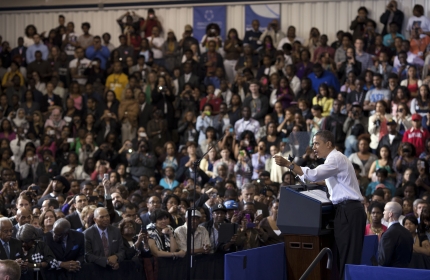
President Barack Obama delivers remarks on energy at Prince George’s Community College in Largo, Maryland, March 15, 2012. (Official White House Photo by Pete Souza)
Today, the President spoke at Prince George’s Community College in Largo, Maryland about his all-of-the-above strategy to develop every available source of American-made energy.
The President's strategy-- the same one the he's been pursuing since he took office-- will help us reduce our dependence on foreign oil by expanding oil and gas production here at home, using more clean energy like wind power and solar power, and developing new technologies that help us use less energy altogether.
When gas prices are high, like they are now and like they’ve been in the past, Americans feel the pinch at the pump and calls for more drilling as a quick fix to bring prices down are loudest. But as the President explained (again) today, more drilling is no quick fix or silver bullet. More drilling here in the United States isn’t enough to bring prices down or meet our energy needs, and here’s how we know:
First of all, we are drilling. Under President Obama’s Administration, America is producing more oil today than at any time in the last eight years.We’re operating a record number of oil rigs, and the President has opened millions of acres for oil and gas exploration both on and offshore that will help bring even more of them online. But prices are still high.
Learn more about Energy and EnvironmentStudents Present Ideas for Better Buildings
Posted by on March 14, 2012 at 2:25 PM EDTPresident Obama has called for an all-of-the-above energy strategy, and one way we can prepare for the future is to engage students in creating energy solutions for the future. Recently, students from across the country came to the White House to present their ideas for energy efficient buildings. University teams—led by their respective energy club—tackled cases that focus on a number of the most common, most stubborn barriers to energy efficiency in both the private sector and in state and local settings. The students came from a variety of academic programs, including engineering, real estate, business/management, and policy.
The cases use real scenarios, information, and data provided by Better Buildings Challenge Partners and others in the commercial buildings industry. Students presented on two city policy scenarios and two private real estate scenarios, answering questions such as, "What is the best mechanism to significantly move the energy efficiency market?" Their creative and innovative solutions addressed policy, finance, business and real estate challenges.
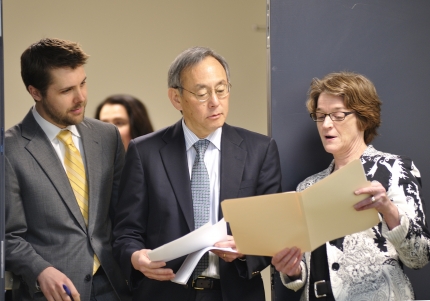
Reviewing student ideas, from left: Brian Deese, Deputy Director of the National Economic Council; Energy Secretary Chu; and Kathleen Hogan, Deputy Assistant Secretary for Energy Efficiency.
This forum provides the next generation of engineers, entrepreneurs and policymakers with skills and experience to start careers in clean energy and generates creative solutions to real-world problems to be used as models by businesses and other organizations across the marketplace.
The event supported the Better Buildings Challenge, a national energy efficiency leadership initiative and a core element of President Obama's plan to make commercial buildings 20 percent more energy efficient by 2020. In addition to supporting significant energy reduction, the Better Buildings Challenge is focused on finding solutions to persistent barriers to energy efficiency that have limited the energy efficiency market.
Energy Secretary Steven Chu announced the winners of the competition and congratulated them for their efforts to tackle some of the most common and stubborn barriers to improving energy efficiency.
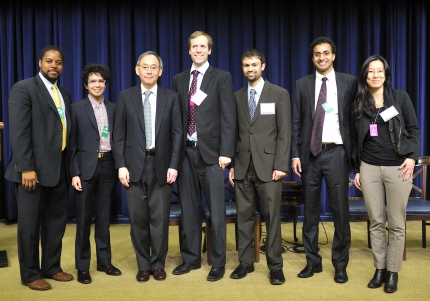
Energy Secretary Steven Chu (3rd from left) pictured with the student team from Massachusetts Institute of Technology, one of the winning teams.
Participating Universities:
Babson College
Carnegie Mellon University
Columbia University
Dartmouth College
Duke University
The George Washington University
Georgetown University
Georgia Institute of Technology
Harvard University
Massachusetts Institute of Technology
Texas A&M University
Tufts University
University of California, Berkeley
University of California, Irvine
University of Colorado, Denver
University of Michigan, Ann Arbor
University of Southern California
Vanderbilt University
Yale UniversityRead more on the President's Better Buildings Initiative.
Maria Vargas is Director of the Better Buildings Challenge at the U.S. Department of Energy
Learn more about Energy and EnvironmentStudy Finds Ocean Acidification Rate is Highest in 300 Million Years, CO2 is Culprit
Posted by on March 13, 2012 at 1:27 PM EDTA new study concludes that the current rate of ocean acidification is higher than at any time in at least the last 300 million years and attributes this ecosystem-threatening change to the huge quantities of carbon dioxide being released into the atmosphere from fossil-fuel burning and deforestation. The study’s investigators, at Columbia University and other institutions, scrutinized Earth’s geologic record for times in ancient history when natural events such as intensive volcanic activity may have similarly led to CO2 releases or ocean acidification. Although none of those ancient chemical changes appear to have been as extreme as those occurring today, there is nonetheless evidence that they contributed to serious ecological disruptions. That suggests that current trends similarly pose serious threats to marine ecosystems, the researchers conclude in the journal Science.
Learn more about Energy and Environment
- &lsaquo previous
- …
- 85
- 86
- 87
- 88
- 89
- 90
- 91
- 92
- 93
- …
- next &rsaquo
Related Videos
-
 May 09, 2014 9:21 AM
Inside the White House: Solar Panels
-
 September 01, 2016 9:25 PM
President Obama Delivers a Statement to the Press
White House Blogs
- The White House Blog
- Middle Class Task Force
- Council of Economic Advisers
- Council on Environmental Quality
- Council on Women and Girls
- Office of Intergovernmental Affairs
- Office of Management and Budget
- Office of Public Engagement
- Office of Science & Tech Policy
- Office of Urban Affairs
- Open Government
- Faith and Neighborhood Partnerships
- Social Innovation and Civic Participation
- US Trade Representative
- Office National Drug Control Policy