Energy and Environment Latest News
Scientific Integrity Policies Released
Posted by on April 6, 2012 at 9:03 AM EDTResponding to an initial call by the President—amplified in a memorandum developed by my office with significant input from science stakeholders and the public—departments and agencies across the Federal government have been diligently crafting scientific-integrity policies to guide them as they pursue their diverse missions. As I’ve documented in previous blog posts, the number of agencies that have worked this complex process to completion has grown steadily in the past year. By December 2011, all departments and agencies with science and technology as core parts of their mission had either completed or were very close to completing their policies. But most were still conducting internal reviews and had not made their policies public.
In February, in keeping with this Administration’s commitment to maximizing openness and transparency, I asked all departments and agencies to make their policies public by March 30, whether those policies were final or still in final draft form. The response was positive; as of this week almost every covered Federal entity is in compliance, and the few remaining others report they are very close to unveiling their final policies.
Specifically, the following departments and agencies have released their scientific integrity policies: the Departments of Agriculture, Commerce, Education, Energy, Health and Human Services, Interior, Justice, State, and Transportation, as well as the US Agency for International Development, Environmental Protection Agency, Marine Mammal Commission, National Aeronautics and Space Administration, National Institute of Standards and Technology, National Oceanic and Atmospheric Administration, National Science Foundation, Intelligence Community, and Veterans Affairs.
Learn more about Energy and Environment, TechnologyAfter Two Years of Sorrow, A Reflection and a Promise
Posted by on April 5, 2012 at 12:58 PM EDTEd note: this post originally appeared on the Department of Labor's Work in Progress blog
Today marks the second anniversary of the worst U.S. coal mining disaster in nearly four decades, as well as the single most heartbreaking day of my tenure as U.S. Secretary of Labor. The day after the explosion at Upper Big Branch mine in West Virginia, I went to the site and sat vigil with the family members and loved ones of the miners who were trapped underground. We prayed for a miracle that never came. I will never forget the 29 men who perished in an explosion that ripped through the chambers of the mine, the two miners who were seriously injured, or their loved ones.
Since then, MSHA has introduced tough new practices to counteract the type of misdeeds that were so prevalent at Upper Big Branch under Massey Energy. Joe Main, my assistant secretary of labor for MSHA, testified to Congress last week detailing the steps the agency is taking to make sure that we never again see such a senseless loss of life among miners. Our impact inspection program, which targets mines with chronic compliance problems, is an important new tool in our enforcement efforts. Many of the surprise inspections conducted under this program have forced mine operators to shut down production until they have addressed hazards.
Joe and his team are also making sure that we hold mine operators more accountable. A new rule to be published April 6 and effective in August, requires underground coal mine operators to examine their mines more thoroughly by finding and fixing common violations, including some of those that were cited in the investigation of the UBB mine disaster.
We have more to do. We cannot allow mine operators to hide hazards from inspectors, which was a major problem at many Massey mines. We need stronger criminal penalties for rogue operators who skirt the law, enhanced whistleblower protections so that miners can speak out about safety, and a host of other reforms.
Mines across the country operate productively every day while adhering to sound health and safety programs. There is never an excuse for cutting corners on worker protection. Employers should never put profits over people. If every mine operator meets its legal obligation to ensure the safety and health of its workers, we can prevent another tragedy like Upper Big Branch from ever happening again.
Learn more about Energy and Environment, Additional IssuesLAUNCHing Ideas for a Waste-less Tomorrow
Posted by on April 2, 2012 at 3:25 PM EDTAs a participant of the first LAUNCH forum, LAUNCH: Water, and someone who recently returned from six months experiencing the orbital perspective of our planet from 240 miles above the Earth, I invite innovators from around the world to participate in LAUNCH: Beyond Waste.
LAUNCH, a social entrepreneurship forum, is in its third year of existence,and is taking public/private partnerships to new heights—literally and figuratively. A partnership among NASA, the U.S. Agency for International Development, the State Department, and NIKE, it has become a testbed for collaboration across non-traditional disciplines and organizations, bringing innovative solutions to difficult sustainability challenges around and above the world.
Learn more about Energy and EnvironmentEverlasting Struggle: The Sentiments of a Legend
Posted by on March 29, 2012 at 12:09 PM EDT
“Rogelio, the struggle will never end, we must always be prepared,” these are the words that our farm worker leader Cesar Chavez used during organizing meetings. Now, I always keep those words in my mind and my heart. They help me to continue with my job as a union representative. They help me to administer, enforce and guard our union contract. They help me to organize and fight for those issues affecting my co-workers and community.
It is an honor to have been selected as a “Champion of Change.” This recognition is not just for me, but also for those who work every day from sunrise to sundown to provide food for all the families in America. I never dreamed of receiving recognition from the White House because my ideals and values are to serve others without expecting anything back. If I didn’t have these principles, I wouldn’t have lasted a single year in the farm worker movement. I have been involved in the farm worker movement without expecting anything back for most of my life.
My history with the farm worker movement and the United Farm Workers (UFW) started in 1972. My motivation came from living the injustices and abuses that we, as farm workers, were experiencing. We were treated as slaves, we did not have any representation in society, we were discriminated against and there were neither benefits nor labor protections. Farm workers needed a change, and I am proud to say that I became a part of that change. In 1981, with the help, guidance and support of the UFW, I started an organizing campaign in my workplace so my co-workers and I could get a union contract. I received training from the UFW on how to talk to, motivate and organize my co-workers. Little by little, I started to inspire more and more of my co-workers and we became leaders in our workplace and community.
Five Reasons to Repeal Subsidies for Oil Companies
Posted by on March 29, 2012 at 11:57 AM EDT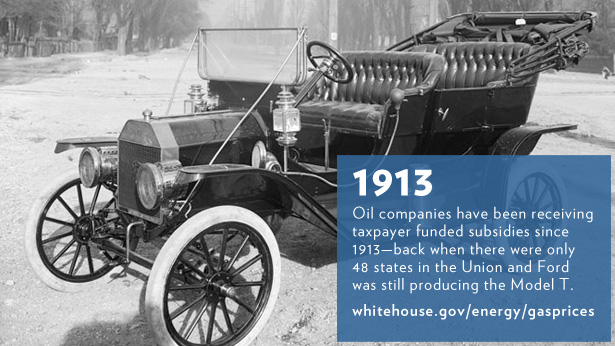
Today, Members of Congress have a simple choice to make: stand with big oil companies, or stand with the American people. President Obama spoke about that choice this morning from the Rose Garden:
Right now, the biggest oil companies are raking in record profits – profits that go up every time folks like these pull into a gas station. But on top of these record profits, oil companies are also getting billions a year in taxpayer subsidies – a subsidy they’ve enjoyed year after year for the last century.
Think about that. It’s like hitting the American people twice. You’re already paying a premium at the pump right now. And on top of that, Congress thinks it’s a good idea to send billions more of your tax dollars to the oil industry?
Here are five reasons to repeal oil subsidies:
- In 2011 the three largest U.S. oil companies made a combined profit of more than $80 billion. They don’t need more help from taxpayers who are already having a tough time filling up their tanks. High oil prices give oil companies all the incentive they need to produce more.
- American oil is booming. Domestic oil production is the highest it’s been in eight years. We’ve quadrupled the number of operating oil rigs to a record high. We’ve added enough oil and gas pipeline to circle the Earth and then some. For two years in a row, we’ve made more oil here in the United States than we bought from other countries. And the Obama Administration has taken other steps to help oil companies succeed, including opening up millions of acres of federal lands and waters to oil and gas production.
- We can’t drill our way out of high gas prices. We use more than 20 percent of the world’s oil, but we only have 2 percent of the world’s known oil reserves. That means that even if we drilled every drop of American oil tomorrow, we’d still have to buy oil from other countries to make up the difference.
- Clean energy technologies are more promising than ever. Investments in wind and solar power are providing clean, renewable energy to millions of homes and businesses around the country. Manufacturers are building more fuel efficient cars and trucks that are helping drivers get more miles to the gallon so they can fill up less. Advanced, homegrown biofuels are powering fleet trucks across the country.
- Oil and gas are only one part of an all-of-the-above energy strategy. We want successful companies to thrive and grow, but we also have to get our priorities straight. We have to invest in our future, not subsidize the past. Instead of taxpayer giveaways to an industry that’s never been more profitable, we should be using that money to double-down on investments in clean energy technologies that will help us break the cycle of high prices that happen year after year.
Read more about President Obama's all-of-the-above energy strategy.
Learn more about Economy, Energy and EnvironmentEnergy Performance Upgrades Offer Savings, Jobs, and are Self-Funded
Posted by on March 29, 2012 at 10:45 AM EDTLast week, GSA announced the Deep Retrofit Challenge, which challenges the private sector to bring innovative, energy saving retrofits to Federal buildings and to take performance-based contracts to the next level. These retrofit projects create jobs, and performance-based contracts provide government with decades of lower utility bills and long term cost savings without an up front investment from the taxpayers.
The Deep Retrofit Challenge is offering 30 buildings across the country, totaling nearly 17 million square feet, that will use Energy Service Performance Contracts (ESPCs) to make existing buildings more energy efficient. ESPCs retrofit buildings for guaranteed greater energy performance at no net cost to taxpayers. The retrofit projects are paid for through energy savings over time.
Last December, President Obama announced nearly $4 billion in commitments to perform energy efficiency upgrades to buildings over the next two years. Two billion dollars of this effort will come from the private sector through upgrading manufacturing facilities, retail stores, universities, and other buildings. Up to $2 billion more will come from Federal buildings through the use of ESPCs, which the President directed in a Presidential Memorandum to all government agencies. GSA’s Deep Retrofit Challenge will contribute to the President's performance contracting goals for the Federal government.
As the President said, performance-based contracts are a “triple win”-- they create jobs, offer guaranteed energy savings, and they come at no cost to taxpayers. Through an ESPC, building owners leverage private funds to perform energy efficiency upgrades. When the work is done, money will be saved on energy costs. Federal buildings are built to last, and these contracts span a maximum of 25 years; therefore, the Federal government stands to reap the benefits of energy and cost savings for decades without making an initial investment.
GSA already has extensive experience with performance contracting. Since 1998, GSA has contracted over $460 million in ESPCs through the Department of Energy’s Federal Energy Management Program. GSA owns roughly 182 million square feet of space in over 1,500 buildings nationwide, and we are eagerly reviewing our owned building portfolio to determine where we can best use ESPCs to increase energy efficiency.
In addition to the Presidential Memorandum on Implementation of Energy Savings Projects and Performance-Based Contracting issued in December 2011, President Obama issued Executive Order 13514 on Leadership in Environmental, Energy, and Economic Performance in 2009, which requires agencies to meet a number of energy, water, and waste reduction targets in existing Federal buildings. Performance based contracts help Federal agencies to meet these benchmarks and to become more sustainable.
Martha Johnson is Administrator of the U.S. General Services Administration
Learn more about Energy and Environment
- &lsaquo previous
- …
- 81
- 82
- 83
- 84
- 85
- 86
- 87
- 88
- 89
- …
- next &rsaquo
Related Videos
-
 May 09, 2014 9:21 AM
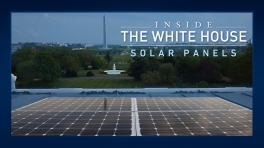
Inside the White House: Solar Panels
-
 September 01, 2016 9:25 PM
President Obama Delivers a Statement to the Press
White House Blogs
- The White House Blog
- Middle Class Task Force
- Council of Economic Advisers
- Council on Environmental Quality
- Council on Women and Girls
- Office of Intergovernmental Affairs
- Office of Management and Budget
- Office of Public Engagement
- Office of Science & Tech Policy
- Office of Urban Affairs
- Open Government
- Faith and Neighborhood Partnerships
- Social Innovation and Civic Participation
- US Trade Representative
- Office National Drug Control Policy