Energy and Environment Latest News
It’s Time to End the Taxpayer Subsidies for Big Oil
Posted by on March 28, 2012 at 5:44 PM EDTTomorrow, Congress has a real opportunity to do right by the American people. In response to President Obama’s repeated call to end the unwarranted tax breaks for big oil companies – which cost the American taxpayers billions of dollars each year – Congress will vote on a bill that could end these subsidies once and for all.
There are a lot of tough issues that come before Congress each year. This is not one of them. After all, these are tax breaks that oil companies don’t need and that we can’t afford. It should be a no brainer.
The United States has been subsidizing the oil industry for a century. President Obama believes that’s long enough. In fact, some of the oldest tax breaks for the oil companies date back to 1913 – a time when there were only 48 states in the Union and Ford was still producing the Model T.
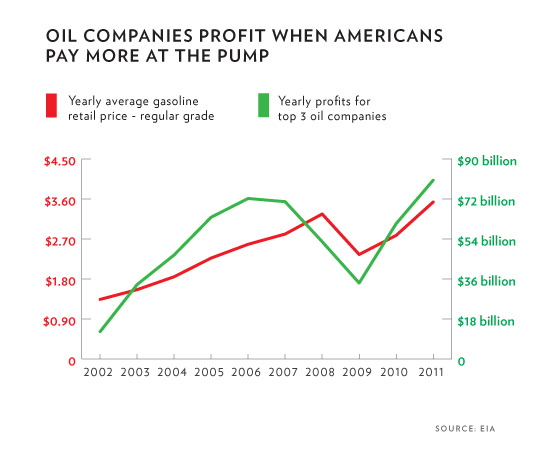
After 100 years, there’s no reason for Congress to keep these subsidies on the books, especially right now. Today, as American families all across the country are feeling pain at the pump, the oil industry is posting record profits. In 2011 alone, the three largest American oil companies made a combined profit of more than $80 billion, or more than $200 million per day.
Now, we don’t begrudge companies for being successful in America. We want them to thrive and grow. But we also have to get our priorities straight. We have to invest in our future, not subsidize the past. Yet in the latest budget proposal by House Republicans, they want to keep the billions in tax breaks for oil companies in place while slashing discretionary investments in clean energy programs by nearly half. That just doesn’t make sense.
So the question that Congress needs to ask itself this week is simple: at a time when oil companies are making more money than ever before, how can we justify giving them billions more in taxpayer subsidies every year? And if Congress doesn’t vote to eliminate these tax breaks now, then when? How much bigger do oil company profits need to be? How many more years will the American people have to wait? This is a perfect example of an issue that makes Americans so cynical about Washington.
U.S. Winter 2011-2012 is Fourth Warmest in Recorded History
Posted by on March 26, 2012 at 4:12 PM EDTNew data released last week by the National Oceanic and Atmospheric Administration (NOAA) showed that the 2011-2012 winter season was the fourth warmest ever recorded in the United States.
The data were published in NOAA’s National Climatic Data Center State of the Climate report, which provides regularly updated climate and weather information for regions across the United States.
The data show that this past winter was generally both warmer than average and drier than average for the lower 48 States. The average temperature across these states for December through February was 36.8 degrees F, nearly 4 degrees higher than the long-term average for U.S. winters from 1901 – 2000. Precipitation was down 12 percent on average, and when it came to snow, the United States experienced its third smallest winter snow-cover footprint—square miles of snow-cover, as measured by satellites—since recording began 46 years ago.
More than half of the United States experienced winters that ranked in their top 10 warmest winters ever recorded.
In addition to temperature and precipitation data, NOAA collects and publishes information on extreme weather events across the country. This information is communicated using NOAA’s U.S. Climate Extremes Index, an index that tracks the frequency of extreme climate indicators such as very high or low temperatures, droughts, and tropical cyclones across the United States during a given period. The Climate Extremes Index this winter ranked ninth highest among since recording began more than a century ago.
Although it’s clear that human-caused climate change has made unusually warm seasons and weather extremes more likely in many regions, it’s not possible to fully attribute any single warm period or weather event to human-caused climate change. But it’s important to recognize that such certainty of attribution is not necessary to justify taking action to minimize human contributions to climate change.
After all, it’s impossible to say with certainty that cigarette smoking was the cause of any individual smoker’s lung cancer, since a minority of cases do have other causes. But given the overwhelming evidence that tobacco use increases risks for many types of cancer—that, in fact, cigarette smoking is the No. 1 risk factor for lung cancer—it makes sense to support smoking cessation programs.
In the same way, no one can say why this past winter was as warm as it was. But scientists around the world have concluded overwhelmingly that modern climate change trends are primarily attributable to human activities. So doesn’t it make sense to kick some of our most egregious energy habits before the prognosis gets even more dire?
To read NOAA’s full State of the Climate Report, please visit: http://www.ncdc.noaa.gov/sotc/
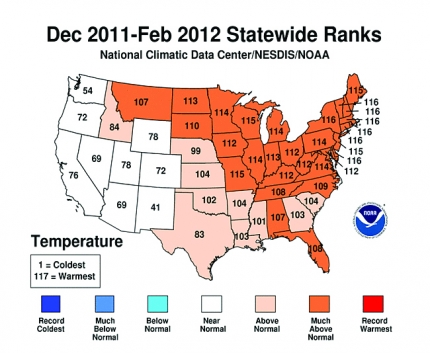
State-by-state information on winter 2011-2012 temperatures is represented above. Redder colors indicate states in which this winter was relatively warm compared to previous winters; white indicates states in which this winter was near-normal. No state had below-normal temperatures. Numbers indicate state-by-state rankings of winter 2011-2012 temperatures within the 117-year NOAA temperature dataset for each state; 117 would indicate the warmest winter on record; 1 would indicate the coldest winter on record. (Graphic courtesy NOAA)
Phil Duffy is a Senior Policy Analyst and Becky Fried is a Policy Analyst at OSTP
Learn more about Energy and EnvironmentInvest in a Clean Energy Future by Ending Fossil Fuels Subsidies
Posted by on March 26, 2012 at 10:38 AM EDT Earlier this month, President Obama called on Congress to repeal the $4 billion annual subsidies we give to oil companies, and they are scheduled to vote on doing so today.
Congress "can either stand up for oil companies, or they can stand up for the American people," the President said in a recent Weekly Address. "They can either place their bets on a fossil fuel from the last century, or they can place their bets on America’s future."
Investing in an all-of-the-above energy strategy—one that relies on domestically produced oil and gas, clean renewable resources like wind and solar power, and new technologies that help us use less energy altogether—requires the putting the right incentives in place.
Instead of subsidizing the fossil fuels of the last century by giving away $4 billion of taxpayer money each year to oil companies that are more profitable than ever, we should be investing in a clean energy future—especially when gas prices are high and drivers, whose budgets are already stretched thin, are feeling the pain at the pump.
President Obama explained earlier this month in New Hampshire:
We want to have successful oil companies that are able to get the oil that we have in our country, but we also understand that our future requires us to make investments in clean, renewable energies. And that has to start now. We can’t wait. We can’t wait until gas has skyrocketed more and people are desperate. We need to start making those investments now.
Learn more about Economy, Energy and EnvironmentWeekly Address: President Obama Says House Must Pass Bipartisan Transportation Bill
Posted by on March 24, 2012 at 5:50 AM EDTPresident Obama is calling on the House of Representatives to pass a bipartisan transportation bill that would repair crumbling roads and bridges and support construction jobs in communities all across America. According to a new report, 90 percent of these construction jobs are middle class jobs. The Senate passed the bill with the support of Democrats and Republicans because if the bill stalls in Congress then constructions sites will go idle, workers will have to go home, and our economy will take a hit.
Transcript | Download mp4 | Download mp3
Learn more about Economy, Energy and EnvironmentConservation That Works
Posted by on March 23, 2012 at 6:26 PM EDTWorking with farmers, ranchers and forest landowners is critical to President Obama’s vision of an economy built to last, one where rural communities provide clean air, clean water and wildlife habitat to generate economic opportunities for outdoor recreation and jobs, while protecting farm and ranch traditions. Working Lands for Wildlife demonstrates the President’s focus on the rural economy and his commitment to keep working lands working.
Knowing I was speaking to an audience passionate about wildlife, I took a moment to revisit a time from 100 years ago when Theodore Roosevelt addressed a similar group, saying, "There can be no greater issue than that of conservation in this country." People of all political persuasions have found commonality around the fundamental principle of conservation—a principle that has always recognized the importance of wildlife.
Working Lands for Wildlife is a partnership between the Department of Agriculture’s Natural Resources Conservation Service (NRCS) and Department of Interior’s U.S. Fish and Wildlife Service to make measurable progress in wildlife conservation through focused community-driven, locally led efforts across America.
To engage private landowners, NRCS has committed $33 million to share in the cost of conservation practices benefiting the bog turtle, golden-winged warbler, gopher tortoise, greater sage-grouse, lesser prairie-chicken, New England cottontail and the Southwestern willow flycatcher. The U.S. Fish and Wildlife Service will work to provide landowners with regulatory certainty and tools to assist them in making long-term business decisions.
This collaborative approach builds on the success we are realizing in the Western U.S. with NRCS’s Sage-Grouse Initiative (SGI), where ranchers are projected to have increased sage grouse populations by 8 to 10 percent through wildlife habitat conservation practices such as prescribed grazing, brush management and fence flagging.
Through SGI, on the Bedortha Ranch in central Oregon, intensive efforts to boost sage grouse habitat are underway. As part of that effort, crews have cut and flattened invasive juniper trees. These trees have expanded beyond their historic locations into sagebrush terrain throughout the West, out-competing other valuable shrubs and plants that provide habitat for the ground-dwelling sage-grouse.
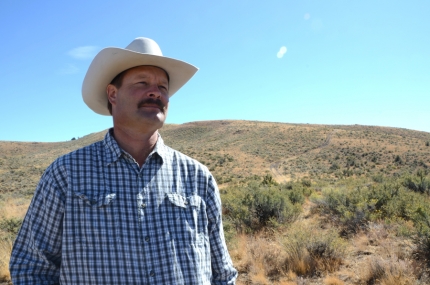
Rancher Gary Bedortha removed nearly 7,000 acres of invading juniper on his ranch to improve his working lands for sage grouse habitat.
As the junipers increased on his ranch, Gary Bedortha watched the sage-grouse population decline. “When I was a kid growing up in this country, I knew some of these draws had an excess of 100 sage grouse—you would ride through the draws and the whole ground would move in front of you. At that time, we didn’t have the juniper like we do now,” Bedortha said.
This ranch is only one example of the success we can accomplish on private lands. Bedortha used the information and financial assistance he received from NRCS to remove nearly 7,000 acres of invading juniper in less than three years. We know taking a focused approach to wildlife conservation maximizes the public’s investment and return.
We hope to increase populations for all seven focal species targeted by Working Lands for Wildlife. Americans dedicated to wildlife conservation on private lands will ensure that it is not only an effective tool for wildlife but that it works as a viable tool for outdoor recreation, jobs and opportunities to create rural wealth.
Since the White House Rural Council was established last June, the Council has provided a forum for increasing conservation work and creating jobs in rural America. The Working Lands for Wildlife joint partnership between the Department of Agriculture and the Department of the Interior exemplifies the progress we can achieve through the work of the Rural Council.
Harris Sherman is Undersecretary for USDA’s Natural Resources and Environment
Learn more about Energy and Environment, RuralLaw of the Sea Convention Update
Posted by on March 23, 2012 at 5:36 PM EDTPresident Obama has stated that the United States will promote the stewardship and sustainable use of the oceans in several ways including by cooperating and exercising leadership at the international level and pursuing U.S. accession to the Law of the Sea Convention. On March 21st, the State Department published a Fact Sheet identifying a number of compelling reasons why the United States should join the Law of the Sea Convention now.
Among the advantages noted in the Fact Sheet, joining the Law of the Sea Convention will create American jobs and bolster U.S. national security. That is one reason why U.S. companies, business groups, labor unions, the U.S. Navy, the U.S. Coast Guard, and a host of others support joining the Convention now.
To learn more about the Law of the Sea Convention: http://www.state.gov/e/oes/lawofthesea/factsheets/186605.htm.
Jerry Miller is Deputy Director for Science and Technology in the National Ocean Council Office
Learn more about Energy and Environment
- &lsaquo previous
- …
- 82
- 83
- 84
- 85
- 86
- 87
- 88
- 89
- 90
- …
- next &rsaquo
Related Videos
-
 May 09, 2014 9:21 AM
Inside the White House: Solar Panels
-
 September 01, 2016 9:25 PM
President Obama Delivers a Statement to the Press
White House Blogs
- The White House Blog
- Middle Class Task Force
- Council of Economic Advisers
- Council on Environmental Quality
- Council on Women and Girls
- Office of Intergovernmental Affairs
- Office of Management and Budget
- Office of Public Engagement
- Office of Science & Tech Policy
- Office of Urban Affairs
- Open Government
- Faith and Neighborhood Partnerships
- Social Innovation and Civic Participation
- US Trade Representative
- Office National Drug Control Policy