Energy and Environment Latest News
Report from USDA: Supporting Cutting-Edge Efforts to Reduce America’s Reliance on Fossil Fuel
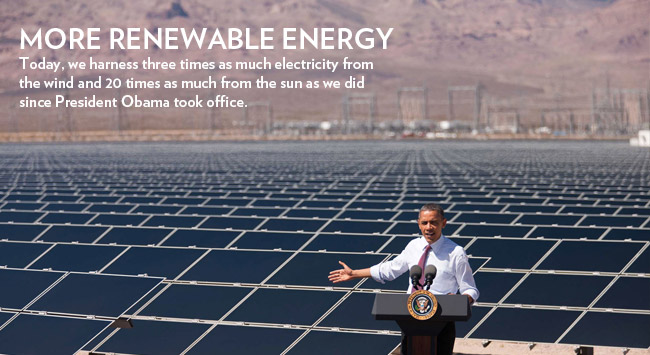
Posted by on April 13, 2012 at 9:58 AM EDTSince taking office, President Obama has been committed to an all-of-the-above approach that expands production of American energy resources. Already, there are signs that this strategy is making an impact. Last year, domestic oil production reached the highest level in nearly a decade. Imports of foreign oil fell to the lowest level in 16 years. We’re producing more natural gas than at any time in our history. Since 2008, renewable energy generation from sources like wind, solar, and geothermal has nearly doubled. And the Obama Administration has supported the first nuclear power plant in thirty years.
Strengthening the domestic biofuels industry has been another critical component of this overall strategy. And today, U.S. biofuel production is at its highest level in history. In fact, average monthly production increased more than 40 percent between 2008 and 2011. That means more jobs – especially in rural America – and greater energy security.
At USDA, we continue to support cutting-edge efforts to reduce America’s reliance on fossil fuel. For example, earlier this month, USDA announced approval of a $5 million payment to Western Plains Energy, LLC to support the construction of a biogas anaerobic digester in Oakley, KS. The completed project will utilize waste energy resources from a local cattle feedlot to replace almost 90 percent of the fossil fuels currently used by Western Plains Energy. In Blairstown, Iowa, USDA funding will be used to construct a 55,000 square foot facility that will produce cellulosic ethanol by converting municipal solid waste and other industrial pulps into advanced biofuels, as well as using conventional renewable biofuel derived from seed corn waste. When operational, the facility is expected to produce approximately 3.6 million gallons of cellulosic ethanol per year. Support for renewable energy projects such as these is an example of the many ways USDA is helping revitalize rural economies.
Good Environmental Management Makes Good Business Sense
Posted by on April 12, 2012 at 11:39 AM EDT
Wayne Balta is being recognized as a Champion of Change for his work demonstrating that corporate environmental leadership makes sense, both for business and for American communities.
The popularity of environmental sustainability has exploded in recent years. It is implanted in the minds of leaders no matter what aspect of business, government or society they serve. But to be realistic, it hasn’t always been this way. The broad popularity of environmental sustainability has been cyclical since the first Earth Day back in 1970. If the sustainability of our planet is indeed a future imperative, a relevant question for any organization is, how do you sustain sustainability over the long term?
At IBM, environmental leadership has been practiced regardless of its popularity or the company’s financial performance at any given point in time. Environmental sustainability is managed as a strategic imperative. We work to anticipate opportunities and prevent problems. Underlying this commitment is a conviction that good environmental management makes good business sense.
The Joy of Sustainability
Posted by on April 12, 2012 at 11:35 AM EDT
David Bolt is being recognized as a Champion of Change for his work demonstrating that corporate environmental leadership makes sense, both for business and for American communities.
I have dedicated my life to eliminating waste. Whether it was trying to reduce the number of steps to cut the lawn as a child, reduce the time it took a computer program to run as a software developer, or today, trying to get more done with less energy.
If you knew me in late 2003 you would say I was the epitome of the American Dream. I was born into a wonderful middle class family, worked hard in school and in my career, made enough money by my mid 40’s to potentially retire and take life easy. While I was blessed to have the gift of time and money, the future was still quite uncertain for my 14 year old son and my 8 year old daughter.
On the positive side there has been tremendous technological progress. Just look at things like cell phones, cable and satellite television, the internet and computers. Despite this tremendous technological progress, I was and still am very concerned about the future that my children are inheriting. The technological and material success does not seem to have brought joy and happiness to many people.
A Secure Approach to American Energy
Posted by on April 11, 2012 at 3:45 PM EDTWhen I served as an Army officer in Baghdad, Iraq in 2003, it became a ritual that our soldiers would reposition fuel trucks on our compound just as the sun went down. Soon after moving these trucks, insurgent mortar fire would target the area where they had previously been sitting. These were the moments when my soldiers and I began to realize the importance of energy to our warfighters on the battlefield. The issue also surfaced as the roads in Baghdad became more dangerous during our 15 month deployment, but we still needed to send daily logistical convoys into those streets to go pick up the new fuel supply.
Over the last 10 years of war, America's warfighters have gained a better understanding of the significant and inherent connection between energy independence and national security. As a result, the Department of Defense is making great strides in addressing these issues and enhancing our nation's energy security. That is why, as a veteran and in my new role as the Federal Environmental Executive, I am so proud of today's announcements by the Obama Administration, which take steps to bolster energy security for not only our brave men and women fighting on the front lines, but for all Americans.
Today, the Administration announced:
-
The Army will open a new 30,000-square-foot lab in Michigan to develop cutting edge energy technologies for the next generation of combat vehicles. This new lab will support the launch of the Army Green Warrior Convoy, which will test and demonstrate advanced vehicle technology including fuel cells, hybrid systems, battery technologies and alternative fuels.
-
The Energy Department's Advanced Research Projects Agency will launch a research competition to engage our country's brightest scientists, engineers and entrepreneurs in improving the capability of energy storage devices that can be used in the battlefield and for civilian applications.
- Building on the commitment President Obama made in his State of the Union Address, the Department of Defense (DOD) will make one of the largest commitments to clean energy in history, with a new goal to deploy three gigawatts of renewable energy – including solar, wind, biomass, and geothermal – on Army, Navy, and Air Force installations by 2025 – enough to power 750,000 homes.
Learn more about Energy and Environment-
The Army will open a new 30,000-square-foot lab in Michigan to develop cutting edge energy technologies for the next generation of combat vehicles. This new lab will support the launch of the Army Green Warrior Convoy, which will test and demonstrate advanced vehicle technology including fuel cells, hybrid systems, battery technologies and alternative fuels.
Champions of Change: Corporate Environmental Leaders
Posted by on April 11, 2012 at 2:39 PM EDTAcross the country, millions of people wake up every day with a mission to make their workplace and their community a better place. Tomorrow, at a Champions of Change event that you can watch live, the White House will honor an extraordinary group of these Americans.
This event will highlight individuals who are demonstrating how environmental leadership contributes not just to the well-being of our planet, but to our economic growth and our public health. Every day, these Champions rise to meet some of the most significant environmental challenges of the 21st century.
The President is also a leader on sustainability. He has taken unprecedented action to build the foundation for a clean energy economy and protect our environment, including by investing in and supporting leaders in the private sector and in communities across the country. Just a few of the Administration's actions include:
-
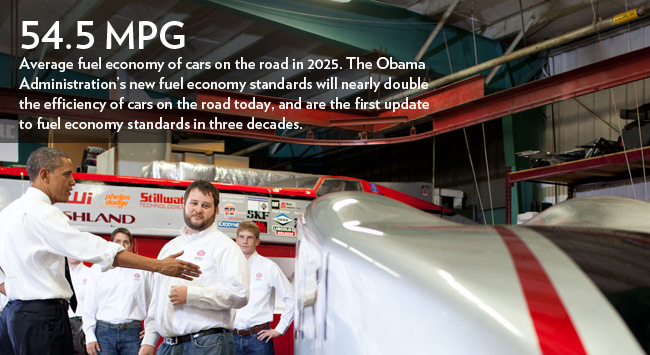
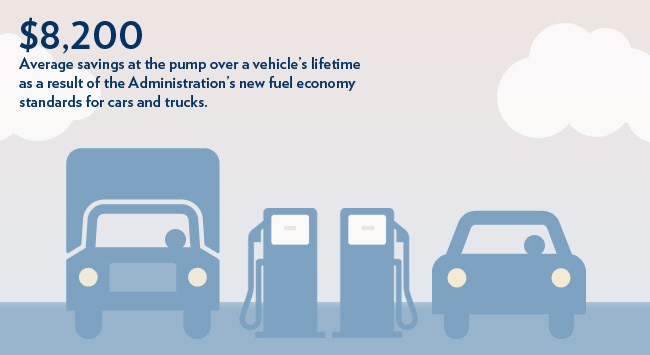
Adopting historic fuel economy standards that will double the fuel efficiency of cars and light trucks by 2025, save consumers $1.7 trillion at the pump, eliminate 6 billion metric tons of CO2, and cut oil consumption by 2.2 million barrels per day.
-
Partnering with dozens of CEOs, mayors, university presidents and others to commit nearly $4 billion in combined federal and private sector dollars for energy efficiency upgrades to buildings over the next 2 years at no net cost to taxpayers.
-
Investing $90 billion in clean energy through the Recovery Act, which has supported hundreds of thousands of jobs and put us on track to double US renewable generation by 2012.
- Directing the Federal Government – the largest energy consumer in the U.S. economy – to dramatically reduce energy use, waste and carbon pollution. These reductions can avoid up to $11 billion dollars in energy costs and eliminate the equivalent of 235 million barrels of oil over the next decade.
We all have a role to play in building a more sustainable future – for our organizations, for our communities, and for our country.
Please tune in to learn from these Champions' experiences, and see if you can apply the lessons they've learned in your own organization. We know you will be inspired.
The program will begin at 1:30pm EDT on April 12, 2012 at: www.whitehouse.gov/champions.
Rohan Patel is Associate Director for Public Engagement at the Council on Environmental Quality
Learn more about Energy and Environment-
Adopting historic fuel economy standards that will double the fuel efficiency of cars and light trucks by 2025, save consumers $1.7 trillion at the pump, eliminate 6 billion metric tons of CO2, and cut oil consumption by 2.2 million barrels per day.
Launching Apps for Energy! Developers, Are You Ready?
Posted by on April 10, 2012 at 6:04 PM EDTThe Energy Department’s first ever Apps for Energy competition challenges the American developer community to build apps that help consumers get the most out of their utility data.
Apps for Energy leverages Green Button -- an open standard for sharing electricity usage information. For the competition, developers will mash-up Green Button data with other public data sources to create innovative, energy-focused apps (visit our developer page for a list of resources). Submissions can be any kind of software application broadly available to the public -- including apps for the web, personal computers, and mobile devices.
Developers who take on the Apps for Energy challenge have an opportunity to significantly impact the way millions of Americans think about and use their electricity usage data. Building apps that provide insight and useful information into everyday electricity consumption will help empower consumers to effectively manage their energy use in ways that save money and energy.
Learn more about Energy and Environment, Technology
- &lsaquo previous
- …
- 80
- 81
- 82
- 83
- 84
- 85
- 86
- 87
- 88
- …
- next &rsaquo
Related Videos
-
 May 09, 2014 9:21 AM
Inside the White House: Solar Panels
-
 September 01, 2016 9:25 PM
President Obama Delivers a Statement to the Press
White House Blogs
- The White House Blog
- Middle Class Task Force
- Council of Economic Advisers
- Council on Environmental Quality
- Council on Women and Girls
- Office of Intergovernmental Affairs
- Office of Management and Budget
- Office of Public Engagement
- Office of Science & Tech Policy
- Office of Urban Affairs
- Open Government
- Faith and Neighborhood Partnerships
- Social Innovation and Civic Participation
- US Trade Representative
- Office National Drug Control Policy