Energy and Environment Latest News
Weekly Wrap Up: Going Green
Posted by on March 23, 2012 at 11:53 AM EDTA quick look at the week of March 19, 2012:
A Pint with the President: On Saturday afternoon, the President left the White House and grabbed a pint of Guinness in celebration of St. Patrick’s Day at the Dubliner, an Irish pub near the U.S. Capitol in Washington, DC.
A Season of New Beginnings: In a video message Tuesday, President Obama sent his best wishes to all of those who are celebrating Nowruz around the world – a holiday when many Iranian families come together to celebrate the hope that comes with renewal. Noting the continued tension between the two countries, the President reaffirmed that “there is no reason for the United States and Iran to be divided from another.”
A Timely Visit from Taoiseach Enda Kenny: On Tuesday, President Obama welcomed Irish Prime Minister Enda Kenny to the White House. Besides discussions on the economy and the benefits of trade, commerce, and investment between the two countries, the Taoiseach’s stay in Washington included breakfast at the Naval Observatory, a St. Patrick’s Day lunch at the United States Capitol and a St. Patrick’s Day reception in the East Room hosted by the President and the First Lady.
Learn more about Energy and Environment, Foreign PolicyPresident Obama and the Buckeye Bullet
Posted by on March 23, 2012 at 11:16 AM EDT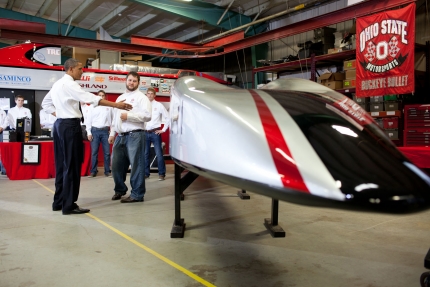
President Barack Obama looks at the Buckeye Bullet, a high speed electric land speed race car, during a tour of the Center for Automotive Research at Ohio State University in Columbus, Ohio, March 22, 2012. An earlier version of the Buckeye Bullet holds the U.S. electric land speed record at 314.958 mph. (Official White House Photo by Pete Souza)
The Ohio State University in Columbus was President Obama's final stop on this week's energy tour. It's home to the Center for Automotive Research, a hotbed of innovation in the fields of energy production and advanced vehicles.
There, President Obama had a chance to see the Buckeye Bullet -- an electric car that has already traveled at speeds in excess of 300 miles per hour. Engineers at the school told him that they're now aiming to design the vehicle so that it's capable of going more than 400 miles per hour.
Today, Buckeye Bullet is already the fastest electric car in the world, and at OSU, they're aiming to make it even faster. President Obama said that kind of ingenuity is "essential to American leadership."
He told the Columbus crowd:
[As] long as I’m President, we are going to keep on making those investments. I am not going to cede the wind and solar and advanced battery industries to countries like China and Germany that are making those investments. I want those technologies developed and manufactured here in Ohio, here in the Midwest, here in America. By American workers. That's the future we want.
As for the Buckeye Bullet, the President also promised that his daughter Malia, who will turn16 in a couple of years, will never drive 300 miles per hour, despite the vehicle's impressive success.
Learn more:
- Read about President Obama's all-of-the-above energy strategy.
- The President discusses oil and gas infrastructure in Oklahoma
- The President discusses domestic energy production in New Mexico
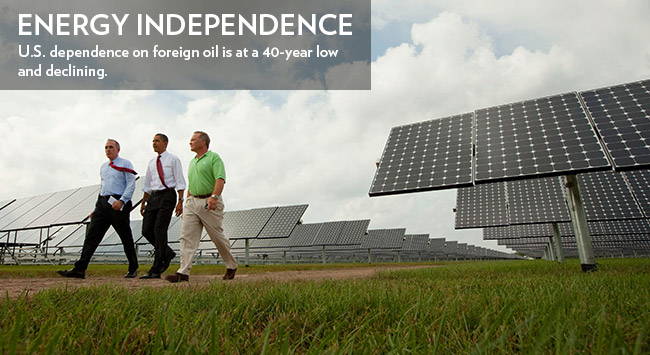
- The President visits the largest solar power plant in the United States.
Learn more about Economy, Energy and EnvironmentSupporting science-based decision-making in the Arctic Region
Posted by on March 23, 2012 at 10:30 AM EDTToday, we are pleased to announce a significant step in ocean stewardship for the Arctic Region. Through ocean.data.gov, the National Ocean Council is making available a wealth of data for planning and management in the Arctic, including information on biological, physical, oceanographic, habitat, and human use in the region. By making information more easily and widely accessible to local decision makers and stakeholders, the United States will be best positioned to lead in an ever changing Arctic environment.
The United States has broad interests in this region, from national security and territorial sovereignty to sustainable management of domestic energy and living resources, environmental protection, cultural heritage, and scientific research, all of which must be addressed in the context of rapidly changing conditions. The Nation, the State of Alaska, Tribal governments, and coastal communities are faced with critical decisions about how best to enhance natural resources and manage sustainable human activities in this region. The data and information made available through ocean.data.gov will help to inform future actions and decisions.
Right now and ready for use through ocean.data.gov, you will find information on Arctic fisheries, marine mammals, near-shore impacts, bathymetry, salinity, temperature, and much more. Ocean.data.gov is the National Ocean Council’s portal for data, information, and tools to support people engaged in planning for the future of the ocean, our coasts, and the Great Lakes. This portal provides easy access to many tools for the implementation of ecosystem-based management including models to evaluate ecosystem services and visual tools to create maps of human use and marine habitat. We are just getting started and look forward to hearing from you about additional data and tools to include.
A cornerstone of the National Ocean Policy is developing and implementing ecosystem-based management to promote more effective and sustainable stewardship of our Nation’s ocean, coasts, and Great Lakes. This whole-system approach considers the full range of activities taking place within an ecosystem to understand how they impact each other, and to develop a responsible management plan that balances those interests. This effort to make Arctic data and information available is an initial step in implementing ecosystem-based management in the region. These domestic efforts will also support collaboration on ecosystem-based management with our international partners on the Arctic Council.
We will continue to build this information resource by adding more data sets and tools in the near future. Please join the community, tell us what you think, and help us support you in your Arctic stewardship efforts.
Deerin Babb-Brott is Director of the National Ocean Council Office
Learn more about Energy and EnvironmentExpanding Our Oil and Gas Pipeline Infrastructure
Posted by on March 22, 2012 at 4:00 PM EDT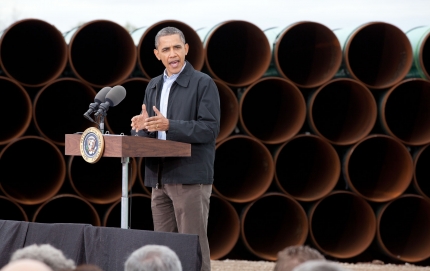
President Barack Obama delivers remarks on energy at the TransCanada Stillwater Pipe Yard near Cushing, Okla., March 22, 2012. The President highlighted the Administration’s commitment to expanding domestic oil and gas production. (Official White House Photo by Pete Souza)
Cushing, Oklahoma is an oil town. It’s a major hub for connecting our nation’s crude oil supply with refineries along the Gulf Coast, and the latest stop on President Obama’s cross-country tour to discuss American energy production.
Domestic oil and gas production is the highest it’s been in eight years. We’re actually producing so much that, even though we've added enough new oil and gas pipelines to circle the Earth in the last three years, we still don’t have enough pipeline to transport it all around the country quickly enough, particularly to our nation's refineries.
And, as President Obama explained when he spoke there today, the fact that production is outpacing pipeline capacity is causing bottlenecks in places like Cushing, slowing our ability to further increase oil supplies when gas prices are high and we need it the most.
Modernizing pipeline infrastructure and expanding its ability to deliver oil to refineries and consumers around the country is a vital piece of a strategy to reduce our reliance on foreign oil and expand production of American-made energy. That’s why President Obama directed his Administration to expedite the permitting and construction process of a new pipeline that will help crude oil make its way to Gulf Coast refineries more quickly, and doing so while protecting natural resources and the health of local communities along the pipeline’s proposed path.
Read more about President Obama's all-of-the-above energy strategy
Learn more about Economy, Energy and EnvironmentTeaching Good Habits
Posted by on March 22, 2012 at 1:35 PM EDT My love for the outdoors is what inspires and drives me on a daily basis to teach students about keeping physically fit and the benefits from the natural environment around them. It has been a realization of mine that children today do not get outside to just play and socialize with friends. Wanting to find a way to address this issue two colleagues and I applied and received a Fund For Teacher grant in 2008. This grant allowed us to explore Norway and understand the healthy life style of the Norwegians. Our trip included hiking the Fjords, visiting an outdoor school, meeting and speaking to people about their love for the outdoors. Once we were back from our 12 day excursion we hit the ground running excited to start a new way of teaching physical activity to our students. Our idea was simply called the Outdoor Classroom. We took our students out to explore a local park near our school and quickly discovered that many of our students had never been to the park before. This fact propelled us to further develop and tweak our program to fit the needs of our students. The once a month outdoor classrooms are spent hiking, exploring, orienteering, snowshoeing, team building and journaling. Students are learning that the park lands have so much to offer and it’s free recreational fun right in their own backyards.
 In addition to the Outdoor Classroom I have helped to establish other programs that complement our outdoor concept. Our school is a “Safe Routes to School” school which is a national program that promotes safely walking and bicycling to school. We are encouraging our students to walk or bike to school rather than be driven which supports physical activity and a greener environment. Our school participates in special events sponsored by Safe Routes to School which includes the National and Massachusetts Walk To School Days, celebrating students walking or biking to and from school.
President Obama Discusses Domestic Energy Production in New Mexico
Posted by on March 22, 2012 at 1:34 PM EDT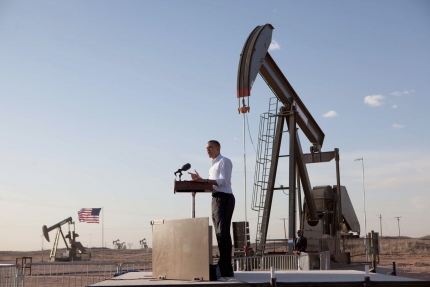
President Barack Obama delivers remarks highlighting the Administration’s commitment to expanding domestic oil and gas production, at the Maljamar Cooperative Association located on federal lands outside of Maljamar, New Mexico, March 21, 2012. (Official White House Photo by Lawrence Jackson)
The second stop of President Obama's energy tour this week was a set of oil and gas production fields located on federal lands outside of Maljamar, New Mexico. It's currently home to more than 70 active drilling rigs.
He told people in New Mexico:
I’m here to talk about what we’re calling an all-of-the-above energy strategy -- a strategy that relies on producing more oil and gas here in America, but also producing more biofuels in America, more fuel-efficient cars in America, more wind power in America, and more solar power in America. I believe this all-of-the-above approach is the only way we can continue to reduce our dependence on foreign oil, and ultimately put an end to some of these gas spikes that we’re going through right now and that obviously hurt a lot of families all across the country.
The President's commitment to expanding oil and gas production is very real. Domestic production has increased each year he has been in office. Domestic oil production is currently at an eight year high -- up 13 percent on federal lands alone in the last three years.
Learn more about Energy and Environment
- &lsaquo previous
- …
- 83
- 84
- 85
- 86
- 87
- 88
- 89
- 90
- 91
- …
- next &rsaquo
Related Videos
-
 May 09, 2014 9:21 AM
Inside the White House: Solar Panels
-
 September 01, 2016 9:25 PM
President Obama Delivers a Statement to the Press
White House Blogs
- The White House Blog
- Middle Class Task Force
- Council of Economic Advisers
- Council on Environmental Quality
- Council on Women and Girls
- Office of Intergovernmental Affairs
- Office of Management and Budget
- Office of Public Engagement
- Office of Science & Tech Policy
- Office of Urban Affairs
- Open Government
- Faith and Neighborhood Partnerships
- Social Innovation and Civic Participation
- US Trade Representative
- Office National Drug Control Policy