Energy and Environment Latest News
Department of Energy Hosts Women In STEM Tweet Up
Posted by on March 22, 2012 at 1:28 PM EDTEd. note: This is cross-posted from the U.S. Department of Energy
Jobs in STEM (science, technology, engineering, and mathematics) fields are high-paying, innovation-driven, and mission-essential. Yet while women have half of all jobs in the U.S. economy, 76 percent of STEM jobs are held by men. This gap has been seen throughout the past decade. We need to take a close look at the gender disparity in these fields that are so critical to completing the mission of the Department of Energy, and encourage and support women to take part in STEM positions.
Join us for a conversation about women in STEM on Twitter on Thursday, March 22 at 2:30pm EDT by following the hashtag #STEM.
You'll be able to ask experts how we can advance women's education and empowerment to bring women into STEM careers.
The Energy Department's (@ENERGY) Assistant Secretary for Electricity Delivery and Energy Reliability Patricia Hoffman and Technology Transfer Coordinator Dr. Karina Edmonds will host the Tweet Up.
The Department of Education's Faith Based and Community Partnerships Director Reverend Brenda Girton-Mitchell (@edpartners) will join the conversation, along with Congresswoman Eddie B. Johnson (@RepEBJ), Argonne National Lab Women in Science and Technology Leader Kawtar Hafidi (@argonne), the White House Initiative on Asian American and Pacific Islanders (@WhiteHouseAAPI), NASA's Mamta Patel Nagaraja (@womenNASA), the Department of Agriculture's Dr. Jenna Jadin & Dr. Dionne Fortson Toombs (@USDA), the National Oceanic and Atmospheric Administration's Office of Education Director Louisa Koch (@usNOAAgov) and the Department of Labor's Sara Manzano-Diaz at (@usDOL).
You can send us your questions before or during the event via Twitter to @Energy using the hashtag #STEM or by email to diversity@hq.doe.gov
Gloria B. Smith is Deputy Director, Office of Diversity & Inclusion for the U.S. Department of Energy
Helping A Community Discover (Re-Discover) An Active Lifestyle
Posted by on March 22, 2012 at 1:27 PM EDT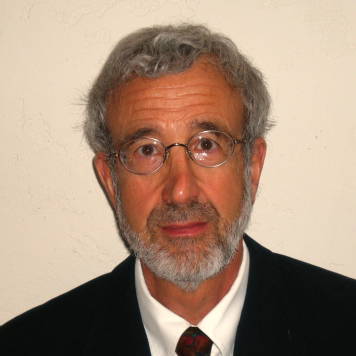
I have practiced my medical specialties of family and preventive medicine in rural New Mexico for 40 years. One would think that a surrounding landscape of mountains, mesas and endless vistas would lead almost everybody in my community of Cuba to an active outdoor lifestyle. But sadly this is often not the case. Our town – like many others – has become a place for motor vehicles rather than pedestrians. Our trails often connect natural places to each other rather than to places where people live. Success in our schools and workplaces often deprives us of the time we need to restore our minds and bodies through outdoor activity. Increasingly our recreation depends upon “screen time,” rather than time with others. We become heavier, and develop diabetes, high cholesterol, and cardiovascular diseases at younger ages.
About five years ago I decided to take my practice out of the exam room and into my community. I organized a group of leaders that shared my vision for a healthier Cuba, developed a broad local and external partnership, and created a program of outdoor physical activity – Step Into Cuba. We soon became aware that solid research paves the way for communities such as ours to successfully promote active living, but implementing the recommendations in a rural New Mexico community of under 2000 people is a challenge. But we have been creative and persistent and mutually supporting, and many of our ambitious goals are now in sight.
Green Button Giving Millions of Americans Better Handle on Energy Costs
Posted by on March 22, 2012 at 8:32 AM EDTThis afternoon President Obama is visiting Ohio State University to highlight some of the nation’s most advanced energy-related research and development projects. Technological innovation is a key element in the Administration’s “all-of-the-above” strategy to reduce energy costs for consumers while protecting health and the environment—a strategy that focuses on developing cleaner and more efficient energy sources and also on novel ways to help consumers conserve energy and save money right now. That’s why we are pleased to co-host a White House event today at which utility company CEOs from across the country are committing to participate in the “Green Button” initiative.
Green Button is an industry-led effort that responds to a White House call-to-action to provide consumers with easy-to-understand data about their household energy use. At today’s event, nine major utilities and electricity suppliers will sign on to the initiative, committing to provide more than 15 million households secure access to their energy data with a simple click of an online Green Button. That builds on similar commitments made by utilities in January to provide Green Button capability to nearly 12 million households this year. With that information in hand, consumers can take advantage of a growing array of online services that can help them manage energy use and save on their bills.
Learn more about Energy and Environment, TechnologyPresident Obama Discusses Solar Power in Nevada
Posted by on March 21, 2012 at 7:59 PM EDT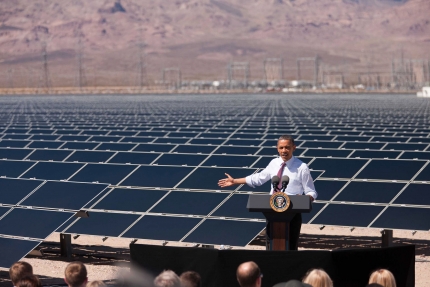
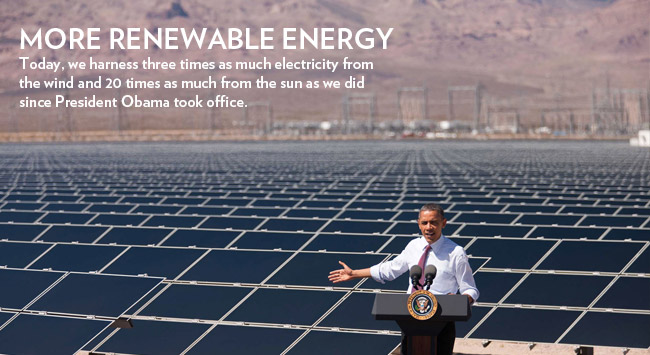
President Barack Obama delivers remarks on energy after a tour of a Solar Panel Field at the Copper Mountain Solar 1 Facility, the largest photovoltaic plant operating in the country with nearly one million solar panels powering 17,000 homes, in Boulder City, Nevada, March 21, 2012. (Official White House Photo by Lawrence Jackson)
Today, President Obama visited the Copper Mountain Solar 1 Facility in Boulder City, Nevada. The facility is the largest photovoltaic plant in the country, and its one million solar panels power 17,000 homes in California.
Boulder City, a small town near Las Vegas with fewer than 20,000 residents, was initially established to house the workers building the Hoover Dam. Today, the sun shines on Boulder City 320 days each year, making it an ideal place for a massive solar facility. Construction began in 2010, and hundreds of local residents now have jobs because of the plant. Things are going so well, in fact, that a second and third Copper Mountain facility are in the works, which will eventually generate enough electricity to power 45,000 and 66,000 homes, respectively.
Across the country, businesses like the one that built Copper Mountain are developing enough solar energy to power 730,000 homes.
Increasing the use of renewable energy sources like solar power is one piece of President Obama’s strategy to develop every available source of American-made energy. Since he took office, federal investment in renewable energy has helped nearly double its use across the country. And as a result, we are reducing our dependence on oil and other fossil fuels while becoming more energy independent, creating jobs, and keeping our environment clean.
Read more about the other parts of the President’s all-of-the-above energy strategy.
Learn more about Economy, Energy and EnvironmentFirst Question 3/19/12: Jay Carney Answers Your Questions on Energy and the Affordable Care Act
Posted by on March 19, 2012 at 4:30 PM EDTToday, White House Press Secretary Jay Carney announced the return of First Question, an online engagement series that utilizes social media to answer questions from people across the country. On a regular basis, the Press Secretary takes questions from the press – via First Question, he adds questions from citizens to that mix.

Through Twitter and the White House Google+ page, hundreds of people submitted their questions for Jay. He responded to questions on gas prices, tax breaks for oil companies and the Supreme Court and the Affordable Care Act. Check out the full video, or use the links below to jump to a specific question.
Do you have a question for the White House Press Secretary? Follow Jay on Twitter @PressSec, @WhiteHouse and the White House on Google+ for upcoming chances to ask your question.
White House Rural Council Sponsors "Working Lands and Healthy Watersheds Roundtable"
Posted by on March 19, 2012 at 10:45 AM EDTSuccess Stories Highlighted
On Wednesday, the White House Rural Council sponsored a Working Lands and Healthy Watersheds roundtable. The Rural Council, established last June, provides a forum for discussing how to support conservation work and create jobs in rural America. This week's roundtable brought together folks from across the country with experience in farming, ranching, conservation, and water quality to share their experience in how to more effectively and efficiently invest resources to improve water quality for rural communities.
The roundtable was an opportunity to celebrate some of the good work already happening and to share innovative ideas for continuing progress. We heard how leaders from three states successfully used EPA Section 319 grant program and USDA Farm Bill conservation programs to improve water quality in critical watersheds. We also heard about what stakeholders most need to carry out new and long-term on-the-ground efforts, and how EPA and USDA can improve their support for those efforts at the local scale.
Some of the themes that emerged from the session are:
- Partnerships and On-the-Ground Leadership are essential to success. It takes time to forge the relationships that lead to results.
- Stakeholder Education and Engagement helps landowners and producers understand their broader role and tie their actions to a broader community and mission.
- Using a Watershed Scale Approach creates a community for all who impact or depend on the watershed.
- Flexibility is essential to success on the ground, and allows stakeholders to work strategically and to leverage resources to support watershed efforts.
- Tracking the outcomes and impact of projects over time is critical to success and assists in identifying where further investments are needed.
The nation's rural landowners, farmers, ranchers, and forest owners are often our best environmental stewards, providing clean water and wildlife habitat from the healthy, functioning watersheds on their lands. We are committed to supporting this good work, and look forward to continuing the conversation about partnerships that support farmers, ranchers, forest owners, and the healthy watersheds communities depend on.
Here's what some of the roundtable participants had to say about the discussion:
Successful water quality improvement projects appear to be united by four primary themes. Positive relationships between landowners/land operators and the agency specialists that facilitate projects are a critical first step to success. Access to, and understanding of, water monitoring and practice performance data leads to setting goals, targeting implementation and measuring outcomes at the watershed level. Coordination and information sharing between partners expedites the process of implementing watershed improvement plans. Versatility in how funding can be used from public and private sources can lead to unexpected opportunities and benefits.
It's easy to see we have the system in place to provide great technical expertise, but we need to incorporate lessons learned from watershed project successes around the country and utilize a strategy that facilitates and empowers watershed communities, priming individuals to act.
~ Chad Ingels, Extension Watershed Specialist, Iowa State University Extension
Voluntary efforts to address nonpoint source pollution can work. The trick is you need strong partnerships with local entities like conservation districts that have a positive history with landowners You also must coordinate programs from EPA 319 and USDA to ensure you get the most bang for your buck. This, combined with monitoring data to assess the effects of best management practices on tributaries, has achieved show significant reductions in nonpoint source pollution in many priority watersheds.
~ Clay Pope, Executive Director, Oklahoma Association of Conservation Districts
Farmers in the U.S. have made tremendous strides over the past several decades toward increasing production while at the same time improving environmental conservation. EPA Section 319 grants and USDA Farm Bill conservation programs have played an important role in supporting the voluntary adoption of best management practices. Using a watershed approach, we are also able to more accurately measure how conservation practices are directly improving water quality in a particular region, which in turn helps farmers and landowners focus our efforts.
As the world's population increases to 9 billion people by 2050, we understand that agricultural producers will be expected to do more with less. We have a finite amount of land, water and other natural resources; however, through research, technology development and support from federal programs, American farmers will continue to produce the most abundant and affordable supply of food, feed, fuel and fiber in the world. We will be equipped to meet growing demand while also preparing to pass along the land, better than we found it, to the next generation of producers.
~ Rod Snyder, National Corn Growers Association
Ann Mills is Deputy Under Secretary for Natural Resources and Environment at USDA
Larry Elworth is Chief Agriculture Counselor at EPA
Learn more about Energy and Environment, Rural
- &lsaquo previous
- …
- 84
- 85
- 86
- 87
- 88
- 89
- 90
- 91
- 92
- …
- next &rsaquo
Related Videos
-
 May 09, 2014 9:21 AM
Inside the White House: Solar Panels
-
 September 01, 2016 9:25 PM
President Obama Delivers a Statement to the Press
White House Blogs
- The White House Blog
- Middle Class Task Force
- Council of Economic Advisers
- Council on Environmental Quality
- Council on Women and Girls
- Office of Intergovernmental Affairs
- Office of Management and Budget
- Office of Public Engagement
- Office of Science & Tech Policy
- Office of Urban Affairs
- Open Government
- Faith and Neighborhood Partnerships
- Social Innovation and Civic Participation
- US Trade Representative
- Office National Drug Control Policy