Energy and Environment Latest News
Clean Air and Electricity Delivery
Posted by on December 1, 2011 at 5:40 PM EDTWe can have clean air and reliable electricity at the same time. That’s the clear conclusion from a new report by the Department of Energy (DOE) released today. This confirms what the United States has always experienced in the 40 year history of the Clean Air Act – namely, the ability to safeguard public health without compromising the ability to keep the lights on in communities across the country.
Over the past few years, to build on four decades of success under the Clean Air Act, the Obama Administration has taken a series of historic actions to reduce harmful air pollution and promote public health. The new standards that we have established to slash mercury emissions, curb cross-state pollution, and make cars and trucks more efficient will result in enormous economic and health benefits to society. For example, the recently finalized cross-state air pollution rule alone is expected to prevent up to 34,000 premature deaths each year.
These are all appropriate and necessary steps to protect families and the environment that can and must be implemented in a way that maintains reliability of the electric grid. Historically speaking, the electric utility sector has a strong track record of providing both safe and reliable electricity to American consumers. Grid operators, states, generators, and federal agencies have developed tools, procedures, and technologies to ensure the continued reliable delivery of electricity to consumers.
Nonetheless, a few industry voices argue that the Administration’s new standards will undermine grid reliability. Many of those claims have been based on early or incomplete predictions about Environmental Protection Agency (EPA) rules. That’s why the independent analysis carried out by DOE is so important. Their analysis modeled a “stress test” scenario that deliberately went well beyond the requirements of the new clean air standards being put into place by the EPA. The point of the analysis was to test whether even under extreme conditions there would be enough power generating capacity to meet peak electricity demand throughout the country. The result: the power grid passed with flying colors.
Additionally, the DOE report finds that the law allows enough time for utilities to upgrade their power plants or add new generation – and that in specific cases where localized issues do arise, the Clean Air Act already provides the tools and necessary flexibility to address those concerns on a plant-specific or local basis.
Learn more about Energy and EnvironmentGiving Thanks
Posted by on November 23, 2011 at 4:22 PM EDTI love Thanksgiving. I love everything about it -the crunchy leaves beneath our feet, the sound and smells of a kitchen at work, making a list of the things I’m thankful for (baseball, the men and women in military service, my parents, America), the company of friends and family while retelling old stories, and of course the food!
A great writer once called Thanksgiving the “one day that is ours … the one day that is purely American.” On this day we gather around to enjoy a feast to end all feasts, surrounded by those we love to share our gratitude for all that we have.
As President Obama said in his remarks during the annual turkey pardoning ceremony, we also need “to be mindful of those who have less. Let’s appreciate those who hold a special place in our lives, and make sure that they know it.” It’s that very sentiment that inspired a young woman to create a solution that gives back to those in need.

Eva Radke. (Photo from HelloGiggles)
Empowering Customers With a Green Button
Posted by on November 21, 2011 at 5:53 PM EDTSixty days ago, U.S. CTO Aneesh Chopra challenged the utility industry to enable consumers to download their detailed energy usage with the simple click of a “Green Button.”
The concept of a Green Button—inspired by successes in getting Americans their own health care data, but developed by the energy industry in a consensus process and adopted voluntarily—builds on policy objectives in the Obama Administration's Blueprint For a Secure Energy Future and Policy Framework for the 21st Century Grid to ensure that consumers have timely access to their own energy data in consumer-friendly and computer-friendly formats.
Learn more about Energy and EnvironmentVoice of an Innovator: Equipping Students for 21st Century Jobs
Posted by on November 21, 2011 at 3:00 PM EDTAt Harrisburg Area Community College (HACC), Central Pennsylvania's Community College, we have a long tradition of understanding the educational and training needs of our local industries. We also understand that preparing our students to meet these needs can dramatically increase their chances of securing good jobs when they leave our program.
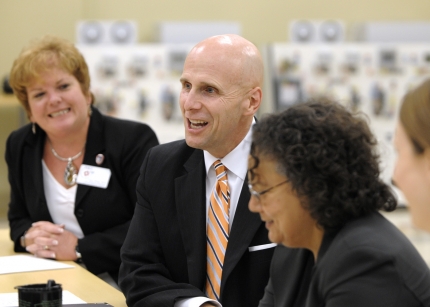
From left, Cindy Reiner, HACC Dean of Workforce Training; HACC President John J. Sygielski; and CEQ Chair Nancy Sutley. The three engage in a roundtable discussion on initiatives that are helping to lead students to the 21st century clean energy economy.
President Obama's American Jobs Act would invest $5 billion in modernizing community colleges across the country. In addition to making sure colleges are equipped to prepare our students for 21st century job opportunities, modernizing schools will create jobs in the very industries we are training our students for – jobs assessing the energy use of old buildings, and installing green technologies that save schools energy and money.
Pennsylvania has a number of old industrial sites that need to be reclaimed, restored and put back into alternative use. That's why we offer a brownfields program that trains the technicians who can inspect and remediate the old factory sites and return them to useful life. And because of the growing demand for renewable energy and energy efficiency equipment and services, our college offers training programs in green technologies like photovoltaic technology and geothermal heating and cooling systems; technician training in wind power; and certificate programs for building analysts and energy auditors. In a key example of how these programs meet real-world gaps in the workforce, one of our photovoltaic technology professors uses the training program to recruit employees for his own solar manufacturing company.
In the end, we embrace green technologies because they are good for our students, for our communities and for our environment. We see great promise for future growth in these industries, and we know that our students will be prepared to take advantage of these new opportunities.
John J. “Ski” Sygielski, EdD is President of HACC, Central Pennsylvania’s Community College, and Immediate Past President of the American Association of Community Colleges
Learn more about Energy and EnvironmentWe Can’t Wait: Driving Forward with New Fuel Economy Standards
Posted by on November 16, 2011 at 2:21 PM EDTToday marks a major step forward in the Obama administration’s efforts to save American families money at the pump, reduce our country’s dependence on oil, and boost domestic manufacturing.
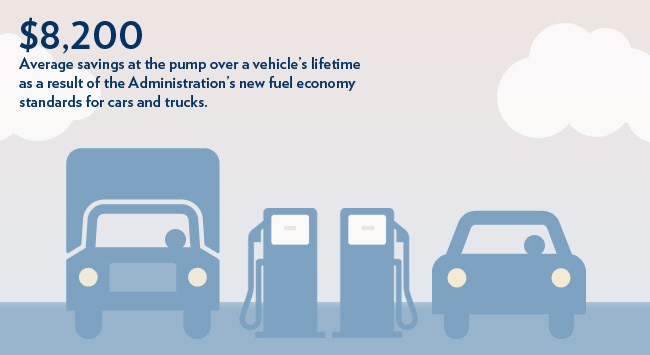
The Environmental Protection Agency (EPA) and the Department of Transportation (DOT) have formally announced their joint proposal to set stronger fuel economy and greenhouse gas pollution standards for model year 2017-2025 passenger cars and light-duty trucks. When combined with other actions the Administration has taken to increase efficiency in the transportation sector, this announcement will save Americans $1.7 trillion, reduce oil consumption by 2.2 million barrels per day by 2025, and slash greenhouse gas emissions by 6 billion metric tons.
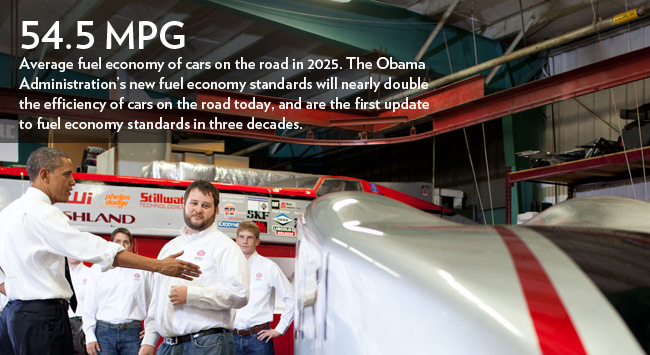
Under the proposal, model year 2017-2025 cars and light-duty trucks are expected to achieve increases in fuel efficiency equivalent to 54.5 miles per gallon by 2025. This builds on the first phase of President Obama’s national program announced in 2009, which will raise the average fuel economy of passenger vehicles to 35.5 miles per gallon by 2016.
These standards provide regulatory certainty and flexibility for auto manufacturers. By continuing the national program developed for model year 2012-2016 vehicles, EPA and DOT have designed a proposal that allows manufacturers to keep producing a single, national fleet of passenger cars and light trucks that satisfies all federal and California requirements, while ensuring that consumers enjoy a full range of vehicle choices.
The ambitious goals established in these standards will drive innovation in the manufacturing sector and help create high-quality jobs across the country. Major auto manufacturers are already heavily invested in developing advanced technologies that can significantly reduce fuel use and greenhouse gas emissions beyond the existing model year 2012-2016 targets. A wide range of technologies are currently available for automakers to meet the new standards, including advanced gasoline engines and transmissions, vehicle weight reduction, lower tire rolling resistance, improvements in aerodynamics, diesel engines, more efficient accessories, and improvements in air conditioning systems. The new standards should also encourage manufacturers to explore electric technologies such as start/stop, hybrids, plug-in hybrids, and electric vehicles. Notably, the model year 2017-2025 proposal includes a number of incentive programs to promote early adoption and introduction of “game changing” advanced technologies, such as hybridization for pickup trucks.
Developed in partnership with 13 major auto manufacturers including Ford, GM and Chrysler, the state of California, the United Auto Workers (UAW), consumer and environmental groups, and other stakeholders, these achievable and cost-effective standards represent the most significant federal action ever taken to improve fuel economy and reduce carbon pollution. In fact, these standards will bring the nation over halfway to the President’s goal of reducing oil imports by a third by 2025.
The President’s national fuel economy program represents a key component of the comprehensive energy policy that this Administration has pursued since day one, which aims to increase safe and responsible energy production at home while reducing our overall dependence on oil with advanced biofuels and greater efficiency.
Learn more about Economy, Energy and EnvironmentA Big Step Forward on Environmental Justice
Posted by on November 16, 2011 at 11:00 AM EDTEvery American deserves to live in a community that fosters health and prosperity. Yet all too often, low-income and minority families live in the shadows of some of the worst pollution in the Nation, leading to higher rates of diseases like asthma, cancer, and heart disease, and threatening the economic potential of their communities. The Obama Administration is committed to addressing these disparities.
Now, Federal agencies are releasing their Environmental Justice Strategies for public comment. These strategies are tailored to agencies' individual missions, and serve as a road map that will help integrate environmental justice into the programs they run, the policies they make, and the activities they engage in. By identifying potential ways that their work may have disproportionally adverse health and environmental effects on low-income and minority populations, as well as proposing strategies to address the inequalities, Federal agencies are advancing this Administration's unwavering commitment to ensure that all Americans have the opportunity to live in healthy and safe communities.
The release of the draft Environmental Justice Strategies is just the latest step in Administration-wide efforts to ensure all Americans are protected from environmental and health hazards. In 1994, President Bill Clinton issued an executive order directing federal agencies to participate in a government-wide effort to address environmental justice issues. The Obama Administration revitalized this effort by reconvening the Interagency Environmental Justice Working Group for the first time in more than a decade, engaging community members at a White House Forum on Environmental Justice, and most recently, bringing Federal agency leaders together to sign a Memorandum of Understanding on Environmental Justice. It was through this MOU that agencies committed to developing Environmental Justice Strategies and releasing annual implementation reports.
Over the next few weeks, agencies will have open comment periods on their draft strategies to give the public a chance to weigh in. Federal agencies will review all public comments and take them into account before finalizing the strategies early next year. We look forward to hearing from you as we expand the conversation on environmental justice in pursuit of healthy communities for all Americans.
You can read the strategies and share your ideas here: http://www.epa.gov/environmentaljustice/interagency/index.html.
Nancy Sutley is Chair of the White House Council on Environmental Quality
Learn more about Energy and Environment
- &lsaquo previous
- …
- 101
- 102
- 103
- 104
- 105
- 106
- 107
- 108
- 109
- …
- next &rsaquo
Related Videos
-
 May 09, 2014 9:21 AM
Inside the White House: Solar Panels
-
 September 01, 2016 9:25 PM
President Obama Delivers a Statement to the Press
White House Blogs
- The White House Blog
- Middle Class Task Force
- Council of Economic Advisers
- Council on Environmental Quality
- Council on Women and Girls
- Office of Intergovernmental Affairs
- Office of Management and Budget
- Office of Public Engagement
- Office of Science & Tech Policy
- Office of Urban Affairs
- Open Government
- Faith and Neighborhood Partnerships
- Social Innovation and Civic Participation
- US Trade Representative
- Office National Drug Control Policy