Energy and Environment Latest News
The Ocean Affects All of Us Every Day
Posted by on July 20, 2011 at 1:55 PM ESTWe've been here only a few short months, but in that time we've more than just gotten our feet wet, so to speak, implementing the National Ocean Policy. Now, one year after President Obama created the first comprehensive policy for the stewardship of the oceans, our coasts, and the Great Lakes, is a good time to reflect on the value of this national effort, and to take stock of the progress we have made in advancing ocean stewardship.
Perhaps you are one of the millions of Americans who are spending part of their summer visiting the seashore or the Great Lakes. You may be enjoying that grilled salmon, perch, or striped bass freshly caught by a local fisher. You may be spending time with your friends and family outside in the sunshine and water. But our waters do more than just provide sustenance and recreation. They support our communities and drive our national economy in countless ways, providing jobs not just on our shores but in every state in the Nation. Wherever we live, the ocean affects all of us every day. The National Ocean Policy helps focus our attention and efforts on the most critical issues facing our oceans and coasts. It also establishes a collaborative, regionally based planning process to ensure healthy and productive ocean, coastal, and Great Lakes resources for generations to come.
Here are a few milestones reached under the National Ocean Policy to date:
- convened the Cabinet-level National Ocean Council to take action on our most pressing ocean policy issues;
- formed a Governance Coordinating Committee consisting of state, local, and tribal representatives that will serve as a key coordinating body on ocean policy issues;
- hosted the Unites States’ first ever Coastal and Marine Spatial Planning Workshop, bringing together hundreds of representatives from all levels of government as well as stakeholders and members of the public, to strengthen partnerships for a regional approach to better managing our oceans;
- released for public comment draft outlines of strategic action plans with specific, measureable actions the Federal government can take to address key challenges facing our oceans, coasts, and Great Lakes, including climate change, ocean acidification, coastal pollution, and changing conditions in the Arctic; and
- hosted twelve public listening sessions across the country to ask Americans for their views on the actions they want to see to sustain and protect our oceans.
Successful ocean stewardship requires action and engagement from all levels of government, all stakeholders, and all Americans. We will continue to make sure you have opportunities to share your thoughts and feedback on what you care most about, and where you think we should be focusing our attention. While we have much work ahead of us, we have the highest confidence that together we can ensure healthy and productive ocean, coastal and Great Lakes resources, and a healthy and prosperous America.
Jay Jensen is Associate Director for Land and Water Ecosystems at the White House Council on Environmental Quality
Steve Fetter is Principal Assistant Director for Environment at the White House Office of Science and Technology Policy
Learn more about Energy and EnvironmentSupport Biomass Crops and Renewable Energy
Posted by on July 19, 2011 at 5:46 PM ESTEd. Note: Champions of Change is a weekly initiative to highlight Americans who are making an impact in their communities and helping our country rise to meet the many challenges of the 21st century.
Last week in our meeting with Secretary Vilsack concerning rural development opportunities it became apparent that our country is facing a critical point. Energy and food production are approaching unprecedented challenges with occurrences such as China, South Korea and Saudi Arabia’s recent purchases and leases of over 140 million acres of land in Ethiopia and Sudan. To put things in perspective, this is the equivalent of all of the U.S.’s wheat and corn land currently in production.
The United States is fortunate enough to have abundant and fertile land and a strong transportation infrastructure. The challenge is to turn our focus to rural America, from which so much of our food and energy come but which has only 16% of our population. Fellow Champions of Change outlined many creative ways of addressing rural America’s needs. Local food movements, energy efficient and consolidated housing development, and energy crops were among some of the many established and on-the-ground examples that are already functioning and put in place by just the few people in the room. All of these examples had something in common, which was the support of the USDA either through outreach or initial funding.
Learn more about Energy and Environment, RuralWith Ohio's Help, Creating Clean Electricity and Jobs
Posted by on July 19, 2011 at 10:36 AM ESTIf you ever get the chance to meet Irish-born entrepreneur, Philip Brennan, he’ll be quick to tell you, “Depending on who you believe in my family, I’m a fourth or fifth generation entrepreneur. I’ve worked for big corporations for many years and was tired of trying to turn the aircraft carrier in another direction. It is more fun sailing our hydrofoil sailboat, allowing the team to move quicker and respond faster to the changing conditions.” This is a simple way to describe his career and his current venture as a co-founder and the CEO of Echogen Power Systems LLC based in Akron, OH.
In 1992, at the age of 22, Mr. Brennan began charting his course by becoming the youngest recipient of Georgetown University’s Graduate Fellowship for the Masters in Business Administration. Over the next 20 years after graduation, Phil held various senior and executive management positions in operations, finance, manufacturing, sales and general management for Fortune 100 companies such as Pfizer, Warner Lambert, and Rubbermaid. In those roles, he led and managed a variety of businesses of greater than $200 million in sales where he conceived, developed, and launched over 100 new products. Since then he has helped to raise angel financing and prepare a number of new companies for the next stage of venture funding.

Philip Brennan founded Echogen, which transforms waste industrial heat directly into clean, emission-free electricity. (Photo by Marc Golub).
Sustainable Agriculture in the Midwest
Posted by on July 19, 2011 at 8:59 AM ESTEd. Note: Champions of Change is a weekly initiative to highlight Americans who are making an impact in their communities and helping our country rise to meet the many challenges of the 21st century.
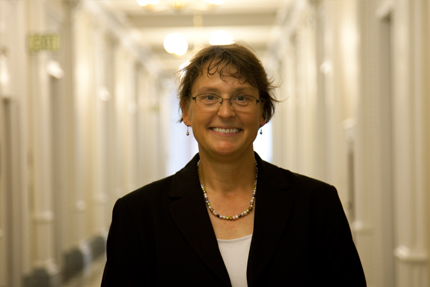
It was a privilege to be among the Champions of Change for Rural America. What an amazing group of people. I was heartened to meet my fellow champions, to hear their stories and to witness their passion.
In rural Iowa we grow a good deal of the nation’s corn and soybeans. We have the richest soil in the U.S. and yet we import more than 85% of food we eat from outside our state. Our farmers are aging; the average age of a farmer in the U.S. is about 58. Few young people have aspirations to become farmers. Our rural landscape is littered with small towns devoid of businesses, shrinking schools, and for some, a sense of hopelessness. It astounded me, this rural decay in the midst of such rich land.
I am a professor of biology at Marshalltown Community College. I am also a small organic farmer who along with my family raises fruit, vegetables and some livestock. I knew what the land could produce. I knew that our community could feed and employ itself far better if we grew their own produce. To that end I proposed that we develop the Entrepreneurial and Diversified Agriculture program at the community college. This a two year degree program preparing new farmers to grow and market diverse crops locally.
Learn more about Energy and Environment, RuralAmerica's Modern Moon Shot
Posted by on July 15, 2011 at 4:57 PM ESTAs countries around the world race to seize the economic opportunities of clean energy, we have the chance to harness the incredible ingenuity and entrepreneurship of Americans to capture the advantage – and the jobs of the future – for the U.S.A. President Obama has compared this to our moon shot moment – the moment we decided that through determination and innovation, we would come from behind and win the race to be the first country in the world to put someone on the moon.
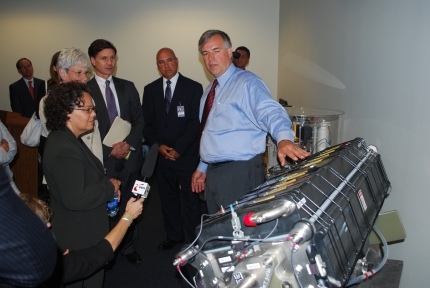
Nancy Sutley discusses the technology behind UTC Power's fuel cell for transit buses in South Windsor, Connecticut with (from left to right) Connecticut Lt. Gov. Nancy Wyman; Dan Esty, Commissioner of the Connecticut Department of Energy and Environmental Protection; Joe Triompo, Vice President and General Manager of UTC Power; and Mike Brown, Vice President of Government Affairs and General Counsel of UTC Power. (Photo courtesy of UTC Power)
On Thursday, I got a chance to visit a company that is part of both yesterday's moon shot and today's. UTC Power in South Windsor, Connecticut, supplied clean energy to the 1969 Apollo space mission that first took Americans to the moon. Today, the company is using its fuel cell technology to deliver clean, highly efficient power to transit systems, schools, hospitals, supermarkets and corporations around the world. UTC Power's innovation has created more than 450 American jobs. They are just one example of how the global appetite for clean energy is presenting opportunities for our businesses, for good jobs that pay good wages, and for greater economic security for American families. The jobs of the future are in smart, sustainable, and modern clean energy technologies. Along with America's innovators, workers and entrepreneurs, we will make sure those jobs and those industries will be right here in the U.S.A.
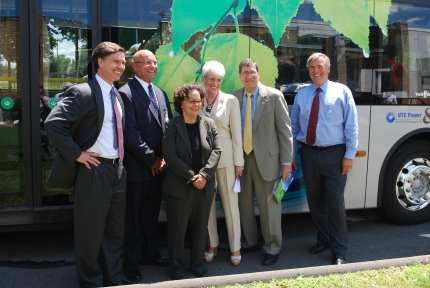
Nancy Sutley stands in front of a zero-emissions CT Transit bus powered by a UTC Power fuel cell. Photographed from left to right are Dan Esty, Commissioner of the Connecticut Department of Energy and Environmental Protection; Joe Triompo, Vice President and General Manager of UTC Power; Nancy Sutley, Chair of the White House Council on Environmental Quality; Connecticut Lt. Gov. Nancy Wyman; CT State Senator Gary LeBeau; and Mike Brown, Vice President of Government Affairs and General Counsel of UTC Power. (Photo courtesy of UTC Power)
Nancy Sutley is Chair of the White House Council on Environmental Quality
Learn more about Energy and EnvironmentOne Tree at a Time
Posted by on July 15, 2011 at 12:47 PM ESTEd. Note: Champions of Change is a weekly initiative to highlight Americans who are making an impact in their communities and helping our country rise to meet the many challenges of the 21st century.
“How great it is that nobody need wait a single moment before starting to improve the world.” – Anne Frank.
After working hard to improve my corner of the world, I have been able to share it with others. This week's Champions of Change call was a wonderful opportunity to talk with other youth who are making a difference one school at a time.
For my 15th birthday, I wanted to do something more than a “wasteful” party, and I wanted to do something. I knew after getting involved with energy conservation and green building I wanted to do something now and not debate the might or could be. I worked with the local arborist to plant 30 trees with a bunch of friends for a “Party with a Purpose,” and it turned out successful. Food, trees and fun. My family and friends wanted to do some more. The second Party with a Purpose was in March of 2009, these 100 saplings were the start of Discover Green. We continued planting trees, I started writing grants, and the next thing I knew my organization had been involved in 101 events, presented to 6,095 youth, planted or distributed 6,701 trees, collected over 50 tons of trash, marked 2,500 storm drains – worked with 1,100 teens and made sure that almost 2,100 pieces of pizza were eaten. This doesn’t include all the other great partnerships and projects invasive species, watershed education, native wildlife habitats and more.
With more than 2,000 community service hours in the last five years, people ask me why I do this. My answer – “Why not!” As FDR said, “We cannot always build the future for our youth, but we can build our youth for the future.”
Learn more about Energy and Environment
- &lsaquo previous
- …
- 118
- 119
- 120
- 121
- 122
- 123
- 124
- 125
- 126
- …
- next &rsaquo
Related Videos
-
 May 09, 2014 8:21 AM
Inside the White House: Solar Panels
-
 September 01, 2016 8:25 PM
President Obama Delivers a Statement to the Press
White House Blogs
- The White House Blog
- Middle Class Task Force
- Council of Economic Advisers
- Council on Environmental Quality
- Council on Women and Girls
- Office of Intergovernmental Affairs
- Office of Management and Budget
- Office of Public Engagement
- Office of Science & Tech Policy
- Office of Urban Affairs
- Open Government
- Faith and Neighborhood Partnerships
- Social Innovation and Civic Participation
- US Trade Representative
- Office National Drug Control Policy