
Energy and Environment Latest News
Help Consumers Save Money by Saving Energy
Posted by on July 12, 2011 at 1:02 PM EDTEd. Note: Cross posted from the Energy Blog.
At a time when families are struggling to pay their energy bills, leaders in the House are pushing to roll back common sense standards for residential lighting that save families money by saving energy.
It’s important to remember that these standards were passed just a few years ago with overwhelming bipartisan support from 86 Senators and 314 members of the House. They were championed and co-sponsored by the former Speaker of the House, Dennis Hastert, and signed into law by President Bush.
I also want to take this opportunity to dispel a myth. The standards do NOT ban incandescent bulbs. You’ll still be able to buy energy-saving halogen incandescent bulbs that look exactly the same as the ones you’re used to, and more than pay for themselves over the life of the 100 watt replacement bulb.
The only difference is that your electric bills will be lower.
To save even more money, there are a wide range of new options like CFLs and LEDs. These options are 75 or 80 percent more efficient than traditional lighting, and they’ll last 10 or 25 times longer. In some cases, you might never have to replace them.
Learn more about Energy and EnvironmentCoordinating Safe and Responsible Energy Development in Alaska
Posted by on July 12, 2011 at 12:17 PM EDTToday President Obama, formalizing one of several steps he announced this spring to continue to increase safe and responsible domestic oil and gas production, announced the formation of a new, high-level interagency working group to coordinate on energy development in Alaska. Officially created through an Executive Order, President Obama established the Interagency Working Group on Coordination of Domestic Energy Development and Permitting in Alaska. As Deputy Secretary of the Interior, I am honored to lead this cross-agency team.
The formation of this group is only the most recent step the President has taken to support the increased development our nation’s important resources, while ensuring that we do so safely and responsibly, including being guided by the important lessons learned by the largest oil spill in our nation’s history. The foundation for this effort is laid out in the President’s Blueprint for a Secure Energy Future , which charts a path to build a 21st century clean energy economy over the long term and dramatically cut our oil imports by 2025, through the responsible development of oil and gas at home, while at the same time facilitating the development of cleaner, alternative fuels and increasing efficiency .
Learn more about Energy and EnvironmentWoman Business Owner Creates Clean Energy Jobs By Being Bold
Posted by on July 6, 2011 at 7:32 PM EDTWendy Jameson’s life slogan is “Fear Mediocrity: don’t be afraid to be bold”; a motto that Wendy and her partner in Colnatec, Scott Grimshaw (whom she met on Twitter), established. Wendy has always been an individual who stands out from the crowd and takes risks each and every day, the epitome of an entrepreneur. She is a former business consultant and coach with 25 years experience in sales, marketing, and business strategy for growth companies. A wife and mother of two boys, family has always been an important part of Wendy’s life, too. But they are not the only people she calls family--the nine employees who work for Colnatec care for each other and believe in the success of Colnatec as much as she does.
Joining Forces for Our Oceans, Coasts, and Great Lakes
Posted by on July 1, 2011 at 2:31 PM EDTLast week, the National Ocean Council brought together more than 500 Federal, state, tribal, and local government representatives, indigenous community leaders, and other stakeholders and members of the public from across the country for a National Coastal and Marine Spatial Planning (CMSP) Workshop in Washington, DC. An additional 260 participants joined us online for the Workshop webcast. The workshop kicked off a major program of regional collaboration to advance the stewardship of our ocean, coasts, and Great Lakes—and by all accounts it provided a great start to achieving this important goal.
We heard from participants how cooperative ocean and coastal planning can be used to create jobs, help secure energy independence, enhance recreational opportunities, and maximize the uses of our Nation’s working waters while ensuring their conservation for future generations. We also discussed how our country’s first comprehensive National Ocean Policy engages tribal nations as equal partners alongside states and the Federal government to produce a balanced plan that serves all Americans who have equities in our ocean, coastal and Great Lakes resources.
The workshop was part of a growing conversation among our partners and stakeholders in the Nation’s regions to establish regional planning bodies that will work collaboratively to develop comprehensive regional coastal and marine spatial plans. Among the key issues discussed at the workshop were:
- The importance of science and evidence-based data and traditional knowledge and experience in advancing CMSP;
- How best to represent existing local and regional entities on the regional planning bodies
- How to design incentives that will spur implementation of CMSP; and
- How to strike the right balance between the need for regional flexibility and the value of national consistency as regional planning bodies are established and as they carry out their work
The workshop featured expert panels, question and answer sessions, and a planning simulation exercise that explored how different groups can work together to effectively tackle these and other important issues. Discussions also helped bring to light a wide range of valuable “lessons learned” from previous state and regional efforts to implement CMSP. We heard about efforts already underway in Rhode Island, Massachusetts, Washington, Oregon, New York, and California, as well as through regional partnerships. During the last several years, these and other efforts have played a prominent role leading the way towards more effective and integrated planning, and we intend to learn from and build on these successes as we move forward.
This was just the beginning of a discussion to ensure the future health of our ocean, coasts and Great Lakes. Regional workshops will also be held across the country in the months ahead to build on the progress we made last week. The National Ocean Council will be using the many suggestions proffered during the workshop, along with advice gathered from continued dialogue with partners and stakeholders to further inform the establishment of regional planning bodies in the months ahead. In particular, the National Ocean Council will obtain input from our Governance Coordinating Committee, composed of states, tribes, and local government representatives, on additional representation on the regional planning bodies. We very much look forward to working with our state and tribal partners, and all interested Americans, toward healthy and productive oceans, coasts and Great Lakes.
You can watch the public session of the CMSP Workshop here.
Andy Lipsky is an Ocean Policy Advisor for the National Ocean Council
Learn more about Defense, Energy and EnvironmentAn Invitation to Our Latest Open Innovation Ecosystem: Energy.Data.Gov
Posted by on June 30, 2011 at 7:58 PM EDTToday we launched Energy.Data.Gov, the latest installment of our growing family of Data.gov communities to deepen our engagement with stakeholders interested in the analytics to measure our Nation’s energy performance. As with our previous open government communities, in health and law, this platform aggregates tools, high-value datasets, and applications to shed light on energy use. It includes 216 free datasets and tools have been gathered from agencies across the Federal government with the goal of empowering all Americans to understand energy issues, including energy consumption within the Federal government.
Our motivation in launching these communities is to harness the creativity and entrepreneurial spirit within each of you to catalyze the breakthroughs the President has challenged us to achieve in unleashing a clean energy economy. To further our efforts in this regard, I called on technology and innovation leaders across the government to help scale best practices that embrace this model of open innovation, emphasizing the government’s role as “impatient convener.”
When you visit Energy.data.gov, you will find a portfolio of apps, tools, and ideas about how to better monitor, manage, and save energy. To maximize opportunities for education and entrepreneurship, Energy.data.gov has simplified access to challenges, prizes, and competitions that relate to energy data in meaningful and engaging ways. Or you can be inspired by existing innovations like the “Mashathon” that cobbled together data from multiple sources across seven cities highlighting opportunities like the following for residents of Milwaukee, WI – that residents might save $903 annually with a 5kW solar (PV) system.
And this is just the beginning.
By the end of the year, we will showcase data on Federal building energy use, prospects for energy efficiency improvements, and the Federal government's energy consumption and costs dating back to 1975 by agency and energy type.
Whether your interest lies in alternative fuels, electricity generation, managing buildings to be more energy efficient, or trying to better manage energy use in your own home, this platform has the raw material for you to build new products and services that have the potential to deliver our clean energy future. I look forward to celebrating the birth of a new competitive marketplace for innovative applications powered by open energy data that improve our energy security. Let’s get started.
Aneesh Chopra is US Chief Technology Officer
Learn more about Energy and Environment, TechnologyVoice of an Innovator: The Comeback of American Manufacturing
Posted by on June 27, 2011 at 7:00 PM EDTEditor's Note: This blog introduces readers to Michelle Gibson, CEO of IceStone, a small green manufacturer based in Brooklyn, NY. Click here to read about CEQ Chair Nancy Sutley's discussion with leaders from IceStone and other green manufacturers on how the Obama Administration is supporting innovation and job growth in the manufacturing sector.
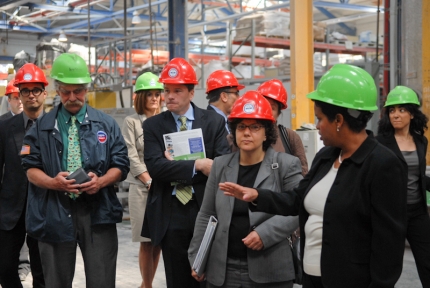
IceStone CEO Michelle Gibson (right) discusses green manufacturing with Council on Environmental Quality Chair Nancy Sutley in Brooklyn, NY. (Photo Credit Flaam Hardy)
In his 2011 state of the union address, President Obama called on Americans to "out-innovate, out-educate, and out-build the rest of the world." After more than 20 years overseeing the supply chain and operations of multi-national corporations, I witnessed firsthand the opportunity for businesses to shift from production that follows a "cradle to grave" value stream, to one that prioritizes renewable materials, clean energy, and the well-being of workers and customers. IceStone is one company striving to do just that, proving that an American manufacturing renaissance is possible. Since 2003, IceStone has been producing premium durable surfaces made of recycled glass and concrete. The production of our surfaces has diverted millions of tons of glass from the waste stream, and has created green collar jobs in the manufacturing sector that pay a living wage. IceStone is proof that it's possible to create good U.S. jobs; all it takes is capital, job training, and a sustainable business model.
To remain competitive in the global economy, incentive programs and policies must be designed to support the small businesses and start-ups that are driving smart innovation in our country. IceStone has been the beneficiary of state and federal support, securing the capital needed to purchase equipment, train workers, and invest in research and development. Furthermore, IceStone’s renovated 19th century factory is located inside the Brooklyn Navy Yard, a city-owned industrial park expected to add 2,000 new jobs in the next two years. The Navy Yard recently received the promise of a $15 million commitment from the New York State Senate allocated for increasing the number of green businesses there. Such resources are essential to incubate and fuel the types of businesses President Obama believes will "lead the comeback of American manufacturing."
In addition to capital, our workforces need the education, training, and benefits necessary to meet the demands of a new economic climate. Business and government must work together to provide not only green manufacturing jobs, but the requisite skills to perform those jobs. Furthermore, businesses must recognize that if we put the welfare of workers first, U.S. manufacturing will flourish. Providing safe, living-wage jobs for all our employees has always been part of IceStone’s mission, and we have trained members of our operations team to be stronger managers on the factory floor and to proactively create their own development plans.
Peter Strugatz and Miranda Magagnini co-founded IceStone with hopes of re-defining conventional business philosophy. I left the corporate world to join IceStone because I shared that vision, and understood the clear need for the triple bottom line. This new business model will be the most important trait of America's manufacturing renaissance. When I reflect on the culture we’ve created at IceStone, the outreach we’ve done in our local community, the waste we’ve reduced and up-cycled, the facility renovations that improve the energy efficiency of our operations, and the people IceStone has touched, I believe what the President said in his address to be true: "In America, innovation doesn’t just change our lives. It is how we make our living."
Michelle Gibson is CEO of IceStone.
Learn more about Energy and Environment
- &lsaquo previous
- …
- 120
- 121
- 122
- 123
- 124
- 125
- 126
- 127
- 128
- …
- next &rsaquo
Related Videos
-
 May 09, 2014 9:21 AM
Inside the White House: Solar Panels
-
 September 01, 2016 9:25 PM
President Obama Delivers a Statement to the Press
White House Blogs
- The White House Blog
- Middle Class Task Force
- Council of Economic Advisers
- Council on Environmental Quality
- Council on Women and Girls
- Office of Intergovernmental Affairs
- Office of Management and Budget
- Office of Public Engagement
- Office of Science & Tech Policy
- Office of Urban Affairs
- Open Government
- Faith and Neighborhood Partnerships
- Social Innovation and Civic Participation
- US Trade Representative
- Office National Drug Control Policy