

Energy and Environment Latest News
Sound Ocean Policy Builds the Marine Economy
Posted by on July 28, 2011 at 3:27 PM EDT
(Photo Credit: NOAA)
We are fortunate that the Obama Administration and the business community in Rhode Island understand the value of our rivers, Bay, and Coast. We know from experience that for a business to be successful and sustainable, it must be clean and green. That is why environmental regulation and policies, from the local to state to federal levels, need to make sense for these businesses. While we recognize the importance of good, strong environmental laws, they have to be practical, feasible, clear, and fair. They must also produce effective and measurable results.
All of us in Rhode Island are connected to the water in some way. Our many marine industries—from boatbuilding, service, and repair, to marinas and public boating facilities—play a vital role in the regional economy, and in supporting the many different ways people use and enjoy the ocean and coastal environment.
Founded in 1964, the Rhode Island Marine Trades Association (RIMTA) represents all aspects of the marine industry. Our member companies and organizations are dedicated to the growth in recreational boating and the creation of jobs for our industry in an environmentally friendly, safe and responsible way.
It is with these principles in mind that RIMTA rolled up our sleeves and participated in the Rhode Island Ocean Special Area Management Plan (SAMP), which recently became the first federally-approved plan of its kind in the nation. The Plan represents a strong effort to do coastal marine spatial planning through an open and public process based on good science and direct observations drawn from the participants.
Respecting the balance between the stakeholders' interests is essential to success. Every perspective is valuable and deserves to be heard. We were impressed to see nearly every one of the stakeholders take a constructive attitude aimed at solutions and results. We've learned that when industry groups work closely with the environmental organizations, universities, and other non-governmental organizations, it makes a powerful alliance.
Federal ocean policy can only work if it is sensible and helps build our economy. Rhode Island is unique, but aspects of our experience can help inform the President and the federal agencies as the national ocean policy takes shape. When it comes to the ocean and our public waters, it is critical that we get it right the first time, and we are grateful to the Obama Administration for recognizing its importance.
Michael Keyworth is Chairman of Legislative Affairs for the Rhode Island Marine Trades Association
Learn more about Energy and EnvironmentWhite House Hosts Roundtable on Scientific Integrity
Posted by on July 28, 2011 at 2:44 PM EDTScience plays a big role in our everyday lives – from the food we grow and eat to the cars we drive to the environment in which we live. We all must be assured that the science conducted in the U.S. is of the highest quality and meets the most stringent standards. President Obama, in the early days of his administration, called for a way to ensure that federally funded science would not be misused and could be trusted for those who need to make decisions based on that science.
The federal science agencies are in the stages of drafting their scientific integrity policies to meet a late summer deadline as requested by John Holdren, the President’s science advisor. Tuesday, the National Oceanic and Atmospheric Administration (NOAA) – the agency that monitors and studies our weather, climate, ocean, and fisheries – took another step toward completing its draft scientific integrity policy.
Learn more about Energy and EnvironmentFastest Growing Industry in the U.S. – Solar Energy
Posted by on July 27, 2011 at 2:37 PM EDTEditor's Note: This post introduces readers to Rhone Resch, President and CEO of the Solar Energy Industries Association. Today, as part of President Obama's Executive Order calling on Federal agencies to lead by example in Energy, Environment, and Economic Performance, the Department of Veterans Affairs announced that they will install solar photovoltaic (PV) systems by summer 2012 at five VA medical centers in Oklahoma City; Temple, Texas; Amarillo, Texas; Loma Linda, Calif. and West Los Angeles.
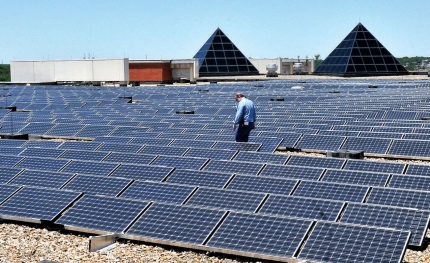
Solar Panel installation at the Dallas VA Medical Center. (Photo courtesy of Dept. of Veterans Affairs)
The U.S. solar energy industry is booming.
In June, the Solar Energy Industries Association and GTM Research released the U.S. Solar Market Insight: 1st Quarter 2011 report showing that in the last three years the U.S. solar industry has gone from a start-up to a major industry that is creating well-paying jobs and growing the economy in all 50 states.
Solar's robust growth in the past years has been the result of a very favorable combination of new, innovative business models, affordability for consumers, rapidly decreasing manufacturing costs, and most importantly, a strong commitment from the Obama Administration and other policymakers in Washington.In the first quarter of 2011, the solar industry installed 252 megawatts of new solar electric capacity, a 66 percent growth from the same time frame in 2010. There are now almost 3,000 megawatts of solar electric energy installed in the U.S., enough to power 600,000 homes. In the manufacturing sector, solar panel production jumped 31 percent.
And with the growth of the solar industry, thousands of jobs have been created. In fact, solar energy creates more jobs per megawatt than any other energy source. According to the Solar Foundation’s National Solar Jobs Census, 93,000 Americans were employed in the U.S. solar industry in 2010 and that number is expected to grow between 25-50,000 this year.
The Obama Administration has taken solar energy initiatives to unprecedented levels and is leading the effort to win our clean energy future. In addition to creating American jobs, President Obama has put words to action through his call for the government to lead by example:
- Just today, The Department of Veterans Affairs (VA) announced that it will install solar photovoltaic systems by summer 2012 at five VA medical centers in Oklahoma City; Temple, Texas; Amarillo, Texas; Loma Linda, Calif. and West Los Angeles. Prior to this announcement the VA has also awarded nearly $78 million in contracts to build solar panels at its facilities with a goal to derive 15 percent of its annual electricity usage from renewable sources by 2013.
- The Department of Energy has issued loan guarantees for solar power projects and manufacturing facilities that will create more than 26,000 jobs.
- The Department of the Interior has approved permits for solar power projects on public lands that will provide enough power for over 730,000 homes.
- The Department of Agriculture actively promotes the deployment of solar energy on farms and ranches throughout the country. The American Recovery and Reinvestment Act of 2009 extended benefits to farmers and ranchers who utilize solar systems.
And the list goes on.
The U.S. market is expected to more than double yet again in 2011, installing enough solar for more than 400,000 homes. Last year, the industry set the ambitious yet achievable goal of installing 10 gigawatts annually by 2015 – enough to power 2 million more homes each and every year. Combining continued leadership from the Administration with industry innovation that drives down cost, that goal is now within reach.
Rhone Resch is President and CEO of the Solar Energy Industries Association
Learn more about Energy and EnvironmentTaking a Chance with Solar Energy
Posted by on July 27, 2011 at 1:13 PM EDTIn the winter of 2007, Ella Jenness was like many Americans. She was looking for a job.
After four months of unemployment, she joined a company with just six workers in a field almost entirely new to her. Most of her experience was in real estate, and this was a solar energy production firm. It was “a new challenge,” Jenness said.
Today, that small company, Martifer Solar USA, has grown. The California-based business now has offices in Colorado and Connecticut. Martifer Solar will sub-contract out about 15,000 man-hours of labor. And the number of employees has jumped rather markedly – 983 percent, or 53 others to be precise.
Learn more about Economy, Energy and EnvironmentVoice of an Innovator: We're Hiring!
Posted by on July 26, 2011 at 3:57 PM EDTEditor's Note: This post introduces readers to Tom L. Pierson, Founder of TAS Energy Inc., a renewable energy and energy efficiency technology manufacturing plant based in Houston, Texas.
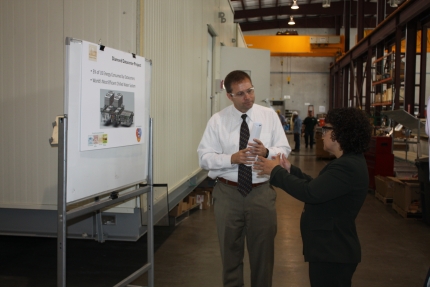
Senior TAS Energy Executive and White House Council on Environmental Quality Chair Nancy Sutley discuss the company's clean energy solutions. (Photo courtesy of TAS Energy)
A few weeks ago we were very pleased to welcome CEQ Chair Nancy Sutley and our Congresswoman, Sheila Jackson Lee, to TAS Energy to discuss and showcase how U.S. entrepreneurs are creating innovative ways to improve our energy infrastructure— directly resulting in significant domestic job growth. In fact, at TAS Energy we have almost 50 job openings!
We focused our discussion on American job creation opportunities from the modular, or exportable, approach to capitalize on the 'low hanging fruit' of economic clean energy—including emission free baseload power from industrial waste heat, modular cooling for building air conditioning and data centers (that is twice the efficiency of traditional systems), and a cooling technology for gas power plants to dramatically and cost effectively increase capacity.
These examples of the 'low hanging fruit' of economic clean energy have a unique advantage in leading the world in clean energy and American job creation, for both manufacturing and aftermarket services. The modular approach to manufacturing these energy systems for global export will result in a revolutionized clean energy economy for domestic job growth, significant energy conservation and an abundance of clean generation.
Our Country's leadership under President Obama is right on the mark when they say that American innovation is one of the keys to our economic recovery and future success. The TAS team and its many suppliers appreciated the opportunity to demonstrate for Chair Sutley and Congresswoman Jackson Lee how American innovation is creating jobs TODAY with tremendous opportunity for future American job growth with smart policy adoption. We look forward to helping the American economy grow through American job creation in the clean energy field.
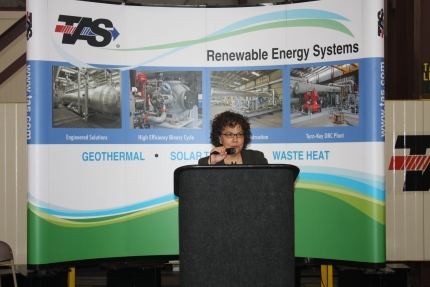
Chair Sutley delivers remarks at TAS Energy's headquarters in Houston, Texas. (Photo courtesy of TAS Energy)
Tom L. Pierson is Founder of TAS Energy Inc.
Learn more about Energy and EnvironmentEnergy Information Helps Save Money and the Planet
Posted by on July 26, 2011 at 11:27 AM EDTWhile the U.S. is known around the world for innovative companies like Google and Facebook, there is a new vanguard of American companies creating and exporting clean energy technologies,” said Jim Kapsis. His company, OPower, an information-enabled energy efficiency company, is one of them. Opower is transforming the relationship between consumers and how they use energy in their homes. According to Kapsis, Opower is on track to save households more than $100 million next year and enough energy to take the equivalent of more than 100,000 households off the grid.
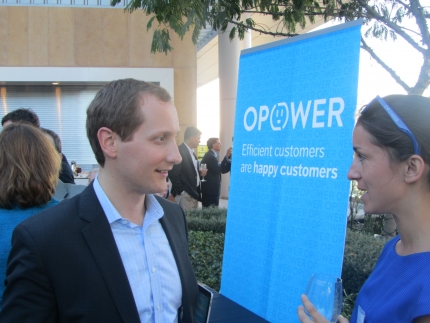
OPower provides 10 million U.S. households with home energy information and has clients in 25 states. (by OPower)
Founded in 2007 by two college buddies, the company started out with a simple idea: utility bills are too difficult to understand. The friends, co-founders, Dan Yates and Alex Laskey, bet that if people had better information about their energy usage, they would use less of it, save money, and improve the environment. “It was an innovative business idea, but given the complexity of the energy market, they weren’t sure at first that it was going to work,” said Kapsis. By working with utility companies to deliver better information to their customers, OPower not only helps people understand how they are consuming energy, but how they are doing relative to other similar homes in their neighborhood. By coupling this context with personalized energy saving advice, Opower is giving households the tools to make more informed choices about their energy use.
Learn more about Economy, Energy and Environment
- &lsaquo previous
- …
- 116
- 117
- 118
- 119
- 120
- 121
- 122
- 123
- 124
- …
- next &rsaquo
Related Videos
-
 May 09, 2014 9:21 AM
Inside the White House: Solar Panels
-
 September 01, 2016 9:25 PM
President Obama Delivers a Statement to the Press
White House Blogs
- The White House Blog
- Middle Class Task Force
- Council of Economic Advisers
- Council on Environmental Quality
- Council on Women and Girls
- Office of Intergovernmental Affairs
- Office of Management and Budget
- Office of Public Engagement
- Office of Science & Tech Policy
- Office of Urban Affairs
- Open Government
- Faith and Neighborhood Partnerships
- Social Innovation and Civic Participation
- US Trade Representative
- Office National Drug Control Policy