Energy and Environment Latest News
Investing in Advanced Biofuels to Create Jobs
Posted by on August 17, 2011 at 3:56 PM EDTYesterday, President Obama announced that our Departments will jointly invest $510 million over the next three years to develop the domestic capacity for advanced biofuels. The funds will be leveraged with at least a one-to-one private industry match to construct or retrofit advanced biofuel plants to produce drop-in aviation and marine biofuels that will power our military’s ships and aircraft and our commercial transportation fleet. For the first time, our Departments’ efforts have been put behind a single project to help create the new energy future and new energy economy set out in the President’s Blueprint for a Secure Energy Future (pdf) issued this March.
As the President said yesterday at the White House Rural Economic Forum in Iowa, “We're going to do more to speed the development of next-generation biofuels, and we’re going to promote renewable energy and conservation.”
Learn more about Economy, Energy and EnvironmentFostering the New Green Economy
Posted by on August 16, 2011 at 1:20 PM EDTEditor's Note: This post introduces readers to Fred Walti, Chief Executive Officer of the new Los Angeles Cleantech Incubator (LACI). White House Council on Environmental Quality Chair Nancy Sutley visited LACI prior to its official opening.
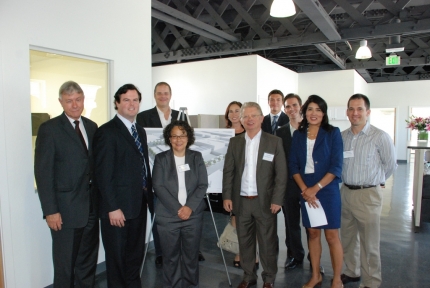
Chair Sutley visits the new Los Angeles Cleantech Incubator that is being launched to accelerate the development of innovative clean technologies in Los Angeles. Chair Sutley and to her left, Fred Walti, Executive Director of LACI, are joined by representatives from UCLA, Community Redevelopment Agency/Los Angeles, the Los Angeles Department of Water & Power, Senator Feinstein's office, Senator Boxer's office, and JPL.
White House Council on Environmental Quality Chair Nancy Sutley visited Los Angeles to discuss the Obama Administration's commitment to harnessing clean energy opportunities to create American jobs on Friday, July 22. She met with business leaders, city officials and top educators from UCLA and other institutions and toured the new LA Cleantech Incubator (LACI), at the future site of LA Cleantech Corridor. Los Angeles is committed to leading the charge toward a new green economy, and it is LACI's mission to support that growth and be a central resource for the cleantech sector. It was a great opportunity to connect with an Administration official and to hear how President Obama’s initiatives, along with our work here in LA, will create thousands of local family-supporting jobs in green sectors in the years to come.
Years in the making, Los Angeles launched its new cleantech business incubator to accelerate development of startups focused on sustainable solutions that can create both efficient clean technologies and green jobs. The incubator offers flexible ready-to-go office space, lab facilities, and a supportive environment where startup teams can share ideas with other entrepreneurs and fuel innovation. LACI also gives each startup the chance to work with a dedicated mentor, as well as access to a growing network of cleantech and business experts and introductions to prospective investors. LACI is the business equivalent of baseball's farm system: identifying local talent, nurturing it, and preparing the best prospects to perform on a global stage, resulting in more jobs and a bigger green economy in Los Angeles and beyond.
LACI currently has partnerships with UCLA, USC, Caltech and NASA's Jet Propulsion Laboratory, and will help accelerate the commercialization of their clean technologies in addition to championing and nurturing the growth of local entrepreneurs. Currently the largest market for electric vehicles and solar installations, Los Angeles is a great place for cleantech companies to make their homebase.
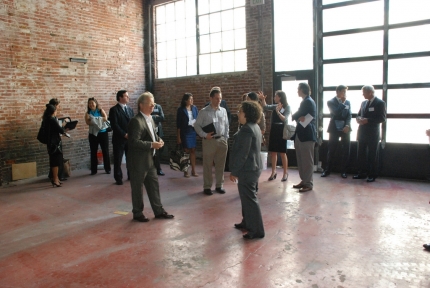
Chair Sutley and Fred Walti stand in LACI's permanent location, under construction now. The 25,000 square foot La Kretz Innovation Campus is located at the heart of Los Angeles's Cleantech Corridor.
LACI offers its portfolio companies three game-changing services: (1) Fully built-out, furnished, and equipped office/lab space at flexible terms; (2) CEO coaching and mentoring from highly accomplished, senior advisors who have created and managed highly successful companies; (3) Access to our large and growing network of potential customers, industry experts, investors, and public leaders.
Statement of Support from Alexandra Paxton, Project Manager, Downtown Region, Community Redevelopment Agency of the City of Los Angeles:
It was very gratifying to hear from Chair Nancy Sutley firsthand about President Obama’s initiatives to foster innovation for the clean energy economy of the future. As a redevelopment agency, our vision is that the young companies fostered here will move into the surrounding industrial area, revitalizing the district as a place to live, work, innovate, and manufacture. In this way, partnering with education and workforce development, we will be able to build opportunities and jobs for the people who live in our communities, as well as solve our environmental problems. Ambitious? Yes. Achievable? Absolutely!
To find out more about the Los Angeles Cleantech Incubator, please visit http://www.laincubator.org/.
Fred Walti is Chief Executive Officer of the new Los Angeles Cleantech Incubator (LACI)
Learn more about Energy and EnvironmentThe White House Connects with Student Body Presidents
Posted by on August 15, 2011 at 6:12 PM EDTThis week President Obama’s youth liaison, Ronnie Cho, began holding outreach calls with Student Body Presidents from colleges and universities all over the country. These calls will continue to take place in the coming weeks in Northeast, South, Midwest, Southwest and Western States.
The hundreds of Student Body Presidents who dial into these calls hear from Ronnie and give him valuable feedback for how the White House can best move forward. Student leaders have been mobilizing around important issues, and these calls allow students to discuss their ideas and solutions when it comes to our nation’s biggest challenges.
During the calls, students learn about the work that has been done this year to keep young people engaged with the White House. Participants hear about the 100 Youth Roundtables initiative, where administration officials and young people participated in hundreds of roundtables throughout the country, exchanging ideas about the issues they care about most. They also hear about the work the administration is doing surrounding youth entrepreneurship to encourage job growth in new and exciting sectors.
Weekly Wrap Up: Common Sense Solutions
Posted by on August 12, 2011 at 6:00 PM EDTA quick look back at what happened this week on WhiteHouse.gov
Watch the President's Remarks on the credit downgrade here.
Common Sense Solutions: On Monday, August 8th, President Obama addressed our nation’s credit downgrade and said that our nation's problems are "eminently solvable." He laid out steps Congress can take right now to jumpstart the economy. "Specifically, we should extend the payroll tax cut as soon as possible, so that workers have more money in their paychecks next year and businesses have more customers next year," said the President. Watch the remarks.
Crisis in Africa: Right now, thousands of families are starving as a result of a famine caused by the worst drought in the Horn of Africa in 60 years. This week, Dr. Jill Biden led a delegation including former Senator Bill Frist and USAID Director Rajiv Shah to the Dadaab Refugee Camp in Kenya where they witnessed the suffering first hand. If you are as touched by their plight as Dr. Biden and her team, there are many ways you can help,
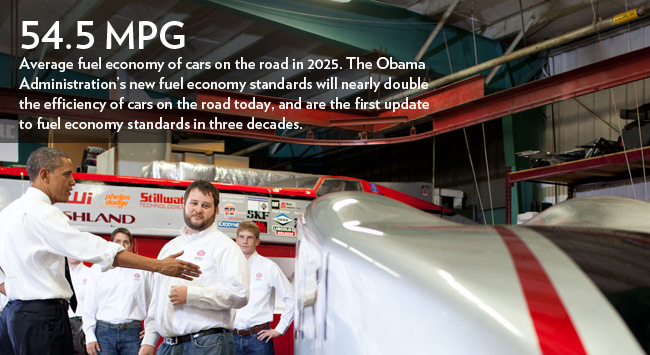
New Fuel Rules: On Tuesday, President Obama announced historic new fuel efficiency standards for work trucks, buses and other heavy-duty vehicles. These new standards will save American businesses approximately $50 billion over the life of the program, while reducing oil consumption by a projected 530 million barrels and greenhouse gas (GHG) pollution by approximately 270 million metric tons. Transportation Secretary Ray LaHood calls the new standards a “significant win.” On Thursday, the President travelled to Holland, MI where he visited an advanced battery plant making the batteries that will be needed to power these vehicles of the future and talked about his goal to see more products that are made in America sold around the world.
Celebrating Ramadan: The ninth month of the Islamic calendar marks Ramadan, a holy month of prayer and fasting for Muslims around the world. On Thursday night, the President marked this occasion at an Iftar dinner with Muslim-American members of Congress and diplomatic corps, as well as Muslim-American families. According to the CIA World Fact Book, there are approximately 1.8 million Muslims in the United States. Watch President Obama's speech.
Bright Ideas: Thomas Edison would be amazed. The conventional light bulb now has some serious competition. Philips Lighting North America has invented a revolutionary 10-watt light emitting diode (LED) bulb. Phillips is the first winner of the Energy Department's Bright Tomorrow Lighting Prize(L Prize). The L Prize challenged the lighting industry to develop high performance, energy-saving replacements for conventional light bulbs that will save American consumers and businesses money.
Special Education: On Friday, the Department of Education announced more than $5 million in grants to 19 Parent Training and Information (PTI) Centers in 13 states and Puerto Rico. These centers will help parents understand their child's disability early on and offer information on special education services and opportunities. For the full list of Education Department-funded special education parent information and training centers, visit www.parentcenternetwork.org
Learn more about Economy, Energy and EnvironmentThe Sensible, Affordable Option of Solar Hot Water Heating
Posted by on August 12, 2011 at 1:58 PM EDTEd. Note: Champions of Change is a weekly initiative to highlight Americans who are making an impact in their communities and helping our country rise to meet the many challenges of the 21st century.
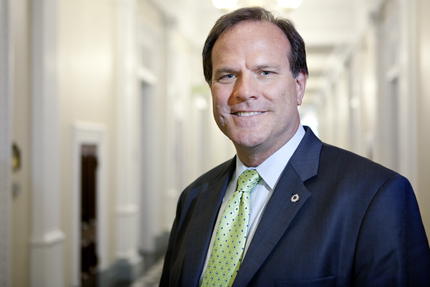
Since I was a young boy, I was always interested in how things worked, right down the tiniest detail. I would disassemble and reassemble everything from watches, to televisions, to motors. While doing so, I was always thinking about why something was constructed or done in one way, versus another. It was with this same analytical curiosity that compelled me to question why solar water heating, so popular in buildings around the world, lost its popular, widely adopted use, and instead became seldom-used and not worth pursuing as a product in business.
When I first started my career in the renewable energy industry, I was taken by the simplicity and cost effectiveness of solar water heating. A single solar panel on the roof of a home provides reliable hot water for a home at a cost that is very competitive with electric and gas. Even today the rest of the world uses solar energy to heat water. Realizing this, I have always held the idea that traditional utilities that deliver electricity, water, gas, or other services on a monthly basis could provide yet another service - solar water heating.
In the utility business a solar system installed in a home is called “distributed generation.” But wait doesn’t “generation” beget electricity? Unfortunately, that is where solar water heating is disadvantaged; it is neither electricity, nor conservation, nor generation supply. Hence, solar water heating tends to be ignored by utilities and businesses despite that fact that it is four to seven times more cost effective than PV (photovoltaic), and takes up equally as less roof space. In most States that have renewable goals (RPS) solar water heating is not an eligible technology, for no good reason at all. When you talk to regulators or policy people that claim it is an oversight. As a taxpayer and ratepayer I want my dollars spent wisely, and so should you!
Learn more about Energy and EnvironmentAcross the Administration, Action for Healthy Communities
Posted by on August 12, 2011 at 9:00 AM EDTIn too many American communities, low-income and minority families shoulder a disproportionate burden of pollution in the places where they live, work and learn. These disparities result in health challenges like asthma and heart disease, and end up turning away job creators looking for attractive, healthy places to set up their businesses.
This past week the Obama Administration took an important step to address those disparities when Federal leaders signed their agencies into Memorandum of Understanding (MOU) on Environmental Justice. At the highest levels of the Obama Administration, we are intent on ensuring Americans have equal opportunity to enjoy the health and economic benefits of a clean environment.
Across the Administration, agencies have already turned words into action to generate on-the-ground health, environmental and economic results for American communities. Agencies are:
- Integrating environmental justice into Federal programs. EPA has launched EJ2014, an environmental justice action plan with specific actions taken over the past few months including: incorporating environmental justice into enforcement; expanding community engagement with initiatives like Gulf Coast Restoration Environmental Justice Roundtables; and initiating Brownfield area-wide planning efforts in 23 communities. The Department of Transportation has recently issued an Emerging Trends and Best Practices Guidebook to promote a deeper understanding of the responsibilities, opportunities and benefits of addressing environmental justice in transportation planning.
- Increasing engagement with American communities. In response to feedback from environmental justice leaders at an historic White House Forum on the issue in December, many agencies have expanded their efforts to host listening sessions, sponsor conferences, and offer their programs up for public comment to ensure Americans have a chance to weigh in on issues that affect their daily lives. For example, the USDA’s Office of Tribal Relations is working with the Forest Service to improve protection and preservation of American Indian and Alaska Native Sacred Sites. This initiative has already involved listening sessions with Tribal elected and spiritual leaders in more than 50 locations, and will result in a series of recommendations on ways to improve the Forest Services' sacred sites policy.
- Making policy choices that prioritize communities that are shouldering a disproportionate amount of pollution. For example, the Department of Commerce and the Economic Development Administration have implemented a set of policy priorities to help focus investment funding as part of the competitive grant process. Two of these priorities are aimed specifically at reducing the burden of, or bringing benefits to, communities experiencing environmental justice issues.
- Revitalizing polluted waterways in under-served cities. Waterways are vital to the economic and public health of communities. Through an innovative new Urban Waters Federal Partnership (http://www.urbanwaters.gov/), 11 agencies are working with communities to clean, restore and revitalize polluted urban waterways in under-served cities across the country. The goal is to stimulate local economies and create jobs while improving the environment and protecting public health. The partnership will focus its initial efforts on seven pilot cities – Baltimore, the Bronx, Denver, Los Angeles, New Orleans, Northwest Indiana, and Washington.
- Focusing on the health of low-income rural communities. The Department of Agriculture is working to better serve persistent poverty in rural communities and socially disadvantaged farmers through its Strike Force initiative. This includes identifying and addressing disproportionate environmental and human health impacts in persistently poor communities.
- Helping communities tackle their health issues. The Department of Health and Human Services (HHS) has announced it will make more than $100 million available in Community Transformation Grants for states and communities to make policy, environmental, programmatic and infrastructural changes to address the leading causes of death and associated risk factors. HHS also announced the Healthy People 2020 Community Innovations Project, which will make awards to community-based organizations to tackle health issues, placing a special emphasis on environmental justice, health equity, or healthy behaviors across all life stages.
These actions are just the beginning of our efforts to lay the ground work for achieving environmental justice for all Americans. The many Agencies involved are advancing this work as a part of an Interagency Working Group on Environmental Justice (EJ IWG). Stay tuned to the EJ IWG home page (http://www.epa.gov/environmentaljustice/interagency/index.html) for environmental justice updates in the coming months, including the release of Environmental Justice Strategies.
Nancy Sutley is Chair of the Council on Environmental Quality
Lisa Jackson is Administrator of the Environmental Protection Agency
Learn more about Energy and Environment
- &lsaquo previous
- …
- 112
- 113
- 114
- 115
- 116
- 117
- 118
- 119
- 120
- …
- next &rsaquo
Related Videos
-
 May 09, 2014 9:21 AM
Inside the White House: Solar Panels
-
 September 01, 2016 9:25 PM
President Obama Delivers a Statement to the Press
White House Blogs
- The White House Blog
- Middle Class Task Force
- Council of Economic Advisers
- Council on Environmental Quality
- Council on Women and Girls
- Office of Intergovernmental Affairs
- Office of Management and Budget
- Office of Public Engagement
- Office of Science & Tech Policy
- Office of Urban Affairs
- Open Government
- Faith and Neighborhood Partnerships
- Social Innovation and Civic Participation
- US Trade Representative
- Office National Drug Control Policy