Energy and Environment Latest News
In Service and Commemoration
Posted by on September 16, 2011 at 12:00 PM EDTIn the immediate aftermath of 9/11, many Americans were compelled to serve their fellow citizens and communities. As a tribute to that spirit of unity – and to honor those we lost – September 11 has been designated a National Day of Service and Remembrance. On Sunday, we were honored to join CEQ Chair Nancy Sutley for a Day of Service and Remembrance organized by the Volunteer Center for Anne Arundel County in Annapolis, Maryland.
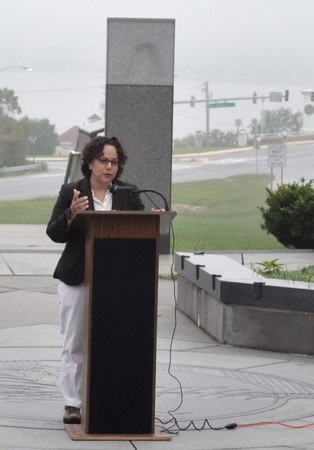
Chair Nancy Sutley delivers remarks at the opening ceremony of Project Green: 9/11 Day of Service and Remembrance. (Photo Credit: Mary McGuirt with the Historic Annapolis Patch)
The day began with a ceremony at the Maryland World War II Memorial to commemorate those who have lost their lives in service. We then joined volunteers, including members of the US Naval Academy Midshipmen Action Group, at Jonas Green Park for clean-up activities including debris collection, weeding, planting native species and controlling storm water runoff to better protect the health of the community and the Chesapeake Bay. Our efforts were focused in the rain garden, where weeding and planting were essential to absorb rain water and improve water quality in the surrounding Bay.

CEQ's Danny Lampton and a local volunteer work in the rain garden just steps away from the Severn River in Annapolis, Maryland.
The effort was part of the Ocean Conservancy’s International Coastal Cleanup, the world’s largest volunteer effort for ocean health. As we got our hands dirty in Jonas Green Park, we were joining nearly half a million others around the world in protecting the coast lines and waterways that are vital to the health of our communities.
The day was a humbling and empowering reminder of what can be accomplished when we draw on our national spirit of unity and service.
Shira Miller and Danny Lampton both work at the Council on Environmental Quality
Protecting Marine Life, Protecting Ourselves
Posted by on September 15, 2011 at 7:00 PM EDT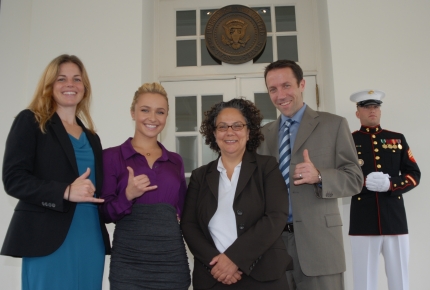
Hayden Panettiere and Administration officials pose after their meeting to discuss conservation of our world’s great whales. (Left to right): Celeste Connors, Director for Environment and Climate Change, National Security Council/National Economic Council; Actress Hayden Panettiere; Nancy Sutley, Chair of the Council on Environmental Quality; and Jay Jensen, Associate Director for Land & Water Ecosystems at the Council on Environmental Quality. (Photo Credit: Jeff Pantukhoff, President & Founder, The Whaleman Foundation)
About 3 years ago, I had the great privilege of meeting President Obama for the first time while he was on the campaign trail. He told me that some of his fondest childhood memories growing up in Hawaii were when he was swimming in the ocean and saw its wondrous creatures up-close and personal, including dolphins and whales. We spoke of the need to protect them and in particular to stop whaling. Today, the Obama Administration took a step toward doing just that.
In a meeting with the President's environmental policy advisor, Nancy Sutley, and several officials from the Administration, I thanked and applauded President Obama for taking action today against Iceland's illegal slaughter of fin and minke whales, which is in direct violation of the International Whaling Commission (IWC) commercial whaling moratorium.

CEQ Chair Nancy Sutley, Hayden Panettiere and Administration officials meet to discuss President Obama's message to Congress regarding Pelly Certification and Icelandic Whaling.
Tens of millions of U.S. citizens, including myself, have written or emailed the President and his Administration supporting these actions under the Pelly Amendment. I am grateful that the President and our government have listened and will be raising this issue with Iceland at the highest levels. They will continue to monitor the companies involved and examine other options available to us.
These include the diplomatic measures just announced here today, such as directing the State Department to examine Arctic cooperation projects, and where appropriate, link U.S. cooperation to the Icelandic government changing its whaling policy and abiding by the IWC moratorium on commercial whaling. It also calls on Iceland to cease its commercial whaling activities.
It has been the policy of the United States to support the conservation of the world's whale populations through science based policies and leadership within the International Whaling Commission. Just recently, the National Oceanic and Atmospheric Administration, which leads the U.S. delegation to the International Whaling Commission, signed a "sister sanctuary" agreement with France to support the protection of endangered humpback whales, and they are currently working with Bermuda to declare a sister humpback whale sanctuary there as well.
Also, at the 2010 meeting of the International Whaling Commission in Agadir, The US delegation, by the request of our organization, introduced a five-year study by Dr. Roger Payne and Dr. John Wise that showed how toxins and pollutants are being dispersed throughout the world's oceans and up the food chain. It outlined how these pollutants are not only a serious health threat to marine life, including apex predators like dolphins and whales, but also pose serious health threats to humans.
By protecting marine life and our oceans, ultimately we are protecting ourselves. President Obama recognizes this and has repeatedly supported innovative and conservation-minded efforts, not only at the International Whaling Commission, but with the unprecedented forward thinking demonstrated in his National Ocean Policy.
Hayden Panettiere is an Actor and the International Spokesperson for The Whaleman Foundation & the Save the Whales Again! Campaign
Learn more about Energy and EnvironmentModeling a Green Energy Challenge after a Blue Button
Posted by on September 15, 2011 at 4:55 PM EDTOn Monday, President Obama declared this week National Health IT Week. To kick it off, HHS Secretary Sebelius co-hosted a Consumer Health IT Summit where the Robert Wood Johnson Foundation announced the creation of bluebuttondata.org. This new website advances the movement of enabling consumers to download their personal health data and share it with health providers, care givers, and others they trust—all by the click of a button.
The US Department of Veterans Affairs originally launched Blue Button with industry and non-profit collaboration. It’s a simple, common-sense idea—people should be able to access and download their own health information—with the potential for a big impact.
As President Obama said in August 2010, “For the first time ever, veterans will be able to go to the VA website, click a simple blue button, and download or print your personal health records so you have them and can share with your doctor outside of the VA.”
Why can’t the same common-sense concept be applied to the energy industry with a “Green Button”? Consumers should have access to their energy usage information. It should be easily downloadable and in an easy-to-read format offered by their utility or retail energy service provider.
So today at GridWeek, I challenged the smart grid ecosystem to deliver on the vision of Green Button and provide customers access to their energy usage information electronically. With this information at their fingertips, consumers would be enabled to make more informed decisions about their energy use and, when coupled with opportunities to take action, empowered to actively manage their energy use.
Furthermore, making this information available—in simple standard formats—will help spur innovative new consumer applications and devices from entrepreneurs, big companies, and even students. Imagine being able to check your air conditioner from your smartphone or having a clothes dryer that saves money for you automatically during critically hot days or simply getting some helpful customized hints on how best to save energy and money in your house or apartment.
This concept of encouraging customer access to electronic energy usage information is part of the Administration’s Policy Framework for a 21st Century Grid. This framework, launched at a White House event in June 2011, highlights the value of empowering consumers with enhanced information to save energy, ensure privacy, and shrink bills.
The vision of consumer access to energy data is shared by the National Association of Regulatory Utility Commissioners (NARUC), which recently passed a resolution endorsing smart grid principles that include the importance of providing consumers with affordable and timely access to their own energy use data.
And if modeled after a successful program like Blue Button, Green Button has the potential to deliver untold benefits to consumers and utilities alike.
Since its release, Blue Button has been adopted by Medicare, the Department of Defense, and private sector health care organizations. Software developer challenges have spurred applications that expand on the Blue Button’s promise by helping consumers use their data to stay healthy and manage their care.
Through a collaborative effort, we can build an open-reference implementation of a Green Button, based on national standards for the smart grid. If the health industry can work together through Blue Button to make this world a better place, then the energy industry can do so through Green Button.
Let’s get to work.
Aneesh Chopra is US Chief Technology Officer
Attacks to the Clean Air Act & the False Choice between a Healthy Environment and Healthy Economy
Posted by on September 15, 2011 at 3:39 PM EDTOver the past four decades, the Clean Air Act has proven to be an invaluable tool in our nation’s efforts to reduce dangerous air pollution and promote public health. The track record of the Clean Air Act also shows that strong environmental safeguards and strong economic growth go hand in hand.
In fact, the history of the Clean Air Act clearly shows that its benefits – in the form of longer lives, healthier kids, greater workforce productivity and ecosystem protections – have outweighed the costs by more than 30 to 1. And in the time since the Clear Air Act was passed, air pollution has been reduced by more than 60 percent and the Gross Domestic Product of the United States has grown by more than 200 percent.
To build on the successes of the Clean Air Act, the Obama Administration has taken the most aggressive steps in a generation to protect the health of American families by reducing harmful pollution. Our actions to date, both historic and comprehensive, include new standards for cleaner, more efficient vehicles, common-sense regulations to curb pollution from power plants and industrial sources and efforts to deploy cleaner sources of energy across the country.
Despite the compelling record of the Clean Air Act, some still believe that we cannot clean up pollution, create jobs and grow our economy all at the same time.
Just this week, House Republicans voted on two separate bills that would roll back existing Clean Air Act public health protections. Notably, these bills would indefinitely delay the health benefits associated with rules that establish national limits on emissions of toxic air pollution – like mercury – from a variety of sources, including incinerators, industrial boilers and cement plants.
Let’s take a closer look at what these bills would mean for American families:
H.R. 2250, the “EPA Regulatory Relief Act of 2011”
According to EPA’s analysis, this bill would allow up to:
- 20,000 additional premature deaths;
- 12,000 additional heart attacks; and
- 123,000 additional asthma attacks that could have been avoided.
H.R. 2681, the “Cement Sector Regulatory Relief Act of 2011”
According to EPA’s analysis, this bill would allow tens of thousands of adverse health effects from particulate matter exposure alone, including up to:
- 12,500 additional premature deaths;
- 7,500 additional heart attacks; and,
- 85,000 additional asthma attacks that could have been avoided.
Efforts like these to halt important safeguards for Americans are based on claims we have heard before, claims that EPA standards are harmful to the economy and employment. But based on the Clean Air Act’s forty year history, this Administration rejects the notion that a healthy environment and a healthy economy are two conflicting goals.
Families should never have to choose between a job and healthy air, because they deserve both. That’s why we will fight against attempts to weaken and undermine the Clean Air Act moving forward, and continue to build on our strong record of clean air achievements to date.
Learn more about Economy, Energy and EnvironmentThe Truth about Clean Energy Jobs
Posted by on September 15, 2011 at 11:06 AM EDTEd note: This has been cross posted from energy.gov
The Washington Post’s assertions today about the Department of Energy’s loan programs today are both incomplete and inaccurate.
Here are the facts: over the past two years, the Department of Energy’s Loan Program has supported a robust, diverse portfolio of more than 40 projects that are investing in pioneering companies as we work to regain American leadership in the global race for clean energy jobs. These projects include major advances for our renewable power industry including the world’s largest wind farm, several of the world’s largest solar generation facilities, and one of the country’s first commercial-scale cellulosic ethanol plants. Collectively, the projects plan to employ more than 60,000 Americans, create tens of thousands more indirect jobs, provide clean electricity to power three million homes, and save more than 300 million gallons of gasoline a year, all while investing in American competitiveness. What matters to the men and women who have those jobs is that the investments that this Administration is making are helping to keep factories open and running.
When the Washington Post claims that the program has created 3,500 jobs, here is what the reporters are excluding:
- 33,000 American auto jobs saved at Ford: The Post article does acknowledge that the program enabled Ford to modernize its factories to produce more fuel efficient vehicles, which a Ford spokeswoman credits for “helping retain the 33,000 jobs by ensuring our employees can build the fuel-efficient cars people want to drive.”
- More than 7,300 construction jobs: Many of the projects funded by the program are wind and solar power plants, which create significant numbers of construction jobs but once built can be operated inexpensively without a large workforce. But the Washington Post chose to ignore all of those jobs. If a community built a new highway or a bridge that employed 200 workers directly during construction – and many more in the supply chain -- and that also strengthened the local economy by making it faster to transport goods, would anyone say that the project created zero jobs?
- Supply chain jobs: While these jobs aren’t reflected in official government estimates because of the difficulty in obtaining a precisely accurate count, that doesn’t mean they don’t exist. When a company spends $100 million or $200 million building a wind farm or a solar power plant, most of that economic value actually goes into the supply chain – creating huge manufacturing opportunities for the United States.
In fact, when you look at the Washington Post’s graphic, you can see that the program has already created or saved roughly 44,000 jobs. Many of the projects it has funded are just getting going, and many of the loans won’t even go out the door until the next few weeks. Others have not ramped fully up to scale. But we are on pace to achieve more than 60,000 direct jobs – and many more in the supply chain.
Here’s a simple example:
Last year, the Department awarded a loan guarantee to build the Kahuku wind farm in Hawaii. It employed 200 workers during construction. Those wind turbines were built in Cedar Rapids, Iowa. The project also features a state of the art energy storage system supplied by a company in Texas. The supply chain reached 104 U.S. businesses in 21 states. But by the Washington Post’s count, none of those jobs – not even the 200 direct construction jobs – should count.
What’s critically important and completely ignored by the Washington Post, is that the value of this program can’t be measured in operating jobs alone. The investments are helping to build a new clean energy industry here in America. We are now on pace to double renewable energy generation from wind and solar from the time the President took office. Yet we are still in danger of falling behind China and other nations that are competing aggressively for leadership in these technologies. This is a race we can and will win, but only if we make these investments today. These investments will pay dividends not just in today’s jobs but in entire industries and supply chains – and in cleaner air and water for our children and grandchildren.
One of the goals of the program is to create projects that will encourage the private sector to take the financing risk on other, similar projects on its own. If we can show, for example, that a commercial scale cellulosic biofuel plant in Iowa can succeed, the private sector will likely finance many more of them around the country.
America’s economic strength has been built on technological leadership. The next great technological revolution is the clean energy revolution, and this Administration is committed to making sure that America will continue to lead the world.
Learn more about Economy, Energy and EnvironmentAir Force Jumpstarts Electric Vehicle Program
Posted by on September 9, 2011 at 4:49 PM EDTThis week, Air Force officials unveiled a plan to establish Los Angeles Air Force Base as the first Federal facility to replace 100% of its general-purpose fleet with Plug-in Electric Vehicles (PEV’s). This is the start of a broader Department of Defense (DoD) effort toward large-scale integration of PEV’s into its fleet. Lessons learned from this project will help DoD and other agencies understand operational implications of fleet electrification, while demonstrating cutting-edge PEV technologies, such as vehicle-to-grid (V2G) systems.
The move is the latest example of an Administration strategy of supporting emerging sustainable technologies, including biofuels, by being an early adopter. Large-scale government purchases can stimulate private sector investment, help create and nourish new domestic industries, and make government more cost-effective at the same time.
The switch to PEV’s at Los Angeles AFB will take place over the next year and will include a variety of vehicles, ranging from passenger sedans to pick-up trucks and shuttle buses. Only security and emergency response vehicles will be exempted. The project will provide vital information to support the broader DoD PEV Program and serve as a model for future activities.
As part of this transition, Los Angeles AFB will also be a test bed for vehicle-to-grid (V2G) technologies. With V2G, PEV’s will not only receive electricity from the grid but will also be able to provide electricity back to the grid as needed. This capability can be used to help reduce facility energy costs, generate revenues by supporting the public electrical grid, and provide back-up power to the facility during grid outages.
The main objective of DoD’s broader PEV effort is to bring PEV’s into its fleet at cost parity with conventional vehicles. To help accomplish this, DoD has partnered with the General Services Administration (GSA) to conduct a comprehensive study of the lifecycle costs and residual values of PEV’s. For example, two separate studies are underway to assess the costs of installing PEV charging stations. DoD is also working closely with the Department of Energy, GSA, and industry to gather key vehicle performance data.
The approximately 200,000 vehicles in DoD’s non-tactical ground fleet provide an excellent testbed to help pave a path toward a cleaner, more secure future. Here at Los Angeles AFB, we intend to create that future today.
Camron Gorguinpour is a special assistant in Office of the Assistant Secretary of the Air Force Installations, Environment & Logistics.
Arun Seraphin is Assistant Director for Defense Programs at OSTP
Learn more about Energy and Environment, Technology
- &lsaquo previous
- …
- 108
- 109
- 110
- 111
- 112
- 113
- 114
- 115
- 116
- …
- next &rsaquo
Related Videos
-
 May 09, 2014 9:21 AM
Inside the White House: Solar Panels
-
 September 01, 2016 9:25 PM
President Obama Delivers a Statement to the Press
White House Blogs
- The White House Blog
- Middle Class Task Force
- Council of Economic Advisers
- Council on Environmental Quality
- Council on Women and Girls
- Office of Intergovernmental Affairs
- Office of Management and Budget
- Office of Public Engagement
- Office of Science & Tech Policy
- Office of Urban Affairs
- Open Government
- Faith and Neighborhood Partnerships
- Social Innovation and Civic Participation
- US Trade Representative
- Office National Drug Control Policy