Energy and Environment Latest News
Cleaner Air and a Stronger Economy – A Record of Success
Posted by on September 2, 2011 at 10:30 AM EDTOver the last two and a half years, the Obama Administration has taken unprecedented steps forward to protect the public health of American families by reducing harmful air pollution. Taken together, the Administration’s clean air achievements will produce enormous benefits for public health and the environment – while promoting the nation’s continued economic growth and well-being.
Clean Air: An Investment in Health, the Environment, and the Economy
Clean air is critical to protecting public health and the environment and the evidence shows that it’s a good investment. A recent report by the Environmental Protection Agency (EPA) shows that the direct benefits of the Clean Air Act – in the form of cleaner air and healthier, more productive Americans – are estimated to reach nearly $2 trillion in the year 2020, exceeding the costs by a factor of more than 30 to one. These benefits are ultimately about the health of our families.
According to the report, in 2010 alone, the reductions in fine particle and ozone pollution from the Clean Air Act prevented:
- 160,000 premature deaths;
- More than 80,000 emergency room visits;
- Millions of cases of respiratory problems;
- Millions of lost workdays, increasing productivity;
- Millions of lost school days due to respiratory illness and other diseases caused or exacerbated by air pollution.
Learn more about Energy and EnvironmentGrowing Green - A Capital Idea
Posted by on August 29, 2011 at 5:05 PM EDT
A redesign option for Main Street in Little Rock that incorporates rain gardens and improved crosswalks. (Courtesy the U.S. Environmental Protection Agency) August 29, 2011. (by Environmental Protection Agency)
Over the last year, federal, state and city workers in Little Rock, Arkansas, have been working with residents and businesses to develop design ideas that turn vacant lots into pocket parks, line streets with mini gardens, and expand an existing trolley line. Along with making the city a healthier place to live and work by cutting back pollution and capturing stormwater, these green changes also bring the potential to attract new businesses and new jobs to the area, all while facilitating new and better housing and transportation choices for families.
Little Rock looks forward to the day when a bustling Main Street will connect to the newly-revitalized River Market District – which after years of decay now boasts new parks, businesses, homes and museums, thanks to public and private investments and smart design concepts now being replicated throughout the city.
EPA has been part of Little Rock’s progress through our Greening America’s Capitals program, an effort to help America's capital cities turn their visions of a more prosperous future into reality. Across America, EPA is partnering with communities to not only improve our health and the health of our environment, but also to create places where businesses want to invest and families want to live and grow.
This month we announced five additional partner communities participating in the Greening America’s Capitals program: Montgomery, Alabama; Phoenix, Arizona; Washington, DC; Jackson, Mississippi; and Lincoln, Nebraska. These capital cities join Little Rock and a host of other cities throughout the nation in our work to create jobs, enhance the quality of life for residents and use public investments wisely through sustainable design and green development.
Greening America’s Capitals is just one of the many actions we’re taking through our Partnership for Sustainable Communities, a collaboration with the Departments of Housing and Urban Development and Transportation. This partnership recognizes that our communities benefit when we work together to align our transportation investments with our affordable housing investments and our environmental protection efforts. This smart approach to growth makes it easier for residents to live closer to jobs, schools and recreation, saving households time and money in transportation costs while reducing pollution and making cities more economically and environmentally sustainable.
Bob Perciasepe is the Deputy Administrator of the Environmental Protection Agency
Learn more about Energy and EnvironmentRural America = Smart America
Posted by on August 29, 2011 at 4:42 PM EDTToday, Agriculture Secretary Vilsack announced that the USDA will fund $900 million of smart grid technologies and improvements to generation and transmission facilities, as part of the Obama Administration commitment to supporting energy efficiency and economic growth in rural America. These loans to rural electric cooperatives will help consumers save money and create jobs across 14 states.
"Rural electric cooperatives provide direct jobs and support economic growth in our rural communities," Vilsack said in a statement. "By financing electrical system improvements USDA and the Obama Administration help ensure sustainable growth and business job creation. Investments in smart grid technologies will give rural electric utilities and their consumers one more tool to better manage use of electricity, increase reliability and lower costs."
USDA’s investments reflect the Obama Administration’s commitment to modernizing the Nation’s electric grid for a 21st century economy. In June, the Administration outlined a series of efforts to build new transmission lines and apply digital technologies to the electric system to ensure a secure and reliable grid, catalyze innovation, and create jobs of the future. The Administration released a policy framework that promotes cost-effective smart grid investments, fosters innovation to spur the development of new products and services, empowers consumers to make informed decisions with better energy information, and secures the grid against cyber-attacks.
Smart grid technologies can help electric utilities and grid operators better manage the Nation’s electric infrastructure, including during extreme events like Hurricane Irene and long-duration heat waves. Additionally, these new technologies will give consumers easy-to-use tools that will allow better monitoring and management of their own energy consumption. These tools, which include new web sites, smart meters, and Internet-connected thermostats, have the ability to lower consumers' electric bills and occupy one part of a new economic ecosystem in which grid-oriented entrepreneurs are starting new businesses and creating jobs.
Nick Sinai is Senior Advisor to the U.S. Chief Technology Officer
Learn more about Energy and Environment, TechnologyBright Ideas for the Economy and Environment
Posted by on August 29, 2011 at 4:21 PM EDTIt's a debate dating back decades - can a modern company be both financially successful as well as socially and environmentally friendly?
Chris "Chip" Fraga says the answer is in, and it is a definitive yes.
Fraga, a 22-year veteran of start-ups and large companies alike, is the founder and CEO of the SolarSense family of businesses, a group that develops distributed generation, renewable and alternative energy projects for commercial for profit and not-for-profit enterprises throughout the mid-Atlantic and Northeast region.Learn more about Economy, Energy and EnvironmentDoing Well by Doing Good — Remembering Ray Anderson
Posted by on August 26, 2011 at 10:23 AM EDTThe Federal Government is among the organizations that Ray Anderson's work has informed and inspired. President Obama's Executive Order 13514 challenges the Federal Government to lead by example, and to live up to its responsibilities as our Nation's single largest energy consumer. The people in military and civil service who are making the President's goals a reality – myself included – have Ray Anderson's example, and the examples of many others, to thank for making the path a little clearer.
Ray Anderson's vision for making the $1.1 billion global carpet tile company he founded the first sustainable company in the world set a highwater mark for corporate sustainability and gave a new generation of American business leaders a model of a social enterprise – how to do well by doing good. I know it first-hand: Ray Anderson taught me the business case for sustainability.
I grew up in LaGrange, Georgia, less than 10 miles from Interface's first carpet tile plant. I never thought I'd end up back there after grad school, but I did, and I’m very grateful it was working for him.
It was shortly after Ray had read The Ecology of Commerce, and been so inspired that he made it Interface Inc.'s mission to become a sustainable company – taking nothing, doing no harm. "Climbing Mt. Sustainability," as he called it, began with a war on waste. And waste, by the way, was defined as "any cost that [Interface] incurred that does not add value to our customer and that translates to doing everything right the first time, every time."
That was about 1995, and even then you could tour any Interface manufacturing plant, and whether you were talking to the plant manager or a second shift tufting machine operator, he or she could tell you exactly how their work connected to sustainability and quality for the customer.
Of course the war on waste was just the beginning. Ray challenged the company to redesign products to use less material and last longer, reengineer processes to use less energy and water, and create a recycling program that used old carpet to create new products instead of sending it to a landfill as trash.
But what did it do for Interface's bottom line, and for their shareholders? Ray described it this way: "Our costs are down, not up. Our products are the best they have ever been. Our people are motivated by a shared higher purpose — esprit de corps to die for. And the goodwill in the marketplace — it's just been astonishing."
As a young person who'd always been passionate about the environment but didn't know how to connect it with my profession, seeing how Ray's vision transformed a company from the inside showed me how to marry profit with purpose.
His influence, of course, didn't end with Interface. His evangelical zeal for using his company's success as a demonstration that green business is good business led him around the world as leading advocate for corporate sustainability and helped to inspire a green building movement that is creating better, more efficient places to live, work, and go to school in communities around the world. Ray Anderson may have passed on August 8 of this year, but his legacy will continue to grow.
Michelle Moore is Federal Environmental Executive at the White House Council on Environmental Quality
Learn more about Energy and EnvironmentConservation, Innovation and Collaboration Creates Jobs in Rural Oregon
Posted by on August 25, 2011 at 10:16 AM EDTAs a forester, I have always believed that smart, common sense initiatives to conserve our lands and waters go hand-in-hand with growing our economy and creating jobs. Under President Obama's leadership, the health of our natural treasures and the communities and economies that they support has seen robust advancement. On a recent fact finding trip to John Day Oregon, I saw this support firsthand. On the Malheur National Forest, a collaborative partnership between local businesses, local government, the Federal Government and conservation groups has restored forest health and reduced wildfire threat while sustaining the local forest products industry and starting a local clean energy market. This allowed a local lumber company to add infrastructure and retain and create new jobs equal to six percent of the non-farm workforce in Grant County. This new clean energy industry is estimated to reduce energy costs by $4.4 million across the regional economy.
This rural economic development success in John Day demonstrates the interdependence of a healthy environment and a strong economy and the good things that happen when local communities and the Federal Government work collaboratively to solve complex problems. This approach is a cornerstone of the President's America's Great Outdoors Initiative (AGO), a 21st century conservation agenda built in partnership with the American people, and reinforces the work of the White House Rural Council.
Established to improve rural economic opportunity and quality of life, the Rural Council is tasked with finding opportunities to enhance collaboration for Federal investments so that innovative developments like the one in Oregon can find success across the country. Throughout August the President and the White House Rural Council have been engaging local leaders in rural America to hear directly from them about the issues and actions that matter to them most.
Rural Americans arguably have one of the strongest ties to, and often live off of, the land which motivates innovative solutions to complex problems. This infrastructure success in John Day represents what the President’s Rural Council will learn and build from and look to repeat across the country: an amazing bottom line of protecting the environment, reducing wildfire threat, creating clean energy, promoting energy independence, and adding local jobs, all while diversifying and strengthening the regional economy. Below local residents in Oregon share their views on how this collaboration with the Federal Government has made a difference for their communities and economy.
Jay Jensen is Associate Director for Land and Water Ecosystems at the White House Council on Environmental Quality
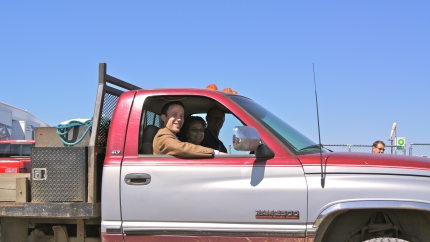
Chair Sutley and Jay Jensen greet the camera before exploring the public-private partnerships that are helping to make Grant County, Oregon, a leader in advancing our Nation's clean energy future. (Photo Credit: Sustainable Northwest)
Posted by Cassandra Moseley:
Grant County is a dramatic, arid landscape where, for generations, people have made their livelihoods working the land. But by the late 1990s, battered by a changing global economy and a two-decade conflict over federal land management, businesses had closed, jobs disappeared, and many families had left. In the early-2000s, looking for new solutions, community leaders decided it was time to talk instead of yell. They reached out to their neighbors, environmentalists, and timber industry representatives. These conversations turned into collaboration and then into innovation. They found a willing partner in the U.S. Forest Service. In 2009, the Forest Service's Malheur National Forest began awarding innovative stewardship contracts to implement their restoration projects. Federal investments in forest restoration in Oregon create jobs and these investments create even more jobs when the byproducts of restoration – small trees – are turned into value-added products and energy.
With ecological goals at the forefront, the harvested trees are small. To take advantage of this new timber supply, folks again innovated. The Malheur Lumber Company partnered with an energy company to integrate a new pellet and biobrick facility into their sawmill. With little private financing available, they used a USDA Recovery Act grant, New Market Tax Credits, and other federal programs to fund construction. Today, these products are helping to cleanly heat homes, the local airport, and hospital, while reducing heating costs, decreasing dependence on foreign oil, and creating jobs.
The President's proposed fiscal year 2012 Forest Service budget would accelerate similar innovation in communities like Grant County. By combining line items that contribute to restoration, this modernized budget structure would allow the agency to break out of its silos, address complex problems, integrate restoration and job creation, and improve partnerships.
Cassandra Moseley is the Director of the Ecosystem Workforce Program and Institute for a Sustainable Environment at the University of Oregon
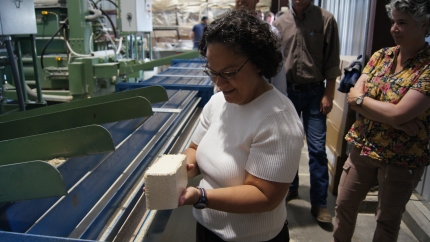
Chair Nancy Sutley visits the Malheur Lumber Company to witness how its innovative pellet and biobricks are created. (Photo Credit: Sustainable Northwest)
Posted by Maia Enzer and Chad Davis:
Transforming our economy while stewarding vast landscapes requires local, regional and national partnerships. That is why Sustainable Northwest and our partners launched the Dry Forest Investment Zone, an initiative catalyzed by the U.S. Endowment for Forestry and Communities' $2 million investment to build strong forest-based rural economies.
Public and private partnerships are critical to achieving results in rural communities. The addition of a pellet mill at Malheur Lumber Company in John Day is a great example. Supply is secured through forest restoration projects. Pellets are being used as a source of renewable energy to provide heat at several community facilities. The use of wood pellet fuel reduces energy costs and offsets the consumption of imported petroleum-based heating fuels keeping dollars spent on local energy.
Throughout our history, rural America has been a stronghold of innovation and resilience. We hope the Rural Council will glean successful models from the entrepreneurial vision of communities like John Day. We need strong conservation-based rural economies. Rural America is where our food, fiber and energy come from, it's where we vacation, and it’s these places that our art and music celebrate. Ultimately, it's these places that will define the future of America.
Maia Enzer is the Policy Director and Chad Davis is the Forest Stewardship Director at Sustainable Northwest
Learn more about Energy and Environment, Rural
- &lsaquo previous
- …
- 110
- 111
- 112
- 113
- 114
- 115
- 116
- 117
- 118
- …
- next &rsaquo
Related Videos
-
 May 09, 2014 9:21 AM
Inside the White House: Solar Panels
-
 September 01, 2016 9:25 PM
President Obama Delivers a Statement to the Press
White House Blogs
- The White House Blog
- Middle Class Task Force
- Council of Economic Advisers
- Council on Environmental Quality
- Council on Women and Girls
- Office of Intergovernmental Affairs
- Office of Management and Budget
- Office of Public Engagement
- Office of Science & Tech Policy
- Office of Urban Affairs
- Open Government
- Faith and Neighborhood Partnerships
- Social Innovation and Civic Participation
- US Trade Representative
- Office National Drug Control Policy