Energy and Environment Latest News
Now Is Not the Time to Wave the White Flag on Clean Energy Jobs
Posted by on October 4, 2011 at 1:26 PM EDTThis morning, Chairman Cliff Stearns, who leads the House Energy and Commerce Subcommittee on Oversight and Investigations, told NPR that "We can't compete with China to make solar panels and wind turbines."
This comment reflects exactly the sort of counterproductive defeatism that Energy Secretary Steven Chu warned against this weekend when he spoke to a group of America’s most promising young solar innovators:
“The United States faces a choice today: Will we sit on the sidelines and fall behind or will we play to win the clean energy race? Some say this is a race America can’t win. They’re ready to wave the white flag and declare defeat… Others say this is a race America shouldn’t even be in. They say we can’t afford to invest in clean energy. I say we can’t afford not to.
“It’s not enough for our country to invent clean energy technologies – we have to make them and use them too. Invented in America, made in America, and sold around the world – that’s how we’ll create good jobs and lead in the 21st century.”
The race for clean energy jobs and industries is on – and it is a race well worth winning. The International Energy Agency projects that in the coming decades, solar power could grow to more than 20 percent of the world’s electricity. Conservatively, this means that there is an economic opportunity worth trillions of dollars for whichever countries claim the lead. The global market for wind turbines is also growing exponentially.
But it’s not just the vast potential of jobs tomorrow – these industries employ a growing number of Americans today. In fact, business groups estimate that America’s solar industry accounts for about 100,000 jobs and the wind industry employs 75,000. Should we simply tell those workers that we’ve given up on them?
A study released last month showed that, in spite of the intense global competition, the U.S. remains a net global exporter of solar technology – with $5.6 billion in exports and an overall positive trade balance of $1.8 billion.
It is certainly true that China is playing to win. Last year alone, China offered its solar manufacturers $30 billion in government financing, vastly exceeding the U.S. investment. And China has overtaken the United States market share in solar power – a technology we invented.
Chairman Stearns and other members of his party in Congress believe that America cannot, or should not, try to compete for jobs in a cutting edge and rapidly growing industry. We simply disagree: the answer to this challenge is not to wave the white flag and give up on American workers. America has never declared defeat after a single setback – and we shouldn’t start now.
America’s entrepreneurs and innovators are still the very best in the world. Our workers are second to none – and we have never been afraid of a challenge. It’s time to do what we’ve always done in the face of a tough competitor: roll up our sleeves and recapture the lead.
An Energy Efficiency Leader at the Department of the Navy
Posted by on October 4, 2011 at 11:55 AM EDTEditor's Note: This blog introduces readers to Kateri Callahan, president of the Alliance to Save Energy, a DC-based nonprofit promoting energy efficiency.
Since assuming her post as the Navy's chief official on energy matters in March 2010, Assistant Secretary of the Navy (Energy, Installations and Environment) Jackalyne Pfannenstiel has been managing over 75,000 buildings and facilities that support Navy and Marine operations around the world. Her sharp focus on energy efficiency has far-reaching impacts within and beyond the military, and it's why she has been selected as the 2011 recipient of the Alliance to Save Energy's Chairman's Award.
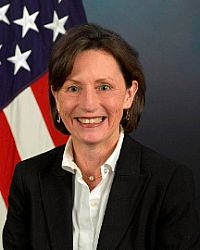
The Honorable Jackalyne Pfannenstiel, Assistant Secretary of the Navy (Energy, Installations and Environment)
Pfannenstiel believes the Navy must be innovative in the way it uses energy in global missions. When President Obama issued his Executive Order 13514 in 2009 directing Federal agencies to lead in energy, environmental, and economic performance, he lead the way for exactly this type of innovation. At the Alliance, we encourage all government agencies to follow Pfannenstiel’s example by embracing energy efficiency initiatives to demonstrate the remarkable potential of energy efficiency in replicable, achievable ways.
Our Honorary Chair, Senator Jeanne Shaheen, selected Pfannenstiel for her career-long efforts to drive energy efficiency through her creativity, commitment and innovation. She has worked in both the public and private sectors to save energy for consumers, businesses and governments alike. In this position she now has the opportunity to have an even greater impact, saving the Federal Government and taxpayers money that can be used for other important needs while keeping our country safe.
As with its Great White Fleet of 1907, the U.S. Navy is again leading the way as a military power, this time with its "Great Green Fleet" that heavily emphasizes energy efficiency as a first step toward energy independence. With the "Great Green Fleet," the Navy has pledged to:
• Reduce petroleum use in its commercial vehicle fleet by 50% by 2015;
• Produce 50% of shore-based energy from alternatives sources by 2020; and
• Achieve net-zero energy use in 50% of Navy installations by 2020.In addition, Pfannenstiel hopes military research and development will drive energy efficiency technology, in the same way that it embraced now-common public technologies like the Internet and GPS.
Assistant Secretary Pfannenstiel has amply demonstrated her commitment to energy efficiency, and we look forward to honoring her and other remarkable energy efficiency champions at our Awards dinner this evening.
Learn more about Energy and EnvironmentFor the Win: Riding the Green School Bus
Posted by on September 30, 2011 at 4:31 PM EDTFor the Win is a guest blog series featuring the remarkable initiatives that young Americans are advancing to win the future for their communities. Each week we highlight a new young person and learn about their inspiring work through their own words. Submit your story to appear in the For the Win guest blog series.
Jonny Cohen is a junior at Highland Park High School in Highland Park, Il. He is an inventor and experimenter as well as the founder of GreenShields. He is constantly working to help the environment. Jonny is a member of the 2011 PARADE All-America High School Service Team, an award recognizing outstanding young service leaders presented by PARADE Magazine in partnership with generationOn, the global youth service division of Points of Light Institute:

Johnny Cohen (Photo courtesy of Points of Light Institute)
When I walk to school, I notice things. In seventh grade I noticed that school buses parked in front of my junior high were spewing exhaust and something had to be done to make this better. Then it hit me! The shape of the school bus was not aerodynamic. I had taken a Saturday class in aerodynamics at Northwestern University. I thought that maybe a shield angled on the front of the school bus that was clear and plastic could redirect the airflow and this could save gas. I told my older sister, Azza, and she liked the idea. (Side note: there were a lot of other ideas that involved loud noises and homemade rockets that she was not a fan of!)
I went to see Mr. Kunal Pujara, the physics teacher at Highland Park High School and he encouraged me to explore more. I entered a Youth Venture science contest, won a grant and built my own wind tunnel in the garage with a leaf blower to test school bus models. I knew I needed a team, so I asked Azza and her friends to help. I went to a Youth Venture Summit and met with other inspiring teens, which encouraged me to enter the Pepsi Refresh contest, where I won another grant. To receive the Pepsi grant I used Facebook and emailed everyone I knew to get people to vote for my project. I never thought I could win! Online voting seemed impossible and I didn’t want to bother people. But you know what? I pushed myself. I sat in the grocery store on weekends and I made presentations at city hall, all the while asking people in my town to vote for my idea so I could get the funding I needed!
In March of my freshman year I was notified that I had won a $25,000 grant and was interviewed on Good Morning America! The computer drawings I brought with me were made by my friend and fellow student team member, Alex Berkowitz. We worked all weekend on them and I was so excited! I realized that I could finally build and test my idea, but I knew that I needed more smart people to help me. I sent out emails and Northwestern University answered. For the past two summers I have had the privilege to work on this project, which I have since named GreenShields with project advisor, Stacy Benjamin and engineering interns, Tim Healy and Matt Filak. There have been ups and downs but that is exactly what makes solving a problem fun.
The first prototype worked, we saved about 28 percent gas mileage, but it was big, heavy and took time to install. We have been working to make it smaller, lighter and easier to attach. We tested other materials, some worked and some didn’t. We are considering a new scoop design. This is engineering and we need to keep trying until we find an answer.
The most important lesson that I’ve learned is that it’s ok to think up crazy ideas and share them, even when other people might think it’s not possible. As I always say, try to see things not the way they are, but how they could be. Don't be afraid to think or say something different. That crazy idea of yours just might help solve a problem for the environment and the world!
NASA Contest Heralds Dawn of the Electric Plane
Posted by on September 30, 2011 at 1:54 PM EDT
Team members of the e-Genius aircraft prepare their plane prior to competition as part of the 2011 Green Flight Challenge, sponsored by Google, at the Charles M. Schulz Sonoma County Airport in Santa Rosa, Calif. on Monday, Sept. 26, 2011. NASA and the Comparative Aircraft Flight Efficiency (CAFE) Foundation are having the challenge with the goal to advance technologies in fuel efficiency and reduced emissions with cleaner renewable fuels and electric aircraft. (Photo Courtesy NASA/Bill Ingalls)
In addition to NASA's missions in space that amaze the world, our work in aeronautics continues to spur innovation and jobs.
NASA is providing the $1.65 million prize purse for the Comparative Aircraft Flight Efficiency (CAFE) Foundation Green Flight Challenge competition, sponsored by Google, taking place this week outside of Santa Rosa, Calif.
The purse is the largest aviation prize in history and attracted 13 teams, all led by American innovators. Three teams successfully completed aircraft and flight qualification requirements and are competing for the purse. Teams are flying electric and biofueled powered aircraft to prove they have the most fuel efficient, small aircraft in the world.
To win the competition, an aircraft must fly 200 miles in less than two hours and use less than one gallon of fuel per occupant, or the equivalent in electricity.
Why is NASA sponsoring the competition?
NASA-funded prize competitions establish an important goal without having to choose the approach or the team that is most likely to succeed. NASA pays only for results. The competitions highlight excellence in a particular domain of human endeavor to motivate, inspire, and guide others.
NASA prize competitions increase the number and diversity of the individuals, organizations, and teams that are addressing a particular problem or challenge of national or international. They stimulate private sector investment that is many times greater than the cash value of the prize, while furthering NASA's mission by attracting more interest and attention to a defined program, activity, or issue of concern. And they capture the public imagination and change their perception of what is possible.
Aerospace remains a strong component of our national fabric and is the largest positive contributor to our nation’s trade balance. However, this technological leadership position is not a given. To remain the leader in aerospace technology, we must continue to perform research and invest in the people who will create the breakthroughs of tomorrow.
The CAFE Green Flight Challenge, sponsored by Google, may be the birth of a new segment of the aviation industry. This competition represents the dawn of a new era in efficient flight and is the first time that full-scale electric aircraft have performed in competition. The technologies demonstrated by the winning plane may end up in general aviation aircraft, spawning new jobs and new industries for the 21st century.
For photos of the Green Flight Challenge, visit:
http://www.flickr.com/photos/nasahqphoto
Charles Bolden is Administrator of NASA
Learn more about Energy and Environment, TechnologySacred Power: Growing Jobs and Nurturing Communities
Posted by on September 22, 2011 at 6:25 PM EDTSacred Power Corporation (SPC) was established in 2001 as Native American owned and operated small business that provides renewable energy solutions to government, commercial and residential customers. "Using the strengths of the Father to Protect the Gifts of the Mother" is our guiding principle, and it has guided us to success.
SPC has always been at the forefront of renewable energy innovation, beginning with our installation of the first solar carport structure in the State of New Mexico. Nearly eleven years later, that same carport is generating clean energy for the Indian Pueblo Cultural Center in Albuquerque, NM. With funding from the American Reinvestment and Recovery Act and the support of the Obama Administration, we have now put large-scale renewable energy installations in New Mexico Schools for the first time. This allowed SPC to hire people at a time when jobs are scarce. With hundreds of installations across the U.S, SPC now employs 59 people from all disciplines, including engineers, electricians, installers, and office and administrative staff. We're also working with teachers to help them educate and inspire students about the great potential of green technology and green jobs in our communities. And we're working with Tribal Nations on the construction of energy efficient and solar powered Housing and Urban Development homes for lower-income Americans, who spend much of their earnings on their energy bills.
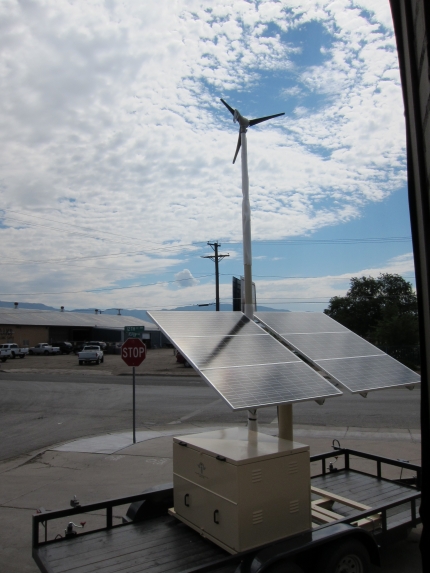
Sacred Power's portable solar array/wind turbine combination is transported to nearby schools for clean and efficient energy use.
SPC's patented stand-alone solar generators provide cost effective rural electrification for Native American homes. This power provides refrigeration for fresh foods, milk, and medicines, and for basic home needs. Unfortunately, there are over 10,000 of these “off-grid” homes scattered across Native Lands in the desert southwest without power, fuel or running water. SPC systems have already helped hundreds of senior citizens, single parent and low income families.
We are proud to have over ten Tribal Nations represented among our employees. And we are proud that our remote power systems, energy efficient telecommunication shelters, and grid tie photovoltaic power generators have served public sector customers of Tribal Nations, the U.S. Military, Department of Defense, Department of Energy, U.S. Forest Service, and NASA, to name a few.
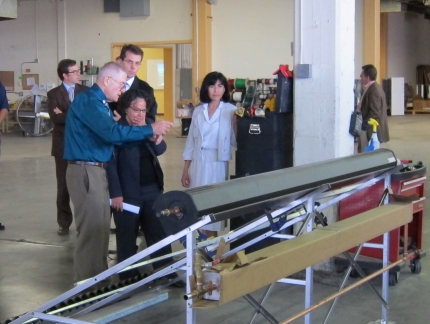
CEQ Chair Sutley tours Sacred Power Corporation.
At SPC, we know firsthand the potential of renewable energy and green technology to provide good jobs. We hope to take advantage of this potential to continue to grow and sustain our community for years to come.
David Melton is Chief Executive Officer of Sacred Power Corporation
Learn more about Energy and EnvironmentInstructions for Implementing Sustainable Locations for Federal Facilities
Posted by on September 16, 2011 at 6:10 PM EDTFederal agency location decisions represent significant opportunities to design, construct, maintain, and operate high performance sustainable buildings in sustainable locations, and strengthen the vitality and livability of the communities. Federal, state, and local governments invest significant resources in promoting economic development, increasing availability of affordable housing, providing transportation choices, and ensuring environmental stewardship. Federal agencies have a duty to make responsible choices in location decisions and it is important that agencies have clear guidance for achieving a balanced approach towards sustainable locations.
On September 15, 2011, in accordance with Executive Order 13514 to have an integrated strategy toward sustainability in the Federal Government, the Council on Environmental Quality (CEQ) issued a set of implementing instructions to provide direction to all Federal agencies seeking to acquire or develop owned or leased space as well as anticipated moves, expansions or consolidations that significantly impact the overall built environment and community, such as transportation (i.e., vehicle miles traveled, commuting time, congestion), infrastructure, economic development, water and air quality. These instructions will improve Federal agency sustainability performance by ensuring a balanced evaluation between land use and the built environment, cost, security, mission need and competition on facility location decision-making.
Federal agencies will be required to review agency business practices and develop internal policies and procedures that align their facility decision-making to the following recommended Principles:
1. Advance local and regional planning goals
a) Consider sustainable locations from a regional perspective, consulting with local officials and considering their recommendations
b) Consider recommendations of local officials in light of Federal sustainability goals
2. Seek location-efficient sites
a) Prioritize central business districts and rural town centers
b) Prioritize locations that promote transportation choice
c) Promote walkable and bikeable sites
d) Locate in areas that are accessible to a diverse range of employees and visitors
3 .Maximize use of existing resources
a) Leverage investment in existing infrastructure
b) Prioritize brownfield/grayfield and infill development
c) Promote the preservation of historic resources and other existing buildings
d) Maximize use of existing Federal space
4. Foster the protection of the natural environment
a) Preserve existing ecosystems
b) Avoid development of green space
c) Promote climate change adaptation planning
5. Review workplace standards to promote more efficient facility development
6. Reduce parking demand for single occupancy vehicles
Finally, CEQ will provide Federal agencies assistance in meeting the requirements of the implementing instructions through the annual reporting of the strategic sustainability performance plans. Click here to read the implementing instructions.
Michelle Moore is the Federal Environmental Executive at the Council on Environmental Quality
Learn more about Energy and Environment
- &lsaquo previous
- …
- 107
- 108
- 109
- 110
- 111
- 112
- 113
- 114
- 115
- …
- next &rsaquo
Related Videos
-
 May 09, 2014 9:21 AM
Inside the White House: Solar Panels
-
 September 01, 2016 9:25 PM
President Obama Delivers a Statement to the Press
White House Blogs
- The White House Blog
- Middle Class Task Force
- Council of Economic Advisers
- Council on Environmental Quality
- Council on Women and Girls
- Office of Intergovernmental Affairs
- Office of Management and Budget
- Office of Public Engagement
- Office of Science & Tech Policy
- Office of Urban Affairs
- Open Government
- Faith and Neighborhood Partnerships
- Social Innovation and Civic Participation
- US Trade Representative
- Office National Drug Control Policy