




Energy and Environment Latest News
Supporting Veterans: "We have a plan, now we need community progress"
Posted by on September 9, 2011 at 3:45 PM EDTIn the next five-to-six years over one million servicemembers are projected to leave the military and return to their communities all across this country. While today these great Americans are 'employed' by the Department of Defense they will soon leave that structured and familiar life to become veterans (and family members) of their armed forces, which for many served as the singular source of great pride, confidence and comfort throughout a decade of prolonged and grueling combat, separation and loss.
I for one am worried, for if what we see every day in our organization continues, these men and women are in for some real challenges. In many ways, Rochester, New York is a blessed community – caring, giving, and trying to do its best - but we are just one community. Western New York is second only to Metropolitan New York City with regard to its veteran (and family member) population. Our organization – Veterans Outreach Center, Inc. – is woven into that community fabric as the nation's oldest independent and community-based non-profit serving veterans and their family members. The community tells me frequently that we're lucky in this community, because here we have an organization whose mission in life is to serve veterans and their families.
Other communities are not so lucky and geography seemingly takes on greater importance when becoming a veteran. Geography seems to matter because where you choose to live can ultimately have a direct bearing on the level of resources available to support veterans' needs. Some will be fortunate, others may not be so fortunate. The time has come to recognize that caring for veterans (and their families) is not just the Government's job; it is instead every community's business to embrace veterans for their example, their commitment to serving others, and their passion for service.
We have a plan – the President has articulated well this Administration's commitment to serving veterans and their families – whether in the form of greater and predictable funding for VA healthcare, expansion of veterans benefits (including education and job training), or the First Lady's Joining Forces Challenge for communities to become more involved in the responsibility to care for those currently serving in our armed forces or now as veterans. Just last month the President and Administration added more value to the plan by pledging to commit additional resources to specifically help all servicemembers transition from service and find meaningful employment, perhaps the biggest challenge faced by today's veterans and families.
At a time when some question where we're headed as a Nation, I know one thing: our commitment to those who serve their country is unwavering. That commitment is on plan and now it's time for progress, real progress, not by Government so much as by communities.
Now we need community progress – Every community has the opportunity to contribute, small and large. Employers can. Colleges can. Healthcare providers can. Businesses can. Our community dedicates a portion of their giving every day, whether through volunteerism or otherwise. Rochester, New York has a rallying point in its arsenal of caring – Veterans Outreach Center, Inc – and all communities could have such a unifying force if they took inventory of their strengths available through citizenship and example.
Colonel James D. McDonough, Jr., U.S. Army (Retired), is President & CEO, Veterans Outreach Center, Inc.
Learn more about Energy and Environment, VeteransJumpstarting Jobs, Enhancing Education: The American Jobs Act
Posted by on September 9, 2011 at 12:55 PM EDTCommunities across the country agree that providing high-quality education for our children is critical to building a strong, sustainable economic future. To keep our nation competitive, our students need an education that enables them to succeed in a global economy. Yet, the American Society of Civil Engineers currently rates the quality of our nation's public school infrastructure a "D." Similarly, the National Research Council found that ventilation rates in many schools are inadequate, and that providing sufficient fresh air will improve students' comfort and productivity. To fulfill our commitment to high-quality education, we must start by providing our children with safe and healthy schools in which they can learn.
Last night, the President proposed the American Jobs Act, which includes a $30 billion investment to do just that – putting Americans back on the job, and modernizing at least 35,000 public schools. Improvements range from emergency repair and renovation projects, enhancing school health and safety through abatement of environmental contaminants, greening and energy efficiency upgrades, and modernization efforts to build new science and computer labs and Internet-ready classrooms. As anchors for their communities at large, local school districts will also be able to invest in shared spaces ranging from school ground outdoor learning and play areas to adult vocational and job development centers. To ensure that schools in the most disrepair will be able to make necessary enhancements, 40 percent of these funds will be directed toward the 100 largest high-need public school districts. A portion of the $30 billion investment will go also toward modernizing facilities at community colleges. This investment will ensure that these local, bedrock education institutions have the facilities and equipment to address current workforce demands in today's highly technical and growing fields.
Rebuilding our Nation's schools will put hundreds of thousands of Americans – construction workers, engineers, maintenance workers, boiler repairmen and women, and electrical workers – back to work. These investments will create jobs, while improving classrooms and upgrading our schools to meet 21st century needs. See the overwhelming support the President's plan has already received from groups across the Nation:
David Terry, Executive Director, NASEO
"The National Association of State Energy Officials (NASEO) strongly supports expanded energy efficiency efforts in schools. We look forward to working with the White House and Congress on the implementation of this new $30 billion proposal. The State Energy Offices have been implementing energy efficiency programs in schools for decades. This infusion of capital, coupled with private sector partners such as energy services companies, could dramatically increase these critical efforts."Randi Weingarten, American Federation of Teachers
"Congress must pass this jobs package immediately so that students will have the teachers they need and fewer rundown schools; drivers will have better roads and bridges; and Americans will have better opportunities to get and keep good jobs, and have more money in their pockets. Tonight, President Obama made clear that we can and must do better. This package will help provide good jobs that support families; public services that build communities; and resources for schools to provide students a high-quality and robust education in safe and healthy buildings. President Obama also made it clear that the path to our future is through education. We have seen a loss of 300,000 education jobs since 2008 as well as long-delayed school repairs and modernization projects."Rick Fedrizzi, President, CEO and Founding Chair, U.S. Green Building Council
"The President's proposal tonight will go a long way toward jump starting jobs across every sector of the building community, a sector especially hard hit by the struggling economy. Energy retrofits especially are a cornerstone to broader economic recovery in every sector, and nowhere will that be more important than in our homes, our neighborhoods and our schools. In fact, there is a long list of school infrastructure improvements ready to go and awaiting funding. Not only could this mean great things for the economy and the millions of professionals in the building industry desperate to get back to work, it means great things for the health and well being of our children."James Dixon, Chairman, National Association of Energy Service Companies (NAESCO) and Vice President, Legal & Compliance Services at Con Edison, New York City
"The National Association of Energy Service Companies (NAESCO) supports the President's proposal to modernize public schools, because in addition to the obvious benefits to students and teachers of a vastly improved infrastructure we know from experience that modernization investment will create hundreds of thousands of jobs in the hard-hit construction industry. Over the past twenty years, NAESCO member energy service companies (ESCOs) have delivered about $15 billion of energy efficiency and renewable energy projects to public schools and community colleges and we estimate that every $1 million of project value creates about 10 direct jobs in engineering, construction and equipment manufacturing, professions that have been the hardest hit by the recession. The multiplier effect of the income created by these direct jobs provides another 10-12 indirect and induced jobs per $1 million of project value. Thus, we believe that the President's proposal to invest $30 billion in the modernization of public schools has the potential to create more than a half million jobs.
Furthermore, this potential job creation from the federal government investment can be significantly leveraged by private investment in the energy efficiency and renewable energy aspects of school modernization projects. NAESCO member companies deliver on average $3 billion of energy efficiency projects each year to schools, colleges and local governments. The projects are financed by private investment, which is repaid from the energy savings resulting from infrastructure improvement which lower energy use. The Lawrence Berkeley National Laboratory has estimated that K-12 schools across the country need at least $25 billion of energy efficiency improvements, which can be financed by private investment and paid for with energy and maintenance savings. The total jobs creation potential of a program that combines the federal government investment proposed by the President with the private investment that finances the energy efficiency and renewable energy infrastructure improvements will in all likelihood exceed 1 million jobs."Kevin Surace, CEO, Serious Energy
"Improving education is a national priority that needs to be tackled with attention paid to developing the economy as a whole – including creating jobs and decreasing our overall energy consumption. There is no greater imperative, and no better place to aggressively put these initiatives in place than within our education infrastructure. The President's proposed American Jobs Act does just that. No initiative will produce more value to our schools and communities, nor provide greater energy impact to our nation. We must get serious about energy, and about delivering this energy savings in a manner that is realistic, capital efficient, and achievable in today's economic environment. Our SeriousCapital energy efficiency financing solutions break through the cost barriers that will enable our schools to fund energy efficiency projects to save money and ensure dollars are spent where they matter most – on the programs that serve our students and our teachers."Daryl Dulaney, CEO, Siemens Industry Inc.
"There is little doubt that the President's proposal to improve the health, safety and energy efficiency of schools would have a tremendously positive impact, not only on students and their learning environments but also as an economic driver that will create well-paying, skilled jobs for thousands of Americans. The nation's 17,450 K-12 school districts spend more than $6 billion annually on energy. Fortunately, our experience has shown that via comprehensive energy efficiency improvements, virtually every school building in the United States has the potential to reduce energy consumption by as much as 30 percent. These savings will have a direct and immediate effect – both on the financial health and sustainability of our schools as well as the economic well-being of millions of Americans."David J. Anderson, Executive Vice President, Ameresco, Inc.
"Energy smart schools with state-of-the-art technologies are a cornerstone to a quality education for all of our students and future leaders. Ameresco supports the modernization of America's educational facilities. With the proposed investments, we can restore aging infrastructure, upgrade facilities with energy efficient technology, create local jobs, significantly reduce utility costs, and provide a safe learning environment – one free of mercury, PCBs and other hazardous materials. By investing in our school districts, comprehensive energy efficiency and renewable energy solutions will help create a more environmentally friendly and sustainable future with less reliance on fossil fuels. The added benefits include lower utility costs that will allow educators to redirect those critical dollars for other important needs such as saving teachers’ jobs and funding extracurricular activities. Upgrade schools. Create more jobs. Save money. Enhance America’s educational system. Why wouldn't we invest?"Jeff Drees, US Country President, Schneider Electric
"The President's plan to modernize public schools through energy efficiency upgrades is good for taxpayers, the school's financial budget, the local community and local job creation, and will improve our children’s learning environments. Alternative financing mechanisms such as Energy Savings Performance Contracts are the best way to accomplish this without capital investment, as energy improvements pay for themselves with the dollar savings they generate. What better way to educate our youth about energy efficiency and environmental responsibility than to lead by example in the schools they attend every day."Dan Domenech, Executive Director, American Association of School Administrators
"The American Jobs Act would devote $25 billion to the renovation of 35,000 schools and $30 billion to preventing the layoff of 280,000 teachers. Keeping teachers in our classrooms is essential to meeting the educational needs of our students. Creating jobs that will make much needed repairs to our schools is a win-win situation. We urge Congress to move towards the immediate passage of the American Jobs Act."Michael P. O'Brien, President and CEO of the Window & Door Manufacturing Association
"The Window & Door Manufacturers Association has been a longtime proponent of improving the energy efficiency of our nation's existing building stock, which consumes nearly forty percent of the nation's energy. At the same time, investing in energy efficient building upgrades helps create and preserve jobs in the severely depressed building industry. The President's school modernization proposal has the potential for both a positive impact on energy efficiency and job creation at a time when both are sorely needed and WDMA applauds such efforts."David Foster, Executive Director, BlueGreen Alliance
"We are especially pleased with the President's proposal to modernize America's schools. A green school in every community will be a living symbol of how to put America back to work, improve the health of our children and teachers, and move our economy closer to a clean energy future. School modernization creates jobs for construction workers and demand for the energy efficiency products made in America's factories."Johnson Controls Inc.
"We are encouraged by the President's call to include the retrofitting of America's schools with energy efficiency upgrades in the proposed American Jobs Act. Those of us already engaged in retrofitting buildings see the impact on job creation every day: there are new jobs in old buildings, including our nation's schools. Most of the schools across the country were built long before energy efficiency was a concern. They are older, dated facilities and consume a great deal of energy. A school's largest operational expense is paying for energy and they are spending about 25-30% more than they should, according to the U.S. Department of Energy. That money could and should be redirected for educational purposes. The additional good news is that money spent on energy efficiency upgrades has a payback based on reduce energy and operational costs after the work is completed. As a leader in energy retrofits for public and private institutions, Johnson Controls has worked with school districts across the country to improve energy efficiency, enabling them to redirect savings for educational purposes, while at the same time putting people to work in local communities. Improving the energy efficiency of schools is one of the key investments we can make: it helps reduce energy costs, improves the school environment, creates local jobs and pays for itself."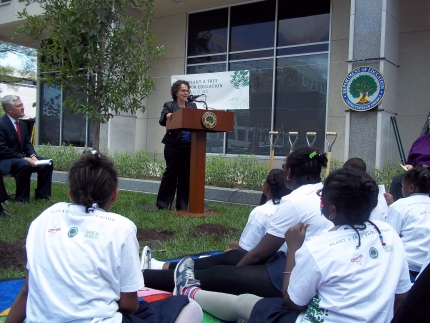
CEQ Chair Sutley speaks to students at the U.S. Department of Education's "official tree" planting and unveiling of the Green Ribbon Schools program in April 2011.
Larry Schweiger, President and CEO of the National Wildlife Federation, sponsor of Eco-Schools USA
"The President's plan to modernize America's schools and make them cleaner and safer for students though the American Jobs Act is also an opportunity for them to be greener and more energy efficient. This will help student health and learning, support job creation and decrease the schools' environmental footprints."Anne L. Bryant, Executive Director, The National School Boards Association (NSBA)
"In the face of massive budget shortfalls and education layoffs at school districts across the country, this new funding would provide necessary aid to America's schools. Our school children deserve a quality education and that cannot happen when their teachers are getting laid off and their school buildings are in need of repairs and upgrades that keep getting postponed due to budget cuts."Jeffrey King, Executive Director, Clean Economy Development Center
"The President’s proposal to modernize 35,000 American schools will create family-supporting jobs and new public-private partnerships in communities all across the country. It is also a critical step toward making America's future workforce more skilled and more competitive. The Clean Economy Development Center will do its part by helping local leaders to build the public-private partnerships required to modernize our schools, create jobs and grow America's clean economy."Bob Wise, President, Alliance for Excellent Education, and former governor of West Virginia
"The nation's schools are in need of an upgrade in order to provide students with a 21st century education. Technology is changing nearly every facet of life, and we must capitalize on the opportunities offered by technology to strengthen the nation’s schools. The President’s school modernization proposal would help schools develop the technological infrastructure to strengthen instruction and prepare our students for success in college and careers. This investment in schools today will pay large dividends in the future."National Indian Education Association
"The NIEA supports the President's plan to invest $30 billion dollars in our public schools, community and tribal colleges. At present 63 of 183 (approximately one third) of federal schools for American Indians administered by the federal government's Bureau of Indian Affairs are in poor condition, making it unsafe and difficult for Indian children to learn. The NIEA supports this proposal because it will create jobs and economic development in rural and tribal communities where these BIA schools and tribal community colleges are located. The President's proposal is a win-win for Indians because it will create jobs and economic development and will enable our Indian students to attend safe schools."Leilani Bell, National Student President, Future Educators Association/PDK International Family of Associations
"After hearing President Obama's speech last night, I felt inspired to continue my education and fulfill my dream of becoming a teacher. My goal is to teach in an urban school that is outfitted with cutting-edge technology like what the President described. As a future teacher I realize the importance of not just being a quality teacher, but in having the tools and the environment that will inspire students to want to stay in school and to learn. It's encouraging to know that the President recognizes this too."Cheryl Scott Williams, Executive Director, Learning First Alliance
"I fully support President Obama's initiative and agree that every child deserves a great school and that we have a responsibility to one another to act as one nation and one people in support of ensuring a great education for all our students. Modernizing aging school buildings and putting teachers back to work on behalf of America's students are key to making that vision a reality."Nancy Sutley is Chair of the White House Council on Environmental Quality
Investing in Communities: The American Jobs Act
Posted by on September 9, 2011 at 5:15 AM EDTLast night, President Obama laid out a bold plan to create jobs and build a stronger economy. Urging Congress to end the political gridlock in Washington, the President called on Congress to pass the American Jobs Act to enable the Federal Government to meet its responsibilities to the American people. Across the country, I have seen firsthand how Federal investments and initiatives help businesses and communities strengthen local economies and jobs.
Today in Rochester, New York, I will visit with workers and employers at the city's Veterans Outreach Center, a program in partnership with New York State's Boards of Cooperative Educational Services (BOCES), that has leveraged a Department of Labor grant to successfully train and place 90 percent of their graduates, our Nation's military veterans, into full-time, green technology jobs. As the President has said, we have hundreds of thousands of bright, skilled Americans who return from military service with unmatched leadership and technical skills. When given the resources, our veterans successfully translate their talents to the civilian workforce. The American Jobs Act puts more people back to work – veterans returning from Iraq and Afghanistan, teachers laid off from state budget cuts, first responders, and construction workers rebuilding our roads, bridges, and schools.
As seen in Rochester, there is demand for clean energy and energy efficiency products, services, and jobs. As an Administration, we're making sure we do everything we can to grow those markets and jobs right here in America. The President's proposal includes robust investments to modernize at least 35,000 public schools to put Americans to work and provide our students with high-quality education and safe and healthy schools in which they can learn.
These immediate job creation ideas also include tax cuts for small businesses to help them hire and grow. It includes a combination of direct spending, such as infrastructure investments, tax relief, and an extension of the payroll tax cut. Supported by both Republicans and Democrats, the President's package will put more people back to work and put more money in the pockets of working Americans – without adding to the deficit. With the Federal Government's investments and incentives put forth in the American Jobs Act, communities all over the country can continue to foster lasting progress for our economy and families. Congress should act immediately when they receive this legislation next week.
Nancy Sutley is Chair of the White House Council on Environmental Quality
Nominate Yourself or Someone You Know for the National Ocean Council's Advisory Committee
Posted by on September 6, 2011 at 1:14 PM EDTThroughout the first year of the National Ocean Council's work, one of our driving goals has been to provide opportunities for the public, stakeholders, non-federal members of the ocean community and beyond to provide your thoughts on implementing the National Ocean Policy.
We opened a public scoping phase in January of this year to get initial thoughts on strategic action plans for the nine priority objectives highlighted in the policy. Throughout June, we held public regional listening sessions to hear directly from you on outlines for these plans and other aspects of the policy implementation. June also saw the opening of a web-based public comment period on the outlines. In late June, we kicked off activities to initiate coastal and marine spatial planning with a national workshop that included a day of public participation. Through all of these efforts we have received very valuable input from you.
We are now very pleased to let you know of a different sort of opportunity to become involved in the National Ocean Council's work. The Council's formal advisory committee, the Ocean Research Advisory Panel (ORAP), is seeking nominations for members.
As an official Federal Advisory Committee, ORAP provides advice to the Council on policies, procedures, and other responsibilities relevant to implementation of the National Ocean Policy. Current ORAP members include representatives of the National Academies, ocean industries, State governments, academia, and others, including eminent individuals in the fields of marine science, marine policy, and related areas such as ocean resource management. Six seats will become vacant in the summer of 2012, and the goal is to balance ORAP membership to the extent possible to capture a range of geographic and sector representation and experience.
Anyone (including any organization) may nominate qualified individuals (including oneself) for membership on the panel. The deadline is September 15, 2011. The Federal Register notice provides all the details you need to officially submit a nomination.
We hope you will consider this opportunity to contribute to the expert advice the Council seeks as we move into our second year of improving our Nation's economy, environment, and future through the National Ocean Policy.
Jay Jensen is Associate Director for Land and Water Ecosystems at the White House Council on Environmental Quality
Steve Fetter is Principal Assistant Director for Environment at the White House Office of Science and Technology Policy
Learn more about Energy and EnvironmentState and Local Officials Speak Out on President’s Commitment to Clean Air and a Strong Economy
Posted by on September 2, 2011 at 6:24 PM EDTOver the last two and half years the Obama Administration, under the leadership of EPA Administrator Lisa Jackson, has taken some of the strongest actions since the enactment of the Clean Air Act four decades ago to protect our environment and the health of our families from air pollution.
On Friday, President Obama asked Administrator Jackson to withdraw the draft Ozone National Ambient Air Quality Standards at this time, as work is already underway to update a 2006 review of the science that will result in the reconsideration of the ozone standard in 2013.
Several state and local officials spoke out about the President’s announcement and commitment to working with state and local governments.
Michigan Governor Rick Snyder:
“The President made the right decision to stop this move by the EPA. The present ozone standard was last reviewed a mere three years ago. Michigan companies have worked hard to meet the standard, because we all support a healthy environment. It is important to balance environmental goals with the need for economic development, particularly as Michigan and the rest of the nation work to recover from the recession”
Los Angeles Mayor Antonio Villaraigosa:
“In our current economic climate, we must do everything we can to stimulate the economy short of taking a step back in the unprecedented environmental gains this administration has already made. This is the sort of balanced approach we need to create jobs and also improve the quality of air, health and life for countless Americans.”
East Moline, Illinois Mayor John Thodos:
“We in the Quad Cities are very happy with the President’s announcement. We take clean air very seriously, but it’s difficult enough to create jobs without these new standards. I fully support the President’s decision.”
Texas State Representative Garnet Coleman:
“I want to thank President Obama and his administration for listening and working with state and local governments. Withdrawing the new standard allows an update of the science and the reconsideration of the ozone standard in 2013 while granting our state and local governments and businesses more regulatory certainty and flexibility. President Obama and his administration are strong partners with those of us on the state and local level of government in the fight for clean air and public health.”
Bettendorf, Iowa Mayor Mike Freemire:
“The standards are quite rigorous as they are, and the threat of new standards from a manufacturing standpoint aren’t helpful for the economy or growing jobs. It’s a prudent move. Everything is a balancing act. I applaud the President for his decision.”
Scott County, Iowa Board of Supervisors Chair Tom Sunderbruch:
“I certainly support the President's move to withdraw the draft Ozone National Ambient Air Quality Standards at this time…I think delaying the standard change is the right thing to do. I also believe making sure you have the right science to know what to do next is important. I believe those responsible for setting the regulations should continue to research the issue.”
Cecilia Muñoz is Deputy Assistant to the President and Director of Intergovernmental Affairs
Learn more about Energy and EnvironmentWest Wing Week 09/01/11, or "Goodnight, Irene"
Posted by on September 2, 2011 at 12:15 PM EDTWelcome to the West Wing Week, your guide to everything that's happening at 1600 Pennsylvania Ave. This week, the President led the federal response to Hurricane Irene, made a key nomination announcement, and addressed the American Legion's 93rd annual conference. That's August 26th to September 1st or "Goodnight, Irene."
- &lsaquo previous
- …
- 109
- 110
- 111
- 112
- 113
- 114
- 115
- 116
- 117
- …
- next &rsaquo
Related Videos
-
 May 09, 2014 9:21 AM
Inside the White House: Solar Panels
-
 September 01, 2016 9:25 PM
President Obama Delivers a Statement to the Press
White House Blogs
- The White House Blog
- Middle Class Task Force
- Council of Economic Advisers
- Council on Environmental Quality
- Council on Women and Girls
- Office of Intergovernmental Affairs
- Office of Management and Budget
- Office of Public Engagement
- Office of Science & Tech Policy
- Office of Urban Affairs
- Open Government
- Faith and Neighborhood Partnerships
- Social Innovation and Civic Participation
- US Trade Representative
- Office National Drug Control Policy