Energy and Environment Latest News
A Clear Commitment to Clean Water for America
Posted by on April 27, 2011 at 2:59 PM EDTClean water is the foundation of healthy communities. It is vital to everyone, from families who want safe drinking water, to fishermen and women who want to know their catch is safe to eat, to farmers who rely on it to grow their crops, and everyone in between. We understand the importance of clean water and healthy watersheds to our economy, to our environment and to our families.
Clean water has been a priority for this Administration from day one. Through an extensive set of policies and initiatives, we are working across Federal agencies, across governments and across sectors to use every tool in our toolbox to make sure Americans have the clean and healthy waters they need and deserve.
Today, we released a national clean water framework that affirms the Obama Administration’s comprehensive commitment to ensuring clean water and healthy waterways for American families, American communities, and the American economy. We're taking strong action to reduce contaminants in our drinking water by using the latest science to update drinking water standards, and by better protecting drinking water sources from pollution. We’re giving farmers incentives to reduce pollution, and giving landowners incentives to open up their lands for fishing, swimming, and other activities that promote public stewardship of our waters. We're working with states to make sure rural communities have affordable and modern clean water systems.
Learn more about Energy and EnvironmentDrawing Inspiration on Smart Grid Innovation from America’s Youth
Posted by on April 27, 2011 at 9:57 AM EDTLast week, I met two high school students who compelled their school to measure energy usage and—wouldn’t you know—empowered with this information, the school was able to realize a 13 percent energy reduction and a 250 percent return on investment.
These two young women, Shreya Indukuri and Daniela Lapidous, high school juniors at the Harker Upper School in San Jose, California, convinced their school administration to adopt simple off-the-shelf sub-metering technology which helped the school discover that the air conditioning switched on in the gymnasium each night.
Sparked by the ease at which such savings can be achieved, Shreya and Daniela founded their own non-profit organization, SmartPowerEd, which helps other schools in the Bay Area to save energy and money.
My colleagues and I, as part of the National Science and Technology Council’s Smart Grid Subcommittee, have been engaged on these issues over the last year. Consistent with the President’s commitment to an open government, members of the Subcommittee have reached out to over 100 stakeholders to better understand how the Federal Government can collaborate with partners across the country and set policies to make America’s electric grid smarter. Our outreach efforts have also included Department of Energy Requests for Information and a collaborative blog facilitated by the Office of Science and Technology Policy and the National Institute of Standards and Technology.
In fact, two weeks ago, we had the pleasure of hosting a coalition to discuss how the deployment of smart grid and smart building technologies can foster innovation in the energy sector, reduce energy waste, and help consumers save money on their electricity bills. At the meeting, participants emphasized the energy saving potential of enabling electronic access to energy data for all homes and buildings, including examples of how consumers are benefiting through a number of pilot programs around the country. The comments shared during this meeting will help inform our ongoing efforts to provide policy recommendations and guidance for development of the Administration’s Smart Grid policy. We also asked members of this group, as we have of other such groups, what efforts they were taking—like the students at SmartPowerEd—to enable consumers to use energy more efficiently.
Enabling greater levels of energy efficiency is part of why making America’s electric grid smarter is an important part of the President’s vision for a clean energy economy and is a critical part of our Nation’s ability to “out innovate” the global competition on energy technologies while helping Americans keep money in their pockets by lowering electricity bills.
Thanks for all of the input. Stay tuned for more.
Aneesh Chopra is U.S. Chief Technology Officer
Learn more about Energy and Environment, TechnologyCultivating the Seeds of Knowledge; Growing a Greener Future for our Nation
Posted by on April 26, 2011 at 5:50 PM EDT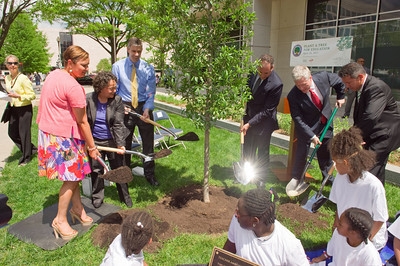
EPA Administrator Jackson, CEQ Chair Sutley and Secretary of Education Duncan plant a Texas Live Oak Tree outside of the U.S. Department of Education (Photo by Eric Vance, US EPA)
As the bitter chill of winter retreats, the vibrancy of spring beckons us outdoors reminding us of the inextricable link between the natural world and our daily lives. In striving to meet the President's challenge to win the future by out-educating the rest of the world, we must cultivate the environmental health of our learning spaces and our students’ understanding of their environment to enable them to meet the challenges of the future. Today, the Department of Education, the Environmental Protection Agency, and the White House Council on Environmental Quality came together to launch the Green Ribbon Schools Program. This program plants the seeds to move toward educational excellence for the future by recognizing schools that are creating healthy and sustainable learning environments - both inside and outside the classroom, teaching environmental literacy, and increasing environmental health by reducing their environmental footprint.
Led by the Department of Education, in close partnership with the EPA and CEQ, the Green Ribbon Schools program will incentivize and reward schools that help to ensure that our students receive an education second to none by improving the health and environmental footprint of nation’s schools. To prepare our children for the clean energy economy of the future, Green Ribbon schools will be those that incorporate science, technology, engineering, and mathematics (STEM), and environmental stewardship into their curricula.
Learn more about Energy and EnvironmentPresident Obama to Congress: "I Hope We Can All Agree That, Instead of Continuing to Subsidize Yesterday's Energy Sources, We Need to Invest in Tomorrow's"
Posted by on April 26, 2011 at 1:06 PM EDTThis afternoon the President wrote a letter to leaders of both parties in Congress on the subject of tax breaks for oil companies. The President's letter comes a day after Speaker of the House John Boehner said that eliminating those tax breaks is "certainly something we should be looking at," adding that, "We're in a time when the federal government's short on revenues. They ought to be paying their fair share." It comes a few weeks after the President included the proposal as part of his Blueprint for a Secure Energy Future.
The full text of the President's letter is below:
Dear Speaker Boehner, Senator Reid, Senator McConnell, and Representative Pelosi:
I am writing to urge you to take immediate action to eliminate unwarranted tax breaks for the oil and gas industry, and to use those dollars to invest in clean energy to reduce our dependence on foreign oil.
Learn more about Economy, Energy and EnvironmentPartners in Sustainability
Posted by on April 25, 2011 at 11:22 AM EDTLast week I had the opportunity to meet with representatives from Seattle area businesses and discuss ways we can work together to strengthen our nations clean energy economy. With the General Service Administration’s portfolio of nearly 10,000 federal buildings and influence over 400,000 federal vehicles we are uniquely positioned to move our government towards this goal. But we can’t do this alone -- that’s why GSA is working to facilitate conversations with private sector leaders that foster an exchange of ideas.
On my first stop in Seattle, I took part in a roundtable conversation with representatives from business, construction and design and academia to discuss the business case for green building. With GSA’s 370 million square feet of facility space it is imperative for us to invest in innovative clean energy technologies that make our buildings more cost and energy efficient for the American taxpayer. Conversations like this roundtable allow GSA to work with the private sector and share best practices so we can make informed decisions on implementing innovative building technologies.
While in the Puget Sound area I also had the opportunity to speak to building managers, urban planners and local government officials at the Bellevue City Hall for a workshop on electric vehicle charging stations. I spoke with attendees who are leading remarkable initiatives to create and support infrastructure for plug-in vehicles. As part of our efforts to make the federal fleet more efficient, GSA will be launching an EV pilot program to purchase 100 plug-in electric vehicles. To make electric vehicles an integral part of our federal fleet we must take steps to ensure the necessary infrastructure exists, including charging stations. The workshop attendees I met with are ensuring we are on track to meet President Obama’s goal of having one million electric vehicles on the road by 2015.
I’d like to thank my hosts in and around Seattle, and I look forward to continuing the conversation with our partners in sustainability.
Learn more about Energy and EnvironmentWeekly Address: Stopping Oil Market Fraud, Beginning a Clean Energy Future
Posted by on April 23, 2011 at 5:30 AM EDTThe President lays out his plans to address rising gas prices over the short and the long term, from a new task force to root out fraud and manipulation in the oil markets to investments in a clean energy economy.
Learn more about Economy, Energy and Environment
- &lsaquo previous
- …
- 128
- 129
- 130
- 131
- 132
- 133
- 134
- 135
- 136
- …
- next &rsaquo
Related Videos
-
 May 09, 2014 9:21 AM
Inside the White House: Solar Panels
-
 September 01, 2016 9:25 PM
President Obama Delivers a Statement to the Press
White House Blogs
- The White House Blog
- Middle Class Task Force
- Council of Economic Advisers
- Council on Environmental Quality
- Council on Women and Girls
- Office of Intergovernmental Affairs
- Office of Management and Budget
- Office of Public Engagement
- Office of Science & Tech Policy
- Office of Urban Affairs
- Open Government
- Faith and Neighborhood Partnerships
- Social Innovation and Civic Participation
- US Trade Representative
- Office National Drug Control Policy