
Energy and Environment Latest News
Earth Day Lesson: You Can Teach an Old Elephant New Tricks
Posted by on April 22, 2011 at 7:59 PM EDT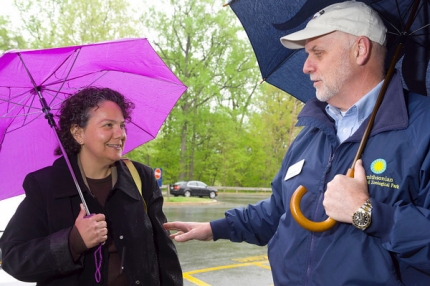
CEQ Chair Sutley joins National Zoo Director Dennis Kelley in touring the zoo grounds (Photo by Eric Vance, US EPA)
As the rain poured down in Washington, DC, I headed to the National Zoo in a soggy but beautiful Rock Creek Park to celebrate Earth Day. What better place to commemorate the day when we honor our natural environment. After all, it's full of animals. But this day took me to the zoo for a very different reason. EPA Administrator Lisa Jackson and I got a behind the scenes to look at a new sustainably designed habitat for some of the zoo's most popular residents, the Asian elephants!
Under the President's Executive Order 13514 for the Federal Government to lead by example in environmental, energy, and economic performance, the National Zoo, as part of the Smithsonian Institution, is finding new and innovative ways to institute green building practices in their facilities. These practices help reduce the environmental foot print of these buildings and save money in the cost of operations.
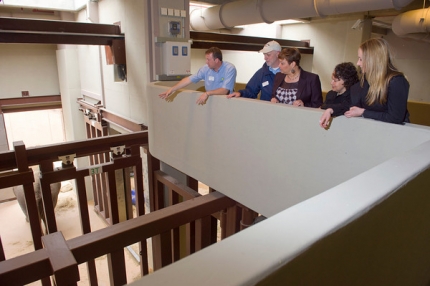
Executives at the National Zoo point out green features in the new elephant habitat for EPA Administrator Jackson, CEQ Chair Sutley and Alexander Cousteau (Photo by Eric Vance, US EPA)
To ensure that these endangered Asian elephants' habitat is comfortable for them, the zoo has incorporated cutting-edge green technologies. From harnessing the heat of the earth to warm the elephants' house, to a green roof that reduces storm water runoff and creates a habitat for birds, butterflies, and fauna, this state-of-the-art home has captured the spirit of Earth Day in so many ways.
Since 1970, when it was first celebrated, Earth Day has meant a time for us to recommit to protecting and preserving the natural wealth we depend on for our livelihood, prosperity, and security. Today, I am proud to see that our National Zoo, already a leader in caring for our wildlife, is also leading the way in delivering on the President’s commitment to a more sustainable government.
It was great to see elephants of all ages, from ten year old Kandula to 63 year old Ambika, enjoy their new home. For the most part, they took to the place right away. Though we did hear it took Ambika a little longer than the rest, but now she's enjoying it as much as the rest. Guess that just goes to show, you can teach an old elephant new tricks!
Nancy Sutley is Chair of the White House Council on Environmental Quality
Learn more about Energy and EnvironmentEarth Day: The Progress We've Made
Posted by on April 22, 2011 at 1:37 PM EDTEach year when Earth Day rolls around, we’re given an opportunity to reflect on how far we’ve come in protecting the health and the environment of our communities. This Earth Day, EPA under President Obama's leadership is proud of all the progress we’ve made in just two years to protect the air we breathe, the water we drink and swim in, and the communities where we build our homes, schools and businesses.
In protecting our air, we’ve marked some historic “firsts”: setting the first joint fuel efficiency and emissions standards with the Department of Transportation that will make American cars and trucks more fuel efficient than ever before, as well as establishing the first new standards for sulfur dioxide in forty years.
And just last month, we set another first: the first national standards for mercury, arsenic and other air pollution from our nation’s power plants. These standards require power plants to use proven pollution control technology at their facilities, a change that will help prevent as many as 17,000 premature deaths and 11,000 heart attacks a year. For our young people, the new standards will help prevent 120,000 incidents of asthma symptoms and about 11,000 fewer cases of acute bronchitis among children.
We’ve also taken major steps to revitalize America’s waters. The Great Lakes Restoration Initiative is setting a new standard of care for the source of 95 percent of America’s surface freshwater. On the Chesapeake Bay, historic efforts are underway to protect waters that touch the lives and livelihoods of 17 million people. And one year after the Deepwater Horizon BP spill that hit the Gulf Coast and my home state of Louisiana so hard, the Gulf Coast Ecosystem Restoration Task Force, which the president asked me to chair, is developing a plan – not just to continue the important recovery from the largest oil spill in U.S. history, but to take on issues that have plagued the region for years. All that is happening at the same time we are collaborating with local communities to revitalize urban waterways, working with schools and small businesses to lead the world in the next generation of clean water technology, and helping communities put in place green infrastructure and other cost-effective tools that work with mother nature to filter and reduce pollution.
As we protect the water that flows through our communities, we’re also protecting the ground these communities are built on. We’ve been cleaning up communities through swift implementation of the president’s Recovery Act, which funded Brownfields and Superfund cleanups across the nation. To make certain every community – including low-income and minority communities that often face disproportionate environmental challenges – have a seat at the table, we’ve stepped up to expand the conversation on environmentalism. We've revitalized our Environmental Justice office at EPA, issued agency-wide guidance on incorporating environmental justice into our decision making and, with my good friend Nancy Sutley, Chair of the president’s Council for Environmental Quality, reconvened the leadership of the Interagency Working Group on Environmental Justice for the first time in over a decade.
Our outreach has not stopped there. We've spoken to farmers, clean energy innovators, clergy, teachers, students and environmental entrepreneurs. I've also been able to keep in touch with the next generation of leaders by achieving yet another "first": the first EPA Administrator with a Facebook page and a Twitter feed. Today there are voices calling for protecting our health and our environment that were not part of this discussion two years ago. They know that this EPA serves them. They know that their concerns are our concerns. And they know that we’re going to make sure all Americans get the protections and opportunities they need and deserve.
These are just a few examples of our efforts over the last two years. We’ve come a long way, but still have a long way to go to strengthen protections for American families, foster more innovation and safeguard the environment we will leave to our children and grandchildren.Lisa P. Jackson is the Administrator of the Environmental Protection Agency
Learn more about Energy and EnvironmentProtecting Consumers at the Pump: The Oil and Gas Price Fraud Working Group
Posted by on April 22, 2011 at 1:15 PM EDTEd. Note: Learn more about the Attorney General's efforts to protect consumers at StopFraud.gov.
Over the past few years, American businesses and families across the country have suffered the effects of the worst financial crisis in generations. Today, although our economic recovery is gaining steam, it remains critically important that we continue to use every available tool and resource to safeguard consumers against additional – and unnecessary – financial burdens.
For many, rapidly rising gasoline prices pose a serious concern. And while some factors – like regional variations and other lawful reasons for increased prices – may be beyond our control, it is imperative that we take action to identify and address potential cases of fraud and manipulation that may harm families and businesses.
Yesterday, I announced the formation of an Oil and Gas Price Fraud Working Group to help identify civil or criminal violations in the oil and gasoline markets, and to ensure that American consumers are not harmed by unlawful conduct. Since last month, at President Obama’s request, I have been directing efforts to increase cooperation between the Department of Justice and other groups with relevant authority, including federal agencies and state attorneys general. I am proud to say that this Working Group will enable us to formalize these partnerships, share monitoring information, and exchange ideas about what works – and what doesn’t work – at the state and federal level.
Learn more about Economy, Energy and EnvironmentWhat I Heard About Energy Policy through Advise the Advisor
Posted by on April 22, 2011 at 12:58 PM EDT
A word cloud of feedback from the Advise the Advisor program gives greater prominence to words that appear more frequently in your feedback (by Wordle.net)
Earlier this month, I asked the public for feedback on energy policy as part of the White House’s “Advise the Advisor” program. Specifically, we asked for your comments and ideas about President Obama’s goal of reducing the amount of oil we import by a third in a little over a decade, along with the need to both increase our domestic energy production and reduce energy waste.
Thousands of you offered suggestions on how we can be more efficient and rely more on America’s clean energy resources. Here is a summary what we heard from you:
Learn more about Energy and EnvironmentWhat You Missed: Open for Questions on Energy and the Environment with Nancy Sutley and Heather Zichal
Posted by on April 22, 2011 at 10:38 AM EDTIn recognition of Earth Day 2011, Nancy Sutley, White House Council on Environmental Quality Chair, and Heather Zichal, Deputy Assistant to the President for Energy and Climate Change, answered your questions on the environment and energy policy in a live chat from the South Lawn of the White House. See what they talked about with the American people, from what everyday folks can do to go green, to what the federal government is doing to make a clean energy economy a reality.
And be sure to check out the Federal agency Sustainability and Energy Scorecard results on the CEQ website, which enable agencies to target and track the best opportunities to lead by example in clean energy; and to meet a range of energy, water, pollution, and waste reduction targets.
Attorney General Holder Announces Formation of the Oil and Gas Price Fraud Working Group
Posted by on April 21, 2011 at 6:24 PM EDTToday, Attorney General Eric Holder announced the creation of the The Oil and Gas Price Fraud Working Group. In March 2011, President Obama asked the Attorney General to work with federal and state agencies to monitor oil and gas markets for potential wrongdoing. The working group is a direct response to the President’s call for action and will focus specifically on fraud in the energy markets.
Learn more by visiting the Department of Justice’s website.
- &lsaquo previous
- …
- 129
- 130
- 131
- 132
- 133
- 134
- 135
- 136
- 137
- …
- next &rsaquo
Related Videos
-
 May 09, 2014 9:21 AM
Inside the White House: Solar Panels
-
 September 01, 2016 9:25 PM
President Obama Delivers a Statement to the Press
White House Blogs
- The White House Blog
- Middle Class Task Force
- Council of Economic Advisers
- Council on Environmental Quality
- Council on Women and Girls
- Office of Intergovernmental Affairs
- Office of Management and Budget
- Office of Public Engagement
- Office of Science & Tech Policy
- Office of Urban Affairs
- Open Government
- Faith and Neighborhood Partnerships
- Social Innovation and Civic Participation
- US Trade Representative
- Office National Drug Control Policy