Energy and Environment Latest News
America’s Home Energy Education Challenge
Posted by on May 24, 2011 at 1:14 PM EDT[Ed. Note: This has been cross posted from Energy.gov.]
Let’s be honest. Many of us probably had trouble paying attention one or two times in middle school science class. While the occasional frog dissection and "potato-volt" experiments were cool, not all of us got up in the morning, scarfed down Cocoa Puffs and got geeked about test tubes and chlorophyll. And that’s not to discredit the great teachers out there, but as they all know (and as Ms. Ives, my 7th grade teacher knew quite well), sometimes the 12-year-old mind just has WAY more important things to think about.
It can be quite a feat coming up with new and exciting ways to engage our young folk when it comes to energy and science, but the Department of Energy and the National Science Teachers Association have put together a new challenge to ignite that spark.
America’s Home Energy Education Challenge
“Energy efficiency is all about helping families save money by saving energy,” said Secretary Chu. “America’s Home Energy Education Challenge leverages the passion and curiosity of students to encourage families across the country to reduce energy waste in their homes while inspiring the next generation of American’s energy leaders.”
Geared specifically towards students in grades 3-8, teams of participating teachers and students will compete this fall to reduce energy waste in their homes by recording their energy consumption data for three months. Then, that data will be compared to energy usage data from the same time period a year ago. These teams will collectively challenge other teams in their community, and then compete regionally and even nationally to see who are the best energy savings champions.
Another cool part of the challenge is the new Energy Fitness Award. Modeled after the famous President’s Physical Fitness award, the Energy Fitness Award challenges students to improve their knowledge of energy use in buildings, to learn more about the energy they use, and to design and develop energy plans.
Registration
So Moms and Dads out there – get ready for a new kind of school science project, one that will get the kids psyched about science and save you money by saving energy at home.
You can get info on prizes, regional breakdowns, grading criteria, and learn much more American’s Home Energy Education Challenge at HomeEnergyChallenge.org
Andy Oare is a New Media Strategist with the Office of Public Affairs at the U.S. Department of Energy
Learn more about Energy and EnvironmentWeekly Wrap Up: A Moment of Opportunity
Posted by on May 20, 2011 at 5:54 PM EDTYour quick look at the week of May 16th to May 20th on WhiteHouse.gov:
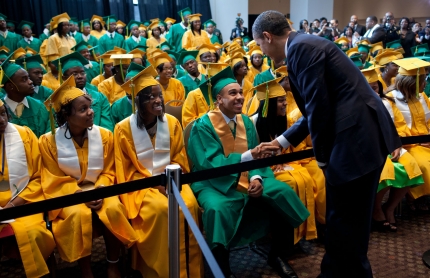
President Barack Obama surprises Booker T. Washington students before their commencement ceremony at Cook Convention Center in Memphis, Tenn., May 16, 2011. (Official White House Photo by Pete Souza)
Graduation Season: This week, the President and First Lady spoke at commencements around the country. President Obama addressed graduating seniors at Booker T. Washington High School in Memphis, TN -- the winners of the 2011 Commencement Challenge. The First Lady spoke at Spelman College in Atlanta and delivered a historic address to graduating Cadets at the United States Military Academy at West Point.
Moment of Opportunity: President Obama laid out his vision for a new chapter in American diplomacy as calls for reform and democracy spread across the Middle East and North Africa. After the speech, Deputy National Security Advisor Ben Rhodes answered questions from all over the world via Twitter.
Do You Know Someone Like This?: Nominate an everyday hero for the 2011 Presidential Citizens Medal.
Huskies at the White House: President Obama honored the NCAA champions the UConn Huskies in a ceremony at the White House. Watch a video of the team's basketball clinic with local kids.
Learn more about Defense, Education, Energy and Environment, Foreign Policy, Homeland Security, Technology, Additional IssuesProtecting Families at the Pump and Expanding Responsible Domestic Oil Production
Posted by on May 17, 2011 at 2:54 PM EDTFrom the beginning, this Administration has shown a commitment to protecting American families at the pump by taking steps to reduce our reliance on foreign oil. In March, the President announced a goal of reducing oil imports by a third by 2025, through a combination of increased domestic production, investment in alternative fuels, and increased efficiency in the vehicles we drive. As the President has made clear, there is no immediate fix for high gas prices. That said there are sensible steps we can take to protect families over the long term. In last week’s weekly address, the President laid out important steps that the Administration is taking to continue to expand responsible and safe domestic oil production. These include a number of sensible, bipartisan ideas that we can act on with existing authority-- like directing the Department of the Interior to conduct annual lease sales in Alaska’s National Petroleum Reserve, while respecting sensitive areas; speeding up the evaluation of oil and gas resources in the mid and south Atlantic; and creating new incentives for industry to develop their unused leases both on and offshore. About 57 percent of leased onshore acres and over 70 percent of leased offshore acres are currently inactive, and last year, of the nearly 37 million offshore acres offered for lease by the Federal government, only 2.4 million acres were leased by companies.
Learn more about Energy and EnvironmentWeekly Address: Expanding Responsible Oil Production in America
Posted by on May 14, 2011 at 5:30 AM EDTAs part of his long-term plan to reduce our reliance on foreign oil, President Obama lays out his strategy to continue expanding safe and responsible domestic oil production.
Transcript | Download mp4 | Download mp3
Learn more about Energy and EnvironmentWest Wing Week: "On the Border"
Posted by on May 13, 2011 at 12:00 AM EDTWelcome to the West Wing Week, your guide to everything that's happening at 1600 Pennsylvania Avenue. This week the President talks clean energy and gas prices in Indiana, focuses on fixing our broken immigration system in Texas, and honors Top Cops here in the Rose Garden.
Watch West Wing Week here.
Find out more about the topics covered in this edition of West Wing Week:
Learn more about Energy and EnvironmentWorking with Communities to Restore a Healthy and Prosperous Gulf Coast
Posted by on May 12, 2011 at 6:00 PM EDTJust a year ago our nation was dealt a harsh reminder of the connection between the health of our economy and the health of our environment. Millions of residents across the Gulf Coast suffered impacts to their daily lives and livelihoods caused by the environmental devastation resulting from the Deepwater Horizon oil spill. The spill intensified the decades-long decline of the Gulf's rich and valuable coastal ecosystems upon which these economies depend. Since taking office, this Administration has been working to protect and restore this natural treasure.
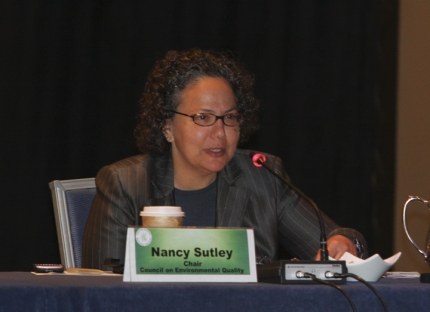
Chair Sutley participates in the Gulf Coast Ecosystem Restoration Task Force Public Meeting with community members in Mobile, AL.
By putting in place smarter and stronger standards of safety and responsibility for deepwater drilling, we're working to protect our natural resources from this kind of catastrophic damage. These higher standards will promote safe and responsible offshore oil exploration and production, while reducing our country's reliance on foreign oil, creating jobs for the American people, and ensuring our nation’s energy security.
The President also established the Gulf Coast Ecosystem Restoration Task Force, which includes representatives from Federal agencies and the Gulf Coast states, to coordinate the long-term restoration effort based on input from local scientists, experts, and citizens. He made clear that restoration priorities should be set by the Gulf region for Washington, and not the other way around. At a Task Force meeting last week in Mobile, Alabama, EPA Administrator Lisa Jackson launched a citizens' advisory committee to provide residents and local organizations a more effective way to voice their environmental concerns to help guide restoration efforts. Key priorities, developed with input from the public and key stakeholder groups throughout the region, for the ongoing restoration of the Gulf include enhancing community resilience and restoring important coastal habitats.
Visiting the Gulf always reinforces for me the tremendous value of the coastal ecosystems to the economies and livelihood of our nation. The Gulf is the heartbeat of the region's economy, and a lifeline to the economy of the United States. The region handles more water-borne commerce than any other place in the country, and is home to the largest commercial fishery in the contiguous United States. It is also a tourism powerhouse, and helps shape the many unique cultures of the communities in that part of the country. And of course, the bayous, barrier islands, bays and estuaries that dominate the region provide critical protections to communities that are devastatingly vulnerable to hurricanes.
We will continue to bring together Federal agencies, states, and local communities to ensure a smart, forward-looking, and comprehensive restoration strategy that responds to the priorities of Gulf residents. We are committed to bringing the Gulf back better than it was before, and to restoring the coast in ways that enhance the livelihood and quality of life for our communities and for our economy.
Nancy Sutley is Chair of the White House Council on Environmental Quality
Learn more about Energy and Environment
- &lsaquo previous
- …
- 125
- 126
- 127
- 128
- 129
- 130
- 131
- 132
- 133
- …
- next &rsaquo
Related Videos
-
 May 09, 2014 9:21 AM
Inside the White House: Solar Panels
-
 September 01, 2016 9:25 PM
President Obama Delivers a Statement to the Press
White House Blogs
- The White House Blog
- Middle Class Task Force
- Council of Economic Advisers
- Council on Environmental Quality
- Council on Women and Girls
- Office of Intergovernmental Affairs
- Office of Management and Budget
- Office of Public Engagement
- Office of Science & Tech Policy
- Office of Urban Affairs
- Open Government
- Faith and Neighborhood Partnerships
- Social Innovation and Civic Participation
- US Trade Representative
- Office National Drug Control Policy