Energy and Environment Latest News
From Coast to Coast, Working Together for our Ocean, Coasts, and Great Lakes
Posted by on March 22, 2011 at 12:40 PM ESTAs the National Ocean Council (NOC) continues working toward implementing the first national policy for the stewardship of the ocean, our coasts and the Great Lakes, our successes depend on effective collaboration and engagement with the people and communities that live, work, and depend on our oceans, coasts, and Great Lakes. From the tribes of Alaska, to the city halls of North Carolina, to the state offices of Mississippi, members of our Governance Coordinating Committee (GCC) represent the diversity of interests that will help cut across political and geographic boundaries to harmonize planning and stewardship of our waters. Earlier this month, this group of tribal, state, and local government officials from across the country met for the first time to begin this important work. In the coming weeks we will highlight in their voices what their work and membership means to the people and the communities they serve. As you can see from a few members’ initial comments below, the enthusiasm and commitment that this group is bringing promises great things to come.
Dee Freeman, Secretary, North Carolina Department of Environment and Natural Resources
“The work of the GCC and the National Ocean Council is groundbreaking. Planning our course together as partners will lead to good and valuable decisions on the future of America’s coastal areas. I look forward to the work ahead and the imperative relationships we will build together as partners.”
Micah McCarty, Tribal Chairman & Marine Policy & Fisheries Advisor, Makah Tribal Council
“The inaugural GCC meeting was an invaluable step towards fulfilling the need for regionally based and focused discussions on harmonizing existing laws and regulations of current uses of our nation's coastal waterways…It was especially encouraging to hear from such a diverse of group government representatives about very real and home-based perspectives on common concerns."
Kevin Ranker, Washington State Senator
“While we have much work before us, the diversity of skill sets and depth of experience of my fellow Committee members gives me faith that we are up to the task. I found the first meeting of the GCC productive and informative. I am honored to be part of this Committee and look forward to helping the Administration advance a National Ocean Policy that protects our oceans and the goods and services they provide for our coastal states.”
Rick Weiss is Director of Communications and Senior Science and Technology Policy Analyst at the Office of Science and Technology PolicySahar Wali is Director of Communications at the Council on Environmental Quality
Learn more about Energy and EnvironmentWeekly Wrap Up: Standing With the People of Japan
Posted by on March 18, 2011 at 5:30 PM ESTA quick look at the week that was on WhiteHouse.gov:
Standing with the people of Japan: After the tragic earthquakes and tsunami in Japan, President Obama spoke on the United States' commitment to support our friend and ally. He also visited the Japanese embassy and signed a condolence book. Find out more about what you can do to help at USAID.gov.
Education: President Obama visited a middle school in Arlington, Virginia, where he spoke on the need to reform the No Child Left Behind legislation before the beginning of the coming school year.
Learn more about , Economy, , Education, Energy and Environment, Ethics, Foreign Policy, Service, Technology, Additional IssuesLearning from you, for you, for our Great Outdoors
Posted by on March 18, 2011 at 3:34 PM ESTIn building the President's America's Great Outdoors initiative, we sought to create a 21st century conservation legacy that reflects the priorities of the American people and preserves our nation's natural treasures for future generations. That's why we went across the country to learn from communities - especially our youth - about the protections and places that they care about the most. By listening to you, we were able to launch a conservation agenda with you, for you. We learned a lot from you and the learning doesn't stop there.
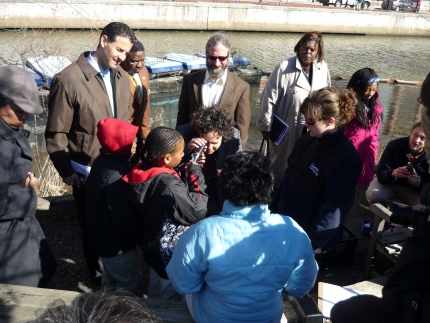
Students share Baltimore Inner-Harbor water samples with Chair Sutley, Congressman Sarbanes and Living Classrooms Foundation CEQ James Bond
As we visit communities across the country, we have the chance to continue this dialog. On a recent visit to Baltimore, MD, I had the chance to visit students at the Living Classrooms Foundation's East Harbor Campus and hear from them directly about what they're learning from the environment that's all around them even in a dense urban setting. Joined by Congressman John Sarbanes and Baltimore Mayor Stephanie Rawlings-Blake, I got my hands dirty with these fifth through eighth graders working on projects that improve the health of their community while learning about the environment. We hear from students and teachers about how kids are becoming better students and getting more out of school through hands-on interaction with nature and science.
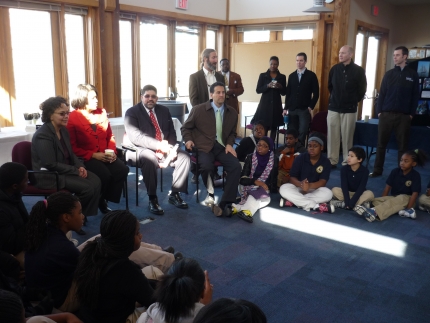
Chair Sutley joins local leaders as students share experiences with the Living Classrooms Programs
Growing up on Little Neck Bay in New York, I remember not being able to swim in or enjoy the Bay because it was too polluted. Through planting floating wetlands, the kids we met are contributing directly to making the Baltimore Inner Harbor fishable and swimmable by 2020 and making the Chesapeake Bay healthier. These students are getting the change to learn in new ways about the outdoors, in the outdoors while giving back to their community.
When President Obama created the America's Great Outdoors Initiative, he had America's kids especially in mind. Today, kids spend far more time inside than their parents did. Many of them also live in cities or suburbs, where it can be hard to find a safe and accessible green space to play. America's children will live with the consequences of the decisions we make today about whether to protect and restore our outdoor spaces, or lose them to pollution or poorly planned development.
Through the Administration's America’s Great Outdoors Initiative, we are confronting these challenges through a new 21st century conservation and recreation agenda. This agenda will not only benefit our urban centers but America's vast rural communities and economies as well. You too can be a part of America's Great Outdoors.
Nancy Sutley is Chair of the Council on Environmental QualityLearn more about Energy and EnvironmentSecretary Salazar and Secretary Vilsack Answer Questions on America's Great Outdoors Initiative
Posted by on March 18, 2011 at 12:57 PM ESTYesterday, Secretary of the Interior Ken Salazar and Secretary of Agriculture Tom Vilsack, hosted a live chat to answer your questions about the America's Great Outdoors initiative. The initiative seeks to reinvigorate our approach to conservation and reconnect Americans, especially our youth, with the lands and waters that are used for farming and ranching, hunting and fishing, and for families to spend quality time together, as well as education purposes. They took questions from YouTube videos and Facebook participants from across the country on ways to develop a conservation and recreation agenda that makes sense for the 21st century.
If you're a young person looking to get involved in the great outdoors, be sure to visit YouthGo.gov. For more information on America's Great Outdoors initiative, check out the full video below or skip to the questions you're interested in by using the links below.
Learn more about Energy and EnvironmentOpen for Questions: A Conversation on The Clean Air Act with Administrator Lisa Jackson
Posted by on March 16, 2011 at 3:24 PM ESTToday, U.S. Environmental Protection Agency Administrator Lisa Jackson announced EPA's proposed Mercury and Air Toxics Standards, a Clean Air Act protection to reduce harmful pollution in the air we breathe and help safeguard the health of millions of Americans.
Join Administrator Jackson for a special White House live chat on the Mercury and Air Toxics Standards tomorrow, Thursday, March 17 at 10:55 a.m. EDT. Administrator Jackson will be joined by young people who are passionate about this issue and the discussion will be moderated by Kalpen Modi of the Office of Public Engagement.
Submit your questions for Administrator Jackson now in a comment on Facebook. And be sure to watch live tomorrow morning at whitehouse.gov/live or join the conversation on Facebook.
Learn more about Energy and EnvironmentRemoving Mercury and Other Toxics From the Air We Breathe
Posted by on March 16, 2011 at 1:06 PM ESTThis week, the EPA proposed Mercury and Air Toxics Standards, a Clean Air Act protection that sets the first-ever national safeguards to limit power plant releases of mercury, arsenic, chromium, nickel and acid gases into the air we breathe. America’s power plants are the source of half of the mercury emissions, half of the acid gases, and a quarter of all toxic metal pollution in the U.S, and almost half of America’s coal plants lack advanced pollution controls. Instead of operating without set limits for these pollutants – which are linked to costly and often fatal health threats like asthma, cancer and developmental disorders – American power plants will install widely available, American made pollution control technology to cut emissions.
Setting commonsense goals for reducing harmful pollution in the air we breathe can save lives, prevent illnesses and promote the creation of new jobs. We’re confident in these expectations for the Mercury and Air Toxics Standards because this has been the history of Clean Air Act protections for the last forty years.
In 2010 alone, protections in the Clean Air Act prevented 160,000 premature deaths and 170,000 hospital visits. Cleaner air has meant trillions of dollars in benefits to our nation – not only through fewer medical bills, but by keeping our kids in school and our workers on the job. The Clean Air Act has also helped create jobs. As of 2008 the environmental technology industry – which develops, manufactures and maintains the tools that help keep our air clean – employed more than 1.7 million Americans.
Learn more about Energy and Environment
- &lsaquo previous
- …
- 136
- 137
- 138
- 139
- 140
- 141
- 142
- 143
- 144
- …
- next &rsaquo
Related Videos
-
 May 09, 2014 8:21 AM
Inside the White House: Solar Panels
-
 September 01, 2016 8:25 PM
President Obama Delivers a Statement to the Press
White House Blogs
- The White House Blog
- Middle Class Task Force
- Council of Economic Advisers
- Council on Environmental Quality
- Council on Women and Girls
- Office of Intergovernmental Affairs
- Office of Management and Budget
- Office of Public Engagement
- Office of Science & Tech Policy
- Office of Urban Affairs
- Open Government
- Faith and Neighborhood Partnerships
- Social Innovation and Civic Participation
- US Trade Representative
- Office National Drug Control Policy