Energy and Environment Latest News
Early Momentum for the President's "Better Buildings Initiative"
Posted by on February 3, 2011 at 7:06 PM ESTToday the President announced an ambitious initiative to make American businesses more efficient as part of his plan to ensure that America wins the future by out-innovating, out-educating, and out-building the competition.
In his State of the Union, the President laid out his vision for winning the future by investing in innovative clean energy technologies and doubling the share of electricity from clean energy sources by 2035. Alongside that effort, the President is proposing new efforts to improve energy efficiency in commercial buildings across the country. The “Better Buildings Initiative,” outlined today at Penn State University, will achieve a 20 percent improvement over the next decade, saving companies and business owners tens of billions of dollars a year.
The plan will spur innovation by reforming tax and other incentives to retrofit, creating a new competitive grant program for states and localities that streamline their regulations to attract retrofit investment, and challenging the private sector to invest in building upgrades through a new “Better Buildings Challenge.”
The President has asked President Clinton, who has been a champion for this kind of energy innovation, to co-lead the private sector engagement along with the President’s Council on Jobs and Competitiveness, headed by Jeff Immelt, the CEO of General Electric.
The response has already been overwhelmingly positive. See some statements of support below from various business leaders and advocacy groups:
Learn more about Economy, Energy and EnvironmentLisa Jackson's Story: Protecting the Health and the Environment of the American People
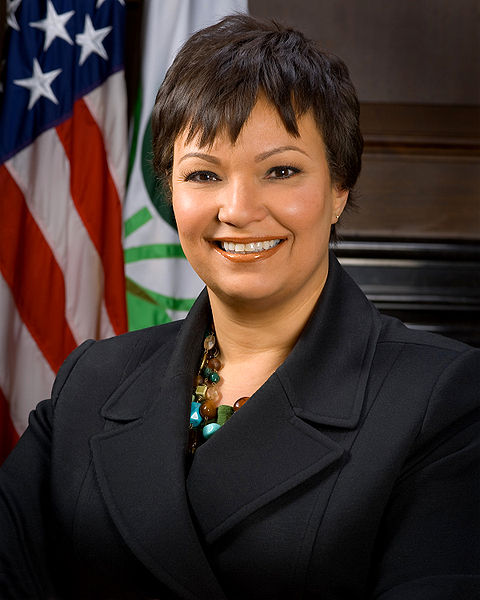
Posted by on February 3, 2011 at 6:19 PM ESTEd. note: This post is part of the Celebrating Black History Month series that highlights the contributions of African-Americans who are helping the President achieve his goal of winning the future.
I'm a proud native of New Orleans – I was raised in Pontchartrain Park in New Orleans’ Upper Ninth Ward. My family's home was flooded during Hurricane Katrina and, like many of our neig
 hbors, it was uninhabitable and had to be gutted. Still, on one of my recent trips back I talked to folks about plans to rebuild the house and others as part of a green, sustainable neighborhood. I’m proud to have grown up in and been shaped by such a resilient community.
After high school at Saint Mary's Dominican in New Orleans, I stayed to go to Tulane University (Roll Wave!) and then got my master’s degree in chemical engineering from Princeton. My dream as a child and throughout school was to become a doctor because I had always wanted to help people when they got sick. But I came to realize that by protecting our environment I was approaching the same problem from a different angle - by making sure people didn’t get sick in the first place.
As the Administrator of the EPA, I oversee a staff of more than 18,000 employees working across the country with a single mission: to protect human health and the environment. I touch on everything from making sure the air we breathe and the water we drink is free from harmful toxins to assisting with response to environmental disasters.
Winning the Future Through Innovation and "Better Buildings"
Posted by on February 3, 2011 at 5:47 PM ESTThe President's vision to "Win the Future" spelled out in his State of the Union Address was not one founded on vague dreams of a brighter day ahead -- it was founded on ideas, advancements, and principles already cropping up across the country that can help keep America on top if we only stand by them. That's what his visit to Penn State today was about:
And right here, right here at Penn State, a university whose motto is “making life better,” you’ve answered the call. (Applause.) So today you’re preparing to lead the way on a hub that will make America home to the most energy-efficient buildings in the world.
Now, that may not sound too sexy until -- (laughter) -- energy-efficient buildings. (Laughter.) But listen, our homes and our businesses consume 40 percent of the energy we use. Think about that. Everybody focuses on cars and gas prices, and that’s understandable. But our homes and our businesses use 40 percent of the energy. They contribute to 40 percent of the carbon pollution that we produce and that is contributing to climate change. It costs us billions of dollars in energy bills. They waste huge amounts of energy.
So the good news is we can change all that. Making our buildings more energy-efficient is one of the fastest, easiest and cheapest ways to save money, combat pollution and create jobs right here in the United States of America. And that's what we’re going to do. (Applause.)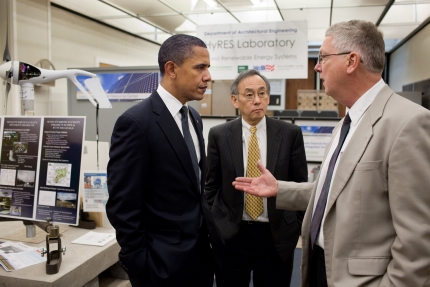
President Barack Obama and Energy Secretary Steven Chu tour the Engineering Labs at Penn State University with James Freihaut, Associate Professor of Architectural Engineering, in State College, Pennsylvania, February 3, 2011. (Official White House Photo by Pete Souza)
Specifically, the President was announcing the “Better Buildings Initiative,” which aims to achieve a 20 percent improvement in energy efficiency by 2020, reduce companies’ and business owners’ energy bills by about $40 billion per year, and save energy by reforming outdated incentives and challenging the private sector to act. The White House fact sheet fleshes out those goals, talks about the successes to be built upon from the last two years, and lays out these steps which will be included in the President's coming budget:
On the Road to Energy Efficiency
Posted by on February 3, 2011 at 6:15 AM ESTLast week, the President visited manufacturers in Wisconsin who are focused on creating the clean energy products of the future. Today, he continues taking his agenda for innovation and a new energy economy on the road, visiting an Energy Innovation Hub in State College, Pennsylvania.
While visiting the researchers and developers at this facility, the President will announce his Better Building Initiative. This initiative aims to achieve a 20 percent improvement in energy efficiency in commercial buildings by 2020, improvements which will save American businesses $40 billion a year. Those savings will free up critical funds that businesses can use to expand, reach new markets, and create more American jobs.
One of the key parts of the Better Building Initiative is a program called Race to Green, a competitive grant process modeled after the highly successful Race to the Top program that has improved education across the country. Race to Green will encourage states and local governments to reform their building codes and make it easier to retrofit buildings with energy-saving technology. The best ideas to streamline regulations will receive grants from the federal government that will help put those ideas into practice.
The biggest, most world-changing innovations in this country's history have come from the private sector, and President Obama knows that that's where we'll find the next ones, too. Winning the future is going to require government and business to work together and foster the good ideas that become great inventions.
Christopher Smith's Story: Clean Energy & Service
Posted by on February 2, 2011 at 5:06 PM ESTEd. note: This is the first blog post in a series that highlights African Americans from throughout the Administration who contribute to the President’s vision of winning the future through their work.
I’m lucky to have been raised by my parents, Raymond and Sue Ann Smith, who value educat
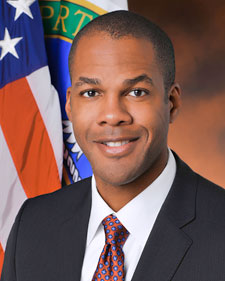 ion. As we celebrate Black History Month I reflect on the fact that I grew up in a period that offered me many more opportunities than my parents had when they were my age. This is one of the things that motivated me to return to public service, and inspires me to work every day to create opportunities for all Americans.
I grew up in Fort Worth Texas and earned a BS degree in Engineering Management from the United States Military Academy at West Point. I began my career as an officer in the U. S. Army and served tours with the 2nd Infantry Division in Korea and the 25th Infantry Division in Hawaii. After leaving military service, I went on to work for Citibank and JPMorgan in New York City and London. While I was in England I earned an MBA from Cambridge University.
I spent the next eleven years in the oil industry, first with Texaco, then with Chevron. I spent most of that time leading international projects, including three years living in Bogotá Colombia negotiating offshore and pipeline agreements. The Secretary of Energy appointed me Deputy Assistant Secretary for Oil and Natural Gas in September of 2009.
Keeping America Competitive: Innovation and Clean Energy
Posted by on January 31, 2011 at 4:01 PM EST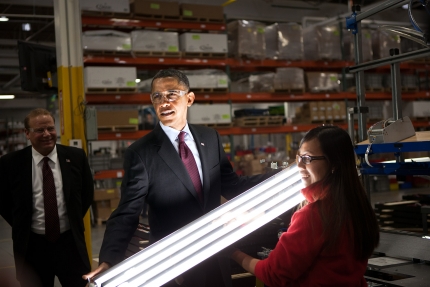
President Barack Obama watches as an operator demonstrates the final stage of light fixture assembly during a tour of Orion Energy Systems, Inc in Manitowoc, Wisc., Jan. 26, 2011. (Official White House Photo by Samantha Appleton)
One of the key challenges we face today is ensuring that America stays economically competitive with countries across the globe, so that the jobs and industries of the future are created here in the United States. Fortunately, we know how to win this race; we know what this moment requires. And in his State of the Union address last week, the President laid out his vision for winning the future – a vision that emphasized the role of innovation.
For generations, American creativity, imagination, and hard work has fostered broad prosperity and made our nation’s economy the largest in the world. Now, we must summon that same spirit of ingenuity, not only to create new jobs and industries, but to strengthen our security and to protect public health and our environment. That is why President Obama is committed to building a new clean energy economy here at home – because the nation that harnesses the power of clean, renewable energy will be the nation that leads the 21st century.
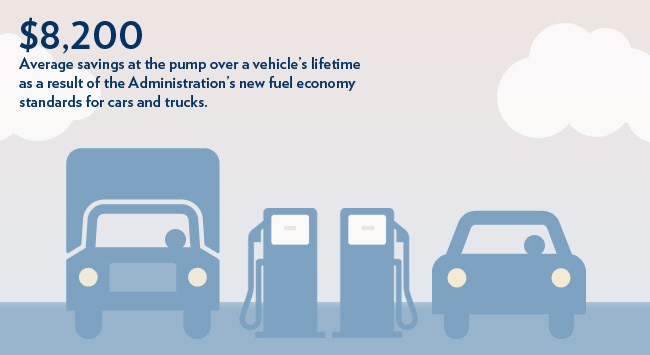
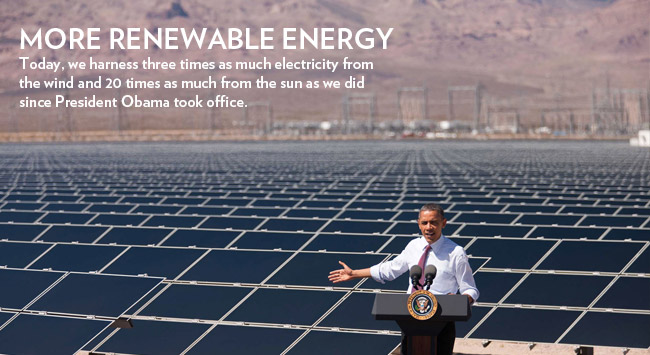
Already, the Administration has taken historic action to promote a clean energy economy. The Recovery Act included a $90 billion investment in clean energy, which has already created nearly 225,000 clean energy jobs and is putting the United States on pace to double renewable energy generation by 2012. Over the last year alone, the Department of Interior green-lighted the first nine commercial-scale solar energy projects for construction on public lands, including the largest solar power plants in the world. We have also helped break our dependence on oil by investing in biofuels and developing aggressive new fuel-economy standards for cars and trucks, which will save 1.8 billion barrels of oil.
Learn more about Energy and Environment
- &lsaquo previous
- …
- 142
- 143
- 144
- 145
- 146
- 147
- 148
- 149
- 150
- …
- next &rsaquo
Related Videos
-
 May 09, 2014 8:21 AM
Inside the White House: Solar Panels
-
 September 01, 2016 8:25 PM
President Obama Delivers a Statement to the Press
White House Blogs
- The White House Blog
- Middle Class Task Force
- Council of Economic Advisers
- Council on Environmental Quality
- Council on Women and Girls
- Office of Intergovernmental Affairs
- Office of Management and Budget
- Office of Public Engagement
- Office of Science & Tech Policy
- Office of Urban Affairs
- Open Government
- Faith and Neighborhood Partnerships
- Social Innovation and Civic Participation
- US Trade Representative
- Office National Drug Control Policy