Energy and Environment Latest News
Chair Sutley Visits California with a Focus on Water
Posted by on September 16, 2010 at 4:06 PM ESTLast week I traveled west to California with a specific focus on water. My trip started by joining Senator Feinstein to celebrate the west coast's largest tidal wetland restoration project, the South Bay Salt Pond Restoration. This project is a unique private-public partnership that will restore habitat for threatened and endangered species.
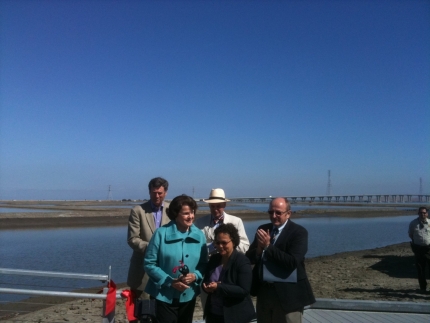
Senator Feinstein, Chair Sutley, President of Gordon and Betty Moore Foundation Steve McCormick, Executive Officer of CA State Coastal Conservancy Sam Schuchat, and California Secretary for Natural Resources Lester Snow at the South Bay Salt Pond Restoration Project
Later in the day, we held a series of meetings focused on the California Bay Delta to hear from business, environmental, and Federal and State representatives who are on the front lines of California's water crisis. That evening, I participated in a public forum in Santa Cruz with Representative Sam Farr focused on the National Ocean Policy that President Obama established by Executive Order on July 19, 2010.
The following evening Dr. Lubchenco, Administrator of the National Oceanic and Atmospheric Administration, and I spoke at the Commonwealth Club, where we highlighted the new National Policy for the oceans, our coasts and the Great Lakes. The National Ocean Policy will create a new National Ocean Council to provide a sustained, high-level and coordinated attention to marine and Great Lakes issues. It will also establish a flexible framework for effective coastal and marine spatial planning. This will allow regional bodies across the country to decide how to address challenges tailored to unique regional circumstances.
Overall, our time in California was very well spent and with a focus on Bay Delta issues and a National Policy that will go a long way towards preserving one of our nation's most valuable resources.
Nancy Sutley is Chair of the White House Council on Environmental Quality
Learn more about Energy and EnvironmentMoving Clean Energy Innovations Out of the Lab and into the Market
Posted by on September 15, 2010 at 4:50 PM EST
Universities in the United States have led the world in scientific research for a century. Sometimes however, innovators, including universities, struggle to translate research ideas into technologies that satisfy real world needs. Universities across the country have embraced the need to address climate and energy challenges, and now we need to effectively harness the resources and intellectual capital of our world’s leading research institutions. The wealth of ideas originating from our university laboratories will help build innovative cleantech companies that drive future economic development and create jobs for Americans.
Today, the Department of Energy is announcing new steps toward strengthening the commercialization successes of our nation’s research universities through a variety of partnerships. We call these projects ‘Innovation Ecosystems’ – collaborative environments that unite key players to identify and develop new clean energy technologies. Through the Department’s Innovation Ecosystem Development Initiative, five selections were made from regions throughout the U.S., which include Southern California, Utah, Florida, the Chicago metropolitan area, and New England. Each project will bring together the strengths of multiple partners, including universities, businesses, financial institutions, government, research institutes, economic development organizations, business accelerators and national laboratories – all with a common goal of moving high impact innovations from the lab to the marketplace.
The key to deploying successful ideas is having a network of individuals that move great, innovative ideas to the prototype stage and on to commercial scale. With over eighty partners in five ecosystems, a combination of resources will be used to review hundreds of nascent technologies, provide entrepreneurship education and business services to faculty and students, and in some cases create challenging competitions among university teams to turn innovative business plans into cleantech realities. Through these partnerships, the brightest scientists and engineers will team with experienced entrepreneurs and investors, who will do what they do best – find and nurture market relevant technologies.
These Innovation Ecosystems will be the blueprint for encouraging innovation and entrepreneurship by students, faculty, staff and alumni at universities across the country. By increasing the number of players in this space, we will put new technologies in the hands of more Americans and help move our country toward a competitive clean energy economy – grown here at home.
Learn more about Innovations, Energy and EnvironmentRevitalizing American Manufacturing
Posted by on September 13, 2010 at 4:39 PM ESTEd. Note: Cross posted from the Energy Blog.
Some people think our economy can run on white collar and service jobs alone, but they are wrong. We can and must make high quality products in America. We are on the verge of a new Industrial Revolution and I believe it will revolve around the greatest untapped opportunity of our time, clean energy. China and Europe see this opportunity and they are already moving aggressively to be at the forefront of it. It is time for America to get into the clean energy race and play to win -- and that is exactly what A123 Systems is doing in Michigan.
At a difficult time for America’s workers and businesses, A123 Systems is leading the way to a brighter future. It is building factories in Livonia, Romulus, and Brownstown. It has already has hired 200 local workers since last August and it expects to hire more than 3,000 people by 2012. Today marks an important milestone for A123 Systems, as they open largest lithium-ion automotive battery production facility in North America. This will help make sure the cars of the future are built right here in America.
This particular project is important because it has managed to link innovation in America to manufacturing in America, an essential connection that has been neglected in recent years.
We are – and have long been – the world leader in innovation. To give just a few examples from the last century: we created the laser, the solar cell, the transistor, and GPS technology. Historically, we’ve also been a powerhouse in manufacturing. But where are high tech products made today? They are largely manufactured in Asia.
Learn more about Innovations, Energy and EnvironmentLeading by Example Toward a Sustainable Future
Posted by on September 10, 2010 at 9:11 AM ESTAs part of our commitment to lead by example, yesterday, Federal agencies released Strategic Sustainability Performance Plans that outline how they will achieve the environmental, economic and energy goals called for by President Obama. This is the first time agencies have developed and submitted Sustainability Plans, now available here.
In the President's 2009 Executive Order on Federal Leadership in Environmental, Energy and Economic Performance, he asked agencies to develop, implement and annually update a plan that prioritizes sustainability actions based on a positive return on investment for the American taxpayer. The goal is to meet energy, water, and waste reduction targets that will save taxpayer dollars, create clean energy jobs, and reduce pollution.
Federal agencies of all sizes came up with a range of sustainability actions that align with their individual missions and responsibilities. At the Department of Defense, for example, the Air Force has a plan to certify all of its aircraft to operate with a 50 percent alternative fuel blend by 2011. And at the Department of Transportation, they've established an awards program to highlight and promote intra-agency best practices in waste prevention, recycling, and green procurement.
The Federal Government has an obligation to lead by example toward a sustainable future. Today we took another step in the right direction.
Nancy Sutley is Chair of the White House Council on Environmental Quality
Learn more about Energy and EnvironmentDOT, EPA Invite Public Input on New Vehicle Fuel Economy Window Stickers
Posted by on September 8, 2010 at 10:26 AM ESTCross posted from the Department of Transportation blog.
Together, the Department of Transportation and the Environmental Protection Agency have produced a new vehicle fuel economy label, and we want your feedback on our two proposed designs.
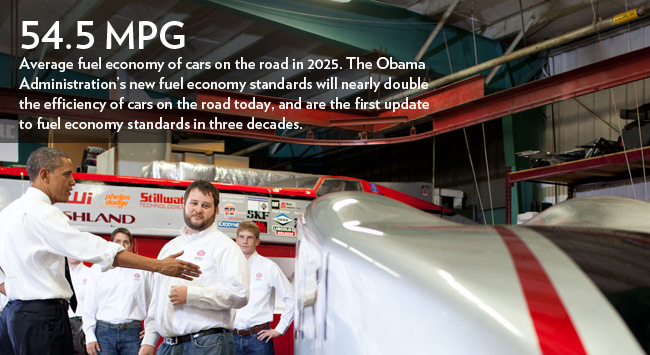
A year ago I blogged that putting millions more fuel-efficient cars, SUVs, and small trucks on the road is a huge step forward toward US energy independence. Well, now that the Obama Administration has taken that step forward with fuel economy standards for model years 2012 through 2016, a new generation of vehicles is hitting the market.
But, as new technologies like battery electric vehicles and plug-in hybrids have become increasingly available, fuel economy and environmental information has become increasingly complicated. Our current label just won't cut it anymore.
That's why, beginning with the 2012 model year, DOT and EPA want to use a new fuel economy label. We need a label that captures energy and emissions information in a way that helps vehicle buyers make better-informed decisions.
Learn more about Energy and EnvironmentThe U.S. and China - Advancing Clean Energy Research Through Cooperation
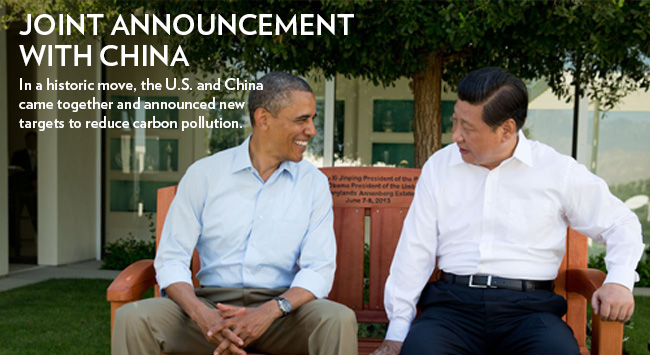
Posted by on September 3, 2010 at 9:55 AM ESTWhat two countries lead the world in energy consumption, energy production and greenhouse gas emissions? The United States and China. Can our two countries work together to help lead the world in a transition to clean energy? A recent announcement by U.S. Energy Secretary Steven Chu is an important step in that direction.
Yesterday, Secretary Chu announced that the University of Michigan and West Virginia University will each lead consortia under the U.S.-China Clean Energy Research Center. The two consortia will receive $25 million in total funding from the U.S. Department of Energy for this work. These amounts will be matched by the grantees, for a total of $50 million in U.S. funding. The Chinese side will contribute an additional $50 million, for a total of $100 million for this innovative project.
Learn more about , Energy and Environment, Foreign Policy

- &lsaquo previous
- …
- 156
- 157
- 158
- 159
- 160
- 161
- 162
- 163
- 164
- …
- next &rsaquo
Related Videos
-
 May 09, 2014 8:21 AM
Inside the White House: Solar Panels
-
 September 01, 2016 8:25 PM
President Obama Delivers a Statement to the Press
White House Blogs
- The White House Blog
- Middle Class Task Force
- Council of Economic Advisers
- Council on Environmental Quality
- Council on Women and Girls
- Office of Intergovernmental Affairs
- Office of Management and Budget
- Office of Public Engagement
- Office of Science & Tech Policy
- Office of Urban Affairs
- Open Government
- Faith and Neighborhood Partnerships
- Social Innovation and Civic Participation
- US Trade Representative
- Office National Drug Control Policy