Energy and Environment Latest News
Commitment to Lead: Solar on the White House
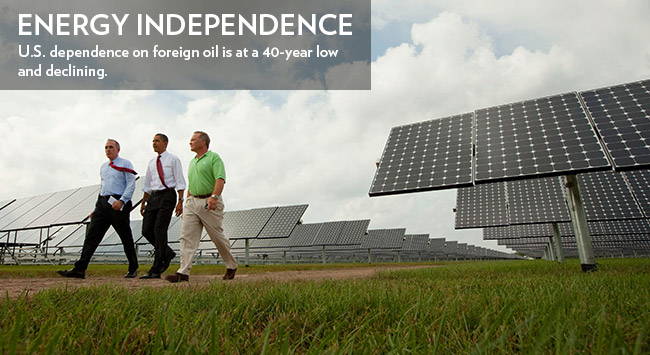
Posted by on October 5, 2010 at 10:48 AM ESTWe kicked off the first annual GreenGov Symposium today at George Washington University with more than 1,000 attendees, and keynotes from U.S. Department of Energy Secretary Steven Chu, U.S. Department of Agriculture Secretary Tom Vilsack and Janine Benyus, president of The Biomimicry Institute and co-founder of the Biomimicry Guild. Secretary Chu and I had the honor of announcing plans to install solar panels and a solar hot water heater on the roof of the White House Residence, a project that demonstrates American solar technologies are available, reliable, and ready for installation in homes throughout the country.

Secretary Chu and Chair Sutley announce plans to install solar panels on the White House Residence, October 5, 2010. (William Atkins, the George Washington University)
It was just one year ago today that President Obama signed an Executive Order asking the Federal Government to look inward and push ourselves to operate more sustainably. He asked us to set, and then meet, some aggressive goals, and to leverage our assets, our purchasing power, and our large and dedicated work force to help advance clean energy opportunities, cut the pollution that is degrading our planet, and save American taxpayer dollars in the process. Agencies across the Federal Government are excited and proud of what they are doing and what they intend to do to live up to the promise of GreenGov.

Secretary of Agriculture Tom Vilsack, Secretary of Energy Steven Chu, CEQ Chair Nancy Sutley, GW President Steven Knapp, and Director of GW Office of Sustainability Meghan Chapple-Brown participate in the first annual GreenGov Symposium, October 5, 2010. (William Atkins, the George Washington University)
Over the next few days, the Symposium will cover a broad range of topics including clean energy, water efficiency, achieving zero waste, greening the supply chain, and sustainable communities. To view the complete workshop agenda, visit: www.whitehouse.gov/greengov/symposium
Nancy Sutley is Chair of the White House Council on Environmental Quality
Learn more about Energy and EnvironmentThe Paris Motor Show
Posted by on October 4, 2010 at 2:00 PM ESTAt the Paris Motor Show today, electric cars are everywhere.
Chevrolet is showing off the Volt, its plug-in hybrid due in U.S. showrooms this December. (Motown music blared as a Chevy rep told me all about the car’s performance.) Nissan is displaying the Leaf, its all-electric sedan scheduled to roll off assembly lines in Tennessee starting in 2012. Volvo has new plug-in models. So do Saab, Peugot and other European manufacturers. And as I walked through the gates in a huge crowd, the first paper put in my hands was a glossy newspaper describing the show under the headline “Un Mondial Electrique” (“An Electric World”).
And even though I’m a Michigan Wolverine, my favorite might have been the sleek all-electric “Buckeye Bullet” built by a team at Ohio State University that broke records going 320 miles per hour on the Bonneville Salt Flats in August.
I was in Paris to help kick off the Electric Vehicles Initiative, a global partnership announced this summer at the Clean Energy Ministerial hosted by U.S. Energy Secretary Steven Chu. Experts from 15 countries – including representatives from national governments, cities, automobile and battery manufacturers, utility companies and more – met to discuss how we can work together to create global market momentum for electric vehicles. The meetings culminated with a public panel organized by the International Energy Agency, including Nissan CEO Carlos Ghosn, French Energy Minister Jean-Louis Borloo and others. The panel was held – appropriately – right next to the track where Motor Show visitors can take more than a dozen new electric cars for test drives.
Fortunately, President Obama and Secretary Chu have helped put the United States on the road to global leadership in this rapidly growing industry. With Recovery Act funding, we have made an historic $2.85 billion investment in electric vehicles. We’re investing $2.0 billion in United States-based manufacturers to produce advanced vehicle batteries and drive train components,$400 million to purchase, test, and deploy different types of electric vehicles to test their viability in the marketplace, and$300 million in cost-share projects under the “Clean Cities” program. These investments are reducing our dependence on oil, cutting pollution and creating thousands of jobs, while building a foundation for even more job growth in the years ahead.
The world is moving forward – quickly – on 21st century electric vehicle technology. The United States can and must be a global leader in this industry in the years to come.
Learn more about Economy, Energy and EnvironmentWeekly Address: Solar Power & a Clean Energy Economy
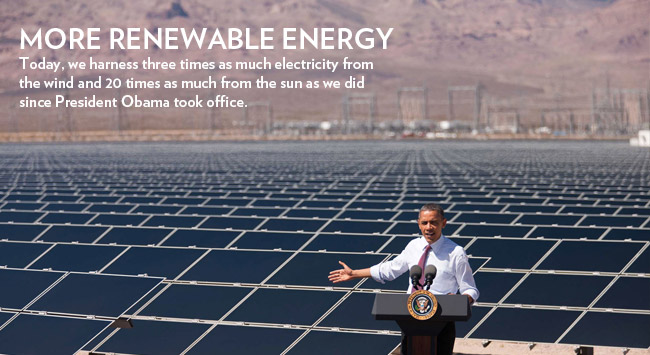
Posted by on October 2, 2010 at 5:00 AM ESTThe President points to a revolutionary new solar plant that will employ 1,000 people and power 140,000 homes. The plant is possible because of the President’s investments in the clean energy economy, which Congressional Republicans want to eliminate.
Learn more about Economy, Energy and EnvironmentKicking Off National Energy Awareness Month
Posted by on October 1, 2010 at 12:31 AM ESTAs you may know, the beginning of October marks the beginning National Energy Awareness Month, a national effort to underscore how central energy is to our national prosperity, security, and environmental well-being. In commemoration of National Energy Awareness Month, the Obama Administration is kicking off a month of clean energy events and activities. Senior administration officials from across the federal government will be highlighting the work they are doing to position our country for a sustainable future, create new clean energy jobs and lay the foundation for our long-term economic security. Check out the current calendar of events, and be sure to check back often as more events are added.
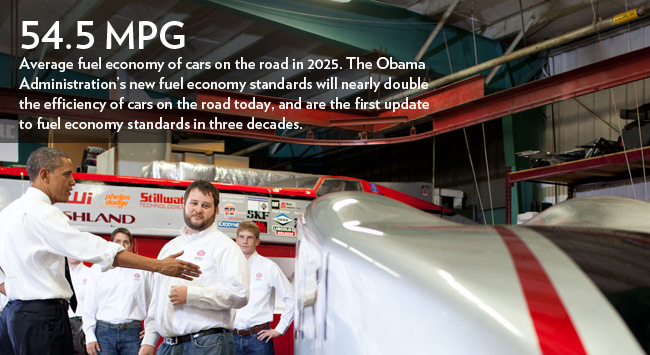
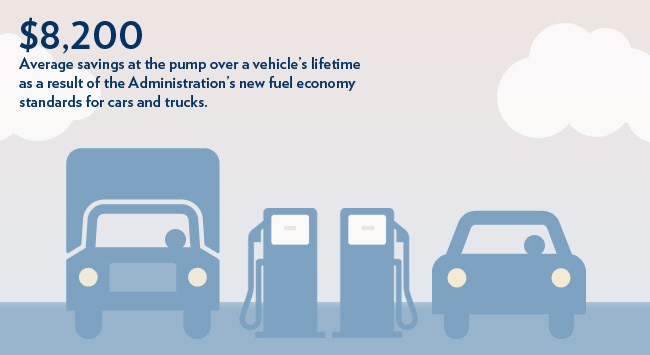
Since taking office, President Obama and his Administration have taken unprecedented steps to build a clean energy economy in this country. We’ve invested over $90 billion in clean energy technology through the Recovery Act. We worked with the automotive industry and the environmental community to set new tough new fuel-economy standards and the first-ever greenhouse gas emissions standards for cars and light trucks. And the federal government itself -- one of the largest consumers of energy in the country, is leading by example by cutting its carbon footprint and finding creative ways to go green.
Learn more about Energy and EnvironmentInvesting in the Health of the Great Lakes
Posted by on September 29, 2010 at 6:25 PM ESTI spent Monday morning in Milwaukee touring the impressive work underway to integrate the natural environment back into water infrastructure. Throughout the tour, I saw ways in which the Milwaukee Metropolitan Sewerage District (MMSD) is using or planning to use green infrastructure to manage and reuse stormwater, reducing pollution in the Great Lakes in a more natural way. I was proud to announce that we are awarding MMSD a $4 million grant through the Great Lakes Restoration Initiative to continue this type of innovative and effective restoration work.

CEQ Chair Nancy Sutley joins Milwaukee Metropolitan Sewerage District Executive Director Kevin Shafer to tour projects that will help meet GLRI restoration goals.
President Obama created the Great Lakes Restoration Initiative to target the most significant problems facing the Great Lakes, and track progress in addressing them. Through this initiative, we have proposed the largest investment in the Great Lakes in two decades. The grant awarded to the Milwaukee Metropolitan Sewerage District will fund projects to help meet these restoration goals.

Chair Sutley and Executive Director Shafer view a Milwaukee Metropolitan Sewerage District project
The Great Lakes support a multi-billion dollar economy, provide drinking water for 30 million people, and help shape the culture and environment of the region. But just like many of our nation’s ecosystems, the Great Lakes face challenges like pollution, invasive species, habitat loss and environmental degradation that threaten to erode them. The Great Lakes Restoration Initiative calls for aggressive action to address priority areas such as cleaning up toxics and toxic hot spots, combating invasive species, protecting watersheds from polluted run-off, and restoring wetlands and other habitats.
Restoring the Great Lakes is a national priority. Working together, we can protect this magnificent resource for the benefit of Great Lakes communities and all Americans.
Nancy Sutley is Chair of the White House Council on Environmental Quality
Learn more about Energy and EnvironmentFive Congregations Win 2010 ENERGY STAR Awards
Posted by on September 29, 2010 at 5:57 PM ESTThe U.S. Environmental Protection Agency (EPA), through its ENERGY STAR program, has recognized five congregations for their environmental and financial stewardship achieved through more efficient energy and water use. The award winners are:
- First Baptist Church of Orlando, Orlando, Fla.;
- First Parish Needham, Needham, Mass.;
- Lakewood Church, Houston, Texas;
- Saint Alban’s Episcopal Church, Monroe, Ga., and;
- Swarthmore Presbyterian Church, Swarthmore, Pa.
Together, the five congregations achieved annual greenhouse gas emissions reductions equivalent to those emitted by more than 564 typical homes, while saving more than $752,500 on their utility bills.
The savings are a result of cost-effective efficiency improvements and practices to reduce energy and water waste, without diminishing comfort or convenience within the worship facility. In addition to capturing significant dollar savings to redirect to their faith-based missions, the congregations also know they are becoming betters stewards of the earth and its resources, in keeping with the teachings of their faith traditions.
EPA's ENERGY STAR program estimates that if all America's 370,000-some worship facilities cut their energy use only ten percent, it would save about $315 million to redirect to congregational needs, while more than one million metric tons of greenhouse gas emissions could be prevented.
ENERGY STAR provides free information: Putting Energy into Stewardship guide, online tools, webinars and technical support to help the faith community reduce energy costs in worship facilities at http://energystar.gov/congregations.
Jerry Lawson is the National Manager of ENERGY STAR for Congregations at the U.S. Environmental Protection Agency.
Learn more about Energy and Environment
- &lsaquo previous
- …
- 154
- 155
- 156
- 157
- 158
- 159
- 160
- 161
- 162
- …
- next &rsaquo
Related Videos
-
 May 09, 2014 8:21 AM
Inside the White House: Solar Panels
-
 September 01, 2016 8:25 PM
President Obama Delivers a Statement to the Press
White House Blogs
- The White House Blog
- Middle Class Task Force
- Council of Economic Advisers
- Council on Environmental Quality
- Council on Women and Girls
- Office of Intergovernmental Affairs
- Office of Management and Budget
- Office of Public Engagement
- Office of Science & Tech Policy
- Office of Urban Affairs
- Open Government
- Faith and Neighborhood Partnerships
- Social Innovation and Civic Participation
- US Trade Representative
- Office National Drug Control Policy