Energy and Environment Latest News
Understanding, Preparing and Responding to Climate Change
Posted by on October 14, 2010 at 2:26 PM ESTI am proud that the Interagency Climate Change Adaptation Task Force released a report today with recommendations that will help strengthen the Nation’s capacity to understand, prepare for, and respond to the risks associated with climate change. The Task Force, co-chaired by the Council on Environmental Quality, the Office of Science and Technology Policy, and the National Oceanic and Atmospheric Administration, includes representatives from more than 20 Federal Agencies that collaborated on these recommendations at the request of the President (you can view the report here).
We know that climate change is already affecting communities, livelihoods and natural places around the world. Curbing greenhouse gas emissions to reduce the effects of climate change is a priority. The Federal Government also has an obligation to prepare for and respond to the risks and vulnerabilities we are already beginning to see, and the impacts we may see in the future.
The Federal Government must consider how climate risks will affect our services, operations and assets throughout the country. Infrastructure such as Federal roads, for example, may require additional resilience to extreme heat, extreme cold, or more frequent and severe floods. Public lands may need to be managed to take into account more frequent or severe droughts and wildfires. Planning for adaptation will reduce the long-term costs of responding to these kinds of impacts, and help protect American communities and the infrastructure and natural areas they rely on.
The Federal Government can also play a critical role in building greater awareness of the importance of adaptation, promoting best practices, and providing access to essential information about climate risks and vulnerabilities. The recommendations we announced today will help ensure the United States is prepared to safeguard our citizens, our communities and our economy as we confront the 21st century challenge of global climate change.
Nancy Sutley is Chair of the White House Council on Environmental Quality
Learn more about Energy and EnvironmentYou Asked, Chu Answered
Posted by on October 14, 2010 at 1:54 PM ESTEd. Note: Cross-posted from the Department of Energy's blog. To learn more about events happening as part of National Energy Awareness Month, check out our calendar.
Last week Secretary Chu invited you to submit your questions on home energy efficiency and the response was tremendous. We sifted through your questions and recently discussed many of them with the Secretary.
Here are the resources that the Secretary referenced during the discussion:
While the Secretary covered a lot of ground during the course of our discussion there were some thoughtful questions that we didn’t have a chance to ask, so we decided to ask the experts at Energy Efficiency and Renewable Energy to weigh in. You can check out their responses below.
Learn more about Energy and EnvironmentProducing Nearly 1200 Megawatts of Solar Power on Public Lands
Posted by on October 14, 2010 at 11:38 AM EST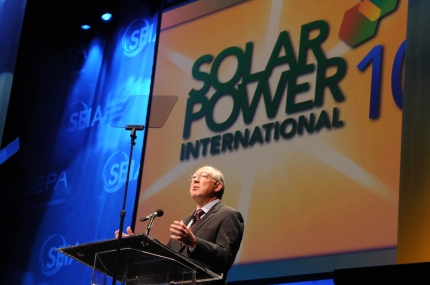
October 13, 2010. (by Tami A. Heilemann - DOI)
Yesterday, I spoke at the Solar Power International Conference in Los Angeles, California. Being at the largest solar conference in North America gives you a real sense of possibility and promise. The pace at which these technologies are advancing is truly remarkable.
Just look at the large-scale solar projects we at the Department of the Interior have approved for construction in the past two weeks alone. They are the firsts of their kind on public lands and some will be among the largest solar projects in the world.
Learn more about Energy and EnvironmentLeading the Military toward a More Secure Energy Future
Posted by on October 13, 2010 at 6:30 PM ESTOctober 13th is the 235th Anniversary of the founding of the United States Navy. So it was incredibly appropriate that today I had the opportunity to speak at two events focused on our military’s energy policy, because how the Navy and Marine Corps have harnessed energy has shaped our history since the birth of the Republic. And how energy is used and produced in the United States will continue to affect both our national security, and the strategic and tactical capabilities of our forces, long into the future.
The military and the United States depend too much on fossil fuels. But over the last two years the Department of the Navy has made significant strides to change that, and is moving toward the President’s vision of a new energy future powered by alternative energy. The reasons for making this change are clear. First and foremost, energy reform is about the lives of our troops. For every 24 fuel convoys that go into Afghanistan, we lose one American, killed or wounded. That is too high a price to pay for energy.
Learn more about Defense, Energy and EnvironmentRural Communities, Our Economy and Our Energy
Posted by on October 8, 2010 at 4:49 PM ESTSince taking office, President Obama has emphasized the critical role America’s rural communities play not only in our national economy but also in helping to tackle our nation’s toughest energy challenges.
Today, nearly all of the fuel that powers our cars, trucks, and aircraft currently comes from oil. This oil – half of which is imported from overseas – also accounts for over one-third of our total carbon emissions.
Yet in small towns and on family farms all across the country, a renewable fuels movement has gained momentum and is reducing our dependence on foreign oil, creating new jobs and industries, and cutting the pollution that contributes to climate change. This is why the President has and will continue to advocate for a robust biofuel industry as part of his comprehensive energy strategy.
Learn more about Energy and Environment, RuralThe First Large-Scale Solar Energy Plants on Public Lands
Posted by on October 5, 2010 at 5:10 PM ESTToday, we took a big step on our nation’s path to clean energy future with the approval of the first large-scale solar energy plants ever to be built on public lands.
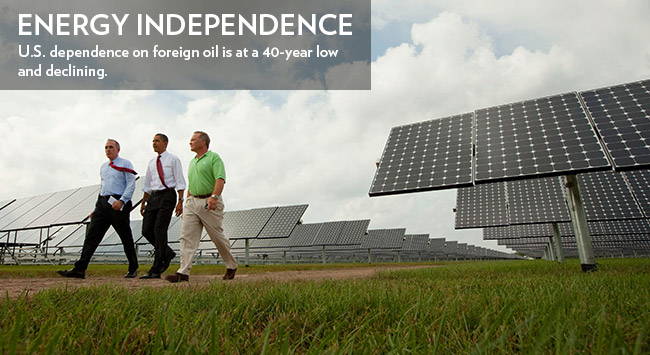
The Tessera Solar Imperial Valley Solar Project and the Chevron Energy Solutions Lucerne Valley Solar Project will both be built in the sunny California desert. Together, the projects could produce up to 754 megawatts of renewable energy, power 226,000 – 566,000 American homes, and support almost 1,000 new jobs.
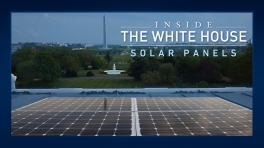
These two projects reflect the priority President Obama has placed on growing America’s clean energy economy. From spurring the deployment of energy-saving windows and advanced batteries for cars to installing solar panels on the White House roof, the Administration is incentivizing and promoting clean energy technology on a historic scale.
At the Department of the Interior, we have a special responsibility to help lead this effort. As stewards of our nation’s public lands, we oversee deserts, plains, and oceans that can make significant contributions to our nation’s renewable energy portfolio.
To capture wind, solar, and geothermal power on public lands, the Bureau of Land Management has worked to create a collaborative and coordinated permitting process that allows the efficient and responsible review of potential renewable energy projects.
The two large-scale solar projects I approved today went through a vigorous assessment, extensive environmental review, and input from the public. Companies have had to take significant steps to mitigate the projects’ environmental impacts, including shrinking the projects’ footprints and creating alternative habitats for wildlife in consultation with conservation stakeholders and the Fish and Wildlife Service.
Today’s projects are proof that we can cut red tape without cutting corners.
We should be proud of today’s milestone as we wisely grow our nation’s clean energy economy, stimulate investment in cutting-edge technology, create jobs for American workers, and promote clean energy for American homes, businesses and industry.
Learn more about Energy and Environment
- &lsaquo previous
- …
- 153
- 154
- 155
- 156
- 157
- 158
- 159
- 160
- 161
- …
- next &rsaquo
Related Videos
-
 May 09, 2014 8:21 AM
Inside the White House: Solar Panels
-
 September 01, 2016 8:25 PM
President Obama Delivers a Statement to the Press
White House Blogs
- The White House Blog
- Middle Class Task Force
- Council of Economic Advisers
- Council on Environmental Quality
- Council on Women and Girls
- Office of Intergovernmental Affairs
- Office of Management and Budget
- Office of Public Engagement
- Office of Science & Tech Policy
- Office of Urban Affairs
- Open Government
- Faith and Neighborhood Partnerships
- Social Innovation and Civic Participation
- US Trade Representative
- Office National Drug Control Policy