Energy and Environment Latest News
Growing our Communities Sustainably
Posted by on May 21, 2010 at 4:42 PM ESTAll across this country, I am continually impressed by the ways cities are working to build their own more livable, environmentally sustainable communities. Last week, I traveled to Colorado where the City of Denver has started building more than 100 miles of new light rail, commuter rail, and bus rapid transit lanes that will link the 32 communities surrounding the city. In February, I witnessed how Portland, Oregon is working to build a 467-mile long passenger rail line that will connect the city with Eugene, Seattle, and Vancouver, Canada.
In January, President Obama told America’s Mayors that “We need strategies that encourage smart development linked to quality public transportation, that bring our communities together.” Today, I had the opportunity to witness first-hand how local planners in Atlanta are doing just that by linking neighborhoods together. Through the Atlanta BeltLine project, the city will combine green space, trails, transit, and new development along 22 miles of historic rail segments that surround the urban core.
Over the past 20 years, metro Atlanta’s growth has occurred in widespread and disconnected pockets of development, which strained the region’s quality of life and economic growth. This has resulted in long commutes, poor air quality, auto dependency, and limited public space for residents and businesses throughout the region. The BeltLine will change this pattern of regional sprawl in the coming decades and lead to a vibrant and livable Atlanta with an enhanced quality of life. This is just the type of redevelopment our Sustainable Communities Initiative will foster across the country.
The Transit, Trails, and Transportation portion of this project will add a network of light rail transit that will connect with the existing transit system and the new, proposed Peachtree Streetcar. The multi-use trails will follow the 22-mile transit loop, and 11 miles of additional trails will extend into the surrounding neighborhoods to increase access to the BeltLine. This project will also include Atlanta’s largest investment ever in affordable workforce housing which will generate an estimated 5,600 affordable units over the course of the project.
Over the next 25 years, the BeltLine will not only connect the City of Atlanta with its surrounding communities, but will create more than $20 billion of new economic development and approximately 30,000 new full-time jobs, and 48,000 year-long construction jobs.
While in Atlanta, I also joined Congressman Hank Johnson and Atlanta Mayor Kasim Reed for a tour of the Pittsburgh Neighborhood, which has been severely impacted by foreclosures and blight. In recent years, it has had the highest foreclosure rate in the region and has been victimized by rampant mortgage fraud while suffering from high levels of vacancy and property abandonment. Many homes in the neighborhood stand vacant and boarded up. With $1.25 million in HUD’s Neighborhood Stabilization Program (NSP) funds, $3 million in loans from the Casey Foundation, and $145,000 in grants from Living Cities and JPMorgan Chase, the Pittsburgh Neighborhood will soon find relief and start to grow again.
While in Atlanta, I also addressed the 18th Congress for the New Urbanism (CNU) about the Obama Administration’s Sustainable Communities Partnership and the work HUD’s Office of Sustainable Housing and Communities is doing to make communities healthier and more economically competitive. As I told the CNU, it is my hope that through this initiative we will be able to encourage the kind of smart growth Atlanta that is experiencing through the BeltLine project, in neighborhoods and communities across the country.

Secretary for Housing and Urban Development Shaun Donovan delivers remarks in Atlanta, joined by Congressman Hank Johnson and Atlanta Mayor Kasim Reed following a tour of the Pittsburgh Neighborhood, a recipient of HUD’s Neighborhood Stabilization Program (NSP) funds. May 21, 2010. (by Steven A. Bales)
Shaun Donovan is Secretary for Housing and Urban Development
Learn more about Energy and Environment, Urban PolicyAnother Step Towards Securing Our Future in Energy
Posted by on May 21, 2010 at 1:25 PM ESTThis morning, President Obama signed a Presidential Memorandum on fuel efficiency standards, an initiative that will build on his goal to move towards improved fuel economy for vehicles. The signing comes a year after he made a historic agreement to break America’s dependence on foreign oil and create clean energy jobs.
The President explained that one year later, we are already beginning to see the results of that goal. The Presidential Memorandum signed today will take another step forward by proposing the development of a national standard for larger heavy-duty trucks. The Memorandum directs the Department of Transportion and the Environmental Protection Agency (EPA) to create a first-ever National Policy to increase fuel efficiency and decrease greenhouse gas pollution from medium- and heavy-duty trucks for Model Years 2014-2018. Trucks consume more than two million barrels of ail every day and emit 20% of all transportation related greenhouse gas pollution, and the new standard is expected to bring down costs for transporting goods while reducing pollution and spurring growth in the clean energy sector.
The President explained that this is a matter of global importance:
We know how important that is. We know that our dependence on foreign oil endangers our security and our economy. We know that climate change poses a threat to our way of life -– in fact we’re already seeing some of the profound and costly impacts. And the disaster in the Gulf only underscores that even as we pursue domestic production to reduce our reliance on imported oil, our long-term security depends on the development of alternative sources of fuel and new transportation technologies.
But we also know that our economic future depends on our leadership in the industries of the future. Around the globe, countries are seeking an advantage in the global marketplace by investing in new ways of producing and saving energy. From China to Germany, these countries recognize that the nation that leads in the clean energy economy will lead the global economy. And I want America to be that nation.

President Barack Obama delivers remarks in the Rose Garden of the White House before signing a Presidential Memorandum outlining the next steps in his vision for cleaner, more efficient vehicles, May 21, 2010. (Official White House Photo by Pete Souza)
Learn more about Energy and EnvironmentDeveloping Our Sustainable Future
Posted by on May 14, 2010 at 5:32 PM ESTI believe that when you set out to look for a home, you aren’t just looking for a house, but you are also looking for a community. You are thinking about access to quality schools and safe streets for your children. You are thinking about transportation to work and school. It’s important for you to have access to good jobs, grocery stores and transportation. When you choose a home, you choose a community and all that is has to offer. As a father, I understand how important it is to spend less time commuting and more time with family.
Through HUD’s Office of Sustainable Housing and Communities we are working with the Department of Transportation and the Environmental Protection Agency to create those sustainable communities. Guided by six “Livability Principles,” our Interagency Partnership is working to break down silos that traditionally exist in the federal government and help local communities across the country improve access to affordable housing, more transportation options, and lower transportation costs, while protecting our environment. It will help communities build more livable, walkable, environmentally sustainable regions by connecting housing to jobs, fostering and encouraging local innovation, and by building a clean energy economy.
Today, I had the opportunity to travel to the great state of Colorado, which has been leading the effort on all things “green” and sustainable. The City of Denver has started building more than 100 miles of new light rail, commuter rail, and bus rapid transit lanes, linking the 32 communities surrounding the city. And it doesn’t stop there.
Along with representatives from the Denver Housing Authority, Mayor John Hickenlooper, Congressman Ed Perlmutter, and I toured Benedict Park Place (BPP). Located near Denver’s central business district in Downtown Denver, BPP is a 15-acre sustainable mixed-income, mixed-used redevelopment project. Within walking distance to a Transit Oriented Development (TOD)-light rail line, bus stop, bike share station, grocery store, parks, charter school and downtown job center, BPP is a model for the type of sustainable communities that we are developing across the country. It has 580 mixed-income units with over 100 homeownership units planned with a total cost of approximately $130 million. The last phase, which broke ground this spring, will deliver 89 mixed-income rental units (30 public housing, 32 Low Income Housing Tax Credits and 27 market rate units) currently scoring as LEED Platinum under the LEED for Homes Pilot Program. It will contain various renewable energy components, including a 42 bore wells geothermal system and a 100kw Solar Photovoltaic System that will reduce the building’s operating costs by over 50% on an annual basis and save as much as $43,000 in HUD utility subsidies a year. And thanks to $5.6 million in HUD Recovery Act funding, the Denver Housing Authority was able to create quality construction jobs for 50 workers as a result of this project, some of whom I was able to meet during my tour today.

Representative Ed Perlmutter, Secretary of Housing and Urban Development Shaun Donovan, and Denvery Mayor John Hickenlooper at Benedict Park Place housing development in Denver, Colorado. May 14, 2010.
Not only is it important for our big cities and urban communities to have access to sustainable development resources, but for our small towns and rural communities as well. They face unique challenges when it comes to accessing health care, grocery stores, and adult education opportunities, among other things. As I mentioned in testimony before the Senate Appropriations Subcommittee on Transportation, Housing, and Urban Development last week, as part of our new Sustainable Communities Planning Grant Program, we are creating a separate, special funding category specifically for small towns and rural places. The program will include a funding set-aside for communities and towns with a population of less than 200,000 people, as well as for those with a population between 200,000 and 500,000. This will ensure that small towns and rural places are not overlooked in this competition.
While in Colorado, I also traveled about an hour north of Denver to the City of Greely (population 95,000). In Greely, I participated in a panel discussion with Congresswoman Betsy Markey, Governor Bill Ritter, and Greely Mayor Tom Norton where we focused on developing more sustainable, walkable, energy efficient housing and communities in America’s small and rural towns.
Whether it’s our rural communities and small towns or our big cities and urban communities, President Obama and I are committed to ensuring that we tie the quality and location of housing to broader opportunities. This includes access to good jobs, quality schools and safe streets. This also means helping communities that face common problems start sharing solutions and becoming partners to create sustainable development.
Shaun Donovan is the Secretary of Housing and Urban Development.
Learn more about Energy and Environment"Relentless Efforts to Stop the Leak and Contain the Damage"
Posted by on May 14, 2010 at 1:51 PM ESTThis morning the President met with members of his Cabinet to get another comprehensive update on the ongoing Administration-wide response to the disastrous BP oil spill in the Gulf region. The President made clear his frustration with BP and the other parties involved in the spill, committed once again to ensuring they are held accountable for picking up the tab, and recapped the Administration’s efforts to tighten up the regulation of offshore drilling sites.
He began with the top priorities, however:
The potential devastation to the Gulf Coast, its economy, and its people require us to continue our relentless efforts to stop the leak and contain the damage. There’s already been a loss of life, damage to our coastline, to fish and wildlife, and to the livelihoods of everyone from fishermen to restaurant and hotel owners. I saw firsthand the anger and frustration felt by our neighbors in the Gulf. And let me tell you, it is an anger and frustration that I share as President. And I’m not going to rest or be satisfied until the leak is stopped at the source, the oil in the Gulf is contained and cleaned up, and the people of the Gulf are able to go back to their lives and their livelihoods.
Now, the most important order of business is to stop the leak. I know there have been varying reports over the last few days about how large the leak is, but since no one can get down there in person, we know there is a level of uncertainty. But as Admiral Thad Allen said today, our mobilization and response efforts have always been geared toward the possibility of a catastrophic event. And what really matters is this: There’s oil leaking and we need to stop it –- and we need to stop it as soon as possible. With that source being 5,000 feet under the ocean’s surface, this has been extremely difficult. But scientists and engineers are currently using the best, most advanced technology that exists to try to stop the flow of oil as quickly as possible.
Our second task has been to contain the spill and protect the Gulf Coast and the people who live there. We are using every available resource to stop the oil from coming ashore. Over one million feet of barrier boom have been deployed to hold the oil back. Hundreds of thousands of gallons of dispersant have helped to break up the oil, and about four million gallons of oily water have been recovered; 13,000 people have been mobilized to protect the shoreline and its wildlife, as has the National Guard.
The President also discussed the draft legislation sent to Congress this week to ensure that the government can respond as needed, and talked about accountability:
I know BP has committed to pay for the response effort, and we will hold them to their obligation. I have to say, though, I did not appreciate what I considered to be a ridiculous spectacle during the congressional hearings into this matter. You had executives of BP and Transocean and Halliburton falling over each other to point the finger of blame at somebody else. The American people could not have been impressed with that display, and I certainly wasn’t.
I understand that there are legal and financial issues involved, and a full investigation will tell us exactly what happened. But it is pretty clear that the system failed, and it failed badly. And for that, there is enough responsibility to go around. And all parties should be willing to accept it.
That includes, by the way, the federal government. For too long, for a decade or more, there has been a cozy relationship between the oil companies and the federal agency that permits them to drill. It seems as if permits were too often issued based on little more than assurances of safety from the oil companies. That cannot and will not happen anymore. To borrow an old phrase, we will trust but we will verify.
Now, from the day he took office as Interior Secretary, Ken Salazar has recognized these problems and he’s worked to solve them. Oftentimes he has been slammed by the industry, suggesting that somehow these necessary reforms would impede economic growth. Well, as I just told Ken, we are going to keep on going to do what needs to be done.
And so I’ve asked Secretary Salazar to conduct a top-to-bottom reform of the Minerals Management Service. This week, he announced that the part of the agency which permits oil and gas drilling and collects royalties will be separated from the part of the agency in charge of inspecting the safety of oil rigs and platforms and enforcing the law. That way, there’s no conflict of interest, real or perceived.
He closed on a note of concern for those most affected:
The people of the Gulf Coast need our help, and they deserve nothing less than for us to stand up and do whatever is necessary to stop this spill, prevent further damage, and compensate all those who’ve been harmed already. That’s our job.
It’s also our job to make sure this kind of mess doesn’t happen again. It’s a job we’ve been doing. It’s a job we will keep doing until the well is capped and the spill is cleaned up, and all claims are paid.
Learn more about Deepwater BP Oil Spill, Energy and EnvironmentRestoring the Chesapeake Bay
Posted by on May 13, 2010 at 6:33 PM ESTNot far from its famous monuments and museums, Washington, D.C. has wonderful green space and natural areas. On Tuesday, I had the opportunity to see one of them up close, the Anacostia River. The Anacostia is a great example of a natural place that is facing serious environmental challenges. While there, I joined several other senior Administration officials to announce a new Federal strategy for protecting and restoring the Chesapeake Bay.
The President called for this strategy a year ago when he signed an Executive Order officially declaring what we have long known: that the Chesapeake Bay is a national treasure, and that we must restore and protect it for the people of the region, and for the Nation as a whole.
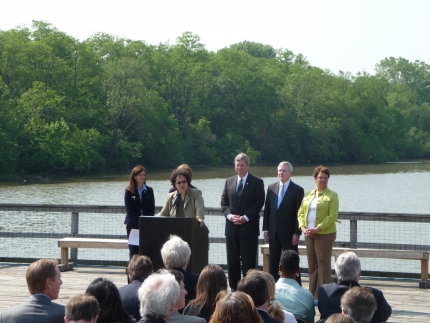
Chair Nancy Sutley, Principal Deputy Undersecretary Monica Medina, Assistant Secretary Anne Castle, Secretary Tom Vilsack, Secretary Ray Mabus, and Administrator Lisa Jackson announce a new Federal strategy for protecting and restoring the Chesapeake Bay May 12, 2010.
The range of agency officials at the announcement – including USDA Secretary Tom Vilsack, EPA Administrator Lisa Jackson, Secretary of the Navy Ray Mabus, DOI Assistant Secretary Anne Castle, and NOAA Principal Deputy Undersecretary Monica Medina – shows the commitment across the Federal Government to strengthen programs to protect the Bay and to work together to make a clean Bay a reality. We were joined by a number of local groups who are working hard to restore the Chesapeake and its tributaries, underscoring the importance of the Federal, state, local and community partnerships in this effort.
Restoring the Chesapeake Bay means restoring or improving the thousands of streams, creeks and rivers that feed into it, like the Anacostia River. For the residents of the region, the Chesapeake Bay is a source of beauty and pride, an economic engine, and a vital part of the area’s culture and communities, just like the many other dynamic aquatic ecosystems elsewhere in America.
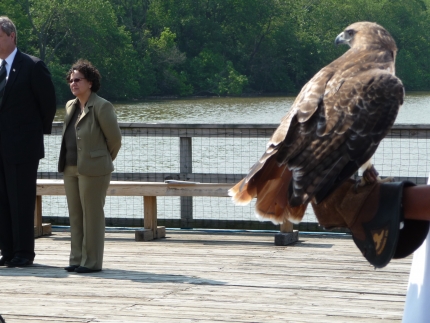
A red-tailed hawk also enjoyed the event. May 12, 2010.
There is still a great deal of work to be done to restore the Chesapeake Bay to health. But the new Federal strategy we have set forth will put the Bay on a path toward substantial and sustained improvement, and help ensure it continues to delight and support generations of Americans. Standing by the Anacostia River on a sunny Tuesday morning, with fellow Administration leaders and the support of a wide range of state, local and community partners, the outlook for this work seemed very bright indeed!
You can find the strategy on the Chesapeake Bay Program website: http://www.chesapeakebay.net/.
Nancy Sutley is the Chair of the White House Council on Environmental Quality
Learn more about Energy and EnvironmentAn Invitation to Join the League of Awesomeness
Posted by on May 13, 2010 at 11:47 AM ESTWeb comedian Ze Frank once coined the term “The League of Awesomeness” to describe people who “strive to make the world more awesome.” The assembled multitude at the “Enabling Environmental Protection Through Transparency and Open Government” symposium in Philadelphia is doing just that this week.
Over one thousand people are spending four days at the symposium, sponsored by the Environmental Protection Agency’s (EPA) Office of Environmental Information. In an extravaganza of 86 separate sessions, they are talking about the “how to” of open government – how to implement EPA’s Open Government Plan and translate the lofty ideas of transparency, participation, and collaboration into practical means of furthering it’s the agency’s core mission.
That’s one thousand attendees from private sector organizations; state, local, and tribal governments; EPA program and regional offices; environmental groups; business and industry; the scientific community; academia; the media; and the general public, all gathering to explore strategies for incorporating transparency, participation, and collaboration into the EPA’s work to safeguard the environment and promote smart and sustainable growth.
They are discussing what new information—such as the toxic release inventory—should be published online (via data.gov and the EPA’s own data finder, to inform people about environmental hazards, encourage the development of new jobs and businesses based on environmental information, catch wrong-doers committing environmental crimes, and reduce the costs of compliance to business. They have come to explore strategies for using modern technology, including web 2.0 social media, to foster greater participation by the public in the work of the EPA as well as greater collaboration across EPA disciplines (such as legal, finance, and tech), departments and agencies, and with the private sector.
During the Q&A after the Introductory Plenary, a woman stood up and introduced herself as “just a citizen.” She went on to describe how she had been forced to vacate her home because of environmental contaminants. She gave an impassioned plea to be consulted in any ensuing EPA investigation as she knew the situation first-hand and had useful knowledge to share.
The League of Environmental Awesomeness applauded in empathetic support. She had come to the right place. The room was filled with the spirit of excitement and the possibility of engaging with the EPA in entirely new ways.
You too can become a member of the league of open-government awesomeness, and you don’t even have to come to Philadelphia. Follow the ongoing meeting online via @EPAlive, (hash tag #OEI2010) or watch videos of the plenary sessions.
Learn more about Energy and Environment, , Technology
- &lsaquo previous
- …
- 173
- 174
- 175
- 176
- 177
- 178
- 179
- 180
- 181
- …
- next &rsaquo
Related Videos
-
 May 09, 2014 8:21 AM
Inside the White House: Solar Panels
-
 September 01, 2016 8:25 PM
President Obama Delivers a Statement to the Press
White House Blogs
- The White House Blog
- Middle Class Task Force
- Council of Economic Advisers
- Council on Environmental Quality
- Council on Women and Girls
- Office of Intergovernmental Affairs
- Office of Management and Budget
- Office of Public Engagement
- Office of Science & Tech Policy
- Office of Urban Affairs
- Open Government
- Faith and Neighborhood Partnerships
- Social Innovation and Civic Participation
- US Trade Representative
- Office National Drug Control Policy