Energy and Environment Latest News
Our Forests and Climate Change
Posted by on September 12, 2013 at 10:13 AM EDTAmericans know the importance of forests to our communities and our economy. They provide jobs and recreational opportunities, filter our air and water, and make up essential habitat for wildlife and natural resources. But increasingly, we’re also recognizing that forests play an important role in mitigating climate change.
Recently, President Obama announced a Climate Action Plan to reduce carbon pollution, prepare for the impacts of climate change on our communities and economy, and lead international efforts to combat global climate change. This plan recognizes that America’s forests play a critical role in addressing carbon pollution, absorbing as much as 14 percent of our country’s greenhouse gas emissions each year. Over the last several decades, forest regrowth on former farm lands, reforestation, and maturing forests have kept our forest growth rates high, helping us absorb even more carbon.
At the same time, development of forest lands is reducing the amount of carbon we can absorb now and in the future. Carbon pollution is also taking a toll on our forests – heat waves, wildfires, pests and drought are all worsened by climate change, reducing our forests’ ability to sequester carbon.

Photo Credit: U.S. Bureau of Land Management
This initiative will build on the significant work the Administration already has underway to ensure healthy, thriving forests. For example, the Department of Agriculture announced this year the creation of seven new regional hubs to provide research and timely information to farmers and forest landowners as we work together to combat climate change. This work will complement research by DOI Climate Science Centers, in areas such as evaluating management options, projecting forest conditions and carbon storage under climate change, evaluating the effects of changing rainfall and snow conditions, and studying the effects of changing forests on particular species and ecosystem services. This information is helping to inform restoration efforts undertaken by the Forest Service and its partners to make our forests more resilient. And DOI and USDA are working together with other Federal agencies, states, tribes, and private landowners to engage in historic, landscape scale conservation projects that will put critical ecosystems on a stronger footing for the future.
Climate change poses a tough new challenge for the forest ecosystems that provide so much for all Americans. Following President Obama’s lead, we’re getting ahead of the game – focusing on new partnerships, strengthening interagency collaboration, and ensuring that the best science is available as we take on climate change in the years to come.
Robert Bonnie is Under Secretary of Agriculture for Natural Resources and the Environment
Anne Castle is Assistant Secretary for Water & Science at the Department of the Interior
Learn more about Energy and EnvironmentAnnouncing the Advisory Council to the President’s Taskforce on Wildlife Trafficking
Posted by on September 9, 2013 at 4:09 PM EDTEarlier today, I joined Secretary of the Interior Sally Jewell, former Secretary of State Hillary Clinton, and Clinton Foundation Vice Chair Chelsea Clinton for an event here at the White House to discuss efforts to combat wildlife trafficking.
Wildlife trafficking is a growing crisis. Since 2007, the trade has doubled in size and is now one of the most lucrative types of transnational organized crime in the world. Billions of dollars are made every year off the trade of illegal animal goods, and animal populations are being decimated in the process, while criminal syndicates and terrorist groups profit. As the trade grows, poachers are using increasingly powerful and sophisticated weapons, and traffickers are exploiting porous borders, corrupt officials, and weak institutions to profit from protected animals. At the same time, local economies that depend on wildlife tourism are being threatened.
At this afternoon’s event, we discussed the Administration’s efforts to counter wildlife trafficking as well as opportunities for public-private collaboration. Secretary Jewell also announced the members of the Advisory Council on Wildlife Trafficking, which was formed in response to the President's Executive Order of July 1 that charted a path forward to increase U.S. efforts to counter poaching and the illegal wildlife trade. The Advisory Council, comprised of private-sector leaders, nonprofit organizations, and former government officials, will make recommendations to the Administration on wildlife trafficking and provide it with ongoing advice and assistance.
Learn more about Energy and Environment, Foreign PolicyWhite House Hosts Forum to Counter Wildlife Trafficking and Announces Advisory Council
Posted by on September 6, 2013 at 1:00 PM EDT“The entire world has a stake in making sure that we preserve Africa's beauty for future generations.”
- President Obama in Tanzania on July 1, 2013, announcing his Executive Order on Wildlife Trafficking
Tune in on Monday from 1:00 to 3:00 p.m. at http://www.wh.gov/live as the White House hosts a Forum to Counter Wildlife Trafficking featuring Deputy National Security Advisor Ben Rhodes, Secretary of the Interior Sally Jewell, former Secretary of State Hillary Clinton, and Clinton Foundation Vice Chair Chelsea Clinton.
At the President’s direction, the United States is intensifying our assistance to foreign governments working to combat wildlife trafficking and related organized crime. At the Forum, Secretary Jewell will announce the members of the new Advisory Council on Wildlife Trafficking. The Council will work closely with and advise the President’s Task Force in developing a National Strategy on these issues, as directed by the Executive Order on Combating Wildlife Trafficking that the President signed in July.
Learn more about Energy and Environment, Foreign PolicyInnovating to Improve Disaster Response and Recovery
Posted by on September 3, 2013 at 2:30 PM EDTLast week, the White House Office of Science and Technology Policy (OSTP) and the Federal Emergency Management Agency (FEMA) jointly challenged a group of over 80 top innovators from around the country to come up with ways to improve disaster response and recovery efforts. This diverse group of stakeholders, consisting of representatives from Zappos, Airbnb, Marriott International, the Parsons School of Design, AOL/Huffington Post’s Social Impact, The Weather Channel, Twitter, Topix.com, Twilio, New York City, Google and the Red Cross, to name a few, spent an entire day at the White House collaborating on ideas for tools, products, services, programs, and apps that can assist disaster survivors and communities.
This collaboration is a great example of this Administration’s commitment to convening private-sector talent and innovators to work with public servants in order to deliver better results for the American people. The event mobilized innovators from the private sector, nonprofits, artistic organizations, and Federal as well as local government agencies to develop solutions that support and integrate both public and private efforts for disaster relief. It also comes as our Nation prepares for what is usually the peak of Hurricane Season. In fact, the two-year anniversary of Hurricane Irene fell last week, and the one-year anniversary of Hurricane Sandy is approaching.
During the “Data Jam/Think Tank,” we discussed response and recovery challenges with the participants and other Federal leaders, including Patricia Hoffman, Assistant Secretary at the Department of Energy and Dr. Nicole Lurie, Assistant Secretary at the Department of Health and Human Services. The participants then broke into subgroups to brainstorm innovative ideas for addressing those challenges, vote on the best ideas, and commit to implementing them.Learn more about Energy and EnvironmentReducing America’s Dependence on Foreign Oil As a Strategy to Increase Economic Growth and Reduce Economic Vulnerability
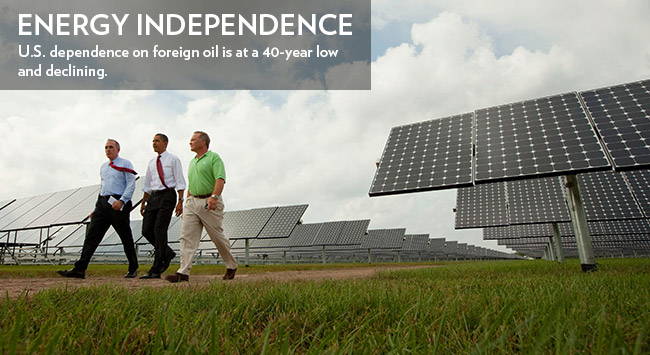
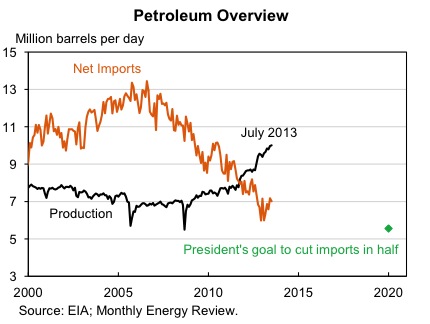
Posted by on August 29, 2013 at 5:51 PM EDTToday the Bureau of Economic Analysis revised up its estimate of second quarter GDP from 1.7 percent to 2.5 percent. This stronger estimate of growth was a result of an upward revision in net exports, with the trade data showing that a key part of the revision is because the trade deficit in petroleum fell to a record low in June. This is yet another reminder that the President’s focus on increasing America’s energy independence is not just a critical national security strategy, it is also part of an economic plan to create jobs, expand growth and cut the trade deficit.
The President established a national goal in 2011 to reduce oil imports by one third by 2020 and elevated the goal in 2012 to reduce them by one half by 2020. We are currently on track to meet this ambitious goal if we continue to follow through on the policies that are critical to achieving it.
 Learn more about Economy, Energy and Environment
Historic Energy Efficiency Rules Would Save Consumers Money and Cut Carbon Emissions
Posted by on August 29, 2013 at 3:10 PM EDTEnergy efficiency is one of the clearest and most cost-effective opportunities to save families money, make our businesses more competitive, and reduce greenhouse gas emissions.
In President Obama’s first term, the Energy Department established new minimum efficiency standards for dishwashers, refrigerators, and many other products. Through 2030, these standards will cut consumers’ electricity bills by hundreds of billions of dollars and save enough electricity to power more than 85 million homes for two years.
To build on this success, the President set a new goal in his Climate Action Plan: Efficiency standards for appliances and federal buildings set in the first and second terms combined will reduce carbon pollution by at least 3 billion metric tons cumulatively by 2030 – equivalent to nearly one-half of the carbon pollution from the entire U.S. energy sector for one year – while continuing to cut families’ energy bills.
Today, the Energy Department is taking steps towards achieving this new goal by issuing two proposed rules that could cut energy bills by up to $28 billion and cut emissions by over 350 million metric tons of CO2 over 30 years. This reduction in CO2 emissions would be the equivalent of taking nearly 109 million new cars of the road for one year. Or put another way, the energy saved from these proposed rules would be equal to the amount of electricity used by 50 million homes in a year.
Learn more about Energy and Environment
- &lsaquo previous
- …
- 49
- 50
- 51
- 52
- 53
- 54
- 55
- 56
- 57
- …
- next &rsaquo
Related Videos
-
 May 09, 2014 9:21 AM
Inside the White House: Solar Panels
-
 September 01, 2016 9:25 PM
President Obama Delivers a Statement to the Press
White House Blogs
- The White House Blog
- Middle Class Task Force
- Council of Economic Advisers
- Council on Environmental Quality
- Council on Women and Girls
- Office of Intergovernmental Affairs
- Office of Management and Budget
- Office of Public Engagement
- Office of Science & Tech Policy
- Office of Urban Affairs
- Open Government
- Faith and Neighborhood Partnerships
- Social Innovation and Civic Participation
- US Trade Representative
- Office National Drug Control Policy