


Energy and Environment Latest News
Clean Energy and Climate Change Are American Issues
Posted by on November 5, 2013 at 12:18 PM EDT
Robin Eckstein is being honored as a Veteran Advancing Clean Energy and Climate Security Champion of Change.
In 2003 I deployed with the 1st Armored Division, 123rd Main Support Battalion to Baghdad, Iraq as a truck driver. In Iraq, I drove supply missions in and around the Baghdad area. During that time there was no opportunity to reflect on the daily missions to deliver fuel to forward operating bases that left our convoys vulnerable to constant attacks. These forward operating bases were going through so much fuel that the convoys had to leave the safer confines of the main bases and put American lives at risk so that this dirty fossil fuel could be used up almost as fast as it was delivered. I realized there had to be a better way, but during war you don’t have time to worry about the “what ifs.”
After returning home I decided to continue my service to the country by striving to make a difference in clean energy. In 2007 I began working on veterans issues with VoteVets.org. Then in 2009, the Truman National Security Project started a campaign called Operation Free, a coalition of veterans and national security agencies campaigning for comprehensive clean energy reform. This is where I found a true place I could make a difference and ease the pain of losing my chance to serve directly after being medically discharged from my combat disability.
I boarded a bus with a group of fellow veterans from around the nation and we drove across the country speaking at hundreds of different venues, each time discovering that when a group of veterans discussed clean energy and climate change, it was no longer a partisan issue, but one that everyone in America could be concerned about. Whether it was a meeting at the Minot, ND, Chamber of Commerce or a VFW hall in Berkeley, MI, people could see the connections.
Our message was amplified by the Pentagon’s move to take climate change seriously as a threat multiplier. The Department of Defense is taking the lead to help reduce that impact, because every solar generator that replaces a fuel-using one saves lives in a war by not having me or my fellow truck drivers dodging bullets to transport that fuel to forward operating bases.
Bringing a no-nonsense message to the American people from honest war veterans proved that minds and attitudes could be changed. There has been a lot of forward movement on climate change and clean energy in the country, and there is more good work being done today. I know the changes the military is making now will mean fewer convoys being attacked because of the old fuel-guzzling ways of yesteryear. Not only did my fellow veterans and I make a difference by bringing the connection and the truth to Americans across the nation, but I also helped myself by continuing my service to my country and giving myself a reason to not let my disability win. I am honored to be a Champion of Change and thankful to all my fellow veterans that also spread the message on that big blue bus and the many others who helped along the way.
Robin Eckstein is a veteran and a Truman Defense Council member living in Appleton, WI.
Learn more about Energy and EnvironmentA Future for All in Green Energy
Posted by on November 5, 2013 at 12:15 PM EDT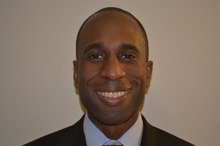
Phillip Green is being honored as a Veteran Advancing Clean Energy and Climate Security Champion of Change.
I am often commended by people for my courage to start Green Powered Technology (GPTech), a green energy business. I then think to myself that starting the business was not nearly as courageous as they imagined, since I initially maintained my day job. However, I think I displayed conviction in graduating from public schools in the Bronx on time, obtaining my college degrees on time as I served in the Army Reserve, researching green energy in Japan and China, and deploying to Afghanistan. All these endeavors were filled with pitfalls I overcame, so I am glad to be honored as a Champion of Change. I am also excited about the chance this recognition has given me to be a role model for others and a messenger for green technology’s many opportunities.
I started GPTech to fully utilize my education, government experience, and global interest in making the world more energy efficient. In 2004, my experience with light-emitting diode, which I researched in Japan, and their adoption challenges prompted me to learn more about technology adoption. After further experience with technology adoption, I felt confident I could form specialized teams to overcome hurdles in adopting green energy and make it easy for anyone to incorporate sustainable energy into their operations and communicate results to interested parties. My time in the U.S. Army and business school greatly assisted me with these team-building skills.
Towards the goal of making the world a more efficient place, GPTech pursued U.S. federal government contracts, since the U.S. government is the single largest energy-consuming entity in the world. Given this scale of consumption, GPTech’s offer to help save money, enhance operations, protect the environment, and provide energy reliability and security could have an especially large effect. I have also positioned my business to do work in Africa and China, because of their rising growth and energy needs.
GPTech provides experts to develop and implement strategies, initiatives, projects, and programs to help federal clients comply with the energy conservation and renewable energy requirements outlined in the Energy Policy Act of 2005, the Energy Independence and Security Act of 2007, Executive Order 13423, and Executive Order 13514.
In emerging markets, GPTech provides support to the U.S. Trade and Development Agency on proposal reviews and feasibility studies for renewable energy projects in the Power Africa Initiative. GPTech is also working on a USAID contract to promote clean energy in emerging markets.
Green energy allows us to improve our communities and our national, economic, and environmental security. The Department of Defense (DoD) risks lives to secure energy by protecting convoys that deliver fossil fuels and securing open sea lanes for oil tankers. Emerging markets require energy for economic growth, but they are not necessarily employing the best energy practices. GPTech envisions better solutions for DoD, emerging markets, and the world by sharing best energy practices, energy efficiency measures, and renewable energy sources.
Green energy presents challenges, which I view as opportunities on both the supply and demand sides. Additionally, green energy requires U.S. students to embrace and find employment in science, technology, engineering, and mathematics fields and eventually find our future energy solutions.
Fortunately, there are researchers working on green energy challenges and companies promoting innovative green energy business models across the globe. The greening of the supply chain presents additional opportunities. In other realms, providing solutions around the nexus of energy, water, and food will continue to present challenges for society and opportunities for entrepreneurs.
Phillip Green is the founder and president of Green Powered Technology, a firm that provides expert advice to our clients on energy and the environment.
Learn more about Energy and EnvironmentSolar Power is a Force Multiplier for Us All
Posted by on November 5, 2013 at 12:13 PM EDT
Nat Kreamer is being honored as a Veteran Advancing Clean Energy and Climate Security Champion of Change.
Tracer rounds from 50-caliber machine guns lit up the sky the night I landed at Baghdad International Airport. Like hundreds of thousands of Americans over three decades, I was in the Middle East, in uniform, carrying a gun to protect our national energy interests. A little over a year later I took off from Bagram Airfield, returned home, and co-founded SunRun to help American homeowners get their energy from clean, affordable, and domestic solar power. There’s nothing like a war with natural resource implications to kick-start passion and faith for renewable energy.
Our lifestyles cannot continue to subsidize foreign energy sources with more blood and more treasure. American soldiers, sailors, airmen, and Marines have and continue to make tremendous personal sacrifices to protect our national energy interests around the world. We have spent at least $7.3 trillion to defend our energy interests in the Persian Gulf alone over the last thirty years, according to research by Princeton University professor Robert J. Stern. To put this in perspective, $7.3 trillion equals approximately $23,000 per U.S. citizen. Imagine the last thirty years without two wars in the Gulf, with a healthier economy, and with a cleaner environment.
We owe our veterans and fellow citizens a way of life powered by clean, affordable, and domestic energy sources like solar. Fortunately, we are making progress. In the first three months of this year 82 percent of all new power generators built in the United States came from renewable energy sources. Every month around 10,000 Americans buy hybrid or electric cars. Every four minutes another solar system powers on in America. In many states a household can buy solar electricity for less than its current utility bill. A car that runs on solar is half as expensive to operate as one running on gasoline. Those simple home economics mean we may not have to spend the next thirty years fighting debt-financed foreign wars.
Our military is leading from the front. The military is putting solar electricity systems on the roofs of base buildings around the country. That solar electricity saves the military money it can invest in our national defense, and installing distributed solar electricity systems on military bases improves their defense by helping make bases self-sustaining and harder to attack.
U.S. military units in the field are starting to use solar panels to generate electricity to run combat systems. Those solar panels make our fighting units more effective by reducing their reliance on vulnerable supply chains and expensive over-land diesel fuel deliveries for generators. According to the U.S. Marine Corps Expeditionary Energy Office, it costs the U.S. military approximately $50 per gallon for every gallon of diesel delivered to combat units in the field. An average solar panel costs approximately $150, creates as much energy as approximately 250 gallons of diesel fuel, and only has to be delivered once. Solar power is a force multiplier for us all.
Nat Kreamer served as a US Navy officer and in the US Special Forces in Afghanistan, where he was awarded the Bronze Star. Today he is the President and CEO of Clean Power Finance, and the Vice Chairman of the Board of Directors of the Solar Energy Industry Association.
Learn more about Energy and EnvironmentVeteran Clean Energy Leaders – Continuing a Call to Serve
Posted by on November 5, 2013 at 12:11 PM EDT
Elizabeth Perez-Halperin is being honored as a Veteran Advancing Clean Energy and Climate Security Champion of Change.
I am grateful to be a recipient of the Veterans Advancing Clean Energy and Climate Security Champions of Change honor – it is more than a personal recognition; it is an acknowledgement I share with my fellow veterans who are also committed to keeping America safe and strong.
Like so many of my peers, I was motivated not only to serve in uniform but also to serve our families, our communities, and our country in the rest of my life. For me, continuing my service meant finding ways to reduce the root causes of conflict – so that fewer wars will be necessary and our country can redirect its efforts to more peaceful pursuits.
This path led me to learn about energy security, sustainability, water conservation, and the challenges posed by climate change. Since my service ended I have examined the close relationship between energy independence and national security, and I have learned that the U.S.’s dependence on foreign energy sources poses a serious military threat, both economically and geopolitically. In addition, climate change presents a severe risk to the security and prosperity of the United States and the world.
Like many veterans, I was influenced by a legacy of my family’s military service – and their military hardships. I often think about this in the context of 1991 and the start of the First Gulf War. While at age twelve I had no awareness of the concept of climate change, I did understand the concept of limited resources and the reasons my father was going to war. My father enlisted in the Army for 17 years and served during the First Gulf War with the 101st Airborne Division. I lost my father shortly after his medical discharge from the Army – and then I joined the Navy in his honor.
I quickly realized enlistment meant saying goodbye to being a kid. Like many of my fellow Navy enlistees, I had to grow up overnight and no day underscored that point better than the day the U.S.S. Cole was attacked. I lost a friend, my “shipmate”, Seaman Palmer from San Diego, CA. Seaman Palmer and I were alike in many ways. We were both the same young age, with seemingly bright futures. But her life was taken away too soon and her memory stays with me to this day.
Not long after I found myself overseas directly supporting the 5th and 6th Fleets in the Second Gulf War. With many sleepless nights on watch, I thought a lot about the conflict we were once again engaged in, and I imagined the world I wanted my children to live in and how I could advance that more prosperous future in the years after I returned home.
Since transitioning from active duty, I have been on a journey of finding solutions to create a safer, stronger country. These goals connected me to my Native American traditions of protecting the earth and my experiences as a veteran protecting the U.S. in war. That is why I founded the renewable energy firm, GC Green, which works to broaden the outreach and impact of the green economy.
Even more valuably, GC Green has given me a platform to provide education, training, and outreach in renewable energy and water conservation. GC Green has allowed me to place more veterans in good jobs within the growing green economy. Since its founding in 2010, GC Green has served more than 1,300 individuals by providing training in the renewable energy industry, teaching entrepreneurship skills, and providing clean tech industry job placement assistance.
I look forward to using this award’s recognition to inspire even more veterans to use their skills and experience to confront the world’s challenges.
Elizabeth Perez-Halperin is a Navy veteran and the CEO and Founder of GC Green in San Diego, CA. GC Green is a renewable energy general contracting and consulting firm that provides veteran outreach, education, training, and job placement in the clean tech industry throughout California.
Learn more about Energy and EnvironmentCarrying the Flag Forward To a Clean Energy Future
Posted by on November 5, 2013 at 12:08 PM EDT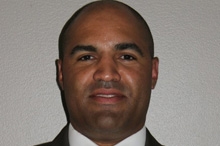
Kevin Johnson is being honored as a Veteran Advancing Clean Energy and Climate Security Champion of Change.
It is a tremendous honor to be recognized as a White House Champion of Change and I am humbled by the opportunity to share my experiences as an Iraq War Veteran now working to combat our nation’s dependence on fossil fuels and the impacts of climate change. Throughout my life, I have had the good fortune to be surrounded by positive influences that have helped me shape my values and choose my career path. Growing up in Scranton, PA, I learned the true meaning of hard work and sacrifice from my mother. I learned what community really means and the importance of friendship, trust, and integrity. Moreover, I learned how important it is to appreciate service and leadership in all forms.
I graduated from the United States Military Academy at West Point and served as an Army Captain in Bayji, Iraq. My tour in Iraq was served in the shadow of seemingly endless oil fires that filled the desert sky as insurgents attacked pipelines at a nearby refinery in an attempt to cripple the country’s economy. At the same time, our own military’s dependence on fossil fuels was placing thousands of my fellow soldiers in harm’s way. One in every 24 fuel convoys in Iraq and Afghanistan ended in an American casualty, with more than three thousand Americans killed in fuel-supply convoys between 2003 and 2007 alone.
My proudest professional accomplishment was safely returning all 130 of my soldiers home to their families upon redeployment from Bayji in 2005. My experience taught me that reducing our dependence on fossil fuels would make our nation more secure and bring more soldiers home safely. For these reasons, I decided to focus my MBA studies at Cornell University and my civilian career at Acciona Energy on the advancement of clean energy technologies.
Thankfully, many veterans – ranging from privates to general officers – are returning from a decade of war with a similar commitment to securing our nation’s energy future and combating the impacts of climate change. Operation Free, a national coalition of thousands of veterans, national security leaders, and military family members in all fifty states, is tackling climate change. Today, Operation Free is leading the fight for clean energy policies at both the federal and state levels.
The Department of Defense has recognized that the need to secure our nation’s energy future is a national security issue of the highest magnitude and will require bold and decisive action. Deploying clean energy technology can help create a better future and a stronger nation, but it will not be easy. This is precisely the kind of challenge our veterans are trained for.
As the President noted in his 2009 inaugural address, “[…] it has been the risk-takers, the doers, the makers of things – some celebrated, but more often men and women obscure in their labor – who have carried us up the long rugged path towards prosperity and freedom. Let it be said by our children's children that when we were tested we refused to let this journey end, that we did not turn back nor did we falter.”
Our nation’s veterans, from Scranton to Seattle, have been battle tested. We will carry the flag forward on this long, rugged path to a clean energy future. We will not turn back and we will not falter.
Kevin Johnson is the Senior Manager of Mergers & Acquisitions and Federal Business Development for Acciona Energy North America, a global leader in renewable energy.
Learn more about Energy and EnvironmentDrive Less, Live More
Posted by on November 5, 2013 at 10:29 AM EDT
Joseph Kopser is being honored as a Veteran Advancing Clean Energy and Climate Security Champion of Change.
Henry Ford had a pretty great idea when he introduced the first Model T in 1908: make the automobile business more efficient and personal transportation accessible to everyone. He revolutionized travel, but for the last century things have remained largely the same.
I think it’s time for another change – we need to re-think transportation efficiency and Defense Energy.
I first became aware of our country’s Defense Energy Security policy in 2004 while serving with the Army in Iraq and helping with Iraqi national elections. The base had hundreds of Containerized Housing Units all powered by enormous generators. Speaking with local Iraqis, I was shocked to learn just how much fuel these housing units were wasting.
There we were – Americans serving to protect American interests in the Middle East, but using precious energy in a very inefficient manner. Since that realization I have dedicated my efforts to solving this pervasive problem. My goal is to lighten the load for the war-fighter. While never sacrificing mission effectiveness, I want to reduce energy demand with lighter, more efficient systems.
One of the most important things we can do to reduce our dependency on foreign oil is to simply use less of it. In the United States our daily commute is an incredibly inefficient use of resources – including oil, money, and time. We waste billions of gallons of fuel and hours of time just sitting in idle traffic. We can do better.
I created RideScout to present people with all their options to get from Point A to Point B. Inside the app are options for public, commercial, and private transportation – including Car2Go and SideCar – that allow the user to plan his/her transport depending on specific needs. When people see they can reach their destination in nearly the same amount of time without driving alone or fighting for parking, it changes their entire mindset.
RideScout is a tool that can help Americans reduce personal car use without sacrificing their sense of independence. Unlike Henry Ford, I don’t believe that freedom is tied to car ownership, but rather the ability to get to your destination with reliability and flexibility at an affordable price.
When we decrease the number of cars on the road, reduce our foreign oil use, and spend more time doing things we love rather than sitting in traffic, everyone wins.
As a country we need to focus our resources on a comprehensive solution to fixing our Defense Energy Security problem. Starting in central Texas, I believe we can assemble the right collection of industry, university, government, non-governmental organizations, and military leaders to tackle our biggest problems.
Joseph Kopser is the co-Founder and CEO of RideScout, a mobile app that shows all transportation options in one view.
Learn more about Energy and Environment
- &lsaquo previous
- …
- 45
- 46
- 47
- 48
- 49
- 50
- 51
- 52
- 53
- …
- next &rsaquo
Related Videos
-
 May 09, 2014 9:21 AM
Inside the White House: Solar Panels
-
 September 01, 2016 9:25 PM
President Obama Delivers a Statement to the Press
White House Blogs
- The White House Blog
- Middle Class Task Force
- Council of Economic Advisers
- Council on Environmental Quality
- Council on Women and Girls
- Office of Intergovernmental Affairs
- Office of Management and Budget
- Office of Public Engagement
- Office of Science & Tech Policy
- Office of Urban Affairs
- Open Government
- Faith and Neighborhood Partnerships
- Social Innovation and Civic Participation
- US Trade Representative
- Office National Drug Control Policy