Energy and Environment Latest News
Introducing the National Drought Resilience Partnership
Posted by on November 15, 2013 at 2:03 PM EDTToday, the Obama Administration is excited to announce a new partnership between seven Federal agencies that will help communities better prepare for droughts and reduce the impact of drought events on families and businesses. The interagency National Drought Resilience Partnership is part of the President’s Climate Action Plan. Federal agencies are already working with communities, businesses and farmers and ranchers to build resilience to drought on the ground, and this Partnership will enhance those efforts.
Droughts are not new to many communities. Climate change is increasing the frequency and intensity of extreme weather events like droughts, storms, floods, and wildfires nationwide. About two-thirds of the continental United States was affected by drought in 2012, impacting water supplies, tourism, transportation, energy and fisheries, costing the agricultural sector alone $30 billion and causing $1 billion in losses from wildfires. During this disaster, the Administration provided all available assistance to towns, communities and agricultural producers impacted by drought, and the 2012 drought also highlighted effective planning and preparedness is to helping communities recover and prevent the worst impacts. We heard directly from states, tribes, businesses, and local communities that there was a need for a more accessible “front door” to make it easier to access Federal assistance. That is why the National Drought Resilience Partnership is designed to provide communities with a single point of contact to help them navigate various Federal programs to find the right one for their needs.
Spearheaded by the Department of Agriculture and the National Oceanic and Atmospheric Administration, the immediate focus of the Partnership will be on creating a new, web-based portal to ease access to Federal agency drought resources, hosting more frequent regional drought outlook forums to continue to hear directly from communities, and supporting the coordination of a national soil moisture monitoring network to help improve monitoring and forecasting drought conditions. In collaboration with local, state and regional governments, the Partnership will also undertake a pilot project in a western area hard hit by drought to create a local-scale drought resilience plan that could be applied in other areas.
This Partnership reflects the work of the White House Rural Council, and it also follows the President’s November 2013 Executive Order on preparing our communities for the impacts of climate change. That Executive Order created a Task Force of state, local and tribal leaders to advise the Administration on steps the Federal Government can take to help communities increase preparedness, and committed Federal agencies to examining their programs and policies to make it easier for states and communities to build resilience against storms, droughts and other weather extremes.
As we face increasing challenges from severe weather and climate impacts, it is more important than ever that Federal agencies work together effectively and efficiently to support the needs of local communities. The interagency National Drought Resilience Partnership is another important step in our commitment to helping communities stay strong and resilient in the face of climate change.
Nancy Sutley is Chair of the Council on Environmental Quality
Learn more about Energy and Environment, RuralDriving Toward Greater Energy Security
Posted by on November 13, 2013 at 4:39 PM EDTPicture yourself back in 1995 for a moment. Besides questionable music and fashion choices, we were at the start of some troubling trends in energy. The fuel economy of our cars and trucks had flatlined for five years, and they would stay that way for another 15. We were producing less and less of our own fuel at home, and biofuels were barely on the map, let alone in our gas tanks. We began to import more and more oil to make up for surging demand at home.
Fast forward to today, and our energy landscape couldn’t be more different. Our cars and trucks have never been more efficient, and homegrown biofuels account for about 10 percent of our transportation fuel. We are producing more of our oil here at home, and we are getting it from resources that we thought were unreachable just a decade ago.
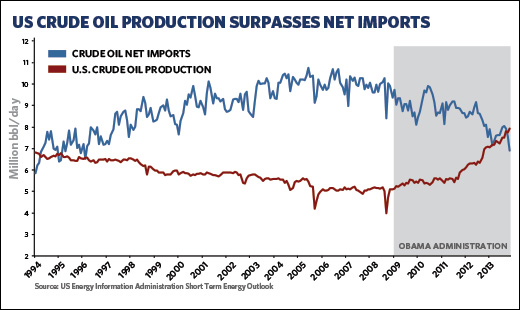
Today, the Department of Energy announced that we’ve hit another milestone on our path to a more secure energy future. In October, domestic oil production exceeded crude oil imports for the first time since 1995, while petroleum net imports were the lowest since February 1991. For energy, the last two decades have been a story of resurgence and regaining control of our energy security, and this achievement underscores the changes in how we produce and use energy.
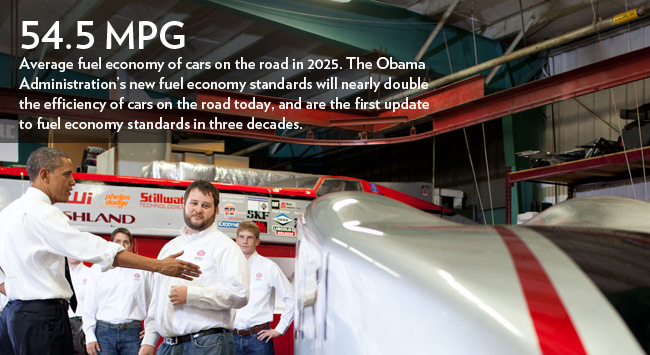
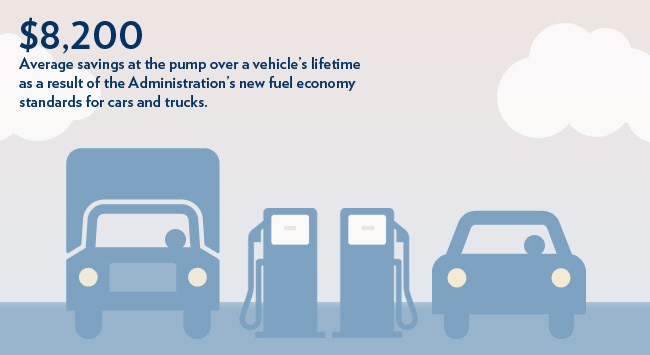
But how did we get from 1995 to today? The actions that President Obama and his Administration have taken to reduce our reliance on foreign oil play a significant role in this story. One of the very first actions the President took to implement his energy and climate strategy was to direct the Environmental Protection Agency and the Department of Transportation to work with the auto industry to develop new fuel economy standards for cars and trucks – because improving fuel efficiency represents one of the best opportunities we have to reduce our dependence on oil. As a result, we’re already seeing more efficient cars and trucks rolling off of assembly lines and into garages across the county. More than 70% of the oil we use is for transportation, and these investments in efficient cars and trucks have helped drive down oil consumption and save drivers money at the pump.
Learn more about Energy and EnvironmentVideo: Veterans Advancing Clean Energy and Climate Security
Posted by on November 12, 2013 at 5:56 PM EDTEd. Note: This blog is cross-posted from the U.S. Department of Energy.
Last week, Secretary Moniz joined other federal officials in honoring veterans that are working in clean energy and climate security at a "Champions of Change" event at the White House. The event honored 12 veterans that are using the skills they learned while in the service to help secure our clean energy future.
Across the country, these veterans are making a difference in their communities, whether by launching new small businesses, advising large institutions on their energy efficiency strategies or providing education and training in renewable energy and energy efficiency to fellow veterans.
The video above features a few of these veterans:
- Joseph Kopser serves as the Co-Founder and CEO of RideScout, a startup smartphone app created to increase transportation efficiency by getting people out of their cars and into other public, commercial, and private options. A West Point and Harvard Kennedy School graduate, Joseph served in the United States Army for 20 years, retiring in 2013 as a lieutenant colonel.
- Andrea Marr is a commissioning engineer at McKinstry’s Irvine, California, office where she advises large institutions on energy efficiency strategies. She served as a gunnery officer on two deployments in support of Operation Iraqi Freedom and as a nuclear engineering officer during a third deployment.
- Elizabeth “Liz” Perez-Halperin is the President and Founder of GC Green Incorporated, a green building general contracting and consulting firm. Liz also served in the United States Navy for over eight years as an aviation logistics specialist. GC Green is involved in an effort to broaden the outreach and impact of the green economy.
Though these veterans have returned from active duty, their service to our nation continues here at home.
Watch our latest video featuring highlights from the Champions of Change: Veterans Advancing Clean Energy and Climate Security event and learn more about the Champions of Change program.
Ben Dotson is the Project Coordinator for Digital Reform in the Office of Public Affairs at the U.S. Department of Energy.
Learn more about Energy and EnvironmentToward a National Plan for Observing our Earth
Posted by on November 12, 2013 at 11:48 AM EDTToday, the White House Office of Science & Technology Policy (OSTP) took an important next step to maximize the value of the enormous amount of data collected every day about the Earth and its many environments: a call for public input to inform the development of a blueprint for future Federal investments in this increasingly important domain.
The U.S. Government is the world’s largest single provider of Earth observations—including data and measurements collected from complex networks of satellites, ocean buoys, stream gauges, human surveys, and an array of other sophisticated tools and systems. Earth observations span land, air, sea, ice, ecosystems, and more—and address many of the multidimensional interactions among them. These observations provide information that is critical to the protection of human life and property; economic growth; national and homeland security; and scientific research. Earth-observations data that are openly shared also fuel job-creating companies and important services used across America every day, such as weather forecasts and analyses of crops and fisheries.
In April 2013, the Obama Administration’s National Science and Technology Council released a National Strategy for Civil Earth Observations, setting a course to meet society’s most pressing Earth-data and information needs. Building on this Strategy, the call for input issued today will inform the development of a National Plan for Civil Earth Observations. The Plan will map out priority Federal Government activities to manage Earth-observation systems through routine assessments, improved data management, and coordinated planning. All of these activities will aim to enable stable, continuous, and coordinated Earth-observing capabilities for the benefit of society.
Learn more about Energy and EnvironmentRooftop Solar Challenge: Empowering Innovators to Reach for the Sun
Posted by on November 6, 2013 at 10:05 AM EDTThis article was originally published on Energy.gov.
Today, Energy Secretary Ernest Moniz kicked-off the latest round of the Rooftop Solar Challenge – an initiative that empowers local governments across the Nation to make it easier, cheaper, and faster for more Americans to go solar. The Rooftop Solar Challenge is spearheaded by the Energy Department’s SunShot Initiative – a national collaborative effort to make solar energy cost-competitive with traditional energy sources by the end of the decade.
Solar panels, inverters, and other hardware components that make up solar energy systems are more affordable than ever before. It is the “soft” costs of solar – including permitting for installation, interconnection, and maintenance fees – that represent an increasingly large portion of the cost of solar installations.
To address this “soft” costs barrier, the Rooftop Solar Challenge brings together local officials, utilities, private industry, non-profits, and other stakeholders to simplify the solar installation process – from streamlining and standardizing solar permitting for area residents to digitizing many of the administrative steps required.
During the competition’s first round, regional teams worked to dramatically reduce the soft costs of solar in 22 communities across the Nation – serving as models for other communities across the country. These efforts helped cut permitting time by 40 percent and reduce fees by over 10 percent – opening the door to make it faster and easier for more than 47 million Americans to install solar.
Learn more about Energy and EnvironmentEnergy Storage Technology is Critical for Developing Secure, Dependable Renewable Power
Posted by on November 5, 2013 at 12:20 PM EDT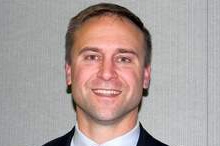
Adam Cote is being honored as a Veteran Advancing Clean Energy and Climate Security Champion of Change.
On December 21, 2004, I was in the mess hall in Mosul, Iraq when a suicide bomber attacked, killing twenty-two and wounding another seventy-two. Lucky to have been behind a large refrigerator, I was uninjured. In the pandemonium that followed I organized the treatment and evacuation of casualties and personally cared for numerous fellow soldiers.
When I returned from Iraq, I applied these skills as a quick thinker and problem solver in complex situations front and center to my work in the energy sector.
My previous deployments to Bosnia and Iraq left me looking for ways to use my civilian career as an energy attorney to strengthen our economic and energy security here at home. Coming from Maine, a state with some of the highest home heating costs in the country – yet some of the most incredible renewable energy resources – I started looking for a way to connect the dots between economic and energy security. How could we start integrating locally generated renewable power to increase our state’s energy security and reduce heating costs for families?
In 2009, my business partners and I founded Thermal Energy Storage of Maine (TESM), a company dedicated to promoting the use of affordable, off-peak electric thermal storage technology as both an economical home heating solution for families and as a way to convert intermittently-generated renewable power into a stable, secure, and local source of power and heat. TESM promotes electric thermal storage (ETS) furnaces and room heaters, which consist of a super-insulated metal box with ceramic bricks and heating elements inside. At night an automatic timer opens a circuit and the heater charges, converting lower-cost, off-peak power into heat energy stored in the bricks for heating homes and businesses.
Today our company works with Central Maine Power Company, Dead River Company, Madison Electric Works, Houlton Water Company and others to offer Mainers affordable, off-peak electric heating solutions that provide home heating at the equivalent cost of $2.25 to 2.90 per gallon of home heating oil.
Integrating renewable power into the U.S. power grid will require widespread development of energy storage technologies. Today, plants using carbon-based resources, such as oil and natural gas, often maintain energy generation and load in a near-perfect equilibrium state. However, many renewable energy resources such as wind, solar, wave and tidal power can be intermittent and difficult to control to match load levels. Energy storage offers a flexible and controllable load that can be available to handle renewable power deliveries whenever they occur.
To use an Army colloquialism, energy storage is “good logistics” – it is a simple solution to a complex problem. If we encourage and incorporate storage technologies in a variety of forms, we will make our entire energy infrastructure more flexible, efficient and secure.
Our company is dedicated to promoting the use of energy storage, and we are proud to add our voice to those calling for storage technologies to be recognized as a key strategic infrastructure goal for our country.
Notification that I had been selected as a White House Champion of Change reached me at the Joint Forces Training Center at Camp Shelby, MS, where I was training with the Maine Army National Guard’s 133rd Engineering Battalion for our deployment to Afghanistan. Although not able to attend the White House event in person, I am humbled and honored to be selected.
Adam Cote is CEO and Co-Founder of Thermal Energy Storage of Maine and currently deployed as a Company Commander in the Maine Army National Guard 133rd Engineering Battalion’s Task Force Black Bear in Afghanistan.
Learn more about Energy and Environment
- &lsaquo previous
- …
- 44
- 45
- 46
- 47
- 48
- 49
- 50
- 51
- 52
- …
- next &rsaquo
Related Videos
-
 May 09, 2014 9:21 AM
Inside the White House: Solar Panels
-
 September 01, 2016 9:25 PM
President Obama Delivers a Statement to the Press
White House Blogs
- The White House Blog
- Middle Class Task Force
- Council of Economic Advisers
- Council on Environmental Quality
- Council on Women and Girls
- Office of Intergovernmental Affairs
- Office of Management and Budget
- Office of Public Engagement
- Office of Science & Tech Policy
- Office of Urban Affairs
- Open Government
- Faith and Neighborhood Partnerships
- Social Innovation and Civic Participation
- US Trade Representative
- Office National Drug Control Policy