Health Care Blog
Director Orszag on Health Care Reform: Higher Quality for Lower Costs
Posted by on June 16, 2009 at 4:55 PM ESTOMB Director Peter Orszag makes clear where fiscal responsibility lands in the health care reform debate:Readers of this blog are familiar with my argument: Our fiscal future is so dominated by health care that if we can slow the rate of cost growth by just 15 basis points a year (0.15 percentage points), the savings for Medicare and Medicaid would equal the impact from eliminating Social Security’s entire 75-year shortfall.Learn more about Health CareWhy Reform, Why Now
Posted by on June 15, 2009 at 3:19 PM ESTViewing this video requires Adobe Flash Player 8 or higher. Download the free player.download .mp4 (599.6 MB) | read the transcriptThis afternoon the President gave a landmark, sweeping speech on health care reform to the American Medical Association in Chicago. More so than at any time before, he explained his vision for comprehensive reform that addresses every weak point in our health care system. It is a vision that implements best practices that have allowed some towns and companies to cut costs by as much as half compared to others. It is a vision that makes sure everybody has access to quality, affordable coverage, whether your family hits a rough patch or you have a pre-existing condition. It is a vision in which patients’ and doctors’ interests are aligned. And it is a vision where Americans’ choices of doctors and coverage are maintained, and they also have a choice of a public option that can help keep private insurers honest. It is a vision that focuses on prevention, making sure Americans stay healthy throughout their lives.It is well worth the while to read through the entire speech, but here are a few key excerpts, including some key points you may not have heard before:On the costs of inaction:If we fail to act -- (applause) -- if we fail to act -- and you know this because you see it in your own individual practices -- if we fail to act, premiums will climb higher, benefits will erode further, the rolls of the uninsured will swell to include millions more Americans -- all of which will affect your practice.If we fail to act, one out of every five dollars we earn will be spent on health care within a decade. And in 30 years, it will be about one out of every three -- a trend that will mean lost jobs, lower take-home pay, shuttered businesses, and a lower standard of living for all Americans.And if we fail to act, federal spending on Medicaid and Medicare will grow over the coming decades by an amount almost equal to the amount our government currently spends on our nation's defense. It will, in fact, eventually grow larger than what our government spends on anything else today. It's a scenario that will swamp our federal and state budgets, and impose a vicious choice of either unprecedented tax hikes, or overwhelming deficits, or drastic cuts in our federal and state budgets.So to say it as plainly as I can, health care is the single most important thing we can do for America's long-term fiscal health. That is a fact. That's a fact. (Applause.)On incentives for doctors:There are two main reasons for this. The first is a system of incentives where the more tests and services are provided, the more money we pay. And a lot of people in this room know what I'm talking about. It's a model that rewards the quantity of care rather than the quality of care; that pushes you, the doctor, to see more and more patients even if you can't spend much time with each, and gives you every incentive to order that extra MRI or EKG, even if it's not necessary. It's a model that has taken the pursuit of medicine from a profession -- a calling -- to a business.That's not why you became doctors. That's not why you put in all those hours in the Anatomy Suite or the O.R. That's not what brings you back to a patient's bedside to check in, or makes you call a loved one of a patient to say it will be fine. You didn't enter this profession to be bean-counters and paper-pushers. You entered this profession to be healers. (Applause.) And that's what our health care system should let you be. That's what this health care system should let you be. (Applause.)Now, that starts with reforming the way we compensate our providers -- doctors and hospitals. We need to bundle payments so you aren't paid for every single treatment you offer a patient with a chronic condition like diabetes, but instead paid well for how you treat the overall disease. We need to create incentives for physicians to team up, because we know that when that happens, it results in a healthier patient. We need to give doctors bonuses for good health outcomes, so we're not promoting just more treatment, but better care.On making sure doctors and patients have all the right information:A recent study, for example, found that only half of all cardiac guidelines are based on scientific evidence -- half. That means doctors may be doing a bypass operation when placing a stent is equally effective; or placing a stent when adjusting a patient's drug and medical management is equally effective -- all of which drives up costs without improving a patient's health.So one thing we need to do is to figure out what works, and encourage rapid implementation of what works into your practices. That's why we're making a major investment in research to identify the best treatments for a variety of ailments and conditions. (Applause.)On America’s relationship with doctors:But my signature on a bill is not enough. I need your help, doctors, because to most Americans you are the health care system. The fact is Americans -- and I include myself and Michelle and our kids in this -- we just do what you tell us to do. (Laughter.) That's what we do. We listen to you, we trust you. And that's why I will listen to you and work with you to pursue reform that works for you. (Applause.)Together, if we take all these steps, I am convinced we can bring spending down, bring quality up; we can save hundreds of billions of dollars on health care costs while making our health care system work better for patients and doctors alike. And when we align the interests of patients and doctors, then we're going to be in a good place.On the Health Insurance Exchange and a public option:Now, if you don't like your health care coverage or you don't have any insurance at all, you'll have a chance, under what we've proposed, to take part in what we're calling a Health Insurance Exchange. This exchange will allow you to one-stop shop for a health care plan, compare benefits and prices, and choose a plan that's best for you and your family -- the same way, by the way, that federal employees can do, from a postal worker to a member of Congress. (Applause.) You will have your choice of a number of plans that offer a few different packages, but every plan would offer an affordable, basic package.Again, this is for people who aren't happy with their current plan. If you like what you're getting, keep it. Nobody is forcing you to shift. But if you're not, this gives you some new options. And I believe one of these options needs to be a public option that will give people a broader range of choices -- (applause) -- and inject competition into the health care market so that force -- so that we can force waste out of the system and keep the insurance companies honest. (Applause.)Now, I know that there's some concern about a public option. Even within this organization there's healthy debate about it. In particular, I understand that you're concerned that today's Medicare rates, which many of you already feel are too low, will be applied broadly in a way that means our cost savings are coming off your backs.And these are legitimate concerns, but they're ones, I believe, that can be overcome. As I stated earlier, the reforms we propose to reimbursement are to reward best practices, focus on patient care, not on the current piecework reimbursements. What we seek is more stability and a health care system that's on a sounder financial footing.And the fact is these reforms need to take place regardless of whether there's a public option or not. With reform, we will ensure that you are being reimbursed in a thoughtful way that's tied to patient outcomes, instead of relying on yearly negotiations about the Sustainable Growth Rate formula that's based on politics and the immediate state of the federal budget in any given year. (Applause.)And I just want to point out the alternative to such reform is a world where health care costs grow at an unsustainable rate. And if you don't think that's going to threaten your reimbursements and the stability of our health care system, you haven't been paying attention.So the public option is not your enemy; it is your friend, I believe.Perhaps the most rousing moment of the speech came about half way through, as he stated the underlying moral basis for health reform:We are not a nation that accepts nearly 46 million uninsured men, women and children. (Applause.) We are not a nation that lets hardworking families go without coverage, or turns its back on those in need. We're a nation that cares for its citizens. We look out for one another. That's what makes us the United States of America. We need to get this done. (Applause.)Learn more about Health CareWeekly Address: Health Care Reform as the Key to Our Fiscal Future
Posted by on June 12, 2009 at 11:00 PM ESTThe President has long noted that skyrocketing health care costs will be disastrous in terms of our long term national debt unless we pass real reform. In this Weekly Address, the President also explains how he will cover the upfront costs of reform by eliminating overpayments from Medicaid and Medicare and driving down costs contributing to government’s health care expenditures across the board.Viewing this video requires Adobe Flash Player 8 or higher. Download the free player.download .mp4 (52.1 MB) | read the transcriptUPDATE: OMB Director Peter Orszag adds some thoughts on this address and other health reform developments.Learn more about Health CareA Town Hall, and a Health Care Model, in Green Bay
Posted by on June 11, 2009 at 1:30 PM ESTViewing this video requires Adobe Flash Player 8 or higher. Download the free player.download .mp4 (159.8 MB) | read the transcriptThe President just concluded a town hall at Southwest High School in Green Bay, Wisconsin, with a focus on one of the President’s top priorities for his entire presidency. Over the past two weeks, the President has spelled out his vision for health care reform, met with key Members of Congress, and dedicated his Weekly Address to discussing the urgency of getting reform done and the unprecedented coalition that has formed to support that goal.But passing health care reform is no DC parlor game, it is an issue that affects every family in America, addressing a problem that hangs over the head of every parent who faces the question of whether they can afford to give their children the care they need. And so it makes sense that the President is leaving the Beltway to talk directly to the American people. However, Green Bay is not just any American town, rather it has shown itself to be a model of controlling health care costs which have skyrocketed across the country and which will continue to do so unless reform gets done. The Washington Post describes a study from the University of Dartmouth, which the President and many others have cited:In the final two years of a patient's life, for example, they found that Medicare spent an average of $46,412 per beneficiary nationwide, with the typical patient spending 19.6 days in the hospital, including 5.1 in the intensive-care unit. Green Bay patients cost $33,334 with 14.1 days in the hospital and just 2.1 days in the ICU, while in Miami and Los Angeles, the average cost of care exceeded $71,000, and total hospitalization was about 28 days with 12 in the ICU.For a President who has looked at every possible avenue to lower costs and expand access for all Americans while ensuring patient choice, Green Bay was a natural venue. But of course even as a model, Green Bay could not solve all the problems themselves, showing even more why comprehensive reform is necessary. In his remarks the President addressed the broad problems at hand:For the government, the growing cost of Medicare and Medicaid is the biggest threat to our federal deficit, bigger than Social Security, bigger than all the investments that we've made so far. So if you're worried about spending and you're worried about deficits, you need to be worried about the cost of health care.We have the most expensive health care system in the world, bar none. We spend almost 50 percent more per person on health care than the next most expensive nation -- 50 percent more. But here's the thing, Green Bay: We're not any healthier for it; we don't necessarily have better outcomes. Even within our own country, there are a lot of the places where we spend less on health care, but actually have higher quality than places where we spend more. And it turns out Green Bay is a good example. Right here in Green Bay, you get more quality out of fewer health care dollars than many other communities across this country. (Applause.) That's something to be proud of. I want to repeat that: You spend less; you have higher quality here in Green Bay than in many parts of the country. But across the country, spending on health care keeps on going up and up and up -- day after day, year after year.I know that there are millions of Americans who are happy, who are content with their health care coverage -- they like their plan, they value their relationship with their doctor. And no matter how we reform health care, I intend to keep this promise: If you like your doctor, you'll be able to keep your doctor; if you like your health care plan, you'll be able to keep your health care plan.And he also addressed some of the specific solutions he would like to see, in addition to measures already passed like improved health IT:But the real cost savings will come from changing the incentives of a system that automatically equates expensive care with better care. We've got to move from addressing -- we've got to address flaws that increase profits but don't actually increase the quality of care for patients.We have to ask why places like Geisinger Health systems in rural Pennsylvania, or Intermountain Health in Salt Lake City, or communities like Green Bay can offer high-quality care at costs well below average, but other places in America can't. We need to identify the best practices across the country, learn from the successes, and then duplicate those successes everywhere else.And we should change the warped incentives that reward doctors and hospitals based on how many tests and procedures they do -- (applause) -- even if those tests and procedures aren't necessary or result from medical mistakes. Doctors didn't get into the medical profession to be bean counters or paper pushers. They're not interested in spending all their time acting like lawyers or business executives. They became doctors to heal people, and that's what we have to free them to be able to do.We also have to provide Americans who can't afford health insurance more affordable options. That's a economic imperative but it's also a moral imperative, because we know that when somebody doesn't have health insurance, they're forced to get treatment at the ER, and all of us end up paying for it. The average family pays a thousand dollars in extra premiums to pay for people going to the emergency room who don't have health insurance. So you're already subsidizing other folks; it's just you're subsidizing the most expensive care. You'd be better off subsidizing to make sure they were getting regular checkups. We're already paying for it. It's just it's hidden in your premiums.So what we're working on is the creation of something called the Health Insurance Exchange, which would allow you to one-stop shop for a health care plan, compare benefits and prices, choose the plan that's best for you. If you're happy with your plan, you keep it. None of these plans, though, would be able to deny coverage on the basis of pre-existing conditions. (Applause.)Every plan should include an affordable, basic benefits package. And if you can't afford one of these plans, we should provide assistance to make sure that you can. (Applause.) I also strongly believe that one of the options in the Exchange should be a public insurance option. (Applause.) And the reason is not because we want a government takeover of health care -- I've already said if you've got a private plan that works for you, that's great. But we want some competition. If the private insurance companies have to compete with a public option, it'll keep them honest and it'll help keep their prices down. (Applause.)Now, covering more Americans is obviously going to require some money up front. We'll save money when they stop going to the emergency room and getting regular checkups, but it's going to cost some money up front. Helping families lower their costs, there's going to be a cost to this. And it comes at a time when we don't have a lot of extra money to spend, let's be honest. When I came in we had a $1.3 trillion deficit. And with the economic recession that we're going through, tax revenues are down -- I was talking to Governor Doyle -- tax revenues are down, more people are seeking help from the state. So we've got a lot of pressure on our budget.So that's why I've already promised that reform cannot add to our deficit over the next 10 years. And to make that happen, we've already identified hundreds of billions of dollars worth of savings in our budget -- savings that will come from steps like reducing Medicare overpayments to insurance companies and rooting out waste and fraud and abuse in both Medicare and Medicaid. And I'll be outlining hundreds of billions of dollars more in savings in the days to come. And I'll be honest, even with these savings, reform will require some additional up front resources. And that's why I've proposed that we scale back how much the highest-income Americans can deduct on their taxes back -- take it back to the rate that existed under the Reagan years, and we could use some of that money to help finance health care reform. (Applause.)In all these reforms, our goal is simple: the highest-quality health care at the lowest-possible cost. Let me repeat what I said before: We want to fix what's broken, build on what works.As the President made clear, no excuses, no endless delay. (President Barack Obama speaks at a town hall meeting on health care reform Thursday, June 11, 2009, at Southwest High School in Green Bay, Wisconsin. Official White House Photo by Chuck Kennedy.)Learn more about Health Care
Rubber Hitting the Road on Health Care
Posted by on June 10, 2009 at 2:21 PM ESTThe President invites key Senators on health reform to the White House to hear out their ideas and express his own as the committees begin working through their bills: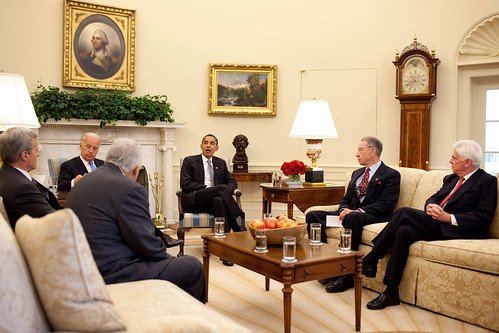
(President Barack Obama and Vice President Joe Biden meet in the Oval Office Wednesday, June 10, 2009 with (from left) Senate Finance Committee Chairman Sen. Max Baucus, (D-Mont.) Sen. Michael Enzi, (R-Wyo.) the ranking member on the Senate Committee on Health, Education, Labor and Pensions, Sen. Charles Grassley, (R-Iowa) the ranking member of the Senate Finance Committee, and Sen. Chris Dodd, (D-Conn.), the senior member of the Senate Committee on Health, Education, Labor and Pensions to discuss health care reform. Official White House Photo by Pete Souza)Learn more about Health CareRace for the Cure
Posted by on June 9, 2009 at 3:46 PM ESTThe Vice President and Dr. Biden served as Honorary Co-Chairs of the Susan G. Komen Global Race for the Cure, joining around 45,000 participants on Saturday as they walked and ran on the National Mall. "My husband Joe and I are thrilled to participate in the ongoing effort to raise awareness, fund research and empower people throughout the world in the fight against breast cancer," Dr. Biden said. (Dr. Jill Biden and Vice President Biden speak at the opening ceremonies of the Global Race For the Cure on the National Mall, Saturday, June 6, 2009. Official White House Photo by David Lienemann)Dr. Biden, who has long been involved in advocating breast health education and awareness herself, addressed the crowd at the opening ceremony and thanked them for their efforts in the global fight. She started her own charity, the Biden Breast Health Initiative, in the early 1990s after several of her friends were diagnosed with breast cancer. The program works to educate young women about the importance of breast self-examination and living a healthy lifestyle.
 (Dr. Jill Biden and Vice President Biden speak at the opening ceremonies of the Global Race For the Cure on the National Mall, Saturday, June 6, 2009. Official White House Photo by David Lienemann)Learn more about Health Care, Service
- &lsaquo previous
- …
- 202
- 203
- 204
- 205
- 206
- 207
- 208
- 209
- 210
- …
- next &rsaquo
From the Press Office
Related Videos
-
 December 13, 2016 5:04 PM
Signing Ceremony for the 21st Century Cures Act
-
 December 10, 2016 5:00 AM
Weekly Address: It’s Time to Get Covered on the Health Insurance Marketplace