Health Care Blog
By the Numbers: $4,200
Posted by on March 19, 2012 at 11:20 AM EST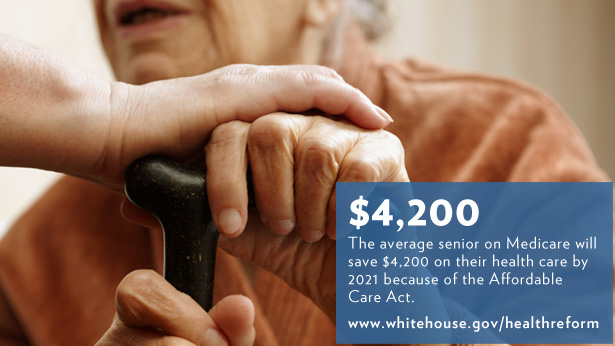
The average senior on Medicare will save $4,200 on their health care by 2021 because of the Affordable Care Act.
President Obama’s health reform law strengthens Medicare for seniors in a few ways. It gives them access to preventive services, such as mammograms and colonoscopies, with no co-pay or deductibles, as well as a free annual wellness visit. Nearly 32.5 million people have already received a free preventive service.
And, the Affordable Care Act is making it easier for seniors to pay for the medications they need, by providing a 50 percent discount on brand-name prescription drugs for seniors once they hit the prescription coverage gap known as the “donut hole.” By 2020, that donut hole will be closed completely.
Already, more than 5.1 million seniors and people with disabilities saved over $3.2 billion in drug costs. That comes to an average savings of $635 per person.
For more information:
- How health reform helps seniors
- VIDEO: Health reform is giving Helen, a senior from West Philadelphia, peace of mind and more money in her pocket
- Tell us your story: How is the Affordable Care Act improving your care?
Learn more about Health CareHelenCare: Giving Seniors Peace of Mind and More Money in Their Pockets
Posted by on March 19, 2012 at 9:53 AM ESTEd Note: This was originally posted on HealthCare.gov, a website by the US Department of Health and Human Services.
Helen R. is a senior who likes to keep busy. From helping her grandson with his education, to assisting other seniors at a West Philadelphia senior center, Helen knows there are lots of people counting on her. That’s why it’s a relief to Helen that she can count on the Affordable Care Act to get the care she needs at an affordable cost.
The law provides free preventive services under Medicare, such as cancer screenings and an annual wellness visit for Helen and other seniors to sit down and talk with their doctor about their concerns and needs. She says that it’s good to know that she and other seniors can access these services “without breaking the bank.”
Helen also falls into the prescription drug coverage gap called the “donut hole”, but because of the law, she receives a 50 percent discount on brand-name drugs. By 2020, the donut hole will be closed.
“I am a grandmother who is trying to assist a grandson with his education. I take seven different medications. Getting the donut hole closed, that gives me a little more money in my pocket,” Helen explains.
Breaking It Down: The Health Care Law and Seniors
Posted by on March 19, 2012 at 9:46 AM ESTEd Note: This was originally posted on HealthCare.gov, a website by the US Department of Health and Human Services.
The President's health law gives hard working, middle-class families the security they deserve. The Affordable Care Act forces insurance companies to play by the rules, prohibiting them from dropping your coverage if you get sick, billing you into bankruptcy through annual or lifetime limits, and, soon, discriminating against anyone with a pre-existing condition.
For seniors, the new health care law, the Affordable Care Act, not only means more time with their doctor and important new benefits like free preventive services like cancer screenings and annual wellness visits, but it also means more money in their pocket. The new health care law strengthens Medicare. Already, more than 5.1 million seniors and people with disabilities saved over $3.2 billion in drug costs. That comes to an average savings of $635 per person for seniors caught in the coverage gap known as the donut hole. And, 32.5 million people with Medicare have received preventive service without a deductible or copay, thanks to the new law.
Here are more ways the law helps seniors:
- You get free preventive services. Medicare now covers certain preventive services, like mammograms or colonoscopies, with no cost sharing. You also can get a free annual wellness visit.
- You get cheaper prescription drugs. If you’re in the donut hole, you will receive a 50 percent discount when buying brand-name prescription drugs covered by Medicare Part D. The discount is applied automatically when you fill your prescription—you don’t have to do anything to get it. These changes are already saving seniors billions of dollars. And by 2020, the donut hole will be closed.
- Your doctors are supported to better coordinate your care. Many doctors, hospitals, and other providers are taking advantage of new programs to help them work better as teams to provide you the highest quality care possible. They are working to get you the care you need at the time you need it.
- The law fights fraud and strengthens Medicare. The Affordable Care Act builds on our efforts to combat fraud and abuse. These efforts are saving billions of dollars in money that was being stolen from people with Medicare. And thanks to these efforts and other improvements, the life of the Medicare Trust fund has been extended.
- Your Medicare coverage is protected. Under the new health care law, your existing Medicare-covered benefits won’t be reduced or taken away. As always, you will be able to choose your own doctors.
CBO Update Shows Lower Costs for the New Health Care Law
Posted by on March 14, 2012 at 7:45 AM ESTYesterday, the Congressional Budget Office released updated cost estimates for some parts of the Affordable Care Act. In this update, CBO projects that net spending on several parts of the health care law are about $50 billion less than it projected last year. That partly reflects CBO’s confirmation of a trend we’ve been following – slower growth in health insurance premiums. CBO said:
“By 2021, premiums are now estimated to be about 8 percent lower than CBO estimated in March 2011. That change reduces the estimated costs of the coverage provisions of the ACA.”
This suggests that taxpayers will save $50 billion more, on net, through 2021 and Americans will pay even less for private insurance than CBO previously projected – which is good news.
It is also important to be clear about what the CBO report does not say.
The CBO update does not provide new estimates of the entire cost of the Affordable Care Act. That’s because the new report looks at how much the government will spend on discrete elements of the new law, but not how much the government will save due to other parts of the law such as efforts to slow Medicare cost growth and reduce fraud.
Learn more about Health CareCommemorating National Women and Girls HIV/AIDS Awareness Day
Posted by on March 13, 2012 at 2:16 PM ESTOn Wednesday, March 14th at 8:30a.m. EST, please join the White House as we commemorate National Women and Girls HIV/AIDS Awareness Day. This multi-agency event will discuss the intersection of HIV/AIDS, violence against women, and gender related health disparities. Speakers and panelists will examine the juncture of these three important issues that impact women’s lives both domestically and globally.
You can watch the event live at: http://obamawhitehouse.archives.gov/live.You can also join the conversation on Twitter by following @AIDSgov and @PEPFAR and by using #NWGHAAD.
White House Meeting on the Intersection of HIV/AIDS, Violence against Women and Gender Related Health Disparities
- Welcome and Event Overview
- Global Announcement
- Framing the Data: A Presentation by the Centers for Disease Control and Prevention
- Research Update: A Brief Update on Ongoing Research by the National Institutes of Health
- Panel Discussion: Linkage between HIV/AIDS and violence against women; a discussion of these issues and gender related health disparities in the global/domestic context.
- Domestic Announcement
- Global and Domestic Synergy
- Closing Remarks
James Albino is the Senior Program Manager of the Office of National AIDS Policy
Learn more about , Health CareImproving Healthcare for Military Families
Posted by on March 6, 2012 at 11:26 AM ESTMedscape, the largest source of online continuing education for physicians and other health professionals, has teamed up with Joining Forces to ensure that our country’s servicemembers, veterans, and military families receive the best healthcare possible.
Soon after the White House released “Strengthening Our Military Families” in January 2011, Medscape began working with leading experts in military healthcare to create 10 new online education programs on topics ranging from military culture to screening for post-traumatic stress disorder and helping families connect with VA services. The free modules include links to resources from the government, warrior advocacy groups and medical associations. More than 100,000 physicians, nurses and other healthcare providers have viewed these education courses in the past year.
The curriculum that Medscape has created enables community health professionals to understand and meet the needs of military families. As servicemembers return home to their communities, such preparation is imperative—only half of those eligible for VA services seek treatment there.
- &lsaquo previous
- …
- 90
- 91
- 92
- 93
- 94
- 95
- 96
- 97
- 98
- …
- next &rsaquo
From the Press Office
Related Videos
-
 December 13, 2016 5:04 PM
Signing Ceremony for the 21st Century Cures Act
-
 December 10, 2016 5:00 AM
Weekly Address: It’s Time to Get Covered on the Health Insurance Marketplace