The Clock is Ticking

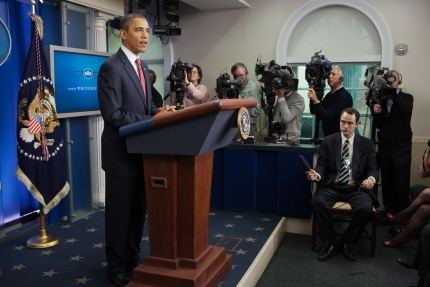
This afternoon, President Obama went to the briefing room to urge Congress to pass tax cuts for the middle class before they go home for the holidays.  Immediately following the briefing, the White House launched a countdown clock on WhiteHouse.gov and in the press briefing room, to let people know exactly how much time is left before taxes go up for middle class families unless Congress acts.

Check out this email from David Plouffe about the countdown clock and the tax cut calculator.  If you didn't get the email, be sure to sign up for the White House email list.

It's simple. If lawmakers don't vote to extend the payroll tax cut, taxes for 160 million Americans will go up on January 1st. 

President Obama just left the press briefing room at the White House where he called on Congress to extend the tax cut, pay for it responsibly, and expand it so middle class families get a $1,500 break next year.

He told Congress to put country before party and stop wasting time.

Every day, folks are fighting to make ends meet and businesses are working to keep their doors open. The longer Congress waits to extend the payroll tax cut, the more uncertainty it creates for ordinary Americans. So we've put a clock on every page of the White House website, counting down the days, hours, and minutes until taxes for the middle class increase. In the briefing room, where the President just spoke, that same clock is ticking down as well.

And to make sure you have the information you need to know exactly what this means for your family, we've put together a calculator to show how much of your money hangs in the balance.

This calculator illustrates for you what nearly every independent economist has said: letting this tax cut expire will be a blow to the economy. We can’t let that happen. Now is the time to make a real difference in the lives of the people who sent us here.

Check it out and pass it along:

http://obamawhitehouse.archives.gov/taxcut

Thanks,

David Plouffe
Senior Advisor to the President

Related Topics: Economy, Taxes

President Obama Urges Congress to Extend and Expand the Payroll Tax cut

20111205 POTUS podium

President Barack Obama delivers a statement to the Press in the James S. Brady Press Briefing Room of the White House, Dec. 05, 2011. (Official White House Photo by Pete Souza)

Just after 2:00 PM ET, President Obama stopped by the White House press briefing room to talk about the fight to extend the payroll tax cut.

"It's the right thing to do," he said -- not just for the economy, but for American workers and their families:

Although the unemployment rate went down last month, our recovery is still fragile, and the situation in Europe has added to that uncertainty. And that's why the majority of economists believe it's important to extend the payroll tax cut. And those same economists would lower their growth estimates for our economy if it doesn’t happen. 

Not only is extending the payroll tax cut important for the economy as a whole, it's obviously important for individual families.  It's important insurance for them against the unexpected.  It will help families pay their bills.  It will spur spending.  It will spur hiring.

On Thursday, the Senate voted on extending the tax cut, but Republicans blocked the proposal. The President, however, said we're starting to see evidence that lawmakers might be ready to put politics aside and do the right thing for the middle class:

Now, the good news is I think the American people's voices are starting to get through in this town.  I know that last week Speaker Boehner said this tax cut helps the economy because it allows every working American to keep more of their money.  I know that over the weekend Senate Republican leaders said we shouldn’t raise taxes on working people going into next year.

Congress has 26 days to find a solution to this impasse. To underscore that point, we've started a clock on WhiteHouse.gov, counting down the time until the tax cut expires. And to make sure you have the information you need to see what this means for your family, we've put together a calculator to show how much of your money hangs in the balance. Check it out here.


Related Topics: Economy, Taxes

The White House

Office of the Press Secretary

Statements on the Departure of Phil Schiliro

WASHINGTON, DC— The White House today released statements on the departure of Assistant to the President and Special Advisor Phil Schiliro.  Schiliro was announced as Assistant to the President and Director of Legislative Affairs on November 15, 2008 and served in that role from the beginning of the Obama administration until January of 2011.  During that time he presided over the passage of a series of critical pieces of legislation including the Recovery Act, the Affordable Care Act, Wall Street reform and New START, as well as the confirmations of two Supreme Court justices. Since then, he has served as Assistant to the President and Special Advisor, providing counsel to the President on a wide array of issues. He will stay on in that role until the end of the year.

President Obama said, “As my advisor and chief liaison to Congress during one of the most productive legislative periods in our history, Phil Schiliro helped shepherd through a series of historic accomplishments on behalf of the American people, from health care reform that will make coverage more affordable and accessible to Wall Street reform that will protect consumers and our economy. The White House will not be the same without Phil, but more importantly, the country would not be the same without his steady leadership and tireless effort over the past three years.”

White House Chief of Staff Bill Daley said, “Phil Schiliro has been an integral member of the President’s team. Regardless of the issue at hand, Phil’s thoughtful counsel, sound judgment, and unparalleled understanding of and relationships with Congress have made his advice invaluable. His presence will be sorely missed at the White House, but his tremendous contributions to the American people will live on long beyond his departure.”

The White House

Office of the Press Secretary

Readout of the President's Meeting with College Presidents

Earlier today, President Obama held a roundtable discussion on making college more affordable for our nation’s students. The President hosted White House senior officials, Secretary of Education Arne Duncan and a dozen college presidents and higher education thought leaders from across the country to discuss rising college costs and strategies to reduce these costs while improving quality.  During the meeting, the President conveyed the urgent need to pursue bold and innovative solutions to help more Americans attain a higher education at an affordable price.  In response, attendees shared how they have worked to promote innovation, reduce costs and increase productivity during a time of reduced funding for higher education at the state level.

List of participants:
      
Dr. King Alexander, President, California State University – Long Beach
Dr. Francisco Cigarroa, Chancellor, University of Texas System
Dr. Jared Cohon, President, Carnegie Mellon University
Dr. Freeman Hrabowski, President, University of Maryland – Baltimore County
Dr. William “Brit” Kirwan, Chancellor, University System of Maryland
Dr. Robert Mendenhall, President, Western Governor’s University
Dr. Larry Shinn, President, Berea College
Mr. Thomas Snyder, President, Ivy Tech Community College
Dr. Holden Thorp, Chancellor, University of North Carolina – Chapel Hill
Dr. Nancy Zimpher, Chancellor, State University System of New York
Mr. Jamie Merisotis, President and CEO, Lumina Foundation for Education
Ms. Jane Wellman, Executive Director, Delta Project on Postsecondary Education Costs, Productivity, and Accountability

President Obama Speaks on Middle Class Tax Cuts

December 05, 2011 | 7:39 | Public Domain

President Obama urges Congress to get to work on extending and expanding the payroll tax cut, which will help put more money in the pockets of middle class families.

Download mp4 (73MB) | mp3 (7MB)

The White House

Office of the Press Secretary

Statement by the President

James S. Brady Press Briefing Room

2:10 P.M. EST

THE PRESIDENT:  Good afternoon, everybody. 

My number-one priority right now is doing everything that I can, every single day, to create jobs faster and to provide more security for middle-class families and those trying to get into the middle class.  And at this moment, that means making sure that nearly 160 million hardworking Americans don't see an increase in their taxes on January 1st.

A year ago at this time, both parties came together to cut payroll taxes for the typical American family by about $1,000.  But as soon as this year ends, so does that tax cut.  If Congress fails to renew this tax cut before then, that same family will see a tax hike of about $1,000 a year.  There aren’t many folks either in the middle class or those trying to get into the middle class who can afford to give up $1,000 -- not right now.  And that's why Congress must act. 

Although the unemployment rate went down last month, our recovery is still fragile, and the situation in Europe has added to that uncertainty.  And that's why the majority of economists believe it's important to extend the payroll tax cut.  And those same economists would lower their growth estimates for our economy if it doesn’t happen. 

Not only is extending the payroll tax cut important for the economy as a whole, it's obviously important for individual families.  It's important insurance for them against the unexpected.  It will help families pay their bills.  It will spur spending.  It will spur hiring.  And it's the right thing to do.

And that's why in my jobs bill I proposed not only extending the tax cut but expanding it to give a typical working family a tax cut of $1,500 next year.  And it was paid for by asking a little more from millionaires and billionaires -- a few hundred thousand people paying a little bit more could have not only extended the existing payroll tax cut but expanded it.

Last week, virtually every Senate Republican voted against that tax cut.  Now, I know many Republicans have sworn an oath never to raise taxes as long as they live.  How could it be that the only time there's a catch is when it comes to raising taxes on middle-class families?  How can you fight tooth and nail to protect high-end tax breaks for the wealthiest Americans, and yet barely lift a finger to prevent taxes going up for 160 million Americans who really need the help?  It doesn’t make sense.

Now, the good news is I think the American people's voices are starting to get through in this town.  I know that last week Speaker Boehner said this tax cut helps the economy because it allows every working American to keep more of their money.  I know that over the weekend Senate Republican leaders said we shouldn’t raise taxes on working people going into next year.

I couldn't agree more.  And I hope that the rest of their Republican colleagues come around and join Democrats to pass these tax cuts and put money back into the pockets of working Americans. 

Now, some Republicans who have pushed back against the idea of extending this payroll tax cut have said that we've got to pay for these tax cuts.  And I'd just point out that they haven't always felt that way.  Over the last decade, they didn’t feel the need to pay for massive tax cuts for the wealthiest Americans -- which is one of the reasons that we face such large deficits.  Indeed, when the Republicans took over the House at the beginning of this year, they explicitly changed the rules to say that tax cuts don't have to be paid for.  So forgive me a little bit of confusion when I hear folks insisting on tax cuts being paid for.

Having said that, we all recognize that we've got to make progress on the deficit, and I'm willing to work with Republicans to extend the payroll tax cut in a responsible way.  What I'm not willing to do is to pay for the extension in a way that actually hurts the economy. 

As Americans are well aware, this summer I signed into law nearly $1 trillion in spending cuts, with another trillion dollars in cuts in the pipeline.  And it would be irresponsible to now make additional deep cuts in areas like education or innovation or our basic safety net that are critical to the economy in order to pay for an extension of the payroll tax cut. We're not going to do that.  Nor are we going to undo the budget agreement that I signed just a few short months ago.

Finally, with millions of Americans still looking for work, it would be a terrible mistake for Congress to go home for the holidays without extending unemployment insurance.  If that happens, then in January they'll be leaving 1.3 million Americans out in the cold.  For a lot of families, this emergency insurance is the last line of defense between hardship and catastrophe.  Taking that money out of the economy now would do extraordinary harm to the economy.

And if you believe that government shouldn’t take money out of people's pockets, I hope members of Congress realize that it's even worse when you take it out of the pockets of people who are unemployed and out there pounding the pavement looking for work.

We are going through what is still an extraordinary time in this country and in this economy.  And I get letters every single day, and I talk to people who say to me:  This unemployment insurance is what allowed me to keep my house before I was able to find another job.  This is what allowed me to still put gas in the tank to take my kids to school. 

We cannot play games with unemployment insurance when we still have an unemployment rate that is way too high.  I've put forward a whole range of ideas for reform of the unemployment insurance system, and I'm happy to work with Republicans on those issues.  But right now, the most important thing is making sure that that gets extended as well.

This isn't just something that I want.  This isn't just a political fight.  Independent economists, some of whom have in the past worked for Republicans, agree that if we don't extend the payroll tax cut and we don't extend unemployment insurance, it will hurt our economy.  The economy won't grow as fast and we won't see hiring improve as quickly.  It will take money out of the pockets of Americans just at a time when they need it.  It will harm businesses that depend on the spending just at the time when the economy is trying to get some traction in this recovery. It will hurt all of us.  And it will be a self-inflicted wound. 

So my message to Congress is this:  Keep your word to the American people and don't raise taxes on them right now.  Now is not the time to slam on the brakes; now is the time to step on the gas.  Now is the time to keep growing the economy, to keep creating jobs, to keep giving working Americans the boost that they need.  Now is the time to make a real difference in the lives of the people who sent us here.  So let's get to work.

Thank you very much.

END
2:17 P.M. EST

The White House

Office of the Press Secretary

Fact Sheet on the Seventh Review Conference of the Biological and Toxin Weapons Convention

“We must come together to prevent, detect, and fight every kind of biological danger – whether it is a pandemic like H1N1, a terrorist threat, or a treatable disease.”

-  President Obama, United Nations General Assembly, September 22, 2011

Today, the States Parties to the Biological and Toxin Weapons Convention (BWC) are meeting in Geneva for the start of the Seventh Review Conference (RevCon) of the Biological Weapons Convention to evaluate the implementation of the treaty and chart a course for the coming years.  To underscore the importance the United States places on the BWC as a critical tool to help counter biological threats, the President has asked Secretary of State Clinton to lead the United States delegation to the RevCon, where she will deliver the opening statement for the United States on December 7th.

Part of a Broader National Strategy

The BWC is a critical venue for advancing objectives set forth in the President’s National Strategy for Countering Biological Threats, which emphasizes the need for multinational collaboration on concrete activities to help counter biological proliferation and bioterrorism.   The three-week BWC Review Conference presents an opportunity for countries to promote real action to improve global response capabilities, reinforce norms against the misuse of biological science, and to help identify and thwart those who would seek to cause harm.
 

Revitalizing International Efforts to Reduce Biological Threats

The United States believes the BWC should be the premier forum for bringing together the security, health, law enforcement, and science communities to raise awareness of evolving biological risks and how to best manage them.  The U.S. believes that revitalized international efforts and a coordinated series of actions can help reduce the threat of biological attacks.

At the RevCon, the United States will seek the endorsement of the BWC States Parties of a work program for the next five years in three broad areas of work that will greatly enhance international efforts to counter biological threats.

  • First, the United States is asking States Parties to establish an effort to develop constructive ways to strengthen implementation of the BWC and build confidence that all members are living up to their obligations.  The dual-use nature of biological work simply makes it too easy to conceal prohibited activities – so the United States has proposed efforts to promulgate legislative and regulatory frameworks, safety and security measures, outreach to stakeholders, improved annual reporting, and options for addressing compliance concerns.
  • Second, the United States is proposing that the RevCon create a working group that will be tasked with taking concrete actions to make the BWC a more robust forum for building global capacities for preventing, detecting, and combating disease outbreaks, regardless of whether they are natural, deliberate or accidental.  We need to be prepared, both nationally and internationally, to deal with a biological attack should one occur.  The United States seeks to capitalize on synergies between security and public health communities – and to do so through the sort of international cooperation called for in the BWC.
  • Third, the United States is asking States Parties to establish a mechanism for assessing developments in science and technology to better understand their potential benefits to the BWC as well as their potential misuse by terrorists or others.  It is important for BWC States Parties to have a structured dialogue with the international scientific community on emerging technologies in order to better address the potential for their misuse.

In order to meet these goals, the United States will propose that the BWC RevCon establish a vigorous work program for the next five years that focuses on the common needs and interests of all States Parties in combating biological threats.  Pursuing this robust program will help the international community produce concrete results, thereby enabling successful annual Meetings of States Parties and a robust Eighth BWC Review Conference in 2016.

The White House

Office of the Press Secretary

Remarks by the President at Reception for Kennedy Center Honorees

The East Room

5:29 P.M. EST

THE PRESIDENT:  Well, good evening, everybody.  Welcome to the White House.  What a spectacular looking crowd here.  (Laughter.)  I want to start by thanking David Rubenstein, Michael Kaiser, and the Kennedy Center Trustees, and everyone who has made the Kennedy Center such a wonderful place for so many people for so many years.  I also want to acknowledge my good friend, Caroline Kennedy, for continuing her family's legacy of supporting the arts.  And finally, I want to thank the creator of the Kennedy Center Honors and the Co-Chair of the President's Committee on the Arts and the Humanities, George Stevens.  (Applause.)  George and his son, Michael, are still bringing this show to life after 34 years, and we are grateful to both of them.  So -- (applause.)

Tonight, we honor five giants from the world of the arts -- not just for a single role or a certain performance, but for a lifetime of greatness.  And just to be clear, this doesn't mean that they're over the hill.  (Laughter.)  It just means they've come a long way. 

Now, at first glance the men and women on this stage could not be more different.  They come from different generations, different walks of life.  They have different talents, and they've traveled different paths.  And yet they belong here together.  Because each of tonight's honorees has felt the need to express themselves and share that expression with the world. 

It's a feeling that all of us have at some point in our lives.  That's why we sing, even if it's just in the shower.  (Laughter.)  It's why we act, even if we never get past the school auditorium.  That's why we dance, even if, as Michelle says, I look silly doing it.  (Laughter.)  It's one of the downsides of being President:  Your dance moves end up on YouTube.  (Laughter.)

But tonight's honorees take it a step further.  By expressing themselves, they help us learn something about ourselves.  They make us laugh.  They move us to tears.  They bring us together, and they push the boundaries of what we think is possible.  And each of them has been blessed with an extraordinary gift.  Tonight, we thank them for sharing that gift with us.

Barbara Cook has been said to have the most magnificent voice in popular music.  But she was born into a family that didn't know the first thing about singing.  Growing up, while the other kids in her neighborhood were out playing hide and seek, Barbara would be inside listening to opera on the radio.  By the time she was 23, Barbara was starring in her first Broadway show, and she went on to win a Tony for her performance as the original "Marian the Librarian" in "The Music Man." 

But success didn't come without pain, and she faced more than her share of challenges before a show-stopping concert at Carnegie Hall in 1975 catapulted her back into the spotlight.  Barbara's greatest strength has always been her ability to put her own feelings and experiences into her songs.  As she says, "If I sing about emotion, and you say, yes, I've felt that, too, then it brings us together, even if it's just for a little while."

These days, Barbara has been through enough to sing just about anything.  So now she teaches up-and-coming singers to do the same.  The lesson always starts with "Be yourself," a piece of advice that she has always taken to heart.  Maybe that's what has kept her so young.  And Barbara says that some days she feels like she is 30, and tonight you look like you're 30.  (Laughter.)  Some days she feels like she's 12, although her knee apparently does not agree.  (Laughter.)

All we know is that we've never heard a voice like hers, so tonight we Barbara -- honor Barbara Cook.  (Applause.)

Neil Diamond's songwriting career began like so many others -- he was trying to impress a girl.  (Laughter.)  The difference was that it worked and he went on to marry the girl.  As Neil says, "I should have realized then the potential power of songs and been a little more wary."  (Laughter.) 

Even after such a promising start, music wasn't Neil's first choice.  He wanted to go to medical school and find a cure for cancer.  But then he met reality, which for him came in the form of organic chemistry.  (Laughter.)  Neil ended up dropping out of college to take a $50-a-week songwriting job, and the "Solitary Man" was born.  With a voice he describes as being full of gravel, potholes, left turns and right turns, he went on to sell more than 125 million records.  Elvis and Frank Sinatra asked to record versions of his songs, and today, Neil is the rare musician whose work can be heard everywhere from kids' movies to Red Sox games.  (Laughter.)

When someone asked him why "Sweet Caroline" remains so popular, Neil said, "It's because anybody can sing, no matter how many drinks you've had."  (Laughter.)

Now, his shirts aren't as flashy as they used to be -- I noticed you're buttoned up all the way to the top there.  (Laughter.)  Neil can still -- (laughter) -- (inaudible) -- (laughter) -- Neil can still put a generation of fans in their seats.

And so tonight, we honor one of the great American songwriters for making us all want to sing along.  Thank you, Neil Diamond.  (Applause.)

When Sonny Rollins was growing up, he and his friends would sneak into jazz clubs by drawing mustaches on themselves -- (laughter) -- with an eyebrow pencil -- (laughter) -- to try to look older.  Did that work, Sonny?  (Laughter.)  We don't know if it fooled anybody, but they did get into the clubs. 

Harlem in the 1930s was a hotbed of jazz, and for a young musician with a big horn and bigger dreams, it was heaven.  Duke Ellington and Coleman Hawkins lived around the corner.  Sonny learned melody and harmony from Thelonious Monk, and Miles Davis was a regular playing partner.

It wasn't long before Sonny earned the nickname "the Saxophone Colossus," and became known as one of the greatest improvisers in the history of jazz.  Today, he often plays hour-long solos without any repetition, leaving audiences speechless.  People sometimes wonder how he can play for so long, but in Sonny's words, "It just means there's something out there, and I know I have to find it."

Sonny also loves to roam the crowd during a performance.  One story goes that he was halfway through a solo one night when he jumped off the stage and disappeared.  (Laughter.)  Just when the band was about to go looking for him, the solo started back up.  Sonny had broken his foot and was lying on the floor, but he finished the set with so much energy and passion, the audience didn't notice.

To hear Sonny tell it, he's just keeping things pure.  "The worst thing in the world to me is to play by rote," he says.  "You have to play from the inside; that's real jazz." 

So tonight, we honor a real jazz master, Mr. Sonny Rollins.  (Applause.)

Meryl Streep was once described as a cross between a den-mother and a class cutup.  (Laughter.)  I don't know who that was, but -- (laughter.)

When a reporter asked Clint Eastwood why he chose Meryl to star opposite him in "The Bridges of Madison County," he shrugged and replied, "She's the greatest actor in the world."  At 15, Meryl won the role of "Marian the Librarian" -- there's a theme here -- (laughter) -- in her high school's production of "The Music Man," following the footsteps of her idol, Barbara Cook.  (Laughter.)  That led to Yale drama school, and then to Hollywood, where Meryl won two Oscars in 4 years.  And then she turned 38 -- (laughter) -- which, in Washington at least, according to Meryl, is the sell-by date for Hollywood actresses.  And she remembers turning to her husband, Don, and saying, "Well, it's over."

Luckily, it was not over.  Since then, Meryl has tackled incredibly complex roles, ranging from Julia Child to, most recently, Margaret Thatcher.  Today, she's the most nominated actress in the history of the Academy Awards.  She's tossed aside more than a few stereotypes along the way.  Each of her roles is different, and different from what we expect Meryl Streep to be.  As she says, "I've picked the weirdest little group of personalities, but I think they've all deserved to have a life." 

For giving life to those characters and joy to so many of us, let's give Meryl Streep a round of applause.  (Applause.)

One final honoree is something of a regular here at the White House.  I was telling him we need to give him a room.  (Laughter.)  The Blue Room, the Red Room, and the Yo-Yo Ma room.  (Laughter.)  We keep inviting him, and for some reason, he keeps on coming back.  (Laughter.)

When Yo-Yo Ma took his first cello lesson, there wasn't a chair short enough for him, so he sat on three phone books instead.  By the age of 4, he was learning the Bach suites.  At age 7, he was performing for President Kennedy in this room.  Today, he has 16 Grammys and is considered one of the greatest classical musicians alive.

But maybe the most amazing thing about Yo-Yo Ma is that everybody likes him.  (Laughter.)  You've got to give me some tips.  (Laughter and applause.)  It's remarkable.

In a profession known for, let's face it, some temperament among its stars, Yo-Yo is a little different.  He named one of his 300 year old cellos "Petunia."  He's a big hugger.  (Laughter.)  For every question you ask him, he asks you two in return.  He's been named one of People Magazine's sexiest men alive.  (Laughter.)  He has appeared on Sesame Street; I thought about asking him to go talk to Congress.  (Laughter and applause.)

And yet, somehow, he's also found the time to become one of the most innovative and versatile musicians in the world.  Yo-Yo likes to say that his goal is to take listeners on a trip with him and make a lasting connection.  His sense of curiosity has driven him to experiment from everything from the Argentine tango to Chinese folk music, and he has brought musicians from around the world together with the sheer force of his personality.  As he says, "If I know what music you love, and you know what music I love, we start out having a better conversation."

The great Pablo Casals once described himself as a human being first, a musician second, and a cellist third.  There is no doubt that Yo-Yo Ma is a great musician and a great cellist, but tonight we also honor him because he is a great human being. 

Thank you, Yo-Yo Ma.  (Applause.)

Barbara Cook, Neil Diamond, Sonny Rollins, Meryl Streep, Yo-Yo Ma:  At a time of year when Americans everywhere are counting their blessings, we want to give thanks to their extraordinary contributions.  They have been blessings to all of us.  We are grateful that they've chosen to share their gifts, to enrich our lives, and to inspire us to new heights.

And I think, for all of us, each of us can probably remember some personal moment -- Michelle, during the rope line, was talking about how her dad loved jazz and could hear Sonny Rollins blasting through their little house on South Side.  And it's true -- everybody sings Neil Diamond songs no matter how many drinks they've had.  (Laughter.)

Yo-Yo Ma, unfortunately my association with him is studying at law school, listening to Bach and his -- no, it soothed my mind.  (Laughter.)

Meryl Streep, anybody who saw "The French Lieutenant's Woman" had a crush on her.  I assume they -- everybody remembers that.  (Laughter.)

AUDIENCE MEMBER:  (Inaudible.)  (Laughter.)

THE PRESIDENT:  I'm ad libbing here a little bit.  (Laughter.) 

So each of them have made these extraordinary contributions, and it's worthwhile, then, for us to commit ourselves to making this a place where the arts can continue to thrive.  Because right now, somewhere in America, there is a future Kennedy Center honoree -- practicing on some phone books, or writing songs to impress a girl, or wondering if she can cut it on the big stage.  Let's make sure our young people can dream big dreams, and follow them as far as they can go.  And let's make sure the arts continue to be an important -- no, a critical part of who we are in the kind of world that we want to live in.

Tonight, we congratulate all our extraordinary honorees.  Thank you very much.  (Applause.)

END
5:45 P.M. EST

Kennedy Center Honorees at The White House 2011

December 04, 2011 | 15:30 | Public Domain

President Obama greets the 2011 Kennedy Center Honorees at the White House - Barbara Cook, Neil Diamond, Sonny Rollins, Meryl Streep, and Yo-Yo Ma.

Download mp4 (148MB) | mp3 (14MB)

Read the Transcript

Remarks by the President at Reception for Kennedy Center Honorees

The East Room

5:29 P.M. EST

THE PRESIDENT:  Well, good evening, everybody.  Welcome to the White House.  What a spectacular looking crowd here.  (Laughter.)  I want to start by thanking David Rubenstein, Michael Kaiser, and the Kennedy Center Trustees, and everyone who has made the Kennedy Center such a wonderful place for so many people for so many years.  I also want to acknowledge my good friend, Caroline Kennedy, for continuing her family's legacy of supporting the arts.  And finally, I want to thank the creator of the Kennedy Center Honors and the Co-Chair of the President's Committee on the Arts and the Humanities, George Stevens.  (Applause.)  George and his son, Michael, are still bringing this show to life after 34 years, and we are grateful to both of them.  So -- (applause.)

Tonight, we honor five giants from the world of the arts -- not just for a single role or a certain performance, but for a lifetime of greatness.  And just to be clear, this doesn't mean that they're over the hill.  (Laughter.)  It just means they've come a long way. 

Now, at first glance the men and women on this stage could not be more different.  They come from different generations, different walks of life.  They have different talents, and they've traveled different paths.  And yet they belong here together.  Because each of tonight's honorees has felt the need to express themselves and share that expression with the world. 

It's a feeling that all of us have at some point in our lives.  That's why we sing, even if it's just in the shower.  (Laughter.)  It's why we act, even if we never get past the school auditorium.  That's why we dance, even if, as Michelle says, I look silly doing it.  (Laughter.)  It's one of the downsides of being President:  Your dance moves end up on YouTube.  (Laughter.)

But tonight's honorees take it a step further.  By expressing themselves, they help us learn something about ourselves.  They make us laugh.  They move us to tears.  They bring us together, and they push the boundaries of what we think is possible.  And each of them has been blessed with an extraordinary gift.  Tonight, we thank them for sharing that gift with us.

Barbara Cook has been said to have the most magnificent voice in popular music.  But she was born into a family that didn't know the first thing about singing.  Growing up, while the other kids in her neighborhood were out playing hide and seek, Barbara would be inside listening to opera on the radio.  By the time she was 23, Barbara was starring in her first Broadway show, and she went on to win a Tony for her performance as the original "Marian the Librarian" in "The Music Man." 

But success didn't come without pain, and she faced more than her share of challenges before a show-stopping concert at Carnegie Hall in 1975 catapulted her back into the spotlight.  Barbara's greatest strength has always been her ability to put her own feelings and experiences into her songs.  As she says, "If I sing about emotion, and you say, yes, I've felt that, too, then it brings us together, even if it's just for a little while."

These days, Barbara has been through enough to sing just about anything.  So now she teaches up-and-coming singers to do the same.  The lesson always starts with "Be yourself," a piece of advice that she has always taken to heart.  Maybe that's what has kept her so young.  And Barbara says that some days she feels like she is 30, and tonight you look like you're 30.  (Laughter.)  Some days she feels like she's 12, although her knee apparently does not agree.  (Laughter.)

All we know is that we've never heard a voice like hers, so tonight we Barbara -- honor Barbara Cook.  (Applause.)

Neil Diamond's songwriting career began like so many others -- he was trying to impress a girl.  (Laughter.)  The difference was that it worked and he went on to marry the girl.  As Neil says, "I should have realized then the potential power of songs and been a little more wary."  (Laughter.) 

Even after such a promising start, music wasn't Neil's first choice.  He wanted to go to medical school and find a cure for cancer.  But then he met reality, which for him came in the form of organic chemistry.  (Laughter.)  Neil ended up dropping out of college to take a $50-a-week songwriting job, and the "Solitary Man" was born.  With a voice he describes as being full of gravel, potholes, left turns and right turns, he went on to sell more than 125 million records.  Elvis and Frank Sinatra asked to record versions of his songs, and today, Neil is the rare musician whose work can be heard everywhere from kids' movies to Red Sox games.  (Laughter.)

When someone asked him why "Sweet Caroline" remains so popular, Neil said, "It's because anybody can sing, no matter how many drinks you've had."  (Laughter.)

Now, his shirts aren't as flashy as they used to be -- I noticed you're buttoned up all the way to the top there.  (Laughter.)  Neil can still -- (laughter) -- (inaudible) -- (laughter) -- Neil can still put a generation of fans in their seats.

And so tonight, we honor one of the great American songwriters for making us all want to sing along.  Thank you, Neil Diamond.  (Applause.)

When Sonny Rollins was growing up, he and his friends would sneak into jazz clubs by drawing mustaches on themselves -- (laughter) -- with an eyebrow pencil -- (laughter) -- to try to look older.  Did that work, Sonny?  (Laughter.)  We don't know if it fooled anybody, but they did get into the clubs. 

Harlem in the 1930s was a hotbed of jazz, and for a young musician with a big horn and bigger dreams, it was heaven.  Duke Ellington and Coleman Hawkins lived around the corner.  Sonny learned melody and harmony from Thelonious Monk, and Miles Davis was a regular playing partner.

It wasn't long before Sonny earned the nickname "the Saxophone Colossus," and became known as one of the greatest improvisers in the history of jazz.  Today, he often plays hour-long solos without any repetition, leaving audiences speechless.  People sometimes wonder how he can play for so long, but in Sonny's words, "It just means there's something out there, and I know I have to find it."

Sonny also loves to roam the crowd during a performance.  One story goes that he was halfway through a solo one night when he jumped off the stage and disappeared.  (Laughter.)  Just when the band was about to go looking for him, the solo started back up.  Sonny had broken his foot and was lying on the floor, but he finished the set with so much energy and passion, the audience didn't notice.

To hear Sonny tell it, he's just keeping things pure.  "The worst thing in the world to me is to play by rote," he says.  "You have to play from the inside; that's real jazz." 

So tonight, we honor a real jazz master, Mr. Sonny Rollins.  (Applause.)

Meryl Streep was once described as a cross between a den-mother and a class cutup.  (Laughter.)  I don't know who that was, but -- (laughter.)

When a reporter asked Clint Eastwood why he chose Meryl to star opposite him in "The Bridges of Madison County," he shrugged and replied, "She's the greatest actor in the world."  At 15, Meryl won the role of "Marian the Librarian" -- there's a theme here -- (laughter) -- in her high school's production of "The Music Man," following the footsteps of her idol, Barbara Cook.  (Laughter.)  That led to Yale drama school, and then to Hollywood, where Meryl won two Oscars in 4 years.  And then she turned 38 -- (laughter) -- which, in Washington at least, according to Meryl, is the sell-by date for Hollywood actresses.  And she remembers turning to her husband, Don, and saying, "Well, it's over."

Luckily, it was not over.  Since then, Meryl has tackled incredibly complex roles, ranging from Julia Child to, most recently, Margaret Thatcher.  Today, she's the most nominated actress in the history of the Academy Awards.  She's tossed aside more than a few stereotypes along the way.  Each of her roles is different, and different from what we expect Meryl Streep to be.  As she says, "I've picked the weirdest little group of personalities, but I think they've all deserved to have a life." 

For giving life to those characters and joy to so many of us, let's give Meryl Streep a round of applause.  (Applause.)

One final honoree is something of a regular here at the White House.  I was telling him we need to give him a room.  (Laughter.)  The Blue Room, the Red Room, and the Yo-Yo Ma room.  (Laughter.)  We keep inviting him, and for some reason, he keeps on coming back.  (Laughter.)

When Yo-Yo Ma took his first cello lesson, there wasn't a chair short enough for him, so he sat on three phone books instead.  By the age of 4, he was learning the Bach suites.  At age 7, he was performing for President Kennedy in this room.  Today, he has 16 Grammys and is considered one of the greatest classical musicians alive.

But maybe the most amazing thing about Yo-Yo Ma is that everybody likes him.  (Laughter.)  You've got to give me some tips.  (Laughter and applause.)  It's remarkable.

In a profession known for, let's face it, some temperament among its stars, Yo-Yo is a little different.  He named one of his 300 year old cellos "Petunia."  He's a big hugger.  (Laughter.)  For every question you ask him, he asks you two in return.  He's been named one of People Magazine's sexiest men alive.  (Laughter.)  He has appeared on Sesame Street; I thought about asking him to go talk to Congress.  (Laughter and applause.)

And yet, somehow, he's also found the time to become one of the most innovative and versatile musicians in the world.  Yo-Yo likes to say that his goal is to take listeners on a trip with him and make a lasting connection.  His sense of curiosity has driven him to experiment from everything from the Argentine tango to Chinese folk music, and he has brought musicians from around the world together with the sheer force of his personality.  As he says, "If I know what music you love, and you know what music I love, we start out having a better conversation."

The great Pablo Casals once described himself as a human being first, a musician second, and a cellist third.  There is no doubt that Yo-Yo Ma is a great musician and a great cellist, but tonight we also honor him because he is a great human being. 

Thank you, Yo-Yo Ma.  (Applause.)

Barbara Cook, Neil Diamond, Sonny Rollins, Meryl Streep, Yo-Yo Ma:  At a time of year when Americans everywhere are counting their blessings, we want to give thanks to their extraordinary contributions.  They have been blessings to all of us.  We are grateful that they've chosen to share their gifts, to enrich our lives, and to inspire us to new heights.

And I think, for all of us, each of us can probably remember some personal moment -- Michelle, during the rope line, was talking about how her dad loved jazz and could hear Sonny Rollins blasting through their little house on South Side.  And it's true -- everybody sings Neil Diamond songs no matter how many drinks they've had.  (Laughter.)

Yo-Yo Ma, unfortunately my association with him is studying at law school, listening to Bach and his -- no, it soothed my mind.  (Laughter.)

Meryl Streep, anybody who saw "The French Lieutenant's Woman" had a crush on her.  I assume they -- everybody remembers that.  (Laughter.)

AUDIENCE MEMBER:  (Inaudible.)  (Laughter.)

THE PRESIDENT:  I'm ad libbing here a little bit.  (Laughter.) 

So each of them have made these extraordinary contributions, and it's worthwhile, then, for us to commit ourselves to making this a place where the arts can continue to thrive.  Because right now, somewhere in America, there is a future Kennedy Center honoree -- practicing on some phone books, or writing songs to impress a girl, or wondering if she can cut it on the big stage.  Let's make sure our young people can dream big dreams, and follow them as far as they can go.  And let's make sure the arts continue to be an important -- no, a critical part of who we are in the kind of world that we want to live in.

Tonight, we congratulate all our extraordinary honorees.  Thank you very much.  (Applause.)

END
5:45 P.M. EST

Close Transcript

The White House

Office of the Press Secretary

White House Releases New Report on the Importance of a Consumer Financial Protection Bureau Director

NEC Report Details Real Consequences for Consumers if Congress Fails to Confirm Cordray as CFPB Director

WASHINGTON, DC – Today, the White House released a report from the National Economic Council called Improving Americans’ Financial Security: The Importance of a CFPB Director.  The report is embargoed for 8:00 pm ET Sunday. 

A link to the full report can be found HERE.

The President signed into law the strongest consumer protections in history in the Wall Street Reform and Consumer Protection Act, which created a single agency, the Consumer Financial Protection Bureau (CFPB), to serve as a watchdog for American consumers with the responsibility of protecting and educating Americans who use financial products.

This week, the United States Senate will vote on the nomination of Richard Cordray to lead the Consumer Financial Protection Bureau.  Cordray has spent his career fighting for middle class families and finding solutions that help consumers, and he has seen bipartisan support from people around the country.  However, some Senate Republicans have vowed to block his nomination without raising question about his qualifications or background – and their opposition puts consumers at risk.

As the White House makes the aggressive case to the American people this week about why Senate Republicans must act to confirm Cordray, this report lays out the ways that the CFPB cannot exercise its full authorities to make good on the consumer protection goals in the law unless a director is in place.