President Obama at Fort Hood: "It Is Love, Tested by Tragedy, That Brings Us Together Again."

Watch on YouTube

Today, the President and First Lady traveled to Killeen, Texas to attend a memorial ceremony at the Fort Hood Military Base, remembering those who lost their lives in last week's tragic shooting at the base.

During his remarks at the memorial, the President explained that we must honor their lives "not in word or talk, but in deed and in truth."

Related Topics: Homeland Security, Texas

The White House

Office of the Press Secretary

Readout of the Vice President’s Meetings on Workforce Development and Job-Driven Training

As part of Vice President Biden’s ongoing work to improve America’s training programs, the Vice President hosted a conference call today with National Governors Association (NGA) leadership to discuss workforce development and job-driven training. The Vice President highlighted the importance of giving America’s workers opportunities to acquire skills they need to pursue in-demand jobs and careers. The Vice President also highlighted innovative efforts in states across the country that have proven successful, and encouraged the governors to expand on these efforts in their roles as state executives and leaders of the NGA. The Vice President was joined on today’s call by Governor Fallin of Oklahoma, Governor Hickenlooper of Colorado, Governor Beshear of Kentucky, and Governor Sandoval of Nevada.
 
The Vice President also dropped by a meeting today at the White House with entrepreneurs and leaders from information technology companies to discuss the importance of ensuring that our training efforts teach skills that are in demand by employers. The Vice President encouraged the leaders to increase job-driven training by supporting efforts to promote partnerships with training organizations and community colleges; define common skills, credentials, and standards that workers need to get middle class jobs; and increase the number of apprenticeship programs.
 
The Vice President’s meetings today are part of his ongoing work with private companies, non-profit organizations, federal agencies, education institutions, state and local leaders, and others across the country to make the workforce and training system more job-driven, integrated, and effective.

The White House

Office of the Press Secretary

Remarks by the President at Fort Hood Memorial Service

Fort Hood
Killeen, Texas

2:06 P.M. CDT
 
THE PRESIDENT:  In our lives -- in our joys and in our sorrows -- we’ve learned that there is “a time for every matter under heaven.”  We laugh and we weep.  We celebrate and we mourn.  We serve in war and we pray for peace.  But Scripture also teaches that, alongside the temporal, one thing is eternal. “Love bears all things, believes all things, hopes all things, endures all things.  Love never ends.”
 
Deputy Secretary Fox; General Dempsey; Secretary McHugh; Generals Odierno and Milley; and most of all, the families of the soldiers who have been taken from us; the wounded -- those who have returned to duty and those still recovering; and the entire community of Fort Hood, this “Great Place”:  It is love, tested by tragedy, that brings us together again.
 
It was love for country that inspired these three Americans to put on the uniform and join the greatest Army that the world has ever known.  Sergeant First Class Daniel Ferguson.  Staff Sergeant Carlos Lazaney-Rodriguez.  Sergeant Timothy Owens. 
 
And Danny and Carlos joined two decades ago, in a time of peace, and stayed as the nation went to war.  Timothy joined after 9/11, knowing he could be sent into harm’s way.  Between them, they deployed nine times.  Each served in Iraq.  Danny came home from Afghanistan just last year.  They lived those shining values -- loyalty, duty, honor -- that keep us strong and free.
 
It was love for the Army that made them the soldiers they were.  For Danny, said his fiancée, being in the Army “was his life.”  Carlos, said a friend, was “the epitome of what you would want a leader to be in the Army.”  Timothy helped counsel his fellow soldiers.  Said a friend, “He was always the person you could go talk to.”
 
And it was love for their comrades, for all of you, that defined their last moments.  As we’ve heard, when the gunman tried to push his way into that room, Danny held the door shut, saving the lives of others while sacrificing his own.  And it’s said that Timothy -- the counselor, even then -- gave his life, walking toward the gunman, trying to calm him down. 
 
For you, their families, no words are equal to your loss.  We are here on behalf of the American people to honor your loved ones and to offer whatever comfort we can.  But know this:  We also draw strength from you.  For even in your grief, even as your heart breaks, we see in you that eternal truth: “Love never ends.”
 
To the parents of these men -- as a father, I cannot begin to fathom your anguish.  But I know that you poured your love and your hopes into your sons.  I know that the men and soldiers they became -- their sense of service and their patriotism -- so much of that came from you.  You gave your sons to America, and just as you will honor them always, so, too, will the nation that they served.
 
To the loves of their lives -- Timothy’s wife Billy and Danny’s fiancée Kristen -- these soldiers cherished the Army, but their hearts belonged to you.  And that’s a bond that no earthly power can ever break.  They have slipped from your embrace, but know that you will never be alone.  Because this Army and this nation stands with you for all the days to come.
 
To their children -- we live in a dangerous world, and your fathers served to keep you safe and us safe.  They knew you have so much to give our country; that you’d make them proud.  Timothy’s daughter Lori already has.  Last Wednesday night, she posted this message online: “I just want everyone to think for a moment.”  Love your family, she said, “because you never know when [they’re] gonna be taken from you.  I love you, daddy.”
 
And to the men and women of Fort Hood -- as has already been mentioned, part of what makes this so painful is that we have been here before.  This tragedy tears at wounds still raw from five years ago.  Once more, soldiers who survived foreign warzones were struck down here at home, where they’re supposed to be safe.  We still do not yet know exactly why, but we do know this:  We must honor their lives, not “in word or talk, but in deed and in truth.”
 
We must honor these men with a renewed commitment to keep our troops safe, not just in battle but on the home front, as well.  In our open society, and at vast bases like this, we can never eliminate every risk.  But as a nation, we can do more to help counsel those with mental health issues, to keep firearms out of the hands of those who are having such deep difficulties.  As a military, we must continue to do everything in our power to secure our facilities and spare others this pain.
 
We must honor these men by doing more to care for our fellow Americans living with mental illness, civilian and military.  Today, four American soldiers are gone.  Four Army families are devastated.  As Commander-in-Chief, I’m determined that we will continue to step up our efforts -- to reach our troops and veterans who are hurting, to deliver to them the care that they need, and to make sure we never stigmatize those who have the courage to seek help.
 
And finally, we must honor these men by recognizing that they were members of a generation that has borne the burden of our security in more than a decade of war.  Now our troops are coming home, and by the end of this year our war in Afghanistan will finally be over.
 
In an era when fewer Americans know someone in uniform, every American must see these men and these women -- our 9/11 Generation -- as the extraordinary citizens that they are.  They love their families.  They excel at their jobs.  They serve their communities.  They are leaders.  And when we truly welcome our veterans home, when we show them that we need them -- not just to fight in other countries, but to build up our own -- then our schools and our businesses, our communities and our nation will be more successful, and America will be stronger and more united for decades to come. 
 
Sergeant First Class Daniel Ferguson.  Staff Sergeant Carlos Lazaney-Rodriguez.  Sergeant Timothy Owens.  Like the 576 Fort Hood soldiers who have given their lives in Iraq and Afghanistan, they were taken from us much too soon.  Like the 13 Americans we lost five years ago, their passing shakes our soul.  And in moments such as this, we summon once more what we’ve learned in these hard years of war.  We reach within our wounded hearts.  We lean on each other.  We hold each other up.  We carry on.  And with God’s amazing grace, we somehow bear what seems unbearable. 
 
“Love bears all things, believes all things, hopes all things, endures all things.  Love never ends.”  May God watch over these American soldiers, may He keep strong their families whose love endures, and may God continue to bless the United States of America with patriots such as these.  

END
2:18 P.M. CDT

The White House

Office of the Press Secretary

Press Gaggle by Press Secretary Jay Carney en route Killeen, TX, 4/9/2014

Aboard Air Force One
En Route Killeen, Texas

10:10 A.M. EDT

MR. CARNEY:  Good morning, everyone.  Welcome aboard Air Force One as we make our way to the great state of Texas.  I think you understand -- or know the President’s schedule for the day, so we’ll go right to your questions.

Q    Thanks, Jay.  You’ve been supportive of Ukraine’s restraint amid pressure from Russia.  Now Ukraine is saying that if pro-Russian protestors don’t evacuate some of these government buildings in Eastern Ukraine, Ukraine’s government will remove them by force.  If the protestors don’t oblige, will the U.S. support Ukraine removing the protestors by force?

MR. CARNEY:  Josh, we’re following the situation in Eastern Ukraine very closely.  We are concerned about it, and we continue to condemn any violence.  The Ukrainian authorities continue to act professionally and with restraint.  We admire that approach in a very difficult situation.

The Ukrainian government has made clear that it is offering to resolve that situation through dialogue, and we support that approach.  As I noted yesterday, there is ample evidence, both in traditional and social media and elsewhere, that some of the protestors are being paid, that they’re not locals, and that is certainly of concern to us.  But again, we support the Ukrainian authorities’ approach to this matter.

Q    Who’s paying them, Jay?  Who’s paying them and where are they coming from?

MR. CARNEY:  I would just point you to the reports showing that some of them have been paid.  I think it’s clear that Russia has not played a helpful role in trying to reduce tensions in Ukraine, but rather, through a variety of actions, has sought to destabilize the situation in Ukraine.  And as Secretary Kerry said yesterday on Capitol Hill, we urge Russia to instead pursue a path of deescalation to withdraw its troops -- or draw down its troops, return them to their pre-crisis positions and numbers; to engage directly with the government of Ukraine; and to allow international monitors to assess on the ground whether or not ethnic Russians are in any way having their rights compromised in parts of Ukraine.

Q    Jay, earlier today, Putin threatened to shut off imports from Ukraine.  Does the U.S. regard this as a provocative act at all?

MR. CARNEY:  I don’t have a specific reaction to that report.  I would say that, again, we urge Russia to refrain from provocative actions and to instead pursue a path of de-escalation.  The cost of further escalation, of further transgressions and provocations I think are clear to the Russians.  The authorities exist under the executive orders the President signed to increase sanctions on Russia.  The authorities exist to allow the Treasury Department to identify sectors of the Russian economy in which entities and individuals could be sanctioned should the United States make that choice in reaction to further provocations and transgressions by Russia.  Those costs are real. 

But Russia has an alternative. Foreign Minister Lavrov and Secretary Kerry have been in discussions about moving forward towards a path of de-escalation.  And we continue to engage in a dialogue with Russia and our partners on this matter, as well, importantly, as with the Ukrainian government.
Q    One follow-up.  Do you think this might be an attempt by Russia to destabilize Ukraine before the main elections?

MR. CARNEY:  What might be an attempt?

Q    Blocking of imports.

MR. CARNEY:  Well, again, I don’t have a specific reaction to that report.  I can say that it is clear that Russia has engaged in actions that have as an effect destabilization in Ukraine and presumably a goal of destabilizing Ukraine.  That’s what we saw in Crimea and that’s what we see with the positioning of large numbers of troops on the Ukrainian border and with some of the other actions that we’ve seen.  Obviously, that’s not helpful.  It’s something we urge the Russians to cease and instead to pursue a path of deescalation.

Q    Is the President making any further calls about this to Putin, European leaders, Ukrainians?

MR. CARNEY:  As you know, Peter, the President has been engaged with our partners and allies on this issue since the crisis began and has had a number of conversations, lengthy conversations with President Putin.  I don’t have any new calls to report to you, but we’ll certainly keep you apprised if there are some that we can read out.

Q    Are there meetings, regular meetings?  Is he having briefings on this beyond the normal, daily PDB kind of briefing? 

MR. CARNEY:  Well, there are as a rule, within the -- on the President’s national security team, meetings on this subject, as well as others that are top of the agenda, and the President is regularly briefed on developments in Ukraine.  I don’t have any specific meetings involving the President to read out.  Ukraine was of course one of the subjects discussed in the President’s meeting with Secretary Kerry that the Vice President joined yesterday, I believe it was.

Q    Jay, does the President -- has he been briefed on the school stabbing incident this morning in Pennsylvania?  Do you have any information about that incident?

MR. CARNEY:  I only have information that I’ve seen in media reports.  The President is aware of it, but I would refer you at this point to local law enforcement.

Q    Jay, this is the second time that the President has gone to Fort Hood after a mass shooting.  I’m wondering what he thinks can and should be done that hasn’t already been done to eliminate the possibilities of these kind of events, and what he thinks in particular of suggestions that more military personnel should be allowed to go armed on military installations.

MR. CARNEY:  Well, I think the Defense Department has spoken on that issue.  The President described accurately this event as heartbreaking.  And he is deeply saddened by the fact that he’s making a trip to Fort Hood again for a memorial ceremony.  He will meet with families of the deceased, as well as of the wounded, and offer whatever comfort he can.  He will be joined by the First Lady, as you know.

On the broader issues of gun violence, you know the President’s position.  You know the efforts that he’s undertaken.  You know the disappointment he felt when the Congress failed to heed the desires of an overwhelming majority of the American people and refuse to pass a commonsense measure to expand background checks.  But he has committed to take actions that he can that were outlined in his plan to reduce gun violence, the actions that he can take through his executive -- using his executive authorities.  And he has followed through on every one of those, as well as some others.  So that effort continues.

Q    Specifically on the idea of letting military personnel carry guns on bases, is he for that or against that?

MR. CARNEY:  Again, I think the Defense Department -- the President’s Defense Department has spoken to this, and I would refer you to what they’ve said. 

Q    Jay, is the President satisfied with the actions taken by Director Pierson to sort of address the situation that continues to pop up with the Secret Service?

MR. CARNEY:  Well, the President has full confidence in Director Pierson and supports the approach she’s taken as a general proposition in having zero tolerance for misconduct of this nature.  I haven’t spoken to him about the specific actions that were reported today.

Q    One more on Ukraine.  These aggressions that you see Russia taking, whether they’re covert or whatever, are they moving closer to more sanctions coming down the line from the U.S., from allies?  What’s the trigger mechanism that we see more sanctions now against Russia?

MR. CARNEY:  We are, as we assess the situation in Ukraine on the ground, reviewing the authorities that permit the United States to impose sanctions.  As I’ve said a few times I think this week, under the authorities, the United States has already imposed sanctions in response to actions taken by Russia and others with regards to Crimea.  And it certainly remains possible that further sanctions could be coming in response directly to the action in Crimea.  And I just want to always emphasize that, and not say that any new sanctions would only be related to new provocations, because the authorities remain open and available with regards to the actions in Crimea. 

As for further provocations and transgressions, we are assessing what we are seeing on the ground and what the Russians are doing and not doing in that regard.  And we’ll certainly let you know if we take further action.

Q    Are further sanctions imminent, would you say, Jay?

MR. CARNEY:  I wouldn’t want to characterize that, Steve.  We’re reviewing it.  We have significant concerns, as Secretary Kerry said yesterday, about Russia’s actions that serve to at least attempt to destabilize the situation in Ukraine, and that’s an approach that is counterproductive, to say the least.

Q    Would you talk about the speech tomorrow a little bit?  What does he hope to accomplish with this speech at the Civil Rights Summit?

MR. CARNEY:  Without previewing the speech, which the President is still working on and which he looks forward to delivering, I would say that President Obama has deep appreciation for the effort that went into passing landmark civil rights legislation -- an effort led by President Johnson, and a successful effort that will be forever to President Johnson’s credit. 

I think it's fair to say there is a connection between the passing of that legislation, and the fact that Barack Obama is President of the United States says a lot about America. 
So he looks forward to it.  And beyond that, I won’t characterize his remarks.

Q    Is he impatient with Congress for failing to --

MR. CARNEY:  Never.  (Laughter.)

Q    -- come up with a new formula to replace the one the Supreme Court struck down on the Voting Rights Act?

MR. CARNEY:  I think the President appreciates that there is a bipartisan effort underway to work on this issue, and that is a good thing.  I haven’t assessed his level of patience.  I know that he believes Congress needs to address this, and he’s heartened by the fact that this is a bipartisan effort.

Q    Jay, on the Friday trip to New York and speaking at Reverend Sharpton’s organization, is there any second thoughts given the reports about his involvement with the FBI and the mafia just in terms of timing and awkwardness? 

MR. CARNEY:  No.  Reverend Sharpton and the National Action Network have made significant contributions to civil rights efforts, and the President looks forward to appearing at the conference.

Q    Is this his first time at that conference?

MR. CARNEY:  No.  I know I’ve been with him at least once when he’s spoken to the group.

Q    Jay, Secretary Jeh Johnson is meeting today with members of the Congressional Hispanic Caucus about their ideas for reforming deportation.  Is there a timeline for action on that?  And if Speaker Boehner indicates he won’t move on anything before the recess, will this administration act by itself?

MR. CARNEY:  On the matter of Secretary Johnson’s review, I would refer you to DHS. 

Q    But Obama asked for that review, so --

MR. CARNEY:  He sure did, yes.  And he has great confidence in Secretary Johnson to conduct a thorough review and to do it expeditiously.  But I don't have a timeframe to attach to it. 

The President believes there remains an opportunity for House Republicans and the House Republican leadership -- not just Speaker Boehner, but Leader Cantor, Congressman McCarthy -- to do the right thing for the country, for the economy, for our security and for the Republican Party, and to move forward on comprehensive immigration reform.  So I’m not going to speculate about what might happen if they fail to take action, because the President is hopeful that they will.

Q    Jay, as we head to fundraisers this evening, what’s the President’s, just generally speaking, level of confidence heading into the midterms for particularly Senate Democrats?

MR. CARNEY:  Sure.  For specifics, I’d obviously refer you to the DNC or the party committees.  But the President is very pleased to be assisting Democrats running in this election cycle.  He believes that he and they have an agenda that is broadly supported by middle-class Americans across the country in all of the states where there are competitive elections.

And I think if you look at the debate just this week, the distinction that we see is one that highlights how President Obama and Democrats are working on behalf of Americans, and in this case women, to expand opportunity and ensure that there’s a level playing field when it comes to opportunities in the workforce. 

I have honestly been surprised a little bit by the fact that Republican leaders seem to proudly tout their opposition to the Paycheck Fairness Act, proudly tout their opposition to every action that this President and previous Presidents and Democrats in Congress have taken to support paycheck fairness and pay equity and women’s rights in the past.  I can’t imagine how they think that’s good politics.  It’s certainly not good policy.

Q    Understood.  But what’s his level of confidence that this message is getting across to voters?  Does he think that the Senate -- that the Democrats are going to be able to hold the Senate, win back the House?  What are his expectations?

MR. CARNEY:  He and we are confident that the Senate will retain -- that Democrats, rather, will take control of the Senate because of the policy agenda that Democrats support and are actively working on.  And he believes Democrats will do well in House races as well.  I mean, again, for specifics about race-by-race analysis, I’d refer you to the committees.

Q    Is the President going to cross paths with any other Presidents in the next two days?  Is he going to see Bush, the elder, in Houston or see any of the other Presidents at the LBJ event?

MR. CARNEY:  I don’t know the answer to that question.  I know that when it comes to those former Presidents who are speaking, I think that it’s staggered in a way that -- I know that President Carter has already spoken and I believe President George W. Bush is speaking tomorrow evening after the President.  So I’m not sure what that means in terms of any encounters President Obama might have with any of his predecessors.  I’ll try to get an answer to that question.  I know he would enjoy it as he did at the opening of the George W. Bush Library, and he certainly enjoyed the many hours he spent with President Bush 43 and First Lady Laura Bush on that trip for Mandela’s funeral.

Q    Has he commented on the paintings yet?

MR. CARNEY:  I don’t think he has.  I have.  (Laughter.)  I think you and I have both covered President Bush.  At least I’ll speak for myself -- are both surprised and impressed by the pursuit that he’s taken up and the clear dedication he has given it.  So I know when he was onboard Air Force One with President Obama and Secretary Clinton that he showed the President and the First Lady and Secretary Clinton some of his paintings on his iPad and I think everybody was impressed.

Q    President Obama going to pick up the hobby himself?

MR. CARNEY:  What’s that?

Q    Is President Obama going to follow suit?

MR. CARNEY:  Well, we’ve got --

Q    Eisenhower painted in the White House.

MR. CARNEY:  -- close to three years remaining in the President’s second term, so he’s got his hands full at the moment.

Q    Does he want Bush to do a portrait of him?

MR. CARNEY:  Well, I think that would be up to President Bush.  I don’t think they had that discussion.

Q    When he’s at the LBJ Library, will he be looking with an eye towards what his own library should look like?  Is he looking for ideas?

MR. CARNEY:  I don’t think so.  I think that the President will be focused on the meaning of the event, the significance of the anniversary of the passage of the Civil Rights Act.  I think that will be his focus.

Q    Is he having meetings with John Lewis or any of the other civil rights figures who will be there?  Is there anything on the agenda other than the speech?

MR. CARNEY:  Not that I’m aware of, Peter.  If we have more details on the President’s schedule that we can provide, we will.  But I’m not aware of anything.

Q    Anything the First Lady is doing independently of her husband that we should know about?

MR. CARNEY:  Not that I’m aware of, no.

Q    Thanks, Jay.

MR. CARNEY:  Thanks, everybody.

END
10:30 A.M. EDT

An Update on the President’s My Brother’s Keeper Initiative

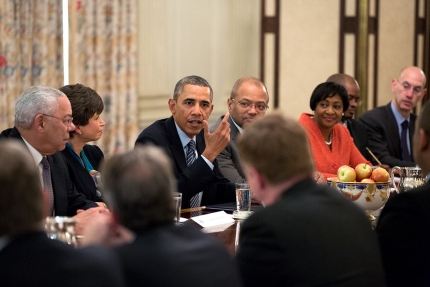
President Barack Obama meets with foundation and business leaders to discuss "My Brother's Keeper," an initiative to expand opportunity for young men and boys of color

President Barack Obama meets with foundation and business leaders to discuss "My Brother's Keeper," an initiative to expand opportunity for young men and boys of color, in the State Dining Room of the White House, Feb. 27, 2014. (Official White House Photo by Pete Souza)

“My administration’s policiesfrom early childhood education to job training, to minimum wagesare designed to give a hand up to everybody, every child, every American willing to work hard and take responsibility for their own success. That's the larger agenda. 

But the plain fact is there are some Americans who, in the aggregate, are consistently doing worse in our societygroups that have had the odds stacked against them in unique ways that require unique solutions; groups who’ve seen fewer opportunities that have spanned generations. And by almost every measure, the group that is facing some of the most severe challenges in the 21st century in this country are boys and young men of color.”

President Obama used these words to launch My Brother’s Keeper, his initiative to help ensure that boys and young men of color in America have the opportunity to reach their full potential. 

Since then, the public response has been overwhelming. We’ve heard from private philanthropies and businesses, mayors, state and local leaders, faith organizations, community based non-profits, and thousands of  interested citizens, all who are committed to creating more pathways to success for these boys and young men. We will continue to engage and listen to these critical voices and those of the boys and young men this initiative focuses on, as we continue to learn from the efforts of the many stakeholders who have been committed to this cause for years. And we will do our best to live up to the optimism and incredible expectations this initiative has unleashed. 

Related Topics: Urban Policy

President Obama Speaks on Equal Pay for Equal Work

April 08, 2014 | 26:22 | Public Domain

Following an introduction by Lilly Ledbetter, President Obama announces two new executive actions to strengthen enforcement of equal pay laws for women.

Download mp4 (972MB) | mp3 (25MB)

Read the Transcript

Remarks by the President on Equal Pay for Equal Work

East Room

11:58 A.M. EDT

THE PRESIDENT:  Thank you, everybody.  (Applause.)  All right.  Well, thanks to my friend, Lilly Ledbetter, not only for that introduction but for fighting for a simple principle:  Equal pay for equal work.  It's not that complicated.  And, Lilly, I assure you, you remain the face of fair pay.  (Laughter.)  People don't want my mug on there.  (Laughter.)  They want your face.  

As Lilly mentioned, she did not set out to be a trailblazer. She was just somebody who was waking up every day, going to work, doing her job the best that she could.  And then one day, she finds out, after years, that she earned less than her male colleagues for doing the same job.  I want to make that point again.  (Laughter.)  Doing the same job.  Sometimes when you -- when we discuss this issue of fair pay, equal pay for equal work, and the pay gap between men and women, you’ll hear all sorts of excuses about, well, they’re child-bearing, and they’re choosing to do this, and they’re this and they’re that and the other.  She was doing the same job -- probably doing better.  (Laughter and applause.)  Same job.  Working just as hard, probably putting in more hours.  But she was getting systematically paid less.   

And so she set out to make sure this country lived up to its founding, the idea that all of us are created equal.  And when the courts didn’t answer her call, Congress did. 

The first time Lilly and I stood together in this room was my tenth day in office, and that's when we signed the Lilly Ledbetter Fair Pay Act.  (Applause.)  First bill I signed into law.  And some of the leaders who helped make that happen are here today, including Leader Pelosi and Senator Mikulski and Congresswoman DeLauro.  (Applause.)  I want to thank all the members of Congress and all the state legislators who are here  and all the advocates who are here, because you all contributed to that effort.  And I want to give a special thanks to the members of the National Equal Pay Task Force, who’ve done outstanding work to make workplaces across America more fair.
We’re here because today is Equal Pay Day.  (Applause.)  Equal Pay Day.  And it's nice to have a day, but it's even better to have equal pay.  (Applause.)  And our job is not finished yet. Equal Pay Day means that a woman has to work about this far into 2014 to earn what a man earned in 2013.  Think about that.  A woman has got to work about three more months in order to get what a man got because she’s paid less.  That's not fair.  That’s like adding an extra six miles to a marathon.  (Laughter.)  It’s not right.

AUDIENCE MEMBER:  Ain’t right.

THE PRESIDENT:  Ain’t right.  (Laughter.)  It's not right and it ain’t right.  (Laughter.) 

America should be a level playing field, a fair race for everybody -- a place where anybody who’s willing to work hard has a chance to get ahead.  And restoring that opportunity for every American -- men and women -- has to be a driving focus for our country. 

Now, the good news is today our economy is growing; businesses have created almost 9 million new jobs over the past four years.   More than 7 million Americans have signed up for health care coverage under the Affordable Care Act.  (Applause.)
That’s a good thing, too.  I know it’s Equal Pay Day and not Obamacare Day -- (laughter) -- but I do want to point out that the Affordable Care Act guarantees free preventive care, like mammograms and contraceptive care, for tens of millions of women, and ends the days when you could be charged more just for being a woman when it comes to your health insurance.  (Applause.)  And that’s true for everybody.  (Applause.)  That’s just one more place where things were not fair. 

We’ll talk about drycleaners next, right -- (laughter) -- because I know that -- I don’t know why it costs more for Michelle’s blouse than my shirt.  (Laughter.) 

But we’ve got to make sure that America works for everybody. Anybody who is willing to work hard, they should be able to get ahead.  And we’ve got to build an economy that works for everybody, not just those at the top.  Restoring opportunity for all has to be our priority.  That’s what America is about.  It doesn’t matter where you started off, what you look like -- you work hard, you take responsibility, you make the effort, you should be able to get ahead. 

And we’ve got to fight for an opportunity agenda, which means more good jobs that pay good wages, and training Americans to make sure that they can fill those jobs, and guaranteeing every child a world-class education, and making sure the economy rewards hard work for every single American. 

And part of that is fighting for fair pay for women -- because when women succeed, America succeeds.  (Applause.)  When women succeed, America succeeds.  It’s true.  I believe that.  (Applause.)  It’s true.  It’s true.  It's true. 

Now, here’s the challenge:  Today, the average full-time working woman earns just 77 cents for every dollar a man earns; for African American women, Latinas, it’s even less.  And in 2014, that’s an embarrassment.  It is wrong.  And this is not just an issue of fairness.  It’s also a family issue and an economic issue, because women make up about half of our workforce and they’re increasingly the breadwinners for a whole lot of families out there.  So when they make less money, it means less money for gas, less money for groceries, less money for child care, less money for college tuition, less money is going into retirement savings. 

And it’s all bad for business, because our economy depends on customers out there, and when customers have less money, when hardworking women don’t have the resources, that’s a problem.  When businesses lose terrific women talent because they’re fed up with unfair policies, that’s bad for business.  They lose out on the contributions that those women could be making.  When any of our citizens can’t fulfill their potential for reasons that have nothing to do with their talent or their character or their work ethic, we’re not living up to our founding values.  We don’t have second-class citizens in this country -- and certainly not in the workplace.

So, tomorrow, the Senate has the chance to start making this right by passing a bill that Lilly already alluded to -- the Paycheck Fairness Act.  (Applause.)  They’ve got a chance to do the right thing.  And it would put sensible rules into place, like making sure employees who discuss their salaries don’t face retaliation by their employers. 

And here’s why this is important.  There are women here today who worked in offices where it was against the rules for employees to discuss salaries with one another.  And because of that, they didn’t know they were being paid less than men -- just like Lilly didn’t know -- for doing the exact same work.  For some, it was years before they found out.  And even then, it only happened because a manager accidentally let it slip or, as in Lilly’s case, a sympathetic co-worker quietly passed a note.  She only found out she earned less than her male colleagues for doing the same work because somebody left an anonymous note. 

We can’t leave that to chance.  And over the course of Lilly’s career, she lost more than $200,000 in salary, even more in pension and Social Security benefits -- both of which are pegged to salary -- simply because she was a woman. 

And Lilly, and some of the other women here, decided it was wrong, set out to fix it.  They went to their bosses; they asked for a raise.  That didn’t work.  They turned to the law; they filed suit.  And for some, for years after waiting and persisting they finally got some justice. 
Well, tomorrow, the Senate could pay tribute to their courage by voting yes for paycheck fairness.  (Applause.)  This should not be a hard proposition.  This should not be that complicated.  (Applause.) 
And so far, Republicans in Congress have been gumming up the works.  They’ve been blocking progress on this issue, and of course other issues that would help with the economic recovery and help us grow faster.  But we don’t have to accept that.  America, you don’t have to sit still.  You can make sure that you’re putting some pressure on members of Congress about this issue.  And I don’t care whether you’re a Democrat or a Republican.  If you’re a voter -- if you’ve got a daughter, you got a sister, you got a mom -- I know you got a mom -- (laughter) -- this is something you should care about. 
And I’m not going to stand still either.  So in this year of action I’ve used my executive authority whenever I could to create opportunity for more Americans.  And today, I’m going to take action -- executive action -- to make it easier for working women to earn fair pay.  So first, I’m going to sign an executive order to create more pay transparency by prohibiting federal contractors from retaliating against employees who discuss their pay with each other.  (Applause.)  Pay secrecy fosters discrimination and we should not tolerate it -- not in federal contracting or anywhere else. 

Second, I’m signing a presidential memorandum directing the Department of Labor and our outstanding Secretary of Labor, Tom Perez, to require federal contractors to provide data about their employee compensation so pay discrimination can be spotted more easily. 

Now, I want to be clear:  There are great employers out there who do the right thing.  There are plenty of employers out there who are absolutely certain that there’s no pay discrimination happening in their offices.  But then sometimes when the data is laid out, it paints a different picture.  Many times they then do everything they can to fix the problem, and so we want to encourage them to fix these problems if they exist by making sure that the data is out there.

So everybody who cares about this should pay attention to how the Senate votes tomorrow on this paycheck fairness act, because the majority of senators support this bill, but two years ago, a minority of Senate Republicans blocked it from getting a vote.  Even worse, some commentators are out there saying that the pay gap doesn’t even exist.  They say it’s a myth.  But it’s not a myth; it’s math.  (Laughter and applause.)  You can look at the paychecks.  You can look at the stubs.  (Applause.)

I mean, Lilly Ledbetter didn’t just make this up.  (Laughter.)  The court, when it looked at the documents, said, yep, you’ve been getting paid less for doing the same job.  It’s just the court then said, you know, it’s been -- as Lilly said -- it’s been happening so long, you can’t do anything about it anymore -- which made no sense and that’s why we had to sign another bill.  It’s basic math that adds up to real money.  It makes a real difference for a lot of Americans who are working hard to support their families. 

And of course, the fact that we’ve got some resistance from some folks on this issue up on Capitol Hill just fits with this larger problem, this vision that the congressional Republicans seem to be continually embracing -- this notion that, you know what, you’re just on your own, no matter how unfair things are.  You see it in their budget.  The budget the Republicans in Congress just put forward last week, it’s like a bad rerun.  It would give massive tax cuts to households making more than a million dollars a year, force deep cuts to things that actually help working families like early education and college grants and job training. 

And, of course, it includes that novel idea of repealing the Affordable Care Act.  (Laughter.)  Fiftieth time they’ve tried that -- which would mean the more than 7 million Americans who’ve done the responsible thing and signed up to buy health insurance, they’d lose their health insurance; and the 3 million young adults who’ve stayed on their parents’ plan, they’d no longer have that available; take us back to the days when insurers could charge women more just for being a woman.

On minimum wage, three out of four Americans support raising the minimum wage.  Usually when three out of four Americans support something, members of Congress are right there.  (Laughter.)  And yet here, Republicans in Congress are dead set against it, blocking a pay raise for tens of millions of Americans -- a majority of them women.  This isn’t just about treating women fairly.  This is about Republicans seemingly opposing any efforts to even the playing field for working families. 

And I was up in Michigan last week and I just asked -- I don’t understand fully the theory behind this.  I don’t know why you would resist the idea that women should be paid the same as men, and then deny that that’s not always happening out there.  If Republicans in Congress want to prove me wrong, if they want to show that they, in fact, do care about women being paid the same as men, then show me.  They can start tomorrow.  They can join us in this, the 21st century, and vote yes on the Paycheck Fairness Act.  (Applause.)  Vote yes. 

And if anybody is watching or listening, if you care about this issue, then let your senators know where you stand -- because America deserves equal pay for equal work.

This is not something we’re going to achieve in a day.  There’s going to be a lot of stuff that we’ve got to do to close the pay gap.  We got to make it possible for more women to enter high-paying fields that up until now have been dominated by men, like engineering and computer science.  Women hold less than 6 percent of our country’s commercial patents -- that’s not good enough.  We need more parents and high school teachers and college professors encouraging girls and women to study math and science.  We need more businesses to make gender diversity a priority when they hire and when they promote.  Fewer than five percent of Fortune 500 companies have women at the helm. 

I think we’d all agree that we need more women in Congress. (Applause.)  Fewer than 20 percent of congressional seats are held by women.  Clearly, Congress would get more done if the ratio was -- (laughter) -- evened out a little bit.  So we’ve got to work on that. 

And we’ve all got to do more to make our workplaces more welcoming to women.  Because the numbers show that even when men and women are in the same profession and have the same education, there’s still a wage gap, and it widens over time.  So we’re going to keep making the case for why these policies are the right ones for working families and businesses.  And this is all going to lead up to this first-ever White House Summit on Working Families on June 23rd.

So, ultimately, equal pay is not just an economic issue for millions of Americans and their families.  It’s also about whether we’re willing to build an economy that works for everybody, and whether we’re going to do our part to make sure that our daughters have the same chances to pursue their dreams as our sons, and whether or not we’re willing to restore to the heart of this country that basic idea -- you can make it, no matter who you are, if you try.  

And that’s personal for me.  I’ve said this before -- I’ve got two daughters and I expect them to be treated just like anybody’s sons.  And I think about my single mom working hard, going to school, trying to raise two kids all at the same time.  And I think about my grandmother trying to work her way up through her career and then hitting the glass ceiling.  And I’ve seen how hard they’ve worked, and I’ve seen how they’ve sucked it up.  And they put up with stuff and they don’t say anything, and they just take care of their family and they take care of themselves, and they don’t complain a lot.  But at a certain point, we have the power to do something about it for the next generation.  And this is a good place to start. 

So, for everybody out there who’s listening, ask your senator where you stand on paycheck fairness.  (Applause.)  If they tell you that there’s not a pay gap out there, you tell them to look at the data, because there is.  It’s time to get this done.  And I’m going to do my small part right now by signing this executive order and presidential memoranda.  (Applause.)

END   
12:18 P.M. EDT

Close Transcript

The White House

Office of the Press Secretary

Daily Press Briefing by Press Secretary Jay Carney, 4/8/14

James S. Brady Press Briefing Room

12:48 P.M. EDT

MR. CARNEY:  Hello, everyone.  Thanks for being here.  It's a pleasure to see you all.  I was reminded on my way out here that today is the 40th anniversary of Hank Aaron breaking Babe Ruth’s all-time homerun record.  And we offer him congratulations on that anniversary.  It was a remarkable achievement by a great baseball player and a great man.

Before I take your questions I also wanted to note that some of you have seen that the President will travel on April 22 to Oso, Washington, to view the devastation from the recent mudslide and to meet with families affected by this disaster, as well as first responders and recovery workers.  Further details about the President’s travel to Washington will be available in the coming days. 

First and foremost, our thoughts and prayers go out to everyone who lost a loved one and those whose friends and family remain missing as a result of this devastating incident.  The administration remains focused on supporting state and local efforts and first responders.  As you know, the President, earlier this month, declared a major disaster in the State of Washington and ordered federal aid to supplement state, tribal, and local recovery efforts.  This assistance is in addition to the support provided under the Presidential Emergency Declaration granted on March 24, 2014.

Julie Pace.

Q    Thank you, Jay.

MR. CARNEY:  How are you?

Q    I'm good.  How are you?

MR. CARNEY:  I'm great.

Q    I just wanted to ask about the equal pay event today and the President’s remarks.  You and other officials have been saying that this renewed focus on equal pay does not have to do with politics, but I'm wondering how that assertion squares with the President’s remarks today, which were sharply partisan in which he tried to draw a lot of contrast with Republicans.

MR. CARNEY:  Because Republicans are blocking passage of the Paycheck Fairness Act.  Right?  If they wanted to take politics out of it, they should do what the President asked them to do today, which is pass the Paycheck Fairness Act.  Instead, they are, for reasons that I've yet to quite understand but appreciate, decided to engage in a debate about whether or not this is the right thing to do. 

Well, we absolutely welcome that debate, as progressives have for years, which is when there is something that a President or a Congress can do to ensure that there’s greater equality in our country for women, we ought to do it.  And this is something that, upon any close scrutiny, is clear we ought to do.  That's why the President took action, using the authorities that he has, to sign an executive order -- or two executive orders today to empower women who work for federal contractors.  But Congress can provide the same kind of protections for all women workers out in the country by passing this important legislation.

So if they’re complaining about it being politics now, then they ought to just pass it, because it's the right thing to do.

Q    But I'm wondering, do you see this as a policy issue that you support but one that is also advantageous politically?

MR. CARNEY:  I think that paycheck fairness is the right thing to do for our economy because when women succeed in our economy America succeeds.  That's how the President views it.  It's why he signed in his first few days as President the Lilly Ledbetter Act, which addresses some of the issues related to paycheck fairness.  But more needs to be done.  That's why the President took the action he took today and why he called on Congress to pass additional legislation. 

Again, this President, and the Democratic Party more broadly, have been pushing these kinds of issues for a long time. The reason why the President signed the Lilly Ledbetter Act and that was the first bill he signed as President was because it had been blocked previously be Republicans and it took a Democratic President to sign it.  The only way to prove that there’s bipartisan support for women on these issues is to demonstrate it with votes in Congress.

Q    And on another topic, the President is going to Fort Hood tomorrow.  He has attended a memorial service there previously.  These memorial services have almost become -- I don't want to say routine, but they’ve become sort of part of the job for him.  I wonder how he views tomorrow’s memorial service in sort of the spectrum of memorial services he’s had to attend for gun violence victims.

MR. CARNEY:  Julie, I would say that it is true that the President has attended ceremonies and services of this nature in the past far too often, but they never become routine.  The pain of the family members who lost loved ones is not routine; it's unique in each case, in each instance.  And I think the President is as heartbroken by this event as he has been on each occasion that something like this has happened in the country and where he has traveled to participate in ceremonies or services that commemorate those lost and celebrate their lives. 

Q    Should we expect any particular focus on any policy element of gun violence in his remarks tomorrow?

MR. CARNEY:  The President’s views on the need to take common-sense steps that address the challenge and problem of gun violence in America are clear and he has continued to act on his views through executive action.  He has made clear his extreme disappointment in Congress’s failure to follow the lead of the American people and overwhelming majorities of Americans in every state in the country by expanding background checks.  The memorial ceremony that he’ll attend I think will focus on, and the President will focus on, the families of those who were lost and those who were lost themselves.

Jeff.

Q    Jay, outside economists say that the data that the President is citing, the 77 cents phrase, is wrong.  Regardless of the merits of this push, do you have better data?

MR. CARNEY:  Well, that’s absolutely not the case.  There are some economists who have different views on what it means.  But to say economists -- I mean, from Reuters I would expect something a little more precise.

Q    Whoa --

MR. CARNEY:  That’s just not true.  The facts are that women make 77 cents for every dollar that men make.  There are a variety of reasons for that --

Q    Are those the facts, though?  Seriously, are those the facts?  Because that's been disputed --

MR. CARNEY:  Yes, that’s based on Census data.

Q    -- over the last couple days as this story has gotten a lot of play.

MR. CARNEY:  That’s based on Census data.  Now, there has been an important discussion in the last several days and even prior to that about what those data represent and how much of that is due to a lack of transparency in the pay that women receive versus men; the lack of -- the kinds of things that ensure that women who do the same work get the same pay that men get; and also things that have to do with the fact that women tend to fill lower-wage jobs, which is why it’s so important to raise the minimum wage.

Again, if Republicans feel like this is a political or partisan issue, they ought to demonstrate that they want to help women at the lower end of the income ladder here by raising the minimum wage -- because I think 60 percent of minimum wage workers are women in this country.

But certainly there’s a lot of discussion about what that figure represents, but I don’t believe there’s any doubt on the basic fact that women earn 77 cents for every dollar that men earn.

Q    There is doubt.  Maybe not all economists -- I should have said “many” -- and I’m sure that there are others who would say --

MR. CARNEY:  Again, Jeff, it’s based on Census data.  I understand that there is discussion about what it means.  But, look, I just want to thank everybody for allowing us to have a sustained debate about this issue because I think every day that we talk about it and every day that the American people see that this President and his allies in Congress are fighting for women is a good day because it brings us closer to the day when we can actually get things done in Congress that will help women.

Look at what the President signed today.  Look at what is contained within the Paycheck Fairness Act.  These are not objectionable provisions.  These are things that just allow for the kind of transparency that means that women will know whether or not they’re getting fairly paid for the work that they do, and that they have the kind of protections that they need to ensure that.  I don’t know why you would oppose that.

Q    Let me ask about another issue.  Ukraine’s state security service has said that protestors in Luhansk have seized the state building, wired it with explosives, and are holding 60 hostages.  The protestors are denying this.  Does the U.S. have any confirmation on that?

MR. CARNEY:  We’ve seen the reports.  We do not have independent confirmation.  We would certainly, as we have made clear, oppose any violence, any taking of hostages, any placement of explosives in a building, as has been reported.  But we don’t have independent confirmation.  We have serious concerns about developments in parts of Ukraine, and I think you heard Secretary Kerry discuss this in open testimony on Capitol Hill earlier today.

So as to this specific report, we don’t have independent confirmation, but we are certainly concerned about a pattern here that is very worrying when it comes to efforts to cause unrest and to destabilize Ukraine and destabilize the Ukrainian government.

Q    Will this be the primary issue discussed by the President and Secretary Kerry in their meeting today?

MR. CARNEY:  Well, as you know, the President and Secretary Kerry have a standing meeting weekly if they’re both in town, and they discuss the whole panoply of issues that fall into the Secretary of State’s portfolio, so that would include this issue; it would include the Middle East peace process; it would include all the other issues that are front and center currently on the  -- within foreign affairs.

Jim.

Q    Jay, your own Labor Department has that gender pay equity metric at 81 cents.

MR. CARNEY:  Again, I want to thank you, Jim, again, for bringing this up and giving me the opportunity --

Q    I sent you the link.

MR. CARNEY:  And the point is?

Q    That Reuters didn’t get it wrong.  (Laughter.)

Q    That was for you, Jeff. 

The numbers are a little bit all over the place, are they not?  That number, 77 cents --

MR. CARNEY:  Do you doubt -- I mean, we can have this --

Q    I’m not saying there’s any doubt that there’s gender pay inequity.

MR. CARNEY:  Does anyone here doubt that -- okay.  There’s gender pay inequity.  It’s clear, as Lilly Ledbetter can attest, that it is essential for women to be able to know what they’re being paid compared to women who -- I mean, to men who do the same work.  It’s clear that there needs to be protections for women so that they aren’t retaliated against when they seek to discuss what they’re paid or find out what their coworkers are paid.  And the efforts underway here, whether it’s the executive orders and the provisions the President signed today, or the call on Congress to pass the Paycheck Fairness Act, are very common-sense ways to address the need for these protections for women and the transparency that allows for those protections to take effect.

So again, the data that -- the 77 cents figure, which is a widely used figure, is based on Census data, as I understand it. I don’t think -- if there’s ways to slice this data that alters it by a few cents here or there -- there’s any dispute over the fact that that gap continues to exist.  There is an important discussion about what contributes to that gap, but I think that it is fair to say that women in most workplaces would recognize that the gap is a problem and it’s one that needs to be addressed.  And first and foremost, what needs to be addressed is the need for equal pay for equal work.

Q    But should the President sign an executive order establishing gender pay equity here at the White House?

MR. CARNEY:  Again, I’m glad you raised --

Q    You’ve acknowledged yourself that --

MR. CARNEY:  I’m glad you raised this again and I was looking forward to the question, because what we have here is a circumstance because of the transparency that exists at the White House, where everyone in America can find out what everyone here earns, everyone in America knows that everybody is paid equally for the same job.  So that we have two senior advisors to the President -- one is a male, one is a female -- they’re paid the same. We have two deputy chiefs of staff -- one is a male, one is a female -- they’re paid the same.  Our National Security Advisor, our Counterterrorism Advisor, our White House Counsel, our Director of Communications -- they’re all paid at the same level as their male counterparts. 

And that is a good thing.  And that’s how it ought to be and what the Paycheck Fairness Act would do and what the executive orders the President signed today would do, is ensure that there is more transparency so that women who don’t work here but work in places where there isn’t that kind of transparency cannot be retaliated against when they discuss their salaries and try to find out what their male counterparts are making, and that they can enjoy the protections necessary to assure that they can pursue equal pay for equal work.

Q    And getting back to Secretary Kerry’s accusation that Russia is making mischief and perhaps even setting a pretext for further intervention in eastern Ukraine -- does that suggest that perhaps Moscow has not taken seriously or is not taking very seriously this threat of additional sanctions?

MR. CARNEY:  Well, obviously we’re concerned about what Russia has done in Crimea.  We’re very concerned about the presence of substantial troop numbers on the Ukrainian border.  We’re concerned about efforts underway in Ukraine to destabilize the situation there in eastern Ukraine, destabilize the government.  

I think there’s ample evidence that some of the unrest there has been promoted by people who aren’t local, people who are paid.  And that suggests an effort underway to destabilize Ukraine, and causes us great concern, which is why Secretary Kerry spoke about this as he did before the Senate Foreign Relations Committee today, why I discussed this yesterday, and why we are monitoring the situation there very closely, and why we are making clear to Russia that there will be additional costs incurred by Russia should Russia engage in further provocations and transgressions.

Major.

Q    Jay, would you just acknowledge that this debate is a bit more nuanced?  I mean, as the briefing showed yesterday, you can pay everyone in a workplace the same for equal work and still have a median wage gap because of various choices, education, jobs held.  And the Labor Department data says when you factor those things in, you get a wage gap that’s not $1 to 77 cents, but the difference can be as little as 5 or 6 cents.  I mean, you often ask us -- the Affordable Care Act or other things -- to look at the broader list of statistical nuances around a public policy issue.  Would you at least acknowledge that that is part of the --

MR. CARNEY:  And, again, I am absolutely encouraging a broader discussion here about these issues and hope that we can talk about this --

Q    -- that 77 cents is not, though we have   discrimination --

MR. CARNEY:  I hope we have this discussion every day until Congress passes the Paycheck Fairness Act.

Q    Do you acknowledge that?

MR. CARNEY:  I’m sorry, acknowledge --

Q    That the 77 cents to a dollar is not absolute proof of 23-cents-per-dollar discrimination.  There can be other economic factors.

MR. CARNEY:  I acknowledged that in my first answer, which is that there are a variety of factors that play into the gap. That the gap exists I think is indisputable, and that there is workplace discrimination I think is indisputable, especially for women who have experienced it.  And that there are things that we can do administratively and legislatively to address that problem is also indisputable, as the legislative language in the Paycheck Fairness Act demonstrates, as the Lilly Ledbetter Act demonstrates, which again Republicans blocked and Republicans are blocking this bill now.  I mean, there is a long sort of track record here. 

Q    I'm not talking about Republicans --

MR. CARNEY:  So when Republicans get up -- when Republicans get up and they --

Q    I’m not talking about Republicans.  This is Labor Department data --

MR. CARNEY:  They’ve cited the arguments that you’re making and they cite -- they want to talk about what’s happening in different work places, as opposed to what they can do to help improve the situation.  What they’re not acknowledging is that there’s a problem that they have the power to address, but they refuse to address it.  And they refuse to address it through raising the minimum wage.  And they refuse to address it by putting in place protections for women when it comes to paycheck fairness.  That’s a problem and it’s a shame.  And I think that there’s an opportunity here for Republicans to get right on this, and we certainly hope they do.  We certainly hope they take away this debate from us by doing the right thing.

Q    On Ukraine, is the message to the Ukrainian transitional government, in the face of provocation, you are essentially on your own?  That if there is a security situation from provocateurs or paid agents, that you have to deal with it yourself?  And is there a concern in this building that there is some level -- as you’ve talked before about the restraint the transitional Ukrainian government has showed -- at which they can no longer be restrained and have to respond in a way to either protect themselves, protect their territorial sovereignty, or their very own citizens?

MR. CARNEY:  I think I need a more specific question.  Obviously, it’s a sovereign government and they enjoy all the rights and responsibilities of sovereignty.  And I don’t think the actions that the United States has taken or that our allies have taken --

Q    But, clearly, this administration --

MR. CARNEY:  -- suggest that Ukraine is on its own, and quite to the contrary.  We’ve acted very quickly with our international partners to support Ukraine and to provide assistance to Ukraine.

Q    I guess what I’m saying is those are long-distance signals.  And as the question from Jim suggested, you’re not always sure whether or not Moscow reads those signals the way you want them to be read.  I’m talking about actual things on the ground where in Ukraine that are not parts of Crimea that are up for grabs essentially, this administration has complimented the transitional government for not sort of taking the bait and responding in an aggressive, military way to things that look provocative.  Is there a concern that there could be a point at which that transitional government can no longer take that provocation and acts in a way that it believes legitimately protects its citizens, but could cause a more destabilized military situation that could spin out of control?  And what are you trying to counsel them to do?

MR. CARNEY:  I think I understand what you’re getting at.  I think that our view has been that the Ukrainian government has performed admirably in the face of a very difficult situation, both economically and in dealing with the provocations and transgressions by the Russian government and others who seek to destabilize Ukraine and to undermine its efforts to focus on and move forward towards May 25th elections.  So we continue to make clear our admiration for the manner in which the Ukrainian government has addressed these challenges. 

We’ve made clear, as Secretary Kerry did today, earlier, that we strongly oppose and are concerned by some of the actions we’ve seen in eastern Ukraine and, of course, categorically reject and oppose the occupation of Crimea and the attempted annexation of Crimea with utter disregard for international law, treaty obligations and the will of the Ukrainian government, parliament and people.

Q    Secretary Kerry’s testimony was read by some in the Middle East today.  They concluded that he was blaming -- or placing the larger share of blame on the current impasse in the Middle East peace talks on Israel, not allowing -- not following through on the scheduled Palestinian prisoner release and the new tenders in the settlements.  Is that a sense you think is a fair reading of what the Secretary said?  And does the President share that?

MR. CARNEY:  I think that we have and Secretary Kerry has made clear that it is incumbent upon both sides to make difficult decisions and difficult choices to move the process forward.  And both sides have done things that have made it more difficult to move forward, and I think we’ve made that clear when it comes to actions by the Palestinians with regards to international organizations, as well as the issues you cite with regards to the Israelis. 

So I don’t -- I think that our view -- I know that our view has been that both parties need to continue what they had done earlier, which is make some tough decisions and do so in pursuit of negotiations and ultimately a negotiated peace.  Right now, at the request of both parties, the United States facilitated a meeting, as I think you know, between Israeli and Palestinian negotiators just last night to continue the intensive effort to resolve their differences.  Gaps remain, but both sides say they are committed to narrowing the gaps.

There is a window of time for a path back to substantive negotiations.  The issue now is whether the parties can demonstrate that they are willing to make the difficult decisions required to move the process forward.  The parties both understand what the choices are, and they are not choices or decisions that the United States can make for them; they are choices and decisions that the parties have to make for themselves.  So we play a role in facilitating this process, and it’s an important role.  But ultimately, some of these tough -- all of these tough choices and decisions have to be made by the parties.

Yes, in the back.  Yes, sir.

Q    Thank you.  A couple of questions, if I may.  We know that Rwanda is celebrating the 20th anniversary of -- or, I’m sorry, commemorating, not celebrating -- the 20th anniversary of the genocide.  But in that region, right now, there is a crisis unfolding in South Sudan with 3.7 million people facing -- the U.N. says 3.7 million people are facing starvation, which would be akin to the famine that happened in Ethiopia in the early ‘80s.  And of $1.27 billion requested by the U.N. only $385 million has been received, and the U.N. reports that if $230 million is not received in the next 60 days, this is what might unfold.  Has this administration focused any attention on what is going on there, and is there a reason why we haven’t heard very much about this?

MR. CARNEY:  Well, actually, I discussed this last week in response to a question, and the answer is, yes, we’re very focused on it.  The situation in South Sudan is of great concern, and we are working with our partners to address it.  I think some of the questions that you ask have to do with the United Nations and not just the United States, but our focus from our representation at the United Nations as well as here at the White House and the State Department is very intense on this challenge.

Q    At what point would the United States enter?  For example, with this great attention being given to, say, Ukraine

-- and rightly so -- and the goings-on there directly by the United States, for example -- at what point would the United States -- what would be the calculus at which point the United States would decide to move in and take action outside of the U.N.?  Because not everything, clearly, happens by the U.N.

MR. CARNEY:  Well, that’s certainly the case, but we, as we have with Ukraine and as we do with crises internationally all the time, we work together collectively with our partners to address challenges, and we work unilaterally.  And I think that’s been the case with Ukraine; it’s been the case with South Sudan, and will continue to be.  

But I understand -- part of the point of your question I think is that when the world’s attention is focused on a crisis like Ukraine, there’s almost a limit to the bandwidth and that the media have to focus a spotlight on a challenge like you see there or elsewhere when there are situations in places like Ukraine.  It’s incumbent on this administration, this Congress and governments around the world to make sure that even as we address some of these crises that are getting the most attention at the moment, that we’re continuing to make progress on other challenges.  And when it comes to South Sudan, we are committed to doing that.  And there’s no question that that challenge is no easier than many of the others we face. 

Q    And on the question of fair pay -- sorry, just one more -- there is clearly a racial component as well, with black men making about 25 percent approximately; Latino men making approximately 66 percent; black women 70 percent and Latino women 60 percent.  What is the calculus, political or otherwise, for not having a focus on this inequity in pay?  Is there a calculus?

MR. CARNEY:  Well, I would disagree that there’s not a focus on it.  One of the reasons -- and this goes to the example I cited about women, but also goes to employments facts about minority men and women -- is that we need to raise the minimum wage because it will benefit directly those who currently earn the minimum wage, earn below $10.10 an hour, as well as help everyone above that pay level, and help the economy. 

So, again, this is an opportunity for Congress to take direct action that can assist people who are working full-time, taking responsibility for themselves and their families, and yet receiving a wage that places them in poverty, which surely isn’t what anyone’s view of what a minimum wage should do.  And what I think you fail to hear Republicans concretely address is whether they support a minimum wage at all, because the logical extension of their arguments against raising it leads you to the conclusion that they don’t support a minimum wage at all, at least some of them don’t.  And if they don’t, they should say so.  They would be, I think, aggressively opposed by vast majorities of the American people should they say that.

Q    Jay, the question on equal pay, in terms of what the President is presenting with this statistic -- when it came to health care, the President himself cleaned up his words and said, look, I should have been more careful about if you like your doctor or if you like your plan, you can keep your plan.  On this issue, when you’re acknowledging 77 percent is not exactly the figure, his own Labor Department is saying it’s not it, why does he continue -- including today -- why does he cite that figure when even you’re saying, well, it’s not quite that?

MR. CARNEY:  I didn’t say that.

Q    You said it’s more nuanced than that.  You said in your first answer --

MR. CARNEY:  I said that there are many -- 77 cents is based on Census data.  You can argue with the Census if you like.  I can give you their number.  Two, I did say that there are a lot of factors that go into the gap and I would not contest that.  Nobody here has contested that.  But surely you’re not contesting -- and I want to commend the men aligning here in the front row and the interest they’re taking in this issue -- but surely you’re not contesting the suggestion that there is pay discrimination in this country, right?  And if there isn’t -- and if there is, shouldn’t we --

Q    Slate Magazine called it a lie to say 77 percent, though, and they said when you factor in a bunch of other stuff, it’s probably 91 cents compared to a dollar -- which is still not right because it’s not a dollar to dollar.  So let’s make that clear.  However, it’s not 77 cents.  So why does the President say that?

MR. CARNEY:  Ed, again, this is Census data.  This is built on Census data.  I’m not disputing that others have made different assessments about the factors that go into that gap.  The gap is --

Q    Even here at the White House -- you cited that again and again, that 88 cents is not really fair because that’s --

MR. CARNEY:  No, I didn’t say that.

Q    Well, you said because there are some who make a little lower and that brings the median down. 

MR. CARNEY:  No question.

Q    And so it’s more nuanced.

MR. CARNEY:  And the reason you know what people make here, every dollar for every individual, is because we publish what people make.

Q    Congress publishes that, right?

MR. CARNEY:  And I think you ought to ask Congress what the equities are in offices in Congress.  The fact that there’s a problem here that needs to be fixed doesn’t mean -- and that the problem exists in a lot of places only reinforces the need to fix it. 

And, again, I think it’s excellent that there is so much interest in this subject because certainly millions of Americans across the country are interested in paycheck fairness and they’d like to see Congress take action.  And while they’re doing it, they’d like to see Congress raise the minimum wage because that would disproportionately help women workers across the country as well as all workers across the country.

Q    One other quick question.  Attorney General Holder today testified on a number of subjects on the Hill.  And he was asked about General Petraeus and whether there’s still an active criminal investigation as to whether he leaked classified information.  Attorney General Holder testified openly under oath that that investigation is still open almost two years after General Petraeus stepped down at the CIA.  My question being, one, has the President been briefed on that investigation at all in the last two years?

MR. CARNEY:  I think you have to ask the Department of Justice.  We don’t weigh into Justice Department investigations.

Q    The President has spoken publicly many times about how terrible it is and illegal to leak classified information.  So why has this case not been resolved after a couple of years?  Wouldn’t the Justice Department -- wouldn’t this administration want to get to the bottom of it?

MR. CARNEY:  I would refer you to the Justice Department for questions about a Justice Department investigation.

Q    A question about how the data is going to be handled once the Department of Labor gets it from these federal contractors.  I looked through the --

MR. CARNEY:  Sounds like a question you might want to ask the Department of Labor, but I’ll try.

Q    Okay, just bear with me for one moment.  If not, I’m going to ask you about dry-cleaning disparity between men and women, so it’s your choice.

MR. CARNEY:  It’s terrible!  (Laughter.)

Q    And I’m wondering when the President will take up that battle.

MR. CARNEY:  How about the disparity that existed until three years ago where insurance companies could charge you twice as much as your twin brother, even if you’re in the same health.

Q    Leaving, aside my fictional twin brother -- on the question of the data, so for example, it's going to be collected, it's going to be aggregated. It's not going to, obviously, identify names.  But I'm curious if whether the government is interested in, for example, disclosing this information so a Latina engineer at Lockheed Martin would know what she’s earning compared to a white male engineer at that same company, rather than, for example, relying on that coworker to share that information voluntarily with her.  Is that something that the policy of the administration would consider?

MR. CARNEY:  I think that is something you would probably need to address to the Department of Labor, and I can take the question to see if we have any insight.  I believe that the EO talks about prohibiting retaliation against those who discuss what they’re paid and what their colleagues are paid, but for more details, we'll take the question and I suggest you go to the Department of Labor.

Jon.

Q    Jay, I just want to clarify, come back to the pay equality issue.  So the President cited Census data that women on average make 77 percent of what men make.  Why is that an example or evidence of discrimination in the workforce at large, but it's not evidence of discrimination with women here at the White House making 88 percent of what men here at the White House make?

MR. CARNEY:  Again, Jon, what I can --

Q    It's the same measure.  It's the same metric.  And there’s a big gap on both sides.

MR. CARNEY:  And we are hard at work here at the White House in the most transparent of ways to ensure that women compete for and earn senior positions, that women are recruited for more junior positions so they’re put in the pipeline for senior positions in the future.  In fact, virtually every woman who sits in a senior staff office today was promoted internally within the White House or the administration to that position, which demonstrates the President’s commitment to a diverse workforce here at the White House and in the administration, and demonstrates his commitment to having the very best talent around him advising him. 

Because it's not just a question of fairness; it's a question of quality.  And there have been great studies in the private sector about having more women in senior levels in Fortune 500 companies improves the performance of those companies and improves the bottom line of those companies.  And I know the President feels that the quality of debate and discussion and advice that he gets within this White House and, more broadly, within this administration is improved by the presence of women and, more broadly, of a diverse body of advisors.

So there’s no question that everybody needs to do more to get this right.  One of the reasons why, one of the factors that goes into the figures that exist here at the White House is an aggressive effort to bring in young, talented women and others to help the workforce here to be diverse and to make sure that there are people in the pipeline that are promoted within this White House and future White Houses and administrations so that that talent base is there in the future.  Because it goes to fairness, but it goes to quality.

Q    But, Jay, I'm asking about the metric here.  You would say there is no pay discrimination here at the White House, right?  I mean, there’s no pay discrimination here at the White House?

MR. CARNEY:  It's absolutely the case that there’s equal pay for equal work.

Q    Okay.  But you're using the same metric to argue there’s pay discrimination in the workforce at large.  Explain to me why the metric works in the economy at large but it doesn’t work here at the White House.

MR. CARNEY:  Again, the fact that there is indisputable Census data that women earn 77 cents on the dollar that men earn -- a lot of things go into that discrepancy.  Discrimination and lack of transparency and the inability of women to find out what they’re paid vis-à-vis their male coworkers is part of the problem.  That is something we in the administration, via the President’s authorities, and Congress, through legislation, can address.  That's what the President is saying today.  That's why he took the action he took.  That's why he called on Congress to do what it can do to address those problems. 

I’m not disputing that there are a lot of factors that go into that.  But the discrepancy is real.  And, again, I think that --

Q    But I still don’t understand why you’re saying that’s evidence of discrimination outside the White House, but the same metric is not evidence of discrimination inside the White House.  I mean, it’s the same metric. 

MR. CARNEY:  Again, Jon, what I’m saying --

Q    You’re not doing very well.  You’re at 88 percent. 

MR. CARNEY:  Well, first of all, again, if you want to compare metrics we’re doing better than the public at large.

Q    So is that the goal, to do a little bit better than the outside?

MR. CARNEY:  No, the goal is to do absolutely the best that we can do.  And that’s what we’re striving to do here, and that’s what the legislation the President calls on Congress to pass would ensure that others are doing across the country.  And what astounds me about this debate is the suggestion -- and you don’t hear a lot of women making it -- that there isn’t pay discrepancy here, there isn’t pay discrimination.

Q    I’m not making that suggestion.  I’m asking about a metric you are using for companies outside the White House.

MR. CARNEY:  I think we don’t dispute anything you’re saying, except that we have transparency here.  What this law, if passed, would provide would be greater transparency for women.  The transparency exists here at the White House.  It should exist everywhere.  And women should have the protections and tools in order to fight for paycheck fairness and transparency.  Republicans object to this strenuously, using the same arguments that conservatives use when they objected to every bit of progress made on civil rights for women and minorities over the past many decades.  And they were wrong then and they’re wrong now. 

But I want to have this debate.  I want you guys to -- let’s talk about this every day until they pass it.  Peter.

Q    I’ve got a quick question on Ukraine.  You talked yesterday about evidence or a suggestion that the Russians are basically hiring some of these people that are causing these disruptions in Eastern Ukraine.  Now the Russian Foreign Ministry is out saying that there are 150 American mercenaries from the company Greystone Limited, formerly part of Blackwater, that are dressed up in Ukrainian special task force uniforms and creating disruptions in Eastern Ukraine.  Just for the record, what do you make of this?  This is from the Russian Foreign Ministry.

MR. CARNEY:  Yes, well -- I mean, I would I think point you to what the company itself has said in the past, which is that this is not true.  And certainly -- I mean, I’m not sure what your question is.  I would point you to what the company has said. 

Q    Is this bogus, this allegation?

MR. CARNEY:  It seems bogus to us, yes.

Q    Can I follow on that?

MR. CARNEY:  Yes. 

Q    Thanks, Jay.  The Senate voted yesterday to block the entry of the new Iranian U.N. envoy to the U.S.  Will the administration follow up and block his entry?

MR. CARNEY:  Well, we share the Senate’s concerns regarding this case and find the potential nomination extremely troubling.  The U.S. government has informed the government of Iran that this potential selection is not viable.  The legislation passed by the Senate underscores just how troubling this potential nomination would be.  

Q    Would President Obama sign it?

MR. CARNEY:  First of all, this is a potential nomination.  We’ve informed the government of Iran that this potential selection, rather, is not viable. 

Q    Yes, but the bill passed by the Senate yesterday to deny a visa.

MR. CARNEY:  It’s a potential selection, as I understand it, that has not been formally made.  We’ve informed the government that that selection is not viable. 

Connie.

Q    First, on the Middle East, you said the window of opportunity is closing.  Hasn’t it been closing for 66 years?  I mean, what’s so special about this period of time?

MR. CARNEY:  Well, that’s obviously a longer discussion.  But the parties have been engaged in a process to try to move towards a framework for negotiations and a way of resolving some of the most difficult issues that separate the parties.  We’ve put in place a process with some timelines associated with it.  And we’ve been working with the parties to facilitate the discussions and negotiations that they’ve been engaged in. 

They met again last night.  There was some progress, but there are decisions that need to be made and steps that need to be taken that only can be made and taken by the parties themselves.

Q    Now, on the Alan Gross situation in Cuba, he now says he is going on a hunger strike.  He wants the U.S. to talk directly to the Cubans.  After 50 years, isn’t it time to just talk directly to them and not --

MR. CARNEY:  Connie, I don’t think there’s any doubt in the minds of any senior Cuban government official what our views are, which is that Mr. Gross ought to be released immediately.  And that has been made abundantly clear I think to the government of Cuba, and it remains our position to this day.

Q    But they want the recognition of direct talks.

MR. CARNEY:  Well, I think they want the release of Mr. Gross, and that’s what we are working very hard to achieve.

April.

Q    Jay, on another topic.  On Thursday, President Obama travels to another part of Texas and he’s going to commemorate the 50th anniversary of the Civil Rights Act.  Can you talk to me about what the President plans to say, particularly as this is his second term and he’s been more outspoken this term, it seems, when it comes to matters of race?

MR. CARNEY:  You want me to preview his remarks?

Q    Yes, I do.  (Laughter.)

MR. CARNEY:  Well, I won’t get ahead of the President.  I know the President looks forward to this event and will be delivering remarks, and I don’t want to steal his thunder.  The achievements that the Civil Rights Act represent are historic, and the President will gladly participate in an event celebrating that achievement.  But I’m not going to -- you’ve heard the President address some of the issues, as you noted, so I think you know where he comes from and what his thinking is.  I’m sure that will be reflected in the remarks that he gives.  But beyond that, I’m not going to preview it.

Q    So you say you don’t want to steal the President’s thunder -- should we take that as being something like the President might make news, he will speak more forcefully on issues of race?

MR. CARNEY:  I’m going to leave it to the President to --

Q    I’m asking you because you said that.  You said you don’t want to steal his thunder, and thunder makes you think that he’s going to shake something up.

Q    There’s thunder coming.  (Laughter.)

Q    Give me something.  (Laughter.)

MR. CARNEY:  Look, I think the President has spoken about civil rights in the past, and done so I think with clarity and passion.  I wouldn’t expect this to be any different.

Olivier.

Q    Jay, I’m sorry, I don’t mean to be dense, but what does “not viable” mean?

MR. CARNEY:  Not viable?

Q    The potential nomination --

MR. CARNEY:  It’s diplomatic jargon --

Q    Yeah, it kind of is, right?

MR. CARNEY:  -- to mean what you want it to mean.

(Laughter.)  No, I think it’s --

Q    That’s actually a very candid answer, because I can’t tell from that whether you guys would let this person in the country or not.  And so I’m wondering whether you’re --

MR. CARNEY:  This is an issue in terms of our -- the fact that we host the United Nations and some of the issues around that, and the questions about that process that I would refer to our representation at the U.N.

We have made our views as an administration known, as I did just now, about this.  And we think that the bill that the Senate passed reinforces the point that we’re making, but we’ve communicated that to the Iranian government.

Q    What point are you making?

MR. CARNEY:  It’s not viable.  (Laughter.)

Q    Jay, the House is scheduled to vote on budget alternatives this week -- I think five of them in total.  Representative Mick Mulvaney of South Carolina, a Republican, is going to bring to the floor the President’s budget.  Something similar to this happened in 2012, I think it was, with numbers but no specific policy behind it.  It was voted down 0-414.  Does the White House have --

MR. CARNEY:  Because it’s not the President’s budget.  If they follow that path again, that will be welcome to us, because what they’re really trying to do is hide from a debate about the Paul Ryan budget, which is, as the President said, like a very bad rerun, which in budget form ensures, if passed, that millionaires would be an enormous tax break; that middle-class families would get hit hard; that Medicare would be turned into a voucher program, no longer a guarantee; that, in the height of hypocrisy, the savings that the Affordable Care Act achieves would be retained in order to give those tax cuts to millionaires, but the Affordable Care Act would be repealed, meaning that the 7-point -- however many million who have signed up on the marketplace, plus the 3 million kids -- young adults, rather -- who are on their parents’ plans, plus the millions who have benefited from expanded Medicaid would be out of luck, but those millionaires would get that substantial tax cut.

I think whatever phony votes they might have, the debate is going to be around those priorities.  And you know what the President’s priorities are, which is to work together to invest in our economy, invest in our people, to expand opportunity, to reward hard work, to do things like raise the minimum wage so that folks at the very bottom who are working full-time and not even making a salary that pulls them out of poverty get a fighting chance -- not to reward people at the very top with a hefty new tax cut.  I just don’t think that’s good policy.  I don’t think most Americans think it’s good policy.  But we welcome the debate.

Q    I know in the front row we’ve talked about the 77 cents and 88 cents on the dollar conversation.  I want to ask you specifically -- I know in the White House if you work the exact same position you get paid the exact same no matter your gender. Some nonpartisan, nonpolitical organizations have done all sorts of studies on this and found, to quote them, “Once you compare men and women with the same background doing the same job and working for the same type of employer, they essentially earn the same amount throughout America,” which is to say that this problem for people doing the same thing for the same amount of time is --

MR. CARNEY:  Well, I don’t know who you’re citing, but I don’t --

Q    It’s from an organization named PayScale, based in Seattle, Washington.  The number I think is separated by like, perhaps 3 to 5 percent, they suggest.  So does the White House concede that there have been great gains made; that actually, if people across America are doing the same thing for the same amount of time whether they’re a man or woman, they are making about the same amount of money?

MR. CARNEY:  Again, I’m not familiar with that study.  I think there is certainly ample evidence that, as I think Lilly Ledbetter discovered, that that is not uniformly the case.  And it is something that is not the case and is allowed to not be the case in part because of the lack of transparency and the retaliation that some females across the country experience from their employers when they seek to find out what they’re making compared to what their male colleagues are making, or counterparts are making.  So that’s why we need something like the Paycheck Fairness Act.

If, as a broad matter, you’re making the argument that we’ve made progress in this country on equal rights for women, I think that’s true -- often resisted by the same folks who are resisting this.  So we need to make more progress.  And passing this bill, taking the action the President took today, signing the Lilly Ledbetter Act, as he did in 2009 -- those are all steps along a road and a path that is unfinished, but that needs to be finished.

Jessica.

Q    A question on Syria.  A lot of the time during the hearing with Secretary Kerry today was spent on Syria, and he suggested that we would be sending -- the U.S. would be sending more assistance to the moderate opposition.  I’m wondering, since there’s been some reporting on a debate in the White House between the Pentagon and the State Department, if that assistance is going to include training and arming the moderate opposition.

MR. CARNEY:  As I think I’ve said and others have said, Secretary Kerry and others have said, the President has asked his team to constantly evaluate the situation in Syria as it evolves and as it changes, and what our options are when it comes to making sure that we’re employing the best policies when it comes to providing humanitarian assistance to the Syrian people and assistance to the moderate opposition. 

As we’ve discussed periodically, that conversation continues and that discussion continues.  And we are, and the President is, evaluating different options.  But I don’t have any announcements to make or even a review of the options that may or may not be on the table to present to you except that the President is always tasking his team to assess what options are available to him.

Q    Is it fair to say that there is more support within the administration or a bigger push for military action, or a little bit more traction at that point --

MR. CARNEY:  Well, I don’t know what you mean exactly by military action.  I think the President has addressed the question of direct military action.  Beyond that, I’m not going to discuss what options are on the table.

Yes, sir.

Q    Thank you, Jay.  A question on Canada, but not Keystone this time.  Any comments on yesterday’s result of the election in Quebec, where the party in favor of breaking up the country lost the government?

MR. CARNEY:  I don’t have any reaction here.  The State Department might have it.

Q    Thanks, Jay.

MR. CARNEY:  Thanks very much, everybody.

END
1:40 P.M. EDT

The White House

Office of the Press Secretary

Presidential Proclamation -- National Former Prisoner of War Recognition Day, 2014

BY THE PRESIDENT OF THE UNITED STATES OF AMERICA

A PROCLAMATION

Since the earliest days of our Republic, the brave men and women of our Armed Forces have answered the call to serve. They have put their lives on the line for our Nation, and many have sacrificed their own freedom to safeguard ours. On National Former Prisoner of War Recognition Day, we honor those who stood up, took an oath, put on the uniform, and faced immeasurable challenges far from home.

These patriots often suffered physical and mental torture during captivity. Many endured starvation and isolation, not knowing when or if they would make it safely back to our shores. Families experienced days, months, and sometimes years of uncertainty, but they showed remarkable strength that mirrored the grit of their loved ones through long stretches of imprisonment. These warriors rendered the highest service any American can offer our country -- they fought and sacrificed so that we might live in peace, security, and prosperity.

Today, we are solemnly reminded of our responsibility to care for those who have borne these burdens for us. We recommit to honoring that sacred obligation -- to serving our former prisoners of war, our veterans, and their families as well as they have served us. With unyielding pride and unending gratitude, let us fulfill our promises to the courageous heroes of generations past, to this generation of veterans, and to all who will follow.

NOW, THEREFORE, I, BARACK OBAMA, President of the United States of America, by virtue of the authority vested in me by the Constitution and the laws of the United States, do hereby proclaim April 9, 2014, as National Former Prisoner of War Recognition Day. I call upon all Americans to observe this day of remembrance by honoring all American prisoners of war, our service members, and our veterans. I also call upon Federal, State, and local government officials and organizations to observe this day with appropriate ceremonies and activities.

IN WITNESS WHEREOF, I have hereunto set my hand this eighth day of April, in the year of our Lord two thousand fourteen, and of the Independence of the United States of America the two hundred and thirty-eighth.

BARACK OBAMA

The White House

Office of the Press Secretary

Remarks by the President on Equal Pay for Equal Work

East Room

11:58 A.M. EDT

THE PRESIDENT:  Thank you, everybody.  (Applause.)  All right.  Well, thanks to my friend, Lilly Ledbetter, not only for that introduction but for fighting for a simple principle:  Equal pay for equal work.  It's not that complicated.  And, Lilly, I assure you, you remain the face of fair pay.  (Laughter.)  People don't want my mug on there.  (Laughter.)  They want your face.  

As Lilly mentioned, she did not set out to be a trailblazer. She was just somebody who was waking up every day, going to work, doing her job the best that she could.  And then one day, she finds out, after years, that she earned less than her male colleagues for doing the same job.  I want to make that point again.  (Laughter.)  Doing the same job.  Sometimes when you -- when we discuss this issue of fair pay, equal pay for equal work, and the pay gap between men and women, you’ll hear all sorts of excuses about, well, they’re child-bearing, and they’re choosing to do this, and they’re this and they’re that and the other.  She was doing the same job -- probably doing better.  (Laughter and applause.)  Same job.  Working just as hard, probably putting in more hours.  But she was getting systematically paid less.   

And so she set out to make sure this country lived up to its founding, the idea that all of us are created equal.  And when the courts didn’t answer her call, Congress did. 

The first time Lilly and I stood together in this room was my tenth day in office, and that's when we signed the Lilly Ledbetter Fair Pay Act.  (Applause.)  First bill I signed into law.  And some of the leaders who helped make that happen are here today, including Leader Pelosi and Senator Mikulski and Congresswoman DeLauro.  (Applause.)  I want to thank all the members of Congress and all the state legislators who are here  and all the advocates who are here, because you all contributed to that effort.  And I want to give a special thanks to the members of the National Equal Pay Task Force, who’ve done outstanding work to make workplaces across America more fair.
We’re here because today is Equal Pay Day.  (Applause.)  Equal Pay Day.  And it's nice to have a day, but it's even better to have equal pay.  (Applause.)  And our job is not finished yet. Equal Pay Day means that a woman has to work about this far into 2014 to earn what a man earned in 2013.  Think about that.  A woman has got to work about three more months in order to get what a man got because she’s paid less.  That's not fair.  That’s like adding an extra six miles to a marathon.  (Laughter.)  It’s not right.

AUDIENCE MEMBER:  Ain’t right.

THE PRESIDENT:  Ain’t right.  (Laughter.)  It's not right and it ain’t right.  (Laughter.) 

America should be a level playing field, a fair race for everybody -- a place where anybody who’s willing to work hard has a chance to get ahead.  And restoring that opportunity for every American -- men and women -- has to be a driving focus for our country. 

Now, the good news is today our economy is growing; businesses have created almost 9 million new jobs over the past four years.   More than 7 million Americans have signed up for health care coverage under the Affordable Care Act.  (Applause.)
That’s a good thing, too.  I know it’s Equal Pay Day and not Obamacare Day -- (laughter) -- but I do want to point out that the Affordable Care Act guarantees free preventive care, like mammograms and contraceptive care, for tens of millions of women, and ends the days when you could be charged more just for being a woman when it comes to your health insurance.  (Applause.)  And that’s true for everybody.  (Applause.)  That’s just one more place where things were not fair. 

We’ll talk about drycleaners next, right -- (laughter) -- because I know that -- I don’t know why it costs more for Michelle’s blouse than my shirt.  (Laughter.) 

But we’ve got to make sure that America works for everybody. Anybody who is willing to work hard, they should be able to get ahead.  And we’ve got to build an economy that works for everybody, not just those at the top.  Restoring opportunity for all has to be our priority.  That’s what America is about.  It doesn’t matter where you started off, what you look like -- you work hard, you take responsibility, you make the effort, you should be able to get ahead. 

And we’ve got to fight for an opportunity agenda, which means more good jobs that pay good wages, and training Americans to make sure that they can fill those jobs, and guaranteeing every child a world-class education, and making sure the economy rewards hard work for every single American. 

And part of that is fighting for fair pay for women -- because when women succeed, America succeeds.  (Applause.)  When women succeed, America succeeds.  It’s true.  I believe that.  (Applause.)  It’s true.  It’s true.  It's true. 

Now, here’s the challenge:  Today, the average full-time working woman earns just 77 cents for every dollar a man earns; for African American women, Latinas, it’s even less.  And in 2014, that’s an embarrassment.  It is wrong.  And this is not just an issue of fairness.  It’s also a family issue and an economic issue, because women make up about half of our workforce and they’re increasingly the breadwinners for a whole lot of families out there.  So when they make less money, it means less money for gas, less money for groceries, less money for child care, less money for college tuition, less money is going into retirement savings. 

And it’s all bad for business, because our economy depends on customers out there, and when customers have less money, when hardworking women don’t have the resources, that’s a problem.  When businesses lose terrific women talent because they’re fed up with unfair policies, that’s bad for business.  They lose out on the contributions that those women could be making.  When any of our citizens can’t fulfill their potential for reasons that have nothing to do with their talent or their character or their work ethic, we’re not living up to our founding values.  We don’t have second-class citizens in this country -- and certainly not in the workplace.

So, tomorrow, the Senate has the chance to start making this right by passing a bill that Lilly already alluded to -- the Paycheck Fairness Act.  (Applause.)  They’ve got a chance to do the right thing.  And it would put sensible rules into place, like making sure employees who discuss their salaries don’t face retaliation by their employers. 

And here’s why this is important.  There are women here today who worked in offices where it was against the rules for employees to discuss salaries with one another.  And because of that, they didn’t know they were being paid less than men -- just like Lilly didn’t know -- for doing the exact same work.  For some, it was years before they found out.  And even then, it only happened because a manager accidentally let it slip or, as in Lilly’s case, a sympathetic co-worker quietly passed a note.  She only found out she earned less than her male colleagues for doing the same work because somebody left an anonymous note. 

We can’t leave that to chance.  And over the course of Lilly’s career, she lost more than $200,000 in salary, even more in pension and Social Security benefits -- both of which are pegged to salary -- simply because she was a woman. 

And Lilly, and some of the other women here, decided it was wrong, set out to fix it.  They went to their bosses; they asked for a raise.  That didn’t work.  They turned to the law; they filed suit.  And for some, for years after waiting and persisting they finally got some justice. 
Well, tomorrow, the Senate could pay tribute to their courage by voting yes for paycheck fairness.  (Applause.)  This should not be a hard proposition.  This should not be that complicated.  (Applause.) 
And so far, Republicans in Congress have been gumming up the works.  They’ve been blocking progress on this issue, and of course other issues that would help with the economic recovery and help us grow faster.  But we don’t have to accept that.  America, you don’t have to sit still.  You can make sure that you’re putting some pressure on members of Congress about this issue.  And I don’t care whether you’re a Democrat or a Republican.  If you’re a voter -- if you’ve got a daughter, you got a sister, you got a mom -- I know you got a mom -- (laughter) -- this is something you should care about. 
And I’m not going to stand still either.  So in this year of action I’ve used my executive authority whenever I could to create opportunity for more Americans.  And today, I’m going to take action -- executive action -- to make it easier for working women to earn fair pay.  So first, I’m going to sign an executive order to create more pay transparency by prohibiting federal contractors from retaliating against employees who discuss their pay with each other.  (Applause.)  Pay secrecy fosters discrimination and we should not tolerate it -- not in federal contracting or anywhere else. 

Second, I’m signing a presidential memorandum directing the Department of Labor and our outstanding Secretary of Labor, Tom Perez, to require federal contractors to provide data about their employee compensation so pay discrimination can be spotted more easily. 

Now, I want to be clear:  There are great employers out there who do the right thing.  There are plenty of employers out there who are absolutely certain that there’s no pay discrimination happening in their offices.  But then sometimes when the data is laid out, it paints a different picture.  Many times they then do everything they can to fix the problem, and so we want to encourage them to fix these problems if they exist by making sure that the data is out there.

So everybody who cares about this should pay attention to how the Senate votes tomorrow on this paycheck fairness act, because the majority of senators support this bill, but two years ago, a minority of Senate Republicans blocked it from getting a vote.  Even worse, some commentators are out there saying that the pay gap doesn’t even exist.  They say it’s a myth.  But it’s not a myth; it’s math.  (Laughter and applause.)  You can look at the paychecks.  You can look at the stubs.  (Applause.)

I mean, Lilly Ledbetter didn’t just make this up.  (Laughter.)  The court, when it looked at the documents, said, yep, you’ve been getting paid less for doing the same job.  It’s just the court then said, you know, it’s been -- as Lilly said -- it’s been happening so long, you can’t do anything about it anymore -- which made no sense and that’s why we had to sign another bill.  It’s basic math that adds up to real money.  It makes a real difference for a lot of Americans who are working hard to support their families. 

And of course, the fact that we’ve got some resistance from some folks on this issue up on Capitol Hill just fits with this larger problem, this vision that the congressional Republicans seem to be continually embracing -- this notion that, you know what, you’re just on your own, no matter how unfair things are.  You see it in their budget.  The budget the Republicans in Congress just put forward last week, it’s like a bad rerun.  It would give massive tax cuts to households making more than a million dollars a year, force deep cuts to things that actually help working families like early education and college grants and job training. 

And, of course, it includes that novel idea of repealing the Affordable Care Act.  (Laughter.)  Fiftieth time they’ve tried that -- which would mean the more than 7 million Americans who’ve done the responsible thing and signed up to buy health insurance, they’d lose their health insurance; and the 3 million young adults who’ve stayed on their parents’ plan, they’d no longer have that available; take us back to the days when insurers could charge women more just for being a woman.

On minimum wage, three out of four Americans support raising the minimum wage.  Usually when three out of four Americans support something, members of Congress are right there.  (Laughter.)  And yet here, Republicans in Congress are dead set against it, blocking a pay raise for tens of millions of Americans -- a majority of them women.  This isn’t just about treating women fairly.  This is about Republicans seemingly opposing any efforts to even the playing field for working families. 

And I was up in Michigan last week and I just asked -- I don’t understand fully the theory behind this.  I don’t know why you would resist the idea that women should be paid the same as men, and then deny that that’s not always happening out there.  If Republicans in Congress want to prove me wrong, if they want to show that they, in fact, do care about women being paid the same as men, then show me.  They can start tomorrow.  They can join us in this, the 21st century, and vote yes on the Paycheck Fairness Act.  (Applause.)  Vote yes. 

And if anybody is watching or listening, if you care about this issue, then let your senators know where you stand -- because America deserves equal pay for equal work.

This is not something we’re going to achieve in a day.  There’s going to be a lot of stuff that we’ve got to do to close the pay gap.  We got to make it possible for more women to enter high-paying fields that up until now have been dominated by men, like engineering and computer science.  Women hold less than 6 percent of our country’s commercial patents -- that’s not good enough.  We need more parents and high school teachers and college professors encouraging girls and women to study math and science.  We need more businesses to make gender diversity a priority when they hire and when they promote.  Fewer than five percent of Fortune 500 companies have women at the helm. 

I think we’d all agree that we need more women in Congress. (Applause.)  Fewer than 20 percent of congressional seats are held by women.  Clearly, Congress would get more done if the ratio was -- (laughter) -- evened out a little bit.  So we’ve got to work on that. 

And we’ve all got to do more to make our workplaces more welcoming to women.  Because the numbers show that even when men and women are in the same profession and have the same education, there’s still a wage gap, and it widens over time.  So we’re going to keep making the case for why these policies are the right ones for working families and businesses.  And this is all going to lead up to this first-ever White House Summit on Working Families on June 23rd.

So, ultimately, equal pay is not just an economic issue for millions of Americans and their families.  It’s also about whether we’re willing to build an economy that works for everybody, and whether we’re going to do our part to make sure that our daughters have the same chances to pursue their dreams as our sons, and whether or not we’re willing to restore to the heart of this country that basic idea -- you can make it, no matter who you are, if you try.  

And that’s personal for me.  I’ve said this before -- I’ve got two daughters and I expect them to be treated just like anybody’s sons.  And I think about my single mom working hard, going to school, trying to raise two kids all at the same time.  And I think about my grandmother trying to work her way up through her career and then hitting the glass ceiling.  And I’ve seen how hard they’ve worked, and I’ve seen how they’ve sucked it up.  And they put up with stuff and they don’t say anything, and they just take care of their family and they take care of themselves, and they don’t complain a lot.  But at a certain point, we have the power to do something about it for the next generation.  And this is a good place to start. 

So, for everybody out there who’s listening, ask your senator where you stand on paycheck fairness.  (Applause.)  If they tell you that there’s not a pay gap out there, you tell them to look at the data, because there is.  It’s time to get this done.  And I’m going to do my small part right now by signing this executive order and presidential memoranda.  (Applause.)

END   
12:18 P.M. EDT

The White House

Office of the Press Secretary

Executive Order -- Non-Retaliation for Disclosure of Compensation Information

EXECUTIVE ORDER

- - - - - - -

NON-RETALIATION FOR DISCLOSURE OF COMPENSATION INFORMATION

By the authority vested in me as President by the Constitution and the laws of the United States of America, including the Federal Property and Administrative Services Act, 40 U.S.C. 101 et seq., and in order to take further steps to promote economy and efficiency in Federal Government procurement, it is hereby ordered as follows:

Section 1. Policy. This order is designed to promote economy and efficiency in Federal Government procurement. It is the policy of the executive branch to enforce vigorously the civil rights laws of the United States, including those laws that prohibit discriminatory practices with respect to compensation. Federal contractors that employ such practices are subject to enforcement action, increasing the risk of disruption, delay, and increased expense in Federal contracting. Compensation discrimination also can lead to labor disputes that are burdensome and costly.

When employees are prohibited from inquiring about, disclosing, or discussing their compensation with fellow workers, compensation discrimination is much more difficult to discover and remediate, and more likely to persist. Such prohibitions (either express or tacit) also restrict the amount of information available to participants in the Federal contracting labor pool, which tends to diminish market efficiency and decrease the likelihood that the most qualified and productive workers are hired at the market efficient price. Ensuring that employees of Federal contractors may discuss their compensation without fear of adverse action will enhance the ability of Federal contractors and their employees to detect and remediate unlawful discriminatory practices, which will contribute to a more efficient market in Federal contracting.

Sec. 2. Amending Executive Order 11246. Section 202 of Executive Order 11246 of September 24, 1965, as amended, is hereby further amended as follows:

(a) Paragraphs (3) through (7) are redesignated as paragraphs (4) through (8).

(b) A new paragraph (3) is added to read as follows:

"The contractor will not discharge or in any other manner discriminate against any employee or applicant for employment because such employee or applicant has inquired about, discussed, or disclosed the compensation of the employee or applicant or another employee or applicant. This provision shall not apply to instances in which an employee who has access to the compensation information of other employees or applicants as a part of such employee's essential job functions discloses the compensation of such other employees or applicants to individuals who do not otherwise have access to such information, unless such disclosure is in response to a formal complaint or charge, in furtherance of an investigation, proceeding, hearing, or action, including an investigation conducted by the employer, or is consistent with the contractor's legal duty to furnish information."

Sec. 3. Regulations. Within 160 days of the date of this order, the Secretary of Labor shall propose regulations to implement the requirements of this order.

Sec. 4. Severability. If any provision of this order, or the application of such provision or amendment to any person or circumstance, is held to be invalid, the remainder of this order and the application of the provisions of such to any person or circumstances shall not be affected thereby.

Sec. 5. General Provisions. (a) Nothing in this order shall be construed to limit the rights of an employee or applicant for employment provided under any provision of law.

It also shall not be construed to prevent a Federal contractor covered by this order from pursuing a defense, as long as the defense is not based on a rule, policy, practice, agreement, or other instrument that prohibits employees or applicants from discussing or disclosing their compensation or the compensation of other employees or applicants, subject to paragraph (3) of section 202 of Executive Order 11246, as added by this order.

(b) Nothing in this order shall be construed to impair or otherwise affect:

(i) the authority granted by law to a department, agency, or the head thereof; or

(ii) the functions of the Director of the Office of Management and Budget relating to budgetary, administrative, or legislative proposals.

(c) This order shall be implemented consistent with applicable law and subject to the availability of appropriations.

(d) This order is not intended to, and does not, create any right or benefit, substantive or procedural, enforceable at law or in equity by any party against the United States, its departments, agencies, or entities, its officers, employees, or agents, or any other person.

Sec. 6. Effective Date. This order shall become effective immediately, and shall apply to contracts entered into on or after the effective date of rules promulgated by the Department of Labor under section 3 of this order.

BARACK OBAMA