The White House

Office of the Press Secretary

Presidential Memorandum -- Advancing Pay Equality Through Compensation Data Collection

MEMORANDUM FOR THE SECRETARY OF LABOR

SUBJECT: Advancing Pay Equality Through Compensation
Data Collection

While working women have made extraordinary progress over the past five decades since enactment of the Equal Pay Act of 1963, they still earn only 77 cents for every dollar that a man earns. For African-American women and Latinas, the pay gap is even greater. This pay differential shortchanges women and their families by thousands of dollars a year, and potentially hundreds of thousands of dollars over a lifetime. Moreover, given the connected impact on benefits and retirement savings, the loss and the accompanying threat to economic security are even greater.

Federal law, including the Equal Pay Act of 1963, Title VII of the Civil Rights Act of 1964, and Executive Order 11246 of September 24, 1965 (Equal Employment Opportunity), specifically prohibits compensating men and women differently for the same work. Effective enforcement of this mandate, however, is impeded by a lack of sufficiently robust and reliable data on employee compensation, including data by sex and race. The National Equal Pay Task Force, which I created to improve enforcement of equal pay laws, identified this lack of data as a barrier to closing the persistent pay gap for women and minorities. To address this lack of data, the Department of Labor (DOL) solicited stakeholder input on the design and operation of a potential compensation data collection tool in an Advance Notice of Proposed Rulemaking (ANPRM) published on August 10, 2011. The extensive response to the ANPRM provides ample information from which DOL can develop a tool that will enhance the effectiveness of its enforcement.

Therefore, I hereby direct you to propose, within 120 days of the date of this memorandum, a rule that would require Federal contractors and subcontractors to submit to DOL summary data on the compensation paid their employees, including data by sex and race. In doing so, you shall consider approaches that: (1) maximize efficiency and effectiveness by enabling DOL to direct its enforcement resources toward entities for which reported data suggest potential discrepancies in worker compensation, and not toward entities for which there is no evidence of potential pay violations; (2) minimize, to the extent feasible, the burden on Federal contractors and subcontractors and in particular small entities, including small businesses and small nonprofit organizations; and (3) use the data to encourage greater voluntary compliance by employers with Federal pay laws and to identify and analyze industry trends. To the extent feasible, you shall avoid new record-keeping requirements and rely on existing reporting frameworks to collect the summary data. In addition, in developing the proposal you should consider independent studies regarding the collection of compensation data.

This memorandum is not intended to, and does not, create any right or benefit, substantive or procedural, enforceable at law or in equity by any party against the United States, its departments, agencies, or entities, its officers, employees, or agents, or any other person.

You are hereby authorized and directed to publish this memorandum in the Federal Register.

BARACK OBAMA

Taking Action in Honor of National Equal Pay Day

President Barack Obama signs executive actions to strengthen enforcement of equal pay laws for women, at an event marking Equal Pay Day, in the East Room of the White House, April 8, 2014.

President Barack Obama signs executive actions to strengthen enforcement of equal pay laws for women, at an event marking Equal Pay Day, in the East Room of the White House, April 8, 2014. (Official White House Photo by Pete Souza)

Today, President Obama signed a new Executive Order to prevent workplace discrimination and empower workers to take control over negotiations regarding their pay.

Just over two months after President Obama raised the minimum wage to $10.10 for federal contractors, he is again leading by example and taking action to protect American workers from retaliation if they broach the topic of unequal compensation. This is a problem facing a broad range of American workers, but women in particular are too often on the receiving end of subtle or overt penalties for even mentioning their pay.

In addition, the President is asking the Secretary of Labor to require federal contractors to submit data on employee compensation by race and gender — which will help employers take proactive efforts to ensure fair pay for all their employees.

Lilly Ledbetter was the plaintiff in the discrimination case Ledbetter v. Goodyear Tire & Rubber Co. and the namesake for the first bill President Obama signed into law. Cecilia Muñoz is the Director of the Domestic Policy Council.
Related Topics: Equal Pay

Maria Contreras-Sweet Ceremonially Sworn In as Administrator of the Small Business Administration

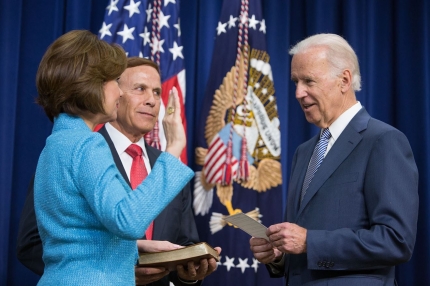
Vice President Joe Biden ceremonially swears in Small Business Administrator Maria Contreras-Sweet,

Vice President Joe Biden ceremonially swears in Small Business Administrator Maria Contreras-Sweet, with her husband Ray Sweet holding the bible, in the South Court Auditorium of the White House, April 7, 2014. (Official White House Photo by David Lienemann)

Yesterday, at the White House, President Obama and Vice President Biden participated in a ceremonial swearing-in ceremony for Maria Contreras-Sweet as the new Administrator of the Small Business Administration (SBA). Mrs. Contreras-Sweet is an excellent choice to lead the SBA, having served at high levels in both the public and private sectors.  Mrs. Contreras-Sweet served as the first Latina cabinet secretary in the history of California, oversaw one of the largest state government agencies in the country, and built a successful bank dedicated to serving traditionally underserved Latino communities from scratch. 

Maria Contreras-Sweet is a champion for the success of small businesses; that’s why President Obama said during her nomination that “Maria Contreras-Sweet will help small businesses get their good ideas off the ground, to expand, to hire, to sell their products and ideas not only in our domestic markets, but also overseas.” Strengthening the economy is the President’s top priority and Mrs. Contreras-Sweet will play an integral role by supporting small businesses with expanded access to SBA loans.

The White House

Office of the Press Secretary

FACT SHEET: Expanding Opportunity for All: Ensuring Equal Pay for Women and Promoting the Women’s Economic Agenda

When women succeed, our families succeed and America succeeds. President Obama believes that ensuring that women earn equal pay for equal work is essential to improving the economic security of our families and the growth of our middle class and our economy.  Women compose nearly half of the American workforce – yet, according to the latest U.S. Census statistics, on average, full-time working women still earn 77 cents to every dollar earned by men. 

The first piece of legislation that the President signed into law after taking office was the Lilly Ledbetter Fair Pay Act, which empowers women to recover wages lost to discrimination by extending the time period in which an employee can file a claim.  Yet a central challenge that remains to enforcing equal pay laws is that many women do not even know that they are underpaid, and therefore cannot take steps to ensure equal pay for equal work.  

That’s why the President is taking two new executive actions to help combat pay discrimination and strengthen enforcement of equal pay laws:

  • The President is signing an Executive Order prohibiting federal contractors from retaliating against employees who choose to discuss their compensation.  The Executive Order does not compel workers to discuss pay, nor does it require employers to publish or otherwise disseminate pay data – but it does provide a critical tool to encourage pay transparency, so workers have a potential way of discovering violations of equal pay laws and are able to seek appropriate remedies.
  • In addition, the President is signing a Presidential Memorandum instructing the Secretary of Labor to establish new regulations requiring federal contractors to submit to the Department of Labor summary data on compensation paid to their employees, including data by sex and race.  The Department of Labor will use the data to encourage compliance with equal pay laws and to target enforcement more effectively by focusing efforts where there are discrepancies and reducing burdens on other employers.

This week, the Senate is considering the Paycheck Fairness Act, which the President believes Congress must pass to ensure the standards put forward by the executive order he will sign are applied to all employers covered by the Fair Labor Standards Act.  The President is using the power of his pen to act where he can on this issue, and will continue to urge Congress to pass the Paycheck Fairness Act to ensure all employers are held to the same high standard working women deserve.

Building on Progress

Since day one, President Obama has been laser-focused on ensuring women have the fundamental rights they deserve when it comes to earning a fair and equal wage. 

For example, President Obama has fought for an increase in the national minimum wage, including signing an executive order that will raise the minimum wage to $10.10 for federal contract workers.  Raising the national minimum wage would give millions of hard working Americans a raise and would especially benefit women:

  • While women account for about half of the workforce, 55 percent of non-tipped workers benefiting from increasing the minimum wage to $10.10 an hour are women – and women are even more disproportionately represented in predominantly tipped occupations.
  • Women account for a higher concentration of workers in low-wage sectors of the labor force such as food preparation, sales and personal care workers.
  • Raising the minimum wage would increase the average wage among the bottom quartile of female workers by 93 cents (from $8.78), compared to 60 cents (from $9.65) for the bottom quartile of male workers.      

Women are the primary breadwinners in 40 percent of U.S. households but are bringing home 23 percent less than their male counterparts – which means less for families’ everyday needs, less for investments in our children’s futures, and, when added over a lifetime of work, substantially less for retirement.   And the pay gap is significantly greater for women of color, with African-American women earning 64 cents and Latinas earning 56 cents for every dollar earned by a Caucasian man. That is why the Obama Administration is:

  • Combating pay discrimination.  The President made the Lilly Ledbetter Fair Pay Act the first bill he signed into law, which extended the time period in which claimants can bring pay discrimination claims and enabled countless victims of pay discrimination to seek redress where they otherwise could not. 
  • Created a National Equal Pay Task Force.  In 2010, the President created the National Equal Pay Task Force to crack down on violations of equal pay laws.  Under this Administration, the government has strengthened enforcement, recovered substantial monetary recoveries, and made critical investments in education and outreach for both employers and employees. 
  • Promoting the Paycheck Fairness Act.  The President continues to call on Congress to pass the Paycheck Fairness Act, commonsense legislation that would give women additional tools to fight pay discrimination.
  • Encouraging State Paid Leave Initiatives. In addition, the President’s Budget provides support for States that are considering establishing paid leave programs, as California, New Jersey and Rhode Island have done.
  • Leveraging Technology to Close the Pay Gap.  DOL, in conjunction with the Equal Pay Task Force, launched the “Equal Pay App Challenge” and invited software developers to create applications that provide greater access to pay data, deploy interactive tools for early career coaching or online mentoring, or disseminate data to help inform pay negotiations.  The winning teams created tools that (1) provide easy access to U.S. wage estimates by city, state and job title, empowering employees or applicants for employment with reliable and specific compensation information to support informed salary negotiations; and (2) supply users with current wage data and interview, resume and negotiation tools, as well as connect users to relevant social networks.
  • Expanding the EITC for Childless Workers. The Earned Income Tax Credit (EITC) is a proven tool to increase and reward work among low-income families with children.  However, childless workers – including noncustodial parents – can receive only up to $500 and must be at least 25 years old, so the credit does little to encourage work, particularly during the crucial years at the beginning of a young person’s career. The President has proposed doubling the maximum credit to $1,000, raising the income eligibility standard so the credit is available to a full-time minimum wage worker, and lowering the age limit from 25 to 21. The proposed expansion would be fully paid for within his budget and would benefit 13.5 million workers, including 6.1 million women.

The White House

Office of the Press Secretary

Statement by the President on the Senate Voting to Renew Unemployment Insurance

Today the Senate acted in a bipartisan way to reinstate emergency unemployment insurance for 2.3 million Americans who depend on it as they search for work. As I’ve said time and again, Washington needs to put politics aside and help these hard-working, responsible Americans make ends meet and support their families as they look for a job.  Each week Congress fails to act on this crucial issue, roughly 70,000 long-term unemployed Americans lose their vital economic lifeline. I urge House Republicans to stop blocking a bipartisan compromise that would stem this tide, take up the bill without delay, and send it to my desk. Let’s remove this needless drag on our economy and focus on expanding opportunity for all Americans.

The President and Vice President Speak at the Swearing-In of Maria Contreras-Sweet as SBA Administrator

April 07, 2014 | 18:17 | Public Domain

President Obama says he nominated Maria Contreras-Sweet as Administrator of the Small Business Administration because "she knows first-hand the challenges that small businesses go through -- and she has a proven track record of helping them succeed."

Download mp4 (673MB) | mp3 (18MB)

Read the Transcript

Remarks by the President, Vice President, and SBA Administrator Maria Contreras-Sweet at Swearing-In Ceremony

South Court Auditorium

3:35 P.M EDT

THE PRESIDENT:  All right, everybody please have a seat. 
I just wanted to stop by and congratulate Maria on officially being sworn in as the head of the SBA. 

I want to thank all the members of Congress who are here today, as well as the terrific staff at the SBA for helping America’s small businesses succeed, and who have been holding down the fort until we got this confirmation through.

I nominated Maria because she knows first-hand the challenges that small businesses go through -- and she has a proven track record of helping them succeed.  She was California’s Secretary of Business, Transportation and Housing, and in that role she was the driving force behind major public investments in job-creating industries.  As the founder of the ProAmerica Bank, she supported Latino entrepreneurs throughout Los Angeles. 

So Maria understands that small businesses are the lifeblood of our economy.  They represent the promise that if you work hard in this country, you can succeed and you can help your children do even better. 

And that’s why this administration has been so focused on helping small businesses succeed from day one.  We cut taxes 18 times for small businesses in my first term.  We’ve helped more than 200,000 small businesses get loans supported by the SBA.  Today, our economy is growing and our businesses have created almost 9 million jobs, and a lot of that has to do with the fact that there are small businesses out there who are making things happen every single day.

But we can always do more.  And that’s why having such a hard charger as Maria, who knows both the entrepreneurial side as well as public service, is so important.  When I announced her nomination back in January, I was absolutely confident that she was going to do a terrific job.  And I am no less confident today.

I understand she already had meetings this morning.  She didn’t really wait for the ceremony -- (laughter) -- to start meeting with some of our veterans and women-owned businesses, and Latino and African American-owned businesses.  And she’s going to be out there I know listening to small businesses, working with our other agencies that are in charge of helping businesses grow.  And I’m confident that by the end of her tenure she’s really going to have made her mark and made a difference.  And, of course, she also has a really beautiful family, which is good too.  (Applause.)

So with that, Biden is in charge of the next state of this thing.  (Laughter.)  And he always does a great job.  And it’s not that many lines -- (laughter) -- so hopefully we’ll get them right.  We had a few problems my first time out, but second time went smoothly.  And Joe has done this a lot.

So congratulations again, Maria.  (Applause.) 

THE VICE PRESIDENT:  Well, Maria, you brought out the first team here.  I can see that Congress is in full array here and anchored by Secretary Jack Lew at the end of the aisle there.
Folks, Ray, thank you for being willing to do this.  And I mean that sincerely.  All the members of the House here know that no one does a job on their own, that if their spouse isn’t in on the deal, it doesn't work.  And so thank you for being willing to do this.  And, Francesca, it’s a pleasure to meet you, as well as Antonio.  And I understand your sister Anna is here?

ADMINISTRATOR CONTRERAS-SWEET:  Indeed, there she is.

THE VICE PRESIDENT:  Hey, sis.  How are you?  Welcome, welcome.  (Applause.)

Look, the history of the journey of this country, in my view, has been the promise that anything is possible, that anything is possible in the United States of America. 

And, Maria, I think you’re living proof of that, the vitality of that promise.  Maria came to the United States from Mexico as a young child not speaking a single word of English.  But, Maria, you worked hard.  You stayed in school, and you remembered what your grandmother -- a migrant worker -- told you that one day that you’d be able to work in an office.  You’d be a secretary.  (Laughter.)   I don't think she had this in mind.  (Laughter.)  But I tell you what, you did become a secretary -- Secretary of Business, Transportation and Housing in the state of California.  And as I said, I’m not sure your grandmom had this in mind, but I don't think she has any doubt about it, as she looks down, that you’ve become whatever you wanted to be.

You also became vice president of the 7-UP Bottling Company; co-founder of a private equity fund focusing on Hispanic businesses; founded the first Hispanic-owned business bank in California in over 30 years.  And the common thread here is you’ve never forgotten to look back.  You know that -- the business potential in the Hispanic community, and you’ve known it.  You’ve nurtured it, and you’ve helped it at every turn because you know everyone here -- what everyone here today knows, that the Hispanic business community is absolutely central -- central -- to this country’s growth.  Hispanics in this country start businesses three times as often as on the national average as any other group of Americans.

And right now there are about 3.2 million Hispanic-owned businesses across the country, contributing almost a half a trillion dollars to the American economy.  Not all of them are small businesses.  Some of them are pretty big that used to be small, and that's exactly what we want to happen.  And that's why since we took office, the Small Business Administration has helped Hispanic-owned businesses secure 16,000 loans of over $6 billion and garnered over $41 billion in prime contacts with the federal government, and in no small part because of our friends in the Congress.

And just as important is the growth of women-owned businesses in this country.  Over the past 40 years, women have gone from owning 5 percent of all small businesses in America, today owning 30 percent.  That's why the Small Business Administration has increased lending to women-owned businesses by 31 percent just since 2009.

And they’ve also opened new doors to 23 new businesswomen centers which have trained and counseled more than 270,000 women in America.

Small businesses represent a fundamental American promise that if you work hard, if you just get a chance, there’s nothing that can't be done.  And, Maria, I have every confidence in the world that you’ll do everything in your power to give all of America’s small businesses and entrepreneurs the chance that they dream of.

And so it’s now my pleasure, Maria, to swear you in and perform the oath of office here. 

[The oath is administered.]  (Applause.)
 
ADMINISTRATOR CONTRERAS-SWEET:  Thank you.  Thank you. 

Thank you, Mr. Vice President, for those very generous words.  I also want to thank the President for his confidence and for giving me this opportunity to be an advocate for America’s 28 million small businesses; and to Representatives Becerra, Garcia, Hinojosa, Napolitano, and Roybal-Allard, and Secretary Lew for being here today.  I want to thank the members of the Senate for their vote of confidence.  I look forward to working with all the members of Congress.

My journey from Guadalajara to this house today is one that could only happen in America.  And that journey has not been a lonely one.  Thank you to my family, my friends, my associates, who have made my entire career a prologue to the position I assume today.

I want to give special thanks to the SBA partners and stakeholders who are here today, and for your patience and support throughout this entire process.  I know how hard you worked behind the scenes so that I could be standing here before you today and I'm so grateful.

I want to thank my family -- of course, my husband, Ray, who everywhere he goes he says, I'm the one who made her sweet.  (Laughter and applause.)  To my three wonderful children, two of whom are here today -- one is in the middle of a very good case that we sure hope it was worth it and that he wins -- and of course, to Francesca Maria and to Antonio Kenneth. 

My mother worked so hard her entire life to give her six children opportunities she would never have.  And my dear grandmother who told me I could be a secretary someday, but a Cabinet Secretary?  Never in her wildest dreams.  I came to this country at the age of 5 with my mom and five siblings.  We didn’t have much, but what we did have was an abundance of hope.  We didn’t speak the language yet -- neither the business language, nor or the English language.  But my grandmother taught us to believe in the promise of America. 

This country was founded by risk-takers, resourceful pioneers who built this prosperous nation.  Entrepreneurialism is in our heritage.  The American Dream has always been about the opportunity to earn a good education and the keys to own your home.  But the expanding American Dream is also about the opportunity to start your own business.  I've lived that dream.  And as the SBA Administrator, I'm determined to help others realize theirs as well.

Some small businesses employ one out of two workers today in America.  SBA is a driving force that helps propel this economic activity.  SBA provides access to capital, contracting opportunities, and consultation through a national network of partners, and of course, disaster relief loans. 

I'm energized to begin this work on behalf of the nation’s entrepreneurs who wish so much to start new businesses and create most of our new jobs.  I've already had a busy first morning on the job.  I met with our disaster assistance team, which is on the ground in Washington State, following the presidential declaration to assist those impacted by the devastating mudslide. I also met with a group of veterans to thank them and to explore how more of our military heroes can use their skills to become successful small business owners.

I recall when John F. Kennedy said, all of us do not have equal talent, but all of us should have an equal opportunity to develop our talents.  I've come to realize that access to the American Dream means access to capital.  Entrepreneurs are the difference-makers in our economy. 

I've seen the pivotal role that SBA plays in our entrepreneurial ecosystem.  I was both a community banker and an SBA lender.  I was a small business owner whose small business helped small businesses every day.  As the bank chairwoman, I examined business plans, their viability and management’s ability to execute.  The only thing that I understood was that they strengthened my knowledge of the challenges that small businesses face.  It also strengthened my resolve to help them overcome those hurdles and succeed.

When I started my first business almost 20 years ago, I experienced the same challenges that entrepreneurs face today.  On any given day, I'd be called upon to be the company’s human resources director, the CFO, the spokesperson, or even the chief sales officer, all the while competing against larger firms in highly competitive markets.  Today’s small business owners multitask their way through similar days, relying on their determination, the courage of their convictions, and the power of their entrepreneurial spirit.

At the SBA, we're working to create the next American success story.  SBA lending has helped launch businesses on the path to the Fortune 500 -- companies like Apple, and FedEx.  SBA helped launch an iconic American ice cream brand -- Ben and Jerry’s.  SBA even helped six small businesses partner together with NASA to launch the Mars Rover Curiosity, which is exploring the surface of the planet as we speak.

As Administrator, my mission is to make the SBA an agency that's as innovative as the small businesses that we serve.  Two out of three new jobs in America are created by small businesses. Millions of middle-class families are working for folks who depend on the SBA’s ability to facilitate access to capital, counseling and contracting opportunities.  We must draw on technology to streamline the process of working with the SBA to make it easier for borrowers to access capital and easier for lenders to lend.  The SBA must be nimble, agile to keep pace with our digital age. 

Do you remember when a bank was only a tall building you walked into to do business with a teller or a loan officer?  Then ATMs came along and transformed our relationship to our banks.  Today, Americans can use their smartphone to scan their checks and make deposits out of their living room. 

The SBA must anticipate the kinds of rapid changes that are transforming how Americans access financial services so that our products are accessible and that they’re relevant to the technological age.  Demographic changes also require fresh thinking.  We know that there are more retired people who are looking to start a second career, to be their own boss.  There are more women, more minorities seeking to join the entrepreneurial class.  And the data shows that immigrants are twice as likely to file patents and twice as likely to start a new enterprise.  Think about that -- twice as likely to file patents and twice as likely to start a new enterprise.

As Administrator, I plan to embrace them all with a broad, inclusive vision.  I’m determined to get more loans into the hands of entrepreneurs who reflect the diversity of America.  We know SBA lending to African Americans, Asian Americans and Hispanic American-owned businesses, as well as women-owned businesses can lift up entire communities.  SBA must do more Main Street business -- help more Main Street businesses seeking loans.  We will do this by making it easier for community banks and micro lenders to become our partners.

Through our vast resource network, we can strengthen entrepreneurial education, which is so important to 1 million people who get game-changing SBA counseling every year.  We will seed startup businesses focused on high-growth areas like advanced manufacturing.  We must build bridges with rural communities as well as the urban centers alike.  They’re exporting more and are integrated into the global supply chain every day.  With the President’s support, I’m going to collaborate with my Cabinet colleagues to make sure more government contracts are awarded to our nation’s small businesses. 

I’m eager to get to work to help our entrepreneurs grow their companies and the American economy along with it.  At the SBA, taking care of business has been our business for 61 years. This agency has been a pivotal force in America’s economic comeback story.  But, ladies and gentlemen, we’re only getting started. 

So thank you again, Mr. Vice President, for this very special opportunity.  Ladies and gentlemen, let’s get down to business.  (Laughter.)  And I invite you to join me on Twitter at #gettingdowntobusiness -- (laughter) -- to begin that dialogue today.  God bless you and God bless the United States of America.  Thank you.  (Applause.)
 
END 
3:53 P.M. EDT

Close Transcript

The White House

Office of the Press Secretary

Daily Press Briefing by Press Secretary Jay Carney, 04/07/14

James S. Brady Press Briefing Room

12:10 P.M. EDT

MR. CARNEY:  It’s kind of a sparse crowd.  Must be the weather. 

Q    It’s too early is what it is.

MR. CARNEY:  It's a little early.  I have a parent-teacher conference.  So I'll try to get out by 1:00 p.m.

Q    We like it early.

MR. CARNEY:  Good, okay.  Well, glad to be of assistance.

I have no announcements to make.  Welcome here on this rainy Monday after what was almost a spring-like weekend -- a little chilly, but we'll take it. 

Julie Pace.

Q    Thanks, Jay.  There have been a lot of developments in Eastern Ukraine over the last 24 hours or so, with pro-Russian separatists seizing an administration building, calling for a referendum that looks similar to the one that happened in Crimea. Does the White House believe that Russia is behind these developments?

MR. CARNEY:  That's a very good question, Julie.  We're concerned about several escalatory moves in Ukraine over the weekend and we see those as a result of increased Russian pressure on Ukraine.  As you noted, we saw groups of pro-Russian demonstrators take over government buildings in the Eastern cities of Kharkiv, Donetsk and Luhansk.  And there is strong evidence suggesting some of these demonstrators were paid and were not local residents.

In Donetsk, a handful of pro-Russian separatists in the barricaded Donetsk oblast government administration declared the creation of the “Donetsk People’s Republic,” announced a so-called referendum on May 11 seeking to join Russia, and requested Russia send in military peacekeepers.  These people lack the legal authority to make any of those decisions.

If Russia moves into Eastern Ukraine, either overtly or covertly, this would be a very serious escalation.  We call on President Putin and his government to cease all efforts to destabilize Ukraine and we caution against further military intervention.

Q    When you say that some of these people were paid and were not local residents, do you think that they were being paid by Russia?

MR. CARNEY:  Well, again, we can divine from the strong evidence that some demonstrators were paid and that they were not local residents, and I think that at least suggests that outside forces, not local forces, were participating in the effort to create these provocations.  But I'm not going to --

Q    But you mean by outside forces, Russian forces?

MR. CARNEY:  What we can say -- what’s clear is this is a result of increased Russian pressure on Ukraine.  And we see it in the troops that have massed on the border.  We see it in a variety of developments internally within Ukraine in the regions of the country where there are more ethnic Russians in some of the concerns expressed about the fate of ethnic Russians. 

I mean, we’ve seen this along throughout this crisis out of Moscow where there have been discussions or assertions about ethnic Russians being mistreated, and certainly at the time when that first started, there were statements to that effect that bore no resemblance to the actual truth at the time.

So all of this is of concern to us, and we’ve made very clear that should Russia take action that violates Ukraine’s territorial integrity further, or violates Ukraine’s sovereignty further, there will be further consequences.  As you know, the President signed two executive orders, and the second one creates authorities that would allow the United States to level more additional sanctions aimed at sectors of the Russian economy.  Our partners in Europe and elsewhere have indicated a likeminded approach should there be further troubles.

Now, I say that, but I want to remind you that we are continuing to push for a diplomatic resolution to this matter, a de-escalation of the crisis.  And we are working with -- or at least engaged in conversations with Russia and others about the need to have a dialogue between the Russian and Ukrainian governments that can be joined by international partners, the need for Russia to pull its forces back to its bases and to the levels that existed prior to the crisis, and for a series of other steps that need to be taken so that this situation does not escalate.

Q    Have you received any concrete signs from the Russians since the Kerry-Lavrov meeting that they are actually interested in a diplomatic solution?

MR. CARNEY:  Well, we continue to be engaged with Russia in discussions, including at the level of Secretary Kerry and Foreign Minister Lavrov.  We also are engaging with our European Union partners and others, and importantly, directly with the government of Ukraine on these issues. 

And I wanted to take this opportunity to applaud the steps that Ukraine has taken to continue disarming and reintegrating irregular forces, including parliament’s action to order law enforcement agencies to disarm immediately these groups.  And that I think reflects the fact that the government in Ukraine has been handling this very difficult situation responsibly, and that has certainly not been the case with the government of Russia.

Q    And if I can just ask quickly -- the White House and State Department both said at the end of last week that the President and Secretary Kerry would have a meeting to discuss the future of the U.S. role in Mideast peace talks.  Has that meeting taken place yet?

MR. CARNEY:  I don’t have any meetings involving the President to read out to you.  Obviously, the President and Secretary Kerry are in regular contact about that issue, Middle East peace, as well as the many others that confront us around the globe, including the situation in Ukraine.  But as you know, Secretary Kerry has a standing meeting with the President, and I assume that that will be one of many topics that they discuss when that meeting takes place.

Q    The Russians had talked of pulling back some forces in Eastern Ukraine, Jay.  Has that happened?

MR. CARNEY:  I have no update on our view of that, and I think that our last statement regarding those reports was that we hadn’t seen any evidence to suggest that there had been an actual pullback of forces.  And I think General Breedlove had said that.

Q    And basically what we’re seeing in Eastern Ukraine, do you see this as a repeat of the Crimea scenario?

MR. CARNEY:  Well, I think circumstances are obviously different in the regions that we’re talking about, but we do see developments that are of concern, as I just noted, in Donetsk and Kharkiv and Luhansk, other areas of Ukraine.  And we note the presence of a significant number of Russian troops on the border, as has been the case now for some time.  And we monitor those developments and we have warned Russia against further intervention in Ukraine.  In order to resolve and deescalate the situation, Russia needs to move those troops back from the border region and to begin negotiations directly with the Ukrainian government.  As I noted before, we are prepared to impose further sanctions on sectors of the Russian economy should the situation escalate.

Q    And are those sanctions ready to go, ready to announce as soon as you detect some movement?

MR. CARNEY:  Well, I don’t want to delve too deeply into the process, but you can be sure that when the President signs an executive order of the kind that he signed, the second one -- which deals with the potential for sanctions on sectors of the economy -- that a certain amount of work goes into preparing that executive order, and work continues should the authorities contained within it be employed.

Q    And lastly, Jay -- sorry -- now that you’ve hit the 7 million mark on Obamacare, will this allow the President to have more time to push his policies -- equal pay, minimum wage -- be able to promote those policies more?

MR. CARNEY:  I think the way I would answer that is to say that the effort underway since October 1st -- from October 1st to March 31st, and particularly in the wake of the troubled rollout of the website, while enormously distracting for a lot of folks and something that required a lot of attention so that we could get it right, even then did not prevent the President from focusing on his number-one objective, which is to take action wherever possible, with Congress when possible, using his executive authority or his convening power when necessary, to expand opportunity for Americans around the country; to ensure that we’re putting in place policies that reward hard work and responsibility. 

And he’s been doing that, and I think he’s going to continue doing that.  You know he’s got an event tomorrow on equal pay.  He’s going to take action using his executive authority in that arena, even as he calls on Congress to do what it should, which is to pass the Paycheck Fairness Act.

So, look, I think that, as we noted last week, that was an important milestone and we were all gratified at the extraordinary work that went into hitting the 7 million signup mark.  And that number has only increased since then as those who were already in line, who had begun the process of signing up but weren’t able to finish it by March 31st continue to sign up.  And that’s all to the good.  But the President is going to be focused on what he was focused on in the past, which is expanding opportunity and rewarding hard work.

Michelle.

Q    Putin was warned before they took action in Crimea.  So the warnings that everyone issues now and the fact that we already have sanctions in place, do you think that there’s any evidence that what has been done already towards Russia is a deterrent to them doing anything further?

MR. CARNEY:  Well, it’s hard to prove a negative.  Obviously, they’ve had troops on the border in Ukraine --

Q    Well, I mean, based on the conversations that have happened.

MR. CARNEY:  -- they’ve had troops on the border in Ukraine for some time.  We can’t be sure about Russian motivations.  We are concerned about the presence of those troops.  We’re concerned about developments within Eastern Ukraine.  And we’ve made clear, as you noted, that further transgressions by Russia will be met with and responded to by further sanctions, including in the areas outline in the executive order the President signed.

So there are costs associated with the actions that Russia has taken already, and there could be further costs coming as a result of the actions that Russia has already taken.  And there will certainly be more costs if Russia takes further action.

Q    But even in that last conversation between the President and Putin, did Putin reiterate that they have no further designs on Ukraine?  And also, he was supposed to put something in writing if he wanted to go further with discussion. Did that ever happen?

MR. CARNEY:  On the first question, we’ve read out in some detail the President’s conversation with President Putin.  And I would point you to public statements by Russian officials and note that whatever is being said by Russian officials is not something we consider the last word.  We’re obviously looking at Russian actions, and that includes actions on the border, actions within Ukraine.

On the question of the so-called U.S. proposal that the two Presidents spoke about a week ago Friday, without getting into detail, Secretary Kerry and Foreign Minister Lavrov continue to discuss how to deescalate the situation.  And the U.S. is fully prepared -- or rather fully coordinated with the Ukrainian government on these discussions. 

But within the context of these conversations, as you know, the general elements of an off-ramp that we have proposed include international monitors, a pulling back of Russian forces, and direct Russia-Ukraine dialogue, supported by the international community, as the Ukrainian government proceeds towards constitutional reform efforts and prepared for elections on May 25th.

Again, I’d like to note the responsible approach that the Ukrainian government has taken in these last weeks, despite the enormous pressure they’ve been under because of the situation precipitated by Russia’s actions in Crimea and elsewhere.

Q    So we can't really say if they’ve put something in writing since --

MR. CARNEY:  Look, there have been conversations.  I’m not going to go into detail about the way they’ve communicated.  But Russian officials understand what we have proposed very clearly, and we have been in discussions about our proposal, supported by our partners, for deescalation.  And we certainly hope that those conversations produce a decision by Russia to deescalate.

Jon.

Q    Jay, we just passed the anniversary of the start of the Rwandan genocide, and I’m just wondering if there’s any -- even your own analysis, this anniversary comes as we’re seeing what we’ve seen unfold in Syria, another mass humanitarian crisis, mass killing, more than 2 million displaced people.  Are we looking again at another “never again” moment?  Is there a concern within the White House not that the United States necessarily could have stopped what’s happened there, but it’s certainly been a failure on the part of the world community to stop yet another mass killing that is approaching the magnitude of what we saw in Rwanda?

MR. CARNEY:  Well, I thank you for the question.  Let me say a couple of things about Rwanda, and then I will address the question about Syria.  You saw the President’s statement yesterday.  And as the President said, we join with the people of Rwanda in marking 20 years since the beginning of the genocide that took the lives of so many innocents and which shook the conscience of the world.  At this moment of reflection, we also remember that the Rwandan genocide was neither and accident, nor unavoidable.  It was a deliberate and systematic effort by human beings to destroy other human beings.  The world’s failure to respond more quickly reminds us that we always have a choice.

The President believes and the United States believes that in the face of hatred, intolerance, and suffering, we must never be indifferent.  We must remember the humanity we share and work together as an international community to prevent atrocities and to bring an end to genocide once and for all.

On the question of Syria, we remain deeply committed to the Syrian people and are assisting those affected by the violence through our approximately $1.7 billion now in humanitarian assistance.  We’ve consistently said that those responsible for atrocities in Syria must be held accountable.  We’ve supported the U.N. Commission of Inquiry and other institutions helping document atrocities and build the foundation for transitional justice.

We are helping Syria’s neighbors, Libya -- I’m sorry -- Lebanon, Jordan and Iraq cope with the spillover from the conflict, and we are coordinating with partners to counter the threat of extremism.  And we continue to push for the elimination of Syria’s chemical weapons, in coordination with the United Nations and OPCW.  We are continuing to look at what more we can do to end the conflict and ease the suffering of the Syrian people. 

I think that the United States, this administration have -- we have acted aggressively in supporting the Syrian people, in assisting the opposition, in working with our partners to try to put pressure on the Assad regime, a regime that has committed unspeakable atrocities.  We have taken the case with our partners to the United Nations repeatedly.  We have been blocked by Russia at the United Nations Security Council, and I think the fact that you can number Assad’s friends on one hand demonstrates that the world community has elevated what’s happening in Syria so that everyone understands the appalling nature of the regime and the need for the world to act.  And we’re going to continue to press in every way we can to assist the Syrian people.

Q    But you may think you’ve acted aggressively, as you said, but you can't think that the efforts of the United States have been successful here, or the world community.

MR. CARNEY:  Well, no, certainly the war continues.  The killing continues.  What we are constantly doing is reviewing and assessing what else we can do.  These kinds of discussions when bad things continue to happen in a place like Syria, always can be reduced to the question of, is the United States going to use its military forces to try to do something? 

Q    That's not the only question, though, right?

MR. CARNEY:  And we may -- well, but I’m getting there for you in a way, and I’m saying that we assess all options and we make decisions based on what we believe is the right course of action to take in support of the Syrian people and in support of our national security interests.

Q    And just a quick question on the issue of equal pay.  The President has cited a figure of women making 77 cents on the dollar compared to men.  I’m wondering if you’ve looked at the -- a couple people have looked at White House salaries.  There was an AEI study that said the median salaries in the White House, women make 88 percent of what men make.  And I think PolitiFact had a similar study back during the campaign.  How do you explain what appears to be a wage gap here at the White House?

MR. CARNEY:  Well, I would say a couple of things about this.  We know that closing the gender wage gap is a key part of our economic agenda, women’s agenda.  And here at the White House equal pay legislation deems that there should be equal pay for equal work, and that's what we have -- men and women in equivalent roles here earn equivalent salaries.

For example, we have two deputy chiefs of staff, one man and one woman, and they earn the same salary.  We have 16 department heads, over half of them are women, all of whom make the same salary as their male counterparts.

And I think that it is worth noting, as anyone who participates in our senior staff meetings can see, that we have here in the White House over half the women -- over half the staff are women and fulfilling key senior leadership roles across the board, including Deputy Chief of Staff Alyssa Mastromonaco, Counterterrorism Adviser Lisa Monaco,  National Security Advisor Susan Rice, White House Counsel Kathy Ruemmler, Senior Adviser to the President Valerie Jarrett, Direct of Domestic Policy Cecilia Muñoz, Director Communications Jennifer Palmieri, Director of Legislative Affairs Katie Beirne Fallon, Director of Scheduling Danielle Crutchfield, and Director of Management Administration Katie Kale. 

And what that tells you is the President has enormously qualified people in the most senior spots in the White House and they're --

Q    But why is that the median salary of women in the White House is 88 percent of men then?

MR. CARNEY:  I think that those studies look at the aggregate of everyone on staff, and that includes from the most junior levels to the most senior.  What I can tell you is that we have -- as an institution here -- have aggressively addressed this challenge.  And obviously, though, at the 88 cents that you cite, that is not 100, but it is better than the national average.  And when it comes to the bottom line that women who do the same work as men have to be paid the same, there is no question that that is happening here at the White House at every level.

Bill.

Q    You made the point earlier that the administration is prepared to impose further sanctions on Russia -- sector sanctions.  Do you have buy-in from the Europeans?  Because sector sanctions will hurt both their economy and that of the U.S.

MR. CARNEY:  As the President noted when he spoke on the morning that he signed that second executive order, imposing those sanctions on the Russian economy and sectors of it would not be our preferred course because there would be harm done to the U.S. economy, to the global economy, to the European economy, but it would be necessary to do so if Russia engaged in further transgressions against Ukraine.

What you saw when the President visited Europe and had meetings with our closest allies in Europe was just what you’ve asked about, which was a buy-in, if you will, a consensus among our European allies that this would be the next step that would have to be taken if the Russians engaged in further transgressions.

So, obviously I'm not going to speak for the European Union or individual European countries, but I would point you to what European leaders said while the President was in the Netherlands and in Belgium, and note that from Chancellor Merkel to Prime Minister Cameron to leader after leader in Europe, you have seen very strong statements about what Russia has done and very firm commitments to holding Russia accountable for the transgressions that have already occurred and for any potential further transgressions.

Q    But given the reporting that we've seen since the European meetings, there seems to be a discrepancy between what Russia -- what Europe would sanction and what we would call -- or what would cause us to sanction. 

MR. CARNEY:  Well, I'm not sure of the reporting that you refer to.  I can tell you that we have been working very closely with our European partners, as well as Japan, as part of the G7 meeting, on this issue and feel that we've achieved a very strong, joint commitment when it comes to how to respond and how to act should Russia engage in further transgressions.

Ed.

Q    I just want to follow up on Jon’s question about pay equity.  So you're basically saying that women at the senior levels here make equal or more than men, but if you're at the lower level and you're a woman on the White House staff, you don't make as much?

MR. CARNEY:  No, that would be a misreading and misinterpretation of what I said.  Everybody at every level here at the White House is paid the same for the same work, male or female.  And that is reflected at the most senior levels here where half or more than half of the department heads are women; some of the most senior positions in the White House are filled by women, including National Security Advisor, Homeland Security Advisor, White House Counsel, Communications Director, Senior Advisor, Deputy Chief of Staff.  It goes on and on.

Q    So how do we get to the 88 cents?

MR. CARNEY:  Well, I think I just explained that, but I'll do it for you as well, and that is that when you look at the aggregate -- and this includes everybody from the most senior levels to the lowest levels -- you're averaging all salaries together, which means including the lowest-level salaries, which may or may not be, depending on the institution, filled by more women than men.  But at every level here at the White House you're paid the same for the work that you do regardless of your gender.

Q    But couldn't federal contractors, some of them say that that's what they’re doing as well but the numbers are off because of what you just stated?

MR. CARNEY:  The equal pay issue, Ed -- and I'm glad you're taking an interest in it -- is focused on ensuring that, for example, Lilly Ledbetter was in a circumstance where she had no idea that she was being paid less than men who were doing the same work until she was informed well after the fact through an anonymous tip.  And the legislation the President signed in his first week in office addressed that issue.  The actions he’s going to take tomorrow, using his executive authority, address those issues, and they have to do with making sure that women are not discriminated against when they’re doing the same job and being paid less for it.

Q    Right.  And Senator Reid is going to have a vote tomorrow, I believe, on this issue, and the Democratic Senatorial Campaign Committee is putting out what they’re calling a GOP pay gap and saying that there are Republican senators who are preventing women from making the same amount as men.  A couple weeks ago when I asked you about this issue and asked you if midterm election-year politics had anything to do with this you said you were offended at that question, that politics had nothing to do with this.  With the DSCC pushing this issue in that way, do you still stand behind the idea this is not a political issue?

MR. CARNEY:  That's like saying the DSCC pushing the minimum wage or pushing any agenda item that they believe is important policy is about the midterm elections.  I would remind you that the President of the United States, the first law he signed, first bill he signed into law was the Lilly Ledbetter bill.  That was a long time from any election.  So the actions the President is taking this week, the action that he supports that the Democratic senator is taking reflect a commitment that he’s held and proven his interest in from the very beginning of his time in office.

Peter.

Q    Jay, on immigration, we heard from former Governor of Florida Jeb Bush, who said something -- I'm curious to get some of the White House’s thoughts on this.  He basically said that those people who come to the country illegally do so because they have no other means to provide for their family.  And he said what they did is “not a felony.”  He said, “It's an act of love. It's an act of commitment to your family.  I honestly think that's a different kind of crime.”  Does the White House view that as a different kind of crime?

MR. CARNEY:  Well, I didn’t see former Governor Bush’s remarks.  It's clearly the case that -- and I've heard former President Bush talk about this, too, and as you know former President George W. Bush was a firm supporter of comprehensive immigration reform.  And he would say -- and I would note this -- I remember in the 2000 campaign, which I covered, that he would stand before rock-ribbed Republican audiences and talk about how family values don't stop at the Rio Grande.  And I think that's what former Governor Jeb Bush is talking about.  And certainly the President would agree with that -- which doesn’t mean that we’re not a nation of laws and that we don't need to enforce our border security, which we do, and this President is obviously committed to that.  But we need to reform our immigration system. It’s broken. 

And I believe both former President Bush, former Governor Bush support comprehensive immigration reform.  And that reflects a broad consensus across the country that exists.  Senator John McCain -- sponsor of comprehensive immigration reform.  That consensus exists.  And it's not ideological, it's not partisan -- it's got Democratic support and Republican support, and big-business support and labor support, support from evangelical communities, support from law enforcement communities.

And the reason why there is this consensus is because the need is so clear and the benefits of comprehensive immigration reform are so clear to our economy, to our security, to our capacity to innovate, and also to ensure that we're showing the kind of compassion when it comes to some of these issues that the President talked about recently.

Q    I guess then, does that desire to have that sense of compassion, or your answer there gel with -- The New York Times put out an analysis today saying that internal government records show that since President Obama took office, nearly two-thirds --or two-thirds of nearly 2 million deportation cases involved people who had committed only minor infractions.  They note traffic violations, no criminal record at all.  Do those two gel?

MR. CARNEY:  Let me say a couple of things about that.  Ninety-eight percent of ICE’s total removals last year met one or more of the agency’s civil immigration enforcement priorities.  Other than convicted criminals, the agency’s priorities include those apprehended while attempting to unlawfully enter the United States, illegal reentrance -- individuals who return to the U.S. after being previously removed by ICE; and fugitives from immigration court.

It's important to note that 82 percent of the individuals removed from the interior of the U.S. were previously convicted of a criminal offense, and 72 percent of these individuals were convicted of an ICE level 1 or level 2 offense.  These individuals we're convicted of aggravated felonies, other felony offenses, or three or more misdemeanors.

Additionally, 93 percent of all of ICE’s non-criminal removals were recent border crossers, repeat immigration violators, or fugitives from immigration court.  It's important to remember that under U.S. law it is a felony to attempt to reenter after being removed, so those individuals fall into one of ICE’s enforcement priorities.  And I think that points out one of the challenges here and one of the reasons why we need to reform our system comprehensively.  Because, as the President has made clear, he remains deeply concerned about the pain too many families feel from the separation that comes from our broken immigration system.  And the President has directed Homeland Security Secretary Jeh Johnson to do an inventory of the department’s current practices to see how the department can conduct enforcement more humanely within the confines of the law.

So you have the facts before you, which is that we have, when it comes to enforcement prioritization, taken steps to make sure that in this case, 82 percent of the individuals removed from the interior were previously convicted of a criminal offense; 93 percent of all of these non-criminal removals were recent border crossers and repeat immigration violators.  And yet there is still this issue of the pain of separation and the need to take action.

That's why we need to pass comprehensive immigration reform. That's why it would be such a good thing for the House of Representatives, for Speaker Boehner and Republican leaders Eric Cantor and Kevin McCarthy to listen to the voices out in the country calling for comprehensive immigration reform, listen to the business leaders calling for it, across the country calling for it, to the law enforcement leaders calling for it.  Listen to the economists who talk about the boon immigration reform would provide to our GDP, to deficit reduction.  Listen to those who argue about how important it is to ensure that all of our employers across the country are playing by the same rules.  Listen to those out in Silicon Valley and elsewhere who are enormously concerned about the need to keep talent that comes to the United States, individuals who come and study here in fields like engineering and computer science, to let them stay here so that they can build businesses here and the United States can continue to be the leader in these high-tech fields that are so valuable to our economic growth.

So there are just so many great reasons to pass this.  There are so many conservative reasons to pass this.  And the President sincerely hopes that Republicans in the House hear those voices, hear those conservative arguments as well as the humane arguments -- not that those are contradictory necessarily -- I didn’t even get a laugh out of that?  And then take action.

Q    Very quickly, tonight in Dallas, the NCAA National Championship game will be held.  You can give me the President’s pics -- UConn -- invited him on to the bandwagon -- versus Kentucky.

MR. CARNEY:  Like so many of us, his picks washed out in the brackets.

Q    So UConn invited him on to the bandwagon -- now is the time to get on.  But I want to ask you more seriously, though, about the University of Kentucky, which starts five freshmen as part of what’s the one-and-done rule.  A lot of people think that’s no way to run a university athletics program or it’s a bad tradition that’s being created in college sports.  What’s the President’s opinion of schools inviting kids in basically for one season in an effort to groom them for the pros, as opposed to for the academic opportunities that it’s intended for?

MR. CARNEY:  I confess, Peter, that I haven’t had that conversation with him.  I know the President has addressed questions like this in some of the interviews he’s done with ESPN and other outlets on issues related to sports and academics within sports.  I know the President believes firmly that it’s important for our student athletes to get an education, but I don’t have a specific response from him on the question of Kentucky’s freshmen.

Carol.

Q    You said in answering Jon’s question that the wage gap between men and women in the White House is better than the national average.  Is that --

MR. CARNEY:  Well, that’s just based on the data that Jon told me.

Q    When you say that, do you mean that that’s good enough for the White House? 

MR. CARNEY:  No --

Q    Is there still work to be done in this regard?

MR. CARNEY:  I think there’s work -- there’s work to be done across the country and we need to engage in that.  I think that on the fundamental issue of do employers pay women equally for the same work, the White House record is crystal clear and the answer is yes.  And not only that, but I think on a separate but related matter, when it comes to ensuring that there are women in senior positions, the White House can point to the very senior women on the staff here in positions ranging from White House Counsel to communications to national security and note that the President has enormously qualified individuals in those positions who happen to be women.

But the broader issue is one that we all as a nation have to address and that’s why the President is committed to it.  The focus, obviously, of the Paycheck Fairness Act and the equal pay-related executive actions that the President wants to take is to ensure that women are not being paid less for the work that they do -- the same work that men do.

Q    And very quickly on Ukraine, just to clarify -- you said that any intervention in Eastern Ukraine either overtly or covertly by Russia would be a serious escalation of the crisis, which would elicit these sector sanctions.  And you also said that the U.S. blames the current unrest on increased Russian pressure in the area and there’s strong evidence that these protestors have been paid.  So given all of those facts, is it fair to say that these developments meet the threshold for the U.S. imposing sanctions?

MR. CARNEY:  I would say that, if you look closely at how I answered the question, that we would consider Russia moves into Eastern Ukraine both overt and covert to be a serious escalation. We have the authorities already to impose further sanctions, and the President and his team will continue to assess Russia’s actions and whether or not to impose those further sanctions.  We also have the authorities to impose further sanctions for the transgressions already made by Russia when it comes to Crimea.

So we are concerned about this.  We have seen evidence, strong evidence that some of the demonstrators were paid, as I said, and were not local residents.  We’ve continued to monitor developments on the border and the positioning and disposition of Russian troops on the border, and that is a concern.  But I’m not announcing new sanctions.  We don’t -- we have the authorities [that] are there.

Q    What I’m trying to get a sense of is whether when you guys talk about any increased action by Russia, that that would elicit these new sanctions that the President signed the executive order to have the authority to do.  Does what we’ve seen in the last 24 hours meet the threshold for imposing those new sanctions?  I’m not asking whether or not you’re going to do that, but would this particular action be enough to elicit those sanctions?

MR. CARNEY:  Well, that is a way of asking that question so what I’ll say is that we are concerned about what we’ve seen.  We’re going to continue to monitor developments there to make clear to Russia that there will be costs for further transgressions, violations of Ukraine's sovereignty and territorial integrity, even as we engage with Russia in an effort to encourage Russia to deescalate the situation and to pursue a diplomatic resolution to the crisis.

Stephen.

Q    When you say that there’s strong evidence of outsiders being involved, is that a way of saying that you believe the Russian covert services are using a tactic they’ve used before of paying outsiders and bringing them in to incite incidents?

MR. CARNEY:  What I would say is that there is evidence that some of the demonstrators are not local, that some of them were paid.  I’m not going to peel back the onion any further, but we’ve seen strong evidence of that and I think there’s been some evidence of that nature that’s been reported on in the press.  And this is a matter of serious concern.  But I’m not going to parse it further than that except to say that we’re -- the kinds of things that we’re seeing in Ukraine are the kinds of things that are of concern to us -- the potential that there might be incidents provoked that create a pretext for other kind of action, certainly developments that are not unprecedented in this kind of history.  So we’re watching very closely.

Q    If I can just ask about the Afghan elections over* the weekend.  Does the evidence so far -- I know the results sort of take a while to come in -- suggest that the candidate that emerges from this process is going to look for a less contentious relationship with the U.S. than President Karzai?

MR. CARNEY:  I think that the best way to answer that question is to say that, first of all, we commend the millions of Afghan men and women who went to the polls on April 5.  And the campaign period over the past two months was full of open and responsible debate among the candidates and the Afghan people turned out in force to choose the direction of their country.  And what’s important about this process is that it was and continues to be Afghan owned.  The Afghan people secured this election, they ran this election, and most importantly, they voted in this election.  It’s an important milestone.

Now, we’re still early in the process.  The results will take some time to be tabulated and our perspective is simply that we don’t have a preferred candidate because the future of Afghanistan is up to the Afghans to decide.  We look forward to a productive relationship with President Karzai’s successor, whomever that may be.

April.

Q    Two topics.  Going back to something Jonathon asked on Rwanda and Syria, you’re saying that the President and this administration is constantly reviewing and assessing facts on the ground, what’s happening in Syria.  But at the same time, understanding that Former President Bill Clinton, when he left office, said he had regrets about not moving into Rwanda faster and sooner -- he could have saved, he thought, at least a third of those who were killed in the genocides there -- are there any regrets as you’re going through the reviewing and assessments of what’s happening in Syria?

MR. CARNEY:  Well, April, I would say a couple of things on the comparative, which is that from the moment the Assad regime began slaughtering its own people, we spoke forcefully and clearly in opposition to that and we began mobilizing an international response in terms of aid to the Syrian people and actions to isolate the Assad regime and to help build up an opposition that emerged obviously from scratch.

So I think that it’s important to note that while the tragedy continues to unfold there, the fact of the assault on the Syrian people was one that this country and others responded to and acted on quickly.

There’s no question that it continues to be a terrible situation and that we continue to evaluate what we can do and what we can do with our partners to further isolate Assad, further put pressure on him.  We continue to implore the Russians to reconsider their support for this horrendous tyrant.  They have continually blocked action by the United Nations Security Council because of their support for Assad.  And we think obviously history is not on the side of Assad or the side of Assad’s protectors. 

So, again, when you talk about moving more forcefully in the comparative, we’ve had discussions here and the President has talked about considerations he has made when it comes to at least the suggestion that the U.S. ought to move in, in varying degrees, militarily in Syria and he has deemed those not to be the right courses of action when it comes to improving the situation in Syria and enhancing our national security.

So this remains a very difficult challenge for the United States and for the international community, and we’re continuing to work with our partners on it. 

Q    And the next issue, the selfie issue.  How far-reaching will this ban go or has there been a determination that there will be a ban officially on selfies with the President?  And what have been the conversations with Samsung and David Ortiz himself?

MR. CARNEY:  There’s no discussion of a ban.  I think that was --

Q    That’s Dan Pfeiffer from yesterday.

MR. CARNEY:  He was saying, I think humorously that the end of all selfies -- and I don’t think he just meant the White House.

Q    So this a nationwide ban on selfies?  (Laughter.)

MR. CARNEY:  We’re going to use our executive authority to  -- (laughter.)

No, look, we have a standing approach to issues like this when the President’s image is used for commercial purposes.  I think Dan spoke yesterday about the fact that White House Counsel had been in communication with her counterpart at Samsung.  I don’t have any more details on that but we believe this issue will be resolved and we’ve taken the same approach on this matter as we have when we’ve had similar incidents or cases when the President’s image has been used for commercial purposes.

Q    How far reaching is this going to go?  Are you just talking to Samsung? 

MR. CARNEY:  Correct.

Q    Is the White House Counsel’s office reaching out to David Ortiz to find out more?  Why can’t you talk about it?

MR. CARNEY:  I’m not -- I am talking about it.  No, we’re not reaching out.  I am talking about it.  I’m saying we talked to Samsung and that’s the sum total of the action with regards to this particular incident.

Q    What does the President feel about this?  Did he feel bad about being duped in the selfie?

MR. CARNEY:  I haven’t talked to him about that.  I have I think told some of you that the President obviously didn’t know that there was a Samsung play here, if you will.  But we’re not treating this any differently than we did in the past when there was a matter concerning the use of the President’s likeness for commercial purposes.

I think I promised you and then I’ve got to run to a very important meeting.

Q    Just what’s the President’s current view on the outlook for the Israeli-Palestinian talks, given the reception that Secretary Kerry received on his last trip with everyone and the long-term analysis you all have?

MR. CARNEY:  Well, Israeli and Palestinian negotiators met last night to discuss ways to overcome the crisis in the talks.  The meeting was serious, it was constructive, and both sides agreed to reconvene today to continue the effort.

The issue now is whether the parties can demonstrate that they are willing to make the difficult decisions necessary to move the process forward.  The parties understand what the choices are and they understand that these are not decisions that the United States or any other country can make.  The parties themselves have to make them.  So we’ve obviously played a role, an important role in trying to facilitate these negotiations, these discussions, but ultimately the decisions that have to be made need to be made by the parties themselves, and we’re going to continue to engage in whatever way we can to try to facilitate this.  But as I think others have said, this issue hasn’t gone unsolved for so long because it’s easy.  It’s precisely because it’s so difficult that it has resisted a resolution for many, many years and resisted the sincere efforts of administrations of both parties over these many years. 

But the fact that these challenges are so intractable doesn’t mean you shouldn’t try.  In fact, it means you’re obligated, as the United States of America, to try, even if the odds are ever long.  And they’re always going to be long in this situation, but not impossible.  And that’s why we engage.

Q    Do they seem a little longer now?

MR. CARNEY:  Well, I never would put odds.  I would say that the sides continue to talk.  We continue to participate in a way that we hope helps facilitate progress.  And beyond that, I’d refer you to the State Department.

Q    Jay, Mickey Rooney -- do you guys have a statement, or anything on Mickey Rooney, on the passing?    

MR. CARNEY:  Certainly a titan of the industry, but I don’t have a -- and certainly our thoughts and prayers go out to his family and friends, but I don’t have anything beyond that.  

Thank you.

END
1:04 P.M. EDT

President Obama Speaks on Education and High School Redesign

April 07, 2014 | 18:31 | Public Domain

At Bladensburg High School in Bladensburg, Maryland, President Obama announce the winners of a competition he launched last fall to bring together educators and employers to redesign the high school experience to give students access to real-world career skills and college-level courses.

Download mp4 (682MB) | mp3 (18MB)

Read the Transcript

Remarks by the President on Opportunity for All -- Bladensburg High School

Bladensburg High School
Bladensburg, Maryland

11:35 A.M. EDT

THE PRESIDENT:  Hello, Mustangs!  (Applause.)  Fantastic.  Well, everybody have a seat.  Have a seat.  Thank you, Leah, for the great introduction.  Give Leah a big round of applause.  Yay!  (Applause.)  Meeting young people like Leah just makes me inspired.  It’s a good way to start the week.  And all of the students here who are discovering and exploring new ideas is one of the reasons I love visiting schools like Bladensburg High.  And so I just want to congratulate all of you for the great work that you’re doing. 

I brought a couple of folks here who are helping to facilitate some of the programs here.  My new Deputy Secretary of Labor, Chris Lu, is here.  Give him a big round of applause.  (Applause.)  And some of the biggest champions for education in Prince George’s County are here, including your Governor, Martin O’Malley.  (Applause.)  County Executive Rushern Baker.  (Applause.)  Mayor Walter James.  (Applause.)  Superintendent Kevin Maxwell.  (Applause.)  Your biggest fans in Congress, Donna Edwards and Steny Hoyer.  (Applause.)  We are proud of all of them, and we’re proud of you.  

All of you remind me, all these young people here, that young people today are working on cooler stuff than they were when I was in high school.  In classrooms across the country, students just like the students here, they’re working hard, they’re setting their sights high.  And we’ve got to do everything we can to make sure that all of you have a chance to succeed.  And that’s why your outstanding principal, Aisha Mahoney, is working so hard at this school.  (Applause.)  That’s why Governor O’Malley has been working so hard to repair old schools and build new ones across the state of Maryland.  And that’s why I’m here today.  Because last year, we launched a national competition to redesign America’s high schools for the 21st century -- the 21st century economy.  And I’m proud to say that your hard work here has paid off, because one of the winners is Prince George’s County.  (Applause.)  Good job.  That’s right, you guys have done great.  (Applause.)

Now, let me tell you why this is so important.  Many of the young people here, you’ve grown up in the midst of one of the worst economic crises of our lifetimes.  And it’s been hard and it’s been painful.  There are a lot of families that lost their homes, lost jobs; a lot of families that are still hurting out there.  But the work that we’ve done, the groundwork that we’ve laid, has created a situation where we’re moving in the right direction.  Our businesses have created almost 9 million new jobs over the last four years.  Our high school graduation rate is the highest on record.  Dropout rates are going down; among Latinos, the dropout rate has been cut in half since 2000.  (Applause.)  More young people are earning college degrees than ever before.  We've been bringing troops home from two wars.  More than 7 million Americans have now signed up for health coverage through the Affordable Care Act.  (Applause.)  
So we’ve been making progress, but we've got more work to do to make sure that every one of these young people, that everybody who is willing to work hard has the chance to get ahead.  We’ve got to make sure that our economy works for everybody, not just a few.  We’ve got to make sure opportunity exists for all people.  No matter who you are, no matter where you started out, you’ve got to have confidence that if you work hard and take responsibility, you can make it.

And that’s the chance that this country gave me.  It's the chance that this country gave Michelle.  And that's why we’re working so hard for what we call an opportunity agenda -- one that gives everybody a shot.  And there are four simple goals:  We want to create new jobs.  We want to make sure that people have the skills to fill those jobs.  We want to make sure every young person has a world-class education.  And we want to make sure that we reward hard work with things like health care you can count on and wages you can live on. 

And Maryland and Governor O’Malley have been working alongside us on these issues, and I want to give a special shout-out to the Maryland legislature because, because of Governor O’Malley’s leadership, you are helping to make sure that we are raising more people’s wages with your push to raise your minimum wage right here in Maryland.  (Applause.)  We're very proud to see that happen.  And I hope Governor O’Malley is going to sign it into law soon.  Give Maryland a raise.  (Applause.)  That's good work.

But the main focus here is guaranteeing every young person has access to a world-class education.  Every single student.  Now, that starts before high school.  We've got to start at the youngest ages by making sure we've got high-quality preschool and other early learning programs for every young child in America.  (Applause.)  It makes a difference. 

We've got to make sure that every student has access to the world’s information and the world’s best technology, and that's why we’re moving forward with an initiative we call ConnectED to finally connect 99 percent of America’s students to high-speed Internet in the next few years.  (Applause.)  It means that we've got to rein in college costs -- because I want to make sure that Leah, when she goes to school, she’s not burdened with too much debt.  (Applause.)  And we've got to make it easier to repay student loans -- because none of the young people here should be denied a higher education just because your family has trouble affording it.  And a world-class education means preparing every young person with the skills they need for college, for a career, and for a lifetime of citizenship.

So what we did was we launched a new competition, backed by America’s Departments of Education and Labor, to start redesigning some of our high schools.  We call it Youth CareerConnect.  And we’re offering $100 million in new grants to help schools and local partners develop and test new curricula and models for success.  We want to invest in your future. 

You guys are all coming up in an age where you’re not going to be able to compete with people across town for good jobs -- you’re going to be competing with the rest of the world.  Young people in India and China, they’re all interested in trying to figure out how they get a foothold in this world economy.  That's who you're competing against.  Now, I'm confident you can match or exceed anything they do, but we don't do it by just resting on what we've done before.  We've got to out-work and out-innovate and out-hustle everybody else.  We've got to think about new ways of doing things.

And part of our concern has been our high schools, a lot of them were designed with curriculums based on the 1940s and ‘50s and ‘60s, and haven't been updated.  So the idea behind this competition is how do we start making high school, in particular, more interesting, more exciting, more relevant to young people.

Last year, for example, I visited a school called P-TECH --- this is in Brooklyn -- a high school that partnered with IBM and the City University of New York to offer its students not only a high school diploma, but also an associate’s degree in computer systems or electromechanical engineering.  IBM said that P-TECH graduates would be the first in line for jobs. 

Then I visited a high school in Nashville that offers “academies” where students focus on a specific subject area -- but they’re also getting hands-on experience running their own credit union, working in their own TV studios, learning 3D printing, tinkering with their own airplane -- which was pretty cool.  I never got to do that.  I did get my own airplane later in life.  (Laughter.)  Although I've got to give it back.  (Laughter.)  I don't get to keep it.

But this is stuff I didn’t get to do when I was in high school -- and I wish I had.  But it's stuff you have to know how to do today, in today’s economy.  Things are moving faster, they’re more sophisticated.  

So we challenged America’s high schools to look at what’s happening in a place like P-TECH, look at what’s happening in cities like Nashville, and then say what can you do to make sure your students learn the skills that businesses are looking for in high-demand fields.  And we asked high schools to develop partnerships with colleges and employers, and create classes that focus on real-life applications for the fields of the future -- fields like science and technology and engineering and math.  And part of the reason we have to do this now is because other countries, they’ve got a little bit of a lead on us on some of these areas. 

A country like Germany right now focuses on graduating their high school students with a technical degree equivalent that give them a head start.  So we’re asking schools to look into what places like Germany are doing. 

Now, not every school that enters into this competition for the $100 million is going to win -- because we don’t have enough money for everybody, and we want to force schools to think hard and redesign, and we want to reward the schools that are being most innovative and are actually proving some of the concepts that they’re trying out.  But the great thing is that through this competition, schools across the country that entered have changed the way they prepare their students, and have already made enormous improvements, even before they get the grant.  And, ultimately, we had to choose the top Youth CareerConnect initiatives.  Today, I’m proud to say that schools across America are putting up some pretty impressive proposals. 

The winners across the board are doing the kinds of stuff that will allow other schools to start duplicating what they’re doing.  The winners in Indianapolis are expanding their career prep programs to encourage more young women and kids from diverse backgrounds to join our science and technology workforce.  New York City likes that Brooklyn high school model, P-TECH, so much that they’re using their grant to fund two more just like it, so that students can gain two degrees at once and get the edge they need in today’s high-tech, high-speed economy.  And as I mentioned earlier, one of our 24 winners is a three-school team including your high school.  Mustangs, you guys are part of the team that won!  (Applause.)  That’s good. 

Now, in part, the reason you won is because you guys were ahead of the curve.  You were already winning.  For a couple years now, your career academies have been integrating classroom learning with ready-to-work skills, and you’re preparing students to move directly into the in-demand jobs of the future -- jobs in IT and biosciences and hospitality.  And now you’re stepping it up.  You’re taking it to another level.  So in the classroom I just visited, you had 10th graders -- although there was also a freshman -- who are studying epidemiology -- the study of disease patterns and outbreaks.  And they’re getting potentially college-level credit for it, which is good because they may be the young people who discover a cure for some disease down the line that we don’t even know about yet.

I know our brilliant scientists at the National Institutes of Health and the Centers for Disease Control, they’d be proud of you.  They like looking at bacteria.  (Laughter.)  And I got a little worried when I went into the classroom -- everybody was wearing goggles and vests, and I didn’t have my goggles.  (Laughter.)  But they assured me it was safe.  But some of you Mustangs are pushing yourselves to get industry-recognized certifications in nursing, while other students on this winning team are studying cutting-edge technology and getting hands-on internship experience at local businesses.  And we know these are skills that will be in demand.  Companies will come looking to hire you because of the experiences you’ve gotten here.

If you’re focused, if you’re working hard, you now have a platform so that by the time you get out of high school you’re already ahead of the game; you’re already in a position where you’ve got some skills that make you employable.  And then you can just take it further, whether it’s a two-year college or a four-year college, or graduate school.  Or there are a couple of young ladies in there who said they want to be neurosurgeons, psychiatrists.  So you can build on these careers, but the point is you have a baseline where you know if you’re focused here at this school, doing your work, you’re going to be able to find a job. 

And the grants that you’ve won in this Youth CareerConnect competition mean that the programs you’ve started are going to expand, and you’re going to get more college and career counseling to help get you a jump on your post-high school plans.  So a little over four years from now, Bladensburg and your partner schools will graduate hundreds more students with the knowledge and skills that you’ll need to succeed.

And that’s what we want for all the young people here.  We want an education that engages you; we want an education that equips you with the rigorous and relevant skills for college and for a career.

And I'm confident -- meeting these young people, they were incredible.  And a couple of them giggled a little bit when I walked in, but after they kind of settled down -- (laughter) -- they were -- they knew their stuff, and they were enjoying it.  And that's part of the message I've got for all the young people here today, is your potential for success is so high as long as you stay focused.  As long as you're clear about your goals, you're going to succeed.

And my message to the older people here -- like me -- is we've got a collective responsibility to make sure that you're getting those opportunities.  And there are resources out there that we've got to pull into the school setting.  Businesses, foundations around the country, they want to fund more CareerConnect programs -- because it’s in their interest.  They want good employees.  They’re looking for folks with skills.

When you can say, hey, the math that I’m doing here could change the way the business operates; or, I see how this biology experiment could help develop a drug that cures a disease -- that’s a door opening in your imagination.  It’s also good for our economy.  It's good for our businesses.  That's a new career path you’re thinking about that allows you to pursue higher education in that field, or the very training you need to get a good job, or create a new business that changes the world.  That's good for our economy, it's good for business, it's good for you, it's good for America.

As a country, we’ve got to do everything we can to make sure that every single young person here can have that “aha” moment, that light bulb goes off and suddenly you're not just studying because your parents tell you to or your teacher tells you to, you're studying because you know you’ve got something to offer.

And I want to make sure every student in America has a chance to get that moment -- that realization that your education can not just unlock your future and take you places you never imagined, but you're also going to be leading this country.  That’s the chance that this country gave to me and Michelle.  And that’s the chance I want for every single one of you.  From preschool for every four-year-old in America, to higher education for everybody who wants to go, every young person deserves a fair shot.  And I’m going to keep on doing everything I can to make sure you get that shot and to keep America a place where you can make it if you try.

I'm proud of your principal.  I'm proud of your superintendent.  I'm proud of everybody who got involved in making sure that you guys were already doing the right thing before you won this new grant -- and I know it's going to be well-spent.  Most of all, I'm proud of the students. 

Thank you very much, everybody.  God bless you.  (Applause.)  Go, Mustangs! All right.  (Applause.) 

END
11:54 A.M. EDT

Close Transcript

The White House

Office of the Press Secretary

Statement by the Press Secretary on H.R. 4275, S. 1557

On Monday, April 7, 2014, the President signed into law:

H.R. 4275, the "Cooperative and Small Employer Charity Pension Flexibility Act," which amends the funding rules for multiple employer defined benefit pension plans offered by cooperative associations and charities; and

S. 1557, the "Children's Hospital GME Support Reauthorization Act of 2013," which extends and reauthorizes appropriations through Fiscal Year 2018 for payments to children's hospitals associated with operating approved graduate medical residency training programs.

The White House

Office of the Press Secretary

Readout of the President’s Meeting with Leaders from Veterans of Foreign Wars

Earlier this afternoon, the President met with Veterans of Foreign Wars (VFW) Commander-in-Chief William A. “Bill” Thien and Executive Director Bob Wallace in the Oval Office.  The President started the meeting by reiterating his thoughts and prayers are with the families and friends of those killed and wounded during the recent shooting at Fort Hood.  The President commended the military personnel, first responders, and medical staff who responded swiftly to the horrific shooting. 

The President discussed key steps his Administration has taken to ensure that our veterans receive quality health care, get the benefits they have earned, and have access to the education and training they need to re-enter the workforce.  The President also raised the issue of military and veterans mental health and suicide prevention and thanked the VFW for its work to ensure that those seeking assistance are able to obtain it.

The leaders from the VFW brought up the issue of sequester, and asked that the President continue to ensure that Department of Veterans Affairs (VA) services are not impacted. The President noted that he has increased VA’s budget since he came into office and that he would continue to make VA funding a top priority.  On the issue of the disability claims backlog, the President noted the VA has made great progress, cutting the backlog by more than 40 percent in the last year, but that there is more work to be done.  The President has previously announced that he remains committed to eliminating the disability claims backlog in 2015.  Leaders from VFW also asked the President to convey their thanks to First Lady Michelle Obama and Dr. Jill Biden for their work through their Joining Forces initiative to support and engage veterans and military families.