The White House

Office of the Press Secretary

Joint Press Conference by President Obama and President Karzai

East Room

1:40 P.M. EST

PRESIDENT OBAMA:  Good afternoon, everybody.  Please have a seat.

It is my pleasure to welcome President Karzai back to the White House, as well as his delegation.  We last saw each other during the NATO Summit, in my hometown of Chicago -- a city that reflects the friendship between our peoples, including many Afghan-Americans, as well as the Karzai family.  So, Mr. President, welcome.

We meet at a critical moment.  The 33,000 additional forces that I ordered to Afghanistan have served with honor.  They’ve completed their mission and, as promised, returned home this past fall.  The transition is well underway, and soon nearly 90 percent of Afghans will live in areas where Afghan forces are in the lead for their own security. 

This year, we’ll mark another milestone -- Afghan forces will take the lead for security across the entire country.  And by the end of next year, 2014, the transition will be complete --Afghans will have full responsibility for their security, and this war will come to a responsible end.

This progress is only possible because of the incredible sacrifices of our troops and our diplomats, the forces of our many coalition partners, and the Afghan people who’ve endured extraordinary hardship.  In this war, more than 2,000 of America’s sons and daughters have given their lives.  These are patriots that we honor today, tomorrow, and forever.  And as we announced today, next month I will present our nation’s highest military decoration, the Medal of Honor, to Staff Sergeant Clinton Romesha for his heroic service in Afghanistan. 

Today, because of the courage of our citizens, President Karzai and I have been able to review our shared strategy.  With the devastating blows we’ve struck against al Qaeda, our core objective -- the reason we went to war in the first place -- is now within reach:  ensuring that al Qaeda can never again use Afghanistan to launch attacks against our country.  At the same time, we pushed the Taliban out of their strongholds.  Today, most major cities -- and most Afghans -- are more secure, and insurgents have continued to lose territory.

Meanwhile, Afghan forces continue to grow stronger.  As planned, some 352,000 Afghan soldiers and police are now in training or on duty.  Most missions are already being led by Afghan forces.  And of all the men and women in uniform in Afghanistan, the vast majority are Afghans who are fighting and dying for their country every day. 

We still face significant challenges.  But because of this progress, our transition is on track.  At the NATO Summit last year, we agreed with our coalition partners that Afghan forces will take the lead for security in mid-2013. 

President Karzai and his team have been here for several days.  We’ve shared a vision for how we're going to move ahead.  We’ve consulted with our coalition partners, and we will continue to do so.  And today, we agreed that as Afghan forces take the lead and as President Karzai announces the final phase of the transition, coalition forces will move to a support role this spring.  Our troops will continue to fight alongside Afghans, when needed.  But let me say it as plainly as I can:  Starting this spring, our troops will have a different mission -- training, advising, assisting Afghan forces.  It will be an historic moment and another step toward full Afghan sovereignty  -- something I know that President Karzai cares deeply about, as do the Afghan people.

This sets the stage for the further reduction of coalition forces.  We’ve already reduced our presence in Afghanistan to roughly 66,000 U.S. troops.  I’ve pledged we’ll continue to bring our forces home at a steady pace, and in the coming months I’ll announce the next phase of our drawdown -- a responsible drawdown that protects the gains our troops have made.

President Karzai and I also discussed the nature of our security cooperation after 2014.  Our teams continue to work toward a security agreement.  And as they do, they will be guided by our respect for Afghan sovereignty, and by our two long-term tasks, which will be very specific and very narrow -- first, training and assisting Afghan forces and, second, targeting counterterrorism missions -- targeted counterterrorism missions against al Qaeda and its affiliates.  Our discussions will focus on how best to achieve these two tasks after 2014, and it’s our hope that we can reach an agreement this year.

Ultimately, security gains must be matched by political progress.  So we recommitted our nations to a reconciliation process between the Afghan government and the Taliban.  President Karzai updated me on the Afghan government’s road map to peace.  And today, we agreed that this process should be advanced by the opening of a Taliban office to facilitate talks. 

Reconciliation also requires constructive support from across the region, including Pakistan.  We welcome recent steps that have been taken in that regard, and we’ll look for more tangible steps -- because a stable and secure Afghanistan is in the interest not only of the Afghan people and the United States, but of the entire region. 

And finally, we reaffirmed the Strategic Partnership that we signed last year in Kabul -- an enduring partnership between two sovereign nations.  This includes deepening ties of trade, commerce, strengthening institutions, development, education and opportunities for all Afghans -- men and women, boys and girls.  And this sends a clear message to Afghans and to the region, as Afghans stand up, they will not stand alone; the United States, and the world, stands with them.

Now, let me close by saying that this continues to be a very difficult mission.  Our forces continue to serve and make tremendous sacrifices every day.  The Afghan people make significant sacrifices every day.  Afghan forces still need to grow stronger.  We remain vigilant against insider attacks.  Lasting peace and security will require governance and development that delivers for the Afghan people and an end to safe havens for al Qaeda and its ilk.  All this will continue to be our work.

But make no mistake -- our path is clear and we are moving forward.  Every day, more Afghans are stepping up and taking responsibility for their own security.  And as they do, our troops will come home.  And next year, this long war will come to a responsible end. 

President Karzai, I thank you and your delegation for the progress we’ve made together and for your commitment to the goals that we share -- a strong and sovereign Afghanistan where Afghans find security, peace, prosperity and dignity.  And in pursuit of that future, Afghanistan will have a long-term partner in the United States of America.  

Mr. President.

PRESIDENT KARZAI:  Thank you.  Thank you very much, Mr. President, for this very gracious and warm welcome to me and the Afghan delegation on this visit to Washington, and for bearing with us, as I mentioned during our talks in the Blair House, with all the crowds that we have there.

The President and I discussed today in great detail all the relevant issues between the two countries.  I was happy to see that we have made progress on some of the important issues for Afghanistan.  Concerning Afghan sovereignty, we agreed on the complete return of detention centers and detainees to Afghan sovereignty, and that this will be implemented soon after my return to Afghanistan.  We also discussed all aspects of transition to Afghan governance and security. 

I'm very happy to hear from the President, as we also discussed it earlier, that in spring this year the Afghan forces will be fully responsible for providing security and protection to the Afghan people, and that the international forces, the American forces will be no longer present in Afghan villages, that the task will be that of the Afghan forces to provide for the Afghan people in security and protection. 

We also agreed on the steps that we should be taking in the peace process, which is of highest priority to Afghanistan.  We agreed on allowing a Taliban office in Qatar -- in Doha, where the Taliban will engage in direct talks with the representatives of the Afghan High Council for Peace, where we will be seeking the help of relevant regional countries, including Pakistan -- where we’ll be trying our best, together with the United States and our other allies, to return peace and stability to Afghanistan as soon as possible, and employing all the means that we have within our power to do that, so the Afghan people can live in security and peace and work for their prosperity and educate their children.

The President and I also discussed the economic transition of Afghanistan and all that entails for Afghanistan.  Once the transition to Afghan forces is completed, once the bulk of the international forces have withdrawn from Afghanistan, we hope that the dividends of that transition economically to Afghanistan will be beneficial to the Afghan people, and will not have adverse effects on Afghan economy and the prosperity that we have gained in the past many years.

We also discussed the issue of election in Afghanistan and the importance of election for the Afghan people, with the hope that we’ll be conducting a free and fair election in Afghanistan where our friends in the international community -- in particular, the United States -- will be assisting in conducting those elections, of course; where Afghanistan will have the right environment for conducting elections without interference and without undue concern in that regard for the Afghan people.

We also discussed in a bit of detail, and in the environment that we have, all aspects of the bilateral security agreement between Afghanistan and the United States, and I informed the President that the Afghan people already in the Loya Jirga that we called for -- the Strategic Partnership Agreement between us and the United States -- have given their approval to this relationship and the value as one that is good for Afghanistan.  So in that context, the bilateral security agreement is one that the Afghan people approve.  And I'm sure we will conduct it in detail where both the interests of the United States and the interests of Afghanistan will be kept in mind.

We had a number of other issues also to talk about.  During our conversations, and perhaps many times in that conversation, beginning with the conversation, of course, I thanked the President for the help that the United States has given to the Afghan people, for all that we have gained in the past 10 years, and that those gains will be kept by any standard while we are working for peace and stability in Afghanistan, including the respect for Afghan constitution.

I also thanked the President and endorsed with him the sacrifices of American men and women in uniform and those of other countries.  Accordingly, I also informed President Obama of the sacrifices of the Afghan people -- of the immense sacrifices of the Afghan people in the past 10 years, both for the servicemen and of the Afghan people. 

I’ll be going back to Afghanistan this evening to bring to the Afghan people the news of Afghanistan standing shoulder to shoulder with America as a sovereign, independent country, but in cooperation and in partnership.

Thank you, Mr. President, for the hospitality.

PRESIDENT OBAMA:  Thank you very much, Mr. President.

Okay, we’ve got two questions each I think from U.S. and Afghan press.  I will start with Scott Wilson of The Washington Post.

Q    Thank you, Mr. President and President Karzai. 

Mr. President, does moving up the deadline for the transition to an Afghan security role lead in the spring mean you’ll be winding down U.S. troops faster than you expected this year?  And as specifically as possible, how many troops do you expect to leave in Afghanistan beyond 2014 for the two missions you outlined?  And would you consider leaving any troops in Afghanistan beyond that date without an immunity agreement for their actions?

And, President Karzai, you’ve spoken often about the threat the American presence in Afghanistan poses to your nation’s sovereignty.  I’m wondering if you will be considering and working on behalf of an immunity agreement to preserve some U.S. forces in Afghanistan after the 2014 date, and how many U.S. troops you would accept after that time.

Thank you.

PRESIDENT OBAMA:  Scott, our first task has been to meet the transition plan that we set first in Lisbon, then in Chicago.  And because of the progress that’s been made by our troops, because of the progress that’s been made in terms of Afghan security forces, their capacity to take the lead, we are able to meet those goals and accelerate them somewhat. 

So let me repeat:  What’s going to happen this spring is that Afghans will be in the lead throughout the country.  That doesn’t mean that coalition forces, including U.S. forces, are no longer fighting.  They will still be fighting alongside Afghan troops.  It does mean, though, that Afghans will have taken the lead, and our presence, the nature of our work will be different. We will be in a training, assisting, advising role. 

Obviously, we will still have troops there and that means that our men and women will still be in harm’s way, that there will still be the need for force protection.  The environment is going to still be very dangerous.  But what we’ve seen is, is that Afghan soldiers are stepping up, at great risk to themselves, and that allows us then to make this transition during the spring.

What that translates into precisely in terms of how this drawdown of U.S. troop proceeds is something that isn’t yet fully determined.  I’m going to be over the coming weeks getting recommendations from General Allen and other commanders on the ground.  They will be designing and shaping a responsible plan to make sure that we’re not losing the gains that have already been made, to make sure that we’re in a position to support Afghan units when they’re in theater, and to make sure that our folks are also protected even as we’re drawing down. 

So I can’t give you a precise number at this point.  I’ll probably make a separate announcement once I’ve gotten recommendations from troop -- from the generals and our commanders in terms of what that drawdown might look like.

With respect to post-2014, we’ve got two goals -- and our main conversation today was establishing a meeting of the minds in terms of what those goals would be with a follow-on presence of U.S. troops.  Number one, to train, assist, and advise Afghan forces so that they can maintain their own security; and number two, making sure that we can continue to go after remnants of al Qaeda or other affiliates that might threaten our homeland. 

That is a very limited mission, and it is not one that would require the same kind of footprint, obviously, that we’ve had over the last 10 years in Afghanistan.

Similar to the issue of drawdown, I’m still getting recommendations from the Pentagon and our commanders on the ground in terms of what that would look like.  And when we have more information about that, I will be describing that to the American people. 

I think President Karzai’s primary concern -- and obviously you’ll hear directly from him -- is making sure that Afghan sovereignty is respected.  And if we have a follow-on force of any sort past 2014, it’s got to be at the invitation of the Afghan government and they have to feel comfortable with it.

I will say -- and I’ve said to President Karzai -- that we have arrangements like this with countries all around the world, and nowhere do we have any kind of security agreement with a country without immunity for our troops.  That’s how I, as Commander-in-Chief, can make sure that our folks are protected in carrying out very difficult missions. 

And so I think President Karzai understands that.  I don’t want to get ahead of ourselves in terms of the negotiations that are still remaining on the bilateral security agreement, but I think it’s fair to say that, from my perspective at least, it will not be possible for us to have any kind of U.S. troop presence post-2014 without assurances that our men and women who are operating there are in some way subject to the jurisdiction of another country.

PRESIDENT KARZAI:  Well, sir, the bilateral security agreement is in mind for the interests of both countries.  We understand that the issue of immunity is of very specific importance for the United States, as was for us the issue of sovereignty and detentions and the continued presence of international forces in Afghan villages and the very conduct of the war itself.

With those issues resolved, as we did today, part of it -- the rest was done earlier -- I can go to the Afghan people and argue for immunity for U.S. troops in Afghanistan in a way that Afghan sovereignty will not be compromised, in a way that Afghan law will not be compromised, in a way that the provisions that we arrive at through our talks will give the United States the satisfaction of what it seeks and will also provide the Afghan people the benefits that they are seeking through this partnership and the subsequent agreement.

Q    Do you have any sense of how many troops you would be willing to have?

PRESIDENT KARZAI:  That’s not for us to decide.  It’s an issue for the United States.  Numbers are not going to make a difference to the situation in Afghanistan.  It’s the broader relationship that will make a difference to Afghanistan and, beyond, in the region.  The specifics of numbers are issues that the military will decide, and Afghanistan will have no particular concern when we are talking of numbers and how they are deployed.

Any Afghan press?  English-speaking press?

Q    I am Abdul Qadir, Kabul, Afghanistan.  I prefer to ask my question to my own language.

(As interpreted.)  Mr. President, the missions of -- combat missions of United States after 2014 -- how this mission will be? Will it be resembling the same mission as it was during 11 years, or is there a difference, different kind of mission?  Those who are in Pakistan, particularly the safe havens that are in Pakistan, what kind of policy will you have?  Thank you.

PRESIDENT OBAMA:  Just to repeat, our main reason should we have troops in Afghanistan post-2014 at the invitation of the Afghan government will be to make sure that we are training, assisting and advising Afghan security forces who have now taken the lead for and are responsible for security throughout Afghanistan, and an interest that the United States has -- the very reason that we went to Afghanistan in the first place -- and that is to make sure that al Qaeda and its affiliates cannot launch an attack against the United States or other countries from Afghan soil. 

We believe that we can achieve that mission in a way that’s very different from the very active presence that we've had in Afghanistan over the last 11 years.  President Karzai has emphasized the strains that U.S. troop presences in Afghan villages, for example, have created.  Well, that's not going to be a strain that exists if there is a follow-up operation because that will not be our responsibility; that will be the responsibility of the Afghan National Security Forces, to maintain peace and order and stability in Afghan villages, in Afghan territory.

So I think, although obviously we're still two years away, I can say with assurance that this is a very different mission and a very different task and a very different footprint for the U.S. if we are able to come to an appropriate agreement. 

And with respect to Pakistan and safe havens there, Afghanistan and the United States and Pakistan all have an interest in reducing the threat of extremism in some of these border regions between Afghanistan and Pakistan.  And that's going to require more than simply military actions.  That's really going to require political and diplomatic work between Afghanistan and Pakistan.  And the United States obviously will have an interest in facilitating and participating in cooperation between the two sovereign countries. 

But as President Karzai I think has indicated, it's very hard to imagine stability and peace in the region if Pakistan and Afghanistan don't come to some basic agreement and understanding about the threat of extremism to both countries and both governments and both capitals.  And I think you're starting to see a greater awareness of that on the part of the Pakistani government.

PRESIDENT KARZAI:  (As interpreted.)  The question that you have made about -- we talked about this issue in detail today about the prisoners, about the detention centers.  All of these will transfer to the Afghan sovereignty, and the U.S. forces will pull out from villages, will go to their bases, and Afghan sovereignty will be restored. 

And after 2014, we are working on this relation.  This relation will have a different nature and will be based on different principles.  It will resemble probably Turkey-United States -- Turkey or Germany.  We are studying these relationships and we will do that.  

Q    Thank you, Mr. President.  As you contemplate the end of this war, can you say as Commander-in-Chief that the huge human and financial costs that this has entailed can be justified, given the fact that the Afghanistan that the world will leave behind is somewhat diminished from the visions of reconstruction and democracy that were kind of prevalent at the beginning of the war?

And, President Karzai, many independent studies have criticized Afghanistan for corruption and poor governance.  Do you stand by your assertion last month that much of this is due to the influence of foreigners?  And are you completely committed to stepping down as President after the elections next year?

PRESIDENT OBAMA:  I want us to remember why we went to Afghanistan.  We went into Afghanistan because 3,000 Americans were viciously murdered by a terrorist organization that was operating openly and at the invitation of those who were then ruling Afghanistan. 

It was absolutely the right thing to do for us to go after that organization; to go after the host government that had aided and abetted, or at least allowed for these attacks to take place. And because of the heroic work of our men and women in uniform, and because of the cooperation and sacrifices of Afghans who had also been brutalized by that then-host government, we achieved our central goal, which is -- or have come very close to achieving our central goal -- which is to de-capacitate al Qaeda; to dismantle them; to make sure that they can't attack us again.

And everything that we've done over the last 10 years from the perspective of the U.S. national security interests have been focused on that aim.  And at the end of this conflict, we are going to be able to say that the sacrifices that were made by those men and women in uniform has brought about the goal that we sought.

Now, what we also recognized very early on was that it was in our national security interest to have a stable, sovereign Afghanistan that was a responsible international actor, that was in partnership with us, and that that required Afghanistan to have its own security capacity and to be on a path that was more likely to achieve prosperity and peace for its own people.  And I think President Karzai would be the first to acknowledge that Afghanistan still has work to do to accomplish those goals, but there’s no doubt that the possibility of peace and prosperity in Afghanistan today is higher than before we went in.  And that is also in part because of the sacrifices that the American people have made during this long conflict.

So I think that -- have we achieved everything that some might have imagined us achieving in the best of scenarios?  Probably not.  This is a human enterprise and you fall short of the ideal.  Did we achieve our central goal, and have we been able I think to shape a strong relationship with a responsible Afghan government that is willing to cooperate with us to make sure that it is not a launching pad for future attacks against the United States?  We have achieved that goal.  We are in the process of achieving that goal.  And for that, I think we have to thank our extraordinary military, intelligence, and diplomatic teams, as well as the cooperation of the Afghan government and the Afghan people.

PRESIDENT KARZAI:  Sir, on the question of corruption, whether it has a foreign element to it, if I have correct understanding of your question, there is corruption in Afghanistan.  There is corruption in the Afghan government that we are fighting against, employing various means and methods.  We have succeeded in certain ways.  But if your question is whether we are satisfied -- of course not. 

And on the corruption that is foreign in origin but occurring in Afghanistan, I have been very clear and explicit, and I don’t think that Afghanistan can see this corruption unless there is cooperation between us and our international partners on correcting some of the methods or applications of delivery of assistance to Afghanistan -- without cooperation and with recognition of the problems.

On elections, for me, the greatest of my achievements, eventually, seen by the Afghan people will be a proper, well-organized, interference-free election in which the Afghan people can elect their next president.  Certainly, I would be a retired President, and very happily, a retired President.

Q    My name is Mujahed Kakar.  My question is to you, Mr. President.  Afghan women fear that they will be the real victim of reconciliation process in Afghanistan.  What assurances you can give them that they will not suffer because of that process?
Thank you.

PRESIDENT OBAMA:  Well, the United States has been very clear that any peace process, any reconciliation process must be Afghan led.  It is not for the United States to determine what the terms of this peace will be.  But what we have also been very clear about is that, from our perspective, it is not possible to reconcile without the Taliban renouncing terrorism, without them recognizing the Afghan constitution and recognizing that if there are changes that they want to make to how the Afghan government operates, then there is a orderly constitutional process to do that and that you can't resort to violence.

The Afghan constitution protects the rights of Afghan women. And the United States strongly believes that Afghanistan cannot succeed unless it gives opportunity to its women.  We believe that about every country in the world.

And so we will continue to voice very strongly support for the Afghan constitution, its protection of minorities, its protection of women.  And we think that a failure to provide that protection not only will make reconciliation impossible to achieve, but also would make Afghanistan's long-term development impossible to achieve. 

The single-best indicator, or one of the single-best indicators, of a country's prosperity around the world is how does it treat its women.  Does it educate that half of the population?  Does it give them opportunity?  When it does, you unleash the power of everyone, not just some.  And I think there was great wisdom in Afghanistan ratifying a constitution that recognized that.  That should be part of the legacy of these last 10 years.

PRESIDENT KARZAI:  Indeed.  Indeed. 

PRESIDENT OBAMA:  Thank you very much, everybody.

END  
2:18 P.M. EST

The White House

Office of the Press Secretary

Joint Statement by President Obama and President Karzai

At the invitation of President Obama, President Karzai and his delegation visited Washington January 8-11, 2013.  President Karzai’s visit comes at an important juncture for both our nations, as we take steps to further strengthen an enduring partnership as sovereign nations, and based upon recognition of our shared interests and shared security.
  
In their meetings today, President Obama and President Karzai discussed a strategic vision for a secure, stable and prosperous Afghanistan and reaffirmed the U.S.-Afghanistan Enduring Strategic Partnership Agreement signed in May 2012.  Further, the Leaders’ discussion emphasized a convergence of interests and vision.  The two Presidents reviewed the security and economic transitions underway in Afghanistan, election preparations, evolving threats and opportunities in the region, and reaffirmed shared commitments to U.S. and Afghan strategic objectives:  advancing peace, security, reconciliation, and regional cooperation; strengthening Afghanistan’s democratic institutions; and supporting Afghanistan’s long-term economic and social development.

Security Transition
During their meetings, the Presidents welcomed recent improvements in Afghanistan’s security environment.  The Leaders welcomed Afghan security forces’ increasing assumption of lead responsibility, noting the marked progress made in the growth and capabilities of the Afghan National Security Forces (ANSF).  Exceeding initial expectations, Afghan forces began leading the majority of operations in July 2012 and now lead approximately 80% of operations.  In February, in conjunction with the fourth tranche of transition, the ANSF is expected to have the lead in securing nearly 90% of the Afghan population.

Consistent with Afghan priorities, Leaders at the Chicago Summit committed to mark a milestone in mid-2013 when the ISAF mission would shift from combat to support.  President Obama welcomed President Karzai’s desire to mark this milestone this spring, when the ANSF are expected to assume the operational lead across Afghanistan, and ISAF will move into an advisor-support role.  This milestone would coincide with announcing the fifth and final tranche of transition, which would commence implementation in the summer, subject to final NATO and Afghan approval.

At the time of the milestone, most unilateral U.S. combat operations should end, with U.S. forces pulling back their patrols from Afghan villages.  Both Leaders recognized that, as the Afghan security forces take greater responsibility for security, improving the quality of the ANSF, including the accelerated provision of appropriate equipment and enablers, remains a key priority. 

Building upon significant progress in 2012 to transfer responsibility for detentions to the Afghan Government, the Presidents committed to placing Afghan detainees under the sovereignty and control of Afghanistan, while also ensuring that dangerous fighters remain off the battlefield.  President Obama reaffirmed that the United States continues to provide assistance to the Afghan detention system.  The two Presidents also reaffirmed their mutual commitment to the lawful and humane treatment of detainees, and their intention to ensure proper security arrangements for the protection of Afghan, U.S., and coalition forces.

Economic Transition
The Leaders discussed the significant development gains in Afghanistan over the past decade and the need for continued progress on a foundation of sustainable economic growth and fiscal self-reliance from Transition in 2014 and through the Transformation Decade that follows.  Afghanistan's economic strategy is focused on investing in its human capital to lead the country's institutions and to create an enabling environment for inclusive economic growth and investment, to harness the private sector, entrepreneurs, and natural wealth for the creation of a prosperous country.  To this end, the Presidents reaffirmed the commitments made in Bonn, Chicago, and Tokyo, including long-term economic and security assistance in the context of the Tokyo Mutual Accountability Framework. 

President Karzai affirmed his view that the international community’s assistance must be effective, efficient, and sustainable, and he stressed the critical importance of Afghan commitments to build a stable, democratic society, based on the rule of law, respect for the rights of all Afghan citizens, including women, an effective and independent judiciary and good governance, including progress in social development and the shared fight against corruption.

President Obama reiterated the U.S. commitment to support Afghan stability by strengthening Afghanistan’s economic foundations and supporting Afghan reforms to achieve sustainable development and self-sufficiency.  He reaffirmed the conclusions of the Tokyo Conference,  including that the U.S. align 80 percent of aid with Afghan priorities and channel at least 50 percent of development assistance through the national budget of the Afghan Government.

Elections 2014 
During the Leaders’ meetings, President Karzai outlined the Government of Afghanistan’s plans to hold free, fair, inclusive, and democratic elections in 2014.  The Leaders reviewed preparations for the 2014 elections and agreed that independent Afghan institutions are to lead election preparations and implementation, in close consultation with legitimate stakeholders in the democratic process.  President Obama welcomed the Afghan Independent Election Commission’s establishment of April 5, 2014 as the date for presidential and provincial council elections, and he reiterated that the United States’ role is not to support any particular candidate but to support a fair and inclusive electoral process. 

Peace and Reconciliation
The Presidents reaffirmed that Afghan-led peace and reconciliation is the surest way to end violence and ensure lasting stability of Afghanistan and the region. Noting progress in the process of peace and reconciliation, they stressed the importance of accelerating efforts, including by countries in the region that have a role to play in support of the Afghan peace process. Through the High Peace Council, the Afghan Government will intensify its efforts to promote the peace process.  The Leaders said that they would support an office in Doha for the purpose of negotiations between the High Peace Council and the authorized representatives of the Taliban.  In this context, the Leaders called on the armed opposition to join a political process, including by taking those steps necessary to open a Taliban office.  They urged the Government of Qatar to facilitate this effort.  The two Presidents reiterated that the outcomes of peace and reconciliation must respect the historic achievements that Afghanistan has made over the past decade, including protecting the rights that all citizens of Afghanistan, both men and women, guaranteed under the constitution.  As a part of the outcome of any process, the Taliban and other armed opposition groups must end violence, break ties with Al Qaeda, and accept Afghanistan's constitution.

Regional Environment
President Obama and President Karzai recognized the important role of the region in supporting Afghanistan’s progress towards stability and prosperity.  In this context, President Obama expressed support for Afghanistan’s efforts to promote regional cooperation to foster a region that is secure, free from extremism and radicalization and that enjoys greater economic integration.  The Leaders expressed support for Afghanistan’s emerging role as a focal point for trade and economic activity at the Heart of Asia.  The Leaders also reiterated that the goals of the U.S.-Afghanistan partnership are fully consistent with Afghanistan’s vision for building strong and cooperative ties with its neighbors and regional partners.    

Bilateral Security Agreement
As we further develop the U.S.-Afghanistan partnership, the United States and Afghanistan look forward to expanded cooperation under the auspices of the U.S.-Afghanistan Bilateral Commission, through 2014 and beyond.  President Obama and President Karzai committed to conclude the Bilateral Security Agreement as soon as possible, reaffirming that such an agreement is in both countries’ interest.   They discussed the possibility of a post-2014 U.S. presence that is sustainable, that supports a capable and effective Afghan National Security Force, and that continues to pressure the remnants of al-Qa’ida and its affiliates.  The scope and nature of any possible post-2014 U.S. presence, legal protections for U.S. forces, and security cooperation between the two countries is to be specified in the Bilateral Security Agreement.  The U.S. reaffirmed that it does not seek permanent bases in Afghanistan.

Conclusion
President Obama reaffirmed the United States’ respect for Afghanistan’s sovereignty and reiterated that as Afghanistan takes full responsibility for its security and development, the United States continues to be committed to supporting the Afghan people.  Both Presidents paid tribute to the sacrifices made by Afghanistan, the United States, and our international partners in efforts to achieve a stable, prosperous, peaceful, sovereign and democratic future for Afghanistan, as well as security for the international community.  The United States and Afghanistan intend to continue working together to achieve the full promise of our enduring partnership.

The White House

Office of the Press Secretary

President Obama to Award Medal of Honor

On February 11, 2013, President Barack Obama will award Clinton Romesha, a former active duty Army Staff Sergeant, the Medal of Honor for conspicuous gallantry. 

Staff Sergeant Romesha will receive the Medal of Honor for his courageous actions while serving as a Section Leader with Bravo Troop, 3d Squadron, 61st Cavalry Regiment, 4th Brigade Combat Team, 4th Infantry Division during combat operations against an armed enemy at Combat Outpost Keating, Kamdesh District, Nuristan Province, Afghanistan on October 3, 2009.

He will be the fourth living recipient to be awarded the Medal of Honor for actions in Iraq or Afghanistan.  He and his family will join the President at the White House to commemorate his example of selfless service.

PERSONAL BACKGROUND

Staff Sergeant Romesha separated from the Army on April 4, 2011.  He and his family currently live in Minot, North Dakota.   He is married to Tamara (Tammy) Romesha and they have three children; Dessi, Gwen, and Colin. 

Staff Sergeant Romesha enlisted in the Army in September 1999 as an M1 Armor Crewman.  After completion of training at Ft Knox, he was assigned as a Tank Gunner with B Company,    1-63rd  Armor, Camp Vilseck, Germany which included an Operational Deployment to Kosovo.  After Germany, he was assigned as a Gunner/Assistant Tank Commander with A Company,       2-72nd Armor, Camp Casey, Korea.  Following Korea, which included a Combat Tour to Iraq, he was assigned as a Section Leader with 3-61st  Cav, Ft Carson, CO.  There he completed the Long Range Reconnaissance Course, Advanced Leader Course, and Air Assault Training.

At the time of the October 3, 2009 combat engagement, Staff Sergeant Romesha was a Section Leader assigned to B Troop, 3-61 Cav, 4th BCT, 4th ID.   His actions were performed at COP Keating, Kamdesh District, Afghanistan. 

His military decorations include: the Afghanistan Campaign Medal w/ Campaign Star, Iraq Campaign Medal w/three Campaign Stars, Bronze Star Medal, three Army Commendation Medals, Purple Heart, five Army Achievement Medals, Valorous Unit Award, Army Good Conduct Medal, National Defense Service Medal, Global War on Terrorism Service Medal, Kosovo Campaign Medal, Korean Defense Service Medal, Non Commissioned Officer Professional Development Ribbon w/ Numeral 2, Army Service Ribbon, Overseas Service Ribbon w/ Numeral 5, NATO Medal w/ Bronze Service Star, and the Combat Action Badge. 

ADDITIONAL INFORMATION

THE MEDAL OF HONOR:

The Medal of Honor is awarded to members of the Armed Forces who distinguishes themselves conspicuously by gallantry above and beyond the call of duty while:

• engaged in an action against an enemy of the United States;
• engaged in military operations involving conflict with an opposing foreign force; or
• serving with friendly foreign forces engaged in an armed conflict against an opposing armed force in which the United States is not a belligerent party.

The meritorious conduct must involve great personal bravery or self-sacrifice so conspicuous as to clearly distinguish the individual above his or her comrades and must have involved risk of life. There must be incontestable proof of the performance of the meritorious conduct, and each recommendation for the award must be considered on the standard of extraordinary merit.

The White House

Office of the Press Secretary

President Obama Signs Pennsylvania Disaster Declaration

The President today declared a major disaster exists in the Commonwealth of Pennsylvania and ordered Federal aid to supplement commonwealth and local recovery efforts in the area affected by Hurricane Sandy during the period of October 26 to November 8, 2012.

Federal funding is available to commonwealth and eligible local governments and certain private nonprofit organizations on a cost-sharing basis for emergency work and the repair or replacement of facilities damaged by Hurricane Sandy in the counties of Bedford, Bucks, Cameron, Dauphin, Forest, Franklin, Fulton, Huntingdon, Juniata, Monroe, Northampton, Pike, Potter, Somerset, Sullivan, and Wyoming.

Federal funding is also available on a cost-sharing basis for hazard mitigation measures for the entire commonwealth.

W. Craig Fugate, Administrator, Federal Emergency Management Agency (FEMA), Department of Homeland Security, named Thomas J. McCool as the Federal Coordinating Officer for federal recovery operations in the affected area.

FEMA said additional designations may be made at a later date if requested by the commonwealth and warranted by the results of further damage assessments.

FOR FURTHER INFORMATION MEDIA SHOULD CONTACT:  FEMA NEWS DESK AT (202) 646-3272 OR FEMA-NEWS-DESK@DHS.GOV

West Wing Week: 01/11/13 or "The Interests of Our Country"

Welcome to the West Wing Week, your guide to everything that's happening at 1600 Pennsylvania Ave. This week, the President nominated a bipartisan slate of leaders to key administration jobs and the Vice President met with a wide array of organizations to talk about efforts to reduce gun violence. 

West Wing Week: 01/11/13 or "The Interests of Our Country"

January 10, 2013 | 3:16 | Public Domain

This week, the President nominated a bipartisan slate of leaders to key administration jobs and the Vice President met with a wide array of organizations to talk about efforts to reduce gun violence.

Download mp4 (102.5MB)

President Obama Nominates Jacob Lew as Treasury Secretary

President Barack Obama announces Chief of Staff Jack Lew is his nominee for Treasury Secretary (January 10, 2013)

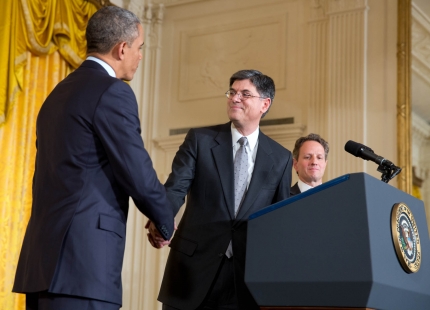
President Barack Obama announces Chief of Staff Jack Lew is his nominee for Treasury Secretary to replace Timothy Geithner, right, in the East Room of the White House, Jan. 10, 2013. (Official White House Photo by Chuck Kennedy)

Today, in an event President Obama nominated Jacob Lew -- the current White House chief of staff -- to serve as the next Treasury Secretary.

"Over the past year, I’ve sought Jack’s advice on virtually every decision that I’ve made, from economic policy to foreign policy," the President said.

Jack Lew has decades of experience tackling some of the nation's toughest economic challenges. As director of the Office of Management and Budget under President Clinton, Lew helped to negotiate the deal that balanced the federal budget -- and led to a budget surplus. In the Obama Administration, even before becoming chief of staff, he has helped to manage the day-to-day operations at the State Department and shepherd through the Budget Control Act to reduce federal spending in a second stint at OMB.

"One reason Jack has been so effective in this town is because he is a low-key guy who prefers to surround himself with policy experts rather than television cameras," said President Obama. "And over the years, he’s built a reputation as a master of policy who can work with members of both parties and forge principled compromises."

The President also offered his gratitude to his current Treasury Secretary, Timothy Geithner -- who helped to guide the country through the financial crisis and get the economy growing again.

"When the history books are written," he said, "Tim Geithner is going to go down as one of our finest Secretaries of the Treasury." 

Read the full remarks here, or watch the video of the event

Related Topics: Economy

President Obama Nominates Jack Lew for Secretary of the Treasury

January 10, 2013 | 14:48 | Public Domain

President Obama announces Jack Lew as his nominee to replace Tim Geithner as Treasury Secretary.

Download mp4 (552MB) | mp3 (36MB)

Read the Transcript

Remarks by the President in Nomination of Secretary of the Treasury

East Room

1:40 P.M. EST

THE PRESIDENT:  Good afternoon, everybody.  Please have a seat.  A little more than four years ago, I stood with Mr. Tim Geithner and announced him as my first nominee to my Cabinet.  We were barely two months into the financial crisis.  The stock market had cratered.  The housing market had cratered as well.  Bank after bank was on the verge of collapse.  And worst of all, more than 800,000 Americans would lose their jobs in just that month.  And the bottom was not yet in sight.

So I couldn’t blame Tim when he tried to tell me he wasn’t the right guy for the job.  (Laughter.)  But I knew that Tim’s extensive experience with economic policy made him eminently qualified, and I also knew that he could hit the ground running.  As Chairman of the New York Federal Reserve, he had just spent several sleepless and chaotic weeks immersed in the complexities of the crisis, and had been working closely with his Republican predecessor at Treasury to save the financial system.

Then, with the wreckage of our economy still smoldering and unstable, I asked Tim to help put it back together.  And thanks in large part to his steady hand, our economy has been growing again for the past three years, our businesses have created nearly 6 million new jobs.  The money that we spent to save the financial system has largely been paid back.  We’ve put in place rules to prevent that kind of financial meltdown from ever happening again.  An auto industry was saved.  We made sure taxpayers are not on the hook if the biggest firms fail again.  We’ve taken steps to help underwater homeowners come up for air, and open new markets to sell American goods overseas.  And we’ve begun to reduce our deficit through a balanced mix of spending cuts and reforms to a tax code that at the time that we both came in was too skewed in favor of the wealthy at the expense of middle-class Americans.

So when the history books are written, Tim Geithner is going to go down as one of our finest Secretaries of the Treasury.  (Applause.)

All right, don't embarrass him.  (Laughter.) 

On a personal note, Tim has been a wonderful friend and a dependable advisor throughout these last four years.  There’s an unofficial saying over at Treasury -- “no peacocks, no jerks, no whiners.”  That would be a good saying for all of Washington -- (laughter) -- "no peacocks, no jerks, no whiners."  Few embody that ideal better than Tim Geithner.  That’s why, when Tim was thinking about leaving a couple of years ago -- (laughter) -- I had to personally get on my knees with Carole to help convince him to stay on a little bit longer.  And I could not be more grateful to Carole and the entire Geithner family for allowing him to make the sacrifices that so many of our Cabinet members ask of their families in serving the country.

The fact is, while a lot of work remains, especially to rebuild a strong middle class and offer working folks new pathways to rise into the middle class, our economy is better positioned for tomorrow than most of those other countries hit by the financial crisis.  The tough decisions Tim made and carried out deserve a lot of credit for that.  So I understand that Tim is ready for a break.  Obviously, we're sad to see him go.  But I cannot think of a better person to continue Tim's work at Treasury than Jack Lew.

This is bittersweet not only because Tim is leaving, but also because Jack has been my Chief of Staff for the last year.  He was my budget director before that.  I trust his judgment.  I value his friendship.  I know very few people with greater integrity than the man to my left.  And so I don’t want to see him go because it's working out really well for me to have him here in the White House.  But my loss will be the nation’s gain. 

Jack has the distinction of having worked -- and succeeded -- in some of the toughest jobs in Washington and the private sector.  As a congressional staffer in the 1980s, he helped negotiate the deal between President Reagan and Tip O’Neill to save Social Security.  Under President Clinton, he presided over three budget surpluses in a row.  So for all the talk out there about deficit reduction, making sure our books are balanced, this is the guy who did it -- three times.  He helped oversee one of our nation’s finest universities and one of our largest investment banks. 

In my administration, he has managed operations for the State Department and the budget for the entire executive branch.  And over the past year, I’ve sought Jack’s advice on virtually every decision that I’ve made, from economic policy to foreign policy.

One reason Jack has been so effective in this town is because he is a low-key guy who prefers to surround himself with policy experts rather than television cameras.  And over the years, he’s built a reputation as a master of policy who can work with members of both parties and forge principled compromises. 

And maybe most importantly, as the son of a Polish immigrant, a man of deep and devout faith, Jack knows that every number on a page, every dollar we budget, every decision we make has to be an expression of who we wish to be as a nation, our values.  The values that say everybody gets a fair shot at opportunity and says that we expect all of us to fulfill our individual obligations as citizens in return.  So Jack has my complete trust.  I know I'm not alone in that. 

In the words of one former senator, “Having Lew on your team is the equivalent as a coach of having the luxury of putting somebody at almost any position and knowing he will do well.”  And I could not agree more.  So I hope the Senate will confirm him as quickly as possible. 

I want to personally thank both of these men and their families, especially Carole and Ruth, for their extraordinary service to our country.

And with that, I'd like to invite them to say a few words, starting with Tim. 

SECRETARY GEITHNER:  Mr. President, it's been a privilege to serve you.  I'm honored and grateful that you asked me to do this, really I am.  And I'm very proud of what my colleagues at Treasury and your economic team was able to help you accomplish these first four years. 

When you stepped into this building as President, you were confronted with a world in crisis, the worst crisis in generations.  And you made the necessary, the hard, the politically perilous choices that saved the American people, saved American industry, saved the global economy from a failing financial system.  And your successful response to the crisis of course did not solve all the nation's challenges.  It could not have done so.  But the actions you took along with those of a forceful and creative Federal Reserve have made the country stronger and have put us in a much better position to face the many challenges still ahead of us -- and they are many.

I have the greatest respect for Jack Lew.  I know him as a man of exceptional judgment, calm under pressure, with an extraordinary record of accomplishment and experience over decades spent at the center of American economic policy.  He's committed to defending the safety net for the elderly and the poor.  He understands what it takes to create the conditions for stronger economic growth and broader economic opportunity.  And he understands that to govern responsibly is to govern with a recognition that we have limited fiscal resources. 

Now, like Jack, I've spent my professional life in this world of public policy and public service.  And as all of you know, our families carry a large share of the burdens we assume in public life.  And I feel incredibly fortunate that my wife Carole and my family have been willing to allow me to do this.  And I thank them for their support and their patience.  And I understand their occasional impatience.  (Laughter.)

I want to express my admiration and my appreciation for the women and the men of the Treasury Department.  Those who came to serve you these years of crisis and the civil servants of the Treasury with whom I first started working in 1988, they are exceptionally talented and honorable public servants.  I'm very proud of what they have helped you accomplish.  And I am confident that my successor will find them the extraordinary asset they are to the nation.

And I also hope that Americans will look at the challenges we face today and decide, as many of you in this room have, that in spite of the divisive state of our political system today that serving your country is compelling and rewarding work.  That was my experience, and I am grateful and will always be grateful to you for having given me the opportunity to serve you as the 75th Secretary of the Treasury.  (Applause.)

MR. LEW:  Mr. President, it has been my honor to serve as your Chief of Staff and before that at OMB and the State Department.  It’s really been a privilege to come to work every day as part of a team that’s dedicated to building a sound economy and a safer world.

Tim, you have been a friend and a colleague for many years -- actually, decades -- and the American people are better off for your outstanding service.  And I thought I knew you pretty well, but it was only yesterday that I discovered that we both share a common challenge with penmanship.  (Laughter.)  Tim, I join the President and everyone here in wishing you and Carole and your whole family well.

As a kid growing up in Queens, I had dreams of making a difference in the world.  These dreams were nurtured in a home where the gifts of American freedom and opportunity were cherished and never taken for granted, and the responsibility to engage in issues of public concern were part of daily life.  I will always be grateful to my parents for grounding me in the values that have remained central to my personal and professional life.

I grew up professional in the office of Speaker O’Neill, whose compass was always clear and who demanded unvarnished advice on how best to reach the desired destination.  Mr. O’Neill cared little about your age or rank, and only about whether or not you did the hard work to inform the decisions of the day.  And he took a big chance giving a lot of responsibility to a very young man, and for that I’ll always be thankful.

Serving at OMB first under President Clinton and more recently in this administration, I worked with one of the finest teams in the government to execute a responsible fiscal policy while advancing policies to promote economic growth.  I’m delighted to see so many of my friends from OMB here today. 

At the State Department, I worked closely with our great Secretary of State and my friend, Hillary Clinton, to advance our nation’s national security agenda, including our international economic policies.

And as Chief of Staff, I’ve had the pleasure of working with a tremendously talented White House team, which manages policy, politics, communications, and complex operations every day with grace, skill, and loyalty. 

If confirmed, I look forward to joining the Treasury Department, whose people are legendary for their skill and knowledge.  It’s a team that I’ve collaborated with closely over many years and have come to respect greatly.

Finally, thank you to Ruth, Shoshi, Danny, Zahava, and the kids for your endless tolerance with the demands of a schedule that tests all family patience.  And thank you, Mr. President, for your trust, your confidence, and friendship.  Serving in your administration has allowed me to live out those values my parents instilled in me, and I look forward to continuing with the challenges ahead.  (Applause.)

THE PRESIDENT:  These are two outstanding public servants.  I think the only point that I want to make -- leave you with is the fact that I had never noticed Jack’s signature -- (laughter) -- and when this was highlighted yesterday in the press, I considered rescinding -- (laughter) -- my offer to appoint him.  Jack assures me that he is going to work to make at least one letter legible -- (laughter) -- in order not to debase our currency should he be confirmed as Secretary of the Treasury.

Thank you very much, everybody.  (Applause.)

END 
1:56 P.M. EST

Close Transcript

The White House

Office of the Press Secretary

Remarks by the President in Nomination of Secretary of the Treasury

East Room

1:40 P.M. EST

THE PRESIDENT:  Good afternoon, everybody.  Please have a seat.  A little more than four years ago, I stood with Mr. Tim Geithner and announced him as my first nominee to my Cabinet.  We were barely two months into the financial crisis.  The stock market had cratered.  The housing market had cratered as well.  Bank after bank was on the verge of collapse.  And worst of all, more than 800,000 Americans would lose their jobs in just that month.  And the bottom was not yet in sight.

So I couldn’t blame Tim when he tried to tell me he wasn’t the right guy for the job.  (Laughter.)  But I knew that Tim’s extensive experience with economic policy made him eminently qualified, and I also knew that he could hit the ground running.  As Chairman of the New York Federal Reserve, he had just spent several sleepless and chaotic weeks immersed in the complexities of the crisis, and had been working closely with his Republican predecessor at Treasury to save the financial system.

Then, with the wreckage of our economy still smoldering and unstable, I asked Tim to help put it back together.  And thanks in large part to his steady hand, our economy has been growing again for the past three years, our businesses have created nearly 6 million new jobs.  The money that we spent to save the financial system has largely been paid back.  We’ve put in place rules to prevent that kind of financial meltdown from ever happening again.  An auto industry was saved.  We made sure taxpayers are not on the hook if the biggest firms fail again.  We’ve taken steps to help underwater homeowners come up for air, and open new markets to sell American goods overseas.  And we’ve begun to reduce our deficit through a balanced mix of spending cuts and reforms to a tax code that at the time that we both came in was too skewed in favor of the wealthy at the expense of middle-class Americans.

So when the history books are written, Tim Geithner is going to go down as one of our finest Secretaries of the Treasury.  (Applause.)

All right, don't embarrass him.  (Laughter.) 

On a personal note, Tim has been a wonderful friend and a dependable advisor throughout these last four years.  There’s an unofficial saying over at Treasury -- “no peacocks, no jerks, no whiners.”  That would be a good saying for all of Washington -- (laughter) -- "no peacocks, no jerks, no whiners."  Few embody that ideal better than Tim Geithner.  That’s why, when Tim was thinking about leaving a couple of years ago -- (laughter) -- I had to personally get on my knees with Carole to help convince him to stay on a little bit longer.  And I could not be more grateful to Carole and the entire Geithner family for allowing him to make the sacrifices that so many of our Cabinet members ask of their families in serving the country.

The fact is, while a lot of work remains, especially to rebuild a strong middle class and offer working folks new pathways to rise into the middle class, our economy is better positioned for tomorrow than most of those other countries hit by the financial crisis.  The tough decisions Tim made and carried out deserve a lot of credit for that.  So I understand that Tim is ready for a break.  Obviously, we're sad to see him go.  But I cannot think of a better person to continue Tim's work at Treasury than Jack Lew.

This is bittersweet not only because Tim is leaving, but also because Jack has been my Chief of Staff for the last year.  He was my budget director before that.  I trust his judgment.  I value his friendship.  I know very few people with greater integrity than the man to my left.  And so I don’t want to see him go because it's working out really well for me to have him here in the White House.  But my loss will be the nation’s gain. 

Jack has the distinction of having worked -- and succeeded -- in some of the toughest jobs in Washington and the private sector.  As a congressional staffer in the 1980s, he helped negotiate the deal between President Reagan and Tip O’Neill to save Social Security.  Under President Clinton, he presided over three budget surpluses in a row.  So for all the talk out there about deficit reduction, making sure our books are balanced, this is the guy who did it -- three times.  He helped oversee one of our nation’s finest universities and one of our largest investment banks. 

In my administration, he has managed operations for the State Department and the budget for the entire executive branch.  And over the past year, I’ve sought Jack’s advice on virtually every decision that I’ve made, from economic policy to foreign policy.

One reason Jack has been so effective in this town is because he is a low-key guy who prefers to surround himself with policy experts rather than television cameras.  And over the years, he’s built a reputation as a master of policy who can work with members of both parties and forge principled compromises. 

And maybe most importantly, as the son of a Polish immigrant, a man of deep and devout faith, Jack knows that every number on a page, every dollar we budget, every decision we make has to be an expression of who we wish to be as a nation, our values.  The values that say everybody gets a fair shot at opportunity and says that we expect all of us to fulfill our individual obligations as citizens in return.  So Jack has my complete trust.  I know I'm not alone in that. 

In the words of one former senator, “Having Lew on your team is the equivalent as a coach of having the luxury of putting somebody at almost any position and knowing he will do well.”  And I could not agree more.  So I hope the Senate will confirm him as quickly as possible. 

I want to personally thank both of these men and their families, especially Carole and Ruth, for their extraordinary service to our country.

And with that, I'd like to invite them to say a few words, starting with Tim. 

SECRETARY GEITHNER:  Mr. President, it's been a privilege to serve you.  I'm honored and grateful that you asked me to do this, really I am.  And I'm very proud of what my colleagues at Treasury and your economic team was able to help you accomplish these first four years. 

When you stepped into this building as President, you were confronted with a world in crisis, the worst crisis in generations.  And you made the necessary, the hard, the politically perilous choices that saved the American people, saved American industry, saved the global economy from a failing financial system.  And your successful response to the crisis of course did not solve all the nation's challenges.  It could not have done so.  But the actions you took along with those of a forceful and creative Federal Reserve have made the country stronger and have put us in a much better position to face the many challenges still ahead of us -- and they are many.

I have the greatest respect for Jack Lew.  I know him as a man of exceptional judgment, calm under pressure, with an extraordinary record of accomplishment and experience over decades spent at the center of American economic policy.  He's committed to defending the safety net for the elderly and the poor.  He understands what it takes to create the conditions for stronger economic growth and broader economic opportunity.  And he understands that to govern responsibly is to govern with a recognition that we have limited fiscal resources. 

Now, like Jack, I've spent my professional life in this world of public policy and public service.  And as all of you know, our families carry a large share of the burdens we assume in public life.  And I feel incredibly fortunate that my wife Carole and my family have been willing to allow me to do this.  And I thank them for their support and their patience.  And I understand their occasional impatience.  (Laughter.)

I want to express my admiration and my appreciation for the women and the men of the Treasury Department.  Those who came to serve you these years of crisis and the civil servants of the Treasury with whom I first started working in 1988, they are exceptionally talented and honorable public servants.  I'm very proud of what they have helped you accomplish.  And I am confident that my successor will find them the extraordinary asset they are to the nation.

And I also hope that Americans will look at the challenges we face today and decide, as many of you in this room have, that in spite of the divisive state of our political system today that serving your country is compelling and rewarding work.  That was my experience, and I am grateful and will always be grateful to you for having given me the opportunity to serve you as the 75th Secretary of the Treasury.  (Applause.)

MR. LEW:  Mr. President, it has been my honor to serve as your Chief of Staff and before that at OMB and the State Department.  It’s really been a privilege to come to work every day as part of a team that’s dedicated to building a sound economy and a safer world.

Tim, you have been a friend and a colleague for many years -- actually, decades -- and the American people are better off for your outstanding service.  And I thought I knew you pretty well, but it was only yesterday that I discovered that we both share a common challenge with penmanship.  (Laughter.)  Tim, I join the President and everyone here in wishing you and Carole and your whole family well.

As a kid growing up in Queens, I had dreams of making a difference in the world.  These dreams were nurtured in a home where the gifts of American freedom and opportunity were cherished and never taken for granted, and the responsibility to engage in issues of public concern were part of daily life.  I will always be grateful to my parents for grounding me in the values that have remained central to my personal and professional life.

I grew up professional in the office of Speaker O’Neill, whose compass was always clear and who demanded unvarnished advice on how best to reach the desired destination.  Mr. O’Neill cared little about your age or rank, and only about whether or not you did the hard work to inform the decisions of the day.  And he took a big chance giving a lot of responsibility to a very young man, and for that I’ll always be thankful.

Serving at OMB first under President Clinton and more recently in this administration, I worked with one of the finest teams in the government to execute a responsible fiscal policy while advancing policies to promote economic growth.  I’m delighted to see so many of my friends from OMB here today. 

At the State Department, I worked closely with our great Secretary of State and my friend, Hillary Clinton, to advance our nation’s national security agenda, including our international economic policies.

And as Chief of Staff, I’ve had the pleasure of working with a tremendously talented White House team, which manages policy, politics, communications, and complex operations every day with grace, skill, and loyalty. 

If confirmed, I look forward to joining the Treasury Department, whose people are legendary for their skill and knowledge.  It’s a team that I’ve collaborated with closely over many years and have come to respect greatly.

Finally, thank you to Ruth, Shoshi, Danny, Zahava, and the kids for your endless tolerance with the demands of a schedule that tests all family patience.  And thank you, Mr. President, for your trust, your confidence, and friendship.  Serving in your administration has allowed me to live out those values my parents instilled in me, and I look forward to continuing with the challenges ahead.  (Applause.)

THE PRESIDENT:  These are two outstanding public servants.  I think the only point that I want to make -- leave you with is the fact that I had never noticed Jack’s signature -- (laughter) -- and when this was highlighted yesterday in the press, I considered rescinding -- (laughter) -- my offer to appoint him.  Jack assures me that he is going to work to make at least one letter legible -- (laughter) -- in order not to debase our currency should he be confirmed as Secretary of the Treasury.

Thank you very much, everybody.  (Applause.)

END 
1:56 P.M. EST

The White House

Office of the Press Secretary

Statement by the Press Secretary on Bills Signed on January 10, 2013

Statement by the Press Secretary on H.R. 1339, H.R. 1845, H.R. 2338, H.R. 3263, H.R. 3641, H.R. 3869, H.R. 3892, H.R. 4053, H.R. 4057, H.R. 4073, H.R. 4389, H.R. 5859, H.R. 6014, H.R. 6260, H.R. 6379, H.R. 6587, H.R. 6620, H.R. 6671, S. 925, S. 3202, S. 3666 and S.J. Res. 49


On Thursday, January 10, 2013, the President signed into law:

H.R. 1339, which designates the City of Salem, Massachusetts, as the birthplace of the U.S. National Guard;

H.R. 1845, the "Medicare IVIG Access and Strengthening Medicare and Repaying Taxpayers Act of 2012," which establishes a demonstration project to evaluate the benefits of allowing Medicare Part B coverage for in-home intravenous treatments for patients with primary immune deficiency disease; and amends certain rules under which Medicare is a secondary payer to specified third party payers;

H.R. 2338, which designates the facility of the United States Postal Service in Cocoa, Florida as the Harry T. and Harriette Moore Post Office;

H.R. 3263, the "Lake Thunderbird Efficient Use Act of 2012," which authorizes the Secretary of the Interior to allow the storage and conveyance of non-project water at the Norman Project in Oklahoma;

H.R. 3641, the "Pinnacles National Park Act," which redesignates the Pinnacles National Monument in California, as the Pinnacles National Park;

H.R. 3869, which designates the facility of the United States Postal Service in Little Rock, Arkansas as the Sidney "Sid" Sanders McMath Post Office Building;

H.R. 3892, which designates the facility of the United States Postal Service in Roseville, California as the Lance Corporal Victor A. Dew Post Office;

H.R. 4053, the "Improper Payments Elimination and Recovery Improvement Act of 2012," which clarifies requirements for Federal agencies to use improper payment information to determine program or award eligibility; establishes a Do Not Pay Initiative; and expands OMB responsibilities in the effort to eliminate and recover improper payments;

H.R. 4057, which requires the Department of Veterans Affairs to establish a comprehensive policy for providing information regarding higher education and training programs to veterans and members of the Armed Forces;

H.R. 4073, which authorizes the Secretary of Agriculture to accept a railroad right of way within and adjacent to the Pike National Forest in Colorado;

H.R. 4389, which designates the facility of the United States Postal Service in Fowler, California as the Cecil E. Bolt Post Office;

H.R. 5859, which repeals the requirement that the Department of Transportation prescribe regulations to require automobile dealers to provide insurance cost comparison information to prospective buyers; and requires the Department to report to Congress on the most useful way to provide consumers with information on the susceptibility of automobiles to damage;

H.R. 6014, the "Katie Sepich Enhanced DNA Collection Act of 2012," which authorizes the Justice Department to carry out a grant program to assist States with the first-year costs associated with the implementation of a process to collect DNA from individuals who are arrested for or charged with certain criminal offenses under State law;

H.R. 6260, which designates the facility of the United States Postal Service as the Lieutenant Kenneth M. Ballard Memorial Post Office;

H.R. 6379, which designates the facility of the United States Postal Service in Ravenel, South Carolina as the Representative Curtis B. Inabinett, Sr. Post Office;

H.R. 6587, which designates the facility of the United States Postal Service in Simi Valley, California as the Postal Inspector Terry Asbury Post Office Building;

H.R. 6620, the "Former Presidents Protection Act of 2012," which restores lifetime Secret Service protection of former Presidents who did not serve as President prior to January 1, 1997, and their spouses; and provides for protection of all children of former Presidents until they become 16 years of age;

H.R. 6671, the "Video Privacy Protection Act Amendments Act of 2012," which allows the informed, written consent that a video tape service provider must receive from a consumer in order to be authorized to disclose personally identifiable information to a third party to also be obtained using the Internet; and specifies that the consent would have to be either given at the time the disclosure is sought or given in advance for a set period of time of up to two years or until the consumer withdraws the consent, whichever is sooner;

S. 925, the "Mt. Andrea Lawrence Designation Act of 2011," which designates "Mt. Andrea Lawrence" in the Inyo National Forest and Yosemite National Park; 

S. 3202, the "Dignified Burial and Other Veterans' Benefits Improvement Act of 2012," which amends authorities of the Department of Veterans Affairs related to: cemetery matters; health care; and miscellaneous matters;

S. 3666, which amends the Animal Welfare Act to modify the definition of "exhibitor"; and

S.J. Res. 49, which appoints Barbara Barrett as a citizen regent of the Board of Regents of the Smithsonian Institution.