The White House
Office of the Press Secretary
The White House
Office of the Press Secretary
The White House
Office of the Press Secretary
Over her long career in public service – as an advocate for environmental justice in California, state legislator, member of Congress and Secretary of Labor - Hilda Solis has been a tireless champion for working families. Over the last four years, Secretary Solis has been a critical member of my economic team as we have worked to recover from the worst economic downturn since the Great Depression and strengthen the economy for the middle class. Her efforts have helped train workers for the jobs of the future, protect workers’ health and safety and put millions of Americans back to work. I am grateful to Secretary Solis for her steadfast commitment and service not only to the Administration, but on behalf of the American people. I wish her all the best in her future endeavors.
The White House
Office of the Press Secretary
James S. Brady Press Briefing Room
12:56 P.M. EST
MR. CARNEY: Good afternoon, ladies and gentlemen. Thank you for being here. Before I start, it is amazing, in today’s era of lightning communications, how this already seems to be a moment that's passing, but it is worth pausing to remember, perhaps in my mind, the greatest political journalist ever, and that's Richard Ben Cramer.
When I got to Washington in 1993, in the spring of that year, from Moscow, a colleague of mine handed me that book -- it has come out the year before -- as I began to cover politics, and it was the best read imaginable. And if there’s anyone in this room who has not read “What It Takes,” you should run out and buy it now. Do a favor to his wife and daughter and actually buy it, don't borrow it, because it is a remarkable book.
And what’s remarkable about it -- it’s funny because when I got the job to work with the Vice President, I reread the chapters on Senator Biden from his campaign in 1988, and it is a series of portraits of men, in this case, running for the highest office in the land, and they are all affectionate portraits. They are appreciative of each individual -- their qualities and their failings -- but everything is done with great affection for the process and the individuals. It’s a joy to read, so if you haven’t already, go get it.
With that, I'll take your questions.
Q Thanks, Jay, and thanks for the appreciation for one of our brethren.
Two questions. Regarding yesterday’s nomination of John Brennan to be CIA director, Senator Lindsey Graham today issued a statement saying, “I do not believe we should confirm anyone as director of the CIA until our questions are answered, like who changed Ambassador Susan Rice’s talking points and deleted a reference to al Qaeda.” I think Major took a stab at that question back in November, and I wondered if we could revisit it. One, does that stand in the way of Brennan’s confirmation? Two, can you answer the question that Graham has raised?
MR. CARNEY: I'll start with number two first. This question was answered, I believe, in briefings on the Hill. Secondly, because the process was one of declassifying classified information and in that process the talking points that were provided to Ambassador Rice, to members of Congress, and to others including myself in the executive branch, were written in the way that was presented by Ambassador Rice.
On the first point, it would be unfortunate I think if in pursuit of this issue, which was highly politicized, the Senate would hold up the nomination of John Brennan to be Director of the Central Intelligence Agency. As the President said yesterday, that post as well as the positions of Secretary of Defense, Secretary of State, these are essential positions that need to be filled if possible without delay. And that is why he called on the Senate to act promptly to hold the necessary confirmation hearings and to give each nominee a fair hearing and then a vote. We certainly hope that that happens.
I think while it's not worth going into in great detail, we certainly discussed a lot last year, late in the year, the essential irrelevance of the issue of what was said on a series of Sunday shows to what actually happened in Benghazi. And this President is committed to ensuring that those who were responsible for the deaths of four Americans in Libya be brought to justice. There is an FBI-led investigation with that as its goal.
And there has been a process ordered by the President, overseen by the Secretary of State, an independent Accountability Review Board, led by Ambassador Pickering and Admiral Mullen, that produced an unsparing assessment of diplomatic security both in Benghazi and broadly, and that included a series of recommendations which the Secretary of State and the President of the United States accepted entirely and which are already being implemented. And the President is focused on those issues, not what seems to be the continued political fascination with appearances on Sunday shows.
Q Second point, I wanted to pick up where you left off yesterday on fiscal issues. I wonder what lessons did the President take away from his discussions in December? When does he expect to reengage with Congress to if not deal with the debt ceiling, at least negotiate over the sequester? And do you guys expect Senator McConnell rather than Boehner -- Speaker Boehner to be your dance partner in coming negotiations?
MR. CARNEY: The President said not too many days ago, when the agreement on the fiscal cliff was passed by both houses of Congress overwhelmingly, that he would continue to seek to compromise with Congress when it came to achieving a balanced approach for continued deficit reduction. And he will do that.
Congress is not here, as you know, but he looks forward to working with Congress in good faith to continue the work that's already begun, and that began with the Budget Control Act and the $1.1 trillion in spending cuts signed into law by this President; that continued with the agreement on the so-called fiscal cliff just last week that achieved significant deficit reduction through revenues, and enshrines into law the principle that we need to move forward in a balanced way as we seek further deficit reduction.
As I said yesterday, the President has said and others have said he will not negotiate with Congress when it comes to the essential responsibility of Congress to pay the bills that Congress has incurred. It would be irresponsible to flirt with default. We saw what happened in the summer of 2011 when Congress did flirt with default, when House Republicans in particular used that as an issue to try to achieve some political objectives and just the mere flirtation with default caused severe economic harm, which I spelled out yesterday.
Q What's the window -- the timing window that the President sees? I mean, the fiscal cliff deal bought you two months for the sequester; speculation that the debt ceiling could be hit by February 15th and March 1st. So when does the President want to start those talks and when does he think they need to be completed and in place?
MR. CARNEY: Well, again, I would separate the debt ceiling from negotiations over eliminating the sequester. The fact is we have two months because of the fiscal cliff agreement, and that is not a great deal of time, and the President will, and the White House will, engage with Congress on those matters in I think the relatively near term.
But when it comes to the debt ceiling, as I said yesterday, we expect Congress to do its job. The President expects that Congress will fulfill its essential responsibility to pay the bills that Congress has incurred. And remember, this is a responsibility that Congress assigned to itself in order to try to get Congress to spend less and be more focused on deficit reduction. So this is -- Congress has the power that it assigned itself to raise the debt ceiling, and it should do so, because the alternative is obviously unacceptable.
And that’s something I think you remember from the period in 2011. Both Senator McConnell and Speaker Boehner at the time said they would not let the United States default, with all the consequences that would ensue, and we hope that Congress wouldn’t let that happen again.
Yes.
Q Thanks, Jay. Just a couple questions. First one is, given the fiscal hurdles that are still looming, has the President asked or is he considering asking Treasury Secretary Geithner to stay on beyond January? And if not, when can we expect the nomination of a successor?
MR. CARNEY: I think Secretary Geithner has expressed his timetable for departing after his service as Treasury Secretary, which has been much appreciated by the President. His record, I think four years on now, reflects some very gutsy decisions that were made by the President on the advice of the Secretary of the Treasury that helped prevent a far worse economic crisis than we endured. I think if you look at the state of the American economy, the fact is while we are not growing as much as we want, we are not creating jobs as fast as we would like, we are doing far better than a number of other countries that endured the fiscal crisis and economic crisis of 2008, 2007, 2009. And that is in part because of some of the very tough calls made by this President and this Treasury Secretary.
I don’t have a timetable for any other personnel announcements, but I have no new information or any change in information on Secretary Geithner’s departure.
Q Okay. Another subject -- AIG says its board will meet tomorrow to discuss whether to join a lawsuit filed against the government alleging that the massive bailout of the company was unfair. It’s been compared to a patient suing their doctor for saving their life. What’s the administration’s response to this?
MR. CARNEY: Well, I won’t comment on a lawsuit that’s pending. I would refer you to the Department of Justice. But I will step back, and this, I think, contextually fits into my answer about Secretary Geithner’s time as Treasury Secretary, and that is to note that the U.S. government acted in a bipartisan fashion to prevent the disorderly failure of AIG after concluding that such a failure would have caused catastrophic damage to the economy and financial system. Again, the action was taken because the failure would have done such great harm to the American economy, to the American financial system, and to the American people.
Because of the successful management of taxpayer dollars by the government and the company’s restructuring efforts, the company recently fully repaid taxpayers with a profit. The overall positive return on the Federal Reserve and Treasury’s combined $182 billion commitment to stabilize AIG during the financial crisis is now $22.7 billion. Again, that’s $22.7 billion in profit.
It is also worth remembering, in response to a question like this, that thanks to the action of the President, thanks to the action of the administration and Congress, an action like the kind that was taken to deal with AIG’s potential disorderly failure, however necessary during the financial crisis, should not happen again, and that’s why this President pursued Wall Street reform. And that’s why it is essential to continue to move forward with the implementation of that reform.
Q So would you urge AIG’s board to just drop the --
MR. CARNEY: Again, I will not comment on a pending lawsuit.
Q Is the President aware of the suit?
MR. CARNEY: I haven’t discussed it with him, but I will not comment on a pending lawsuit.
Dan.
Q Thanks. Can you tell us what kind of progress the Biden gun group, if you will, is making? Do they give the President frequent updates? And also, is the NRA part of this process?
MR. CARNEY: Well, let me say a few things about that. The Vice President, at the President’s request, is overseeing a process that is engaging a variety of stakeholders -- organizations and individuals -- to look broadly at the problem of gun violence in America and to consider actions that could be taken at both the legislative level and elsewhere. As I think has been reported, the process is ongoing. The Vice President’s effort -- the Vice President has had several meetings and conversations so far, and he will have many more before presenting his recommendations to the President.
As for the President’s involvement, the President assigned the Vice President to this task, asked him to do it. And as you know and saw just at the end of last month, the President and the Vice President spent a lot of time together and they will continue to spend a lot of time together, and I am sure, as they do that, that this topic will come up and the Vice President will have the opportunity to informally brief the President on the progress of this effort. And then, when the Vice President is ready to present a series of recommendations to the President, the President will consider them and then make decisions about how to proceed.
Q And is the NRA part of these discussions?
MR. CARNEY: We have invited -- the Vice President’s group has invited a number of organizations and individuals to participate in meetings. They include gun owners and -- groups that represent gun owners, groups that represent sportsmen and sportswomen. The NRA has certainly been one of the groups -- one of the many groups invited. I would leave it to those groups themselves to decide whether to say -- to make any comment on their attendance in those meetings.
Q The NRA says they will be here on Thursday in that meeting. So what is the message that Vice President Biden or this administration will say to the NRA in their first face-to-face conversation, given the only conversations the NRA has had with the public has been a public statement and then “Meet the Press”?
MR. CARNEY: Well, I think as the President said, he doesn’t want to prejudge any recommendations that any stakeholder might present. He did in his “Meet the Press” interview respond to a question about the specific recommendation that the NRA had made by saying that he was skeptical that putting more guns in schools would solve this problem. But again, we look forward to hearing from a variety of organizations and civic groups and others who have insights into this problem.
Q The NRA says it’s here to hear what the White House has to say. So if you guys are here to listen to them, and they’re here to listen to you, and you guys are --
MR. CARNEY: Well, the process is designed to get input. And the Vice President’s group will assess different actions, make recommendations, and the President will decide what he would like to pursue, what he believes is the right course of action, in addition to what he has already called on Congress to do, which is pass the assault weapons ban, pass legislation that would ban high-capacity magazines, pass a bill that would close loopholes in our background check system. Those are things that Congress could move on very quickly, and the President urges them to do so.
Q On the nomination process, I know you didn’t want to spell out anything about who would take over Treasury, but has the President settled on who he wants to fill not only Treasury but also Commerce, EPA, these high-profile roles? Has he settled on these names, or is he still sifting through some top choices?
MR. CARNEY: Well, Dan, as you know, I refrain from commenting on the process of the selection of nominees and don't give updates on the status of the search or short lists, long lists, speculation about individual nominees. I would simply say that the President is obviously engaged in a process that will lead to decisions on who should fill posts that are vacant, and as was the case this week with the Defense Department and the CIA, and prior to that, the State Department, he will make announcements when he’s made a decision.
Q I know you touched on this a little bit yesterday, but is diversity a consideration as the President goes through this process?
Q Check your binder for that. (Laughter.)
MR. CARNEY: I can say that, as I did yesterday, that the President values diversity, believes it’s important because it enhances the quality of the pool of potential nominees for positions across the administration. He believes that by looking broadly for candidates for offices that he ups the chances that he’ll find the very best person for the job. And I think that the diversity of his administration both at the Cabinet level and here at the White House and elsewhere reflects a process that was designed to allow him to find the very best candidates. And he thinks that diversity enhances the process itself, the policy process, because it sort of increases the likelihood of a broader discussion potentially.
But the goal in the end is to find the very best individuals for these specific positions. And he feels he has done that with Secretary Hagel, with John Brennan, with Senator Kerry -- I think I said “Secretary Hagel” -- getting ahead of myself -- Senator Hagel. And that will be what guides him as he makes further decisions.
Q Here’s one more on guns.
MR. CARNEY: Sure.
Q The President has talked about this with some urgency in the past, saying he’s not going to wait around. Is this something -- the longer you get away from a tragedy, the less interest there is in gun control efforts that's happened in the past? Is this something that the President is going to push very hard right out of the ¬--
MR. CARNEY: I think you heard the President say that he expected and had asked the Vice President to report back to him this month. I think that demonstrates the speed with which the President hopes to act.
Now, even prior to the action under the work of the Vice President’s group, the President has already called on Congress and will continue to call on Congress to take action on specific pieces of legislation that either already exists or could easily come together, and which some members of Congress have expressed an interest in pursuing.
So he is mindful of the need to act. He is also mindful of the need to have a process in place, led by the Vice President, that allows for consideration of a variety of ideas, because he’s made the point that this is not a problem that can be solved by gun legislation alone. It is not a problem that can be solved by any specific action or single action that the government might take. It’s a problem that encompasses issues of mental health, of education, as well as access to guns. And that’s why he’s asked the Vice President to undertake the effort that he’s undertaking.
Ann.
Q Thank you, Jay. On the inauguration, presumably the President has begun work on an inaugural address. Will he also this year give a State of the Union address? How would the two differ? Can you bring us up to speed on what he’s doing on the inaugural?
MR. CARNEY: Well, the President, as you know, looks forward -- or as you would expect, looks forward to the privilege of delivering his second inaugural address. I have no content to preview for you. I would expect --
Q Has he started --
MR. CARNEY: Yes, he certainly has. And I would expect that -- or you should expect that he will also deliver a State of the Union address.
Q But how would they differ? Both of them looking forward? And would any of the gun violence legislation or initiatives be ready in time to be included in either one?
MR. CARNEY: I would rather not preview either of these speeches. I’ll leave it to the President to do that when he delivers them. I think that these are different occasions that have historically sort of demanded different types of addresses. But as you know, the President takes the writing of these speeches quite seriously, and I would not preview or prejudge the outcome of that process.
Q At his first inaugural, the President signed several executive orders within, what, an hour or so of taking the oath of office. This time there’s no need to do that since he can do it any time. But does he plan anything of substance in addition to the inaugural address, any action that he would likely be taking on?
MR. CARNEY: On his first day in office? Again, I would ask you -- or ask for your patience to wait for any announcements that we might have along those lines. I’m not suggesting that there might be because you rightly note that he’s already President, but I’m not going to preview anything that far in advance.
Q Lately when you’ve been listing the various elements of dealing with gun violence, you have not mentioned either cultural issues or violent video games and movies. The President did the very first time. You did for a while. But that sort of dropped off the radar screen. I wonder if that’s reflective of internal conversations with the Vice President, you no longer -- the President no longer thinks that’s a part of the equation any longer and is not looking for initiatives or ideas to deal with that.
MR. CARNEY: No, if that has been conveyed, it should not have been. In fact, I should note that I can tell you that this week the Vice President will be meeting on Wednesday with victims groups as well as gun safety organizations; on Thursday with advocates for sportsmen and women, and then separately with gun ownership groups. This is the meeting that we discussed. This week he will also meet -- his group will also meet with representatives of the entertainment and video game industries.
Also, Secretary Duncan will meet with representatives from parent, teacher, and education groups. Secretary Sebelius will meet with mental health and disability advocates. And senior White House staff have also held and will continue to hold meetings with a variety of stakeholders, including medical groups, community organizations, child and family advocates, business owners, faith leaders, and others.
So to your question, one of the meetings this week will be with representatives of the entertainment and video game industries.
Q In the “Meet the Press” interview, the President said something to the effect of the American people are going to have to make this happen, on the question specifically of gun control. And in the minds of those who are pressing the legislation, that made them feel a little bit nervous that the President was sort of handing over at least part of the responsibility for this, maybe drawing back a little bit for his personal advocacy. Obviously, the things you’ve laid out today suggest otherwise. I want to know if you wanted to refer back --
MR. CARNEY: I would simply say that the President is noting a reality that I think applies not just to issues of gun control legislation, but economic or budget legislation. It is very important for the public to be engaged in these issues, and for the public's voice to be heard in Washington. And public opinion can help propel issues forward and compel Congress to act when it comes to legislative matters.
There is also an element here that I think transcends or is separate from legislative action that also involves raising public awareness and raising the voices of the American people who want to see change -- change that would help reduce gun violence in America, change that would help prevent the kinds of horrendous acts of violence that we saw last year in Connecticut and Colorado and elsewhere.
So I think it's just a recognition of the role that the public plays in all of these major issues. It is not -- a participatory democracy is not -- the participation is not just limited to the vote you cast on an Election Day, but is, or can be, or should be year round. And the President has I think demonstrated his belief that that is an effective way to get things done, and this is another case where he believes that’s the right way to go.
Q On the sequester, during the negotiations the administration pushed for a year delay of the limitation of the sequester. You obviously got two months. Republicans report that that was a much higher priority for the administration to avoid it than it was for them. First of all, do you accept that premise that the administration was much more nervous about delaying the implementation of the sequester than Republicans, where they were more comfortable with it, generally, than the administration is?
Secondarily, if the administration is so nervous about the implementation of discretionary cuts, why not be more forceful and more descriptive and more specific about entitlements that would stave that off?
MR. CARNEY: Well, let me address the first assertion, which I think, as the assertion we heard yesterday about a purported disinterest by Republicans in tax incentives for business, I think the idea that Republicans weren't interested in dealing with the sequester conflicts with recent history.
Last year, the Speaker of the House said, "I think the sequester will hurt our Department of Defense, will hurt our ability to do what Americans believe is our most basic responsibility, and that is to provide security for the American people. I believe that Secretary Panetta believes the same thing."
Senator Lindsey Graham, later in the year: "I and others, including Senator Kelly Ayotte from New Hampshire, have been begging the President to sit down with us to avoid what his own Secretary of Defense said would be devastating to national security.” And Senator McCain and others repeatedly, as your colleagues reported on last year, talked about their high concern about the impact of implementation of the sequester, specifically on our defense budget. But as you know, the across-the-board cuts are equally divided between non-defense and defense spending and would be onerous on both sides of that coin.
So if anything, late last year I think you heard more vocal concern about the sequester from Republicans than Democrats -- not that Democrats were less concerned about it but the volume was loudest I think on the Republican side. So it doesn't stand to reason that they suddenly are not interested in dealing with it.
Q And on the entitlement side?
MR. CARNEY: Repeat your question.
Q Well, if you want to delay it, one of the ways to work around it would be to offer up or negotiate a more comprehensive, long-running restructuring of entitlement programs. Republicans have put that on the table -- and that would take off some of the pressure on the discretionary side. Simpson-Bowles, many others looking on the outside say the discretionary side has been squeezed for many years. It was in the BCA. It was before that. Yet entitlements tend not to be. Why not move more of the entitlements up and take some of the pressure off the discretionary side?
MR. CARNEY: What the President said last week and what he said repeatedly before that, and what holds true today, is that he is committed to further deficit reduction in a balanced way. What he will not accept is deficit reduction that is borne solely by -- the burden which is borne solely by seniors, solely by families with disabled children, solely by families trying to send their kids to college or other vulnerable groups.
One of the things that we learned through this process, through the negotiating process and the sort of concurrent communications efforts was that, in fact, specificity when it came to spending cuts could be found more on our side than on theirs. And if the Republicans are suggesting that the answer to the sequester, to the debt ceiling, or any other thing, are simply to slash benefits for seniors, they ought to say so and they ought to provide a specified plan. They know that the President won't accept that.
We have to have balance. And balance means spending cuts; it means entitlement reform and it means tax reform. Tax reform is something that Republicans and Democrats have both expressed keen interest in achieving. Tax reform is something that, according to the Speaker of the House, could produce significant revenue. When coupled with additional spending cuts, that revenue and that savings could further reduce our deficit significantly. And that's certainly what the President hopes to achieve.
Mr. Emanuel, welcome back.
Q Thank you, Jay. The top Senate Republican on the Budget Committee says as part of a deal to raise the debt ceiling the Senate should be forced to pass a budget. Do you have a thought on that?
MR. CARNEY: Again, Congress -- the Senate, the House -- should act to raise the debt ceiling. This is not a deal that the White House -- a negotiation the White House is going to have. It is Congress's responsibility to ensure that the bills Congress racked up are paid.
It's sometimes a useful exercise to look back when you hear the protests and the complaints about deficits and spending from Republicans, especially in the House but also in the Senate, to remember that many of these legislators were in office when the deficits exploded under the previous administration. It's often fun to look at a charge of the deficit, the federal deficit over the years and note that it went down consistently under Democratic President Bill Clinton. It went up again, turning surpluses into deficits, under George W. Bush. And from a high point, because of the economic crisis, it has gone down again under President Obama. That's a trend line.
And the point is that Republicans certainly do not have a corner on the market when it comes to interest in reducing the deficit. The President believes it is necessary to reduce our deficits, to get our fiscal house in order. But he insists that we do it in a fair and balanced way. That's the principle that he took into negotiations over the debt ceiling, his presentation to the super committee. It is the principle that informs his budget proposals. It is the principle that informed the proposals he put forward in his good-faith negotiations with Speaker Boehner in December. And it's the principle he'll carry forth as we continue to deal with our challenges.
Q With $16 trillion and counting, the election is over, some could argue a budget right now is probably more critical than ever -- no?
MR. CARNEY: Well, again, you can address -- those are questions for the Senate. When it comes to -- the presentation of the question was, we will only raise the debt ceiling if this and that happens. Let's just remember what danger awaits the pursuit of that path, the harm that was brought to this economy simply by the flirtation with default in the summer of 2011.
We should and -- we can and should negotiate over how we continue to reduce our deficits in a responsible and balanced way, but we should not play chicken with the full faith and credit of the United States.
Q One other topic, real fast -- reported drone strike today along the AFPAC border region. As you know, Afghan and Pakistani officials have been vocal about their concerns about them possibly killing civilians as opposed to terrorists. What can you say to address their concerns? And can you talk a little bit about the President's thinking when it comes to drone strikes?
MR. CARNEY: I won't talk about anything specific like that. I can tell you that, as John Brennan and others and the President have said, in the effort to battle al Qaeda and other extremist groups, we endeavor to reduce civilian casualties as much as possible. And I think that the broader record here of success in taking the fight to al Qaeda and eliminating al Qaeda leadership and leadership of al Qaeda-affiliated organizations is one that has made the United States safer.
Q If John Brennan is confirmed as CIA director, is it safe to assume the drone program will continue and --
MR. CARNEY: Again, I'm just not going to -- I think that there has been some discussion of the drone program as it relates to the Department of Defense, but I'm not going to get into any further discussion of it from here.
Yes, Peter.
Q There are several looming battles for this White House that will be coming up over the course of the next several months -- the debt ceiling; we have gun control, as we've already addressed here; and now with the nomination of Senator Hagel, there’s the likelihood of a contentious battle, as we heard from members of the Senate, frankly, on both sides. Does this White House have any concern that this fight right now will complicate the ability to --
MR. CARNEY: Which fight? You listed a bunch.
Q I'm saying that the fight over Senator Hagel right now will complicate that for gun control and debt ceiling and other ones where you're going to need bipartisan support?
MR. CARNEY: Well, we fully expect that -- after the fair hearing that Senator McConnell said he hoped Senator Hagel would receive -- that he will be confirmed as the next Secretary of Defense. And we certainly hope and expect that he will be supported by Democrats and Republicans, and that he will then have the opportunity to serve as the first Vietnam veteran and first enlisted serviceman to lead that department.
Look, we have a lot of work to do. And we have disagreements on some fundamental issues with members of Congress. But it is incumbent upon all of us to press forward and confront those challenges and get the work done. That applies to the economy and budget matters, to fiscal matters. It applies to immigration reform, to actions we can take to reduce gun violence, to matters of energy and climate change. These are all things that need to be addressed. And we can't, either here or in Congress, simply say there is too much to be done so we're not going to press forward. We have to press forward with all of it.
Q We heard within the last year that the President says he supports gay marriage. He said at that time that that issue would be worked at the local level. But given the fact that the Supreme Court has now said that it will hear arguments just two months from now, in March, should we expect the President will publicly advocate against Proposition 8, and would he also advocate for same-sex couples to have the right to federal benefits?
MR. CARNEY: Well, let's be clear about a couple of things. For comment on specific Supreme Court cases, I would point you to the Department of Justice. On the issue of DOMA, the Defense of Marriage Act, the administration's position on this is well known and has been, and that’s that the President has determined that Section 3 of DOMA is unconstitutional, and that his administration will no longer defend equal protection challenges against it in the courts. The DOJ has participated in the DOMA cases consistent with that position, and asked the Supreme Court to resolve the questions. So that is the DOMA issue.
On Prop 8, the administrative is not a party to that case, and I have nothing for you on that.
Q Whether he would speak out at --
MR. CARNEY: I have nothing further on that.
Q And then to conclude, Hillary Clinton arrived at the White House a short time ago. This will be the first opportunity for the President to see the Secretary -- outgoing -- soon-to-be-outgoing Secretary of State since her accident. Did they have a chance to speak yet? And how did that conversation go?
MR. CARNEY: Well, they have spoken --
Q Face to face, this will be the first time.
MR. CARNEY: Well, I'm not sure, but you should know that he spoke with her not too many days ago, as well as after her accident, and was keeping tabs on her condition throughout. So this would not be -- when they see each other today, it would not as if they hadn't been --
Q There was no exchange of helmets or something? (Laughter.)
MR. CARNEY: Again, I wasn't there.
Yes.
Q Back to Afghanistan. On the troop levels, reports say the White House is considering keeping between 3,000 and 9,000 U.S. troops in Afghanistan after 2014. Are those numbers accurate?
MR. CARNEY: I have no announcements to make about the pace of the drawdown that will continue, that continues as we speak, after the initial withdrawal of the surge forces, nor do I have any decisions by the President to make regarding post-2014 security arrangements. We've talked about the possibility of assisting -- a counterterrorism effort and assisting in the training of -- for the training of Afghan forces. But beyond that, I have no new numbers to report to you. As we've said in the past, the President is in the process of reviewing proposals, and when he is ready to announce a decision, he'll do that.
Q And is the administrative encouraged by the reports that there's been some progress in the talks involving the Karzai government and the Taliban?
MR. CARNEY: We support, as you know, reconciliation led by the Afghan government with the Taliban, and our position on that hasn't changed. I don't have an assessment to give to you from here of progress being made. I think the Afghan government is a good place to look for that. But we do support it. We believe ultimately that is an essential part of a process that would lead to a more peaceful and stable Afghanistan.
Connie.
Q On Palestine, does the President have a position on the new Palestinian state that Abbas has proclaimed?
MR. CARNEY: Well, we've expressed it many times, the fact that we oppose unilateral actions. We oppose the unilateral action taken by the Palestinians at the United Nations. We believe that when it comes to Middle East peace between the Israelis and Palestinians, it is essential for direct face-to-fact negotiations to resume, and it is essential for each side to refrain from taking unilateral actions that make it more difficult to engage in face-to-face negotiations, and to allow that process to proceed to a point where a sustainable peace is possible. So our position was frequently stated when this was an issue at the United Nations General Assembly and prior to that last year.
Q -- talks with Abbas about this?
MR. CARNEY: Well, I haven't personally, no. But obviously we as an administration have conversations and made our views on this directly known to Palestinian leaders.
Q A quick one on Egypt and Pakistan. Does the U.S. still plan to give billions of dollars of aid to each country?
MR. CARNEY: Well, I don't have a breakdown specifically on aid status for either country, but we believe that it is important to continue to support progress in Egypt, and we work with the Egyptian government to ensure that progress is made. And that would be true with Pakistan. We’ve talked a lot in this room about the complicated relationship with Pakistan, but it is one that is in the interests of U.S. national security to pursue, and we continue to do that with Pakistan.
Laura.
Q There’s a developing story in France involving taxes on the wealthy, with Gerard Depardieu who is leaving France because he wants to avoid to pay higher taxes. He has been granted by Vladimir Putin the Russian nationality, and now he is going to be appointed Minister of Culture of Russia. (Laughter.) Is there any comment from the White House?
MR. CARNEY: Is Andrei here? (Laughter.) I want my friend Andrei’s opinion about that. I have no White House comment on that startling development. (Laughter.)
Mike.
Q Thanks. On the fiscal cliff, moving into the -- to talk about the debt ceiling, it seems that the concern is not getting pushed up against that deadline in March or whenever it’s going to be, that probably the best thing to do would be to get into those issues now and see if you can’t come to some sort of accommodation between the two sides before that even becomes an issue. Is that something that the President is looking at doing, to get those talks started as soon as possible? Or how is the White House viewing that?
MR. CARNEY: Well, let me be clear. We will not negotiate with Congress over the fulfillment of Congress’s responsibility to raise the debt ceiling. The President has been very clear about that. I have, and others have. If Congress is concerned, as it should be, about not showing any indication of allowing a default, then it would be best to act without drama or delay when Congress returns to raise the debt ceiling. We would hope that Congress would do that.
But we won’t negotiate over it. We won’t ask -- the choice that would be presented in such a negotiation presumably would be to ask Americans to either -- it’s basically to pay Congress through voucherization of Medicare or slashed benefits in Social Security or other types of reductions in exchange for Congress doing its job, and that is paying the bills that it’s already incurred. And that’s not an equation the President supports.
There is absolutely room for negotiation and discussion about how we continue to reduce our deficit in a responsible and balanced way. The President has demonstrated, through his proposal to the super committee, through his budget proposals, through his negotiating proposals with Secretary -- I mean Speaker Boehner, that he is willing to compromise; that he has been willing, consistently, to meet Republicans at least halfway when it comes to taking action to responsibly reduce our deficit and get our fiscal house in order. And he is absolutely willing to continue to do that when we talk about turning off the sequester, or just simply dealing with our long-term fiscal challenges.
But he does not in any way accept the premise that he should negotiate with Congress over Congress’s fundamental responsibility to pay the bills that it’s already incurred. We are the greatest nation on Earth. We are the wealthiest nation on Earth and the largest economy. And one of the reasons why we are what we are is because investors around the world, people around the world understand that we pay our bills. And we should never cast doubt on that prospect.
Q So just to clarify, are you saying you won’t enter negotiations with them unless they verbally or in writing or somehow say that they haven’t linked the two issues? I mean, what exactly does that mean -- that the President won’t talk to them unless they delink them or --
MR. CARNEY: I think that -- it’s hard to be more clear: We won’t negotiate over raising the debt ceiling.
Q But would you be willing to start talking to them now?
MR. CARNEY: The President has been willing, and I think demonstrated through his negotiations with the Speaker and through the process that followed, to engage with Congress on matters of deficit reduction and necessary measures to help our economy grow and create jobs at any time. His principles remained throughout that process, which is fundamentally that we have to do it in a responsible way and a balanced way.
But again, he won’t have that negotiation over the debt ceiling because Congress has to simply pay these bills that they’ve incurred.
Again, I could read through it but I’ll spare you -- what happened last time. And throughout this recovery, the weakest month of job creation was in August of 2011. And the primary reason for that was because of the insistence by House Republicans in July and June, the insistence by them to flirt with the prospect of default. And consumer confidence plummeted, the DOW plummeted, investment dried up, and the American people paid the price. And they were not happy by having to pay that price, justifiably.
Q Jay, can you clarify? It sounds like you’re sequencing that Congress has to handle the debt ceiling first before the President will discuss sequestration, or --
MR. CARNEY: I’m separating. I’m separating. Congress -- we called on Congress to act without drama or delay throughout the end of the year last year. We continue to call on them to act without drama or delay to deal with the debt ceiling, to deal with its responsibility.
But again we are separating -- again, the process that you’re envisioning doesn’t -- well, this is the question I answered 45 minutes ago. Congress isn’t here. When Congress returns, I imagine that we will engage in conversations about the sequester and other economic issues. But we will not negotiate over the basic responsibility of Congress to do its job, which is to pay the bills incurred by the United States.
All the way in the back, yes.
Q A follow-up on Hagel with a specific regard to his experience in China -- in the ‘80s as a businessman. Can you talk about whether his experience in China was a factor in his nomination, given the fact that the Asia pivot is a big part of his responsibility at the Pentagon?
MR. CARNEY: Well, I don’t know specifically whether that experience -- how much that experience played into the President’s decision. It is certainly a fact that Senator Hagel has a varied and broad resume that includes his experience as a businessman. But I think you heard the President cite his service in Vietnam and his service in the Senate, his service on the Intelligence Advisory Board as well as his time as a CEO as part of a broad package of experiences that make him the right choice to be the next Secretary of Defense.
Thank you all.
END
1:46 P.M. EST
The White House
Office of the Press Secretary
President Obama will host President Hamid Karzai and his delegation at the White House for bilateral meetings on Friday, January 11. President Obama looks forward to welcoming the Afghan delegation to Washington, and discussing our continued transition in Afghanistan, and our shared vision of an enduring partnership between the United States and Afghanistan.
The White House
Office of the Press Secretary
James S. Brady Press Briefing Room
2:17 P.M. EST
MR. CARNEY: Thank you all for being here. It is wonderful to see you for the first time in the New Year. I hope everyone here had some time off and time with family.
Q What Washington were you -- (laughter.)
MR. CARNEY: I’m sure there were many of you, like many of us, who had too little of both, but it is what it is. And with that I’ll take your questions.
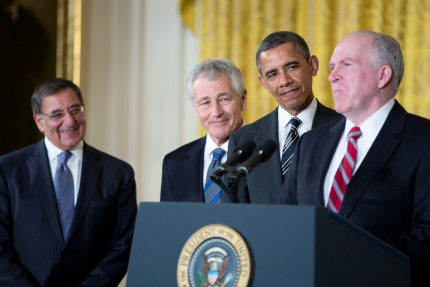
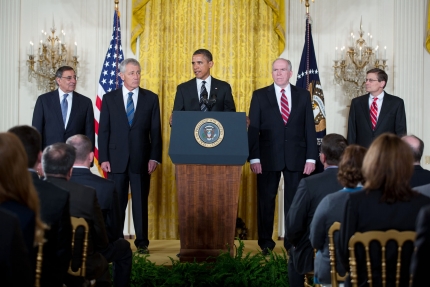
Q Thank you. I noticed that in the nomination ceremony in the East Room, the President, as he was speaking about Senator Hagel, never mentioned Israel, never mentioned Iran. Those have been two of the main criticisms of Senator Hagel. Does the President feel like Hagel needs to address his past comments on Israel and Iran before he can be confirmed, or does he feel like those comments are irrelevant to this process?
MR. CARNEY: Well, today the President announced his nominees for Secretary of Defense and the Director of the Central Intelligence Agency, and he made broad comments about why the two men he nominated are the right people for the jobs. There will be a process in each case where the Senate reviews the nominees and the President asked the Senate to move quickly because these positions are very important for our national security. And I know Senator Hagel and John Brennan look forward to that process and to fair hearings in both cases.
It is a routine part of this exercise that nominees are asked about their views on various issues. And on the matters you just raised, Senator Hagel has been a staunch supporter of Israel, of the Israeli-American relationship, of the United States’ support for Israel’s security throughout his career. And he has also been, as demonstrated by his record, a supporter of the broad sanctions regime that this President has put into place against Iran -- a sanctions regime that is unprecedented and which as recently as I think last spring, Senator Hagel wrote about favorably and urged Washington as a whole to continue. So I know -- I’m sure Senator Hagel looks forward to discussing his record in his nomination hearings.
Q But does the President feel like it’s important that Hagel clarify some of the statements that he made? Even after the President’s announcement today we saw statements from various lawmakers asking him to clarify what he meant.
MR. CARNEY: I think that the process will allow for what it always does, which is a review by the Senate of presidential nominees. I think that Senator Hagel’s record on those issues and so many others demonstrate that he is in sync with the President’s policies. And, on the first issue, let’s be clear. President Obama has, in his administration, overseen the closest, most substantial support for Israel’s defense of any administration in history. And that is a judgment that is not just made by me or others in the President’s administration; it’s a judgment that has been made and expressed by Prime Minister Netanyahu and by Defense Minister Ehud Barak. And that is a policy that will continue under President Obama with all the members of his national security team.
But again, the process is what it’s supposed to be, and I’m sure that there will be the kind of proceedings that normally take place when nominees for these positions are put forward.
Q The President also said that with national security positions in particular it’s important to not have a gap. Over at Treasury, Secretary Geithner has said that he plans to leave by about January 20th. Given all of the fiscal issues that are coming up and all of the deadlines that are coming up, does the President also feel that it’s important to not have a gap between when Secretary Geithner leaves and his replacement is confirmed?
MR. CARNEY: Well, I have no other announcements to make or updates to give with regards to personnel. I am sure that when the President nominates a successor to Secretary Geithner, he will look forward to speedy consideration by the Senate. But I don’t have a timetable for that.
Q So we shouldn’t expect something before Geithner leaves on January --
MR. CARNEY: I have no guidance to give you on the timing. It’s very important for any President to have time and space to consider his or her nominees for these important positions, and when he’s ready to make an announcement, he will.
Reuters.
Q The fiscal cliff deal, as you know, included a package of tax breaks for businesses worth about $64 billion, including the wind tax credit. And Republicans are saying that the President insisted on these, and I’m wondering why, given all of the difficulty reaching that final deal, the President really insisted on including these business tax breaks.
MR. CARNEY: Well, you’re assuming that what you’ve been told is correct. I would simply say that it would strain the credulity of everyone in this room to suggest that Republicans did not support or want tax credits for business. That would truly be turning Washington on its head, and that is not what happened.
The President did support giving certainty to American businesses and consumers by including in the fiscal deal the bipartisan extenders package that the Senate Finance Committee, this summer -- or summer of 2012 -- passed 19 to 5. And more than 90 percent of the cost of the extenders package is associated with longstanding provisions in the tax code, with clear policy rationale for businesses or individuals, including the R&D tax credit to support domestic job-creating research investments; the production tax credit, which you mentioned, which supports clean energy jobs -- if this key support had been allowed to expire, as you know because it was discussed during the campaign, as many as 37,000 clean energy jobs could have been lost; mortgage debt relief to help homeowners, which protect homeowners from paying taxes on up to $2 million of forgiven debt. And the list goes on -- bonus depreciation.
So again, going back to the first point, this package of tax extenders was supported on a bipartisan basis by the Senate Finance Committee. The President supported it. But it is, again -- you would have to suspend disbelief to accept the premise that Republicans did not.
Ann.
Q Thanks, Jay. Is there a moment that the President sat down with Senator Hagel and offered him the job, and had a heart-to-heart talk about what kind of shape he would like to see, or what direction he’d like to see the Pentagon move in?
MR. CARNEY: Well, the President did formally offer Senator Hagel the job, I believe, by phone over the weekend. But the fact is that Senator Hagel and President Obama have a long relationship that dates back to their service together in the United States Senate. As the President mentioned today, they traveled together abroad. And Senator Hagel, after he left the Senate, was co-chair of the President’s Intelligence Advisory Board. So they have had an ongoing conversation about this nation’s national security needs and the President’s policies in the last four years, which I think is clear that Senator Hagel believes have been the right policies and that he looks forward to helping implement, if he is confirmed by the Senate.
Front row is kind of docile, but I’ll go to Chuck. Yes. (Laughter.)
Q What in the President’s background -- what in Chuck Hagel’s background gave the President confidence that he could run a bureaucracy as big as the Pentagon?
MR. CARNEY: Well, among the items on Senator Hagel’s rather unique resume is the fact that he was a CEO, and a successful one, and ran a business. And that is one of the many attributes that he brings to the job of running, as you say, an institution as large as the Defense Department. And that’s part of a record that, as the President noted today, is really quite remarkable.
Here is someone who fought and bled for his country, who enlisted as a volunteer to serve and fight in Vietnam, who was awarded the Purple Heart twice, who then served in the VA and as head of USO, and then as a United States senator, and since then as an advisor to the President on intelligence matters on the Intelligence Advisory Board. This is a remarkable career of service in which all of Senator Hagel’s many talents are reflected. And he will bring those talents to the job.
Q Did anything that was out there trouble the President enough where he re-interviewed Senator Hagel? Like, when he saw a report about --
MR. CARNEY: I’m not going to go through the process of --
Q I mean, how -- did he make Senator Hagel answer some of these questions --
MR. CARNEY: Again, I’m not -- I won’t go through the process that the President uses to select nominees, except that he does so in a very deliberate fashion. He looks for the very best people for these jobs both in the national security arena and elsewhere in the administration.
When it comes to Senator Hagel, as I was just saying, he has known Senator Hagel for a fairly long time and has worked with him directly both in the Senate and as President. So the President knows his record, he knows Senator Hagel’s commitment, and he has full confidence that Senator Hagel will be an excellent Secretary of Defense who will look out, as the President said, for those who serve in our armed forces as volunteers, as he did, who implement the policies, the decisions that are made here in Washington, often at such a far remove from the battlefield. And he has great confidence that Senator Hagel will be an excellent Secretary of Defense.
Q On John Brennan, what makes it different today than four years ago when John Brennan withdrew his name from consideration for the CIA over at the time was thought to be -- there was going to be -- that he wasn’t ready to answer questions about his role in devising the enhanced -- in being a part of the enhanced interrogation technique?
MR. CARNEY: Well, I’d say two things. One, at the time, Mr. Brennan wrote a letter in which he made clear that he opposed so-called enhanced interrogation techniques. And two, for the past four years, John Brennan has served as this President’s chief counterterrorism advisor. And it is this President who banned torture as one of his first acts in office, and he has implemented that policy and many others with the remarkably capable assistance of John Brennan.
Q And finally would you respond to secretary -- sorry -- Senator McConnell over the weekend said the tax issue is now done. Does the White House share his view?
MR. CARNEY: No, we believe that any further deficit reduction, of which there must be, in the President's view -- must be pursued with the same balanced approach that the President has insisted on up to now.
Q -- now, though?
MR. CARNEY: I'm not going to itemize how it breaks down. But the fact is as part of the overall $4 trillion deficit-reduction package that the President put forward, the ratio was more like $2 in spending cuts for every $1 in revenue.
Q Going forward now, now that this --
MR. CARNEY: Well, again, you'd have to break down the numbers and look at it. And I'm not going to prejudge any proposals that might come forward.
But one of the things you heard the President of the United States say on New Year's Day when this fiscal cliff challenge was resolved is that the agreement enshrined the principle that we must have balance as we move forward in our deficit reduction. In the spending cuts that were part of the fiscal cliff deal, they were paid for in a balanced way with both -- rather the buy-down of the sequester was paid for in a balanced way with both -- roughly 50 percent spending cuts and 50 percent revenue. And that is an approach the President -- balance, anyway, is an approach the President believes is very important to continue.
And when members of Congress suggest that revenues are now somehow not part of the equation it doesn't really make a lot of sense, because as I stood here and discussed with you the various proposals going back and forth during the fiscal cliff negotiations, when the President was seeking in negotiations with Speaker Boehner a big deal, one that would address our long-term fiscal challenges through broader deficit reduction, the Speaker put on the table what he claimed was an $800 billion revenue proposal made up entirely of the closure of loopholes and the capping of deductions -- tax reform. Now, either that was good policy that they no longer support, or Republicans also believe, as the President does, that through tax reform we can achieve an improved tax --
Q So you think the Republicans are going to put forward $800 billion in tax increases --
MR. CARNEY: Well, again, I would ask you what about that $800 billion proposal was okay then, it's not okay now. And the President believes, as Republicans have said they believe, that we need to reform our tax code, and that there are loopholes that are crying out to be closed that no longer serve the country, if they ever did, and that there are ways of capping deductions and reforming our tax code that can produce more revenue in a fair way that, again, does not burden the middle class, but asks the wealthiest to pay more.
Q Jay, since you talked about the conversation with Boehner, at that last stage it was $1.2 trillion of revenue the President put on the table in the last conversation with Boehner. Does that mean the President is looking for ballpark $600 billion-$700 billion more in tax reform revenue?
MR. CARNEY: I prefer not to get into the negotiations for how we eliminate the sequester, which the President obviously is interested in doing, from this podium today. But it is clear from the proposals the President put forward dating back to his submission to the super committee, through his budget proposals, and through the negotiations with Speaker Boehner, what his principles are, where he believes we can appropriately reform our tax code and produce more revenue, and the balance that we need to inform us as we make the kind of spending cuts that are necessary for broader deficit reduction.
But the fact is, going back to Chuck's question, is that we know that balance is the way to go here. It is the path that the public supports, and it is inconceivable to the President -- and I would think to many of you -- that the Republicans want to, as we approach the coming months, have as a basic position that what we really need to do is -- for example, going back to some of their previous proposals like the Ryan budget -- voucherize Medicare or slash benefits for seniors without asking the wealthy to do any more. I don't think that's a position that is plausible to take, and it's certainly not a position the President supports.
Q Is he adamantly opposed to a revenue-neutral tax reform approach? And would he veto a bill that was operating on that premise?
MR. CARNEY: Well, you're getting way ahead of any process that's in place now. He is --
Q But Republicans have said --
MR. CARNEY: Well, let me just on the first --
Q -- revenue neutrality is their opening bid on tax reform.
MR. CARNEY: Well, I appreciate that it's their opening bid, but for some reason it was viable a few weeks ago to find $800 billion in revenue through closed loopholes and capped deductions that presumably aren't good for the economy. And the President believes that tax reform can and should produce more revenue, because balance is essential as we achieve further deficit reduction -- because it is not the President's position, as he made clear from this podium just last week, that we will reduce our deficit going forward simply by asking seniors or middle-class families or parents with kids in college to bear the burden solely.
Q How long does the President -- the tepid reaction of Senate Democrats to Senator Hagel's nomination --
MR. CARNEY: The President believes that when the Senate considers the totality of Senator Hagel's career that they will confirm him as the next Secretary of Defense.
The Senator's record is exemplary both in uniform and in the private sector, and as a United States Senator, and as an advisor on intelligence matters to the President. And I know that Senator Hagel looks forward to discussing that record with the Senate.
And I won't bore you or tie up too much of your time by reading the number of endorsements that Senator Hagel's nomination has already received from a variety of quarters, but they are numerous and we expect that more will come.
Q Is it your position that when Hagel was skeptical of sanctions on Iran in 2006, 2005, called for direct negotiations with Hezbollah -- all that stuff was that was then and this is now, it just isn't relevant to the record at all?
MR. CARNEY: Well, those are I think descriptions of the positions that are slightly skewed by the current debate. They're not part of -- the fact is on sanctions, for example, Senator Hagel supported an aggressive sanctions regime against Iran. And he, as recently as last year, wrote about the need to continue to isolate and pressure Iran through sanctions.
Q -- in their roll-call votes in 2005-2006 --
MR. CARNEY: Again, there is the approach that President Obama has taken -- which has been vastly more effective and which has been multilateral in nature, and therefore more effective, to Iran -- and there are individual votes that you can isolate and say represent the whole, which they do not. The fact is Senator Hagel supports a sanctions regime against Iran. And as Secretary of Defense, he will aggressively implement the President's policies, including his very aggressive approach to sanctioning Iran for its failure to meet its international obligations with regards to its nuclear program.
Q What about Hezbollah?
MR. CARNEY: Again, Senator Hagel's record is exemplary on all of these issues. And he will, I'm sure, when he has the opportunity to have a confirmation hearing, be asked a lot of questions about what his views are on policies.
Fundamentally, what's important to remember is that members of this President's national security team, just like members of his broader team, are hired for and do the work of implementing the President's policies. And when it comes to Israel, to the Middle East, to Hezbollah, to Hamas, to Iran, this President's policies are very clear. And Senator Hagel will, as Secretary of Defense, carry out those policies, just as John Brennan will as Director of the CIA, and as other members of the President's team have and will going forward, including, as you know, Secretary Gates, one of this President's Secretaries of Defense who just a few moments ago expressed his admiration for Senator Hagel and his desire that Senator Hagel be confirmed as Secretary of Defense.
Q Jay, in light of that, what do you make of Senator Lindsey Graham's assertion that the Hagel nomination is an "in your face" nomination that suggests an in-your-face second-term President?
MR. CARNEY: Well, again, I'm not going to get into a rebuttal of every stray comment made by members of Congress. The fact of the matter is Senator Hagel's record is exemplary. He fought for his country in uniform as an enlisted member of the armed services in Vietnam. He served his country in the United States Senate.
And it is rather remarkable to hear some of the critics out there question Senator Hagel and whether or not he should have this position when you look back at what those very same members of the Senate said effusively in praise of Senator Hagel just a few years ago. He is the same man today, the same patriot today, the same intellect today that he was then. And we agree with, for example, Senator McCain who said not too many years ago that “Chuck Hagel will be an excellent Secretary of State.” The President happens to believe that he would be an excellent Secretary of Defense.
Q On another matter, the Vice President has been charged with what we are to understand will be a broad approach to dealing with the problem of gun violence. Senator McConnell says he doesn’t want to talk about anything but fiscal matters for the next few years. Does that mean we shouldn’t expect any movement, any recommendations from the Vice President over the next few months? I’m sorry, I said years, I meant months.
MR. CARNEY: Well, with respect to Senator McConnell, I think the President will move forward with his agenda in a timely fashion, and that includes the work that Vice President Biden is doing on the effort to examine measures that we can take to address the problem of gun violence in this country.
I think that many Americans, if not most -- I believe most Americans would disagree with the idea that in the wake of what happened in Newtown, Connecticut, that we should put off any action on the issue of gun violence. I think that sentiment would be met with surprise by the vast majority of the American people who don’t watch the Sunday shows, especially on the Sunday after New Year’s Day. But it’s certainly not a sentiment the President supports.
Q And talk to me about a broad effort as opposed to something that deals with strictly gun laws.
MR. CARNEY: Well, I can cite the President on several occasions where he talked about the fact that issues that -- that approaches that address access to guns including legislation like the assault weapons ban, or legislation that would ban high-capacity gun clips, or legislation that would close the many loopholes in our background check system are only -- while very important and he supports congressional actions right away on those matters -- are only part of the problem and only address part of the problem. And he believes that issues of mental health, issues of education, for example, are part of this problem and need to be addressed as part of the effort that Vice President Biden is undertaking.
Alexis.
Q Jay, on the Hill, Senators had greeted -- or had criticized Susan Rice, who was not nominated for a new position, in a way that prompted the President to suggest that if in fact she was being used as a proxy, that they were actually criticizing him. Does the President listen to the criticism of Senator Hagel in much the same way, believing that the criticism is more aimed at him than it is at Senator Hagel?
MR. CARNEY: Well, I will reject the temptation to compare one to the other. I will simply say that the President believes very firmly as you heard him just moments ago say, that Senator Hagel will make, if confirmed, and excellent Secretary of Defense, that his record is exemplary and unique in that, as the President said, Senator Hagel would be the first Vietnam veteran to run the Defense Department, the first enlisted person to run the Defense Department, and with that he would bring a keen understanding of and appreciation for the men and women who serve throughout our armed forces.
So he looks forward to a speedy consideration by the Senate and believes that Senator Hagel’s record will convince the Senate to confirm him as the next Secretary of Defense.
Q And a quick follow-up on Major’s question about the process towards sequestration. For those who think that the President maybe learned from the process he just went through on the fiscal cliff that he will not be dealing with Speaker Boehner, does the President -- can you just clarify, does he fully intend to have continuing conversations directly with the Speaker, to negotiate with him directly?
MR. CARNEY: Well, the President believes that as part of our system of government the executive branch engages with and negotiates with the legislative branch, and that will continue -- on a range of issues, not just economic and fiscal matters. And the President, as he said, is very open to compromise on a range of issues when it comes to addressing our fiscal challenges and putting in place policies that help our economy grow and continue to create jobs. He will not negotiate over Congress’s responsibility to pay the bills that Congress has incurred.
As you know as a veteran reporter here in Washington, a President cannot by himself or herself spend a single dollar. Congress passes the laws. Congress appropriates the funds. Congress racks up the bills and Congress must pay the bills. And it is simply inappropriate and extremely dangerous to suggest that in the name of a political agenda we would default, for example, on our obligations to pay our bills. That is Congress’s responsibility and the President will not negotiate with Congress over Congress’s responsibility to pay its bills.
Q Jay, the Speaker, prior to --
MR. CARNEY: Glenn, how are you? Happy New Year.
Q Happy New Year.
MR. CARNEY: Where’s your hat? (Laughter.)
Q I'll put it on for you later. (Laughter.)
MR. CARNEY: It’s a little -- the lights are bright and they reflect and -- (laughter.)
Q It’s polite to take your hat off -- it’s good manners.
MR. CARNEY: It is, actually. I remind my son of that periodically. Thank you for that.
Q I will respond to that later. (Laughter.)
MR. CARNEY: I don't want to read that. (Laughter.)
Q The Speaker apparently said explicitly to his own conference prior to his reelection as Speaker last week that he does not want to negotiate directly with the President anymore. Do you think that's appropriate? And what’s the President’s response?
MR. CARNEY: This is not personal and this is about putting in place the policies that are best for the country. That's how the President looks at it.
There’s no question that President Obama, in the course of his four years in office, has learned a great deal about how to work with Congress and how to enlist public support on behalf of policies that are very important to the lives of everyday Americans across the country. And as we've discussed in recent months, the President will continue to make the case to the American people for the policies that he believes are right, and even as he works with and negotiates with Congress on matters of legislative importance.
So I'm not -- I only heard about this indirectly. I didn’t obviously have this conversation directly with the Speaker or even read the article that you're talking about. But I did hear this. I think it is incumbent upon the leaders in Washington to continue to work together to get the necessary work done to advance the economy, continue to create jobs, and to ensure that we're doing everything possible to make America safe. And that includes confirming, for example, presidential nominees for a national security post.
Q Is he committed to pressing that with Speaker Boehner? Will he try to talk to Boehner even if Boehner --
MR. CARNEY: Well, I think the distinction I’m trying to make here, in answer to Alexis’s question, is that he is, as he said from here, eager to and willing to compromise in order to achieve policies that advance our economic growth and help the economy create jobs, and bring down our deficit in a responsible and balanced way. He will continue to do that. And we have, as a result of the fiscal cliff, two more months to deal with the so-called sequester, and that’s something that the President will obviously be addressing.
What he will not do, as he has made clear, is negotiate with Congress over Congress’s sole responsibility to pay the bills that Congress has already incurred. Nobody forced Congress to rack up the bills that it incurred. And it is an abdication of responsibility to say that we’re going to let the country default and cause global economic calamity simply because we’re not getting what we want in terms of our ideological agenda. The President is not going to participate in that.
And I would remind you of the damage caused to our economy by the approach that House Republicans took on this matter just in the summer of 2011. As a result of their flirtation with default, the stock market plummeted. The DOW fell 7 percent, or almost 900 points, in late July and early August of 2011. The United States was downgraded and the DOW fell another 10 percent, or 1100 points after the S&P downgraded the United States. Consumer confidence plummeted to its lowest point since the financial crisis in 2008. Uncertainty for businesses froze hiring. Widespread uncertainty for middle-class families was created and caused. And job figures, job growth in August of 2011 was the lowest of any month in our economic recovery.
And that is what you get when you play games with the full faith and credit of the United States. We don’t expect, and certainly don’t hope -- or certainly hope that the Congress does not engage in that kind of activity.
Q Back to Senator Hagel for a second. In his first interview today, he said that he was “hanging out there in no- man’s land,” unable to respond to charges and falsehoods and distortions against him. I’m wondering if you could walk through what specific groups, outside groups, outside the Senate, have Jack Lew and other administration officials been reaching out to in hopes of smoothing this nomination.
MR. CARNEY: Well, I appreciate the opportunity, but I’ll pass on it. Obviously, broadly speaking, the White House is reaching out to a number of groups and individuals with regards to this nomination and others, and will continue to do so in making the case for these individuals.
But as far as the initial part of your question, it is certainly an unfortunate reality that has become the norm here in Washington that even when names are bandied about in the press as possible nominees, that a process begins where critics jump all over them. And that’s just part of -- well, one of the reasons why Washington has become a more fractious place.
But again, the President looks forward to Senate consideration of his nominees that he announced today. He believes that the Senate will confirm both Senator Hagel and John Brennan to those positions. And in each case, as the President said, these are uniquely qualified individuals for the offices that they will hold if confirmed.
Q Is the White House enlisting other outside people, though, to help with these groups?
MR. CARNEY: No, I think that -- well, I’ll simply say that we have conversations with individuals all the time about -- and groups -- about our policy proposals and nominees for higher office. But I don’t have anything specific to report to you and there’s nothing unusual about that process for either this administration or its predecessors.
Brianna.
Q Jay, the recent personnel announcements that we’ve heard have all been men. I’m wondering how important it is to President Obama to have women in prominent roles in his new Cabinet.
MR. CARNEY: Well, I appreciate the question. The President does believe that diversity is very important and he also believes that picking the absolute right person for each job is very important. And the nominees he announced today represent that principle in that he believes Senator Hagel and John Brennan are the right individuals for the jobs to which they have been nominated.
I would remind you that as part of President Obama’s national security team we have Secretary Clinton, who, after four years, is leaving office. We have Secretary Napolitano, who continues as Homeland Security Secretary. We have Ambassador Susan Rice, who has indicated that she will be staying on in New York as the U.S. Representative to the United Nations, a Cabinet-level position. And there are obviously other remarkably capable women in positions of high office in this administration and will continue to be.
Q But presumably, I mean, some of them will obviously leave over time, and I’m wondering, in terms of having a replacement, for instance, with Secretary Clinton leaving, do you think that --
MR. CARNEY: Well, I think that any suggestion that Secretary Clinton was chosen because of her gender would be rejected by Secretary Clinton and others. And any suggestion that nominees not be chosen for their qualifications would be rejected by everyone whose interest is in, as the President’s is, the very -- finding the very best people for each job. And that’s what he’s done today and that’s what he’ll continue to do.
And he, in that process, insists on diversity on the lists that he considers for the job because he believes that in casting a broader net, you increase the excellence of the pool of potential nominees for these positions. But in the end, he’ll make the choice that he believes is best for the United States. In this case, that would be Secretary Hagel -- or Senator Hagel for Secretary of Defense and John Brennan for Director of the CIA.
Q And on the Biden group, when will we hear from the Biden group?
MR. CARNEY: I think the President has indicated that he wants the effort led by Vice President Biden to report to him with dispatch, but I don’t have a timeline to give you. The President has already urged Congress when it comes back to work to take up initiatives -- legislation to ban assault weapons, to ban high-capacity magazines, and to improve our background checks system because it does have loopholes. The so-called gun show loophole is a problem that he thinks that Congress can and should address. As for the other aspects of what the President will recommend, I’ll leave it to him to announce.
Q It seems January was sort of the absolute last time that he wants for recommendations, and there have been some reports that there will be listening sessions. I’m wondering, is there time?
MR. CARNEY: Well, it is January 7th and it would be --
Q Are there going to be listening sessions?
MR. CARNEY: -- a disservice to the month of January to assume that it was over one week in. (Laughter.) So I would ask you to stay tuned. I just don't have any --
Q I just wish we had December back. (Laughter.)
MR. CARNEY: December, yes --
Q Will there be a chance for people to weigh in in the listening sessions?
MR. CARNEY: I just don't have any more information for you. I know that the Vice President is leading a process that is very inclusive, that is including, as I think has been reported, conversations with many stakeholders who have a keen interest in this issue. And that will continue to be the case.
Roger Runningen, and then Mr. Nakamura.
Q Jay, can you tell us who the sherpas are for each of the nominees today?
MR. CARNEY: I don't have sherpas for you. I think a sherpa is commonly associated with Supreme Court nominees. I don't know that there are such beings in this case. Senator Hagel and Mr. Brennan will be assisted as they go through the process of confirmation in the Senate by a number of people, but I don't have individuals to provide to you.
Q The Senate Chairman will of course set the dates on that, but do you have commitments for them to set an early date as soon as they return on the 22nd or so?
MR. CARNEY: The President, as you heard him earlier today say, hopes that the Senate will take up these nominations, as well as the nomination of Senator Kerry for Secretary of State, as soon as possible because of the importance of filling these positions quickly, importance to our national security. But I don't have a date certain for you and, obviously, we defer to the relevant committees.
Q Jay, just to follow up on Brianna's question, you talked just a minute ago about when the President believes in diversity, insists on diversity, and that he casts a broad net when he's talking about looking for candidates to serve. During the campaign, Mitt Romney was sort of ridiculed for saying that he wanted a binder full of women to make decisions on Cabinet members. What do you mean by the President is insisting on diversity and casts this broad net? Does he interview people like Michele Flournoy for defense jobs to make sure that he's really hearing from women, from other minorities in specifically this job and other jobs? Or does he insist on other ways to find qualified candidates that --
MR. CARNEY: He, again without addressing any specific nomination process, I would say that the answer is yes. He speaks with numerous potential candidates for various positions and diverse candidates. He selects, as I think the officeholders in his first administration and first Cabinet demonstrates, he selects men and women who he believes are the right individuals for the jobs to which they've been appointed. And that continues to be his process.
It's not uniform. It's a broad sentiment. And he believes that the country is served by a process that does seek out the diverse talent in this country for different positions.
Jon Christopher.
Q These early nominations to Senators Kerry and Hagel and Mr. Brennan -- does this prove that the President's second-term agenda will be really focused in terms of priority on national security and foreign policy?
MR. CARNEY: It proves that the President, as he said today, considers the security of the United States and the American people his highest priority and responsibility. And that is why he has asked individuals of such talent and records of service as John Brennan and Senator Kerry and Senator Hagel to serve in the positions that they've been nominated for.
Broadly speaking, as he has said repeatedly, his policy priority -- I mean, there are obviously many, but his top priority continues to be having our economy grow, having it create jobs, giving security to the middle class, and building a foundation for future economic growth in the 21st century that will allow for future generations to enjoy the opportunity and promise of America that previous generations, including the President’s own, have enjoyed. That remains his top priority.
But there is no question that, as he said today, that his primary responsibility, as he views it, is the safety and security of the United States and its people.
Q Can these two priorities be basically intertwined?
MR. CARNEY: I think the answer to that is absolutely yes, because that is the responsibility of every President, and one that this President takes very seriously.
Q I’m going back to the debt ceiling debate for a minute. The Bipartisan Policy Center issued a report today that said the government would actually run out of money prior to what we had normally talked about, so as early as February 15. So I was wondering if the administration was thinking about asking the IRS to postpone refunds for people. Or also, were you all thinking about issuing an order about which creditors would be paid first?
MR. CARNEY: Well, as you know, the Treasury Department handles questions like these and has put out information about it, including in a letter at the end of the year about both the estimates as to when the debt ceiling would be reached and to the measures that the Treasury Department has in the past and is now taking with regards to that matter. But I would refer you for the questions that you asked to the Treasury Department.
George.
Q You keep saying the President won’t negotiate on the debt ceiling. At the risk of sounding naïve, how does that work practically? If the leaders of Congress tell him they don’t have the votes to raise the ceiling, does he just say, no, I’m not going to talk about that?
MR. CARNEY: Well, the President believes that members of Congress were elected to serve their constituents. And as one of their essential responsibilities, to ensure that they do no harm in Congress to this economy and to the livelihoods of average Americans, flirting with default or, even worse, allowing default, would be a violation of those primary responsibilities.
And again, George, I can’t be more clear: These are bills that Congress racked up. If Congress felt that they should not be paying these bills or that there should be less spending and less borrowing, then they should have passed different legislation that appropriated funds. It is not the President’s responsibility to pass legislation to raise the debt ceiling; it is Congress’s responsibility. And he will not engage in a negotiation with Congress that as some advocates of this themselves have described as a hostage situation -- a hostage situation that would result, as it did in the summer of 2011, in great harm to this economy and great harm to American businesses and great harm to average Americans.
So it’s just not the right thing to do. I think that there will be a -- if we were to travel down that road for any time, a great deal of unanimity behind the idea that it’s a terrible proposition to flirt with default or to allow default. And let me remind you that if the position of Republicans in Congress will be that your choice, America, is between default and therefore economic chaos on the one hand, or voucherizing Medicare or slashing benefits for seniors, the American people are going to say no in both instances.
This is not the right way to do things in this country. You have to heed to your responsibilities here, and that includes paying for the bills that you racked up. This has nothing to do with future spending. This has to do with spending that has already been incurred. And it is Congress’s responsibility to pay its bills.
George, when you get a credit card bill, you pay it, and if you don’t, you get penalized. And in the case of not paying your bills when you’re the United States of America, when you’re the United States Congress, the penalty is both real in financial terms and severe for the economy and for the American people. The President won’t negotiate with Congress over Congress’s responsibility to pay its own bills.
Thank you, all.
Q Jay, the President signed all of those spending bills, so why doesn’t he share responsibility?
MR. CARNEY: Well, he did not sign all of those spending bills. The President has been in office for four years. And in fact, a huge portion of our current deficit problems were racked up under --
Q All the spending bills that were enacted on his watch
--
MR. CARNEY: -- previous administrations. And it is often forgotten by Republican leaders that this is the case, that some of the very Republican leaders in office now who claim as their objective deficit reduction, primary objective, presided over enormous budget-busting legislation in the previous administration. It is also often forgotten that the only President in our times here in Washington to have balanced the budget was President Bill Clinton, and he passed to his successor surpluses. And it was actions taken by Congress in the previous decade and the administration in office at the time that eliminated those surpluses and turned them into the largest deficits of our lifetimes, at the time.
So the President takes his responsibility very seriously, but when it comes to bills that Congress has passed and needs to pay, they ought to take their responsibilities seriously and pay those bills.
Thank you.
Q Is the President going to watch the game tonight? (Laughter.)
MR. CARNEY: I haven’t asked him.
Q Still believe that there should be playoffs in college?
MR. CARNEY: (Laughter.) We’re getting closer, right? (Laughter.)
END
3:03 P.M. EST
The White House
Office of the Press Secretary
MEMORANDUM FOR THE SECRETARY OF HOMELAND SECURITY
SUBJECT: National Flood Insurance Program
I have reviewed your request for approval to issue notes to the Secretary of the Treasury in excess of $20.725 billion, but not to exceed $30.425 billion, for the National Flood Insurance Program and am hereby granting approval for you to do so.
BARACK OBAMA
After announcing Chuck Hagel as his nominee for the next Secretary of Defense, President Obama today nominated John Brennan as the next Director of the Central Intelligence Agency.
Brennan, a 25-year veteran of the CIA, has served as President Obama’s Advisor for Counterterrorism and Homeland Security since 2009. “For the last four years,” President Obama said, “John developed and has overseen our comprehensive counterterrorism strategy -- a collaborative effort across the government, including intelligence and defense and homeland security, and law enforcement agencies.”
President Obama called Brennan “one of the hardest working civil servants I’ve ever known” and said that he valued Brennan’s integrity and commitment “to the values that define us as Americans.”
Speaking from the East Room of the White House, President Obama today announced two key nominations for his national security team. He tapped John Brennan to serve as the director of the Central Intelligence Agency, and he asked Sen. Chuck Hagel to serve as Secretary of Defense.
"Chuck Hagel’s leadership of our military would be historic," he said. "He’d be the first person of enlisted rank to serve as Secretary of Defense, one of the few secretaries who have been wounded in war, and the first Vietnam veteran to lead the department. As I saw during our visits together to Afghanistan and Iraq, in Chuck Hagel our troops see a decorated combat veteran of character and strength. They see one of their own."
The President and Hagel have known each other for nearly a decade and served together on the Senate Foreign Relations Committee. Hagel spent two terms in the upper chamber of Congress and helped to lead the fight for passage of the Post-9/11 GI Bill. Under President Reagan, Hagel served as a deputy administrator of the Veterans Administration, and while co-founding his own business, he served as the CEO of the United Service Organization. He's also co-chaired the Intelligence Advisory Board for President Obama.
"Chuck knows that war is not an abstraction," President Obama said. "He understands that sending young Americans to fight and bleed in the dirt and mud, that’s something we only do when it’s absolutely necessary."
January 07, 2013 | 27:30 | Public Domain
President Obama nominates Chuck Hagel as the next Secretary of Defense and John Brennan as the next Director of the Central Intelligence Agency.
East Room
1:15 P.M. EST
THE PRESIDENT: Good afternoon, everybody. Please have a seat. As President and Commander-in-Chief, my most solemn obligation is the security of the American people. Over the past four years, we’ve met that responsibility by ending the war in Iraq, and beginning a transition in Afghanistan; by decimating the al Qaeda core and taking out Osama bin Laden; by disrupting terrorist plots and saving countless American lives.
Among an outstanding national security team, I am especially grateful to Leon Panetta, who has led the CIA and our military with incredible skill. Leon, after nearly five decades of service, you have more than earned the right to return to civilian life. I’ll have much more to say about Leon’s distinguished service in the days ahead. Today, I simply want to convey both to you and to Sylvia the eternal gratitude of the entire nation. Thank you so much, Leon.
I also want to thank Michael Morell, who has earned the admiration of all of us who’ve worked with him across government and here in the White House. In moments of transition, he’s guided the CIA with a steady hand as Acting Director -- not once, but twice. And he is a consummate professional. As I said, everybody in the White House who works with him, everybody across agencies who works with him considers him truly to be one of our most outstanding national security team members. And so, Michael, on behalf of all of us, thank you and Mary Beth for your continued service.
As these leaders know, the work of protecting our nation is never done, and we’ve still got much to do: Ending the war in Afghanistan and caring for those who have borne the battle; preparing for the full range of threats, from the unconventional to the conventional, including things like cyber security; and within our military, continuing to ensure that our men and women in uniform can serve the country they love, no matter who they love.
To help meet the challenges of our time, I’m proud to announce my choice for two key members of my national security team -- Chuck Hagel for Secretary of Defense and John Brennan for Director of the Central Intelligence Agency.
Chuck Hagel is the leader that our troops deserve. He is an American patriot. He enlisted in the Army and volunteered for Vietnam. As a young private, and then a sergeant, he served with honor, alongside his own brother. When Chuck was hit by shrapnel, his brother saved him. When his brother was injured by a mine, Chuck risked his life to pull him to safety. To this day, Chuck bears the scars -- and the shrapnel -- from the battles he fought in our name.
Chuck Hagel’s leadership of our military would be historic. He’d be the first person of enlisted rank to serve as Secretary of Defense, one of the few secretaries who have been wounded in war, and the first Vietnam veteran to lead the department. As I saw during our visits together to Afghanistan and Iraq, in Chuck Hagel our troops see a decorated combat veteran of character and strength. They see one of their own.
Chuck is a champion of our troops and our veterans and our military families. As a leader at the VA, he fought to give our veterans the benefits they deserved. As head of the USO, he devoted himself to caring for our troops. Having studied under the GI Bill himself, he helped lead the fight for the Post-9/11 GI Bill so today’s returning heroes can get their education, too. Having co-chaired my Intelligence Advisory Board, he knows that our armed forces collect, analyze, and depend on good intelligence.
And Chuck recognizes that American leadership is indispensable in a dangerous world. I saw this in our travels together across the Middle East. He understands that America stands strongest when we stand with allies and with friends. As a successful businessman, he also knows that even as we make tough fiscal choices, we have to do so wisely, guided by our strategy, and keep our military the strongest fighting force the world has ever known.
Maybe most importantly, Chuck knows that war is not an abstraction. He understands that sending young Americans to fight and bleed in the dirt and mud, that’s something we only do when it’s absolutely necessary. “My frame of reference,” he has said, is “geared towards the guy at the bottom who’s doing the fighting and the dying.” With Chuck, our troops will always know, just like Sergeant Hagel was there for his own brother, Secretary Hagel will be there for you.
And finally, Chuck represents the bipartisan tradition that we need more of in Washington. For his independence and commitment to consensus, he’s earned the respect of national security and military leaders, Republicans and Democrats -- including me. In the Senate, I came to admire his courage and his judgment, his willingness to speak his mind -- even if it wasn’t popular, even if it defied the conventional wisdom.
And that’s exactly the spirit I want on my national security team -- a recognition that when it comes to the defense of our country, we are not Democrats or Republicans; we are Americans. Each of us has a responsibility, Chuck has said, to be guided not by the interest of our party or our President even, but by “the interests of our country.”
So, Chuck, I thank you and Lilibet for agreeing to serve once more in the interests of our country.
Now, when I’m on the subject of patriots, let me say a few words about John Brennan. In John Brennan, the men and women of the CIA will have the leadership of one of our nation’s most skilled and respected intelligence professionals -- not to mention that unique combination of smarts and strength that he claims comes from growing up in New Jersey. (Laughter.)
A 25-year veteran of the CIA, John knows what our national security demands -- intelligence that provides policymakers with the facts, strong analytic insights, and a keen understanding of a dynamic world. Given his extensive experience and travels -- which include, by the way, traveling through the Arabian Peninsula where he camped with tribesmen in the desert -- John has an invaluable perspective on the forces -- the history, the culture, the politics, economics, the desire for human dignity driving so much of the changes in today’s world.
Having held senior management, analytic, and operational positions at the agency, John is committed to investing in the range of intelligence capabilities we need -- technical and human. He literally built -- and then led -- the National Counterterrorism Center. And he knows the risks that our intelligence professionals face every day. John has lost colleagues and friends -- heroes whose stars now grace that memorial wall at Langley.
For the last four years, as my Advisor for Counterterrorism and Homeland Security, John developed and has overseen our comprehensive counterterrorism strategy -- a collaborative effort across the government, including intelligence and defense and homeland security, and law enforcement agencies.
And so think about the results. More al Qaeda leaders and commanders have been removed from the battlefield than at any time since 9/11. Their communications, recruiting, training, finances are all under enormous strain -- all of which makes it harder to plan and carry out large-scale attacks against our homeland. And our entire team, including our exceptional Director of National Intelligence, Jim Clapper, will remain relentless against al Qaeda and its affiliates.
In all this work, John has been tireless. People here in the White House work hard. But John is legendary, even in the White House, for working hard. (Laughter.) He is one of the hardest-working public servants I’ve ever seen. I’m not sure he’s slept in four years. (Laughter.) When I was on Martha’s Vineyard, John came and did the press briefing -- this is in summer, it’s August, he’s in full suit and tie. And one of the reporters asked him, don’t you ever get any down time? And John said, “I don’t do down time.” (Laughter.) He’s not even smiling now. (Laughter.)
There’s another reason I value John so much, and that is his integrity and his commitment to the values that define us as Americans. He has worked to embed our efforts in a strong legal framework. He understands we are a nation of laws. In moments of debate and decision, he asks the tough question and he insists on high and rigorous standards. Time and again, he’s spoken to the American people about our counterterrorism policies because he recognizes we have a responsibility to be [as] open and transparent as possible.
And so, John, you’ve been one of my closest advisors. You’ve been a great friend. I am deeply grateful for your extraordinary service. I’m even more grateful for Kathy’s willingness to put up with you. And I’m grateful to both of you for your willingness to take this assignment.
Today, I can say to the men and women of the CIA: In Director John Brennan you will have one of your own; a leader who knows you; who cares for you, deeply; and who will fight for you every single day. And you’ll have a leader who has my complete confidence and my complete trust.
As I said, the work of defending our nation is never done. My number-one criteria in making these decisions was simple -- who is going to do the best job in securing America. These two leaders have dedicated their lives to protecting our country. I’m confident they will do an outstanding job. I urge the Senate to confirm them as soon as possible so we can keep our nation secure and the American people safe.
And so, Chuck and John -- congratulations.
And with that, I want to invite each of these leaders on stage to say a few words, starting with Mr. Leon Panetta.
SECRETARY PANETTA: First of all, let me express my deepest gratitude to the President for giving me the honor and the privilege of serving in your administration these last four years as Director of the CIA and now as Secretary of Defense. I have been extremely proud to be part of your national security team, Mr. President, and to be proud of what it has accomplished in your first term.
Looking ahead to the second term, I want to commend President Obama on his decision to nominate Chuck Hagel as the next Secretary of the Defense. And let me also add, as former Director of the CIA, to commend the President for his choice of John Brennan. I have had the opportunity to work with John on counterterrorism issues these last four years. He knows the CIA. He will be a strong leader of that great intelligence agency.
I've also known Chuck for a long period of time as well, and I had the opportunity to work with him closely -- particularly in his capacity as Chairman of the President's Intelligence Advisory Board. I greatly appreciate the work he has done to strengthen our intelligence enterprise. It has been extremely important to our ability to improve our intelligence capabilities. And as Secretary of Defense, I also benefited from his work when he served on our Defense Policy Board.
Chuck Hagel is a patriot, he's a decorated combat veteran, and he is a dedicated public servant. I believe his experience, his judgment, his deep understanding of the security issues facing this country make him the right choice to be Secretary of Defense.
As for me, after close to 50 years of serving the American people -- began in 1964 when I served as a first lieutenant in the United States Army, and then in both the legislative and executive branch positions in Washington -- the time has come for me to return to my wife Sylvia, our three sons, their families, our six grandchildren, and my walnut farm -- (laughter) -- dealing with a different set of nuts. (Laughter.)
I want to deeply thank my family for giving me the fullest measure of love and support during my many absences from home throughout my long career in public service. But I will leave Washington with a very deep sense of pride in what we have accomplished during these last four years being on the President's national security team.
As both Director of the CIA and as Secretary of Defense, I have always believed that our fundamental mission is to keep America safe, to keep America secure. And because of the outstanding dedication of our intelligence and military professionals, America is safer and more secure than it was four years ago, and we have reached a turning point after more than a decade of war.
And on that, as we’ve reached that turning point, we’ve developed a new defense strategy for the 21st century. We have, with John’s leadership, decimated al Qaeda’s leadership and weakened their effort to attack this country. We have brought wars in Iraq and we will bring the war in Afghanistan to an honorable conclusion. We’ve opened up opportunities for all Americans to serve in our military. And we continue to strongly support our forces, their families, and our wounded warriors. These are some of the achievements that I am proud of.
Let me close by expressing my profound gratitude to the outstanding team of military and civilian staff and leaders that I’ve had the honor to serve with at the Department of Defense and at the White House. In particular, let me deeply thank the outstanding men and women in uniform, who I’ve had the privilege to serve and to lead, those who put their lives on the line every day on distant battlefields for this country. Their sacrifices teach us that freedom is not free; a strong democracy depends on a strong defense. But you can also not have a strong and stable defense without a strong and stable democracy.
As we continue to confront strategic challenges and fiscal austerity, my hope for the future is that the sense of duty our servicemembers and their families exhibit every day inspires the leaders of this nation to have the courage to do what is right, to achieve the American Dream, to give our children a better life, and to build a more secure future.
SENATOR HAGEL: Thank you, Mr. President. I’m honored by your trust and your confidence in me, and not unmindful of the immense responsibilities that go with it. I want to also acknowledge my wife, Lilibet; my daughter, Allyn; and our son, Ziller, who is in Chicago today, we hope, back attending his first day of classes at DePaul University. (Laughter.)
And to my friend, Leon Panetta, thank you for your extraordinary service to our country over so many years in so many capacities. You are one of the premier public servants of our time. To follow you at the Department of Defense will be a most challenging task, but I will try to live up to the standards that you, Bob Gates and others have set for this job and this nation.
Let me also express my deep appreciation and congratulations to my friend, John Brennan, and to also acknowledge the President's confidence and trust in John Brennan. Thank you, John, for your service and what you will continue to do for our country. To Mike Morell -- who I have gotten to know over the years not just serving on the Senate Intelligence Committee, but also, as the President has noted, the privilege of co-chairing the President's Intelligence Advisory Board with former Senator Dave Boren -- thank you, Mike, for your continued service.
Mr. President, I am grateful for this opportunity to serve our country again and especially its men and women in uniform and their families. These are people who give so much to this nation every day with such dignity and selflessness. This is particularly important at a time as we complete our mission in Afghanistan and support the troops and military families who have sacrificed so much over more than a decade of war.
I'm also grateful for an opportunity to help continue to strengthen our country and strengthen our country's alliances, and advance global freedom, decency, and humanity as we help build a better world for all mankind. I will always do my best. I will do my best for our country, for those I represent at the Pentagon, and for all our citizens. And, Mr. President, I will always give you my honest and most informed counsel. Thank you very much.
ACTING DIRECTOR MORELL: Mr. President, thank you for your very kind remarks, and thank you for the trust that you placed in me when you asked me to be Acting Director twice.
I have had the honor of knowing and working with John Brennan for the last 20 years. We have worked particularly closely the last three years. John Brennan is a intelligence professional with deep experience in our business, a public servant with extraordinary dedication, and a man of deep integrity. With Senate confirmation, I know that he will be an outstanding Director of the Central Intelligence Agency.
As the President noted, John started his career at CIA and spent nearly a quarter century. So this is a homecoming for John.
John, on behalf of the talented and dedicated men and women of CIA, it is my deep honor to say, welcome home.
MR. BRENNAN: Mr. President, it is indeed a tremendous honor to be nominated to be the Director of the Central Intelligence Agency. The women and men of the CIA are among the most dedicated, courageous, selfless and hardworking individuals who have ever served this country. At great personal risk and sacrifice, they have made countless invaluable contributions to our national security and to the safety and security of all Americans. Most times, their successes will never be known outside the hallowed halls of Langley and the Oval Office.
Leading the agency in which I served for 25 years would be the greatest privilege as well as the greatest responsibility of my professional life. Mr. President, I want to thank you for your confidence in me, but even more for your confidence and constant support to the CIA and to those who serve in the intelligence community. They need and deserve the support of all of their fellow Americans, especially at a time of such tremendous national security challenges.
If confirmed as Director, I will make it my mission to ensure that the CIA has the tools it needs to keep our nation safe, and that its work always reflects the liberties, the freedoms and the values that we hold so dear.
I’m especially proud to stand here today with such patriots as Leon Panetta, Chuck Hagel and Michael Morell. It was a tremendous honor to serve with Leon over the past four years, and I very much look forward to the opportunity and privilege to serve with another of America’s great patriots, Chuck Hagel.
And I am especially proud and touched to be able to stand here today with my close friend and colleague, Michael Morell, who epitomizes what it means to be an intelligence professional. Michael’s leadership at the CIA, as well as his 32-year career, has been nothing short of exemplary. Michael, I very much look forward to working with you in the weeks, months, and years ahead.
And I also look forward to working with Congress, as our national security rests on the ability of the executive and legislative branches of our government to work as a team. While the intelligence profession oftentimes demands secrecy, it is critically important that there be a full and open discourse on intelligence matters with the appropriate elected representatives of the American people. Although I consider myself neither a Republican nor a Democrat, I very much look forward to working closely with those on both sides of the aisle.
Finally, and most importantly, to my wife Kathy; to my children Kyle, Jaclyn, Kelly; to my parents in New Jersey, a shout-out -- (laughter) -- Owen, who is 92 and my mom, Dorothy, who is 91; my brother Tom and my sister Kathleen and my Jersey roots: I could not be where I am today without their love, their patience, their understanding and their support. And there is no way that I can ever repay that, except to say I think I’m going to need it for a little bit longer. (Laughter.)
So again, Mr. President, I am deeply grateful for this opportunity. It will be bittersweet to leave all of my close colleagues and friends here at the White House and at the national security staff, who I have come to work with and respect so deeply over the last four years.
But if confirmed by the Senate, I will consider it to be the honor of my life to serve as the 21st Director of the Central Intelligence Agency.
THE PRESIDENT: Well, these are four outstanding individuals. We are grateful to all of them. I want, in particular, to thank Mike Morell and Leon Panetta for their extraordinary service. And I just want to repeat, I hope that the Senate will act on these confirmations promptly. When it comes to national security, we don’t like to leave a lot of gaps between the time that one set of leaders transitions out and another transitions in. So we need to get moving quickly on this.
The final point I will make: One of the reasons that I am so confident that Chuck Hagel is going to be an outstanding Secretary of Defense and John Brennan is going to be an outstanding Director of the Central Intelligence Agency is they understand that we are only successful because of the folks up and down the line in these respective institutions -- the folks on the ground who are oftentimes putting their lives at risk for us, and are oftentimes at great remove from Washington and its politics.
To have those who have been in the field, who have been in the heat of battle, who understand the consequences of decisions that we make in this town and how it has an impact and ramifications for everybody who actually has to execute our national security strategies, that’s something invaluable. It will provide me the kinds of insights that I need in making very difficult decisions, but it will also mean that these folks are going to be looking out for the people who work for them. And that’s something that, I think, in these leadership positions is absolutely critical.
So I’m looking forward to working with these two gentlemen. They are going to be outstanding.
Thank you very much, everybody. (Applause.)
END
1:42 P.M. EST
The White House
Office of the Press Secretary
NOMINATIONS SENT TO THE SENATE:
Robert E. Bacharach, of Oklahoma, to be United States Circuit Judge for the Tenth Circuit, vice Robert Harlan Henry, resigned.
Caitlin Joan Halligan, of New York, to be United States Circuit Judge for the District of Columbia Circuit, vice John G. Roberts, Jr., elevated.
William J. Kayatta, Jr., of Maine, to be United States Circuit Judge for the First Circuit, vice Kermit Lipez, retired.
Jill A. Pryor, of Georgia, to be United States Circuit Judge for the Eleventh Circuit, vice Stanley F. Birch, Jr., retired.
Patty Shwartz, of New Jersey, to be United States Circuit Judge for the Third Circuit, vice Maryanne Trump Barry, retired.
Srikanth Srinivasan, of Virginia, to be United States Circuit Judge for the District of Columbia Circuit, vice A. Raymond Randolph, retired.
Richard Gary Taranto, of Maryland, to be United States Circuit Judge for the Federal Circuit, vice Paul R. Michel, retired.
Elissa F. Cadish, of Nevada, to be United States District Judge for the District of Nevada, vice Philip M. Pro, retired.
Valerie E. Caproni, of the District of Columbia, to be United States District Judge for the Southern District of New York, vice Richard J. Holwell, resigned.
Sheri Polster Chappell, of Florida, to be United States District Judge for the Middle District of Florida, vice Gregory A. Presnell, retired.
Pamela Ki Mai Chen, of New York, to be United States District Judge for the Eastern District of New York, vice Raymond J. Dearie, retired.
Brian J. Davis, of Florida, to be United States District Judge for the Middle District of Florida, vice Richard A. Lazzara, retired.
Shelly Deckert Dick, of Louisiana, to be United States District Judge for the Middle District of Louisiana, vice Ralph E. Tyson, deceased.
Jennifer A. Dorsey, of Nevada, to be United States District Judge for the District of Nevada, vice Larry R. Hicks, retired.
Katherine Polk Failla, of New York, to be United States District Judge for the Southern District of New York, vice Denise Cote, retired.
Kenneth John Gonzales, of New Mexico, to be United States District Judge for the District of New Mexico, vice Bruce D. Black, retired.
Andrew Patrick Gordon, of Nevada, to be United States District Judge for the District of Nevada, vice Kent J. Dawson, retired.
Ketanji Brown Jackson, of Maryland, to be United States District Judge for the District of Columbia, vice Henry Harold Kennedy, retired.
Rosemary Márquez, of Arizona, to be United States District Judge for the District of Arizona, vice Frank R. Zapata, retired.
Michael J. McShane, of Oregon, to be United States District Judge for the District of Oregon, vice Michael R. Hogan, retired.
Raymond P. Moore, of Colorado, to be United States District Judge for the District of Colorado, vice Wiley Y. Daniel, retired.
Troy L. Nunley, of California, to be United States District Judge for the Eastern District of California, vice Garland E. Burrell, Jr., retired.
Beverly Reid O'Connell, of California, to be United States District Judge for the Central District of California, vice Valerie L. Baker, retired.
William H. Orrick, III, of the District of Columbia, to be United States District Judge for the Northern District of California, vice Charles R. Breyer, retired.
Nitza I. Quiñones Alejandro, of Pennsylvania, to be United States District Judge for the Eastern District of Pennsylvania, vice Richard Barclay Surrick, retired.
Luis Felipe Restrepo, of Pennsylvania, to be United States District Judge for the Eastern District of Pennsylvania, vice Anita B. Brody, retired.
Nelson Stephen Román, of New York, to be United States District Judge for the Southern District of New York, vice Richard M. Berman, retired.
Jeffrey L. Schmehl, of Pennsylvania, to be United States District Judge for the Eastern District of Pennsylvania, vice Thomas M. Golden, deceased.
William L. Thomas, of Florida, to be United States District Judge for the Southern District of Florida, vice Adalberto Jose Jordan, elevated.
Analisa Torres, of New York, to be United States District Judge for the Southern District of New York, vice Naomi Reice Buchwald, retired.
Derrick Kahala Watson, of Hawaii, to be United States District Judge for the District of Hawaii, vice David A. Ezra, retired.
Mark A. Barnett, of Virginia, to be a Judge of the United States Court of International Trade, vice Judith M. Barzilay, retired.
Claire R. Kelly, of New York, to be a Judge of the United States Court of International Trade, vice Evan J. Wallach, elevated.