Watch: Four Kids Who Want President Obama to Do Something About Gun Violence

In the days and weeks after the shooting at Sandy Hook Elementary School, President Obama heard from Americans from all over the country asking him to do something about gun violence in our communities. From signing We the People petitions to sending handwritten letters to the President, hundreds of thousands of people raised their voices on all sides of the issue.

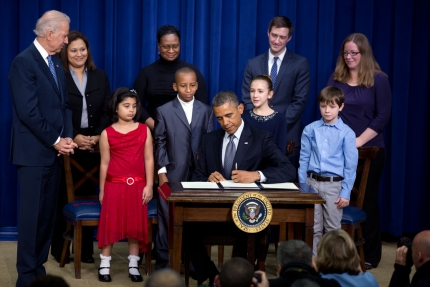
On Wednesday, when President Obama announced the concrete plan he was putting forward to reduce gun violence, he shared the stage with four of the people who wrote him letters. The four had something in common besides their concern; each of them represented a group of Americans President Obama’s proposals are specifically designed to help protect -- our nation’s children.

Below, listen to Hinna, Taejah, Julia and Grant read the letters they wrote to President Obama. Then, learn more about his plan to reduce gun violence and add your voice the conversation.

Related Topics: Violence Prevention

Regional Round Up: Now is the Time

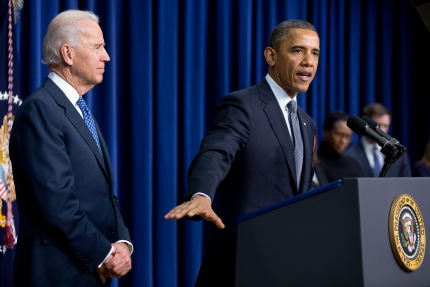
President Barack Obama, with Vice President Joe Biden, delivers remarks unveiling new gun control proposals Jan.16, 2013

President Barack Obama, with Vice President Joe Biden, delivers remarks unveiling new gun control proposals as part of the Administration’s response to the Newtown, Conn. shootings, and other tragedies, in the Eisenhower Executive Office Building, Jan. 16, 2013. (Official White House Photo by Pete Souza)

Yesterday at the White House, President Obama unveiled a package of proposals to protect our children and our communities by reducing gun violence. While no law or set of laws will end gun violence, it is clear that the American people want action. Editorial pages across the country today echoed that sentiment and lauded the President’s broad approach to address this important issue now:

CA - Bakersfield Californian: Obama's plan isn't an end-all, but it's a start. President Obama put forth his long-awaited proposal to address gun violence on Wednesday -- a common-sense yet somehow controversial plan long overdue at the national level. LINK

CA - San Jose Mercury News: Obama ready for a fight on gun laws, finally. "All right, here we go." Those were President Barack Obama's words Wednesday after he signed 23 executive actions and proposed the most sweeping set of gun-reform laws in a generation. He was acknowledging the beginning of a long and difficult fight that he is finally embracing after years of inaction. LINK

CO - Denver Post: Gun laws need a push from the public. President Obama's proposals to curb gun violence are sensible, moderate, enjoy broad public support— and will have a devil of a time getting enough votes to pass Congress. LINK

CT - Connecticut Post: Welcome steps on gun safety. President Barack Obama was decisive and authoritative on Wednesday in announcing 23 executive orders aimed at curtailing gun violence. LINK

CT - Hartford Courant: Obama Throws Down Gauntlet On Guns. It's "game on" between President Barack Obama and the gun lobby. With parents of a Sandy Hook Elementary School shooting victim in his audience Wednesday, Mr. Obama embraced a cause — making the nation less vulnerable to gun violence — that may prove to be the most politically difficult of his presidency. LINK

Josh Earnest is the Principal Deputy Press Secretary in the White House Office of Communications

The White House

Office of the Press Secretary

President Obama Announces More Key Administration Posts

WASHINGTON, DC – Today, President Barack Obama announced his intent to appoint the following individuals to key Administration posts:

• Vinton G. Cerf – Member, National Science Board, National Science Foundation
• Marta Araoz de la Torre – Member, Cultural Property Advisory Committee
• Michael Graves – Member, Architectural and Transportation Barriers Compliance Board
• Laurie Leshin – Member, Advisory Board of the National Air and Space Museum
• Lynne Sebastian – Member, Advisory Council on Historic Preservation

President Obama said, “These fine public servants both bring a depth of experience and tremendous dedication to their new roles.  Our nation will be well-served by these individuals, and I look forward to working with them in the months and years to come.”

President Obama announced his intent to appoint the following individuals to key Administration posts:

Dr. Vinton G. Cerf, Appointee for Member, National Science Board, National Science Foundation
Dr. Vinton G. Cerf is Vice President and Chief Internet Evangelist at Google, a position he has held since 2005.  Previously, he was the Senior Vice President at MCI from 1994 to 2005.  From 1986 to 1994, he served as Vice President of the Corporation for National Research Initiatives, and from 1976 to 1982, he worked as a Program Manager and Principal Scientist at the Defense Advanced Research Projects Agency. Dr. Cerf is President of the Association for Computing Machinery and serves on the Board of the American Registry for Internet Numbers.  He is a distinguished visiting scientist at NASA’s Jet Propulsion Laboratory, and is Chair of the Visiting Committee on Advanced Technology at the U.S. National Institute of Standards and Technology.  From 2000 to 2007, he served as the Chairman of the Internet Corporation for Assigned Names and Numbers.  Dr. Cerf received the Presidential Medal of Freedom in 2005, the National Medal of Technology in 1997, and the ACM Alan M. Turing Prize in 2004 for his contributions to the development of the Internet.  Dr. Cerf received a B.S. from Stanford University, and an M.S. and Ph.D. from the University of California, Los Angeles.

Marta Araoz de la Torre, Appointee for Member, Cultural Property Advisory Committee
Marta Araoz de la Torre is an independent heritage consultant.  From 2003 to 2008, she was the Director of the Museum Studies Graduate Certificate Program at Florida International University in Miami.  From 1985 to 2002, she was a Director at the Getty Conservation Institute in Los Angeles.  Ms. de la Torre was first appointed as a Member of the Cultural Property Advisory Committee (CPAC) by President Obama in October 2011.  She previously served as a Member of CPAC from 2003 to 2008.  Ms. de la Torre served on the Board of Studies of the Wall Paintings Conservation Course of the Courtauld Institute in London, and on the Hamilton Kerr Institute in Cambridge, U.K.  She has served on the Executive Committee of the International Council of Museums and the Board of the American Association of Museums/International Council of Museums.  Ms. de la Torre received a B.A. from the George Washington University and an M.A. from American University.

Michael Graves, Appointee for Member, Architectural and Transportation Barriers Compliance Board
Michael Graves is the founding principal of Michael Graves & Associates, an architecture and design firm that he founded in 1964.  Since then, the practice has evolved into two firms: Michael Graves & Associates and Michael Graves Design Group.  Mr. Graves is also the Robert Schirmer Professor of Architecture, Emeritus at Princeton University, where he taught for nearly 40 years.  The recipient of numerous awards and honors, Mr. Graves is the 2012 Richard H. Driehaus Prize Laureate and the 2010 recipient of the AIA/ACSA Topaz Medallion.  Additionally, he received the American Institute of Architects’ Gold Medal in 2001, the National Medal of Arts in 1999, and was named one of the Top 25 Most Influential People in Healthcare Design by the Center for Health Design in 2010.  He is a Fellow of the American Institute of Architects, and is a Member of the American Academy of Arts and Letters, and serves on the Board of Trustees of the American Academy in Rome. Mr. Graves received a B.S.Arch from the University of Cincinnati and an M.Arch from Harvard University.

Dr. Laurie Leshin, Appointee for Member, Advisory Board of the National Air and Space Museum
Dr. Laurie Leshin is Dean of the School of Science at Rensselaer Polytechnic Institute.  From 2005 to 2011, she served in various senior roles at NASA, including Deputy Associate Administrator for NASA Headquarters' Exploration Systems Mission Directorate, the Deputy Center Director for Science and Technology, and Director of Science at NASA’s Goddard Space Flight Center.  Before joining NASA, Dr. Leshin was the Dee and John Whiteman Dean’s Distinguished Professor of Geological Sciences and the Director of the Center for Meteorite Studies at Arizona State University.  Dr. Leshin was appointed to the President’s Commission on Implementation of United States Space Exploration Policy in 2004.  In 1996, she was awarded the Nier Prize for outstanding research by a scientist under the age of 35 by the Meteoritical Society.  The International Astronomical Union recognized her contributions to planetary science with the naming of asteroid 4922 Leshin.  She received a B.S. from Arizona State University and a Ph. D. from the California Institute of Technology.

Dr. Lynne Sebastian, Appointee for Member, Advisory Council on Historic Preservation
Dr. Lynne Sebastian is Director of Historic Preservation Programs at the Statistical Research Inc. Foundation, a position she has held since 2001.  She is also an Adjunct Associate Professor of Anthropology at the University of New Mexico.  Dr. Sebastian was the State Historic Preservation Officer for the State of New Mexico from 1997 to 1999, and she was the Deputy State Historic Preservation Officer and the State Archaeologist from 1987 to 1997.  She is the President of the Register of Professional Archaeologists and was the President of the Society for American Archaeology from 2003 to 2005.  Dr. Sebastian received a B.A. from the University of Michigan, an M.A. from the University of Utah, and a Ph.D. in Anthropology from the University of New Mexico.

President Obama Introduces a Plan to Reduce Gun Violence

January 16, 2013 | 25:49 | Public Domain

President Obama puts forward a specific plan to protect our children and communities by reducing gun violence, introducing legislative and executive action that combined would close background check loopholes to keep guns out of dangerous hands; ban military-style assault weapons and high-capacity magazines, and taking other common-sense steps to reduce gun violence; make schools safer; and increase access to mental health services.

Download mp4 (959MB) | mp3 (62MB)

Read the Transcript

Remarks by the President and the Vice President on Gun Violence

South Court Auditorium

11:52 A.M. EST

THE VICE PRESIDENT:  Before I begin today, let me say to the families of the innocents who were murdered 33 days ago, our heart goes out to you.  And you show incredible courage -- incredible courage -- being here.  And the President and I are going to do everything in our power to honor the memory of your children and your wives with the work we take up here today.

It’s been 33 days since the nation’s heart was broken by the horrific, senseless violence that took place at Sandy Hook Elementary School -- 20 -- 20 beautiful first-graders gunned down in a place that's supposed to be their second sanctuary.  Six members of the staff killed trying to save those children.  It’s literally been hard for the nation to comprehend, hard for the nation to fathom.

And I know for the families who are here that time is not measured in days, but it’s measured in minutes, in seconds, since you received that news.  Another minute without your daughter. Another minute without your son.  Another minute without your wife.  Another minute without your mom.

I want to personally thank Chris and Lynn McDonald, who lost their beautiful daughter, Grace, and the other parents who I had a chance to speak to, for their suggestions and for -- again, just for the courage of all of you to be here today.  I admire the grace and the resolve that you all are showing.  And I must say I’ve been deeply affected by your faith, as well.  And the President and I are going to do everything to try to match the resolve you’ve demonstrated. 

No one can know for certain if this senseless act could have been prevented, but we all know we have a moral obligation -- a moral obligation -- to do everything in our power to diminish the prospect that something like this could happen again.

As the President knows, I’ve worked in this field a long time -- in the United States Senate, having chaired a committee that had jurisdiction over these issues of guns and crime, and having drafted the first gun violence legislation -- the last gun violence legislation, I should say.  And I have no illusions about what we’re up against or how hard the task is in front of us.  But I also have never seen the nation’s conscience so shaken by what happened at Sandy Hook.  The world has changed, and it’s demanding action.

It’s in this context that the President asked me to put together, along with Cabinet members, a set of recommendations about how we should proceed to meet that moral obligation we have.  And toward that end, the Cabinet members and I sat down with 229 groups -- not just individuals, representing groups -- 229 groups from law enforcement agencies to public health officials, to gun officials, to gun advocacy groups, to sportsmen and hunters and religious leaders.  And I’ve spoken with members of Congress on both sides of the aisle, had extensive conversations with mayors and governors and county officials. 

And the recommendations we provided to the President on Monday call for executive actions he could sign, legislation he could call for, and long-term research that should be undertaken. They're based on the emerging consensus we heard from all the groups with whom we spoke, including some of you who are victims of this god-awful occurrence -- ways to keep guns out of the wrong hands, as well as ways to take comprehensive action to prevent violence in the first place. 

We should do as much as we can, as quickly as we can.  And we cannot let the perfect be the enemy of the good.  So some of what you will hear from the President will happen immediately; some will take some time.  But we have begun.  And we are starting here today and we’re going to resolve to continue this fight.

During the meetings that we held, we met with a young man who’s here today -- I think Colin Goddard is here.  Where are you, Colin?  Colin was one of the survivors of the Virginia Tech massacre.  He was in the classroom.  He calls himself one of the “lucky seven.”  And he’ll tell you he was shot four times on that day and he has three bullets that are still inside him. 

And when I asked Colin about what he thought we should be doing, he said, “I’m not here because of what happened to me. I’m here because of what happened to me keeps happening to other people and we have to do something about it.”

Colin, we will.  Colin, I promise you, we will.  This is our intention.  We must do what we can now.  And there’s no person who is more committed to acting on this moral obligation we have than the President of the United States of America.

Ladies and gentlemen, President Barack Obama.  (Applause.)

THE PRESIDENT:  Thank you, everybody.  Please have a seat.  Good afternoon, everybody. 

Let me begin by thanking our Vice President, Joe Biden, for your dedication, Joe, to this issue, for bringing so many different voices to the table.  Because while reducing gun violence is a complicated challenge, protecting our children from harm shouldn’t be a divisive one. 

Over the month since the tragedy in Newtown, we’ve heard from so many, and, obviously, none have affected us more than the families of those gorgeous children and their teachers and guardians who were lost.  And so we’re grateful to all of you for taking the time to be here, and recognizing that we honor their memories in part by doing everything we can to prevent this from happening again.

But we also heard from some unexpected people.  In particular, I started getting a lot of letters from kids.  Four of them are here today -- Grant Fritz, Julia Stokes, Hinna Zeejah, and Teja Goode.  They’re pretty representative of some of the messages that I got.  These are some pretty smart letters from some pretty smart young people. 

Hinna, a third-grader -- you can go ahead and wave, Hinna. That’s you -- (laughter.)  Hinna wrote, “I feel terrible for the parents who lost their children…I love my country and [I] want everybody to be happy and safe.”

And then, Grant -- go ahead and wave, Grant.  (Laughter.)  Grant said, “I think there should be some changes.  We should learn from what happened at Sandy Hook…I feel really bad.”

And then, Julia said -- Julia, where are you?  There you go -- “I’m not scared for my safety, I’m scared for others.  I have four brothers and sisters and I know I would not be able to bear the thought of losing any of them.”

These are our kids.  This is what they’re thinking about.  And so what we should be thinking about is our responsibility to care for them, and shield them from harm, and give them the tools they need to grow up and do everything that they’re capable of doing -- not just to pursue their own dreams, but to help build this country.  This is our first task as a society, keeping our children safe.  This is how we will be judged.  And their voices should compel us to change.

And that’s why, last month, I asked Joe to lead an effort, along with members of my Cabinet, to come up with some concrete steps we can take right now to keep our children safe, to help prevent mass shootings, to reduce the broader epidemic of gun violence in this country. 

And we can't put this off any longer.  Just last Thursday, as TV networks were covering one of Joe’s meetings on this topic, news broke of another school shooting, this one in California.  In the month since 20 precious children and six brave adults were violently taken from us at Sandy Hook Elementary, more than 900 of our fellow Americans have reportedly died at the end of a gun -- 900 in the past month.  And every day we wait, that number will keep growing.

So I’m putting forward a specific set of proposals based on the work of Joe’s task force.  And in the days ahead, I intend to use whatever weight this office holds to make them a reality. Because while there is no law or set of laws that can prevent every senseless act of violence completely, no piece of legislation that will prevent every tragedy, every act of evil, if there is even one thing we can do to reduce this violence, if there is even one life that can be saved, then we've got an obligation to try.

And I’m going to do my part.  As soon as I'm finished speaking here, I will sit at that desk and I will sign a directive giving law enforcement, schools, mental health professionals and the public health community some of the tools they need to help reduce gun violence.

We will make it easier to keep guns out of the hands of criminals by strengthening the background check system.  We will help schools hire more resource officers if they want them and develop emergency preparedness plans.  We will make sure mental health professionals know their options for reporting threats of violence -- even as we acknowledge that someone with a mental illness is far more likely to be a victim of violent crime than the perpetrator. 

And while year after year, those who oppose even modest gun safety measures have threatened to defund scientific or medical research into the causes of gun violence, I will direct the Centers for Disease Control to go ahead and study the best ways to reduce it -- and Congress should fund research into the effects that violent video games have on young minds.  We don't benefit from ignorance.  We don't benefit from not knowing the science of this epidemic of violence.

These are a few of the 23 executive actions that I’m announcing today.  But as important as these steps are, they are in no way a substitute for action from members of Congress.  To make a real and lasting difference, Congress, too, must act -- and Congress must act soon.  And I’m calling on Congress to pass some very specific proposals right away.

First:  It’s time for Congress to require a universal background check for anyone trying to buy a gun.  (Applause.)   The law already requires licensed gun dealers to run background checks, and over the last 14 years that’s kept 1.5 million of the wrong people from getting their hands on a gun.  But it’s hard to enforce that law when as many as 40 percent of all gun purchases are conducted without a background check.  That’s not safe.  That's not smart.  It’s not fair to responsible gun buyers or sellers. 

If you want to buy a gun -- whether it’s from a licensed dealer or a private seller -- you should at least have to show you are not a felon or somebody legally prohibited from buying one.  This is common sense.  And an overwhelming majority of Americans agree with us on the need for universal background checks -- including more than 70 percent of the National Rifle Association’s members, according to one survey.  So there’s no reason we can’t do this.

Second:  Congress should restore a ban on military-style assault weapons, and a 10-round limit for magazines.  (Applause.) The type of assault rifle used in Aurora, for example, when paired with high-capacity magazines, has one purpose -- to pump out as many bullets as possible, as quickly as possible; to do as much damage, using bullets often designed to inflict maximum damage. 

And that's what allowed the gunman in Aurora to shoot 70 people -- 70 people -- killing 12 in a matter of minutes.  Weapons designed for the theater of war have no place in a movie theater.  A majority of Americans agree with us on this. 

And, by the way, so did Ronald Reagan, one of the staunchest defenders of the Second Amendment, who wrote to Congress in 1994, urging them -- this is Ronald Reagan speaking -- urging them to “listen to the American public and to the law enforcement community and support a ban on the further manufacture of [military-style assault] weapons.”  (Applause.) 

And finally, Congress needs to help, rather than hinder, law enforcement as it does its job.  We should get tougher on people who buy guns with the express purpose of turning around and selling them to criminals.  And we should severely punish anybody who helps them do this.  Since Congress hasn’t confirmed a director of the Bureau of Alcohol, Tobacco and Firearms in six years, they should confirm Todd Jones, who will be -- who has been Acting, and I will be nominating for the post.  (Applause.)

And at a time when budget cuts are forcing many communities to reduce their police force, we should put more cops back on the job and back on our streets.

Let me be absolutely clear.  Like most Americans, I believe the Second Amendment guarantees an individual right to bear arms. I respect our strong tradition of gun ownership and the rights of hunters and sportsmen.  There are millions of responsible, law-abiding gun owners in America who cherish their right to bear arms for hunting, or sport, or protection, or collection. 

I also believe most gun owners agree that we can respect the Second Amendment while keeping an irresponsible, law-breaking few from inflicting harm on a massive scale.  I believe most of them agree that if America worked harder to keep guns out of the hands of dangerous people, there would be fewer atrocities like the one that occurred in Newtown.  That’s what these reforms are designed to do.  They’re common-sense measures.  They have the support of the majority of the American people. 

And yet, that doesn’t mean any of this is going to be easy to enact or implement.  If it were, we’d already have universal background checks.  The ban on assault weapons and high-capacity magazines never would have been allowed to expire.  More of our fellow Americans might still be alive, celebrating birthdays and anniversaries and graduations. 

This will be difficult.  There will be pundits and politicians and special interest lobbyists publicly warning of a tyrannical, all-out assault on liberty -- not because that’s true, but because they want to gin up fear or higher ratings or revenue for themselves.  And behind the scenes, they’ll do everything they can to block any common-sense reform and make sure nothing changes whatsoever. 

The only way we will be able to change is if their audience, their constituents, their membership says this time must be different -- that this time, we must do something to protect our communities and our kids. 

I will put everything I've got into this, and so will Joe.  But I tell you, the only way we can change is if the American people demand it.  And by the way, that doesn’t just mean from certain parts of the country.  We're going to need voices in those areas, in those congressional districts, where the tradition of gun ownership is strong to speak up and to say this is important.  It can't just be the usual suspects.  We have to examine ourselves and our hearts, and ask ourselves what is important. 

This will not happen unless the American people demand it.  If parents and teachers, police officers and pastors, if hunters and sportsmen, if responsible gun owners, if Americans of every background stand up and say, enough; we’ve suffered too much pain and care too much about our children to allow this to continue -- then change will come.  That's what it's going to take.

In the letter that Julia wrote me, she said, “I know that laws have to be passed by Congress, but I beg you to try very hard.”  (Laughter.)  Julia, I will try very hard.  But she’s right.  The most important changes we can make depend on congressional action.  They need to bring these proposals up for a vote, and the American people need to make sure that they do. 

Get them on record.  Ask your member of Congress if they support universal background checks to keep guns out of the wrong hands. Ask them if they support renewing a ban on military-style assault weapons and high-capacity magazines.  And if they say no, ask them why not.  Ask them what’s more important -- doing whatever it takes to get a A grade from the gun lobby that funds their campaigns, or giving parents some peace of mind when they drop their child off for first grade?  (Applause.)

This is the land of the free, and it always will be.  As Americans, we are endowed by our Creator with certain inalienable rights that no man or government can take away from us.  But we've also long recognized, as our Founders recognized, that with rights come responsibilities.  Along with our freedom to live our lives as we will comes an obligation to allow others to do the same.  We don’t live in isolation.  We live in a society, a government of, and by, and for the people.  We are responsible for each other. 

The right to worship freely and safely, that right was denied to Sikhs in Oak Creek, Wisconsin.  The right to assemble peaceably, that right was denied shoppers in Clackamas, Oregon, and moviegoers in Aurora, Colorado.  That most fundamental set of rights to life and liberty and the pursuit of happiness -- fundamental rights that were denied to college students at Virginia Tech, and high school students at Columbine, and elementary school students in Newtown, and kids on street corners in Chicago on too frequent a basis to tolerate, and all the families who’ve never imagined that they’d lose a loved one to a bullet -- those rights are at stake.  We’re responsible.

When I visited Newtown last month, I spent some private time with many of the families who lost their children that day.  And one was the family of Grace McDonald.  Grace’s parents are here. Grace was seven years old when she was struck down -- just a gorgeous, caring, joyful little girl.  I’m told she loved pink. She loved the beach.  She dreamed of becoming a painter. 

And so just before I left, Chris, her father, gave me one of her paintings, and I hung it in my private study just off the Oval Office.  And every time I look at that painting, I think about Grace.  And I think about the life that she lived and the life that lay ahead of her, and most of all, I think about how, when it comes to protecting the most vulnerable among us, we must act now -- for Grace.  For the 25 other innocent children and devoted educators who had so much left to give.  For the men and women in big cities and small towns who fall victim to senseless violence each and every day.  For all the Americans who are counting on us to keep them safe from harm.  Let’s do the right thing.  Let’s do the right thing for them, and for this country that we love so much.  (Applause.) 

Thank you.  Let’s sign these orders.  (Applause.)

(The executive orders are signed.)  (Applause.)

All right, there we go.  (Applause.)

END   
12:17 P.M. EST

Close Transcript

The White House

Office of the Press Secretary

Letter from the President -- LIBERTAD Act

Dear Mr. Chairman: (Dear Madam Chairman:)

(Dear Representative:) (Dear Senator:)

Consistent with section 306(c)(2) of the Cuban Liberty and Democratic Solidarity (LIBERTAD) Act of 1996 (Public Law 104-114) (the "Act"), I hereby determine and report to the Congress that suspension, for 6 months beyond February 1, 2013, of the right to bring an action under title III of the Act is necessary to the national interests of the United States and will expedite a transition to democracy in Cuba.

Sincerely,

BARACK OBAMA

President Obama Announces New Measures to Prevent Gun Violence

President Barack Obama signs executive orders initiating 23 executive actions on gun control, Jan 16, 2013

President Barack Obama, with Vice President Joe Biden, signs executive orders initiating 23 separate executive actions, after delivering remarks to unveil new gun control proposals as part of the Administration’s response to the Newtown, Conn., shootings, and other tragedies, in the Eisenhower Executive Office Building, Jan. 16, 2013. Joining them on stage are children from around the country who wrote the President letters in the wake of the Newtown tragedy expressing their concerns about gun violence and school safety, and their parents. (Official White House Photo by Lawrence Jackson)

President Obama today announced a series of sweeping reforms that will help curb gun violence in our nation.

In front of a crowd that included victims of gun violence, families who lost loved ones to gun violence, elected officials, and school children who had written letters asking him to do something to prevent more senseless massacres like the one at Sandy Hook Elementary School, the President introduced a comprehensive proposal that will make it easier to keep guns out of the hands of criminals and will give law enforcement, schools, mental health professionals, and the public health community the tools they need to help reduce gun violence, and keep our children safe.  

“This is our first task as a society,” the President said. “This is how we will be judged.  And their voices should compel us to change.”

These actions are the result of the effort led by Vice President Joe Biden and members of the Cabinet to come up with concrete steps that we can take right now to keep our children safe, help prevent mass shootings, and reduce the broader epidemic of gun violence in this country. 

The President acknowledged that implementing some of these changes will be difficult, but vowed to make it a priority: “I intend to use whatever weight this office holds to make them a reality. Because while there is no law or set of laws that can prevent every senseless act of violence completely, if there is even one thing we can do to reduce this violence – if even one life can be saved – we have an obligation to try.”

The White House

Office of the Press Secretary

Remarks by the President and the Vice President on Gun Violence

South Court Auditorium

11:52 A.M. EST

THE VICE PRESIDENT:  Before I begin today, let me say to the families of the innocents who were murdered 33 days ago, our heart goes out to you.  And you show incredible courage -- incredible courage -- being here.  And the President and I are going to do everything in our power to honor the memory of your children and your wives with the work we take up here today.

It’s been 33 days since the nation’s heart was broken by the horrific, senseless violence that took place at Sandy Hook Elementary School -- 20 -- 20 beautiful first-graders gunned down in a place that's supposed to be their second sanctuary.  Six members of the staff killed trying to save those children.  It’s literally been hard for the nation to comprehend, hard for the nation to fathom.

And I know for the families who are here that time is not measured in days, but it’s measured in minutes, in seconds, since you received that news.  Another minute without your daughter. Another minute without your son.  Another minute without your wife.  Another minute without your mom.

I want to personally thank Chris and Lynn McDonald, who lost their beautiful daughter, Grace, and the other parents who I had a chance to speak to, for their suggestions and for -- again, just for the courage of all of you to be here today.  I admire the grace and the resolve that you all are showing.  And I must say I’ve been deeply affected by your faith, as well.  And the President and I are going to do everything to try to match the resolve you’ve demonstrated. 

No one can know for certain if this senseless act could have been prevented, but we all know we have a moral obligation -- a moral obligation -- to do everything in our power to diminish the prospect that something like this could happen again.

As the President knows, I’ve worked in this field a long time -- in the United States Senate, having chaired a committee that had jurisdiction over these issues of guns and crime, and having drafted the first gun violence legislation -- the last gun violence legislation, I should say.  And I have no illusions about what we’re up against or how hard the task is in front of us.  But I also have never seen the nation’s conscience so shaken by what happened at Sandy Hook.  The world has changed, and it’s demanding action.

It’s in this context that the President asked me to put together, along with Cabinet members, a set of recommendations about how we should proceed to meet that moral obligation we have.  And toward that end, the Cabinet members and I sat down with 229 groups -- not just individuals, representing groups -- 229 groups from law enforcement agencies to public health officials, to gun officials, to gun advocacy groups, to sportsmen and hunters and religious leaders.  And I’ve spoken with members of Congress on both sides of the aisle, had extensive conversations with mayors and governors and county officials. 

And the recommendations we provided to the President on Monday call for executive actions he could sign, legislation he could call for, and long-term research that should be undertaken. They're based on the emerging consensus we heard from all the groups with whom we spoke, including some of you who are victims of this god-awful occurrence -- ways to keep guns out of the wrong hands, as well as ways to take comprehensive action to prevent violence in the first place. 

We should do as much as we can, as quickly as we can.  And we cannot let the perfect be the enemy of the good.  So some of what you will hear from the President will happen immediately; some will take some time.  But we have begun.  And we are starting here today and we’re going to resolve to continue this fight.

During the meetings that we held, we met with a young man who’s here today -- I think Colin Goddard is here.  Where are you, Colin?  Colin was one of the survivors of the Virginia Tech massacre.  He was in the classroom.  He calls himself one of the “lucky seven.”  And he’ll tell you he was shot four times on that day and he has three bullets that are still inside him. 

And when I asked Colin about what he thought we should be doing, he said, “I’m not here because of what happened to me. I’m here because of what happened to me keeps happening to other people and we have to do something about it.”

Colin, we will.  Colin, I promise you, we will.  This is our intention.  We must do what we can now.  And there’s no person who is more committed to acting on this moral obligation we have than the President of the United States of America.

Ladies and gentlemen, President Barack Obama.  (Applause.)

THE PRESIDENT:  Thank you, everybody.  Please have a seat.  Good afternoon, everybody. 

Let me begin by thanking our Vice President, Joe Biden, for your dedication, Joe, to this issue, for bringing so many different voices to the table.  Because while reducing gun violence is a complicated challenge, protecting our children from harm shouldn’t be a divisive one. 

Over the month since the tragedy in Newtown, we’ve heard from so many, and, obviously, none have affected us more than the families of those gorgeous children and their teachers and guardians who were lost.  And so we’re grateful to all of you for taking the time to be here, and recognizing that we honor their memories in part by doing everything we can to prevent this from happening again.

But we also heard from some unexpected people.  In particular, I started getting a lot of letters from kids.  Four of them are here today -- Grant Fritz, Julia Stokes, Hinna Zeejah, and Teja Goode.  They’re pretty representative of some of the messages that I got.  These are some pretty smart letters from some pretty smart young people. 

Hinna, a third-grader -- you can go ahead and wave, Hinna. That’s you -- (laughter.)  Hinna wrote, “I feel terrible for the parents who lost their children…I love my country and [I] want everybody to be happy and safe.”

And then, Grant -- go ahead and wave, Grant.  (Laughter.)  Grant said, “I think there should be some changes.  We should learn from what happened at Sandy Hook…I feel really bad.”

And then, Julia said -- Julia, where are you?  There you go -- “I’m not scared for my safety, I’m scared for others.  I have four brothers and sisters and I know I would not be able to bear the thought of losing any of them.”

These are our kids.  This is what they’re thinking about.  And so what we should be thinking about is our responsibility to care for them, and shield them from harm, and give them the tools they need to grow up and do everything that they’re capable of doing -- not just to pursue their own dreams, but to help build this country.  This is our first task as a society, keeping our children safe.  This is how we will be judged.  And their voices should compel us to change.

And that’s why, last month, I asked Joe to lead an effort, along with members of my Cabinet, to come up with some concrete steps we can take right now to keep our children safe, to help prevent mass shootings, to reduce the broader epidemic of gun violence in this country. 

And we can't put this off any longer.  Just last Thursday, as TV networks were covering one of Joe’s meetings on this topic, news broke of another school shooting, this one in California.  In the month since 20 precious children and six brave adults were violently taken from us at Sandy Hook Elementary, more than 900 of our fellow Americans have reportedly died at the end of a gun -- 900 in the past month.  And every day we wait, that number will keep growing.

So I’m putting forward a specific set of proposals based on the work of Joe’s task force.  And in the days ahead, I intend to use whatever weight this office holds to make them a reality. Because while there is no law or set of laws that can prevent every senseless act of violence completely, no piece of legislation that will prevent every tragedy, every act of evil, if there is even one thing we can do to reduce this violence, if there is even one life that can be saved, then we've got an obligation to try.

And I’m going to do my part.  As soon as I'm finished speaking here, I will sit at that desk and I will sign a directive giving law enforcement, schools, mental health professionals and the public health community some of the tools they need to help reduce gun violence.

We will make it easier to keep guns out of the hands of criminals by strengthening the background check system.  We will help schools hire more resource officers if they want them and develop emergency preparedness plans.  We will make sure mental health professionals know their options for reporting threats of violence -- even as we acknowledge that someone with a mental illness is far more likely to be a victim of violent crime than the perpetrator. 

And while year after year, those who oppose even modest gun safety measures have threatened to defund scientific or medical research into the causes of gun violence, I will direct the Centers for Disease Control to go ahead and study the best ways to reduce it -- and Congress should fund research into the effects that violent video games have on young minds.  We don't benefit from ignorance.  We don't benefit from not knowing the science of this epidemic of violence.

These are a few of the 23 executive actions that I’m announcing today.  But as important as these steps are, they are in no way a substitute for action from members of Congress.  To make a real and lasting difference, Congress, too, must act -- and Congress must act soon.  And I’m calling on Congress to pass some very specific proposals right away.

First:  It’s time for Congress to require a universal background check for anyone trying to buy a gun.  (Applause.)   The law already requires licensed gun dealers to run background checks, and over the last 14 years that’s kept 1.5 million of the wrong people from getting their hands on a gun.  But it’s hard to enforce that law when as many as 40 percent of all gun purchases are conducted without a background check.  That’s not safe.  That's not smart.  It’s not fair to responsible gun buyers or sellers. 

If you want to buy a gun -- whether it’s from a licensed dealer or a private seller -- you should at least have to show you are not a felon or somebody legally prohibited from buying one.  This is common sense.  And an overwhelming majority of Americans agree with us on the need for universal background checks -- including more than 70 percent of the National Rifle Association’s members, according to one survey.  So there’s no reason we can’t do this.

Second:  Congress should restore a ban on military-style assault weapons, and a 10-round limit for magazines.  (Applause.) The type of assault rifle used in Aurora, for example, when paired with high-capacity magazines, has one purpose -- to pump out as many bullets as possible, as quickly as possible; to do as much damage, using bullets often designed to inflict maximum damage. 

And that's what allowed the gunman in Aurora to shoot 70 people -- 70 people -- killing 12 in a matter of minutes.  Weapons designed for the theater of war have no place in a movie theater.  A majority of Americans agree with us on this. 

And, by the way, so did Ronald Reagan, one of the staunchest defenders of the Second Amendment, who wrote to Congress in 1994, urging them -- this is Ronald Reagan speaking -- urging them to “listen to the American public and to the law enforcement community and support a ban on the further manufacture of [military-style assault] weapons.”  (Applause.) 

And finally, Congress needs to help, rather than hinder, law enforcement as it does its job.  We should get tougher on people who buy guns with the express purpose of turning around and selling them to criminals.  And we should severely punish anybody who helps them do this.  Since Congress hasn’t confirmed a director of the Bureau of Alcohol, Tobacco and Firearms in six years, they should confirm Todd Jones, who will be -- who has been Acting, and I will be nominating for the post.  (Applause.)

And at a time when budget cuts are forcing many communities to reduce their police force, we should put more cops back on the job and back on our streets.

Let me be absolutely clear.  Like most Americans, I believe the Second Amendment guarantees an individual right to bear arms. I respect our strong tradition of gun ownership and the rights of hunters and sportsmen.  There are millions of responsible, law-abiding gun owners in America who cherish their right to bear arms for hunting, or sport, or protection, or collection. 

I also believe most gun owners agree that we can respect the Second Amendment while keeping an irresponsible, law-breaking few from inflicting harm on a massive scale.  I believe most of them agree that if America worked harder to keep guns out of the hands of dangerous people, there would be fewer atrocities like the one that occurred in Newtown.  That’s what these reforms are designed to do.  They’re common-sense measures.  They have the support of the majority of the American people. 

And yet, that doesn’t mean any of this is going to be easy to enact or implement.  If it were, we’d already have universal background checks.  The ban on assault weapons and high-capacity magazines never would have been allowed to expire.  More of our fellow Americans might still be alive, celebrating birthdays and anniversaries and graduations. 

This will be difficult.  There will be pundits and politicians and special interest lobbyists publicly warning of a tyrannical, all-out assault on liberty -- not because that’s true, but because they want to gin up fear or higher ratings or revenue for themselves.  And behind the scenes, they’ll do everything they can to block any common-sense reform and make sure nothing changes whatsoever. 

The only way we will be able to change is if their audience, their constituents, their membership says this time must be different -- that this time, we must do something to protect our communities and our kids. 

I will put everything I've got into this, and so will Joe.  But I tell you, the only way we can change is if the American people demand it.  And by the way, that doesn’t just mean from certain parts of the country.  We're going to need voices in those areas, in those congressional districts, where the tradition of gun ownership is strong to speak up and to say this is important.  It can't just be the usual suspects.  We have to examine ourselves and our hearts, and ask ourselves what is important. 

This will not happen unless the American people demand it.  If parents and teachers, police officers and pastors, if hunters and sportsmen, if responsible gun owners, if Americans of every background stand up and say, enough; we’ve suffered too much pain and care too much about our children to allow this to continue -- then change will come.  That's what it's going to take.

In the letter that Julia wrote me, she said, “I know that laws have to be passed by Congress, but I beg you to try very hard.”  (Laughter.)  Julia, I will try very hard.  But she’s right.  The most important changes we can make depend on congressional action.  They need to bring these proposals up for a vote, and the American people need to make sure that they do. 

Get them on record.  Ask your member of Congress if they support universal background checks to keep guns out of the wrong hands. Ask them if they support renewing a ban on military-style assault weapons and high-capacity magazines.  And if they say no, ask them why not.  Ask them what’s more important -- doing whatever it takes to get a A grade from the gun lobby that funds their campaigns, or giving parents some peace of mind when they drop their child off for first grade?  (Applause.)

This is the land of the free, and it always will be.  As Americans, we are endowed by our Creator with certain inalienable rights that no man or government can take away from us.  But we've also long recognized, as our Founders recognized, that with rights come responsibilities.  Along with our freedom to live our lives as we will comes an obligation to allow others to do the same.  We don’t live in isolation.  We live in a society, a government of, and by, and for the people.  We are responsible for each other. 

The right to worship freely and safely, that right was denied to Sikhs in Oak Creek, Wisconsin.  The right to assemble peaceably, that right was denied shoppers in Clackamas, Oregon, and moviegoers in Aurora, Colorado.  That most fundamental set of rights to life and liberty and the pursuit of happiness -- fundamental rights that were denied to college students at Virginia Tech, and high school students at Columbine, and elementary school students in Newtown, and kids on street corners in Chicago on too frequent a basis to tolerate, and all the families who’ve never imagined that they’d lose a loved one to a bullet -- those rights are at stake.  We’re responsible.

When I visited Newtown last month, I spent some private time with many of the families who lost their children that day.  And one was the family of Grace McDonald.  Grace’s parents are here. Grace was seven years old when she was struck down -- just a gorgeous, caring, joyful little girl.  I’m told she loved pink. She loved the beach.  She dreamed of becoming a painter. 

And so just before I left, Chris, her father, gave me one of her paintings, and I hung it in my private study just off the Oval Office.  And every time I look at that painting, I think about Grace.  And I think about the life that she lived and the life that lay ahead of her, and most of all, I think about how, when it comes to protecting the most vulnerable among us, we must act now -- for Grace.  For the 25 other innocent children and devoted educators who had so much left to give.  For the men and women in big cities and small towns who fall victim to senseless violence each and every day.  For all the Americans who are counting on us to keep them safe from harm.  Let’s do the right thing.  Let’s do the right thing for them, and for this country that we love so much.  (Applause.) 

Thank you.  Let’s sign these orders.  (Applause.)

(The executive orders are signed.)  (Applause.)

All right, there we go.  (Applause.)

END   
12:17 P.M. EST

The White House

Office of the Press Secretary

Presidential Memorandum -- Engaging in Public Health Research on the Causes and Prevention of Gun Violence

January 16, 2013
 
 
MEMORANDUM FOR THE SECRETARY OF HEALTH AND HUMAN SERVICES
 
SUBJECT: Engaging in Public Health Research on the Causes and Prevention of Gun Violence
 
In addition to being a law enforcement challenge, gun violence is also a serious public health issue that affects thousands of individuals, families, and communities across the Nation. Each year in the United States there are approximately 30,000 firearm-related deaths, and approximately 11,000 of those deaths result from homicides. Addressing this critical issue requires a comprehensive, multifaceted approach.
 
Recent research suggests that, in developing such an approach, a broader public health perspective is imperative. Significant strides can be made by assessing the causes of gun violence and the successful efforts in place for preventing the misuse of firearms. Taking these steps will improve our understanding of the gun violence epidemic and will aid in the continued development of gun violence prevention strategies.
 
Therefore, by the authority vested in me as President by the Constitution and the laws of the United States of America, I hereby direct the following:
 
Section 1. Research. The Secretary of Health and Human Services (Secretary), through the Director of the Centers for Disease Control and Prevention and other scientific agencies within the Department of Health and Human Services, shall conduct or sponsor research into the causes of gun violence and the ways to prevent it. The Secretary shall begin by identifying the most pressing research questions with the greatest potential public health impact, and by assessing existing public health interventions being implemented across the Nation to prevent gun violence.
 
Sec. 2. General Provisions. (a) Nothing in this memorandum shall be construed to impair or otherwise affect:
 
(i) the authority granted by law to an executive department or agency, or the head thereof; or
 
(ii) the functions of the Director of the Office of Management and Budget relating to budgetary, administrative, or legislative proposals.
 
(b) This memorandum shall be implemented consistent with applicable law and subject to the availability of appropriations.
 
(c) This memorandum is not intended to, and does not, create any right or benefit, substantive or procedural, enforceable at law or in equity by any party against the United States, its departments, agencies, or entities, its officers, employees, or agents, or any other person.
 
Sec. 3. Publication. You are hereby authorized and directed to publish this memorandum in the Federal Register.
 
 
BARACK OBAMA

The White House

Office of the Press Secretary

Presidential Memorandum -- Improving Availability of Relevant Executive Branch Records to the National Instant Criminal Background Check System

MEMORANDUM FOR THE HEADS OF EXECUTIVE DEPARTMENTS AND AGENCIES

SUBJECT: Improving Availability of Relevant Executive Branch Records to the National Instant Criminal Background Check System

Since it became operational in 1998, the National Instant Criminal Background Check System (NICS) has been an essential tool in the effort to ensure that individuals who are prohibited under Federal or State law from possessing firearms do not acquire them from Federal Firearms Licensees (FFLs). The ability of the NICS to determine quickly and effectively whether an individual is prohibited from possessing or receiving a firearm depends on the completeness and accuracy of the information made available to it by Federal, State, and tribal authorities.

The NICS Improvement Amendments Act of 2007 (NIAA) (Public Law 110-180) was a bipartisan effort to strengthen the NICS by increasing the quantity and quality of relevant records from Federal, State, and tribal authorities accessible by the system. Among its requirements, the NIAA mandated that executive departments and agencies (agencies) provide relevant information, including criminal history records, certain adjudications related to the mental health of a person, and other information, to databases accessible by the NICS. Much progress has been made to identify information generated by agencies that is relevant to determining whether a person is prohibited from receiving or possessing firearms, but more must be done. Greater participation by agencies in identifying records they possess that are relevant to determining whether an individual is prohibited from possessing a firearm and a regularized process for submitting those records to the NICS will strengthen the accuracy and efficiency of the NICS, increasing public safety by keeping guns out of the hands of persons who cannot lawfully possess them.

Therefore, by the authority vested in me as President by the Constitution and the laws of the United States of America, I hereby direct the following:

Section 1. Improving the Availability of Records to the NICS. (a) Within 45 days of the date of this memorandum, and consistent with the process described in section 3 of this memorandum, the Department of Justice (DOJ) shall issue guidance to agencies regarding the identification and sharing of relevant Federal records and their submission to the NICS.

(b) Within 60 days of issuance of guidance pursuant to subsection (a) of this section, agencies shall submit a report to DOJ advising whether they possess relevant records, as set forth in the guidance, and setting forth an implementation plan for making information in those records available to the NICS, consistent with applicable law.

(c) In accordance with the authority and responsibility provided to the Attorney General by the Brady Handgun Violence Prevention Act (Public Law 103-159), as amended, the Attorney General, consistent with the process described in section 3 of this memorandum, shall resolve any disputes concerning whether agency records are relevant and should be made available to the NICS.

(d) To the extent they possess relevant records, as set forth in the guidance issued pursuant to subsection (a) of this section, agencies shall prioritize making those records available to the NICS on a regular and ongoing basis.

Sec. 2. Measuring Progress. (a) By October 1, 2013, and annually thereafter, agencies that possess relevant records shall submit a report to the President through the Attorney General describing:

(i) the relevant records possessed by the agency that can be shared with the NICS consistent with applicable law;

(ii) the number of those records submitted to databases accessible by the NICS during each reporting period;

(iii) the efforts made to increase the percentage of relevant records possessed by the agency that are submitted to databases accessible by the NICS;

(iv) any obstacles to increasing the percentage of records that are submitted to databases accessible by the NICS;

(v) for agencies that make qualifying adjudications related to the mental health of a person, the measures put in place to provide notice and programs for relief from disabilities as required under the NIAA;

(vi) the measures put in place to correct, modify, or remove records accessible by the NICS when the basis under which the record was made available no longer applies; and

(vii) additional steps that will be taken within 1 year of the report to improve the processes by which records are identified, made accessible, and corrected, modified, or removed.

(b) If an agency certifies in its annual report that it has made available to the NICS its relevant records that can be shared consistent with applicable law, and describes its plan to make new records available to the NICS and to update, modify, or remove existing records electronically no less often than quarterly as required by the NIAA, such agency will not be required to submit further annual reports. Instead, the agency will be required to submit an annual certification to DOJ, attesting that the agency continues to submit relevant records and has corrected, modified, or removed appropriate records.

Sec. 3. NICS Consultation and Coordination Working Group. To ensure adequate agency input in the guidance required by section 1(a) of this memorandum, subsequent decisions about whether an agency possesses relevant records, and determinations concerning whether relevant records should be provided to the NICS, there is established a NICS Consultation and Coordination Working Group (Working Group), to be chaired by the Attorney General or his designee.

(a) Membership. In addition to the Chair, the Working Group shall consist of representatives of the following agencies:

(i) the Department of Defense;

(ii) the Department of Health and Human Services;

(iii) the Department of Transportation;

(iv) the Department of Veterans Affairs;

(v) the Department of Homeland Security;

(vi) the Social Security Administration;

(vii) the Office of Personnel Management;

(viii) the Office of Management and Budget; and

(ix) such other agencies or offices as the Chair may designate.

(b) Functions. The Working Group shall convene regularly and as needed to allow for consultation and coordination between DOJ and agencies affected by the Attorney General's implementation of the NIAA, including with respect to the guidance required by section 1(a) of this memorandum, subsequent decisions about whether an agency possesses relevant records, and determinations concerning whether relevant records should be provided to the NICS. The Working Group may also consider, as appropriate:

(i) developing means and methods for identifying agency records deemed relevant by DOJ's guidance;

(ii) addressing obstacles faced by agencies in making their relevant records available to the NICS;

(iii) implementing notice and relief from disabilities programs; and

(iv) ensuring means to correct, modify, or remove records when the basis under which the record was made available no longer applies.

(c) Reporting. The Working Group will review the annual reports required by section 2(a) of this memorandum, and member agencies may append to the reports any material they deem appropriate, including an identification of any agency best practices that may be of assistance to States in supplying records to the NICS.

Sec. 4. General Provisions. (a) Nothing in this memorandum shall be construed to impair or otherwise affect:

(i) the authority granted by law to a department or agency, or the head thereof; or

(ii) the functions of the Director of the Office of Management and Budget relating to budgetary, administrative, or legislative proposals.

(b) This memorandum shall be implemented consistent with applicable law and subject to the availability of appropriations.

(c) This memorandum is not intended to, and does not, create any right or benefit, substantive or procedural, enforceable at law or in equity by any party against the United States, its departments, agencies, or entities, its officers, employees, or agents, or any other person.

(d) Independent agencies are strongly encouraged to comply with the requirements of this memorandum.

Sec. 5. Publication. The Attorney General is hereby authorized and directed to publish this memorandum in the Federal Register.

BARACK OBAMA

The White House

Office of the Press Secretary

Presidential Memorandum -- Engaging in Public Health Research on the Causes and Prevention of Gun Violence

MEMORANDUM FOR THE SECRETARY OF HEALTH AND HUMAN SERVICES

SUBJECT: Engaging in Public Health Research on the Causes and Prevention of Gun Violence

In addition to being a law enforcement challenge, gun violence is also a serious public health issue that affects thousands of individuals, families, and communities across the Nation. Each year in the United States there are approximately 30,000 firearm-related deaths, and approximately 11,000 of those deaths result from homicides. Addressing this critical issue requires a comprehensive, multifaceted approach.

Recent research suggests that, in developing such an approach, a broader public health perspective is imperative. Significant strides can be made by assessing the causes of gun violence and the successful efforts in place for preventing the misuse of firearms. Taking these steps will improve our understanding of the gun violence epidemic and will aid in the continued development of gun violence prevention strategies.

Therefore, by the authority vested in me as President by the Constitution and the laws of the United States of America, I hereby direct the following:

Section 1. Research. The Secretary of Health and Human Services (Secretary), through the Director of the Centers for Disease Control and Prevention and other scientific agencies within the Department of Health and Human Services, shall conduct or sponsor research into the causes of gun violence and the ways to prevent it. The Secretary shall begin by identifying the most pressing research questions with the greatest potential public health impact, and by assessing existing public health interventions being implemented across the Nation to prevent gun violence.

Sec. 2. General Provisions. (a) Nothing in this memorandum shall be construed to impair or otherwise affect:

(i) the authority granted by law to an executive department or agency, or the head thereof; or

(ii) the functions of the Director of the Office of Management and Budget relating to budgetary, administrative, or legislative proposals.

(b) This memorandum shall be implemented consistent with applicable law and subject to the availability of appropriations.

(c) This memorandum is not intended to, and does not, create any right or benefit, substantive or procedural, enforceable at law or in equity by any party against the United States, its departments, agencies, or entities, its officers, employees, or agents, or any other person.

Sec. 3. Publication. You are hereby authorized and directed to publish this memorandum in the Federal Register.

BARACK OBAMA