The White House

Office of the Press Secretary

Remarks by the President at a Campaign Event

Private Residence
Dearborn, Michigan

7:37 P.M. EDT

THE PRESIDENT:  Well, first of all, Denise and Jim, thank you for opening up this incredible home.  They have been great friends.  When I first met Denise, the fact that I was a Blackhawks fan -- (laughter) -- was incidental.  But she, right away, lent us her support, and getting to know her has been just an incredible pleasure.  And Jim, and your sons, thank you so much for helping to make this evening happen.

I want to thank Jerry Acker, I want to thank Barry Goodman for their great work.  You’ve got an outstanding former governor here, Jim Blanchard. (Applause.)

I want to thank Jalen Rose for -- (applause) -- even though he did not pick the Bulls to win the Eastern Conference -- (laughter) -- I’m not sure I agree with his analysis, but he is a wonderful commentator and obviously is a great basketball player.  And to have Willie Horton here is a great honor as well.  (Applause.)

In smaller settings like this what I love to do is not give a long speech, but just rather say a few things at the top and then just open it up for questions and comments.  I just came from the Henry Ford Museum -- what a spectacular museum.  I had never been there before; it exceeded all expectation.  I wanted to just go in there and roam around a bit, but they keep me on a schedule around here. (Laughter.)

But part of what was remarkable is it captured so much of America’s history -- what makes this country exceptional, what makes us special.  You had the ingenuity and the drive and the imagination of the Wright Brothers, and Fords, and all the inventors who helped to trigger this incredible economic superpower, and to build this remarkable middle class that Michigan represents.  And then it also had a range of displays about the long battle for freedom, to make sure that everybody was included in that American Dream.  So I actually had the chance to sit in Rosa Parks’ bus -- I just sat there for a moment and pondered the courage and tenacity that is part of our very recent history, but is also a part of that long line of folks -- sometimes nameless, oftentimes didn't make the history books -- but who constantly insisted on their dignity, their stake in the American Dream.

Now, we’ve gone through three and a half very tough years -- worst economic crisis since the Great Depression.  When I came into office we were losing 750,000 jobs per month.  Michigan had obviously been going through tough times for a decade or more, with outsourcing and plants closing and layoffs.  The auto industry was buckling, on its knees, on the verge of not just conventional bankruptcy but potentially a liquidation bankruptcy.  And I think a lot of people weren’t sure whether we were going to dip into a Great Depression.

And three and a half years later, we can look and say to ourselves that, in part because of the support of some of the folks in this room who helped not just propel me into office but helped to give America a vision of what we could be, GM is now the number-one automaker in the world again, it’s experience record profits; Chrysler is the faster growing auto company -- (applause) -- is making investments in plants and equipment, and we’ve seen 200,000 auto workers hired back, back on the job.  And that’s just part of this steady process of economic healing that’s led to 4 million jobs created in the last two years, businesses starting to invest again, and the financial system stabilized and banks starting to lend again to not just businesses but small -- just like this and small businesses and consumers.
   
And so as we see the economy growing, it gives people some cautious sense of optimism.  As I was at that museum, I reminded myself that when I ran for office in 2008, the goal wasn’t just to get back to where we were in 2006 or 2005.  We had gone through a decade in which job growth was sluggish, and incomes and wages flatlined.  The goal was to get back to that spirit that was reflected in that museum where we are building again, and we are creating products that are the envy of the world, and creating that sense of opportunity for people, where if they work hard they know that they can support a family, buy a home, send their kids to college, retire with dignity and respect; that sense that everybody, regardless of what they look like or where they come from, what their last name is, that everybody has a fair shot and everybody is doing their fair share and everybody is playing by the same set of rules.

And we had a nice big event over at the museum.  I told people, sometimes when you look at Washington you may not feel as if that spirit, that can-do spirit -- that spirit of not just innovation and possibility, but also that spirit that everybody can take part in it -- you might not feel that that’s very evident in Washington.  Because it just seems like folks in Washington are much more interested in ideological arguments and bickering.

But I tell you, as you travel around the country that spirit is still there.  It’s here in Michigan.  It’s in Ohio, where I just was.  You see it in our men and women in uniform as they’re defending our country around the world.  You see it in our places of worship.  That sense that we rise and fall together and that it makes sense for us to constantly be thinking not just about ourselves but about others, not just about today but about the next generation.  That spirit is still out there.  It’s still out there.

And we captured that spirit in 2008.  We’ve got to recapture it in 2012.  And the stakes could not be higher, because the contrast between the two parties is going to be probably more pronounced in 2012 than it was in 2008.  The other side has a very different vision.  Yes, they’re patriots; they care about the country.  But their basic mission seems to be one in which a few folks are doing well at the top and everybody else is struggling to get by, but that’s okay -- that somehow that is a formula for growth.

We’ve got a different idea -- that we believe in the free market, we believe in individual initiative, but we also believe in giving back, and investing in schools so that everybody gets the education they need; investing in science and technology so that the great inventions that the marketplace takes advantage of are constantly happening here in the United States in our labs and our universities.  We believe in creating the infrastructure that serves as a platform for economic growth.  We believe in making sure that the vulnerable among us and our seniors have a basic safety net, because we never know which one of us might at some point be stricken with an illness or suffer a layoff.  And most of us in this room have somebody in their background who knows what it’s like to fall on hard times and understand how important those safety nets are in order to get people back on their feet so they can succeed.

So we’ve got a lot at stake in this election.  The good news is that I think we’ve got the truth on our side, and I think the values that we’re going to be talking about over the next several months are not Democratic values or Republican values, they’re American values.  And I think people are going to be, once again, choosing a better future and our best traditions.  That’s what we’re going to be fighting for.  I’m glad you guys are on the team as I go out there and do that. 

So thank you very much. (Applause.)

END
7:47 P.M. EDT

The White House

Office of the Press Secretary

Remarks by the President at a Campaign Event

Henry Ford Museum
Dearborn, Michigan

5:34 P.M. EDT

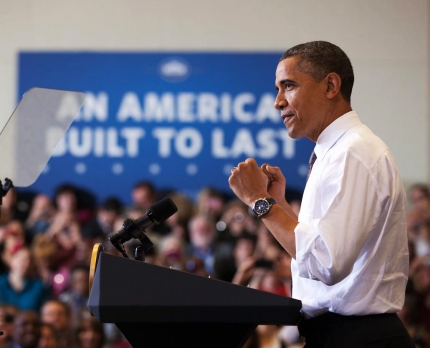
THE PRESIDENT:  Hello, Michigan!  (Applause.)  How is everybody doing?  (Applause.)  It is good to be in Dearborn.  It is good to be back in the Motor City!  (Applause.)

A couple of people I want to acknowledge here.  First of all, give it up for Jeff.  Thank you so much for that outstanding introduction.  Thank you, Jeff.  (Applause.)

We've got Dearborn Mayor -- John O'Reilly is here.  (Applause.)  Wayne County Sheriff Benny Napoleon.  (Applause.)  Wayne County Commissioner Gary Woronchak.  (Applause.)  Although he is not here, he has done an outstanding job representing this district for longer than just about anybody -- John Dingell.  (Applause.)  And John's wonderful wife, Debbie, is here.  (Applause.)  I want to thank Keith William Brown and Gary Bolda from the UAW.  (Applause.)  And I'm grateful that Cynthia and Edsel Ford, II, are here.  Thank you so much.  (Applause.)

And I'm glad all of you are here.  (Applause.)  This is a fantastic museum.  I've got to bring the girls back here.  I've got to check it out.  (Applause.) 

AUDIENCE MEMBER:  (Inaudible.)

THE PRESIDENT:  Look at this guy -- I didn’t mean to start a dialogue here.  (Laughter.) 

Well, listen, I am here not just because I need your help -- although I do.  I’m here because the country needs your help.  I see a lot of folks here who worked tirelessly on my 2008 campaign and -- (applause) -- let's face it you did not do it because you thought this was going to be a cakewalk.  When you decide to support a candidate named Barack Hussein Obama -- (applause) -- you know the odds are not necessarily in your favor.  (Applause.) You didn’t need a poll to tell you that wasn’t going to be a sure thing.  (Laughter.)  

But the point is you didn’t get involved in this campaign just because of me.  You did it because you we're making a commitment to each other.  You had a shared vision for America.  It wasn’t a vision where just a few were doing well and everybody else is left to fend for themselves and play by their own rules. It was a big, bold, generous vision of America where everybody who works hard has a chance to get ahead -- not just those at the very top. 

That’s the vision we shared.  That’s the commitment you made to each other.  And we knew it wasn’t going to be easy.  We knew the changes that we believed in wouldn't necessarily come quickly.  But we understood that if we were determined, that we could overcome any obstacle, that we could meet any challenge.  And in just three years, because of what you did in 2008, we've begun to see what change looks like.  (Applause.)  We've begun to see it. 

Think about it.  Change is the decision we made to rescue the American auto industry from collapse, when some politicians said let Detroit go bankrupt.

AUDIENCE:  Nooo -- 

THE PRESIDENT:  There were 1 million jobs on the line -- and the fate of communities all across the Midwest was on the line -- and we weren’t going to let it happen.  I placed my bets on American workers.  (Applause.)  Today, GM is back on top as the number-one automaker in the world.  Chrysler is growing faster than any other car company.  Ford is investing billions in plants and factories all across America, bringing thousands of jobs home -- (applause) -- 200,000 new jobs over the last two and a half years.  The American auto industry is back.  And that happened because of you.  (Applause.)  That happened because of you. 

There are folks like Jeff all across the country, and all across Michigan, all across Ohio and Indiana, and all across the Midwest.  Because you had confidence in America’s capacity to change, they were able to show just what they can do.

Change is the decision we made to stop waiting for Congress to do something about our oil addiction and finally raise fuel-efficiency standards on cars.  With the agreement of the auto industry, by the next -- by the middle of the next decade, we will be driving American-made cars, better than ever, that get 55 miles to a gallon.  (Applause.)  That saves the typical family over $8,000 at the pump, helps the environment.  That’s what change is.  That happened because of you.

Change is the first bill I signed into law --

AUDIENCE MEMBER:  Lilly Ledbetter! 

THE PRESIDENT:  Lilly Ledbetter -- (applause) -- a law that says women deserve an equal day’s pay for an equal day’s work.  (Applause.)  Our daughters should have the same opportunities as our sons.  (Applause.)

Change is the fight we won to stop handing out over $60 billion in taxpayer giveaways to banks who are managing the student loans -- give that money directly to the students.  And now you’ve got millions of students all across America who are benefitting with higher student loans, help -- more help.  (Applause.)  That happened because of you.  This young man right here mentioned it when I saw him behind stage.

Change is health care reform that we passed after a century of trying.  (Applause.)  Because of your commitment, here in the United States of America, nobody has to go broke because they get sick.  Already 2.5 million young people have health insurance that didn’t have it before because this law lets them stay on their parent's plan.  (Applause.)  Millions of seniors, now paying less for their prescription drugs.  It means Americans can no longer be denied or dropped by their insurance companies when they need care the most.  (Applause.)  And it means every American will be able to get health care, regardless of who you are, how much money you make.  It doesn’t matter if you’ve got a preexisting condition, you will be able to get coverage.  That’s what change is.  (Applause.)

Change is the fact that for the first time in history, you don’t have to hide who you love in order to serve the country you love, because we ended "don't ask, don't tell."  (Applause.)

Change is the promise we made in 2008.  For the first time in nine years, there are no Americans fighting in Iraq.  We have refocused our efforts on the terrorists who actually attacked us on 9/11.  Al Qaeda is weaker than it’s ever been.  Thanks to our amazing troops, Osama bin Laden no longer walks the face of this Earth.  (Applause.)  We have begun to transition out of Afghanistan.  That’s what change is.  (Applause.)

AUDIENCE:  Four more years!  Four more years!  Four more years!

THE PRESIDENT:  None of this change would have happened if it weren’t for you.  And now we’ve got more work to do.  We’ve got a lot more work to do.  There's still too many Americans here in Michigan and all across the country that are out there looking for work.  There are still too many Americans who have a tough time paying the bills or making the mortgage.  We’re still recovering from the worst economic crisis of our generation.
 
But the good news is, is that over the past two years, businesses have added over 4 million new jobs.  Our manufacturers are creating jobs for the first time since the 1990s.  Now we've got to keep it going.  And the last thing we can afford to do is to go back to the very same policies that got us into this mess in the first place.  (Applause.)  That’s part of what this election is all about.
  
That’s what these other folks who are running for this office want to do.  They make no secret about it.  They want to roll back Wall Street reforms, so suddenly Wall Street is playing by its own rules again.  They want to roll back health insurance reform, go back to the days when insurance companies could jack up your rates or deny you coverage without any reason.  They want to spend trillions of dollars more on tax breaks for our wealthiest citizens, even if it means adding to the deficit, even if it means gutting student loan programs and education programs and clean energy, and making Medicare more expensive for seniors.

AUDIENCE:  No!

THE PRESIDENT:  Their philosophy is, is that we’re better off if a few are doing well at the top and everybody else is fending for themselves.  And they’re wrong.  I have no doubt they love this country, but they’re wrong about this. 

In the United States of America, we have always been greater together than we are on our own.  (Applause.)  We’re better off when we stick to that notion that if you work hard in this country -- no matter where you come from, no matter what you look like, no matter what your religious faith, if you work hard, if you believe in this country, you can do well enough to raise a family, own a home, send your kids to college, put a little away for retirement.

That idea, that’s what’s at stake.  That’s the choice in this election.  This is not just another political debate.  There’s always going to be debating in Washington.  I mean, they’ll argue about anything.  (Laughter.)  But this is real.  This is a make-or-break moment for the middle class in this country, and all those who are fighting to get into the middle class.  Are we going to create those rungs on the ladder to opportunity, so that everybody has a shot?
 
We can go back to an economy that’s built on outsourcing and bad debt and phony financial profits.  That’s what we saw before 2008.  Or we can fight for an economy that’s built to last -- built on American manufacturing and American energy and skills for American workers, and the values that made this country great:  Hard work, fair play, shared responsibility.
 
You look at these amazing planes in this museum, and cars in this museum, and you’re reminded part of what made us great is making stuff.  And I want the next generation of manufacturing taking root not in Asia, not in Europe.  I want it to happen right here in Detroit, right here Michigan -- (applause) -- in Pittsburgh, in Cleveland, in the United States of America.  (Applause.)  I don’t want us to just be known for buying stuff from other countries.  I want to invent and build and sell American products all around the world.  (Applause.)

I want us to stop rewarding businesses that ship jobs overseas.  I want to reward companies that are investing here, creating jobs in America.  (Applause.)  I want us to make sure that we’ve got the best schools in the world.  And that means reform; it means properly funding our schools.  It means looking out for the man or woman at the front of the classroom.  (Applause.) 

A good teacher can increase the lifetime earnings of a classroom by over $250,000.  A great teacher can offer an escape from poverty for a child who thinks maybe they’re bound by their circumstances, but suddenly, that teacher helps them to raise their sights.  So I don’t want us defending the status quo, but I also don’t want a bunch of folks in Washington bashing teachers. (Applause.)  I want to give schools the resources they need to keep good teachers, to reward the best ones.  I want to give schools the flexibility they need to teach with creativity and passion, and stop teaching to the test, and train teachers properly.  (Applause.)  

And those who can’t make it, we understand they shouldn’t be in the classroom.  We want accountability, but we also want to make sure that we understand how important teaching is.  Nothing is more important. 

And when kids do graduate from high school, we’ve got to make college affordable.  (Applause.)  Americans already owe more tuition debt than credit card debt.  That’s one of the reasons Congress has to stop interest rates on student loans, which are scheduled to go up in July if we don’t do anything.

AUDIENCE:  Booo --

THE PRESIDENT:  Yes, that’s not good.  And then, colleges and universities have to do their part by keeping tuition from going up.  And state legislatures have to step up and make sure that they’re providing the support to higher education that’s necessary.  Higher education cannot be a luxury.  Whether it’s a two-year program at a community college or a four-year program or a post-doctorate program, it is not a luxury.  It is an economic imperative.  Every American family should be able to afford getting the skills they need to compete in this global economy.  (Applause.)  And that’s what we’re fighting for. 

We need to be supporting scientists and researchers who are trying to make the next breakthrough in clean energy or biotech. I want clean energy to happen here in the United States.  I want advanced batteries made here in the United States.  I want electric cars made here in the United States.  I want solar and wind power made here in the United States.  (Applause.)  We’ve been subsidizing oil companies with taxpayer giveaways for about 100 years now.  It’s time for us to double down on clean energy that has never been more promising.  (Applause.)

And we need to build in America -- roads, bridges, ports, airports, broadband lines.  That’s what this museum reminds us of, is what it means to build.  It’s time we stop taking the money that we’re spending at war -- use half of it to pay down our debt, use the other half to do some nation building here at home. (Applause.)  And when we talk about the deficit --

AUDIENCE MEMBER:  We love you, Obama!
 
THE PRESIDENT:  I love you, baby.  (Laughter and applause.) Thank you.
 
AUDIENCE MEMBER:  We love you more!  (Laughter.)

THE PRESIDENT:  When we talk about the deficit, it’s a real problem.  It is something that we’re going to have to address.  We can’t leave a bunch of unpaid bills for our kids and our grandkids.  And so that means that we’ve got to make some tough decisions, get rid of programs that don’t work to make sure that we can invest in programs that do.  But we’ve also got to make sure that the tax system reflects everybody doing their fair share.  (Applause.) 

The Republicans in the Senate just rejected the Buffett Rule --

AUDIENCE:  Booo --

THE PRESIDENT:  -- wouldn’t let it come up for a vote.  Simple idea that if you make more than $1 million a year, you shouldn’t pay a lower tax rate than your secretary.  Now, the reason that’s important is because if we abided by that rule, then we could say to folks what I have repeatedly said, which is, the 98 percent of Americans who make $250,000 a year or less, your taxes shouldn’t go up.  And that idea is not -- it's not class warfare to say that somebody like me can afford to do a little bit more.  It’s just basic math. 

If I get a tax break that I don’t need and the country can’t afford, then one of two things has to happen.  Either it adds to the deficit because it’s not paid for -- that’s what they’ve been doing -- or somebody else is going to have to shoulder the burden -- a student who has to pay a higher rate on their student loan; a senior who has got to pay higher for their Medicare; a veteran who doesn’t get the help that they need to deal with the aftermath of having fought for our freedoms; a family that’s trying to get by.  That’s not right.  That’s not who we are. 

And when I hear politicians talk about values -- I agree, this campaign is, and should be, about values.  Hard work -- that’s a value.  Looking out for one another -- that’s a value.  (Applause.)  The idea that I am my brother’s keeper, I am my sister’s keeper -- that’s a value.  (Applause.)  That I have a commitment larger than myself. 

Each of us is here, every one of us is here because somebody, somewhere --

AUDIENCE MEMBER:  Made a sacrifice.

THE PRESIDENT:  -- made a sacrifice, was looking out for us. (Applause.)  It starts with the family, but it extends beyond the family.  You think about what -- this museum was built because the Ford family and others said, you know what, this is important to the community that gave us so much.  Our grandparents, our great-grandparents, immigrants, slaves -- think about all the sacrifices they made not just to think about themselves but to think about the country.  Think about all our men and women in uniform making sacrifices because they believe that we are all in this together.  (Applause.) 

The American story has never been about just what we do on our own.  We don’t win the race for new jobs and new businesses and security and growth if it’s just you’re-on-your-own economics.  It doesn’t work.  And it’s never worked.  And we’ve tried it.  We just finished trying it.  Between 2000 and 2008, we tried what they’re selling.  It didn’t work.  Most sluggish job growth that we’ve seen, outsourcing, manufacturing deteriorating, and then it culminates in the worst crisis since the Great Depression.  Why would we think that it would work now?  (Laughter.)  Why would we want to go back to that?  (Applause.)

We’ve all got a stake in each other’s success.  When an outstanding teacher is attracted to the profession, given the pay that she deserves, and then that teacher goes on to teach some talented kid, maybe of modest means, and that kid goes on to become the next Steve Jobs, we all benefit.  If we provide faster Internet service and then it goes to a rural community and suddenly some small business has the chance to market to the world, and is hiring more workers, that benefits everybody’s bottom line.  That benefits the entire economy.  We build a new bridge and that saves the shipping company time and money.  You think about the research that led to the invention of the Internet and how much wealth has been created, but that came out of our collective efforts.  We all invested in that.  That’s how we grow. 

This is not a Democratic idea or Republican idea.  This is an American idea.  (Applause.)  It was Teddy Roosevelt, a Republican, who called for a progressive income tax; and Dwight Eisenhower, a Republican, who built the Interstate Highway System -- so all these outstanding cars from Michigan had somewhere to go.  (Applause.)  It was a Republican in Congress that helped FDR give millions of returning heroes -- including my grandfather -- a chance to go to college under the GI Bill.  This is an American idea.

And you know, that spirit still exists today.  Maybe not in Washington -- (laughter) -- but out in the country.  You go on Main Streets and town halls and VFW halls, you talk to the members of our Armed Forces, you go to our places of worship. 
Our politics is divided, but most Americans, they still understand we’re in this together.  No matter where we come from, no matter what we look like, no matter what our last named are, we rise or fall as one nation and as one people.  And that’s what’s at stake right now.  That’s what this election is all about. 

So let me just say, Michigan, I know these last three and a half years, four years, have been tough.  I know there are times where we think change isn’t happening as fast as we'd like.  But -- and I know that there’s a tendency sometimes -- and look at Washington and just say, you know what, it’s easier being cynical.  It’s easier just -- it's tempting to just say, maybe this isn't possible.  But remember what we said during the last campaign.  I said this was going to be hard.  Change takes time. Sometimes it takes more than year, it takes more than a single term.  It takes more than a single President. 

As I was walking in here, you’ve got a display of Abraham Lincoln, and then you’ve got the bus that Rosa Parks sat down in. It takes ordinary citizens to bring about change, who are committed to keep fighting and keep pushing, and keep inching this country closer to our highest ideals.  (Applause.)

That’s why I need all of you.  I need all of you.  I said in 2008, I am not a perfect man, I will never be a perfect President, but what I promised you was that I would always tell you what I thought, I would always tell you where I stood, and I would wake up every single day fighting for you as hard as I know how.  And I have kept that promise.  (Applause.)  I have kept that promise. 

And if you’re willing to keep pushing with me, to keep working on behalf of our higher ideals, there is nothing that will stop us.  And we will finish what we started in 2008.  (Applause.) 

God bless you.  God bless America.  (Applause.)

END 
5:59 P.M. EDT

The White House

Office of the Press Secretary

President Obama Signs Hawaii Disaster Declaration

The President today declared a major disaster exists in the State of Hawaii and ordered Federal aid to supplement state and local recovery efforts in the area affected by severe storms, flooding, and landslides during the period of March 3-11, 2012. 

Federal funding is available to state and eligible local governments and certain private nonprofit organizations on a cost-sharing basis for emergency work and the repair or replacement of facilities damaged by the severe storms,  flooding, and landslides in Kauai County.  

Federal funding is also available on a cost-sharing basis for hazard mitigation measures statewide. 

W. Craig Fugate, Administrator, Federal Emergency Management Agency (FEMA), Department of Homeland Security, named Mark H. Armstrong as the Federal Coordinating Officer for federal recovery operations in the affected area. 

FEMA said additional designations may be made at a later date if requested by the state and warranted by the results of further damage assessments.

FOR FURTHER INFORMATION MEDIA SHOULD CONTACT:  FEMA NEWS DESK AT (202) 646-3272 OR FEMA-NEWS-DESK@DHS.GOV

President Obama Talks About Investing in Training American Workers

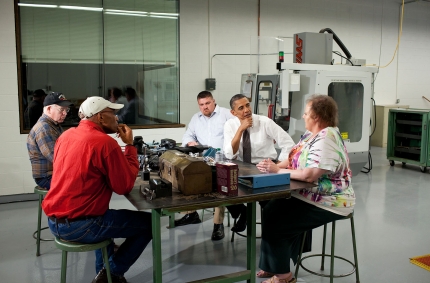
President Barack Obama Participates in a Roundtable with Unemployed Workers

President Barack Obama participates in a roundtable with unemployed workers who are students in Lorain County Community College job training programs, at Lorain Community College in Elyria, Ohio, April 18, 2012. (Official White House Photo by Pete Souza)

President Obama was in Elyria, Ohio today where he met with students at Lorain County Community College. The President was there to talk about the Administration’s job training initiatives to help more Americans get back to work and connect unemployed Americans with the skills training they need to find jobs in high-demand, high-growth industries, including the Community College to Career Fund. He told the students that taking classes at community colleges and getting new skills doesn't just benefit students and their future employers but adds economic value to the entire region:

Investing in a community college, just like investing in a new road or a new highway or broadband lines that go into rural communities, these investments are not part of some grand scheme to redistribute wealth. They’ve been made by Democrats and Republicans for generations because they benefit all of us. That's what leads to strong, durable economic growth. That's how America became an economic superpower. That's how we built the Transcontinental Railroad. That's why we’ve got the best universities and colleges in the world. That's why we have cutting-edge research that takes place here, and that then gets translated into new jobs and new businesses, because somebody did the groundwork.  We created a foundation for those of us to prosper. 

When you take classes at a community college like this one and you learn the skills that you need to get a job right away, that does not just benefit you; it benefits the company that ends up hiring and profiting from your skills.  It makes the entire region stronger economically.  It makes this country stronger economically. 

In this country, prosperity does not trickle down; prosperity grows from the bottom up.  And it grows from a strong middle class out.  That’s how we grow this economy.

President Barack Obama Delivers Remarks Highlighting the Administration’s Job Training Initiatives

President Barack Obama delivers remarks highlighting the Administration’s job training initiatives to help get more Americans back to work and connect unemployed Americans with the skills training needed to find jobs in high-demand, high-growth industries, at Lorain Community College in Elyria, Ohio, April 18, 2012. (Official White House Photo by Sonya N. Hebert)


Learn more:

Related Topics: Buffett Rule, Economy, Education, Ohio

The White House

Office of the Press Secretary

Statement by the President on the Passing of Dick Clark

Michelle and I are saddened to hear about the passing of Dick Clark.  With “American Bandstand,” he introduced decades’ worth of viewers to the music of our times.  He reshaped the television landscape forever as a creative and innovative producer.  And, of course, for 40 years, we welcomed him into our homes to ring in the New Year.  But more important than his groundbreaking achievements was the way he made us feel – as young and vibrant and optimistic as he was.  As we say a final “so long” to Dick Clark, America’s oldest teenager, our thoughts and prayers are with his family and friends – which number far more than he knew.

President Obama Speaks on Skills for American Workers

April 18, 2012 | 21:03 | Public Domain

President Obama visits Lorain County Community College in Elyria, Ohio to highlight how federal job training funding is providing critical services for unemployed workers and helping them to get jobs in high-demand, high-growth industries.

Download mp4 (201MB) | mp3 (48MB)

Read the Transcript

Remarks by the President at Lorain County Community College, Elyria, OH

Lorain County Community College
Elyria, Ohio

2:36 P.M. EDT

THE PRESIDENT:  Thank you, everybody.  Thank you.  (Applause.)  Thank you so much.  Thank you.  (Applause.)  Everybody, please have a seat. 

Well, hello, Ohio! 

AUDIENCE:  Hello!

THE PRESIDENT:  It is good to be back here at Lorain.  Last time I was here I had an outstanding burger at Smitty's.  (Laughter.)  I got my own presidential football helmet at Riddell.  I got a feeling I may need it between now and November. (Laughter.) 

It's also great to be back at Lorain Community College.  I want to thank Bronson for that wonderful introduction.  He is -- (applause) -- I had a chance to meet Bronson and Andrea and David and Duane.  And I just want Bronson's wife to know that he gives her all the credit in the world.  So just in case you're watching -- (laughter) -- Gladys, he loves you to death. 

I also want to thank your president, Dr. Roy Church --  (applause) -- your Mayor, Holly Brinda, for hosting us here today.  (Applause.)  I want to recognize my outstanding Secretary of Labor, Hilda Solis, in the house.  (Applause.)  And I want to thank all of you for coming.

I came here for a simple reason.  In an economy that’s still recovering from the worst financial crisis and the worst economic crisis of our lifetimes, the work that's going on here could not be more important.  I meet business owners all the time who want to hire in the United States, but they can’t always find the workers with the right skills.  You've got growing industries in science and technology that have twice as many openings as we have workers who can do the job.  That makes no sense -- openings at a time when there's still a lot of Americans, including some on this stage, who are looking for work.  So we've got to do a better job training more people for the skills that businesses are looking for. 

When I met with manufacturers a while back, they said it's starting to make economic sense to bring jobs back to Ohio, to bring jobs back to Michigan, to bring jobs back to Illinois and Iowa and Indiana, because even if the labor costs are lower there, the workers are better here.  And when you factor in transportation costs, a lot of times it makes sense to insource now, but that's only going to be true if we can make sure that we've got workers who have higher skills and can manage fancier machinery than folks in other places.  And all that starts with community colleges like this one.

So I just had a chance to listen to four of your classmates and hear a little bit about how they got here, where they’re headed.  I talked to Duane, who was laid off at a packaging company, is now learning how to operate high-tech machinery.  Andrea lost her job as an HR analyst, but she's now getting certified in the fast-growing field of electronic medical records.  David, who in addition to being a truck driver for 23 years was also a Marine, so we know he can do the job -- he's here to retrain for a higher-paying job.  And you just heard from Bronson, who was laid off two years ago, and you heard what he said.  He was at a dead end in his life, and this program -- along with his wife -- (laughter) -- gave him an opportunity.  So he's going to be learning hands-on machining over the next few weeks, after having already done some of the bookwork.

I have to tell you, when I meet these folks, these folks inspire me, because a lot of them have gone through tough times. Andrea is still dealing with the aftermath of the flood that damaged her home.  All of them have supportive family members.   And it's hard being out of work.  It's hard especially when you're mid-career, when you're having to change jobs.  And the resilience they show and the determination they show, that’s what America's about.  That’s our defining spirit.  We don't quit.

And so the question now is, how do we make sure that all of America is expressing that spirit through making sure that everybody is getting a fair shot?  Because that’s going to be a major debate that we have in this country not just for the next few months, but for the next few years:  Should we settle for an economy where a few people do really well and then a growing number are struggling to get by?  Or do we build an economy where people like Duane and Andrea and David and Bronson, they've got a chance to get ahead, where there are ladders of opportunity, where everybody gets a fair shot, and everybody does their fair share, and everybody is playing by the same set of rules?  (Applause.) 

And this is not just another run-of-the-mill political debate.  There's always chatter in Washington.  Folks argue about whether the sun rises in the east and whether it sets in the west, whether the sky is blue.  (Laughter.)  There's always going to be arguments in Washington.  But this one is different, because we're talking about the central challenge of our time.  Right now, we have two competing visions of our future, and the choice could not be clearer.  And let me say, those folks on the other side, I am sure they are patriots, I'm sure they're sincere in terms of what they say.  But their theory, I believe, is wrong.  

See, I’ve never believed that government can or should try to solve every problem we've got.  I believe that the free market is the greatest force for economic progress in human history.  I agree that everybody has personal responsibility for their own lives.  Everybody has got to work hard.  Nothing is ever handed to us.  But I also agree with our first Republican President -- a guy named Abraham Lincoln – who said that, through government, we should do together what we cannot do as well on our own.

There’s some things we don't do well on our own.  That’s why we’ve got a strong military to keep us safe.  That's why we have fire departments because we never know when we might have a fire in our house.  That's why we’ve got public schools to educate our children.  That's how we laid down railroads and highways, and supported research and technology that’s saved lives and helped create entire industries.  That's why we have programs like Medicare and Social Security and unemployment insurance, because any one of us -- I don't care how lucky you are, how rich you are, how blessed you are -- you never know, you could face a layoff, or a crippling illness, or a run of bad luck, or a tragedy.

Folks in Ohio know about that.  Nothing is given.  And that's why we’re helping more community colleges like this one to become community career centers, so folks who are looking for a new job or a better-paying job can learn the skills that businesses need right now.  And that's good for all of us.

Investing in a community college, just like investing in a new road or a new highway or broadband lines that go into rural communities, these investments are not part of some grand scheme to redistribute wealth.  They’ve been made by Democrats and Republicans for generations because they benefit all of us.  That's what leads to strong, durable economic growth.  That's how America became an economic superpower.  That's how we built the Transcontinental Railroad.  That's why we’ve got the best universities and colleges in the world.  That's why we have cutting-edge research that takes place here, and that then gets translated into new jobs and new businesses, because somebody did the groundwork.  We created a foundation for those of us to prosper. 

Somebody gave me an education.  I wasn’t born with a silver spoon in my mouth.  Michelle wasn’t.  But somebody gave us a chance -- just like these folks up here are looking for a chance.   

When you take classes at a community college like this one and you learn the skills that you need to get a job right away, that does not just benefit you; it benefits the company that ends up hiring and profiting from your skills.  It makes the entire region stronger economically.  It makes this country stronger economically.

In this country, prosperity does not trickle down; prosperity grows from the bottom up.  And it grows from a strong middle class out.  (Applause.)  That’s how we grow this economy. And that’s why I’m always confused when we keep having the same argument with folks who don’t seem to remember how America was built.  They keep telling us, well, if we just weaken regulations that keep our air and water clean and protect our consumers, if we just cut everybody’s taxes and convert these investments in community colleges and research and health care into tax cuts especially for the wealthy, that somehow the economy is going to get stronger -- and Ohio and the rest of the country will prosper. That’s the theory.

Ohio, we tested this theory.  Take a look at what happened in Ohio between 2000 and 2008.  It’s not like we didn’t try it. And instead of faster job growth, we had the slowest job growth in half a century.  Instead of broad-based prosperity, the typical American family saw their incomes fall by about six percent.  Outsourcing, rampant; phony financial profits all over the place.  And instead of strengthening our economy, our entire financial system almost collapsed.  We spent the last three and a half years cleaning up after that mess.  So their theory did not work out so well.  Maybe they haven’t been paying attention, but it didn’t work out so well. 

And instead of kind of stepping back and saying to themselves, well, maybe this didn’t work so well, maybe we should try something different, they decided to double down.  Instead of moderating their views even slightly, you now have Republicans in Washington and the ones running for President proposing budgets that shower the wealthiest Americans with even more tax cuts -- folks like me don’t need them, weren’t looking for them.  And when you give somebody like me a tax cut, there are only two ways of paying for it:  Either it adds to our deficit, meaning it’s not paid for, or you end up -- which is what they’ve proposed -- gutting investments in education and medical research and clean energy and job training programs like this one.

If these cuts are spread out evenly, then 10 million college students -- including some of you -- would see your financial aid cut by an average of more than $1,000 each.  Thousands of medical research grants for things like Alzheimer’s and cancer and AIDS would be eliminated.  Our investments in clean energy that are helping to break our dependence on foreign oil and are creating jobs here in Ohio would be cut by nearly a fifth.  By the time you retire, Medicare would turn into a voucher system that likely would not cover the doctors or the care that you need -- that would have to come out of your pocket.  Job training programs like this one would be forced to cut back.  Thousands of Americans would lose out on critical employment and training services.  That's the truth.

When you ask the Republicans, well, what do you say about that, they say, well, no, no, Obama is making this up because we didn't specify which cuts we'd make.  Well, the reason they didn't specify it is because they know folks wouldn't like it.  (Laughter.)  But if you've got to cut a certain amount of money  -- and they've already said they're not going to cut defense spending, and they're going with their tax cuts -- then you've got to go to all the other stuff that's left over, or else you're going to add to the deficit.  That's just math.  That's not theorizing on my part. 

They'll tell you, well, we've got to do this because the deficit is so bad.  The deficit is bad.  We've got to deal with the deficit in a serious way, and that means all of us are going to have to make tough choices.  But it's one thing to deal with the deficit in a way that is fair and asks everybody to do their fair share, and dealing with the deficit as an excuse to do what you wanted to do anyway. 

Their argument might fly if it weren't for the fact that they're also proposing to spend $4.6 trillion on lower tax rates on top of the $1 trillion they would spend on tax cuts for people making more than $250,000 a year or more.  That’s their priority. They want to give me more of a tax break.  Now, I just paid taxes, so I'm -- it's not like I love paying taxes.  (Laughter.) But I can afford it.  I don't need another tax break.

Right now, companies can’t find enough qualified workers for the jobs they need to fill.  So programs like this one are training hundreds of thousands of workers with the skills that companies are looking for.  And it’s working.  And it's going to help America grow.  I’ve seen it.  Here in Lorain County, 90 percent of people who graduate from this program have a job three months later -- 90 percent.  That’s a big deal.  (Applause.)  Why would we want to cut this program to give folks like me a tax cut that we don’t need and that the country can't afford?

What's the better way to make our economy stronger?  Give more tax breaks to every millionaire and billionaire in the country, or make investments in education and research and health care and job training -- make investments in Bronson and Duane and Andrea and David and put folks back to work?  This is just common sense.

Understand this is not a redistribution argument.  This is not about taking from rich people to give to poor people.  This is about us together making investments in our country so everybody has got a fair shot.  And that will make all of us better off.  (Applause.) 

Now, on Monday, nearly every Republican in the Senate voted to block what’s called the Buffett Rule.  Think about this.  The Buffet Rule says if you make a $1 million or more -- I'm not saying you got $1 million -- let's say you're a small business person, you saved, you worked, and after 10, 20, 30 years of working you finally saved up your little nest egg -- that’s not what I'm talking about.  I'm saying you make $1 million a year.  And we said you should at least pay the same percentage in income tax as middle class families do -- as a teacher or a bus driver. (Applause.)  And by doing that, that helps us afford being to say to the 98 percent of families who make $250,000 a year or less, your taxes won't go up. 

This was an idea that was supported by a strong majority of the American people -- including nearly half of Republicans.  The majority of millionaires supported it.  And Senate Republicans didn’t listen.  They refused to even let it come up for a vote; refused to ask the wealthiest among us to do their fair share.  Meanwhile, Republicans in the House just signaled their willingness to gut programs like this one that make a real difference in people’s lives -- thousands of middle-class families or folks who are trying to get into the middle class.

And my point is the middle class has sacrificed enough over the last few decades.  They're having enough trouble.  (Applause.)  And as I travel around the country, people aren’t just concerned about their immediate circumstances.  They're also concerned about our future.  They're thinking how do we make sure that America stays ahead?  How do we make sure that if somebody is willing to work hard, they can get ahead in this country?

And people understand government is not all the answer, and if they see taxpayer money wasted, that makes them angry.  They know the government has got to be lean and mean and do smart things.  But they also understand we can't stop investing in the things that are going to create real, lasting growth in this country.  And we certainly can't do it just as an excuse to give me another tax cut.  That’s not who we are as a country.  We’re better than that.

Everybody here, we’re here because somebody, somewhere, felt a sense of larger responsibility -- not just to themselves; to their family, first of all, but then also to their community, also to their country.  Maybe they served like Dave.  Maybe they worked in a local charity.  They understood -- like my grandparents understood, like my mother understood, like Michelle’s parents understood -- that we do what we do not just for ourselves but also for this larger project we call America.  And now it’s our turn to be responsible.  Now it’s our turn to make sure the next generation has the same opportunities that we do. 

And I know we can do it.   And the reason I know is because of the folks I had a chance to meet.  It’s because of you.  You’re working hard.  You’ve haven’t given up.  You’ve gone through some struggles, but you’re resilient.  Ohio is a great example of the core strength and decency of the American people.
You believe in our future.  You believe in this country.  (Applause.) 

And if we work together in common purpose, I guarantee you we will make this an American Century just like the 20th century was the American Century.  (Applause.)

Thank you.  God bless you.  God bless America.
 
END
2:59 P.M. EDT

Close Transcript

The White House

Office of the Press Secretary

Presidential Nominations Sent to the Senate

NOMINATIONS SENT TO THE SENATE:

Charles Benton, of Illinois, to be a Member of the National Museum and Library Services Board for a term expiring December 6, 2013, vice Harry Robinson, Jr., term expired.

Christie Pearson Brandau, of Iowa, to be a Member of the National Museum and Library Services Board for a term expiring December 6, 2016, vice Lotsee Patterson, term expired.

Norberto Jesus Castro, of Arizona, to be a Member of the National Museum and Library Services Board for a term expiring December 6, 2016, vice Douglas G. Myers, term expired.

William B. Schultz, of the District of Columbia, to be General Counsel of the Department of Health and Human Services, vice Daniel Meron.

The White House

Office of the Press Secretary

Remarks by the President at Lorain County Community College, Elyria, OH

Lorain County Community College
Elyria, Ohio

2:36 P.M. EDT

THE PRESIDENT:  Thank you, everybody.  Thank you.  (Applause.)  Thank you so much.  Thank you.  (Applause.)  Everybody, please have a seat. 

Well, hello, Ohio! 

AUDIENCE:  Hello!

THE PRESIDENT:  It is good to be back here at Lorain.  Last time I was here I had an outstanding burger at Smitty's.  (Laughter.)  I got my own presidential football helmet at Riddell.  I got a feeling I may need it between now and November. (Laughter.) 

It's also great to be back at Lorain Community College.  I want to thank Bronson for that wonderful introduction.  He is -- (applause) -- I had a chance to meet Bronson and Andrea and David and Duane.  And I just want Bronson's wife to know that he gives her all the credit in the world.  So just in case you're watching -- (laughter) -- Gladys, he loves you to death. 

I also want to thank your president, Dr. Roy Church --  (applause) -- your Mayor, Holly Brinda, for hosting us here today.  (Applause.)  I want to recognize my outstanding Secretary of Labor, Hilda Solis, in the house.  (Applause.)  And I want to thank all of you for coming.

I came here for a simple reason.  In an economy that’s still recovering from the worst financial crisis and the worst economic crisis of our lifetimes, the work that's going on here could not be more important.  I meet business owners all the time who want to hire in the United States, but they can’t always find the workers with the right skills.  You've got growing industries in science and technology that have twice as many openings as we have workers who can do the job.  That makes no sense -- openings at a time when there's still a lot of Americans, including some on this stage, who are looking for work.  So we've got to do a better job training more people for the skills that businesses are looking for. 

When I met with manufacturers a while back, they said it's starting to make economic sense to bring jobs back to Ohio, to bring jobs back to Michigan, to bring jobs back to Illinois and Iowa and Indiana, because even if the labor costs are lower there, the workers are better here.  And when you factor in transportation costs, a lot of times it makes sense to insource now, but that's only going to be true if we can make sure that we've got workers who have higher skills and can manage fancier machinery than folks in other places.  And all that starts with community colleges like this one.

So I just had a chance to listen to four of your classmates and hear a little bit about how they got here, where they’re headed.  I talked to Duane, who was laid off at a packaging company, is now learning how to operate high-tech machinery.  Andrea lost her job as an HR analyst, but she's now getting certified in the fast-growing field of electronic medical records.  David, who in addition to being a truck driver for 23 years was also a Marine, so we know he can do the job -- he's here to retrain for a higher-paying job.  And you just heard from Bronson, who was laid off two years ago, and you heard what he said.  He was at a dead end in his life, and this program -- along with his wife -- (laughter) -- gave him an opportunity.  So he's going to be learning hands-on machining over the next few weeks, after having already done some of the bookwork.

I have to tell you, when I meet these folks, these folks inspire me, because a lot of them have gone through tough times. Andrea is still dealing with the aftermath of the flood that damaged her home.  All of them have supportive family members.   And it's hard being out of work.  It's hard especially when you're mid-career, when you're having to change jobs.  And the resilience they show and the determination they show, that’s what America's about.  That’s our defining spirit.  We don't quit.

And so the question now is, how do we make sure that all of America is expressing that spirit through making sure that everybody is getting a fair shot?  Because that’s going to be a major debate that we have in this country not just for the next few months, but for the next few years:  Should we settle for an economy where a few people do really well and then a growing number are struggling to get by?  Or do we build an economy where people like Duane and Andrea and David and Bronson, they've got a chance to get ahead, where there are ladders of opportunity, where everybody gets a fair shot, and everybody does their fair share, and everybody is playing by the same set of rules?  (Applause.) 

And this is not just another run-of-the-mill political debate.  There's always chatter in Washington.  Folks argue about whether the sun rises in the east and whether it sets in the west, whether the sky is blue.  (Laughter.)  There's always going to be arguments in Washington.  But this one is different, because we're talking about the central challenge of our time.  Right now, we have two competing visions of our future, and the choice could not be clearer.  And let me say, those folks on the other side, I am sure they are patriots, I'm sure they're sincere in terms of what they say.  But their theory, I believe, is wrong.  

See, I’ve never believed that government can or should try to solve every problem we've got.  I believe that the free market is the greatest force for economic progress in human history.  I agree that everybody has personal responsibility for their own lives.  Everybody has got to work hard.  Nothing is ever handed to us.  But I also agree with our first Republican President -- a guy named Abraham Lincoln – who said that, through government, we should do together what we cannot do as well on our own.

There’s some things we don't do well on our own.  That’s why we’ve got a strong military to keep us safe.  That's why we have fire departments because we never know when we might have a fire in our house.  That's why we’ve got public schools to educate our children.  That's how we laid down railroads and highways, and supported research and technology that’s saved lives and helped create entire industries.  That's why we have programs like Medicare and Social Security and unemployment insurance, because any one of us -- I don't care how lucky you are, how rich you are, how blessed you are -- you never know, you could face a layoff, or a crippling illness, or a run of bad luck, or a tragedy.

Folks in Ohio know about that.  Nothing is given.  And that's why we’re helping more community colleges like this one to become community career centers, so folks who are looking for a new job or a better-paying job can learn the skills that businesses need right now.  And that's good for all of us.

Investing in a community college, just like investing in a new road or a new highway or broadband lines that go into rural communities, these investments are not part of some grand scheme to redistribute wealth.  They’ve been made by Democrats and Republicans for generations because they benefit all of us.  That's what leads to strong, durable economic growth.  That's how America became an economic superpower.  That's how we built the Transcontinental Railroad.  That's why we’ve got the best universities and colleges in the world.  That's why we have cutting-edge research that takes place here, and that then gets translated into new jobs and new businesses, because somebody did the groundwork.  We created a foundation for those of us to prosper. 

Somebody gave me an education.  I wasn’t born with a silver spoon in my mouth.  Michelle wasn’t.  But somebody gave us a chance -- just like these folks up here are looking for a chance.   

When you take classes at a community college like this one and you learn the skills that you need to get a job right away, that does not just benefit you; it benefits the company that ends up hiring and profiting from your skills.  It makes the entire region stronger economically.  It makes this country stronger economically.

In this country, prosperity does not trickle down; prosperity grows from the bottom up.  And it grows from a strong middle class out.  (Applause.)  That’s how we grow this economy. And that’s why I’m always confused when we keep having the same argument with folks who don’t seem to remember how America was built.  They keep telling us, well, if we just weaken regulations that keep our air and water clean and protect our consumers, if we just cut everybody’s taxes and convert these investments in community colleges and research and health care into tax cuts especially for the wealthy, that somehow the economy is going to get stronger -- and Ohio and the rest of the country will prosper. That’s the theory.

Ohio, we tested this theory.  Take a look at what happened in Ohio between 2000 and 2008.  It’s not like we didn’t try it. And instead of faster job growth, we had the slowest job growth in half a century.  Instead of broad-based prosperity, the typical American family saw their incomes fall by about six percent.  Outsourcing, rampant; phony financial profits all over the place.  And instead of strengthening our economy, our entire financial system almost collapsed.  We spent the last three and a half years cleaning up after that mess.  So their theory did not work out so well.  Maybe they haven’t been paying attention, but it didn’t work out so well. 

And instead of kind of stepping back and saying to themselves, well, maybe this didn’t work so well, maybe we should try something different, they decided to double down.  Instead of moderating their views even slightly, you now have Republicans in Washington and the ones running for President proposing budgets that shower the wealthiest Americans with even more tax cuts -- folks like me don’t need them, weren’t looking for them.  And when you give somebody like me a tax cut, there are only two ways of paying for it:  Either it adds to our deficit, meaning it’s not paid for, or you end up -- which is what they’ve proposed -- gutting investments in education and medical research and clean energy and job training programs like this one.

If these cuts are spread out evenly, then 10 million college students -- including some of you -- would see your financial aid cut by an average of more than $1,000 each.  Thousands of medical research grants for things like Alzheimer’s and cancer and AIDS would be eliminated.  Our investments in clean energy that are helping to break our dependence on foreign oil and are creating jobs here in Ohio would be cut by nearly a fifth.  By the time you retire, Medicare would turn into a voucher system that likely would not cover the doctors or the care that you need -- that would have to come out of your pocket.  Job training programs like this one would be forced to cut back.  Thousands of Americans would lose out on critical employment and training services.  That's the truth.

When you ask the Republicans, well, what do you say about that, they say, well, no, no, Obama is making this up because we didn't specify which cuts we'd make.  Well, the reason they didn't specify it is because they know folks wouldn't like it.  (Laughter.)  But if you've got to cut a certain amount of money  -- and they've already said they're not going to cut defense spending, and they're going with their tax cuts -- then you've got to go to all the other stuff that's left over, or else you're going to add to the deficit.  That's just math.  That's not theorizing on my part. 

They'll tell you, well, we've got to do this because the deficit is so bad.  The deficit is bad.  We've got to deal with the deficit in a serious way, and that means all of us are going to have to make tough choices.  But it's one thing to deal with the deficit in a way that is fair and asks everybody to do their fair share, and dealing with the deficit as an excuse to do what you wanted to do anyway. 

Their argument might fly if it weren't for the fact that they're also proposing to spend $4.6 trillion on lower tax rates on top of the $1 trillion they would spend on tax cuts for people making more than $250,000 a year or more.  That’s their priority. They want to give me more of a tax break.  Now, I just paid taxes, so I'm -- it's not like I love paying taxes.  (Laughter.) But I can afford it.  I don't need another tax break.

Right now, companies can’t find enough qualified workers for the jobs they need to fill.  So programs like this one are training hundreds of thousands of workers with the skills that companies are looking for.  And it’s working.  And it's going to help America grow.  I’ve seen it.  Here in Lorain County, 90 percent of people who graduate from this program have a job three months later -- 90 percent.  That’s a big deal.  (Applause.)  Why would we want to cut this program to give folks like me a tax cut that we don’t need and that the country can't afford?

What's the better way to make our economy stronger?  Give more tax breaks to every millionaire and billionaire in the country, or make investments in education and research and health care and job training -- make investments in Bronson and Duane and Andrea and David and put folks back to work?  This is just common sense.

Understand this is not a redistribution argument.  This is not about taking from rich people to give to poor people.  This is about us together making investments in our country so everybody has got a fair shot.  And that will make all of us better off.  (Applause.) 

Now, on Monday, nearly every Republican in the Senate voted to block what’s called the Buffett Rule.  Think about this.  The Buffet Rule says if you make a $1 million or more -- I'm not saying you got $1 million -- let's say you're a small business person, you saved, you worked, and after 10, 20, 30 years of working you finally saved up your little nest egg -- that’s not what I'm talking about.  I'm saying you make $1 million a year.  And we said you should at least pay the same percentage in income tax as middle class families do -- as a teacher or a bus driver. (Applause.)  And by doing that, that helps us afford being to say to the 98 percent of families who make $250,000 a year or less, your taxes won't go up. 

This was an idea that was supported by a strong majority of the American people -- including nearly half of Republicans.  The majority of millionaires supported it.  And Senate Republicans didn’t listen.  They refused to even let it come up for a vote; refused to ask the wealthiest among us to do their fair share.  Meanwhile, Republicans in the House just signaled their willingness to gut programs like this one that make a real difference in people’s lives -- thousands of middle-class families or folks who are trying to get into the middle class.

And my point is the middle class has sacrificed enough over the last few decades.  They're having enough trouble.  (Applause.)  And as I travel around the country, people aren’t just concerned about their immediate circumstances.  They're also concerned about our future.  They're thinking how do we make sure that America stays ahead?  How do we make sure that if somebody is willing to work hard, they can get ahead in this country?

And people understand government is not all the answer, and if they see taxpayer money wasted, that makes them angry.  They know the government has got to be lean and mean and do smart things.  But they also understand we can't stop investing in the things that are going to create real, lasting growth in this country.  And we certainly can't do it just as an excuse to give me another tax cut.  That’s not who we are as a country.  We’re better than that.

Everybody here, we’re here because somebody, somewhere, felt a sense of larger responsibility -- not just to themselves; to their family, first of all, but then also to their community, also to their country.  Maybe they served like Dave.  Maybe they worked in a local charity.  They understood -- like my grandparents understood, like my mother understood, like Michelle’s parents understood -- that we do what we do not just for ourselves but also for this larger project we call America.  And now it’s our turn to be responsible.  Now it’s our turn to make sure the next generation has the same opportunities that we do. 

And I know we can do it.   And the reason I know is because of the folks I had a chance to meet.  It’s because of you.  You’re working hard.  You’ve haven’t given up.  You’ve gone through some struggles, but you’re resilient.  Ohio is a great example of the core strength and decency of the American people.
You believe in our future.  You believe in this country.  (Applause.) 

And if we work together in common purpose, I guarantee you we will make this an American Century just like the 20th century was the American Century.  (Applause.)

Thank you.  God bless you.  God bless America.
 
END
2:59 P.M. EDT

The White House

Office of the Press Secretary

Press Gaggle by Press Secretary Jay Carney en route Elyria, Ohio, 4/18/12

Aboard Air Force One
En Route Elyria, Ohio

12:30 P.M. EDT

MR. CARNEY:  Hi, everyone.  It looks like a good group.  Well, more or less.  (Laughter.)  It is marvelous to have you all on board today as we make our way to Lorain County, where the President will have an event highlighting job training initiatives to help get more Americans back to work and connect unemployed Americans with the skills training needed to find jobs in high-demand and high-growth industries.

Prior to delivering remarks to an audience of current students and graduates of Lorain County Community College's worker training program, the President will meet with a group of unemployed workers who are students in LCCC's successful job training programs that have benefited from federal funding and have been successful in placing students with jobs shortly after graduation.

The President will visit with students in the college's transformations program for computerized, numerically controlled machining, a program with a proven track record of success, placing more than 90 percent of participants in jobs within three months of graduation.  The President will speak with these students and discuss his efforts to ensure that programs like these can continue to help more Americans get back to work.

Now, you may ask why this is important.  The President obviously supports investing in programs that help retrain American workers for the jobs that can be filled today, putting more Americans back to work.  Who doesn’t support that common-sense idea?  Well, those who support the Ryan/Republican budget.

I know you've been provided information from us about what the dramatic cuts in the Ryan budget/Republican budget would do to job training programs across the country, and would do it in order to pay for tax cuts for the wealthiest Americans, so I will not provide you those numbers verbally now unless you want me to. But it is important to remember that the budget that was passed by the House Republicans and is supported broadly by the Republican Party that is the essential governing document – would-be governing document of the Republican Party -- would devastate job training programs, as it would so many of the programs that are fundamental to ensuring that we invest appropriately to grow our economy in the 21st century.

With that, I will take your questions.

Q    Has the President called Warren Buffett about his stage one cancer?

MR. CARNEY:  I don't know.  I'll have to check.

Q    Has he seen the photos that we ran today of soldiers posing with --

MR. CARNEY:  I know he's been briefed on it.  I didn’t ask him if he had seen -- actually seen the photographs.  I would simply echo the comments from the Pentagon that the conduct depicted in those photographs is reprehensible.  It does not in any way represent the standards, the high standards of the U.S. military.  And the President certainly shares in the Defense Secretary's opinion that this needs to be investigated, and it will be investigated, and that those responsible will be held accountable.

Having said that, we're also very disappointed that -- or at least I will echo what the Defense Department said about the decision made to publish these photographs two years after the incident.  But that's another story.

Q    Jay, you’ve got the GSA story.  You've got the Secret Service story.  Now you've got these soldiers behaving badly story.  Does all of that detract from the President's message and make it harder for him to keep the focus on the economy?  Does it drown out that message? 

MR. CARNEY:  Well, I don't think we look at it that way, Nancy.  I think most Americans are extremely focused on the economy, making ends meet.  Those who are looking for work are very focused on trying to find it.  Those who have jobs are focused on trying to make ends meet, pay the bills.  So I think when the President goes out in the country and talks about those issues, I think they -- what he says very much resonates with Americans across the country.

These are -- the matters that you raise are obviously distinct issues that are -- merit attention and are getting appropriate attention at the different agencies.  The President has made clear his views on all three of them.

Q    He's made a large point of trying to cast government as a force for good and kind of counter that Republican -- does this kind of hurt him --

MR. CARNEY:  The President has been crystal clear since he was a candidate about the standards that he insists be met by those who work for the federal government and on behalf of the American people and for the American people.  That is why his response to the IG report regarding the GSA conference was outrage and insistence that action be taken to hold those responsible for wasting taxpayers' dollars accountable.

You have heard the President speak recently on the matter involving the Secret Service.  I don’t have anything to add to that.  That investigation is still ongoing.  And then I just spoke to the issue with troops in Afghanistan from two years ago.

Q    Is it coincidence that the fundraiser tonight is at the Henry Ford Museum, which is where Romney announced his campaign in '07?

MR. CARNEY:  You'd have to ask the campaign.

Q    North Korea has called the U.S. decision to end the food aid deal a hostile act and said it was ready to take necessary retaliatory measures -- not saying exactly what those are.  But there's expectation that brings North Korea closer to testing a nuclear weapon.  Could you respond?

MR. CARNEY:  I would simply say that the actions by the North Koreans to test a ballistic missile in direct contravention of its obligations internationally, in direct disregard for two United Nations Security Council resolutions was clearly provocative.  And as we made abundantly clear both in Beijing and in the run-up to the failed missile test, such an action would be -- would make it clear to us that we could not provide the nutritional assistance that is so needed by the North Korean people who are being starved by their own government if we could not count on the reliability of the North Korean government to ensure that that assistance was delivered to the right people and not to the elite or to the military.

The choice made here was by the North Korean regime, and it was a bad choice. 

Q    Do you have any -- is there anything left the U.S. can do to prevent North Korea from moving ahead with a nuclear test?

MR. CARNEY:  We're working with our international allies and partners -- who have roundly criticized the action by North Korea -- to continue to isolate and pressure the country, all while making it clear that there is an avenue available to the North Koreans to end their isolation, to allow them to better feed and educate their people, if they simply make the decision to give up their nuclear weapons program and abide by their international obligations.  That option remains available.

Q    Anything new on the renewed rounds of fighting in Homs in Syria?  Is there any movement --

MR. CARNEY:  We're horrified by the aggression of the Syrian regime forces.  It’s another indication of the apparent but not entirely unexpected insincerity of the Assad regime when it promised to abide by the elements of the Kofi Annan plan -- ceasefire and withdrawal.  We will work with our allies and partners on next steps, but we continue to urge the Syrian government to halt the violence, to abide by the Annan plan, and to allow the Syrian people both freedom from government-perpetrated violence but also the freedom to decide their own future.

Q    Did you find out if the President watched the shuttle yesterday when it went by?

MR. CARNEY:  I think he missed it.  I know he regretted not being able to see it, but he marveled at the photographs, like the rest of us.

Q    One more on the photos that we published.  You kept mentioning that it's two years ago.  Are you suggesting that because it’s -- they’re two years old that people shouldn’t see them or know about them?

MR. CARNEY:  No, no, no, no.  Look, I understand.  The point I’m making and I think the Pentagon has made this point is that the Pentagon obviously urged the newspaper not to publish these photos.  The Pentagon takes very seriously the actions represented by -- in those images.  But there are issues that I think are quite clear to you and I think were made clear to the editor about the dangers that publishing photographs like that can create for our men and women in uniform as well as our civilian personnel in Afghanistan.

That's it?

Q    Jay, as far as the GSA goes, and having these also -- the Colombia issue with the Secret Service -- does it make it harder for the President to push on issues that are more revenue-based as opposed to spending-cuts-based?  Does it undermine arguments for increases in revenue as opposed to looking harder for cuts?

MR. CARNEY:  The Secret Service issue?

Q    Reported -- the reported issues down there -- they were on taxpayer dime at the time --

MR. CARNEY:  The President is focused on -- as was made clear by his budget proposal and made clear by his proposals in the American Jobs Act -- making the investments necessary to help our economy grow, to help it continue to recover, to help it create jobs.  He is also focused on, as made clear by his budget proposal, the need to take a balanced approach to deficit reduction.  That is an approach that every serious-minded, independent, bipartisan commission, every serious-minded budget expert of any party who is not an elected member of Congress or a Republican partisan strategist agrees is the only appropriate approach to take in solving our long-term deficit and debt problems.  And he's going to continue to argue for that approach. 
I was struck -- and this is related to this matter -- recently that the -- when the Republicans almost unanimously voted to block passage of the Buffett Rule legislation in the Senate, that they were voting against a principle and a bill that has, according to independent, nonpartisan polling, something like 72 percent support among the American public, more than 50 percent support among self-identified Republicans, almost 50 percent support among self-identified conservatives, but, shockingly, only 2 percent support among Republican senators. 

I think the disconnect that that vote represents -- disconnect between Republican elected officials in Congress and the rest of the country is stunningly obvious.

Q    Thanks, Jay.

MR. CARNEY:  Thank you all, as ever.

END
12:45 P.M. EDT

The White House

Office of the Press Secretary

FACT SHEET: Release of National Security Report on Revising U.S. Export Controls on Satellites

Today, the Departments of Defense and State released a joint final report to Congress on the national security imperative for revising the nation’s export controls on satellites and related items.   These items are controlled on the United States Munitions List (USML) by statute, based on the requirements of the National Defense Authorization Act for Fiscal Year 1999, which makes them the sole USML items for which the President does not have the legal authority to appropriately adjust the controls to ensure they meet current and anticipated U.S. national security requirements and to ensure they do not unintentionally harm the U.S. satellite industry and its supplier base.

Both the Congress and the Obama Administration recognize the importance of this critical sector to the nation’s national and economic security.  The report, prepared by technical and space policy experts from the Departments of Defense and State, with support from the Intelligence Community and NASA, was conducted in accordance with Section 1248 of the National Defense Authorization Act for Fiscal Year 2010.

The preparation and submission of the report is one part of the Administration’s broader review of U.S. space policy and of the nation’s export control system.  The review has generated the new U.S. National Space Policy, the National Security Space Strategy, and the development of the methodology to rebuild the USML as part of the President’s Export Control Reform Initiative.  As a result, today’s report benefits from the most comprehensive review to date of the controls on the export of satellites and related items.

The Findings

1. Compared to the United States, other nations have fewer export controls on commercial space and space-related items, including other advanced space-capable nations who are also our partners in the Wassenaar Arrangement for Export Controls for Conventional Arms and Dual-Use Goods and Technologies.  These Wassenaar-member countries control these items as dual-use (i.e., non-munitions) items. 

2. Over the past 15 years, a substantial number of commercial satellite systems, subsystems, components, and related technologies have become less critical to national security due to the transition from military to predominantly civilian uses.   Examples include direct broadcast television, satellite communications, and earth mapping.  During this period, other countries have become more proficient in space technologies.

3. As a result, U.S. export controls over these items should reflect their decreased sensitivity while still ensuring that they cannot be used to significantly improve the military capabilities of another country.

4. Export of space-related items to our Allies and closest partners presents a low risk to national security and should be subject to fewer restrictions than exports and re-exports to other countries.

5. The United States should maintain strict controls on transfers of non-critical space-related items to end users and for end uses that are likely to be used against U.S. national interests.  This means maintaining the status quo for exports and re-exports to those destinations.

6. USML Special Export Controls (SECs) remain necessary to mitigate against the substantial risks associated with the following services:  satellite failures and anomaly resolution; launch know-how; launch services; and launch failure analysis.  Space export control processes would also be improved if legislation allowed for flexible application of SECs and required industry to reimburse the Department of Defense for all SECs.

7. If authorized by Congress, the risks of removing space-related dual-use items from the USML could be acceptably managed through controls and licensing policies under the Commerce Control List (CCL).  Without such authorization, national security will be harmed because the current export controls required of satellites and related items harm the U.S. satellite industrial base.

The Recommended Changes

Based on the findings, the report recommends the continued need for certain space-related items to remain on the Department of State-administered USML because they and related services contain critical components and technologies – along with the implicit expertise to create and use them – that provide the United States with a critical military or intelligence advantage in space.  These items include:

• Satellites that perform a purely military or intelligence mission;

• Remote sensing satellites with high performance parameters;

• Parts and components unique to the above satellite types and not common to dual-use satellites; and

• Services in support of foreign launch operations for USML and non-USML designated satellites.

The assessment determined that the following items would be more appropriately controlled on the Commerce Control List (CCL) administered by the Department of Commerce:

• Communications satellites (COMSATs) that do not contain classified components;

• Remote sensing satellites with performance parameters below certain thresholds; and

• Parts and components associated with these satellites and with performance parameters below thresholds specified for items remaining on the USML.

Implications

If implemented, these recommendations would result in:

• Prioritizing U.S. export controls for satellites and related items to better focus U.S. Government resources on the most sensitive items, while facilitating secure trade with Allies and close trading partners.

• Synchronizing the Department of State and the Department of Commerce’s  licensing policies, ensuring continued effective implementation of prohibitions to end-users and end-uses of concern.

• Improving the long-term health and competitiveness of the U.S. satellite industrial base.  According to one industry assessment the U.S. space industry, including its supplier chain, remains disadvantaged by current satellite export controls, noting that the U.S. held 73 percent of the worldwide share of satellite exports in 1995 but by 2005 that number had fallen a staggering 25 percent.

• Helping to eliminate the design-out of U.S. origin items, especially from second and third tier suppliers.

• Bolstering the security of supply, particularly from these same second and third tier suppliers, to the U.S. national security community.

• Helping to create reliable supplier relationships between U.S. exporters and foreign customers in Allied and partner countries.

Modernizing our satellite-related export controls is essential to meeting the challenges of the 21st century.  The Administration is committed to continue to work with Congress to enact legislation to ensure that U.S. export controls meet our current and anticipated national security requirements.