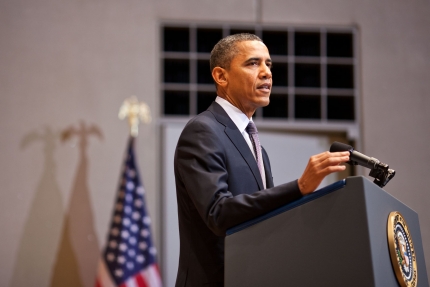
President Obama Presents the Commander-in-Chief Trophy

April 23, 2012 | 7:32 | Public Domain

President Obama presents the Commander-in-Chief Trophy to the United States Air Force Academy football team.

Download mp4 (266MB) | mp3 (17MB)

Read the Transcript

Remarks by the President at Presentation of the Commander-in-Chief Trophy to the United States Air Force Academy Football Team

East Room

2:42 P.M. EDT

THE PRESIDENT:  Please, everybody, have a seat.  Have a seat.  Good afternoon.  Now, I heard last year, with this trophy on the line, Jon Davis said, "You don’t get to meet the President every day."  Today, you do.  (Laughter.) 

Congratulations to the Fighting Falcons on winning their second straight and record 18th Commander-in-Chief Trophy last season.  (Applause.)  There we go.  I’m happy to meet you, too.  (Laughter.)  And welcome, everybody, to the White House.

Now, this trophy, which by the way is the biggest trophy -- I give a lot of these out -- (laughter.)  This is the monster of all trophies here.  This trophy has logged a lot of miles just jetting back and forth between Cadet Field House and the White House the past couple of years.  And I’m looking forward to seeing it again when I visit Colorado Springs next month.

We are honored to be joined today by the Superintendent of the Air Force Academy, Lieutenant General Michael Gould, as well as Representative Mike McIntyre is in the house.  To all the friends of Air Force football, congratulations on holding onto the title of gridiron supremacy in the Armed Forces.

Now, it was no easy feat for this team to make it here today.  These guys faced a brutal schedule, but they never backed down.  As Coach Calhoun said, "This group had a warrior spirit in them."  And they brought that fight to every game this season.  They shut out New Mexico on the road.  They brought home the Ram-Falcon Trophy with a decisive victory over Colorado State –- a game that won them a bowl bid for a record-setting fifth straight year.  They battled down to the wire against Toledo in an exciting Military Bowl, boldly going for the win with a two-point conversion and falling just short.  But I like that in you.  (Laughter.)  

Even when they were dogged by injuries, this team pulled together when it mattered most.  These guys toughed it out -- toughed out a narrow overtime victory against Navy, with Alex Means blocking an extra point in overtime and Tim Jefferson barreling the last yard into the end zone with the game on the line.  They stormed from behind to beat Army and secure this trophy with a third quarter that included two field goals, two touchdowns, a two-point conversion, and two takeaways. 

So this team had to fight hard this whole season.  But the work paid off.  The senior class standing behind me distinguished itself as one of the most talented in school history.  Brady Amack and Jon Davis put together the sixth-ranking passing defense in the country.  Asher Clark led the nation’s third-best rushing attack.  Tim Jefferson will graduate as the winningest Air Force quarterback of all time and the first quarterback in service academy history to lead his team to four consecutive bowl games.

So these young men have a lot to be proud of.  And if the past couple of seasons are any indication of what is to come, Coach Calhoun, we expect the Air Force will be back here this time next year.  (Laughter.)  Now, I know Army and Navy will have something to say about that.  (Laughter.)  But I know that the next year will take these young men from the Cadet Field House to pilot training, to air bases around the world, in defense of our country.  Ultimately, these seniors understand that shutouts and bowl games and trophies are not nearly as important as the solemn obligation, the solemn oath that they will take in just a few weeks as the newest officers in the world's finest Air Force. 

So, gentlemen, I have no higher privilege and no greater honor than serving as your Commander-in-Chief, and I look forward to joining you for that important ceremony.

Today, we honor the success that these outstanding young men had on the playing field.  And we look forward to their continuing excellence on behalf of the nation.  And, cadets, as you look to trade the proud uniform of your team for the proud uniform of your country, I want you to know that this country will stand by you and do everything possible to help you succeed and come home safe.

So God bless all those who serve, and God bless the United States of America, and God bless Air Force.

Thank you so much.

END               
2:47 P.M. EDT

Close Transcript

President Obama Speaks at the U.S. Holocaust Memorial Museum

President Barack Obama Delivers Remarks at the U.S. Holocaust Memorial Museum

President Barack Obama delivers remarks at the U.S. Holocaust Memorial Museum in Washington, D.C., April 23, 2012. (Official White House Photo by Pete Souza)

Today, President Obama spoke at the United States Holocaust Memorial Museum about honoring the pledge of “never again” by making sure we are doing everything we can to prevent and end atrocities and save lives.

After being introduced by Professor Elie Wiesel, a Holocaust survivor, the President spoke of the importance of telling our children—and all future generations—about that dark and evil time in human history when six million innocent men, women, and children were murdered just because they were Jewish.

We must tell our children. But more than that, we must teach them. Because remembrance without resolve is a hollow gesture. Awareness without action changes nothing. In this sense, "never again" is a challenge to us all -- to pause and to look within.

For the Holocaust may have reached its barbaric climax at Treblinka and Auschwitz and Belzec, but it started in the hearts of ordinary men and women. And we have seen it again -- madness that can sweep through peoples, sweep through nations, embed itself. The killings in Cambodia, the killings in Rwanda, the killings in Bosnia, the killings in Darfur -- they shock our conscience, but they are the awful extreme of a spectrum of ignorance and intolerance that we see every day; the bigotry that says another person is less than my equal, less than human. These are the seeds of hate that we cannot let take root in our heart.

Related Topics: Foreign Policy

President Obama Speaks on Preventing Mass Atrocities

April 23, 2012 | 35:42 | Public Domain

After an introduction by Professor Elie Wiesel, President Obama speaks at the U.S. Holocaust Memorial Museum about honoring the pledge of “never again” by doing everything we can to prevent mass atrocities and genocide, and discusses steps his Administration is taking to make this a reality.

Download mp4 (1260MB) | mp3 (82MB)

Read the Transcript

Remarks by the President at the United States Holocaust Memorial Museum

Washington, D.C.

10:00 A.M. EDT

THE PRESIDENT:  Good morning, everyone.  It is a great honor to be with you here today.  Of course, it is a truly humbling moment to be introduced by Elie Wiesel.  Along with Sara Bloomfield, the outstanding director here, we just spent some time among the exhibits, and this is now the second visit I've had here.  My daughters have come here.  It is a searing occasion whenever you visit.  And as we walked, I was taken back to the visit that Elie mentioned, the time that we traveled together to Buchenwald. 
 
And I recall how he showed me the barbed-wire fences and the guard towers.  And we walked the rows where the barracks once stood, where so many left this Earth -- including Elie’s father, Shlomo.  We stopped at an old photo -- men and boys lying in their wooden bunks, barely more than skeletons.  And if you look closely, you can see a 16-year old boy, looking right at the camera, right into your eyes.  You can see Elie. 
 
And at the end of our visit that day, Elie spoke of his father.  "I thought one day I will come back and speak to him," he said, "of times in which memory has become a sacred duty of all people of goodwill."  Elie, you've devoted your life to upholding that sacred duty.  You’ve challenged us all -- as individuals, and as nations -- to do the same, with the power of your example, the eloquence of your words, as you did again just now.  And so to you and Marion, we are extraordinarily grateful.
 
To Sara, to Tom Bernstein, to Josh Bolten, members of the United States Holocaust Memorial Council, and everyone who sustains this living memorial -- thank you for welcoming us here today.  To the members of Congress, members of the diplomatic corps, including Ambassador Michael Oren of Israel, we are glad to be with you. 
 
And most of all, we are honored to be in the presence of men and women whose lives are a testament to the endurance and the strength of the human spirit -- the inspiring survivors.  It is a privilege to be with you, on a very personal level.  As I’ve told some of you before, I grew up hearing stories about my great uncle -- a soldier in the 89th Infantry Division who was stunned and shaken by what he saw when he helped to liberate Ordruf, part of Buchenwald.   And I’ll never forget what I saw at Buchenwald, where so many perished with the words of Sh’ma Yis’ra’eil on their lips. 
 
I’ve stood with survivors, in the old Warsaw ghettos, where a monument honors heroes who said we will not go quietly; we will stand up, we will fight back.  And I’ve walked those sacred grounds at Yad Vashem, with its lesson for all nations -- the Shoah cannot be denied. 
 
During my visit to Yad Vashem I was given a gift, inscribed with those words from the Book of Joel:  "Has the like of this happened in your days or in the days of your fathers?  Tell your children about it, and let your children tell theirs, and their children the next generation."  That’s why we’re here.  Not simply to remember, but to speak. 
 
I say this as a President, and I say it as a father.  We must tell our children about a crime unique in human history.  The one and only Holocaust -- six million innocent people -- men, women, children, babies -- sent to their deaths just for being different, just for being Jewish.  We tell them, our children, about the millions of Poles and Catholics and Roma and gay people and so many others who also must never be forgotten.  Let us tell our children not only how they died, but also how they lived -- as fathers and mothers, and sons and daughters, and brothers and sisters who loved and hoped and dreamed, just like us.   
 
We must tell our children about how this evil was allowed to happen -- because so many people succumbed to their darkest instincts, and because so many others stood silent.  Let us also tell our children about the Righteous Among the Nations.  Among them was Jan Karski, a young Polish Catholic, who witnessed Jews being put on cattle cars, who saw the killings, and who told the truth, all the way to President Roosevelt himself. 
 
Jan Karski passed away more than a decade ago.  But today, I’m proud to announce that this spring I will honor him with America’s highest civilian honor -- the Presidential Medal of Freedom.  (Applause.)
 
We must tell our children.  But more than that, we must teach them.  Because remembrance without resolve is a hollow gesture.  Awareness without action changes nothing.  In this sense, "never again" is a challenge to us all -- to pause and to look within.
 
For the Holocaust may have reached its barbaric climax at Treblinka and Auschwitz and Belzec, but it started in the hearts of ordinary men and women.  And we have seen it again -- madness that can sweep through peoples, sweep through nations, embed itself.  The killings in Cambodia, the killings in Rwanda, the killings in Bosnia, the killings in Darfur -- they shock our conscience, but they are the awful extreme of a spectrum of ignorance and intolerance that we see every day; the bigotry that says another person is less than my equal, less than human.  These are the seeds of hate that we cannot let take root in our heart.
 
"Never again" is a challenge to reject hatred in all of its forms -- including anti-Semitism, which has no place in a civilized world.  And today, just steps from where he gave his life protecting this place, we honor the memory of Officer Stephen Tyrone Johns, whose family joins us today.
 
"Never again" is a challenge to defend the fundamental right of free people and free nations to exist in peace and security -- and that includes the State of Israel.  And on my visit to the old Warsaw Ghetto, a woman looked me in the eye, and she wanted to make sure America stood with Israel.  She said, "It’s the only Jewish state we have."  And I made her a promise in that solemn place.  I said I will always be there for Israel.
 
So when efforts are made to equate Zionism to racism, we reject them.  When international fora single out Israel with unfair resolutions, we vote against them.  When attempts are made to delegitimize the state of Israel, we oppose them.  When faced with a regime that threatens global security and denies the Holocaust and threatens to destroy Israel, the United States will do everything in our power to prevent Iran from getting a nuclear weapon.    
 
"Never again" is a challenge to societies.  We’re joined today by communities who’ve made it your mission to prevent mass atrocities in our time.  This museum’s Committee of Conscience, NGOs, faith groups, college students, you’ve harnessed the tools of the digital age -- online maps and satellites and a video and social media campaign seen by millions.  You understand that change comes from the bottom up, from the grassroots.  You understand -- to quote the task force convened by this museum -- "preventing genocide is an achievable goal."  It is an achievable goal.  It is one that does not start from the top; it starts from the bottom up.
 
It’s remarkable -- as we walked through this exhibit, Elie and I were talking as we looked at the unhappy record of the State Department and so many officials here in the United States during those years.  And he asked, "What would you do?"  But what you all understand is you don't just count on officials, you don't just count on governments.  You count on people -- and mobilizing their consciences. 
 
And finally, "never again" is a challenge to nations.  It’s a bitter truth -- too often, the world has failed to prevent the killing of innocents on a massive scale.  And we are haunted by the atrocities that we did not stop and the lives we did not save. 
 
Three years ago today, I joined many of you for a ceremony of remembrance at the U.S. Capitol.  And I said that we had to do "everything we can to prevent and end atrocities."  And so I want to report back to some of you today to let you know that as President I’ve done my utmost to back up those words with deeds.  Last year, in the first-ever presidential directive on this challenge, I made it clear that "preventing mass atrocities and genocide is a core national security interest and a core moral responsibility of the United States of America."
 
That does not mean that we intervene militarily every time there’s an injustice in the world.  We cannot and should not.  It does mean we possess many tools -- diplomatic and political, and economic and financial, and intelligence and law enforcement and our moral suasion -- and using these tools over the past three years, I believe -- I know -- that we have saved countless lives.    
 
When the referendum in South Sudan was in doubt, it threatened to reignite a conflict that had killed millions.  But with determined diplomacy, including by some people in this room, South Sudan became the world’s newest nation.  And our diplomacy continues, because in Darfur, in Abyei, in Southern Kordofan and the Blue Nile, the killing of innocents must come to an end.  The Presidents of Sudan and South Sudan must have the courage to negotiate -- because the people of Sudan and South Sudan deserve peace.  That is work that we have done, and it has saved lives.
 
When the incumbent in Côte D’Ivoire lost an election but refused to give it up -- give up power, it threatened to unleash untold ethnic and religious killings.  But with regional and international diplomacy, and U.N. peacekeepers who stood their ground and protected civilians, the former leader is now in The Hague, and Côte D’Ivoire is governed by its rightful leader -- and lives were saved.  
 
When the Libyan people demanded their rights and Muammar Qaddafi’s forces bore down on Benghazi, a city of 700,000, and threatened to hunt down its people like rats, we forged with allies and partners a coalition that stopped his troops in their tracks.  And today, the Libyan people are forging their own future, and the world can take pride in the innocent lives that we saved.
 
And when the Lord’s Resistance Army led by Joseph Kony continued its atrocities in Central Africa, I ordered a small number of American advisors to help Uganda and its neighbors pursue the LRA.  And when I made that announcement, I directed my National Security Council to review our progress after 150 days.  We have done so, and today I can announce that our advisors will continue their efforts to bring this madman to justice, and to save lives.  (Applause.)  It is part of our regional strategy to end the scourge that is the LRA, and help realize a future where no African child is stolen from their family and no girl is raped and no boy is turned into a child soldier. 
 
We’ve stepped up our efforts in other ways.  We’re doing more to protect women and girls from the horror of wartime sexual violence.  With the arrest of fugitives like Ratko Mladic, charged with ethnic cleansing in Bosnia, the world sent a message to war criminals everywhere:  We will not relent in bringing you to justice.  Be on notice.  And for the first time, we explicitly barred entry into the United States of those responsible for war crimes and crimes against humanity.
 
Now we’re doing something more.  We’re making sure that the United States government has the structures, the mechanisms to better prevent and respond to mass atrocities.  So I created the first-ever White House position dedicated to this task.  It’s why I created a new Atrocities Prevention Board, to bring together senior officials from across our government to focus on this critical mission.  This is not an afterthought.  This is not a sideline in our foreign policy.  The board will convene for the first time today, at the White House.  And I’m pleased that one of its first acts will be to meet with some of your organizations -- citizens and activists who are partners in this work, who have been carrying this torch.
 
Going forward, we’ll strengthen our tools across the board, and we'll create new ones.  The intelligence community will prepare, for example, the first-ever National Intelligence Estimate on the risk of mass atrocities and genocide.  We're going to institutionalize the focus on this issue.  Across government, "alert channels" will ensure that information about unfolding crises -- and dissenting opinions -- quickly reach decision-makers, including me.
 
Our Treasury Department will work to more quickly deploy its financial tools to block the flow of money to abusive regimes.  Our military will take additional steps to incorporate the prevention of atrocities into its doctrine and its planning.  And the State Department will increase its ability to surge our diplomats and experts in a crisis.  USAID will invite people and high-tech companies to help create new technologies to quickly expose violations of human rights.  And we’ll work with other nations so the burden is better shared -- because this is a global responsibility.
 
In short, we need to be doing everything we can to prevent and respond to these kinds of atrocities -- because national sovereignty is never a license to slaughter your people.  (Applause.) 
 
We recognize that, even as we do all we can, we cannot control every event.  And when innocents suffer, it tears at our conscience.  Elie alluded to what we feel as we see the Syrian people subjected to unspeakable violence, simply for demanding their universal rights.  And we have to do everything we can.  And as we do, we have to remember that despite all the tanks and all the snipers, all the torture and brutality unleashed against them, the Syrian people still brave the streets.  They still demand to be heard.  They still seek their dignity.  The Syrian people have not given up, which is why we cannot give up.

And so with allies and partners, we will keep increasing the pressure, with a diplomatic effort to further isolate Assad and his regime, so that those who stick with Assad know that they are making a losing bet.  We’ll keep increasing sanctions to cut off the regime from the money it needs to survive.  We’ll sustain a legal effort to document atrocities so killers face justice, and a humanitarian effort to get relief and medicine to the Syrian people.  And we’ll keep working with the "Friends of Syria" to increase support for the Syrian opposition as it grows stronger.

Indeed, today we’re taking another step.  I’ve signed an executive order that authorizes new sanctions against the Syrian government and Iran and those that abet them for using technologies to monitor and track and target citizens for violence.  These technologies should not empower -- these technologies should be in place to empower citizens, not to repress them.  And it’s one more step that we can take toward the day that we know will come -- the end of the Assad regime that has brutalized the Syrian people -- and allow the Syrian people to chart their own destiny.

Even with all the efforts I’ve described today, even with everything that hopefully we have learned, even with the incredible power of museums like this one, even with everything that we do to try to teach our children about our own responsibilities, we know that our work will never be done. There will be conflicts that are not easily resolved.  There will be senseless deaths that aren’t prevented.  There will be stories of pain and hardship that test our hopes and try our conscience.  And in such moments it can be hard to imagine a more just world. 
 
It can be tempting to throw up our hands and resign ourselves to man’s endless capacity for cruelty.  It’s tempting sometimes to believe that there is nothing we can do.  And all of us have those doubts.  All of us have those moments -- perhaps especially those who work most ardently in these fields.
 
So in the end, I come back to something Elie said that day we visited Buchenwald together.  Reflecting on all that he had endured, he said, "We had the right to give up."  "We had the right to give up on humanity, to give up on culture, to give up on education, to give up on the possibility of living one's life with dignity, in a world that has no place for dignity."  They had that right.  Imagine what they went through.  They had the right to give up.  Nobody would begrudge them that.  Who’d question someone giving up in such circumstances? 
 
But, Elie said, "We rejected that possibility, and we said, no, we must continue believing in a future."  To stare into the abyss, to face the darkness and insist there is a future -- to not give up, to say yes to life, to believe in the possibility of justice.  
 
To Elie and to the survivors who are here today, thank you for not giving up.  You show us the way.  (Applause.)  You show us the way.  If you cannot give up, if you can believe, then we can believe.  If you can continue to strive and speak, then we can speak and strive for a future where there’s a place for dignity for every human being.  That has been the cause of your lives.  It must be the work of our nation and of all nations. 
 
So God bless you.  And God bless the United States of America.  Thank you very much.  (Applause.)
 
END
10:27 A.M. EDT    
 

Close Transcript

The White House

Office of the Press Secretary

Statement by the President on Department of Defense Initiatives to Combat Sexual Assault in the Military

I applaud the initiatives that Secretary of Defense Leon E. Panetta and General Martin Dempsey, the Chairman of the Joint Chiefs of Staff, have announced to further combat sexual assault in the military.  The men and women of the United States military deserve an environment that is free from the threat of sexual assault, and in which allegations of sexual assault are thoroughly investigated, offenders are held appropriately accountable, and victims are given the care and support they need. Elevating these cases to a higher level of command review is a very important step. I believe that sexual assault has no place in our military.  I thank Secretary Panetta and Chairman Dempsey and look forward to seeing continued progress on this important issue.

The White House

Office of the Press Secretary

Remarks by the President at Presentation of the Commander-in-Chief Trophy to the United States Air Force Academy Football Team

East Room

2:42 P.M. EDT

THE PRESIDENT:  Please, everybody, have a seat.  Have a seat.  Good afternoon.  Now, I heard last year, with this trophy on the line, Jon Davis said, "You don’t get to meet the President every day."  Today, you do.  (Laughter.) 

Congratulations to the Fighting Falcons on winning their second straight and record 18th Commander-in-Chief Trophy last season.  (Applause.)  There we go.  I’m happy to meet you, too.  (Laughter.)  And welcome, everybody, to the White House.

Now, this trophy, which by the way is the biggest trophy -- I give a lot of these out -- (laughter.)  This is the monster of all trophies here.  This trophy has logged a lot of miles just jetting back and forth between Cadet Field House and the White House the past couple of years.  And I’m looking forward to seeing it again when I visit Colorado Springs next month.

We are honored to be joined today by the Superintendent of the Air Force Academy, Lieutenant General Michael Gould, as well as Representative Mike McIntyre is in the house.  To all the friends of Air Force football, congratulations on holding onto the title of gridiron supremacy in the Armed Forces.

Now, it was no easy feat for this team to make it here today.  These guys faced a brutal schedule, but they never backed down.  As Coach Calhoun said, "This group had a warrior spirit in them."  And they brought that fight to every game this season.  They shut out New Mexico on the road.  They brought home the Ram-Falcon Trophy with a decisive victory over Colorado State –- a game that won them a bowl bid for a record-setting fifth straight year.  They battled down to the wire against Toledo in an exciting Military Bowl, boldly going for the win with a two-point conversion and falling just short.  But I like that in you.  (Laughter.)  

Even when they were dogged by injuries, this team pulled together when it mattered most.  These guys toughed it out -- toughed out a narrow overtime victory against Navy, with Alex Means blocking an extra point in overtime and Tim Jefferson barreling the last yard into the end zone with the game on the line.  They stormed from behind to beat Army and secure this trophy with a third quarter that included two field goals, two touchdowns, a two-point conversion, and two takeaways. 

So this team had to fight hard this whole season.  But the work paid off.  The senior class standing behind me distinguished itself as one of the most talented in school history.  Brady Amack and Jon Davis put together the sixth-ranking passing defense in the country.  Asher Clark led the nation’s third-best rushing attack.  Tim Jefferson will graduate as the winningest Air Force quarterback of all time and the first quarterback in service academy history to lead his team to four consecutive bowl games.

So these young men have a lot to be proud of.  And if the past couple of seasons are any indication of what is to come, Coach Calhoun, we expect the Air Force will be back here this time next year.  (Laughter.)  Now, I know Army and Navy will have something to say about that.  (Laughter.)  But I know that the next year will take these young men from the Cadet Field House to pilot training, to air bases around the world, in defense of our country.  Ultimately, these seniors understand that shutouts and bowl games and trophies are not nearly as important as the solemn obligation, the solemn oath that they will take in just a few weeks as the newest officers in the world's finest Air Force. 

So, gentlemen, I have no higher privilege and no greater honor than serving as your Commander-in-Chief, and I look forward to joining you for that important ceremony.

Today, we honor the success that these outstanding young men had on the playing field.  And we look forward to their continuing excellence on behalf of the nation.  And, cadets, as you look to trade the proud uniform of your team for the proud uniform of your country, I want you to know that this country will stand by you and do everything possible to help you succeed and come home safe.

So God bless all those who serve, and God bless the United States of America, and God bless Air Force.

Thank you so much.

END               
2:47 P.M. EDT

The White House

Office of the Press Secretary

Statement by the President on Timor-Leste’s Election

I congratulate Taur Matan Ruak on his victory in Timor-Leste’s presidential election and the people of Timor-Leste for successfully participating in a peaceful, free, and transparent election.  I also recognize with deep appreciation President José Ramos Horta for his close friendship with the United States during his presidency, and look forward to continuing that productive relationship with Taur Matan Ruak.  

Our partnership with Timor-Leste is fundamental and enduring.  It is based on shared values of democracy, freedom, and human rights.  The United States remains steadfast in its support of Timor-Leste’s efforts to strengthen democratic institutions and consolidate peace and security in the country.    

The White House

Office of the Press Secretary

Educating Our Way to an Economy Built to Last: Stopping the Student Loan Interest Rate Hike

Stopping the Student Loan Interest Rate Hike

In his State of the Union Address, President Obama laid out a blueprint for an economy built to last—an economy built on American manufacturing, American energy, skills for American workers, and a renewal of American values.

The President has worked tirelessly to get our economy growing again, but he knows there’s much more we can and must do, and that includes making smart investments in education that lead to better jobs and a stronger middle class. The strength of the American economy is inextricably linked to the strength of America’s education system: particularly at this make-or-break moment for the middle class we must continue to invest in creating an American workforce that has the skills for success in the global economy.  At a time when the average earnings of college graduates is twice that of workers with only a high school diploma, higher education is the clearest pathway into the middle class.

However, the cost of college is putting an affordable education out of reach for too many Americans.  Access to higher education today has become increasingly expensive for families:

  • America is home to the best colleges and universities in the world, yet tuition and fees measured in constant dollars have more than doubled over the past two decades.
  • In 2010, graduates who took out loans left college owing an average of more than $25,000.
  • Student loan debt has now surpassed credit card debt for the first time ever. 

Reductions in state funding and support for institutions are making the college cost problem even more challenging, forcing students to absorb cuts through higher tuition prices and significantly increasing the extent to which students must rely on loans to finance postsecondary education. 

In order to ensure more hard working and responsible students have a fair shot at an affordable higher education, President Obama is calling on states, colleges and universities, and Congress to act to curb rising prices and make higher education more affordable for all Americans.

President Obama is Calling on Congress to Stop Interest Rates
From Doubling on Student Loans:

Americans now owe more tuition debt than credit card debt, and student loan borrowing is more common now than it was a decade ago. At a time when the average student loan debt is $25,000 and tuition prices continue to rise, students are borrowing more than ever to complete their degrees.

On July 1, 2012, the interest rates on subsidized Stafford student loans are slated to double from 3.4% to 6.8%. To out-educate our global competitors and make college more affordable, Congress needs to stop the interest rate on these student loans from doubling.

If Congress doesn’t act before July 1, 2012, interest rates on loans for over 7.4 million students will double. And for each year that Congress doesn’t act, students rack up an additional $1,000 in debt over the life of their loans.

As he did in his State of the Union address, President Obama is calling on Congress to put forward legislation to stop interest rates from doubling. The President is calling on Congress to reward hard work and responsibility by keeping interest rates on student loans low so more Americans get a fair shot at an affordable college education, the skills they need to find a good job, and a clear path to the middle class.


Ensuring American Students have a Fair Shot at an Affordable Higher Education

Higher education is not a luxury: it is an economic imperative that every hard working and responsible student should be able to afford.  President Obama has emphasized that the federal government, states, colleges, and universities all have a role to play in making in making higher education more affordable, by reining in college costs, providing value for American families, and preparing students with a solid education to succeed in their careers. The President is calling on Congress to advance new reforms to give more hard working students a fair shot at pursuing higher education: 

  • Reforming student aid to promote affordability and value:  To keep tuition from spiraling too high and drive greater value, the President has proposed reforms to federal campus-based aid programs to shift aid away from colleges that fail to keep net tuition down, and toward those colleges and universities that do their fair share to keep tuition affordable, provide good value, and serve needy students well. These changes in federal aid to campuses will leverage $10 billion annually to help keep tuition down. 
  • Creating a Race to the Top for college affordability and completion: The President has proposed incentives for states to maintain their commitments to higher education through a new $1 billion investment.  The Race to the Top: College Affordability and Completion challenge aims to increase the number of college graduates and contain the cost of tuition by rewarding states that are willing to systematically change their higher education policies and practices. 
  • Kicking off a First in the World competition to model innovation and quality on college campuses:  The President is proposing an investment of $55 million in a new First in the World competition, to support public and private colleges and non-profit organizations as they work to develop and test the next breakthrough strategy that will boost higher education attainment and student outcome, while leading to reduced costs.
  • Providing better data for families to choose the right college for them: The President is calling for a College Scorecard for all degree-granting institutions, designed to provide essential information about college costs, graduation rates, and potential earnings, all in an easy-to-read format that will help students and families choose a college that is well suited to their needs, priced affordably, and consistent with their career and educational goals.
  • Redoubling federal support to tackle college costs:  The President has already made the biggest investments in student aid since the G.I. Bill through increases to the Pell grant, and by shoring up the direct loan and income-based repayment programs. In his State of the Union Address, the President also called on Congress to make the American Opportunity Tax Credit permanent and double the number of work-study jobs over the next 5 years to better assist college students who are working their way through school. 

Building on Landmark Federal Investments to Make Higher Education More Affordable

The President has set the goal for the U.S. to be first in the world in college attainment by 2020. To achieve this bold goal for our nation’s future and to prepare students to compete in the 21st century global economy, the Obama Administration has championed landmark investments in student financial to make college more affordable for all American families: 

  • Increasing Pell Grants: The President has raised the maximum Pell Grant award to $5,635 for the 2013-14 award year – a $905 increase since 2008. The number of Pell Grant recipients has increased over that same time by 50 percent, providing college access to millions of additional students across the country. 
  • Helping Responsible Students Manage Student Loan Debt: The Administration’s “Pay as You Earn” plan expands income-based repayment to enable 1.6 million responsible students who are current on their payments to take advantage of a new option to cap repayment of student loans at 10% of monthly income.  These changes will reduce the burden of student loans in a fiscally responsible way.
  • Expanding Education Tax Credits: President Obama established the American Opportunity Tax Credit in 2009 to assist families with the costs of college, providing up to $10,000 for four years of college, university, or community college tuition for families earning up to $180,000. Over 9.4 million students and families benefit from the American Opportunity Tax Credit each year.  President Obama has called on Congress to make this tax credit permanent and prevent it from expiring in 2012. 

The White House

Office of the Press Secretary

Presidential Proclamation -- National Crime Victims’ Rights Week, 2012

NATIONAL CRIME VICTIMS' RIGHTS WEEK, 2012
- - - - - - -
BY THE PRESIDENT OF THE UNITED STATES OF AMERICA
A PROCLAMATION

For more than three decades, advocates from every corner of America have worked to reinforce rights, services, and support for victims of crime. Our Nation stands stronger for their efforts. Today, thousands of victim assistance programs empower survivors with the tools to rebuild their lives. Yet, when only about half of all violent crimes are reported to the police and many victims struggle to secure the help they need, we know we must do more. This week, we rededicate ourselves to securing the full measure of justice for every crime victim, resolving disparities in our criminal justice system, and preventing crimes before they occur.

The incidence of crime in the United States is an affront to our national conscience and cannot be ignored. Millions of Americans experience violent or property crime victimization every year, and still more are impacted as they help a loved one in their hour of need. Sadly, children, seniors, persons with disabilities, immigrants, and traditionally underserved communities continue to experience disproportionately high rates of victimization. Moreover, women suffer the vast majority of intimate partner violence, sexual assault, and rape. These outcomes are deplorable, and we must come together to build communities where all people have the opportunity to live in safety and security.

My Administration is committed to realizing that vision. With leadership from the Department of Justice, we are investing in programs to prevent crime, drug abuse, and violence in communities across our Nation. We are partnering with organizations and agencies at every level of government to develop robust victim services, support law enforcement, and strengthen our criminal justice system. We issued a revised definition of rape that will shed new light on how often this crime occurs, and we continue to combat sexual violence and expand support for survivors. From disrupting human trafficking networks, to fighting financial fraud, to empowering the millions who are affected by crime every year, my Administration is working to bring more Americans the services and protection they deserve. For additional information, resources, and assistance, visit www.CrimeVictims.gov.

During National Crime Victims' Rights Week, we commemorate the efforts of all who bring hope to crime victims during their darkest hour. As we reflect on the progress we have made toward ensuring fair treatment and full support for all crime victims, let us renew that fundamental American impulse to stand with those in need.

NOW, THEREFORE, I, BARACK OBAMA, President of the United States of America, by virtue of the authority vested in me by the Constitution and the laws of the United States, do hereby proclaim April 22 through April 28, 2012, as National Crime Victims' Rights Week. I call upon all Americans to observe this week by participating in events that raise awareness of victims' rights and services, and by volunteering to serve victims in their time of need.

IN WITNESS WHEREOF, I have hereunto set my hand this twenty-third day of April, in the year of our Lord two thousand twelve, and of the Independence of the United States of America the two hundred and thirty-sixth.

BARACK OBAMA

The White House

Office of the Press Secretary

Fact Sheet: Sanctions Against Those Complicit in Grave Human Rights Abuses Via Information Technology in Syria and Iran

“Cyberspace, and the technologies that enable it, allow people of every nationality, race, faith and point of view to communicate, cooperate, and prosper like never before.  We encourage people all over the world to use digital media…and denounce those who harass, unfairly arrest, threaten, or commit violent acts against the people who use these technologies.
 

-President Obama, International Strategy for Cyberspace, May 2011

Twenty-first century threats to human rights require twenty-first century tools to combat them.  This Administration recognizes that some oppressive governments seek to target their citizens for grave human rights abuses through the use of information and communications technology.  In an Executive Order signed today, President Obama authorized a new program of sanctions, aimed at those who facilitate serious human rights abuses in Syria and Iran through such means.

The same Global Positioning System (GPS), satellite communications, mobile phone, and Internet technology employed by activists across the Middle East and North Africa and around the world is being used against them in Syria and Iran, as the world has witnessed particularly clearly in Syria in recent weeks.  The Syrian and Iranian governments are rapidly increasing their capabilities to disrupt, monitor, and track communications networks that are essential to the ability of Syrians and Iranians to communicate with each other and the outside world.

The Executive Order announced today by President Obama establishes financial and travel sanctions against those who perpetrate or facilitate “Grave Human Rights Abuses Via Information Technology” in Syria and Iran (or “GHRAVITY sanctions”) and will:

• Degrade the ability of the Syrian and Iranian governments to acquire and utilize such technology to oppress their people;
• Hold accountable those government officials, companies, and individuals committing or facilitating human rights abuses.
• Send a clear message that the United States recognizes and is committed to combating this new and growing human rights threat;
• Further isolate the regimes in Damascus and Tehran;
• Strengthen international norms against using information and communications technology to commit human rights abuses;
The order authorizes sanctions against persons determined:

• To have operated, or to have directed the operation of, information and communications technology that facilitates computer or network disruption, monitoring or tracking that could assist in or enable serious human rights abuses by or on behalf of the Government of Iran or the Government of Syria;
• To have sold, leased, or otherwise provided, directly or indirectly, goods, services, or technology to Iran or Syria likely to be used to facilitate computer or network disruption, monitoring or tracking that could assist in or enable serious human rights abuses by or on behalf of the Government of Iran or the Government of Syria;
• To have materially assisted, sponsored, or provided financial, material, or technological support for, or goods or services to or in support of, those activities; or
• To be owned or controlled by, or to have acted or purported to act for or on behalf of, directly or indirectly, any person whose property and interests in property are blocked pursuant to the order.
We will implement this sanctions instrument consistent with our strong belief in the need to ensure that the citizens of Syria and Iran have access to information and communications technology that facilitates their access to information and ability to protect and organize themselves in the face of oppression.  This order underscores our efforts to help the Syrian and Iranian people pierce through the “electronic curtain” that the Syrian and Iranian regimes have put in place.  The Administration recognizes the importance of preserving the global telecommunications supply chains for essential products and services, and will take great care to ensure the utilization of sanctions does not disrupt transactions necessary to enable the Syrian and Iranian people to communicate. 

Given the deplorable and deteriorating human rights situation in Syria and Iran, our urgent priority is to pursue sanctions against those two governments and entities and individuals in those countries helping them to commit human rights abuses.  The order also authorizes sanctions against third-country entities or individuals where they meet the criteria in the order.    

The White House

Office of the Press Secretary

Remarks by the President at the United States Holocaust Memorial Museum

Washington, D.C.

10:00 A.M. EDT

THE PRESIDENT:  Good morning, everyone.  It is a great honor to be with you here today.  Of course, it is a truly humbling moment to be introduced by Elie Wiesel.  Along with Sara Bloomfield, the outstanding director here, we just spent some time among the exhibits, and this is now the second visit I've had here.  My daughters have come here.  It is a searing occasion whenever you visit.  And as we walked, I was taken back to the visit that Elie mentioned, the time that we traveled together to Buchenwald. 
 
And I recall how he showed me the barbed-wire fences and the guard towers.  And we walked the rows where the barracks once stood, where so many left this Earth -- including Elie’s father, Shlomo.  We stopped at an old photo -- men and boys lying in their wooden bunks, barely more than skeletons.  And if you look closely, you can see a 16-year old boy, looking right at the camera, right into your eyes.  You can see Elie. 
 
And at the end of our visit that day, Elie spoke of his father.  "I thought one day I will come back and speak to him," he said, "of times in which memory has become a sacred duty of all people of goodwill."  Elie, you've devoted your life to upholding that sacred duty.  You’ve challenged us all -- as individuals, and as nations -- to do the same, with the power of your example, the eloquence of your words, as you did again just now.  And so to you and Marion, we are extraordinarily grateful.
 
To Sara, to Tom Bernstein, to Josh Bolten, members of the United States Holocaust Memorial Council, and everyone who sustains this living memorial -- thank you for welcoming us here today.  To the members of Congress, members of the diplomatic corps, including Ambassador Michael Oren of Israel, we are glad to be with you. 
 
And most of all, we are honored to be in the presence of men and women whose lives are a testament to the endurance and the strength of the human spirit -- the inspiring survivors.  It is a privilege to be with you, on a very personal level.  As I’ve told some of you before, I grew up hearing stories about my great uncle -- a soldier in the 89th Infantry Division who was stunned and shaken by what he saw when he helped to liberate Ordruf, part of Buchenwald.   And I’ll never forget what I saw at Buchenwald, where so many perished with the words of Sh’ma Yis’ra’eil on their lips. 
 
I’ve stood with survivors, in the old Warsaw ghettos, where a monument honors heroes who said we will not go quietly; we will stand up, we will fight back.  And I’ve walked those sacred grounds at Yad Vashem, with its lesson for all nations -- the Shoah cannot be denied. 
 
During my visit to Yad Vashem I was given a gift, inscribed with those words from the Book of Joel:  "Has the like of this happened in your days or in the days of your fathers?  Tell your children about it, and let your children tell theirs, and their children the next generation."  That’s why we’re here.  Not simply to remember, but to speak. 
 
I say this as a President, and I say it as a father.  We must tell our children about a crime unique in human history.  The one and only Holocaust -- six million innocent people -- men, women, children, babies -- sent to their deaths just for being different, just for being Jewish.  We tell them, our children, about the millions of Poles and Catholics and Roma and gay people and so many others who also must never be forgotten.  Let us tell our children not only how they died, but also how they lived -- as fathers and mothers, and sons and daughters, and brothers and sisters who loved and hoped and dreamed, just like us.   
 
We must tell our children about how this evil was allowed to happen -- because so many people succumbed to their darkest instincts, and because so many others stood silent.  Let us also tell our children about the Righteous Among the Nations.  Among them was Jan Karski, a young Polish Catholic, who witnessed Jews being put on cattle cars, who saw the killings, and who told the truth, all the way to President Roosevelt himself. 
 
Jan Karski passed away more than a decade ago.  But today, I’m proud to announce that this spring I will honor him with America’s highest civilian honor -- the Presidential Medal of Freedom.  (Applause.)
 
We must tell our children.  But more than that, we must teach them.  Because remembrance without resolve is a hollow gesture.  Awareness without action changes nothing.  In this sense, "never again" is a challenge to us all -- to pause and to look within.
 
For the Holocaust may have reached its barbaric climax at Treblinka and Auschwitz and Belzec, but it started in the hearts of ordinary men and women.  And we have seen it again -- madness that can sweep through peoples, sweep through nations, embed itself.  The killings in Cambodia, the killings in Rwanda, the killings in Bosnia, the killings in Darfur -- they shock our conscience, but they are the awful extreme of a spectrum of ignorance and intolerance that we see every day; the bigotry that says another person is less than my equal, less than human.  These are the seeds of hate that we cannot let take root in our heart.
 
"Never again" is a challenge to reject hatred in all of its forms -- including anti-Semitism, which has no place in a civilized world.  And today, just steps from where he gave his life protecting this place, we honor the memory of Officer Stephen Tyrone Johns, whose family joins us today.
 
"Never again" is a challenge to defend the fundamental right of free people and free nations to exist in peace and security -- and that includes the State of Israel.  And on my visit to the old Warsaw Ghetto, a woman looked me in the eye, and she wanted to make sure America stood with Israel.  She said, "It’s the only Jewish state we have."  And I made her a promise in that solemn place.  I said I will always be there for Israel.
 
So when efforts are made to equate Zionism to racism, we reject them.  When international fora single out Israel with unfair resolutions, we vote against them.  When attempts are made to delegitimize the state of Israel, we oppose them.  When faced with a regime that threatens global security and denies the Holocaust and threatens to destroy Israel, the United States will do everything in our power to prevent Iran from getting a nuclear weapon.    
 
"Never again" is a challenge to societies.  We’re joined today by communities who’ve made it your mission to prevent mass atrocities in our time.  This museum’s Committee of Conscience, NGOs, faith groups, college students, you’ve harnessed the tools of the digital age -- online maps and satellites and a video and social media campaign seen by millions.  You understand that change comes from the bottom up, from the grassroots.  You understand -- to quote the task force convened by this museum -- "preventing genocide is an achievable goal."  It is an achievable goal.  It is one that does not start from the top; it starts from the bottom up.
 
It’s remarkable -- as we walked through this exhibit, Elie and I were talking as we looked at the unhappy record of the State Department and so many officials here in the United States during those years.  And he asked, "What would you do?"  But what you all understand is you don't just count on officials, you don't just count on governments.  You count on people -- and mobilizing their consciences. 
 
And finally, "never again" is a challenge to nations.  It’s a bitter truth -- too often, the world has failed to prevent the killing of innocents on a massive scale.  And we are haunted by the atrocities that we did not stop and the lives we did not save. 
 
Three years ago today, I joined many of you for a ceremony of remembrance at the U.S. Capitol.  And I said that we had to do "everything we can to prevent and end atrocities."  And so I want to report back to some of you today to let you know that as President I’ve done my utmost to back up those words with deeds.  Last year, in the first-ever presidential directive on this challenge, I made it clear that "preventing mass atrocities and genocide is a core national security interest and a core moral responsibility of the United States of America."
 
That does not mean that we intervene militarily every time there’s an injustice in the world.  We cannot and should not.  It does mean we possess many tools -- diplomatic and political, and economic and financial, and intelligence and law enforcement and our moral suasion -- and using these tools over the past three years, I believe -- I know -- that we have saved countless lives.    
 
When the referendum in South Sudan was in doubt, it threatened to reignite a conflict that had killed millions.  But with determined diplomacy, including by some people in this room, South Sudan became the world’s newest nation.  And our diplomacy continues, because in Darfur, in Abyei, in Southern Kordofan and the Blue Nile, the killing of innocents must come to an end.  The Presidents of Sudan and South Sudan must have the courage to negotiate -- because the people of Sudan and South Sudan deserve peace.  That is work that we have done, and it has saved lives.
 
When the incumbent in Côte D’Ivoire lost an election but refused to give it up -- give up power, it threatened to unleash untold ethnic and religious killings.  But with regional and international diplomacy, and U.N. peacekeepers who stood their ground and protected civilians, the former leader is now in The Hague, and Côte D’Ivoire is governed by its rightful leader -- and lives were saved.  
 
When the Libyan people demanded their rights and Muammar Qaddafi’s forces bore down on Benghazi, a city of 700,000, and threatened to hunt down its people like rats, we forged with allies and partners a coalition that stopped his troops in their tracks.  And today, the Libyan people are forging their own future, and the world can take pride in the innocent lives that we saved.
 
And when the Lord’s Resistance Army led by Joseph Kony continued its atrocities in Central Africa, I ordered a small number of American advisors to help Uganda and its neighbors pursue the LRA.  And when I made that announcement, I directed my National Security Council to review our progress after 150 days.  We have done so, and today I can announce that our advisors will continue their efforts to bring this madman to justice, and to save lives.  (Applause.)  It is part of our regional strategy to end the scourge that is the LRA, and help realize a future where no African child is stolen from their family and no girl is raped and no boy is turned into a child soldier. 
 
We’ve stepped up our efforts in other ways.  We’re doing more to protect women and girls from the horror of wartime sexual violence.  With the arrest of fugitives like Ratko Mladic, charged with ethnic cleansing in Bosnia, the world sent a message to war criminals everywhere:  We will not relent in bringing you to justice.  Be on notice.  And for the first time, we explicitly barred entry into the United States of those responsible for war crimes and crimes against humanity.
 
Now we’re doing something more.  We’re making sure that the United States government has the structures, the mechanisms to better prevent and respond to mass atrocities.  So I created the first-ever White House position dedicated to this task.  It’s why I created a new Atrocities Prevention Board, to bring together senior officials from across our government to focus on this critical mission.  This is not an afterthought.  This is not a sideline in our foreign policy.  The board will convene for the first time today, at the White House.  And I’m pleased that one of its first acts will be to meet with some of your organizations -- citizens and activists who are partners in this work, who have been carrying this torch.
 
Going forward, we’ll strengthen our tools across the board, and we'll create new ones.  The intelligence community will prepare, for example, the first-ever National Intelligence Estimate on the risk of mass atrocities and genocide.  We're going to institutionalize the focus on this issue.  Across government, "alert channels" will ensure that information about unfolding crises -- and dissenting opinions -- quickly reach decision-makers, including me.
 
Our Treasury Department will work to more quickly deploy its financial tools to block the flow of money to abusive regimes.  Our military will take additional steps to incorporate the prevention of atrocities into its doctrine and its planning.  And the State Department will increase its ability to surge our diplomats and experts in a crisis.  USAID will invite people and high-tech companies to help create new technologies to quickly expose violations of human rights.  And we’ll work with other nations so the burden is better shared -- because this is a global responsibility.
 
In short, we need to be doing everything we can to prevent and respond to these kinds of atrocities -- because national sovereignty is never a license to slaughter your people.  (Applause.) 
 
We recognize that, even as we do all we can, we cannot control every event.  And when innocents suffer, it tears at our conscience.  Elie alluded to what we feel as we see the Syrian people subjected to unspeakable violence, simply for demanding their universal rights.  And we have to do everything we can.  And as we do, we have to remember that despite all the tanks and all the snipers, all the torture and brutality unleashed against them, the Syrian people still brave the streets.  They still demand to be heard.  They still seek their dignity.  The Syrian people have not given up, which is why we cannot give up.

And so with allies and partners, we will keep increasing the pressure, with a diplomatic effort to further isolate Assad and his regime, so that those who stick with Assad know that they are making a losing bet.  We’ll keep increasing sanctions to cut off the regime from the money it needs to survive.  We’ll sustain a legal effort to document atrocities so killers face justice, and a humanitarian effort to get relief and medicine to the Syrian people.  And we’ll keep working with the "Friends of Syria" to increase support for the Syrian opposition as it grows stronger.

Indeed, today we’re taking another step.  I’ve signed an executive order that authorizes new sanctions against the Syrian government and Iran and those that abet them for using technologies to monitor and track and target citizens for violence.  These technologies should not empower -- these technologies should be in place to empower citizens, not to repress them.  And it’s one more step that we can take toward the day that we know will come -- the end of the Assad regime that has brutalized the Syrian people -- and allow the Syrian people to chart their own destiny.

Even with all the efforts I’ve described today, even with everything that hopefully we have learned, even with the incredible power of museums like this one, even with everything that we do to try to teach our children about our own responsibilities, we know that our work will never be done. There will be conflicts that are not easily resolved.  There will be senseless deaths that aren’t prevented.  There will be stories of pain and hardship that test our hopes and try our conscience.  And in such moments it can be hard to imagine a more just world. 
 
It can be tempting to throw up our hands and resign ourselves to man’s endless capacity for cruelty.  It’s tempting sometimes to believe that there is nothing we can do.  And all of us have those doubts.  All of us have those moments -- perhaps especially those who work most ardently in these fields.
 
So in the end, I come back to something Elie said that day we visited Buchenwald together.  Reflecting on all that he had endured, he said, "We had the right to give up."  "We had the right to give up on humanity, to give up on culture, to give up on education, to give up on the possibility of living one's life with dignity, in a world that has no place for dignity."  They had that right.  Imagine what they went through.  They had the right to give up.  Nobody would begrudge them that.  Who’d question someone giving up in such circumstances? 
 
But, Elie said, "We rejected that possibility, and we said, no, we must continue believing in a future."  To stare into the abyss, to face the darkness and insist there is a future -- to not give up, to say yes to life, to believe in the possibility of justice.  
 
To Elie and to the survivors who are here today, thank you for not giving up.  You show us the way.  (Applause.)  You show us the way.  If you cannot give up, if you can believe, then we can believe.  If you can continue to strive and speak, then we can speak and strive for a future where there’s a place for dignity for every human being.  That has been the cause of your lives.  It must be the work of our nation and of all nations. 
 
So God bless you.  And God bless the United States of America.  Thank you very much.  (Applause.)
 
END
10:27 A.M. EDT