President Obama's 2013 Budget is a Blueprint for an America Built to Last

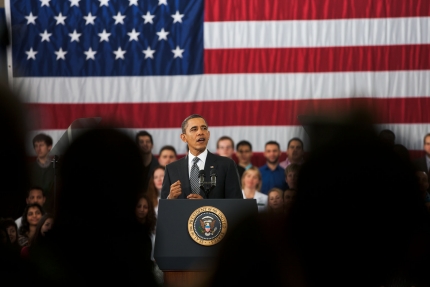
President Barack Obama delivers remarks on the FY 2013 Budget (February 13, 2012)

President Barack Obama delivers remarks to students on the FY 2013 Budget at the Northern Virginia Community College (NOVA), Annandale, Va., campus, Feb. 13, 2012. (Official White House Photo by Lawrence Jackson)

President Obama traveled to Annadale in northern Virginia this morning to talk about his budget for the 2013 fiscal year -- and how it will boost job creation to speed our economic recovery.

A core set of themes helps to define this budget, and in talking to the crowd, the President laid out those ideas:

[An] economy built to last demands that we keep doing everything we can to help students learn the skills that businesses are looking for. It means we have to keep strengthening American manufacturing. It means we’ve got to keep investing in American energy. We've got to double down on the clean energy that’s creating jobs. But it also means we've got to renew the American values of fair play and shared responsibility.

To help reflect that shared responsibility, the President is proposing a new set of reforms that guarantees that millionaires don't pay a lower rate in taxes than the middle class. He said:

Right now, we’re scheduled to spend nearly $1 trillion more on what was intended to be a temporary tax cut for the wealthiest 2 percent of Americans. We’ve already spent about that much. Now we’re scheduled to spend another trillion. Keep in mind, a quarter of all millionaires pay lower tax rates than millions of middle-class households. You’ve heard me say it -- Warren Buffett pays a lower tax rate than his secretary. That’s not fair.  It doesn’t make sense at a time when we've got to pull together to get the country moving.

If you want to read the complete budget, you can download the PDF, or get a copy for your Barnes & Noble Nook. We'll have a version for Amazon Kindle and Apple iBooks soon.


Learn more:

What 40 Dollars Means To You

February 13, 2012 | :40 | Public Domain

Share what losing 40 dollars a paycheck would mean to you buy going to WhiteHouse.Gov, or use the hash-tag #40dollars on Twitter.

Download mp4 (15MB)

The White House

Office of the Press Secretary

Press Briefing by Press Secretary Jay Carney, 2/13/12

James S. Brady Press Briefing Room

3:00 P.M. EST

        MR. CARNEY:  Good afternoon, ladies and gentlemen.  Welcome to the White House.  I know that you have already been well briefed on the President’s budget by an all-star cast of presenters over in the Old EOB.  I just wanted to be available to you to answer questions on presumably other subjects, although I can answer questions on the budget, as well, but probably not as well as they did.

        With that, I will go straight to the Associated Press.

        Q    Thanks, Jay.  Two topics:  The House leadership today proposed extending the payroll tax cut without insisting on pay-fors.  Is the President willing to decouple the payroll tax cut from unemployment insurance in order to get that portion of his budget priority passed?

        MR. CARNEY:  Well, let me say two things about that.  First of all, the President believes very strongly as he has made clear on a number of occasions that we need to extend the payroll tax cut to 160 million Americans, as well as unemployment insurance and the doc fix, the SGR, because they're the right things to do for the economy.  And going specifically to payroll tax and unemployment insurance, those things really have a direct, positive impact on economic growth and job creation.  And so they are essential.  We need to do all three of them, and that includes unemployment insurance.

        The approach the President has taken throughout this process is, despite the fact that -- and I think it’s worth stepping back a little bit -- remember during the payroll tax cut debate at the end of last year, Republicans who had as a matter of their own bylaws, if you will, in the House, said that no tax cut ever needs to be paid for, had insisted that this one be paid for.  The President was happy to work with them to find reasonable ways to offset the payroll tax cut extension, reasonable ways to pay for the payroll tax cut extension, and that remains his position.

        There is time to get this done.  There is time to negotiate a solution that ensures that 160 million Americans don't have their taxes go up on March 1st; that ensures that unemployment insurance is extended to make sure that those folks who are looking for a job have the means to continue to do so -- and that money, as you know, has a direct, positive impact on economic growth and job creation; and to do it in a way that is, in effect, a compromise that Congress can negotiate in a spirit of bipartisan cooperation.

        So he looks forward to doing that.  And don't forget that the payroll tax cut that the President envisioned extending through this year is part of his overall budget proposal, which he put forward today, that includes more than $4 trillion in deficit reduction.

        So we'll see how this process moves forward.  There's time to do it.  There is ample opportunity to do it in a way that does no harm to the economy, but ensures that this tax cut is extended for 160 million Americans.

        Q    So you're saying, at this point, he's not willing to accept this proposal --

        MR. CARNEY:  Well, this is a hypothetical proposal put out that they said they might do if conversations with folks on Capitol Hill don't progress according to the way they want.  Let's just see how this process plays out.  Extending unemployment insurance as well as the so-called doc fix is equally important -- certainly very important, and very important for our economy.  So the President supports extending all of it, and doing it in a way that is easily achievable if folks put ideological and partisan positions aside and just get it done for the American people.

        Q    Second subject.  On Friday, you seemed pretty satisfied that the contraception issue had been settled and you wanted to move on.  But the bishops put out a statement saying that it still raises serious moral concerns, and said the President's plan "continues to involve needless government intrusion in the internal governance of religious institutions."  As you know, there's also legislation in the Senate.  One would allow any employer to raise a conscience objection to the contraceptive issue.  Another one is broader -- even raise conscience objections to any aspect of the rule at all.

        Is this issue settled?  Are you going to be able to move forward?  The bishops have control of the pulpit, so to speak, and they have been talking against it.

        MR. CARNEY:  Well, there are a couple parts to that question.  Let me get to the first part, with regard to the bishops.  We feel very confident that the policy the President announced on Friday ensures both that women will get access to important preventive services like contraception, and they will be able to do so while preserving the religious liberty of the institutions they work for.  

        Nonprofit religious organizations won't have to pay for it, and they will not have to refer their employees for contraceptive services.  Churches and houses of worship, as you know, already were exempt and are exempt in this policy.  And the organizations that will be most affected by this -- Catholic Charities and the Catholic Health Association -- have expressed their support for this policy, and we obviously appreciate that.

        Now, we never set out with the assumption that everyone would be satisfied with this balanced approach, with this what we believe -- approach that ensures that women get -- all women, no matter where they work, get the preventive services they deserve and need, and that religious liberties are accommodated.  And I would simply note with regard to the bishops that they never supported health care reform to begin with, of which this is an important element.

        So then I would like to address the legislation you mentioned.  And whether it’s Senator Rubio or Blunt, the issue here is giving employers the right to deny women -- to deny women -- access to preventive services, including contraception free of charge.  So essentially, this bill or these bills would give any employer the right to deny the women who work for them contraceptive coverage.  That's dangerous and it is wrong.  And we oppose that.

        Q    It’s not -- as you know, it’s not just Rubio.  Senator Machin was on that bill with them.  So there’s -- at least have the cover of bipartisanship.  

        MR. CARNEY:  We think it is absolutely vital that women, no matter where they work, have access to the same health care coverage.  The preventive services here are important for women’s health and it is important that women, no matter where they work, have access to them.

        The President found in the policy he put forward on Friday an approach that balances the vital need to provide these services to women without further cost, while ensuring that religious liberties are protected.  And again, there’s been a broad spectrum of folks who have come out in support of the President’s approach.

        The bill put forward here, the one by Senator Rubio, the one by Senator Blunt -- I guess it’s an amendment -- we believe are both dangerous and wrong by giving any employer the right to deny the women who work for them contraceptive coverage.  And that's simply not the right approach.

        Yes, sir.

        Q    Jay, Israel has accused Iran and Hezbollah of being behind bombings at embassies today in India and Georgia.  What’s the White House reaction to the bombings and to Israel’s suspicions about who is behind them?

        MR. CARNEY:  As you know already, we condemn in very strong terms the attempted attacks against Israeli targets in New Delhi and Tbilisi today.  These incidents underscore our ongoing concern regarding the recent targeting of Israeli interests overseas.

        We continue to examine the situation.  Details are still emerging regarding those incidents.  As Secretary Clinton has indicated, the United States places a high priority on the safety and security of diplomatic personnel around the world, and we stand ready to assist with any investigation of these acts.

        We have no information yet on who is responsible for these attacks, so we’re still evaluating what happened.

        Q    Are you sharing information with Israel, or investigating together about that?

        MR. CARNEY:  Well, you can be sure, as we’ve said in the past, that generally speaking, we have extremely broad cooperation with Israeli intelligence and the Israeli military.  And you can be -- you can assume that that kind of -- those kinds of discussions are taking place.

        Q    And just one follow-up on Jim’s question.  Would the White House entertain the possibility of extending the payroll tax cut without having an offset?

        MR. CARNEY:  I don’t want to entertain hypotheticals.

        Q    Well, it’s not a hypothetical right now.

        MR. CARNEY:  Sure it is.  Would they entertain a bill if it were put forward -- that’s a hypothetical.  

        As I noted at the beginning of my answer, we found it ironic late last year when House Republicans who had made it a cornerstone of their philosophy in dealing with tax cuts, that they should not be paid for, that they were, in the case of a payroll tax cut for 160 million working Americans, insisting that it be paid for.  

        Nonetheless, the President happily worked with Congress to ensure that the extension, the two-month extension, of the payroll tax cut, as well as unemployment insurance, was offset with reasonable cuts.  And we are willing to continue working with Congress to offset the payroll tax cut extension and unemployment insurance extension in a responsible way that doesn’t harm the economy and doesn’t harm the very people the tax cut is meant to help, so that it’s extended for the full year.
        That’s the approach we’ve taken.  And we certainly expect Congress to act accordingly without delay and without drama.

        Q    But how important is it to the President that principle of having it offset?

        MR. CARNEY:  Well, I think we’ve made clear that the principle that it be offset was one established by Republicans.

        Q    So how important is it to --

        MR. CARNEY:  Was established by Republicans as recently as last week -- was reestablished or reasserted.  We are working with them to offset it in a responsible way.  And we expect Congress to get its work done and to extend it -- the payroll tax cut, unemployment insurance, and the doc fix for the end of the year -- for the rest of the year, rather.

        Jake.

        Q    The President, when he spoke to NOVA students and faculty earlier today, acknowledged that the numbers in the budget were so big they were difficult to talk about.  And to break them down, it would be along the lines of a family that makes $29,000 a year, spending $38,000 a year, so taking on $9,000 of new debt with a $153,000 credit card bill that they were not able to pay down.  That would be a way for, like, any average American to afford it -- to understand it.  Does that seem responsible?

        MR. CARNEY:  Well, Jake, I appreciate the analogy.  I think what you know and everyone in this room knows, and what every American knows based on what I’ve seen, is that this economy was in free fall in January of 2009.  It had the government in the previous eight years -- had racked up an enormous amount of debt -- although, it had started the century with surpluses.  And because of the free fall we were in, urgent measures needed to be taken to reverse the direction of the economy and to reverse the direction of employment in this country.

        Those actions were taken.  Hard choices were made.  And thanks to those tough choices made by the President working with Congress, the economy has now grown for a number of consecutive quarters.  It has created private sector jobs for 23 straight months, well over 3.7 million new jobs, and we are headed in the right direction.  But we have a long way to go.

        And what the President made clear, and the Chief of Staff made clear yesterday in his appearances, is that we need to make sure we get it right as we move forward, so that we invest where we need to, we extend the payroll tax cut, for example, because we need to economically; and then, for the medium and long term, we do the things that we need to do to ensure that we reduce our deficit and debt so that we can get our fiscal house in order.  

        And that's what the President's budget does.  As you know from the debate we had last fall, his vision -- again, encapsulated in this budget document -- reduces the deficit -- cuts spending by $4 trillion over 10 years in a balanced way, that includes the $1 trillion in discretionary cuts agreed to in the Budget Control Act.  It includes revenues as well as reductions in entitlement spending, as well as reductions in defense spending.  And that's the approach that the American people expect us to take.

        Q    So he's willing, theoretically, if he had a partner -- a Republican partner in Congress who is willing to take on some of the sacred things in his party -- the President is willing to go farther than this budget document?  This is a budget document according to what he's willing to do on his own; it's not as far as he would go, right?

        MR. CARNEY:  Well, I wouldn't want to negotiate the line items of a global grand bargain, if you will.  The President demonstrated last summer his willingness to take on the sacred cows in his own party, his willingness to do things and lead his party in a direction that would be very difficult for them, because he knew, and the leaders of the Democratic Party in the Congress agreed, that it was the right thing to do for the economy.

        Q    But this budget doesn't reflect that.

        MR. CARNEY:  Well, actually it does.  It does reflect -- I mean, it doesn't reflect every item of the potential grand bargain that the Speaker of the House walked away from, but it does reflect the proposal the President put forward in the fall that achieves $4 trillion -- more than $4 trillion in deficit reduction over 10 years, and does it with a combination of entitlement reductions and reforms -- of revenue increases, asking that those who have done exceptionally well over the last 10 years, the wealthiest Americans pay a little bit extra, pay their fair share, and it does it through sensible, wise reductions in defense spending and discretionary spending.  

        Q    But from your own words and President Obama's own words, it is not as bold as he would be willing to be if he had a Republican partner in Congress willing to --

        MR. CARNEY:  It is a very bold proposal.  And it is absolutely designed on the framework laid out by bipartisan commissions like Erskine Bowles and Alan Simpson chaired, similar to the Domenici-Rivlin commission, in that it encapsulates this balanced approach.

        Now, unfortunately, we haven't had a willingness to travel the bipartisan, balanced road on the Republican side.  You've had an asymmetrical situation here, where the President has been willing to make tough choices, things that are hard for Democrats to do, but we haven't seen the concurrent willingness on the Republican side, unfortunately, to even embrace -- even be open to the idea that Americans overwhelmingly support, which is that we need to do something about revenues so that we can reduce our deficit and deal with our long-term debt in a responsible way.  

        Because the alternative is the so-called Ryan budget, which basically ends welfare as we know it, which asks average seniors to pay up to $6,000 a year --

        Q    Medicare.

        MR. CARNEY:  Medicare, sorry.  Asks average seniors to pay up to $6,000 a year extra for deficit reduction, but also so that millionaires get $100,000 extra in tax breaks.  Now, I just think -- I think that is a tough message to explain to an average American out there who’s struggling to make ends meet, who sees hope in the economy but still knows that we will have a long way to go, and the answer on one side of the aisle is to seriously affect the livelihoods of senior citizens so that we can give more tax breaks to the folks who have gotten the most tax breaks in the previous 10 years.  And I just -- that's not a debate that we believe the other side is likely to win.

        The sensible approach is the bipartisan approach, is the balanced approach, that says we have to do this in a way that deals with all the drivers of our long-term deficit, including revenues, including defense, including discretionary spending.

        Q    So back to my family metaphor, one of the spouses isn’t willing to make the touch choices, but the President is?  (Laughter.)

        MR. CARNEY:  Look, I think the President has demonstrated -- I mean, he took a lot of heat this summer from his party and advocates on the Democratic side of the political spectrum because of his willingness to make some tough choices.  And he remains willing to do that.  And he would welcome a willingness by Republicans to approach deficit reduction in a balanced way.

        I mean, there’s a lot of talk about Simpson-Bowles, a commission that only exists because the President created it, and the outlines of which drove the President’s own broad deficit and debt reduction plan.  What people forget about Simpson-Bowles is that it asks for twice as many revenues as the President’s own proposal.  People forget that it asks for substantially more deficit cuts than the President believes are responsible.

        And what we forget about Simpson-Bowles is not a single House Republican endorsed it or supported it -- even on the commission.  And I think that reflects part of the problem we have in Washington right now.

        Norah.

        Q    On Syria, the U.N. Human Rights chief today essentially said that the failure of the collective action of the Security Council has “emboldened the Syrian government to launch an all-out assault” -- she called it crimes against humanity, a widespread and systematic attack on civilians.  Does the White House agree with that?

        MR. CARNEY:  The White House agrees that the Assad regime continues to perpetrate disgusting acts of violence against its own people who seek only a democratic transition and a better life, and we call on the Assad regime to cease and desist this behavior.  And we work with our international partners to continue to pressure the regime and isolate it to try to bring about a change in behavior.

        As you know, we’ve been working with a group that's standing up the Friends of Syria, which will have its first meeting in Tunisia, I believe on February 24th.  And we will work with all our international partners and allies -- and that includes countries in the region -- to further pressure Assad to get him to stop this behavior, to step aside and allow the Syrian people the future that they deserve, that includes as well discussions of providing humanitarian aid and other measures that can be taken to isolate Assad even further.

        Q    There's an Arab League proposal out there to send in peacekeepers.  Would the U.S. be willing to add to that effort?

        MR. CARNEY:  Well, we strongly agree with the Arab League's demand Sunday to immediately and fully stop all acts of violence and the murder of Syrian civilians, and its renewed call on the Syrian armed forces to immediately lift the military siege imposed on residential districts and villages.  Regarding U.N.  peacekeepers, as a general principle, we support an expanded and enhanced Arab League mission, including with U.N. or other support.  We are discussing with the Arab League, the U.N. and our international partners, the circumstances in which a peacekeeping force -- whether under Arab League, U.N. or other auspices -- could help to maintain peace in Syria, starting with there being a peace to keep.  Unfortunately, as you know, there is not one at this moment.

        Q    So there could be a scenario where U.S. troops are over there as peacekeepers?

        MR. CARNEY:  Well, we're talking U.N., Arab League or other auspices.  You're speculating about an outcome that would require a peace to be kept to begin with.

        Q    Can I ask you about -- given the Arab Spring and other areas where the United States has been involved -- for instance, in Libya -- are there any similarities in terms of Syria and the action we took in Libya?

        MR. CARNEY:  Well, that's a helpful question and an important one, because we've made the point with regard -- in answer to questions about why not act in Syria the same way that the United States acted with Libya -- and I think it is important to point out two things.  One, all the way back when Libya was unfolding, we made clear that every country is different, in our view, and therefore the approach we take in every -- with regards to developments in every country is different.  

        The situation in Libya was one where you had United Nations support; you had broad Arab League support; you had the Libyan people asking for the kind of intervention that was authorized under the U.N. Security resolution that allowed the enforcement of the no-fly zone, and the actions by NATO forces to prevent -- NATO and outside forces to prevent Qaddafi from a mass assault on his own people.

        So there are serious differences, significant differences between these two situations.  But we are -- in a way that is similar, we are working with international allies and partners from Europe, the United Nations, the region, to forge a broad group supporting the Syrian people, and to do everything we can to isolate and pressure Assad, to support the Syrian people in a time of dire need, and to help bring about the democratic transition that the Syrian people desperately deserve.

        Q    Jay, back on the budget.  How can the President and Jack Lew yesterday, when he was on the Sunday show, say this is not a time for austerity; we can’t choke off the recovery, when  -- if you go back to last summer, the economy arguably was in worse shape, unemployment was certainly higher than it is today. And the President, during the debt ceiling debate, was saying it’s a moral imperative to tackle the debt.  Isn’t this budget now basically just kicking the can down the road?

        MR. CARNEY:  Well, it’s a great question because it contains the answer within it.  The President’s vision for fulfilling the moral obligation to tackle the debt is contained within the budget he presented today.  He certainly did not mean last summer that we should contract spending in a way that threw the very fragile recovery at that point into reverse and caused further job loss and inflicted further economic pain on the American people.  

        He has always taken the approach, as we have emerged from the greatest recession since the Great Depression, that we need to take steps to strengthen the economy, create economic growth, have the economy create more jobs in the near term to give it the strength that it needs so that the recovery will become an engine on its own; and that even now, as we’re taking -- we’re passing measures that do that, like the payroll tax cut, for example, or unemployment insurance extension, or the other aspects of the American Jobs Act -- which, unfortunately, Republican have blocked but would put people back to work and cause even greater economic growth -- we do those things, and we do them responsibly and pay for them, but we do those things, even as we lock in the kind of medium- and long-term savings that would reduce the deficit by $4 trillion over 10 years.

        Q    I acknowledge that unemployment is down, but there, when you say lock in those savings -- the Peter G. Peterson Foundation, which is nonpartisan, came out and flatly said that when you look at your own budget, even under optimistic assumptions, the President’s own numbers showed debt rising rapidly after 2022 and reaching levels that would put the economy at risk.  So the first part of your answer seems to be working in terms of the economy coming back.  But the second part -- how are you locking in savings when nonpartisan groups are saying you're not?

        MR. CARNEY:  We are locking in savings over 10 years -- $4 trillion.  It doesn’t meant that every problem is solved --

        Q    -- drop in the bucket when it’s going to be $25 trillion in debt in --

        MR. CARNEY:  I’m sorry, has someone else offered a $25 trillion debt reduction plan?  Because I think I’d be interested to see it.

        But the fact is, the President has put forward a deficit and debt reduction plan that would save more than $4 trillion over 10 years.  That is significant savings.  And it builds on some of the decisions that have been made, working with Congress, last summer through the debt ceiling negotiations that led to the passage of the Budget Control Act that locked in a trillion dollars in discretionary cuts; that locked in an additional $1.2 trillion in cuts through the so-called sequester, which is designed to force Congress to act in a responsible and balanced way for further deficit and debt reduction.  And then in his budget he has further savings that account for the total $4 trillion -- or greater than $4 trillion.  

        That’s the right approach.  It doesn’t mean we’ve solved every problem for the country going forward.  Certainly that wouldn’t be the case.  But it does it in a responsible way, and it does it in a way that proves, as other bipartisan commissions have shown, that you do not have to decimate Medicare, end it as we know it, in order to balance -- to deal with our deficit and debt, to bring it under control, to achieve the so-called primary balance that the President’s budget does.

        You just need to make responsible choices.  You need to ask something of the wealthiest Americans, who at a time when the middle class was getting hammered, was enjoying the greatest accumulation of wealth in the previous decade before the President took office.  And all we’re asking is that everyone pay their fair share so that everyone gets a fair shot.  And the President thinks that’s entirely responsible.  It happens to be a view shared by a broad majority of the American people.

        Q    Last thing.  Despite all those good things you say, the Republicans immediately say every year in the Obama administration, they’ve basically said dead on arrival with the budget, right?  The Ryan budget, they put a plan on the table, you say it hurts senior citizens.  Is there a better way to do this so that that $25 trillion debt that's coming a decade or so from now can actually be cut?  Is there something to the process -- introduce this, they shoot it down, they put -- is there a way to make this process better?

        MR. CARNEY:  Well, I suppose there are many ways to make the process better, but the principal one is for elected officials of goodwill to decide that they're going to check the ideological baggage at the door when they go into negotiate.  And that was the approach that we took in the discussions led by Vice President Biden last summer.  It was the approach the President took in the discussions he had with Speaker of the House John Boehner.  And it’s the approach that we would take tomorrow if there were willingness to acknowledge that there is a way to do this that's fair and balanced; that there is a way to do this that doesn't require the burden of dealing with our deficit and long-term debt to be borne by senior citizens and the most vulnerable in our community; and that if we all are willing to make the tough choices, we can get it done.

        And that's encapsulated in the President’s budget.  It was reflected in the negotiations he had last summer, and it will be his approach going through this year.  I mean, a lot of people talk about how nothing is going to get done this year because it’s an election year, and I think you and I were around -- I think, Ed, you were around in ’96.  I know some others were -- Jake -- that's what everyone said in 1996:  can't be done because there’s an incumbent President running for reelection with a Congress controlled by a different party.  Well, in fact, that was a highly successful legislation year.  And the President hopes that those opportunities will present themselves this year.  
        It takes merely a willingness to compromise, a willingness to not adhere to ideological standards that say no way, no how are we ever going to ask the wealthiest Americans to pay just a little bit more so that we don't have to shift all the burden on to senior citizens.

        Let me move around.  Yes, a little foreign policy, and then Brianna.

        Q    Thank you.  Back on Syria, is there -- you probably wouldn’t talk about this if you knew because it involves intelligence issues -- but is there a reason, does the White House think, for the U.S. applying intelligence assets or sharing those with the opposition in Syria?  Has it be discussed with partners and allies to this point?

        MR. CARNEY:  I think you're right that it’s not the kind of thing I’d be able to speak to here.  We’re obviously working with a broad array of allies and partners who are friends of Syria and who have as their goal in this effort a democratic transition in Syria that follows the cessation of the abhorrent violence that the Assad regime has been perpetrating on its own people.  How we get there, obviously there's a number of aspects to that that mostly involve coordinating with our international partners and further pressuring and isolating Assad.

        Yes, J.C.

        Q    How concerned is this administration that the counterinsurgencies, those who are fighting against Mr. Assad's regime in fact could have the earmarks, could have the markings of an embedded al Qaeda?

        MR. CARNEY:  Well, look, I think as this -- these kinds of questions were asked during the period of the situation in Libya -- we don't know everything about what the so-called opposition is.  Remember that the situation in Syria is one where peaceful protests were fired upon, and that when -- that the violence is pretty one-sided here.  If you're referring to the comments about AQI and others, I mean, we find it worth noting that, overall, the Arab Spring and what it represents and the way that it demonstrates the desire for greater freedom and prosperity and for democracy in the region by the people of the region is an absolute repudiation of the ideology of al Qaeda.  And it proves even -- I mean, proves pretty decisively that the approach of terrorism and violence perpetrated on innocent civilians has been rejected all around the world, including in the very region where this Arab Spring is taking place.

        Q    Could there be a question that this may not be so simple, not so cut and dry in terms of --

        MR. CARNEY:  Well, I don't have any -- I don't have an analysis for you.  I mean, I think that we obviously carefully evaluate movements, groups, individuals in the region, in all these areas, as this process -- and this tumultuous process continues.  But I don't have anything specific with regard to Syria and your question.

        Yes, sir -- Brianna first, sorry.

        Q    Jay, in 2009, President Obama said, "I am pledging to cut the deficit we inherited by half by the end of my first term in office."  Was it a mistake for him to make that promise?

        MR. CARNEY:  It was a promise based on what we knew about the economy at the time.  As has been well established in this briefing and in many other places, the economy turns out to have been far worse and in far greater distress when the President was running for office and then took office than we knew at the time. Even as recently as, I don't know, six or eight months ago, we thought that the economy shrank by something like 4 or 5 percent in the fourth quarter of 2008.  We now know it shrank by 9 percent.  The catastrophe was far worse than we knew.  

        And yet, in spite of that fact, the President's budget that he put forward today achieves that goal of having -- cutting in half the deficit in five years instead of four, which demonstrates his commitment to responsibly reducing our deficit and getting our fiscal house in order.

        Q    And then, his budget calls for carried interest to be taxed as ordinary income, something obviously Mitt Romney benefits from very much, that tax provision.  Is this also a political swipe at him?

        MR. CARNEY:  Well, not at all, because we have held this position with regards to carried interest for quite some time.  We simply believe that in a -- with respect specifically to carried interest, that money earned as a result of work performed should be taxed in the same way, whether you're a hedge fund manager or a shift worker -- as income.  And that's the principle behind the approach we've taken to carried interest.  

        It, again, goes to the broader principle embodied in the Buffett Rule, which is that millionaires and billionaires shouldn't be paying a lower effective tax rate on their income than average folks -- in this case, Mr. Buffett's secretary.  So that's the approach to carried interest.  It doesn't have -- it's not aimed at an individual, it’s just a matter of basic fairness.

        Q    Shouldn’t we expect to be hearing the President ultimately here in the coming months talk about Mitt Romney and carried interest in the same --

        MR. CARNEY:  Again, this is not about -- I can refer you to the campaign for -- if they want to preview campaign lines, but I know because I’ve heard him talk about it, this is about -- and this isn’t about raising revenues for the sake of raising revenues.  It’s about having a balanced and fair approach to ensure that as we get our deficit and debt under control, we are investing in the things that will help our economy grow in the long term.  And that includes education -- as the President pointed out today at Northern Virginia Community College.  It includes innovation, making sure that we’re investing in clean energy technologies so that we can enhance our energy independence in the 21st century.  I mean it’s about building a foundation for competing and winning economically in the 21st century.

        And we need to make sure that we invest in those key areas, or we will fall behind.  And that's unacceptable to this President.  He insists that America remain the great economy that it is because of it’s -- the best workforce in the country, and he insists that we have the best infrastructure and the best innovative technologies going forward because that's how we’re going to win in the 21st century.  

        So it’s about making responsible choices, and one of them is simply asking that hedge fund managers, who benefit enormously from the so-called carried interest rule pay income tax at the effective rate that average folks pay.  

        Yes, Kate.

        Q    So does the President plan to keep talking about the contraception policy, or does he want to move on -- just following up on Debbie’s question.  And then also, is the Blunt and Rubio legislation something the administration is really worried about succeeding?

        MR. CARNEY:  Well, I can't predict its future.  We know that its wrong.  We know that saying that any woman can be denied access to these preventive services by her employer is absolutely the wrong approach.  

        The President feels that the policy he announced on Friday achieves the appropriate balance between the need to extend these services to all women no matter where they work to ensure that they have access without cost to important preventive services like contraception, and doing it while protecting religious liberties and being sensitive to the concerns that were raised by religious institutions.  And again I pointed to statements by Catholic Charities and the Catholic Health Association as evidence we believe of the fact that this balance has been achieved.

        Q    So we can expect more from him, then, going forward as the Bishops keep talking about --

        MR. CARNEY:  I think the President throughout this process has been interested in finding the right policy, the right -- to ensuring that women have access to preventive services free of charge and to doing so in a way that's sensitive to religious beliefs.  

        You heard him stand at this podium on Friday talk from the heart about why he believes that is important, and he believes both goals are very important.  And they are not mutually exclusive.  And that's why he instructed his administration to find a solution to this and was pleased that they did.

        Yes, sir.

        Q    Jay, two questions on China’s Vice President Xi’s visit to the U.S.  First is, I know tomorrow it will be the very first time for the President and the Vice President meet each other.  And so what's the President -- the impression of him so far?  And also, what's the expectation of the President?  And also --

        MR. CARNEY:  Of the President?

        Q    The President on China's Vice President?  And also, the second question, ahead of his visit Mr. Xi gave a interview to The Washington Post in D.C. at a time when people wrote of his stability and development, to "deliberately give prominence to military security agenda, scale up military deployment and strengthen military alliances is not really what most countries in the region hope to see."  So what's the reaction from the White House to his written interview?

        MR. CARNEY:  Well, I don’t have a specific reaction to that. I would simply say that, as you heard the President describe quite fully during his recent trip to Asia, we, the United States of America, are a Pacific power; we are an economic power, as well as a power with important security relationships in the region.  

        And the President feels very strongly that in the previous decade, prior to his taking office, under the previous 8 years, that the region was somewhat neglected by the United States because of its preoccupation and focus on the Middle East, in particular, on Iraq.  And he has sought to rebalance our focus and our national security approach, as well as our economic approach -- international economic approach -- to reflect the important role that the region is playing economically, and the important role that our relations with China and with countries all around the region will play in the 21st century.

        So it's not an either/or, as far as he's concerned.  It's a both/and.  And that I think he spelled out pretty clearly during his trip to Asia.  And you will hear various administration officials I think reflect those views during this important visit this week.

        I don’t have any description for you of the President's views.  I know he looks forward to meeting Vice President Xi and that he's certainly glad that Vice President Biden is hosting this visit, and it's very important for our -- because we have so many important matters between our two countries.

        Q    Thanks, Jay.

        MR. CARNEY:  Last one.  Let me get Mark, yes.

        Q    Yes, Jay, briefly back to the bombings.  Prime Minister Netanyahu just flat out blamed Iran.  He said they're behind these two things.  Is he jumping the gun?  Is he getting ahead of himself?

        MR. CARNEY:  Well, again, I don’t have an assessment to give you of what the Israeli government is saying.  I simply can tell you that we have not made a judgment yet because details are still emerging regarding what happened in both New Delhi and Tbilisi.  And we have no information yet to share with you about who was behind those attacks.  But we're obviously working and discussing with the Israelis and others to ascertain exactly that.  

        Yes.

        Q    Just a little one, Jay.  Do you know whether the President has ever met Whitney Houston, and is he a fan of her music?  Thank you for not laughing at me.

        Q    No, that’s exactly what I was going to ask.  I'm sorry, go ahead.

        MR. CARNEY:  I actually don’t know if he's ever met -- if he did ever meet Whitney Houston.  And as for his -- I mean, I think it would be hard not to be an admirer of her immense talent, and I know that -- well, I haven't spoken with him about it, but I am -- I know that his thoughts and prayers are with her family, especially her daughter.  I mean, it's a tragedy to lose somebody so talented at such a young age.

        But I don’t have anything more on that for you.

        Thank you, all.

END 3:44 P.M. EST

The White House

Office of the Press Secretary

Readout of the President's Call with Prime Minister Cameron of the United Kingdom

The President and Prime Minister Cameron spoke by telephone today, continuing their frequent consultations on a range of global issues.   The President and Prime Minister discussed the situation in Syria, condemning the regime’s violent repression of its own citizens, and agreed to coordinate closely on efforts to pressure the Assad regime and support a transition to democracy.  The two leaders also discussed Somalia, including the status of preparations for the February 23rd London Conference on Somalia.   The President welcomed the Prime Minister’s personal leadership on this issue.  The President also consulted with the Prime Minister regarding the ongoing transition in Afghanistan and on the situation in the eurozone, including recent developments in Greece.  Finally, the President and the Prime Minister reviewed the status of preparations for the Prime Minister’s March 13-14 Official Visit, when President and Mrs. Obama look forward to welcoming Prime Minister and Mrs. Cameron to Washington, D.C.

The White House

Office of the Press Secretary

Presidential Nominations Sent to the Senate

NOMINATIONS SENT TO THE SENATE:

Sharon Block, of the District of Columbia, to be a Member of the National Labor Relations Board for the term of five years expiring December 16, 2014, vice Craig Becker, to which position she was appointed during last recess of the Senate.

William P. Doyle, of Pennsylvania, to be a Federal Maritime Commissioner for the term expiring June 30, 2013, vice Joseph E. Brennan, term expired.

Terence Francis Flynn, of Maryland, to be a Member of the National Labor Relations Board for the term of five years expiring August 27, 2015, vice Peter Schaumber, term expired, to which position he was appointed during the last recess of the Senate.

Richard F. Griffin, Jr., of the District of Columbia, to be a Member of the National Labor Relations Board for the term of five years expiring August 27, 2016, vice Wilma B. Liebman, term expired, to which position he was appointed during the last recess of the Senate.

Richard A. Lidinsky, Jr., of Maryland, to be a Federal Maritime Commissioner for the term expiring June 30, 2017. (Reappointment)

Katharina G. McFarland, of Virginia, to be an Assistant Secretary of Defense.  (New Position)

Kenneth Merten, of Virginia, a Career Member of the Senior Foreign Service, Class of Minister-Counselor, to be Ambassador Extraordinary and Plenipotentiary of the United States of America to the Republic of Croatia.

President Obama Awards the 2011 National Medals of Arts and Humanities at the White House

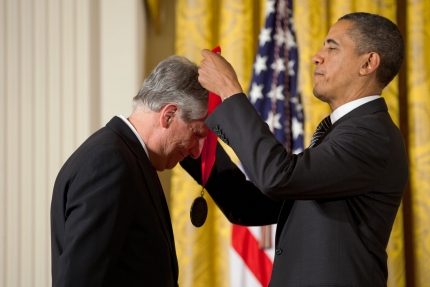
President Barack Obama awards Robert Darnton a 2011 National Humanities Medal

President Barack Obama awards Robert Darnton, author and librarian, the National Humanities Medal for his determination to make knowledge accessible to everyone. President Obama awarded the 2011 National Medal of Arts and National Humanities Medal in the East Room of the White House, Feb. 13, 2012. 2011. (Official White House Photo by Pete Souza)

The 2011 honorees of the National Medals of Arts and Humanities were at the White House today for an event that President Obama said he and First Lady Michelle Obama look forward to every single year. "It's a moment when America has a chance to pay tribute to extraordinary men and women who have excelled in the arts and the humanities, and who, along the way, have left an indelible mark on American culture," the President said before the ceremony in the East Room.

Today's honorees represented the full spectrum of the arts and humanities, and included actors, poets, authors, singers, philosophers, sculptors, curators, musicians, historians and even an economist. President Obama praised the group for their contributions to the arts, and to American society:

You create new possibilities for all of us. And that's a special trait.  And it assigns you a special task.  Because in moments of calm, as in moments of crisis; in times of triumph, as in times of tragedy:  you help guide our growth as a people.  The true power of the arts and the humanities is that you speak to everyone.  There is not one of us here who hasn’t had their beliefs challenged by a writer’s eloquence; or their knowledge deepened by a historian’s insights; or their sagging spirits lifted by a singer’s voice.  Those are some of the most endearing and memorable moments in our lives.

Equal to the impact you have on each of us every day as individuals is the impact you have on us as a society.  And we are told we're divided as a people, and then suddenly the arts have this power to bring us together and speak to our common condition.

Related Topics:

2011 National Medals of Arts and Humanities Ceremony

February 13, 2012 | 23:49 | Public Domain

President Obama honors recipients of the 2011 National Medals of Arts and Humanities.

Download mp4 (227MB) | mp3 (22MB)

The White House

Office of the Press Secretary

Remarks by the President at the 2011 National Medals of Arts and Humanities Ceremony

East Room

1:52 P.M. EST

THE PRESIDENT:  Thank you!  Hello, everybody.  (Applause.)   Thank you.  Thank you very much.  Thank you.  Thank you so much.  Thank you, everybody.  Please, please have a seat.  Thank you.

Thank you so much for joining us in this celebration of the arts and the humanities.  Two outstanding public servants and ambassadors for the arts are here:  Rocco Landesman.  Where's Rocco?  There he is, right here -- Chairman of the National Endowment of the Arts.  And Jim Leach.  Where's Jim?  Good to see you, Jim -- the Chairman of the National Endowment for the Humanities. 

We also have two good friends and co-chairs of the President’s Committee on the Arts and the Humanities who are here:  Margo Lions and George Stevens.  And I also want to acknowledge one of our honorees who, unfortunately, could not make it.  Ever the artist, André Watts had a concert to give in Salt Lake City.  (Laughter.)  So give him a big round of applause in his absence.  (Applause.)   

Michelle and I love this event.  This is something we look forward to every single year, because it's a moment when America has a chance to pay tribute to extraordinary men and women who have excelled in the arts and the humanities, and who, along the way, have left an indelible mark on American culture.  That’s all the honorees we see here today.  We honor your talents, we honor your careers, and your remarkable contributions to this country that we love.

Throughout our history, America has advanced not only because of the will of our citizens, not only because of the vision of our leaders or the might of our military.  America has also advanced because of paintings and poems, stories and songs; the dramas and the dances that provide us comfort and instilled in us confidence; inspired in us a sense of mutual understanding, and a calling to always strive for a more perfect union.

Emily Dickinson wrote, “I dwell in possibility.”  "I dwell in possibility."  And so does the American spirit.  That’s who we are as a people.  And that’s who our honorees are.  Each of you have traveled a unique path to get here.  And your fields represent the full spectrum of the arts and humanities.  With us are actors and poets, authors, singers, philosophers, sculptors, curators, musicians, and historians.  We even have an economist, which we don't always get on stage.  (Laughter.) 

But what connects every one of you is that you dwell in possibilities.  You create new possibilities for all of us.
And that's a special trait.  And it assigns you a special task.  Because in moments of calm, as in moments of crisis; in times of triumph, as in times of tragedy:  you help guide our growth as a people.  The true power of the arts and the humanities is that you speak to everyone.  There is not one of us here who hasn’t had their beliefs challenged by a writer’s eloquence; or their knowledge deepened by a historian’s insights; or their sagging spirits lifted by a singer’s voice.  Those are some of the most endearing and memorable moments in our lives.

Equal to the impact you have on each of us every day as individuals is the impact you have on us as a society.  And we are told we're divided as a people, and then suddenly the arts have this power to bring us together and speak to our common condition.

Recently, I’ve been reminded of Walt Whitman’s famous poem “I Hear America Singing.”  And it's a poem that with simple eloquence spotlights our diversity and our spirit of rugged individualism -- the messy, energized, dynamic sense of what it is to be an American.  And Whitman lifts up the voices of mechanics and carpenters; masons and boatmen; shoemakers, wood-cutters; the mother and the young wife at work, “each singing what belongs to him or her, and to none else.” 

And it’s true that we all have songs in our souls that are only ours.  We all have a unique part in the story of America.  But that story is bigger than any one of us.  And it endures because we are all heirs to a fundamental truth:  that out of many, are one -- this incredible multitude. 
I hear America singing today.  I hear America singing through the artists and the writers that we honor this afternoon; the men and women who are following in the footsteps of Whitman and Hemingway, and Souza and Armstrong, and Eakins and Rockwell. But I also hear America singing through the artists and writers who will be sitting here a few decades from now with another President; the students in Denver who recently wrote a play about teenage homelessness; or the kids in Grand Rapids who designed a mural to bring joy to a struggling community.  They’re singing what Whitman called “strong melodious songs.”

And somewhere in America, the next great writer is wrestling with the first draft of an English paper.  (Laughter.)  Somewhere the next great actor is mustering up the courage to try out for that school play.  Somewhere the next great artist is doodling on their homework.  Somewhere the next great thinker is asking their teacher, "why not?"  They’re out there right now dwelling in possibility.

So as we honor the icons of today, we also have to champion the icons of tomorrow.  They need our support; we need them to succeed.  We need them to succeed as much as we need engineers and scientists.  We also need artists and scholars.  We need them to take the mantle from you; to do their part to disrupt our views and to challenge our presumptions, and most of all to stir in us a need to be our better selves. 

The arts and the humanities do not just reflect America.  They shape America.  And as long as I am President, I look forward to making sure they are a priority for this country.  (Applause.)

It is now my distinct privilege to present these medals to the award winners who we have here today.  And as the citations are read, I’m sure you’ve gotten extensive instructions from our military aides.  (Laughter.) 

MILITARY AIDE:  The National Medal of Arts recipients:

Will Barnet.  (Applause.)  The 2011 National Medal of Arts to Will Barnet for his contributions as an American painter, printmaker, and teacher.  Widely celebrated for a lifelong exploration of abstraction, expressionism, and geometry that marry sophistication and emotion with beauty and form, Mr. Barnet has been a constant force in the visual arts world.  (Applause.)
 
Rita Dove.  (Applause.)  The 2011 National Medal of Arts to Rita Dove for her contributions to American letters and her service as Poet Laureate of the United States from 1993 to 1995. Through works that blend beauty, lyricism, critique, and politics, Ms. Dove has illuminated American poetry and literature, and cultivated popular interest in the arts.  (Applause.)
 
Al Pacino.  (Applause.)  The 2011 National Medal of Arts to Al Pacino for his iconic contributions to American film and theater as actor and director.  Recognized around the world for his signature intensity of the silver screen, Mr. Pacino stands among America’s most accomplished artists.  (Applause.)

Emily Rauh Pulitzer.  (Applause.)  The 2011 National Medal of Arts to Emily Rauh Pulitzer for her contributions as a curator, art collector, and philanthropist.  The founder of the Pulitzer Prize for the Arts, Mrs. Pulitzer has broadened the impact of the arts in our national life by bringing great works into the public sphere.  (Applause.)

Martin Puryear.  (Applause.)  The 2011 National Medal of Arts to Martin Puryear for his reflections on history, culture and identity through sculpture.  Mr. Puryear’s mastery of wood, stone and metal, and his commitment to manual skill offer a stirring counterpoint to an increasingly digital world.  (Applause.)

Mel Tillis.  (Applause.)  The 2011 National Medal of Arts to Mel Tillis for his contributions to country music.  With over 1,000 songs and more than 60 albums to his name, Mr. Tillis's unique blend of warmth and humor distinguishes him as one of the most inventive singer-songwriters of his generation.  (Applause.)
 
Accepting on behalf of the USO, United Service Organizations, Sloan Gibson.  (Applause.)  The 2011 National Medal of Arts to United Service Organizations for lifting the spirits of service members and their families through the arts.  The USO continues to support members of our armed forces by bringing iconic American artists to share the sights and sounds of home with troops stationed around the world.  (Applause.)

The National Humanities Medal recipients:

Kwame Anthony Appiah.  (Applause.)  The 2011 National Humanities Medal to Kwame Anthony Appiah for his contributions to philosophy and the pursuit of truth in the contemporary world.  Dr. Appiah’s writing within and beyond his academic discipline sheds light on the idea of the individual in an era of globalization and evolving group identities.  (Applause.)

John Ashbery.  (Applause.)  The 2011 National Humanities Medal to John Ashbery for his contributions to American letters. One of the New York School of Poets, his work has profoundly influenced generation of writers and garnered awards spanning the Pulitzer Prize to the Grand Prix de Biennales Internationales de Poésie.  (Applause.)

Robert Darnton.  (Applause.)  The 2011 National Humanities Medal to Robert Darnton for his commitment to making knowledge accessible to everyone.  An eminent cultural historian and librarian, Dr. Darnton has illuminated the world of Enlightenment and Revolutionary France, and has pursued his vision for a national library of digitized books.  (Applause.)

Andrew Delbanco.  (Applause.)  The 2011 National Humanities Medal to Andrew Delbanco for his insight into the American character, past and present.  In writing that spans the literature of Melville and Emerson to contemporary issues in higher education, he has continually informed our understanding of what is means to live in America.  (Applause.)

Accepting on behalf of National History Day, Cathy Gorn.  (Applause.)  The 2011 National Humanities Medal to National History Day for sparking passion for history in students across our country.  Every year National History Day inspires more than half a million young Americans to write, perform, research, and document the human story.  (Applause.) 

Charles Rosen.  (Applause.)  The 2011 National Humanities Medal to Charles Rosen for his contributions as a pianist and a scholar.  Demonstrating a rare ability to join artistry to the history of culture and ideas, his writings on Classical composers and the Romantic tradition highlight how music evolves and remains a vibrant, living art.  (Applause.)

Teofilo F. Ruiz.  (Applause.)  The 2011 National Humanities Medal to Teofilo F. Ruiz for his outstanding scholarship in history.  An accomplished teacher and author, Dr. Ruiz has captivated students and scholars by deepening our knowledge of medieval Spain and Europe, and exploring the role terror has played in society for centuries.  (Applause.)

Ramón Saldívar.  (Applause.)  The 2011 National Humanities Medal to Ramón Saldívar for his bold exploration of identity along the border separating the United States and Mexico.  In his studies of Chicano literature and the development of the novel in Europe and America, Dr. Saldívar highlights the cultural and literary markings that divide and unite us.  (Applause.)

Amartya Sen.  (Applause.)  The 2011 National Humanities Medal to Amartya Sen for his insights into the causes of poverty, famine, and injustice.  By applying philosophical thinking to questions of policy, he has changed how standards of living are measured and increased our understanding of how to fight hunger. (Applause.)

THE PRESIDENT:  Let’s give a big hand to our award winners today.  (Applause.)

Well, we are just blessed to have this incredible array of talent and inspiration with us here today.  We are so glad we had the opportunity to make this small gesture of appreciation and thanks to all that you have contributed to us.

Each and every day you continue to inform who we are as a people, and we could not be prouder of everything that you’ve done, and we know you’ve got a lot more to do, so keep at it.

In the meantime, for everybody who is gathered here today, we have a wonderful reception.  So please enjoy.  The food is usually pretty good around here.  (Laughter.)  The music is even better.  I think the Marine Band will probably be out there playing a few tunes.  And again, we are very thankful to all the honorees here today for everything that you’ve done for our country.  Congratulations.  (Applause.)

END
2:16 P.M. EST

President Obama's Plan to Train 2 Million Workers for Jobs in High-Demand Industries

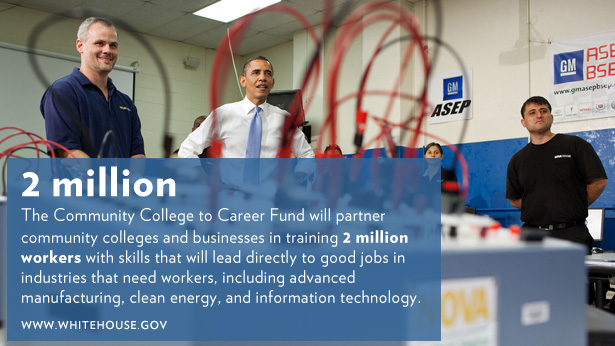
Today, President Obama announced the Community College to Career Fund, an $8 billion investment in his Fiscal Year 2013 Budget that would train two million workers with skills that lead directly to good jobs in industries that need workers, including advanced manufacturing, clean energy, and information technology.

This program will serve a dual purpose: making sure community colleges have the resources they need to equip workers with crucial skills and industry-recognized credentials, and ensuring that employers in high-growth industries have the skilled workforce they need for positions that might otherwise go unfilled—or overseas.

Employers today are looking for skilled, educated workers, and they should be able to find those workers right here in the United States. Here’s how the Community College to Career Fund would help:

Support for workers:

In addition to supporting community college-based training programs that provide workers with targeted, certified training for jobs in rapidly growing industries like clean energy, high-tech manufacturing and information technology, the proposed program will fund:

  • On-the-job training opportunities such as registered apprenticeships and paid internships that allow students to simultaneously earn credit for work-based learning and gain relevant employment experience in  high-wage, high-skill fields.
  • “Pay for Performance” strategies that provide incentives for training providers, community colleges, and local workforce organizations to make sure workers find permanent jobs after they complete training and earn credentials.
Related Topics: Economy

President Obama Speaks on the 2013 Budget

February 13, 2012 | 22:52 | Public Domain

President Obama introduces an initiative to train workers through a partnership between businesses and community colleges, a proposal in his FY 2013 Budget.

Download mp4 (218MB) | mp3 (21MB)

Read the Transcript

Remarks by the President on the Budget

Northern Virginia dale, Virginia

11:12 A.M. EST

THE PRESIDENT:  Thank you very much.  (Applause.)  Thank you, Virginia!  Thank you, NOVA!  (Applause.)  Thank you very much.  Everybody who has a chair please have a seat.  I know not everybody has a chair. 

AUDIENCE MEMBER:  Love you!

THE PRESIDENT:  I love you back.  (Laughter.)  Great to be here.

First of all, I want to thank Mike for the wonderful introduction.  Please give Mike a big round of applause.  (Applause.) 

It is great to be back here at NOVA.  I’ve been here so many times I’m about three credits short of graduation.  (Laughter.)  But there are a couple of reasons that I keep on coming back.  First of all, I think that Dr. Templin and the whole administration here is doing a great job, so I want to give them a big round of applause.  (Applause.)  The other reason is because Jill Biden keeps talking up how great you are.  And just as I do what Michelle tells me to do, I also do what Jill Biden tells me to do.  (Laughter.) 

In addition, by the way, I just want to acknowledge that we also have our Secretary of Labor here, Hilda Solis, who's doing an outstanding job.  (Applause.)

But the main reason I keep on coming back is I think this institution is an example of what's best about America.  Some of you may have your eye on a four-year college.  Some of you may be trying to learn new skills that could lead to a new job, like Mike, or a job that pays more, gives you more opportunity.  But all of you are here because you believe in yourselves, you believe in your ability, you believe in the future of this country.  And that’s something that inspires me and you guys should take great pride in. 

Now, the truth is, the skills and training you get here will be the best tools you have to achieve the American promise -- the promise that if you work hard, you can do well enough to raise a family, own a home, send your kids to college, and put a little away for retirement. 

And the defining issue of our time is how to keep this promise alive today -- for everybody.  Because we've got a choice:  We can settle for a country where a few people do really, really well, and everybody else struggles to get by.  Or we can restore an economy where everybody gets a fair shot, everybody does their fair share, everybody plays by the same set of rules -- from Washington to Wall Street to Main Street.  That’s the America we believe in.  (Applause.) 

Now, we're still recovering from one of the worst economic crises in three generations.  We've got a long way to go before everybody who wants a good job can find one; before middle-class Americans regain that sense of security that’s been slipping away for too long -- long before the recession hit. 

But over the last 23 months, we’ve added 3.7 million new jobs.  (Applause.)  American manufacturers are creating jobs for the first time since the 1990s.  The economy is growing stronger.  The recovery is speeding up.  And the last thing we can afford to do right now is to go back to the very policies that got us into this mess in the first place.  We can't afford it.  (Applause.)  The last thing we need is for Washington to stand in the way of America's comeback.  (Applause.) 

Now, what does that mean concretely?  For starters, Congress needs to stop taxes from going up on 160 million Americans by the end of this month.  And if they don’t act, that's exactly what will happen.  (Applause.)  Congress needs to pass an extension of the payroll tax cut and unemployment insurance without drama, and without delay, and without linking it to some other ideological side issues. 

We've been through this before, remember?  We've seen this movie.  We don't need to see it again.  The time for self-inflicted wounds to our economy has to be over.  Now is the time for action.  Now is the time for all of us to move forward.

But preventing a tax hike on the middle class -- that's only the beginning, that's just starters.  In the State of the Union, I outlined a blueprint for an economy that is built to last -– an economy built on new manufacturing, and new sources of energy, and new skills and education for the American people.

Today, we’re releasing the details of that blueprint in the form of next year’s budget.  And don’t worry, I will not read it to you.  (Laughter.)  It's long and a lot of numbers.  But the main idea in the budget is this:  At a time when our economy is growing and creating jobs at a faster clip, we've got to do everything in our power to keep this recovery on track.

Part of our job is to bring down our deficit.  And if Congress adopts this budget, then along with the cuts that we’ve already made, we’ll be able to reduce our deficit by $4 trillion by the year 2022 -- $4 trillion.  I’m proposing some difficult cuts that, frankly, I wouldn’t normally make if they weren’t absolutely necessary.  But they are.  And the truth is we’re going to have to make some tough choices in order to put this country back on a more sustainable fiscal path.

By reducing our deficit in the long term, what that allows us to do is to invest in the things that will help grow our economy right now.  We can’t cut back on those things that are important for us to grow.  We can't just cut our way into growth. We can cut back on the things that we don’t need, but we also have to make sure that everyone is paying their fair share for the things that we do need. 

We need to restore American manufacturing by ending tax breaks for companies that ship jobs overseas, giving them to companies that are creating jobs right here in the United States of America.  (Applause.)  That’s something that everybody should agree on. 

We need to reduce our dependence on foreign oil by ending the subsidies for oil companies, and doubling down on clean energy that generates jobs and strengthens our security.  (Applause.)

And to make sure our businesses don’t have to move overseas to find skilled workers, we’ve got to invest in places like NOVA, and make sure higher education is affordable for every hardworking American.  (Applause.)

That’s what I want to focus on today -- what we need to do in terms of higher education, and community colleges in particular.  Employers today are looking for the most skilled, educated workers.  I don’t want them to find them in India or China.  I want businesses to find those workers right here, in the United States.  The skills and training that employers are looking for begins with the men and women who educate our children. 

All of us can point to a teacher who’s made a difference in our lives -- and I know I can.  So I want this Congress to give our schools the resources to keep good teachers on the job, and reward the best teachers.  And in return, they also need to give schools the flexibility to stop just teaching to the test, and replace teachers who aren’t helping kids learn.  That’s something that we can do.  (Applause.)

So making sure we’ve got the most skilled workers starts early.  It starts with K-12 -- it starts before K-12, making sure every child is prepared.  And when an American of any age wants to pursue any kind of higher education -- whether it’s that high school grad who's just trying to get that first couple years of college education, or somebody like Mike who's in the process of retraining -- whether it’s two years or four years or more, we’ve got to make sure that education is affordable and available to everybody who wants to go.

Now, this Congress needs to stop the interest rates on student loans from doubling this July.  That's pretty important. (Applause.)  That's in our budget.  We’re saying to Congress, now is not the time to make school more expensive for young people.  And they can act right now to make that change.

They also need to take the tuition tax credit that my administration put in the budget over these last few years -– a tax credit that saves families thousands of dollars on tuition -– and we need to make that permanent.  It shouldn’t be temporary, it should be permanent.  (Applause.)

So between the increases we've provided in Pell grants, these tax credits, keeping interest rates low -- all that is going to help.  And millions of students across the country have benefitted from that.  But students and taxpayers can’t just keep on subsidizing skyrocketing tuition -- we're going to run out of money.  So that’s why I've asked states and colleges to do their part to keep costs down. 

We're putting colleges and universities on notice:  You can't just keep on raising tuition and expect us to keep on coming up with more and more money.  Because tuition inflation has actually gone up even faster than health care.  That’s hard to do.  (Laughter.) 

So what we're saying to states, colleges and universities -- if you can't stop tuition from going up, then funding you get from taxpayers will go down.  Because higher education cannot be a luxury; it is an economic imperative that every family in America should be able to afford.  That’s part of the American promise in the 21st century.  (Applause.)

So that’s what we need to do to get more Americans ready for the jobs of the future.  But what about the jobs that are open today?  I talked about this at the State of the Union.  There are millions of jobs open right now, and there are millions of people who are unemployed.  And the question is how do we match up those workers to those jobs?  What about the companies that are looking to hire right now?

I hear from business leaders all the time who want to hire in the United States, but at the moment, they cannot always find workers with the right skills.  Growing industries in science and technology have twice as many openings as we have workers who can do those jobs.  Think about that.  At a time when millions of Americans are looking for work, we shouldn't have any job openings out there.  They should all be getting filled up.

Here in America, we’ve got the best workers and some of the fastest-growing companies in the world.  There’s no reason we can’t connect the two.  And places like NOVA are proving that we know how to do it.  This institution proves we know how to do it. (Applause.) 

So let's say you are a single parent, or a returning veteran, or somebody who just wants a shot at a better-paying job.  You’re a hard worker, you’re a fast learner, you’re motivated.  You know there are companies looking to hire.  You just need to figure out how to acquire some of the specific skills, the specialized skills that the companies need, and you need to figure that out as quickly as possible -– hopefully without taking on tons of debt.

Everybody in America should be able to get those skills at a community college like NOVA.  And companies looking to hire should be able to count on these schools to provide them with a steady stream of workers qualified to fill those specific jobs.

That's why Mike was sharing his story.  As Mike mentioned, he worked in the mortgage and real estate industry for 10 years, but when business declined after 9/11, he decided to start over. So he began selling building materials.  Then the bottom fell out of the housing market, so Mike had to start all over again.  He's got a knack for computers.  So he figured he’d try a career in cybersecurity, where there is a lot of hiring -- that is going to be a growth industry. 

Luckily for Mike, NOVA is home to a program called CyberWatch.  So he signed up -- even though he's driving a limo on the side, he's still got to pay the bills.  So he's working while going to school.  But in December, Mike earned two certificates -- and, by the way, finished with a 4.0.  So we're proud of that.  (Applause.)   Now he’s working towards his Associate’s degree.  And when he graduates, Mike will have access to a network of over 40 companies and government agencies to help him find a job.

So we need more stories like Mike’s.  That’s why my administration is helping community colleges redesign training programs, so students can learn the skills that are most in demand in industries like health care sciences and advanced manufacturing.  And that’s why we’re making a national commitment to train 2 million Americans with skills they need to get a job right now, or start their own business right now.  (Applause.)

We’ve lined up more companies that want to help.  We’ve already got model partnerships between major businesses like Siemens and community colleges in places like Charlotte and Orlando and Louisville -- they're already up and running.  We know how they work.  And that's why I’ve asked Dr. Biden Secretary Solis to take a bus tour through several states, including Ohio and Kentucky and North Carolina, to highlight businesses and community colleges that are working together to train workers for careers that are in demand right now.  We've got to make these examples a model for the entire nation.

And we also need to give more community colleges the resources they need to become community career centers -- places where folks can learn the skills that local business are looking for right now, from data management to high-tech manufacturing.  This should be an engine of job growth all across the country, these community colleges, and that’s why we’ve got to support them.  That’s why it’s such a big priority.  (Applause.)

So an economy built to last demands that we keep doing everything we can to help students learn the skills that businesses are looking for.  It means we have to keep strengthening American manufacturing.  It means we’ve got to keep investing in American energy.  We've got to double down on the clean energy that’s creating jobs.  But it also means we've got to renew the American values of fair play and shared responsibility.

The budget that we’re releasing today is a reflection of shared responsibility.  It says that if we’re serious about investing in our future and investing in community colleges, and investing in new energy technology, and investing in basic research, well, we’ve got to pay for it.  And that means we've got to make some choices. 

Right now, we’re scheduled to spend nearly $1 trillion more on what was intended to be a temporary tax cut for the wealthiest 2 percent of Americans.  We’ve already spent about that much.  Now we’re scheduled to spend another trillion.  Keep in mind, a quarter of all millionaires pay lower tax rates than millions of middle-class households.  You’ve heard me say it -- Warren Buffett pays a lower tax rate than his secretary.  That’s not fair.  It doesn’t make sense at a time when we've got to pull together to get the country moving. 

I don’t need a tax break.  We don’t need to be providing additional tax cuts for folks who are doing really, really, really well.  Do we want to keep these tax cuts for the wealthiest Americans?  Or do we want to keep investing in everything else -- education, clean energy, a strong military, care for our veterans?  We can't do both -- we can't afford it. 

Some people go around, they say, well, the President is engaging in class warfare.  That’s not class warfare.  That’s common sense.  That’s common sense.  (Applause.)  Asking a billionaire to pay at least as much as his secretary when it comes to his tax rate -- that’s just common sense.  Because Warren Buffet is doing fine, I'm doing fine.  We don’t need the tax breaks.  You need them.  (Applause.)  You're the ones who see your wages stall.  You're the one whose costs of everything from college to groceries has gone up.  You're the ones who deserve a break. 

And we don’t begrudge success in America; we aspire to it.  Everybody here -- I want everybody here to go out there and do great.  I want you to make loads of money if you can.  That’s wonderful.  And we expect people to earn it -- study hard, work hard for it.  So we don’t envy the wealthy.  But we do expect everybody to do their fair share, so that everybody has opportunity, not just some. 

And given where our deficit is, it's just a matter of math that folks like me are going to have to do a little bit more.  Because Americans understand if I get a tax break I don’t need and the country can’t afford, then one of two things is going to happen:  Either that means we have to add to our deficit, or it means you've got to pay for it.  It means a senior has got to pay for it, in terms of suddenly their Medicare benefits are costing more.  It means a student suddenly sees their interest rates go up higher at a time when they can't afford it.  It means a family that's struggling to get by is having to do more because I'm doing less. 

That’s not right.  It's not who we are.  Each of us is here only because somebody, somewhere, felt a responsibility to each other and to our country’s future.  That's why they made investments in places like NOVA.

Here in America, the story has never been about what we can do just by ourselves; it’s about what we can do together.  It’s about believing in our future, and the future of our country.  You believe in that future.  That's why you’re working hard. That's why you’re putting in the long hours.  That's why Mike is doing what he's doing.  Some of you are balancing a job at the same time as you're going to school.  You're scrimping and scratching to make sure that you can pay tuition here.  You know that doing big things isn’t easy, but you haven’t given up.

That’s the spirit we've got to have right now.  We don't give up in this country.  We look out for each other.  We pull together.  We work hard.  We reach for new opportunities.  We pull each other up.  That’s who we are.  (Applause.)  And if we work together in common purpose, we will build an economy that lasts, and remind people around the world why America is the greatest country on Earth.

Thank you very much, everybody.  God bless you.  God bless the United States of America.  (Applause.)

END                                                     
11:35 A.M. EST
 

Close Transcript