The White House

Office of the Press Secretary

President Obama Calls on Congress to Partner on Government Reform

Obama Administration Sends Congress the Consolidating and Reforming Government Act of 2012

WASHINGTON, DC – This afternoon, the Obama Administration sent Congress the Consolidating and Reforming Government Act of 2012, which would reinstate the authority Presidents held for decades to reorganize and consolidate the Federal government.  To guarantee that government reorganization will always result in a more efficient government, the President’s proposal adds a new requirement that any reorganization plan must save money or reduce the size of government.  As President Obama first announced last month, the Administration’s proposal would allow the President to put forward, for expedited consideration by Congress, plans to consolidate and reform the Federal government for the 21st century, making it leaner, smarter and more consumer friendly.

President Obama said, “To support an economy that’s built to last, we need a government that’s built for the 21st Century. We cannot allow redundant bureaucracy and unnecessary red tape to stand in the way of creating good jobs here at home, providing critical services for America’s families, and exporting America’s goods and services around the world. That’s why today I am calling on Congress to join me in reforming our government by passing the Consolidating and Reforming Government Act.” 

In January, the President announced that, if Congress reinstates the authority to reorganize government, his first action would be to make it easier for America’s job creators to access the services they need to grow and export. The President laid out a plan to bring together six agencies focused on business and trade and a handful of other related programs into a single more efficient and effective department with a laser-like focus on promoting American business and competitiveness, while saving taxpayers $3 billion dollars.

If Congress passes legislation providing consolidation authority, the Administration will continue to engage with America’s business owners, lawmakers, agencies and other stakeholders to develop a detailed reorganization proposal that will makes it easier for America’s businesses to succeed and provides a better value for taxpayers. The Administration will also develop additional proposals to make programs more effective and eliminate duplication, overlap and excess overhead in other areas across the government, improving services for America’s families and businesses and saving billions more in taxpayer dollars.

Read the legislation HERE.

The White House

Office of the Press Secretary

Fact Sheet: President Obama’s Budget Expands, Simplifies Small Business Health Care Tax Credits

The Affordable Care Act includes a Small Business Health Care Tax Credit to help small businesses afford the cost of covering their workers.  For tax year 2011 alone, the existing tax credit will benefit an estimated 360,000 small employers who provide health insurance to two million workers.

In his fiscal year 2013 Budget, President Obama has called for expanding and simplifying the Small Business Health Care Tax Credit. If the President’s proposal is enacted, the tax credit would benefit nearly half a million employers who provide insurance to four million workers. Over the next ten years, the proposal would provide an additional $14 billion in tax credits. For a particular business, these changes could mean a tax cut of tens of thousands of dollars. The President has proposed to: 

• Allow Small Businesses with Up to 50 Workers to Qualify for the Credit: Currently the tax credit is only available to employers with fewer than 25 full-time workers.  (Part-time workers are counted proportionally based on the hours they work.)  The President’s Budget doubles this ceiling to 50.  It also doubles – from 10 full-time workers to 20 – the maximum size for a firm to receive the maximum credit matching rate (which is currently 35% and increases to 50% in 2014).

• Adopt a More Generous Phase-Out Schedule.  The tax credit phases out based on both the average wage paid by the employer and the number of workers it employs.  The President’s Budget makes the phase-out schedule more generous and permits every otherwise eligible firm that falls within the limits for size (50 full-time workers) and average wage ($50,000 per full-time worker) to receive the credit.

• Simplify the Credit by Streamlining the Rules. The President’s Budget eliminates two requirements for claiming the credit:

o “Uniformity Requirement.”  The Budget eliminates the requirement that employers claiming the credit determine that they contribute the same percentage of the cost of each employee’s health insurance. This will make the credit less dependent on the specific practices of the employer and easier to claim.  Employers would still be required to contribute at least 50% of the premium, ensuring a substantial commitment to their employees’ health coverage.

Cap Based on State Average Premiums.  The Budget eliminates the cap that limits eligible employer contributions to the amount an employer would have contributed if it offered the plan with the average premium in the state – another requirement that can be complicated to calculate and which is unnecessary given other incentives to control premiums.

Together, eliminating these requirements will significantly simplify the process of claiming the credit.

Examples of How the Budget Proposal Affects Various Businesses


Example 1: Budget Makes Small Business with 30 Full-Time Employees Eligible

Business Profile:
• Full-Time Employees: 30
• Wages: Average $25,000 per employee
• Employer Premium Contribution Per Employee: $5,000

Tax Credit in 2012:
• Under Current Law: Not Eligible
• Under Budget Proposal: $35,000

Tax Credit in 2014:
• Under Current Law: Not Eligible
• Under Budget Proposal: $50,000


Example 2: Budget More than Doubles Credit for Small Business with 15 Full-Time Employees

Business Profile:
• Full-Time Employees: 15
• Wages: Average $35,000 per employee
• Employer Premium Contribution Per Employee: $6,000

Tax Credit in 2012:
• Under Current Law: Up to $8,400
• Under Budget Proposal: $18,900

Tax Credit in 2014:
• Under Current Law: Up to $12,000
• Under Budget Proposal: $27,000

The White House

Office of the Press Secretary

Remarks by the President at a Campaign Event

Private Residence
Los Angeles, California

8:07 P.M. PST

THE PRESIDENT:  Hello, everybody.  It is great to see you.  Obviously I want to, first of all, thank the Bell family, Colleen and Brad, for opening up this spectacular venue and for being such incredible friends.  And thanks your kids, too, for putting up with all of us.  (Laughter and applause.)

I want to just make -- in addition to the host committee, I want to make two other acknowledgements.  First of all, your outstanding mayor, Antonio Villaraigosa is in the house.  (Applause.)  And the mayor who is going to be responsible for making sure that we have a great convention in Charlotte, North Carolina -- Anthony Foxx is here as well.  (Applause.) 

So I'm going to be very brief at the top because I want to spend most of this time in conversation and answering your questions, getting your comments and advice. 

We've gone through three pretty tough years in this country. And as I was just telling the crowd outside, I think when I think back to 2008, nobody here got involved in that campaign because you thought it was going to be easy.  The odds were not in favor of Barack Hussein Obama ending up as President of the United States.  (Laughter.)  The reason you got involved was because we shared a vision of what this country should be.

We believed in a country where everybody gets a fair shot. It doesn’t matter who you are, what you look like, where you come from, if you're willing to put in the sweat and hard work, you're able to achieve.  And we believed in a country where everybody does their fair share.  It's not just some people who are required to be good citizens, not just some who are required to the common good, but everybody has to pull their weight.  Whether it comes to service, whether it comes to taxes, whether it comes to participation, whether it comes to caring for those who are vulnerable, all of us are called.

The third idea was a country in which everybody follows the same set of rules, a country based on fair play.  We don't have one set of rules for Wall Street and a different set of rules for Main Street.  We don't have one set of rules for kids who are born into wealthy neighborhoods and another set of rules for kids that are born into poor neighborhoods -- that we expect everybody is showing responsibility and everybody is acting in accordance with some of our deepest-held values.

And that's what the campaign was about.  There were issues, specific things we wanted to accomplish.  We wanted to end the war in Iraq; we ended the war in Iraq.  (Applause.)  We wanted to reinstate rule of law as we're fighting terrorism and stop torture -- and we did that.  We wanted to make sure that we reversed this economic chaos coming out of the recession where we were losing 750,000 jobs a month, and we're now gaining 250,000 jobs a month and have created 3.7 million jobs over the last 23 months.  (Applause.) 

We said that in this country nobody should go bankrupt because they get sick.  This country is too wealthy for us to allow something like that to happen.  And despite all the frustrations and barriers and setbacks that we experienced, we got it done.  And right now 2.5 million kids have insurance right now that didn’t have it before -- 2.5 million.
 
I get letters from young people who say, you know what, I got diagnosed with a treatable cancer -- wouldn’t have had a chance if it hadn’t been for the fact that this health care bill passed, and I was on my parent’s health care plan, and I was able to go in and get a checkup.  That’s happening right now.  (Applause.)

We said that it shouldn’t matter who you love if you want to serve the country you love.  And we ended “don’t ask, don’t tell.”  (Applause.)  And I was telling the folks outside about the fact that when I was out in Kaneohe Marine Base, working out with Marines -- which is a bad idea because -- (laughter) -- they’re in better shape than you are -- on three separate occasions the Marines came up and said, thank you for ending “don’t ask, don’t tell.”  And you know what, I didn’t even ask them, did it apply to you, because it didn’t matter.  The point was they understood that the integrity of our armed forces would be enhanced, not debilitated, when we got rid of that law.

And so there were a bunch of specific objectives and specific issues that we wanted:  Making sure that the kids got health care.  Making sure that we expanded student loans for young people so that the circumstances they were born into wouldn’t be a barrier to their ability to achieve.  Being able to project an America around the world that is based not just on our might but also on our values.

There were specific things that we did in each of those categories.  But the bigger mission in 2008 was everybody getting a fair shot, everybody doing their fair share, everybody playing by the same set of rules.  And that’s still what this election is about.  It’s still what this battle is about in this country.
 
The other side has a very different vision about where they want to take this country.  And they’ve got fervor and sincerity -- a vision that says, you know what, it’s okay if just a few people do very well, and those who are left behind, it’s probably their fault.  And if we just go back to a philosophy that says we slash taxes for those of us who've been most fortunate -- the folks in this room -- that somehow that’s going to be good for everybody else.  If we get rid of regulations that keep our air clean and our water clean, that somehow business will be unleashed.  That if we roll back reforms that were designed to make sure that the kind of recklessness that got us in this mess in the first place, that those same institutions have a free hand, that somehow we’re going to better off.
 
That’s their working theory.  And it’s wrong.  And it’s not who we are. 

And so we’ve got to fight for what we believe in as much now as we fought for it in 2012.  And it’s not going to be easy because there are a lot of folks out there who are still hurting, and there are a lot of people out there who, understandably, after just slogging for three years, and after, maybe, in some cases, slogging for a decade or two decades, and seeing their standard of living deteriorating, and seeing their home underwater, and seeing their families struggling and folks losing jobs -- it’s understandable that some of them may feel discouraged and feel cynical, and say, you know what, nothing changes.

But part of our job is to say, as tough as it is, as incremental as it sometimes seems, things have changed.  And they can change more if we fight for it, if we’re determined, if we have confidence in each other, if we decide to unite instead of divide. 

And I think the American people, beneath all the pain and hurt and frustration that they feel, they still want to believe that that change is possible, and there's still that hope there. They’re optimistic, fundamentally, about this country.  They love it so deeply.
 
And our job over the next year is to make sure that they can channel that fundamental optimism and decency and courage, and come together to create the kind of country that we want for our kids and our grandkids.
 
I mentioned outside I am much grayer now than I was when I started this thing.  (Laughter.)  And Mario Cuomo once said that campaigning is poetry and governance is prose.  And we’ve been slogging through "prose" for the last three years, and sometimes that gets people discouraged.  Because people, they like the poetry.  That’s what’s inspiring.  The prose is frustrating, because it involves compromises, and it involves half-loaves, and it involves getting some progress but not as much as you want.  And so people get frustrated. 

And I guarantee you, there are all kinds of friends of yours who, when you talk to them -- well, Guantanamo is not closed yet, or the war in Afghanistan is still raging, or why isn't it that the housing crisis hasn’t been completely fixed and climate change is still going on.  And I understand that.  I feel the same way sometimes. 

Every morning I wake up and I say, are we doing everything we can to get everything that needs to be done, done right now?  But one of the things that’s happened over the last three years is a recognition that nothing beats persistence.  Inspiration is wonderful, nice speeches are wonderful, pretty posters -- that’s great.  (Laughter.)  But what’s required at the end of the day to create the kind of country we want is stick-to-it-ness.  It’s determination.  It’s saying, we don't quit. 

And we’ll be tacking and zigging and zagging, and sometimes it will feel like there’s no wind behind us, and we’re just sitting there and it’s frustrating.  But that North Star is still out there.  And if you are determined, then you’ll get there.

And this country has always gotten there.  We have always been able to tack towards that North Star.  And we’re not going to stop now.  That’s what this election is about.  That’s why you’re here.  And I couldn't be more excited about the prospect.

All right.  Thank you very much, everybody.  Thank you.  Thank you.  (Applause.)

END          
8:20 P.M. PST

The White House

Office of the Press Secretary

Remarks by the President at a Campaign Event

Private Residence
Los Angeles, California

6:31 P.M. PST

THE PRESIDENT:  Hello, LA!  (Applause.)  Oh, it is good to be in LA -- although you guys are not used to this kind of weather, are you?  (Applause.)  You're all cold.  This is balmy, people.  I'm trying to let you know.  (Laughter.)

A few folks I just want to acknowledge, first of all -- to Colleen and Brad and the entire Bell family, thank you for making this incredible night possible.  We're so grateful to them.  (Applause.)  What about the Foo Fighters?  (Applause.)  Love the Foo Fighters.  They were tired of winning so many awards, so they said, let's do something else tonight.  (Laughter.)  We are so grateful to them.  Jack Black -- one of my favorites.  (Applause.)  Rashida Jones, we love Rashida.  (Applause.)  The mayor of Los Angeles, Antonio Villaraigosa -- (applause) -- who was announced tonight as the permanent chair of the 2012 Democratic National Convention.  (Applause.)  And our host and cochair in Charlotte, North Carolina -- Mayor Anthony Foxx of Charlotte is here.  So we are grateful to him.  (Applause.)

Now, some of you are back for a return engagement, because you were around in 2008.  (Applause.)  A few of you guys in the front row, you were only 1 year old so you may not remember this. (Laughter.)  But sometimes I have occasion to think back to the 2008 campaign and I think about that magical night in Grant Park -- when it was actually 60 degrees in November, which does not happen in Chicago very often -- and I remind people of what I said that night.  I said change is never easy.  Change doesn’t happen overnight.  Change is hard -- especially when you're dealing with challenges that have been building up over decades. But if everyone maintains their determination, their sense of purpose, the bonds that we have with each other as Americans, then there's no challenge we can't overcome.  (Applause.) 

Now, it's hard to remember that because those were such heady days, those last few days of the campaign.  Some of you had gotten involved in the campaign very early, before anybody could pronounce my name.  (Laughter.)  Right here.  And obviously you didn’t do it because it was a sure thing because, let's face it, the odds of Barack Obama -- Barack Hussein Obama -- becoming President were not high.  (Laughter.) 

The reason you got involved, and the reason you were a constant source of inspiration to me, was because you recognized that the America that you grew up in, your idea of America wasn’t matching up to what was happening all across the country; that the idea that if you work hard, if you are responsible, if you're looking after your family, if you're doing your very best, that somehow you can live out that American Dream and get ahead, and support your family, and have health care that protects your family if something goes wrong, and you're able to retire with dignity and respect, and watch your kids exceed your greatest dreams by going to college and doing great things -- that too many folks felt that that dream had been betrayed.  And this was before this extraordinary financial crisis that we ended up having in 2007 and 2008.

People were already feeling that there was a mismatch between our idea of what America should be and what was happening around the country.  That's what you were fighting for.  That's what this campaign was about.  It was not about me.  It was about you -- and the commitments you make to each other, to your families and your children, your grandchildren, your neighbors and your coworkers and your friends, and your fellow citizens.

And because of the incredible work that you did, we began to transform the country.  We knew it was going to be a long journey.  We didn’t know maybe how steep it was going to be.  We didn’t realize in 2008 the nature of the crisis, how profound it was going to be.  Four million jobs lost before I even took office; 4 million jobs lost in the six months after I took office before any of our economic policies had a chance to take effect. The worst economic crisis since the Great Depression.  All across the country, people struggling to find a job, seeing their home values deteriorate.  We did not fully comprehend at that point how deep this crisis would be.

But because of you, because of your commitment, because of your determination and your vision, we began to see change happening all across the country.  And when you think about change that we can believe in, as hard as these last three years have been, don't underestimate the changes we've made. 

The month I took office, we were losing 750,000 jobs every month; last month we created 250,000 jobs.  We've now created 3.7 million jobs all across the country over the last 23 months.  (Applause.)  We've seen more manufacturing jobs created than any time since the 1990s.  An auto industry is saved, and GM is the number-one automaker in the world again.  (Applause.) 

So, slowly, steadily, as difficult as it's been, we've started to see the economy rebound and recover.  We've started to see people who were starting to lose hope see once again the possibilities in their lives.

But that's not all that we did.  You know, I was talking to a young person who told me that they had been diagnosed with cancer -- they had written me a letter, actually.  And fortunately, the diagnosis was one where the prospects are good. But she told me that she wouldn't even have gone to a doctor had it not been for the fact that we passed something that had alluded Presidents for a century -- the idea that everybody in America deserves health care.  (Applause.)  Nobody should be left out.  And because of those changes, already 2.6 million young people have health care that they wouldn’t otherwise have.  And because she had health care, including preventive care, she was able to get a checkup and this cancer was diagnosed early, and her prospects are good.  (Applause.) 

And she said -- she said, "This wouldn’t have happened had it not been for what you did."  And what I have to tell you today is that's something you did.  There are people whose lives have been saved because of the work that you did in 2008.

I was at a Marine base in Hawaii -- my hometown.  And we were working out.  And you don't want to really work out with Marines because they're all in really good shape and they make you feel bad about yourself.  (Laughter.)  But during the course of the 10 days that I was there, at least three times a Marine would come up and say, "Mr. President, thank you for passing laws rescinding "don’t ask, don't tell," because I am proud to serve my country" -- (applause) -- "and I didn’t think it was ever going to happen.  And to see that happen makes all the difference in my life."  (Applause.) 

And you know what I told them?  I said, don't thank me, thank all the people who worked in 2008 to make this campaign a reality.  That's what you did.  Because of your commitment.

The first bill I signed into law -- the Lilly Ledbetter Act, that says a very simple principle -- (applause) -- there's got to be equal pay for equal work, and I don't want my daughters being treated [differently] than anybody else's sons when it comes to how they're treated on the job -- that happened because of you.  That's what change means.  (Applause.) 

Making sure that young people all across America have a little bit of a better shot going to college.  We took $60 billion that was going to banks, subsidizing banks through the student loan program, and we said let’s give that money directly to students.  And there are millions more students now who are able to go to college and accrue less debt because of you, because of what you did.
 
And then I was down in North Carolina and talking to some troops -- the last troops to come home from Iraq -- (applause) -- a war that I said we would end, and it is now over.  (Applause.) And seeing them greet their families and hug their loved ones, I thought back to the campaign and all the volunteers who had knocked on doors and made phone calls.  That was what you did.  That’s what you did.
 
So the point is, is that as tough as things are, the changes we’ve made are remarkable, and they’re making a difference in the lives of people every single day.  (Applause.)  And that should be a source of satisfaction, but it can’t be a source of complacency -- because we’re not done.  We’ve got so much more work to do.
 
All the challenges that existed before the crisis are still there.  We've still got a middle class that’s struggling.  We still have a make-or-break moment for folks who are in the middle class or trying to get in the middle class, who want to live out that American Dream. 

And that’s why at the most recent State of the Union I laid out a vision for where we need to go, and it means that we’re once again making things in America -- not just buying things in America, but we are building cars and creating new products and new services, and we’re selling them all over the world.
 
It means American manufacturing resurging.  It means American sources of energy -- and not just the old energy, but the new energy -- solar energy and wind energy and biodiesel that can not only free ourselves from dependence on foreign oil but also help save a planet.

We’ve got more work to do.  Making sure that every single one of our young people have the skills that they need to compete in the 21st century.  We still have schools where half the kids are dropping out.  And despite the amazing changes that we’ve been able to make and the reforms we’ve been able to push, we got to follow through, we’ve got to finish up.

And we’ve got to make sure that health care gets implemented, because there are folks who want to roll it back.  And we’ve got to make sure that the Wall Street reform process that we put into place to make sure that never again do we have those kinds of bailouts and the kind of recklessness that almost brought this economy to its knees -- we’ve got to make sure that those who are trying to roll it back do not succeed at rolling it back.  (Applause.)

We’ve got more work to do so that America once again is a place where everybody has a fair shot, everybody does their fair share, and everybody is playing by the same set of rules.  That’s our vision. 

And the other side has a fundamentally different vision of America.  Their view is that everybody is on their own.  If you don’t have health care, tough luck, you’re on your own.  If you were born into poverty, pull yourself up by your bootstraps -- you’re on your own.  They’ve got a different vision that basically says, let’s go back to the old policies where a few do really well and everybody else struggles just to get by.  And they’re explicit about it.  This is not me putting spin on the ball.  (Laughter.)  They’ve been very clear about what their agenda is. 

And so we’re going to have to push back.  We’re going to have to preserve the changes we’ve made and we’ve got to keep on driving.  We’ve got to make sure that our schools are number one. We’ve got to make sure that college is affordable.  We’ve got to make sure health care is implemented.  We’ve got to have immigration reform, because we are a nation of laws and we are a nation of immigrants.  (Applause.)

On the foreign policy front, we’ve got to make sure that now that we’ve ended the war in Iraq responsibly, we’ve got to make sure that we’re transitioning in Afghanistan responsibly and start bringing our troops home there.  (Applause.) 

One of the proudest things of my three years in office is helping to restore a sense of respect for America around the world -- (applause) -- a belief that we are not just defined by the size of our military, despite the incredible feats of our military and the incredible sacrifices of our men and women in uniform, but we’re also defined by our values, and our respect for rule of law, and our willingness to help countries in need.  We’ve got to preserve that, and we’ve got to build on that.

So we’ve got enormous work to do.  And the main message I’ve got for you tonight is it’s not going to be easier this time, it’s going to be harder this time.  We’re not going to have to just have as much energy as we did last time, we’ve got to have more energy than we did last time.  It’s not going to be enough for us to just sit back and say, look at all the great things we’ve done -- because people out there are hurting and they need us to do more.
 
So I’m going to need you.  You are going to have to carry this thing the same way that you did in 2008.  And part of what’s going to make it more difficult -- I'll be honest with you -- is look, I’m older now.  I’m gray.  (Laughter.)  I’ve been a little dinged up.  It’s not quite as cool to be on the Obama bandwagon. Back in 2008, it was the new thing.  (Laughter.)  Everybody had their poster, and you’d be talking to your co-workers, oh, have you heard about Obama?  Yeah!  Oh, no, you haven’t?  Let me tell you about him.  (Laughter.)  Now, everybody can pronounce my name.  They don't always say it nicely, but -- (laughter.) 

But that determination, the values that got us this far, are undiminished.  I believe even more in the possibility of change now than I did when I first got into office, not only because we’ve made those changes -- (applause) -- but also because as President, I have a chance to travel all across the country and meet people of every walk of life -- black, white, Latino, Asian, gay, straight, rich, poor, north, south, east, west.  And what’s remarkable to me is, as hard as these last three years have been, that core decency, that sense that we can overcome whatever challenges are ahead of us, that we are still a nation full of possibility, that we still have the best workers on Earth, and we have the best universities on Earth, and we’ve got the best entrepreneurs on Earth, and we’ve got a democracy that, as flawed and as frustrating as it can be sometimes, still gives everybody a chance to make their voices heard and we work things out.  As bitter and tough as they seem sometimes, we work it out, and we end up on the other side stronger and more unified than we were before -- that’s what gives me confidence.  That’s what inspires me.  You inspire me.
 
And so if you are ready for one more round -- (applause) -- if you are ready for one more fight, if, despite all the naysayers and all the cynicism and all the tough times we’ve been through, you’re staying -- still saying to yourself, "yes we can," -- (applause) -- you’re still saying to yourself there’s change out there I can believe in, and if you’re willing not just to talk the talk but walk the walk, and knock on doors, and make phone calls, and send out emails, and tweet, and do whatever it is that you do to mobilize your neighborhoods and your friends and your co-workers and your family -- and if we get folks out to vote, I promise you there is nothing that can stop the United States of America.  And we will remind them just why it is that this is the greatest nation on Earth.  (Applause.)
Thank you, everybody.  God bless you.  God bless America.  (Applause.)

END          
6:51 P.M. PST

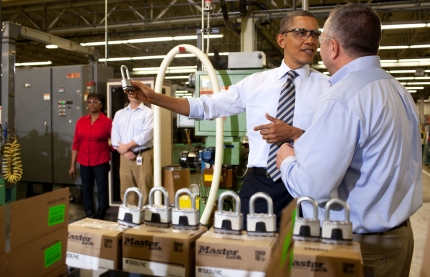
President Obama Discusses Insourcing at Master Lock

President Barack Obama tours Master Lock Company (February 15, 2012)

President Barack Obama tours Master Lock Company with Bob Rice, Senior Vice President for Global Supply Chain/Product Development of Master Lock, in Milwaukee, Wis., Feb. 15, 2012. The President highlighted Master Lock in his State of the Union address as an example of a company moving jobs back to the U.S. (Official White House Photo by Pete Souza)

In the State of the Union, President Obama took time to highlight Master Lock -- a company that has discovered that it can actually save money by keeping production facilities in the United States and bringing jobs back to America.

Today, he traveled to Wisconsin to visit with Master Lock workers and talk about his plans to boost American manufacturing.

Master Lock's decision to keep jobs in America is part of a growing trend. The President calls it insourcing.

And in Milwaukee, he talked about three ideas to reform corporate taxes, aimed at boosting that trend and rewarding companies that don't move overseas.

The White House

Office of the Press Secretary

Remarks by the President on American Manufacturing

Master Lock
Milwaukee, Wisconsin

12:50 P.M. CST

THE PRESIDENT:  Hello, Milwaukee!  (Applause.)  It is good to be back in the great state of Wisconsin.  (Applause.)  This is the closest I've been to home in a while.  I was thinking about getting on the 90-94 and just driving down to my house.  (Laughter.)   

Thank you, DiAndre, for that outstanding introduction -- (applause) -- and for sharing your story.  I can tell, though, DiAndre is a little shy.  He doesn’t necessarily like to get out in front of people.  (Laughter.) 

Before I begin, I want to thank some additional special guests who are here.  Milwaukee Mayor Tom Barrett is in the house.  (Applause.)  Your Congresswoman, Gwen Moore, is here.  (Applause.)  You heard from your local UAW representative, John Drew -- (applause) -- and I got a great tour from the President of UAW Local 469, Mike Bink.  (Applause.)  And, finally, I want to thank Master Lock CEO John Hepner for inviting us here today. (Applause.)  

It is wonderful to be at Master Lock.  I have to say, though, it brought back some memories.  I was thinking about my gym locker in high school.  (Laughter.)  And if you go into the boys locker room in high school, sometimes it's a little powerful -- the odor in there.  (Laughter.)  So I was thinking about the fact that we weren’t washing our stuff enough.  (Laughter.)  And then I was thinking about, as I got older and I kept on using Master Locks, I became an even better customer because I couldn't always remember my combination.  (Laughter.)  So I'd end up having to have the lock sawed off and buy a new one.  So I was giving you guys a lot of business.  (Applause.)

And now, as I was looking at some of the really industrial-size locks, I was thinking about the fact that I am a father of two girls who are soon going to be in high school, and that it might come in handy to have these super locks.  (Laughter.)  For now, I'm just counting on the fact that when they go to school there are men with guns with them.  (Laughter.)   

But I’m actually here today because this company has been making the most of a huge opportunity that exists right now to bring jobs and manufacturing back to the United States of America.  (Applause.)  

I talked about this during the State of the Union.  Over the last few decades, revolutions in technology have made a lot of businesses more efficient and more productive.  And that’s a great thing.  It means you generally have a better choice of products, you get better prices.  But, as some of you know, technology has also made a lot of jobs obsolete.  And it’s allowed companies to set up shop and hire workers almost anywhere in the world where there’s an Internet connection -- you can produce things that previously you could only produce here in the United States.   

So the result has been a pretty painful process for a lot of families and for a lot of communities, especially here in the Midwest.  Too many factories where people thought they’d retire suddenly left town.  Too many jobs that provided a decent living got shipped overseas.  And now the hard truth is, a lot of those jobs are not going to come back.  In a global economy, some companies are always going to find it more profitable to pick up and do business in some other part of the world.  That's just a fact. 

But that doesn’t mean we have to just sit by and settle for a lesser future.  That doesn’t mean there’s nothing we can do to create new jobs and restore middle-class security here in America.  There is always something we can do.  (Applause.)  

For starters, I’m glad to see that Congress seems to be on the way of making progress on extending the payroll tax cut so taxes don’t go up on all of you and 160 million working Americans.  (Applause.)  This tax cut means that the typical American family will see an extra $40 in every paycheck this year.  And that's going to help speed up this recovery.  It will make a real difference in the lives of millions of people.  And as soon as Congress sends me that extension of tax cuts and unemployment insurance to my desk, I will sign it right away.  (Applause.)  You're going to get that signed.

AUDIENCE MEMBER:  Love you, Mr. President!

THE PRESIDENT:  I love you back.  (Laughter.)     

But that's only a start.  There’s a lot more we can do -- a lot more we have to do -- to help create jobs and bring back manufacturing middle-class security to Milwaukee and Wisconsin and the United States of America. 

And we've got examples of success.  When I took office -- a lot of UAW workers here, you guys remember this -- when I took office, the American auto industry was on the verge of collapse. And there were some folks who said we should let it die.  With a million jobs at stake, I refused to let that happen.  (Applause.) I refused to let that happen. 

We said, in exchange for help, we're going to demand responsibility.  We got workers and automakers to settle their differences.  We got the industry to restructure and retool, come up with better designs.  Today, the American auto industry is back.  And General Motors is once again the number-one automaker in the world.  (Applause.)  Chrysler has grown faster in the U.S. than any major car company.  Ford is investing billions in U.S. plants and equipment and factories.  And all together, over the past two years, the entire industry has added nearly 160,000 jobs.  Well-paying jobs.  (Applause.)
   
What’s happening in Detroit can happen in other industries. What happens in Cleveland and Pittsburgh and Raleigh and Milwaukee, that's what we've got to be shooting for, is to create opportunities for hardworking Americans to get in there and start making stuff again and sending it all over the world -- products stamped with three proud words:  Made in America.  (Applause.)

And that's what's happening right here at Master Lock -- because of you.  Over the last few years, it’s become more expensive to do business in countries like China.  Meanwhile, American workers, we've become even more productive.  So when John Heppner was at the White House in January, he told me how it makes more business sense for Master Lock to bring jobs back home here to Milwaukee.  (Applause.)  And today, for the first time in 15 years, this plant is running at full capacity.  (Applause.)  And that's an example of what happens when unions and employers work together to create good jobs.  (Applause.)  Today, you’re selling products directly to customers in China stamped with those words:  Made In America.  (Applause.)  

And the good news is this is starting to happen around the country.  For the first time since 1990, American manufacturers are creating new jobs.  That's good for the companies, but it's also good up and down the supply chain, because if you're making this stuff here, that means that there are producers and suppliers in and around the area who have a better chance of selling stuff here.  It means the restaurant close by suddenly has more customers.  Everybody benefits when manufacturing is going strong.

So you all have heard enough about outsourcing.  More and more companies like Master Lock are now insourcing -- (applause) -- deciding that if the cost of doing business here isn't too much different than the cost of doing business in places like China, then why wouldn't you rather do it right here in the United States of America?  (Applause.)  Why not?  Why not put some Americans to work?  (Applause.)

Companies would rather bet on the country with the best colleges and universities to train workers with new skills and produce cutting-edge research.  They’d rather place their bet on the nation with the greatest array of talent and ingenuity; the country with the greatest capacity for innovation that the world has ever known. 

During the State of the Union, I issued a challenge to America’s business leaders -- folks like John.  I said ask yourself what you can do to bring jobs back to your country, and your country will do everything we can to help you succeed.  (Applause.)  And since then, a number of companies -- large and small, domestic, but also even some foreign companies -- have said they now plan to open new facilities and create new jobs right here in America -- which is still the largest market on Earth.  

These include Wisconsin companies like Diamond Precision, which is a machine manufacturer that is going to be adding dozens of jobs here in Milwaukee -- a company that’s growing because its customers are choosing to buy American-made products instead of supplies from China.  (Applause.)  There’s a company called Collaborative Consulting, an information technology company that wants to open a new call center here in Wausau.  And across the nation, there are well-known companies like Caterpillar that are planning to bring jobs back home.    

So last month, we decided to hold a summit -- that's where John was at -- a summit at the White House so we could hear from companies like these who've decided to insource jobs.  We wanted to learn how can we accelerate this trend.  And this last [sic] fall, for the first time, we’ll be bringing companies from around the world together with governors and mayors and other leaders to discuss the benefits of investing and creating more jobs here in the United States. 

So our job as a nation is to do everything we can to make the decision to insource more attractive for more companies.  (Applause.)  That's our top priority.  That's our top priority.  (Applause.)  We've got to seize this moment of opportunity.  We can't let it slip away.  We've got an opportunity to create new American jobs and American manufacturing, put that back where it needs to be. 

Now, one place to start is with our tax code.  I talked about this a little bit at the State of the Union.  Right now, companies get tax breaks for moving jobs and profits overseas.

AUDIENCE:  Booo --

THE PRESIDENT:  They’re taking deductions for the expenses of moving out of the United States.  Meanwhile, companies that are doing the right thing and choosing to stay here, they get hit with one of the highest tax rates in the world.  That doesn’t make sense.  Everybody knows it doesn’t make sense.  Politicians of both parties have been talking about changing it for years.   So my message to Congress is:  Don't wait.  Get it done.  Do it now.  (Applause.)  Let's get it done. 

As Congress thinks about tax reform principles, there are some basic things they can do.  First, if you’re a business that wants to outsource jobs, you have that right, but you shouldn’t get a tax deduction for doing it.  That money should be used to cover moving expenses for companies like Master Lock that decide to bring jobs home.  (Applause.)  Give them the tax break.  (Applause.) 

Second of all, no American company should be able to avoid paying its fair share of taxes by moving jobs and profits overseas.  (Applause.)  So we've said, from now on, every multinational company should have to pay a basic minimum tax.  And every penny should go towards lowering taxes for companies that choose to stay and hire here in the United States of America.  Give them a bigger tax break.  (Applause.)   

Third, if you’re an American manufacturer, you should get a bigger tax cut.  (Applause.)  If you’re a high-tech manufacturer, creating new products, new services, we should double the tax deduction you get for making products here in America.  If you want to relocate in a community like this one that’s been hard hit when factories left town, you should get help financing a new plant, financing new equipment, training new workers.  (Applause.) 

It is time to stop rewarding companies that ship jobs overseas, and start rewarding companies that are creating jobs right here in the United States of America.  (Applause.)  And this Congress should send me these tax reforms right now.  I will sign them right away.  (Applause.)

AUDIENCE MEMBER:  Right now!

THE PRESIDENT:  Right now. 

AUDIENCE:  Right now!  Right now!  Right now!

THE PRESIDENT:  Right now.  Right now.  (Laughter.)     

Now, another thing we’re doing to support American jobs is to make it easier for businesses like Master Lock to sell their products all over the world.  Everybody knows Master Lock makes the best lock.  (Applause.)  So two years ago, I set a goal of doubling U.S. exports over five years.  With the bipartisan trade agreements I signed into law, we're on track to meeting that goal ahead of schedule.  Pretty soon, there are going to be millions of new customers for American goods in places like Panama and Colombia and South Korea.  I want new cars on the streets of Seoul, South Korea imported from Detroit and Toledo and Milwaukee.  (Applause.)

There's nothing wrong with them being able to sell cars here.  I just want to be able to sell cars there. 

AUDIENCE MEMBER:  Even playing field!

THE PRESIDENT:  Even playing field is what we want.  I'm going anywhere in the world to open up new markets for American products.  And I'm not going to stand by when our competitors don’t play by the same rules.  It’s not fair when foreign manufacturers have a leg up on ours just because they’re getting heavy subsidies from their government.

So I directed my administration to create a Trade Enforcement Unit, and it's only got one job:  investigating unfair trade practices in countries like China, making sure we've got an even playing field -- because when we've got an even playing field, I promise you, nobody is going to out-compete America.  (Applause.)  We've got the most productive workers on Earth.  We've got the most creative entrepreneurs on Earth.  Give us a level playing field -- we will not lose.  (Applause.)

Now, part of creating that level playing field is also making sure that American workers have the skills that today’s jobs require.  And DiAndre talked about how even though he's working, he's still going back to school.  I know that Master Lock’s decision to create even more jobs here in Milwaukee in part is going to depend on something that John raised when we were at our meeting -- it's going to depend on finding enough workers with the right training.

I had a chance to meet one of your coworkers, Eric -- where is -- is Eric here?  There he is right there.  So Eric and I were talking -- been a die maker for a long time.  He's older than he looks.  (Laughter.)  Although we were comparing the gray in his beard to the gray on my head.  (Laughter.)  But he was pointing out that he's actually been able to help make the machinery that he works on more efficient, which is making the company able to do more because it's not lying idle when certain orders aren’t coming in.  But that's an accumulation of experience that he's had over a couple of decades. 

Now, not everybody is going to have all that experience, but the question is, can we make sure if they haven't already been working in this job, can they get that kind of training even before they're hired here at Master Lock so that they can provide that same value-added across the board?  That's what's going to separate the companies that succeed from the companies that don't, is how skilled and talented the workers are, and whether management is listening to the workers.  Because that's important.  Part of what allowed Eric to be successful was somebody -- his supervisor said, hey, this guy has got pretty good ideas. 

So that’s why it's so important for the company's investing in training programs, and partnering with nearby community colleges to help design courses and curriculum, so that when workers show up they're already ready to hit the ground running. That’s why I’ve asked Congress to join me in a national commitment to train 2 million American workers with skills that will lead directly to a job.  (Applause.)  We need to give more community colleges the resources they need to become community career centers -- places that teach people the skills that businesses like Master Lock are looking for right now.  (Applause.)  Right now.

There are jobs from data management to high-tech manufacturing that right now are open.  And we've got a lot of folks out of work, but we've got to match up the folks who are out of work with the jobs.  And sometimes the businesses may not be able to afford to train that person on the job, so let's have the community college help get the training.

At a time when so many Americans are out of work, there should not be any job openings, because every single job opening that comes up, somebody should be able to say, I want that job and I'm prepared and skilled to get it.    

We're still recovering from one of the worst economic crises in three generations.  And I'm not going to lie to you guys.  You know it -- we've still got a long way to go before everyone who wants a good job can find it.  I'm sure that if we traveled all around here, there are a lot of folks who want work and can't find it.  And when you're out of work, that wears on you.  It's not just the income.  It has to do with your sense of place and your sense of dignity, and your ability to support your family, and the pride that you take in making a good product.  That's part of what America has always been about -- is what our work means to us, the values we put behind our work.  We don't just do it for a paycheck. 

And so this has been hard on folks.  It's been hard on our country.  And it's going to take some time before middle-class Americans regain the sense of security that’s been slipping away way before this recession hit.  A lot of these factories were moving out before this recession hit.  There was a lot of outsourcing going on over the last 20 years.  So we've got a long way to go.  

But here's what I want everybody to remember.  Over the last 23 months, businesses have added nearly 3.7 million new jobs.  (Applause.)  Manufacturing is coming back.  Companies are starting to bring jobs back.  The economy is getting stronger.  The recovery is speeding up.  (Applause.)  We're moving in the right direction.  And now we have to do everything in our power to keep our foot on the gas.  (Applause.)  And the last thing we can afford to do is go back to the same policies that got us into this mess. 

Milwaukee, we are not going back to an economy that's weakened by outsourcing and bad debt and phony financial profits. We need an economy that is built to last, that is built on American manufacturing, and American know-how, and American-made energy, and skills for American workers, and the renewal of American values of hard work and fair play and shared responsibility.  (Applause.)  That's what we're about.  (Applause.)  That's what we're about.  

And let me say -- let me say this.  These are not Democratic values or Republican values.  These are American values.  (Applause.)  They have seen us through the most difficult challenges -- through war and depressions and civil strife.  But we've always come out on the other side stronger than we were before.  We don't give up.  This country does not give up. 

And we make sure that everybody is brought along.  We don't leave people behind.  We look out for one another.  (Applause.) We reach out to one another.  We are going for new opportunities, but we pull each other up.  That’s who we are.  (Applause.)

If we work together with common purpose, if we pull together with common effort, I've got no doubt we will rebuild this economy so it lasts.  We're going to create more success stories like Master Lock -- and we will remind the world just why it is the United States is the greatest nation on Earth.

Thank you, everybody.  God bless you.  God bless America.  (Applause.)

END
1:18 P.M. CST

President Obama Speaks About Insourcing Jobs

February 15, 2012 | 25:16 | Public Domain

President Obama speaks on bringing manufacturing jobs back to America to help restore middle class security, and calls for changing our tax code to stop rewarding businesses that ship jobs overseas, and start rewarding companies like Master Lock that create jobs right here in America.

Download mp4 (241MB) | mp3 (23MB)

Read the Transcript

President Obama Travels to Master Lock Company in Milwaukee, Wisconsin to Discuss the Importance of American Manufacturing, Highlight Insourcing and New Investments in Improving the Skills of American Workers

President Obama Will Highlight Insourcing Success Story, Call on Other Companies to Bring Jobs Back Home

Today, the President will travel to Master Lock Company in Milwaukee, Wisconsin to discuss his Blueprint for an America Built to Last, which invests in American manufacturing by encouraging companies to create manufacturing jobs in the United States while removing deductions for shipping jobs overseas and encouraging insourcing.  For a fact sheet on the President’s blueprint to support American manufacturing jobs, discourage outsourcing, and encourage insourcing, click HERE.

Master Lock Company, the world's largest manufacturer of padlocks and related security products, is leading by example and bringing jobs back to the United States.  Since mid-2010, Master Lock has returned approximately 100 jobs back to Milwaukee, Wisconsin that had previously been off-shored.  Master Lock is improving productivity at their plant in Milwaukee by upgrading equipment and the company plans to continue bringing jobs back to Wisconsin. 

The President has highlighted the emerging trend of insourcing - companies bringing jobs back and making additional investments in the United States.  During the past two years, we have begun to see positive signs in American manufacturing, with the manufacturing sector adding more than 300,000 jobs since December 2009.  A link to a recent White House report on the emerging trend can be found HERE.  

The President will also reiterate his call to companies across the nation to invest in the United States, and highlight businesses that have decided to bring jobs back to the United States.  The President will discuss proposals he has put forward to support insourcing and American manufacturing, including tax incentives to encourage job growth in the United States – fully paid for by closing tax loopholes that encourage the shifting of jobs and shielding of profits overseas – efforts to open new markets for American products, and new investments in improving the skills of American workers.

“Right now we have an excellent opportunity to bring manufacturing back -- but we have to seize it,” said President Obama.  “My message to business leaders is simple:  Ask yourselves what you can do to bring jobs back to your country, and your country will do everything we can to help you succeed.”

Also today, the President will announce that, later this year, the Department of Commerce will host the first annual SelectUSA Investment Summit, bringing companies from around the world to meet with governors, mayors and local stakeholders, federal agencies, and state and local economic development organizations to discuss the benefits of investing and growing in the U.S.  The Summit will build on the Administration’s efforts to promote investment in the U.S. by providing an annual forum to attract and expand U.S. investment and address questions and issues that companies face when they choose where to invest globally.

At January’s ‘Insourcing American Jobs’ forum, the President met with manufacturers such as Ford, which will be investing $16 billion and add 12,000 jobs in the U.S. by 2015.  The President also heard from service companies such as software developer GalaxE. Solutions, which is adding hundreds of jobs in conjunction with its "Outsource to Detroit" campaign.

As the President calls on companies to do their part to bring jobs back to the United States, the ‘insourcing’ trend among businesses continues to gain steam, both in Wisconsin and across the country.

Collaborative Consulting (Wisconsin)– Collaborative Consulting, a leading information technology consulting firm, recently launched an initiative to locate new solutions development and support center in the United States, rather than abroad.  The first such center, the company announced, will be located in Wausau, Wisconsin, creating approximately 200 local jobs over the next three years.  Collaborative is considering states such as Oklahoma, Texas, Florida, and West Virginia for future sites.  The company believes that it can help upend the model of offshoring IT jobs by offering services to its clients that are price competitive, higher quality, and less burdensome than traditional firms.

Diamond Precision Products (Wisconsin)Machine component manufacturer Diamond Precision Products recently opened a new 85,000 square foot facility in Milwaukee and has doubled their workforce in the last two years, with further plans to fill the new plant. The company’s expansion has been fueled by the fact that, in order to save on shipping and accelerate speed of delivery, the companies Diamond supplies to are increasingly choosing to contract with local suppliers, rather than buying parts from China. 

Honda (Ohio)Earlier this month, Japanese automaker Honda Motor Company announced it will invest $98 million at its largest auto engine plant, which produce components for its new transmission technology.  The company’s engine plant in Anna, Ohio will make high-tech pulley components for Honda's new continuously variable transmission, which is aimed at improving fuel efficiency.  This announcement builds on other recent large-scale investments by the company -- since the beginning of 2011, Honda has committed to nearly $800 million in new U.S. investments and more than 1,200 new jobs across manufacturing operations in states such as Ohio, Alabama, and Indiana

Caterpillar (Texas)–Later this year, iconic heavy equipment manufacturer Caterpillar is expected to begin production of excavators at a new 850,000 square foot facility in Victoria, Texas.  The company decided to shift production of the excavator from Japan in order to better support customers in the U.S.  Over the past two years, the company has added more than 14,000 American and, during 2011, exported $20 billion in products from the United States.

BACKGROUND ON SELECTUSA AND NATIONAL INVESTMENT SUMMIT:

Launched by Executive Order in June 2011, the Department of Commerce’s SelectUSA program is the first-ever federal effort to help attract, retain, and expand business investment.  Historically, U.S. states and cities have found themselves competing against foreign governments to attract business investments, with the federal government playing only a nominal role in the competition for global investment.  Rather than providing new incentives for investment, SelectUSA plays the critical role of advocacy, coordination, facilitation, and information-gathering and –sharing.

The program has already paid dividends for American workers.  Working hand-in-hand with SelectUSA officials, the Michigan Economic Development Corporation, and other local Michigan agencies, Canadian automotive company AGS Automotive recently elected to make an investment in excess of $20 million to add new manufacturing capabilities to permit it to manufacture bumper impact assemblies in Michigan.  The new business will likely represent in excess of $100 million in annual sales over the next 5 years and will enable AGS to retain approximately 50 jobs and create over 100 new jobs in Michigan.

The President’s Budget proposes $13 million to build on the early success the SelectUSA program has seen.  In addition, later this year, the Department of Commerce will host the first annual SelectUSA Investment Summit, bringing companies from around the world to meet with governors, mayors and local stakeholders, federal agencies, and state and local economic development organizations to discuss the benefits of investing and growing in the U.S.  The Summit will build on the Administration’s efforts to promote investment in the U.S. by providing an annual forum to attract and expand U.S. investment and address questions and issues that companies face when they choose where to invest globally.

Close Transcript

The White House

Office of the Press Secretary

Press Gaggle by Press Secretary Jay Carney en route Milwaukee, WI, 2/15/12

Aboard Air Force One
En Route   

11:25 A.M. EST

MR. CARNEY:  Good morning, everyone.  Thanks for joining us on this first leg of our three-day, multi-state trip with the President.  As you know, we are headed to Milwaukee, Wisconsin, where the President will visit Master Lock Company, where he will discuss the importance of American manufacturing.  He will highlight insourcing and new investments in improving the skills of American workers.  

Master Lock is a great American company, as you know, the largest manufacturer of padlocks and related security products.  And it's leading by example and bringing jobs back to the United States.  Since mid-2010, Master Lock has returned approximately 100 jobs back to Milwaukee, Wisconsin that had previously been offshore.  Master Lock is improving productivity at their plant in Milwaukee by upgrading equipment, and the company plans to continue to bring back jobs to Wisconsin.

As you know, the President has been highlighting a trend in America's manufacturing that has seen a rebound in that sector.  The sector has added more than 300,000 jobs since December of 2009.  He's also been highlighting a trend of insourcing, where American companies have made assessments that it is a smart economic move, smart business move for them to bring jobs back from overseas and relocate them in the United States.  And that's something the President very much -- is a trend the President feels is healthy for the American economy and healthy for American workers and essential to building a foundation for our economic future.

This is all part of the American blueprint -- the President's, rather, blueprint for an "America Built to Last," which, as you know, has four pillars, one of them American manufacturing; the others innovation, skills for American workers, and American values.

I also wanted to just note something, if I could, that caught my attention, which is today the Department of Health and Human Services announced that the Affordable Care Act has provided approximately 54 million Americans with at least one new preventive service -- or did provide those 54 million Americans with at least one new preventive service in 2011 through their private health insurance plans. 

This report is particularly important given the proposal under consideration currently in the United States Senate.  That proposal being considered in the Senate would allow any employer to restrict access to any preventive health service they say they object to.  It is not limited to contraception, and it applies to all employers -- not just religious employers.  As the report makes clear, this proposal could affect tens of millions of Americans.  And as I said yesterday, or maybe the day before, it is dangerous and it is wrong.

With that, I will take your questions.

Q    Robert Zoellick is going to be leaving the World Bank in June.  Has the President talked to Zoellick?  And has he begun vetting candidates for the post?

MR. CARNEY:  I do not know whether the President has spoken with Mr. Zoellick, and I don't have any information for you regarding possible successors.

Q    There have been reports that Hillary Clinton and Larry Summers could be potential successors.  Are those names that have been floated around on a staff level?

MR. CARNEY:  There's been a lot of speculation in the press about this and other jobs, and I’m not going to confirm any of them.

Q    Do you have any reaction to Zoellick's decision to step down?

MR. CARNEY:  None beyond our obvious appreciation for his service to his country and to the international community through his work at the World Bank.

Q    Are there any qualities that Larry Summers and Hillary Clinton have that would make them good fits for the job?

MR. CARNEY:  Excellent try, Kate, but I really don't have any information for you on potential successors at the World Bank.

Q    Jay, Iran has announced that it’s going to cut oil exports to six European countries in response to sanctions -- I wonder if you have a response to that, and whether you fear that this could really ultimately come back and damage the President’s push for creating jobs and the economy?

MR. CARNEY:  Well, I’ll make a couple of points on that, actually.  With regard to those threats, we don't know what Iran’s intentions are, but we are watching closely and consulting with our partners.  The European Union’s own ban on new contracts for Iranian oil imports took effect on January 23rd, as you may know, and the ban on imports under existing contracts will take effect on July 1st.  What’s clear is that Iran is under more pressure from sanctions than ever before, and their economy is clearly being affected by those sanctions.

Q    But could it come back and hurt the European recovery effort and also the U.S.’s growth? 

MR. CARNEY:  Well, we made clear, as the President did when he signed the NDAA that included the new sanctions, that we would seek to implement those sanctions in a way that had the desired effect just to pressure and isolate Iran further, and did not have unintended consequences for any of our allies, or more broadly, for the international oil market.

Q    One more thing on that.  It sounded like, from what the state media is reporting, that the President of Iran has been sort of talking about a nuclear fuel reactors and things like that.  I'm wondering if you can respond to any other information you guys might have about that.

MR. CARNEY:  Well, there is apparently an announcement out of Iran today that it is loading Iranian-made nuclear fuel rods into its reactor, the Tehran Research Reactor.  We saw that announcement.  These activities remain under IAEA safeguards, as you know.  And we expect to learn more from IAEA inspectors on the ground in Iran.

Now, as you know, the United States has never objected to Iran's peaceful and civilian nuclear activities.  In fact, back in 2009, the United States and others proposed to work with Iran to ensure a continued fuel supply for this specific reactor, which has been used to produce medical isotopes to treat cancer. After initially indicating acceptance of that offer, Iran reversed course.

And our interest is in Iran abiding by its international obligations, renouncing its interest in nuclear weapons and returning to the international community.  And that path remains open to Iran as long as it is interested in talks that -- in which -- that they would approach in a constructive manner. 

Q    Jay, both the oil move and the nuclear move could be viewed as a defiant act by Iran.  Is there any sense that the sanctions are not working?  I mean, is there -- does this raise questions about the effectiveness of the sanctions?

MR. CARNEY:  I think quite the contrary, that what we see is provocative acts, defiant acts, statements that are designed to distract attention from the demonstrated impact that the sanctions are having, the demonstrated impact that the isolation of Iran is having.  We are very confident that the sanctions have put enormous pressure on the Iranian economy and on the Iranian regime. 

It is not unusual for Iran to try to distract attention from those uncomfortable facts and from its overall isolation by some burst of rhetoric or some announcement -- making some announcement.

Q    Jay, the Associated Press is reporting that you guys are considering -- the administration is considering how to reduce the nuclear arsenal.  I understand the plan hasn’t come to the President yet.  But can you talk a little bit about that consideration and what criteria the President might use to consider how to reduce the arsenal?  Is that something he would support generally?

MR. CARNEY:  I honestly don’t have anything to give you on that.  The President is extremely focused on nuclear security.  As you know, he hosted a Nuclear Security Summit in Washington.  He will be attending a Nuclear Security Summit in South Korea, and remains committed to playing the leading role -- or having the United States play the leading role in nuclear security around the globe.

Q    Jay, the Post reported that -- today that the Chinese government declined to give a visa to high-level State Department Ambassador Cook for a recent visit to talk about religious freedom issues.  Can you confirm that?  And do you have a reaction to that?

MR. CARNEY:  I would refer you to the State Department for details of that story.  I don’t have any information on that.  I would simply say that, as I noted yesterday and as others certainly did, including the Vice President, we are extremely candid in our conversations with members of the Chinese leadership about human rights and about the other issues of concern that we have in our broader relationship with China.

And I would note that, as you probably did, yesterday Vice President Biden said at the State Department luncheon held in honor of Vice President Xi’s visit, “We see our advocacy for human rights as a fundamental aspect of our foreign policy and we believe a key to the prosperity and stability of our societies.  We have been clear about our concern over the areas in which, from our perspective, conditions in China have deteriorated, and about the plight of several very prominent individuals."

The President raised the importance of human rights and America’s commitment to universal values directly to Vice President Xi during their meeting yesterday in the Oval Office.  Specific human rights cases were raised in the course of the discussions at the White House, as was the situation in Tibet. 

Our commitment to being candid and direct with China about issues where we don’t agree or issues where we have concerns is part of an overall constructive approach to the relationship, which has many aspects to it.  And we are not combative or disrespectful.  We are frank and candid.

Q    Let me ask you -- to follow up on that.  The Post also reported in that story that the Obama administration asked the Ambassador and others briefed on that scenario not to talk about it in advance of the Vice President of China’s trip here, perhaps because it would look bad.  Can you respond -- do you have any response?

MR. CARNEY:  I have nothing on that, no.

Q    What’s the administration’s view of the deal, the tentative deal in the House and the Senate to extend the payroll tax cut to deal with UI and the doc fix?  Is that something the President can sign?

MR. CARNEY:  We’ll obviously wait and see if there is something for leaders in Congress to announce.  As you heard the President make clear yesterday, this is an extremely high priority for him and he welcomes positive signs of progress in Congress towards ensuring that 160 million Americans don’t have their taxes go up on March 1st, and ensuring that unemployment insurance is extended, and ensuring that doctors who are reimbursed through Medicare don’t have their payments slashed by something on the order of 27 percent -- the so-called doc fix.

We have always believed, as the President made clear late last year and earlier this year, that Congress could -- and should -- handle this issue of extending the payroll tax cut, unemployment insurance, and the doc fix without drama and without delay.  And hopefully that is what will happen.  But obviously we’ll wait and see what emerges from Congress.

Q    Jay, what's the administration's reaction to Assad setting a referendum for this new constitution on February 26th? Is that a positive step?  What’s the reaction to it?

MR. CARNEY:  It’s actually quite laughable.  It makes a mockery of the Syrian revolution.  Promises of reforms have usually been followed by an increase in brutality and have never been delivered upon by this regime since the beginning of the peaceful demonstrations in Syria.  The fact of the matter is the Assad regime's days are numbered.  Members of his regime, senior military and civilian leadership, are demonstrating their own faith in the future of -- or lack of faith in the future of Assad by moving assets out of the country, by preparing to send their family out of the country, and it's clear that Syria's future will not include Assad.  It's not a question of if; it's just a question of when.

We are working in a very focused way with an array of international allies and partners who are friends of Syria, friends of the Syrian people, to add to the pressure being brought to bear on Assad, to isolate him further, and to help bring about a peaceful transition to democracy in Syria. 

Q    Right before we took off, Speaker Boehner, at a press conference, totaled up the deficits during the administration -- said $5 trillion in deficits added to the debt.  And he talked about the new budget and said, "There's no real activity here when it comes to cutting spending."  Can you respond to that?  This budget is larger than last year's budget, and of course, on top of that.  What's your response to the Speaker?

MR. CARNEY:  First of all, as you know, this budget includes more than $4 trillion in deficit reduction over 10 years.  And that's a fact.  And as part of that $4 trillion, there's the nearly $1 trillion in discretionary cuts that were signed into law by President Obama after negotiations with Republicans and Democrats in Congress last August.  And there is the guarantee of $1.2 trillion additional cuts that the sequester is designed to force Congress to agree on, and we hope that happens.  And then the President obviously has further reductions that come through reforms to our entitlement programs and through raising revenues on eliminating loopholes and subsidies to corporations, and raising revenues on the wealthiest Americans, who, as you know, saw their share of wealth in this country rise dramatically in the previous 10 years.  And the President does this because a balanced approach to getting our deficit and debts under control is the right way.

I would simply, in response to the Speaker’s comments, marvel at his silence during the years that President Obama’s predecessor was racking up huge deficits.  I’m pretty sure that Speaker Boehner went along with policies that put two wars on a credit card, that led to the passage of a wholly unpaid-for addition to the Medicare entitlement.  He helped lead the effort to pass two massive and unpaid-for tax cuts.  These are the policies that led to -- a situation where budget surpluses were in place for as far as the eye could see in January of 2001, eight years later led to massive deficits.

That's the situation President Obama inherited.  And not only that, he inherited what was the most catastrophic, devastating recession this country has had since the Great Depression.  The President’s policies have reversed the direction of the economy.  They have led to the creation of more than 3.7 million private sector jobs in the last 23 months, and to quarter after quarter now of economic growth.

I understand that Speaker Boehner is opposed to almost all of those policies that have led to that economic growth and job creation, which is unfortunate.  We hope that the signs of progress we’ve seen on the extension of the payroll tax cut might foretell cooperation in the future on measures to help the economy grow.

As you’ve heard me say a few times from the podium lately, this President does not accept the conventional wisdom that Congress can't get anything done in an election year.  In fact, he hopes and expects that quite the opposite will be true.

Q    The President has raised more money from the tech industry than from Hollywood, which is a reversal from the same period in 2007.  Do you think he might get some tough questions at these fundraisers tonight from Hollywood executives about his stance on the anti-piracy legislation, which, seemingly, the administration cast doubt on the Hollywood-supported legislation?

MR. CARNEY:  Well, I believe the President enjoys support from people in both industries.  But beyond that, on the substantive issues of the SOPA legislation, we made our position quite clear, which was we are absolutely committed to working to find solutions to the problem of copyright infringement and intellectual property rights infringement, but we need to do it in a way that doesn’t restrict Internet freedom.  We believe that that's -- it's a both/and, not an either/or proposition.  And that’s the approach the administration is taking.

Q    Do you think it will have any impact on fundraising in Hollywood?

MR. CARNEY:  I would refer you to the campaign for questions about fundraising.

Q    Back on China quickly.  Did either President Obama or Vice President Biden raise the issue of the blocked visa in their candid discussions yesterday?

MR. CARNEY:  Not that I'm aware of, but I can check on that for you. 

Q    Jay, on a lighter note, is the President following at all the story of Jeremy Lin, the Knicks sensation -- "Linsanity," that kind of seems to be catching the world by storm?  I understand the Chinese are very interested in him as well.

MR. CARNEY:  As you know, the President is an avid sports fan, and a particularly avid basketball fan, and we were speaking about Jeremy Lin on Marine One as we flew here -- to Andrews Air Force Base this morning.  If anybody caught the highlights from last night, they were pretty breathtaking.  It's just a great story, and the President was saying as much this morning.  It's obviously terrific for the New York Knicks, but it's the kind of sports story that transcends the sport itself.  It involves people who don’t necessarily pay attention -- I got my wife to watch the highlights this morning.  She was pretty amazed, and she doesn’t watch basketball.  So it's a great story.  And, yes, he's very impressed and fully up to speed.

Q    So had he seen --

MR. CARNEY:  Oh, yes.

Q    He's seen the highlights?

MR. CARNEY:  Yes.  I know he's watched Lin play already, and he had seen the highlights from last night's game.

Q    Has he called "Linsanity"?  (Laughter.)

MR. CARNEY:  I don’t have any calls to read out to you.

Q    Thank you.

MR. CARNEY:  Thank you.

END
11:45 A.M. EST

The White House

Office of the Press Secretary

President Obama Travels to Master Lock Company in Milwaukee, Wisconsin to Discuss the Importance of American Manufacturing, Highlight Insourcing and New Investments in Improving the Skills of American Workers

President Obama Will Highlight Insourcing Success Story, Call on Other Companies to Bring Jobs Back Home

Today, the President will travel to Master Lock Company in Milwaukee, Wisconsin to discuss his Blueprint for an America Built to Last, which invests in American manufacturing by encouraging companies to create manufacturing jobs in the United States while removing deductions for shipping jobs overseas and encouraging insourcing.  For a fact sheet on the President’s blueprint to support American manufacturing jobs, discourage outsourcing, and encourage insourcing, click HERE.

Master Lock Company, the world's largest manufacturer of padlocks and related security products, is leading by example and bringing jobs back to the United States.  Since mid-2010, Master Lock has returned approximately 100 jobs back to Milwaukee, Wisconsin that had previously been off-shored.  Master Lock is improving productivity at their plant in Milwaukee by upgrading equipment and the company plans to continue bringing jobs back to Wisconsin. 

The President has highlighted the emerging trend of insourcing - companies bringing jobs back and making additional investments in the United States.  During the past two years, we have begun to see positive signs in American manufacturing, with the manufacturing sector adding more than 300,000 jobs since December 2009.  A link to a recent White House report on the emerging trend can be found HERE.  

The President will also reiterate his call to companies across the nation to invest in the United States, and highlight businesses that have decided to bring jobs back to the United States.  The President will discuss proposals he has put forward to support insourcing and American manufacturing, including tax incentives to encourage job growth in the United States – fully paid for by closing tax loopholes that encourage the shifting of jobs and shielding of profits overseas – efforts to open new markets for American products, and new investments in improving the skills of American workers.

“Right now we have an excellent opportunity to bring manufacturing back -- but we have to seize it,” said President Obama.  “My message to business leaders is simple:  Ask yourselves what you can do to bring jobs back to your country, and your country will do everything we can to help you succeed.”

Also today, the President will announce that, later this year, the Department of Commerce will host the first annual SelectUSA Investment Summit, bringing companies from around the world to meet with governors, mayors and local stakeholders, federal agencies, and state and local economic development organizations to discuss the benefits of investing and growing in the U.S.  The Summit will build on the Administration’s efforts to promote investment in the U.S. by providing an annual forum to attract and expand U.S. investment and address questions and issues that companies face when they choose where to invest globally.

At January’s ‘Insourcing American Jobs’ forum, the President met with manufacturers such as Ford, which will be investing $16 billion and add 12,000 jobs in the U.S. by 2015.  The President also heard from service companies such as software developer GalaxE. Solutions, which is adding hundreds of jobs in conjunction with its "Outsource to Detroit" campaign.

As the President calls on companies to do their part to bring jobs back to the United States, the ‘insourcing’ trend among businesses continues to gain steam, both in Wisconsin and across the country.

Collaborative Consulting (Wisconsin)– Collaborative Consulting, a leading information technology consulting firm, recently launched an initiative to locate new solutions development and support center in the United States, rather than abroad.  The first such center, the company announced, will be located in Wausau, Wisconsin, creating approximately 200 local jobs over the next three years.  Collaborative is considering states such as Oklahoma, Texas, Florida, and West Virginia for future sites.  The company believes that it can help upend the model of offshoring IT jobs by offering services to its clients that are price competitive, higher quality, and less burdensome than traditional firms.

Diamond Precision Products (Wisconsin)Machine component manufacturer Diamond Precision Products recently opened a new 85,000 square foot facility in Milwaukee and has doubled their workforce in the last two years, with further plans to fill the new plant. The company’s expansion has been fueled by the fact that, in order to save on shipping and accelerate speed of delivery, the companies Diamond supplies to are increasingly choosing to contract with local suppliers, rather than buying parts from China. 

Honda (Ohio)Earlier this month, Japanese automaker Honda Motor Company announced it will invest $98 million at its largest auto engine plant, which produce components for its new transmission technology.  The company’s engine plant in Anna, Ohio will make high-tech pulley components for Honda's new continuously variable transmission, which is aimed at improving fuel efficiency.  This announcement builds on other recent large-scale investments by the company -- since the beginning of 2011, Honda has committed to nearly $800 million in new U.S. investments and more than 1,200 new jobs across manufacturing operations in states such as Ohio, Alabama, and Indiana

Caterpillar (Texas)–Later this year, iconic heavy equipment manufacturer Caterpillar is expected to begin production of excavators at a new 850,000 square foot facility in Victoria, Texas.  The company decided to shift production of the excavator from Japan in order to better support customers in the U.S.  Over the past two years, the company has added more than 14,000 American and, during 2011, exported $20 billion in products from the United States.

BACKGROUND ON SELECTUSA AND NATIONAL INVESTMENT SUMMIT:

Launched by Executive Order in June 2011, the Department of Commerce’s SelectUSA program is the first-ever federal effort to help attract, retain, and expand business investment.  Historically, U.S. states and cities have found themselves competing against foreign governments to attract business investments, with the federal government playing only a nominal role in the competition for global investment.  Rather than providing new incentives for investment, SelectUSA plays the critical role of advocacy, coordination, facilitation, and information-gathering and –sharing.

The program has already paid dividends for American workers.  Working hand-in-hand with SelectUSA officials, the Michigan Economic Development Corporation, and other local Michigan agencies, Canadian automotive company AGS Automotive recently elected to make an investment in excess of $20 million to add new manufacturing capabilities to permit it to manufacture bumper impact assemblies in Michigan.  The new business will likely represent in excess of $100 million in annual sales over the next 5 years and will enable AGS to retain approximately 50 jobs and create over 100 new jobs in Michigan.

The President’s Budget proposes $13 million to build on the early success the SelectUSA program has seen.  In addition, later this year, the Department of Commerce will host the first annual SelectUSA Investment Summit, bringing companies from around the world to meet with governors, mayors and local stakeholders, federal agencies, and state and local economic development organizations to discuss the benefits of investing and growing in the U.S.  The Summit will build on the Administration’s efforts to promote investment in the U.S. by providing an annual forum to attract and expand U.S. investment and address questions and issues that companies face when they choose where to invest globally.

Americans Tell President Obama What $40 Means

President Obama today asked Americans to share their stories, and tell him what losing $40 per paycheck would mean to their family. Thousands responded, sending us photos, tweets, and emails that illustrate just how important decisions made in Washington are to regular people across the country.

At the end of this month, a two-month extension of the payroll tax cut will expire. If Congress doesn't act, taxes will go up on 160 million hardworking Americans. For a family making about $50,000 a year, the payroll tax cut amounts to about $1,000 a year, or about $40 in every paycheck.  It may not seem like a lot of money to some people, but for the people who wrote to us today, that money can make a big difference. Here are some of their stories:

Please, consider that many people like my family live by paycheck only, we cannot even have extra money for emergencies, because living life in this country is so expensive that our paycheck goes to pay rent, bills, and food, and sometimes we don't even have for food. So, please DO NOT take that extra $40.00 taxes cut from our paycheck. -- Brenda from California



To me and my family, $40 is the difference between opportunity and misfortune. When you include registration fees, uniforms, and expenses for equipment, travel and food, extracurricular activities alone can exceed $40 a paycheck (particularly if that money is divided over more than one child). Activities like baseball, martial arts, or community theater are far too important to children's health, development, and well-being to not be apart of their lives. But when it comes down to paying bills and for essentials or extracurricular activities, all one can say is "sorry kids, no baseball this year"! -- Eric from South Carolina
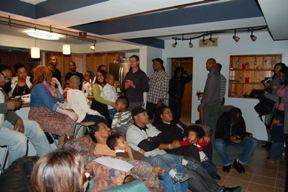


With my paycheck being the sole source of income for our family, $40 means EVERYTHING to us.  Having $40 means we can afford groceries in those last few days before my next paycheck so we won't go hungry.  It means I can put a FEW gallons of gas in my car to make it to work for the next few days. It means I can afford a copay should my son need to see a doctor.  It means we MAY be able to afford a prescription should we be prescribed one.  We have done a short sale on our home, cut our budgets back to bare minimum, have relinquished all luxuries in our life but, yet still get up each day with the hope of something better. So, what does $40 mean to me?  It means the difference between a healthy happy family that can sleep at night with a full stomach or having to tell my son that we may all have to go to bed hungry. -- Amanda from Virginia


$40.00 means the world to my family and I. When the paycheck ends before the second week has begun, $40 is the difference between paying the mortgage or the light bill.  We don't live beyond our means, our cars are paid for. We remodel our home, and maintain the cars ourselves and we work hard for what we have.  For Thanksgiving we hosted over 40 friends and relatives.  Not because we had that luxury, but because we invited everyone to bring a dish because we knew they couldn't afford the entire meal.  We never thought we would get so many.  Too many of our friends and family members have been devastated by the current economic downfall of this country.  Many own/owned their own business and all are hard working decent Americans.  Many, like myself, worked or were/are affiliated with both state and federal government agencies.  We know all too well about politics and government spending.  Some of our friends and associates  are very wealthy and continue to be compensated far too well.  $40 for us, that's $960 for the year or groceries for three months, five months of electric bills.  When you're financially capable, $40 dollars is a night out at the movies, but for us and too many Americans, it is groceries for three months.  

Now with 10 grandchildren, our 6 kids still respectfully rely on our support from time to time.  We remember when we could hand them $40 each to go to the movies with high school friends on a Saturday.  Now, $40 assists them with groceries for the week. We continue to motivate them, and we try to keep everyone's spirits high with "it will get better if we just stick together until it gets better".   -- Michael from Maryland

Read more stories: