The White House

Office of the Press Secretary

Presidential Proclamation -- Martin Luther King, Jr., Federal Holiday, 2012

MARTIN LUTHER KING, JR., FEDERAL HOLIDAY, 2012

- - - - - - -

BY THE PRESIDENT OF THE UNITED STATES OF AMERICA

A PROCLAMATION

On a hot summer day nearly half a century ago, an African American preacher with no official title or rank gave voice to our Nation's deepest aspirations, sharing his dream of an America that ensured the true equality of all our people.  From the steps of the Lincoln Memorial, the Reverend Dr. Martin Luther King, Jr. inspired a movement that would push our country toward a more perfect Union.

At a time when our Nation was sharply divided, Dr. King called on a generation of Americans to be "voices of reason, sanity, and understanding amid the voices of violence, hatred, and emotion."  His example stirred men and women of all backgrounds to become foot soldiers for justice, and his leadership gave them the courage to refuse the limitations of the day and fight for the prospect of tomorrow.  Because these individuals showed the resilience to stand firm in the face of the fiercest resistance, we are the benefactors of an extraordinary legacy of progress.

Today, Dr. King is memorialized on the National Mall where he once spoke, a symbol of how far our Nation has come and a testament to the quiet heroes whose names may never appear in history books, but whose selflessness brought about change few thought possible.  Dr. King's memorial reminds us that while the work of realizing his remarkable dream is unending, with persistence, progress is within our reach.

On the Martin Luther King, Jr., Federal Holiday, we celebrate the man who fought for the America he knew was possible.  Dr. King's faith in a God who loves all His children and a Nation grounded in the promise of equality would not let him rest until victory was won.  As we work to meet the challenges of our time    from fixing our schools so every child gets a world class education to ensuring all Americans have access to strong and secure economic opportunity    let us draw strength from Dr. King's stirring affirmation that "Everybody can be great because everybody can serve."  In his memory, let us continue climbing toward that Promised Land, one more fair and more just for all people.

NOW, THEREFORE, I, BARACK OBAMA, President of the United States of America, by virtue of the authority vested in me by the Constitution and the laws of the United States, do hereby proclaim January 16, 2012, as the Martin Luther King, Jr., Federal Holiday.  I encourage all Americans to observe this day with appropriate civic, community, and service

projects in honor of Dr. King, and to visit www.MLKDay.gov to find Martin Luther King, Jr., Day of Service projects across our country.

IN WITNESS WHEREOF, I have hereunto set my hand this thirteenth day of January, in the year of our Lord two thousand twelve, and of the Independence of the United States of America the two hundred and thirty-sixth.

BARACK OBAMA

The White House

Office of the Press Secretary

Presidential Proclamation -- Religious Freedom Day, 2012

RELIGIOUS FREEDOM DAY, 2012

- - - - - - -

BY THE PRESIDENT OF THE UNITED STATES OF AMERICA

A PROCLAMATION

For nearly four centuries, men and women have immigrated to America's shores in pursuit of religious freedom.  Hailing from diverse backgrounds and faiths, countless settlers have shared a simple aspiration -- to practice their beliefs free from prejudice and persecution.  In 1786, the Virginia General Assembly took a bold step toward preserving this fundamental liberty by passing the Virginia Statute for Religious Freedom, which brought to life the ideal of religious tolerance from the texts of the Enlightenment in the laws of state.  On Religious Freedom Day, we celebrate this historic milestone, reflect upon the Statute's declaration that "Almighty God hath created the mind free," and reaffirm that the American people will remain forever unshackled in matters of faith.

Drafted by Thomas Jefferson, the Virginia Statute formed the basis for the First Amendment, which has preserved religious freedom for both believers and non-believers for over 220 years.  As our Nation has grown, so too has its diversity of faiths, cultures, and traditions; today, individuals of rich and varied beliefs call America home and seek to follow their consciences in peace.  Our long history of religious tolerance and pluralism has strengthened our country, helped create a vibrant civil society, and remained true to the principles enshrined in our founding documents.

Our Nation is committed to religious liberty not only for all Americans, but also for individuals around the world.  Internationally, we bear witness to those who live in fear of violence and discrimination because of their beliefs.  My Administration continues to stand with all who are denied the ability to choose, express, or live their faith freely, and we remain dedicated to protecting this universal human right and the vital role it plays in ensuring peace and stability for all nations.

Today, as we reflect on the many ways religious freedom enriches our country and our lives, let us lend our voice to all people striving to exercise their innate right to a free mind.

NOW, THEREFORE, I, BARACK OBAMA, President of the United States of America, by virtue of the authority vested in me by the Constitution and the laws of the United States, do hereby proclaim January 16, 2012, as Religious Freedom Day.  I call on all Americans to commemorate this day with events and activities that teach us about this critical foundation of our Nation's liberty, and show us how we can protect it for future generations at home and around the world.

IN WITNESS WHEREOF, I have hereunto set my hand this thirteenth day of January, in the year of our Lord two thousand twelve, and of the Independence of the United States of America the two hundred and thirty-sixth.

BARACK OBAMA

The White House

Office of the Press Secretary

Remarks by the President on Government Reform

East Room

THE PRESIDENT:  Good morning, everybody.  Please have a seat.

Welcome to the White House.  I see all sorts of small business people here, and I am thrilled to have you here.  As small business owners, you know as well as anybody that if we’re going to rebuild an economy that lasts -- an economy that creates good, middle-class jobs -- then we’re all going to have to up our game.

The other day, I met with business leaders who are doing their part by insourcing -- by bringing jobs back to the United States.  And I told them that if you are willing to keep asking yourselves what you can do to bring jobs back, then I’ll make sure that you’ve got a government that helps you succeed.

And that’s why we’re here today.  I ran for office pledging to make our government leaner and smarter and more consumer-friendly.  And from the moment I got here, I saw up close what many of you know to be true:  The government we have is not the government that we need. 

We live in a 21st century economy, but we’ve still got a government organized for the 20th century.  Our economy has fundamentally changed -- as has the world -- but our government, our agencies, have not.  The needs of our citizens have fundamentally changed but their government has not.  Instead, it's often grown more complicated and sometimes more confusing. 

Give you a few examples.  There are five different entities dealing with housing.  There are more than a dozen agencies dealing with food safety.  My favorite example -- which I mentioned in last year’s State of the Union address -- as it turns out, the Interior Department is in charge of salmon in fresh water, but the Commerce Department handles them in saltwater.  (Laughter.)  If you’re wondering what the genesis of this was, apparently, it had something to do with President Nixon being unhappy with his Interior Secretary for criticizing him about the Vietnam War.  And so he decided not to put NOAA in what would have been a more sensible place.

No business or nonprofit leader would allow this kind of duplication or unnecessary complexity in their operations.  You wouldn’t do it when you’re thinking about your businesses.  So why is it okay for our government?  It’s not.  It has to change.

Now, what we’ve tried to do over the first three years of my administration is to do a whole range of steps administratively to start making processes, procedures, agencies more consumer-friendly.  But we need to do more, and we need authority to do more. 

So today, I’m calling on Congress to reinstate the authority that past presidents have had to streamline and reform the Executive Branch.  This is the same sort of authority that every business owner has to make sure that his or her company keeps pace with the times.  And let me be clear:  I will only use this authority for reforms that result in more efficiency, better service and a leaner government.

Now, a little bit of history here.  Congress first granted this authority to presidents in the midst of the Great Depression, so that they could swiftly reorganize the Executive Branch to respond to the changing needs of the American people and the immediate challenges of the Depression.  For the next 52 years, presidents were able to streamline or consolidate the Executive Branch by submitting a proposal to Congress that was guaranteed a simple up or down vote.

In 1984, while Ronald Reagan was President, Congress stopped granting that authority.

And when this process was left to follow the usual congressional pace and procedures, not surprisingly, it bogged down.  So congressional committees fought to protect their turf, and lobbyists fought to keep things the way they were because they were the only ones who could navigate the confusion.  And because it’s always easier to add than to subtract in Washington, inertia prevented any real reform from happening.  Layers kept getting added on and added on and added on.  The Department of Homeland Security was created to consolidate intelligence and security agencies, but Congress didn’t consolidate on its side.  So now the Department of Homeland Security reports to over 100 different congressional panels. That’s a lot of paperwork.  That’s a lot of reports to prepare.  That’s not adding value, it’s not making us safer to file a whole bunch of reports all the time.

It has been a generation since a President had the authority to propose streamlining the government in a way that allowed for real change to take place.  Imagine all the things that have happened since 1984.  1984 didn’t have -- we didn’t have the Internet, just to take one example.  A generation of Americans has come of age.  Landlines have turned into smartphones.  The Cold War has given way to globalization.  So much has happened -- and yet the government we have today is largely the government we had back then.  And we deserve better.

Go talk to the skilled professionals in government who are serving their country -- and by the way, you won’t meet harder-working folks than some of the folks in these federal agencies; devote countless hours to trying to make sure that they’re serving the American people.  But they will tell you their efforts are constantly undermined by an outdated bureaucratic maze.  And of course, if you go talk to ordinary Americans, including some of the small business leaders here today, they’ll tell you that to deal with government on a regular basis is not always the highlight of their day.  (Laughter.) 

Over the past three years, as I said, we’ve tried to take some steps to fix the problem -- to bring our government into this century and, in doing so, to root out waste.  So just to take some examples.  We made sure that government sends checks to the right people in the right amount, which should be obvious, but we’ve been able to prevent $20 billion in waste over the last two years, just by making sure that checks are sent properly and we’re reducing error.

We cut government contracting for the first time in more than a decade.  We cut a whole range of overlapping programs.  We have tried to yank the federal government into the 21st century when it comes to technology and making everything we do a little more Web-friendly.  And by the way, that also helps in terms of accountability and transparency, because the public can get on WhiteHouse.gov or the various other websites and they can see what’s happening and track where money goes.

So we’ve done a lot, but we’ve got to do more.  We need to think bigger.  So today, I’m outlining changes we could make if Congress gives the green light to allow us to modernize and streamline.  These changes would help small business owners like you.  It would also help medium and large businesses.  And as a consequence, they would help create more jobs, sell more products overseas, grow our economy faster, improve our quality of life. 

Right now, there are six departments and agencies focused primarily on business and trade in the federal government.  Six.  Commerce Department, Small Business Administration, the U.S. Trade Representative’s office.  In this case, six is not better than one.  Sometimes more is better; this is not one of those cases, because it produces redundancy and inefficiency.  With the authority that I’m requesting today, we could consolidate them all into one department, with one website, one phone number, one mission:  helping American businesses succeed.  That’s a big idea.  (Applause.)

We’ve put a lot of thought into this.  Over the past year, we spoke with folks across the government and across the country.  And most importantly, we spoke with businesses -- including hundreds of small businesses -- to hear what works and what doesn’t when you deal with the government.  What’s frustrating, what’s actually value added.  And frankly, in those conversations, we found some unsatisfied customers.  A lot of times what we heard was, you know what, the individual who I’m working with was really helpful to me, but the process itself is too confusing.  Most of the complaints weren’t about an unresponsive federal worker; they were about a system that was too much of a maze. 

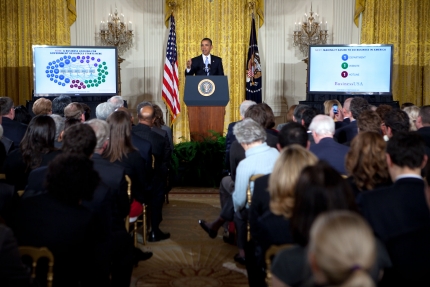
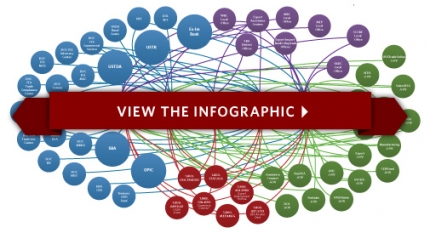
So take a look at this slide.  I don’t usually use props in my speeches -- (laughter) -- but I thought this was useful.  This is the system that small business owners face.  This is what they have to deal with if they want even the most basic answers to the most basic questions like how to export to a new country or whether they qualify for a loan.  And by the way, this is actually simplified because there are some color codes.  (Laughter.)  The business owners don’t get the blue and the purple -- and it’s all just -- there’s a whole host of websites, all kinds of toll-free numbers, all sorts of customer service centers.  But each are offering different assistance.  It’s a mess.  This should be easy for small business owners.  They want to concentrate on making products, creating services, selling to customers.  We’re supposed to make it easier for them.  And we can.  There are some tools that we can put in place that every day are helping small business owners all across the country, but we’re wasting too much time getting that help out.  And if Congress would reinstate the authority that previous presidents have had, we would be able to fix this.

We’d have one department where entrepreneurs can go from the day they come up with an idea and need a patent, to the day they start building a product and need financing for a warehouse, to the day they’re ready to export and need help breaking into new markets overseas.  One website, easy to use, clear.  One department where all our trade agencies would work together to ensure businesses and workers can better export by better enforcing our trade agreements.  One department dedicated to helping our businesses sell their products to the 95 percent of global consumers who live beyond our shores.

So with this authority, we could help businesses grow, save businesses time, save taxpayer dollars. 

And this is just one example of what we could do.  The contrast between this and this sums up what we could do on the business side, but these kinds of inefficiencies exist across government. 

And there’s a real opportunity right now for us to fundamentally rethink, reform and remake our government so that it can meet the demands of our time, so that it’s worthy of the American people, and so that it works.

This should not be a partisan issue.  Congress needs to reinstate this authority that has in the past been given to Democratic and Republican presidents for decades.  In the meantime, as long as folks are looking for work and small businesses are looking for customers, I’m going to keep doing everything I can with my current authority to help.

So, to take one example, as of today, I am elevating the Small Business Administration to a Cabinet-level agency.  (Applause.)  Karen Mills, who’s here today and who’s been doing an outstanding job leading that agency, is going to make sure that small business owners have their own seat at the table in our Cabinet meetings.

In the coming weeks, we’re also going to unveil a new website -- Business USA.  And this site will be a one-stop shop for small businesses and exporters, and it will consolidate information that right now is spread across all these various sites so that it’s all in one place and it’s easy to search.

So with or without Congress, I’m going to keep at it.  But it would be a lot easier if Congress helped.  (Laughter.)  This is an area that should receive bipartisan support, because making our government more responsive and strategic and leaner, it shouldn’t be a partisan issue.

We can do this better.  We can provide taxpayers better value.  So much of the argument out there all the time is up in 40,000 feet, these abstract arguments about who’s conservative or who’s liberal.  Most Americans, and certainly most small business owners, you guys are just trying to figure out, how do we make things work?  How do we apply common sense?  And that’s what this is about.

So I’m going to keep fighting every day to rebuild this economy so that hard work pays off, responsibility is rewarded, and we’ve got a government that is helping to create the foundation for the incredible energy and entrepreneurship that all of you represent.  And I’m going to keep fighting to make sure that middle-class families regain the security that they’ve lost over the last decade.  I’ve said before, I believe this is a make-or-break moment for families who are trying to get in the middle class, folks who are trying to maintain their security, folks who are trying to start businesses.  There’s enormous potential out there.  The trendlines in our global economy are moving in our direction, towards innovation and openness and transparency. 

But we’ve got to take advantage of it.  And you need a strong ally in an effective, lean government.  That’s what this authority can do.

Thank you very much, everybody.  Thank you.  (Applause.)

END               
11:41 A.M. EST

Making it Easier to Do Business in America

President Obama delivers remarks on government reorganization (20120113)

President Barack Obama delivers remarks on government reform in the East Room of the White House, Jan. 13, 2012. (Official White House Photo by Lawrence Jackson)

Today, President Obama announced a new plan that will make it easier to do business in America.

There are currently six major federal departments or agencies that focus on business or trade: the U.S. Department of Commerce’s core business and trade functions, the Small Business Administration, the Office of the U.S. Trade Representative, the Export-Import Bank, the Overseas Private Investment Corporation, and the U.S. Trade and Development Agency.

The President is asking Congress for the authority to merge those six entities into a single department tasked with boosting American business and promoting competitiveness.

The way the system is currently organized, every entrepreneur who needs to do business with the government has to navigate a maze of overlapping regulations and competing bureaucracy.

We've put together a chart that shows exactly how impossible that process can be.

This move from President Obama would change that.

He's hoping to consolidate the redundancies that currently exist, to cut waste, and eliminate duplication.

By the way, this kind of authority isn't new or rare. Presidents had the ability to mandate this type of reorganization for almost the entire period from 1932 through 1984.

And the executive branch of the federal government shouldn't be stuck in 1984.

Related Topics: Economy

The White House

Office of the Press Secretary

President Obama Announces proposal to reform, reorganize and consolidate Government

PLAN WILL MAKE GOVERNMENT LEANER, SMARTER AND MORE CONSUMER-FRIENDLY

WASHINGTON, DC – As a follow up to last year’s State of the Union, today, President Obama called on Congress to reinstate Presidential authority to reorganize and consolidate the federal government, which will ensure swift action on his proposals to streamline government to make it work better for the American people while eliminating duplication, waste and inefficiencies.

“We live in a 21st century economy, but we’ve still got a government organized for the 20th century. Our economy has fundamentally changed – as has the world – but the government has not. The needs of our citizens have fundamentally changed but their government has not.  Instead, it has often grown more complex. Today, I am calling on Congress to reinstate the authority that past presidents have had to streamline and reform the Executive Branch.  This is the same sort of authority that every business owner has to make sure that his or her company keeps pace with the times.  And let me be clear: I will only use this authority for reforms that result in more efficiency, better service, and a leaner government,” said President Obama.
  
Almost every President from Herbert Hoover to Ronald Reagan had reorganization authority.  Too often past attempts to streamline government got caught up in beltway politics and power struggles that prevented meaningful consolidation. And more often than not, new agencies were added without taking any away.

Unlike the authority granted in the past, the President’s proposal would initiate new accountability by mandating that any plan must reduce the number of government agencies or save taxpayer dollars. It would also ensure expedient review by Congress.

The President laid out his first proposed use of that authority consolidating six agencies into one more efficient agency to promote competitiveness, exports and American business.  Currently, there are six major departments and agencies that focus primarily on business and trade in the federal government.  The six are: U.S. Department of Commerce’s core business and trade functions, the Small Business Administration, the Office of the U.S. Trade Representative, the Export-Import Bank, the Overseas Private Investment Corporation, and the U.S. Trade and Development Agency.

Consolidating these agencies along with other related programs will help entrepreneurs and businesses of all sizes grow, compete, and hire, leveraging one cohesive Department with one mission: to spur job creation and expand the U.S. economy. 

In his last State of the Union Address, President Obama noted there was more that we must do to give American businesses all they need to succeed. The Federal Government is a maze of Federal agencies with overlapping services and missions, making it difficult for businesses – and especially small ones – to find the assistance they need to export, expand, and hire. 

He established the Government Reform for Competitiveness and Innovation Initiative to examine how we can update the Federal government to better support America’s competitiveness in a 21st century global economy.   The team reached out to hundreds of businesses, experts, current and former cabinet officials and agency heads, union leaders, Members of Congress and their staff, and thousands of Federal employees to find out what is working and what is not. Across the range of conversations held by the Administration as part of the government reorganization initiative, one theme underscored repeatedly by business owners was that  they are confused about where to go for assistance and often are unaware of services that would help them, particularly those trying to break into the export market for the first time.

For additional information, please click here.

The White House

Office of the Press Secretary

Statement by the President on the Release of Burmese Political Prisoners

President Thein Sein’s decision to release hundreds of prisoners of conscience is a substantial step forward for democratic reform.  Two months ago, I spoke with Aung San Suu Kyi and President Thein Sein about how America’s engagement can help empower democratic reform, and improve relations between our countries.  Shortly afterwards, Hillary Clinton became the first Secretary of State to travel to Burma in over half a century.  In her meetings in Nay Pyi Taw and Rangoon, she discussed with President Thein Sein and other leaders the steps that would advance a new beginning between our countries.  A key part of that discussion was the need to unconditionally release  prisoners of conscience and allow them to participate fully in public and political life.

Since that visit, there have been a number of positive developments, including the announcement of elections to be held on April 1, and the decision to allow Aung San Suu Kyi and her party to participate.  There has also been an important ceasefire agreement reached with the Karen National Union, which the United States welcomes.  Today, I applaud President Thein Seins’s decision to release hundreds of prisoners of conscience, which is a crucial step in Burma’s democratic transformation and national reconciliation process. I’m pleased that Aung San Suu  Kyi has welcomed this step as she continues to pursue a dialogue with the government.  I urge the government to ensure that these and all other former political prisoners are allowed to participate fully and freely in the political process, particularly the upcoming by-elections, and to free all remaining prisoners of conscience.

In Indonesia, I spoke about the flickers of progress that were emerging in Burma. Today, that light burns a bit brighter, as prisoners are reunited with their families and people can see a democratic path forward. Much more remains to be done to meet the aspirations of the Burmese people, but the United States is committed to continuing our engagement with the government in Nay Pyi Taw. I have directed Secretary Clinton and my Administration to take additional steps to build confidence with the government and people of Burma so that we seize this historic and hopeful opportunity. We will continue to support universal rights, and engage the government as it takes the additional steps necessary to advance freedom for prisoners of conscience, democratic governance, and national reconciliation.

West Wing Week 1/12/12 or: "Insourcing: Bringing Jobs Back to America"

January 12, 2012 | 3:55 | Public Domain

Welcome to the West Wing Week, your guide to everything that's happening at 1600 Pennsylvania Ave. This week, the President visited the Consumer Financial Protection Bureau, welcomed this year's NBA Champs, the Dallas Mavericks, addressed the EPA, announced a new Chief of Staff, and introduced the White House's Insourcing Initiative. That's January 6th to January 12th or: "Insourcing: Bringing Jobs Back to America."

Download mp4 (122.1MB)

The White House

Office of the Press Secretary

Readout of the President's Call with University of Alabama Coach Nick Saban

Earlier today, President Obama called Coach Nick Saban to congratulate him and the University of Alabama on their BCS Championship and their exceptional 2011-2012 season. The President said that he watched the entire championship game and could not have been more impressed with the Crimson Tide’s performance. The President commended the coach on his outstanding record and said that he looks forward to congratulating the team in person at the White House.
 

The White House

Office of the Press Secretary

President Obama Announces Presidential Delegation to the Republic of Guatemala to Attend the Inauguration of His Excellency Otto Perez Molina

President Barack Obama today announced the designation of a Presidential Delegation to the Republic of Guatemala to attend the Inauguration of His Excellency Otto Perez Molina on January 14, 2012.

The Honorable Aaron S. Williams, Director of the Peace Corps, will lead the delegation.

Members of the Presidential Delegation:

The Honorable Arnold A. Chacon, United States Ambassador to the Republic of Guatemala, Department of State

The Honorable Mary L. Landrieu, United States Senator, Louisiana

The Honorable Mark Feierstein, USAID Assistant Administrator for Latin America and the Caribbean

The White House

Office of the Press Secretary

Letter from the President to the Speaker of the House of Representatives and the President of the Senate Regarding the Debt Limit

Dear Mr. Speaker:  (Dear Mr. President:)

Pursuant to section 3101A(a)(2)(A) of title 31, United States Code, I hereby certify that the debt subject to limit is within $100,000,000,000 of the limit in 31 U.S.C. 3101(b) and that further borrowing is required to meet existing commitments.

Sincerely,

BARACK OBAMA